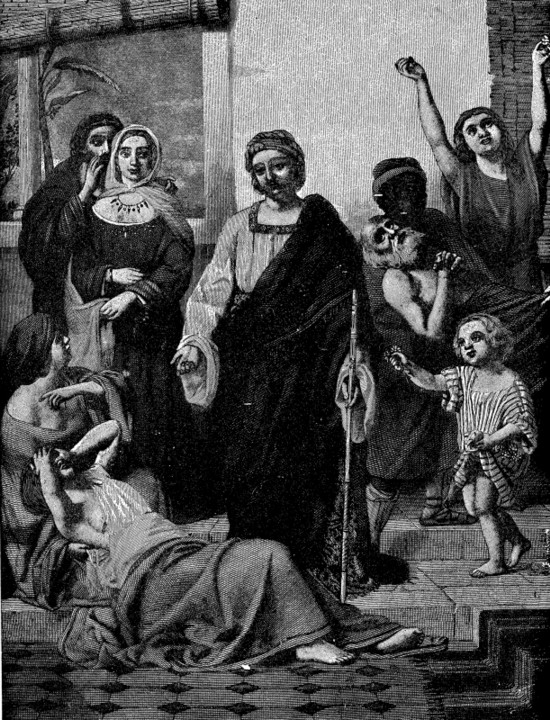
Parable of the Sower – Matt 13

In chapter 13, Jesus sat beside the sea. Crowds gathered, and he got into a boat and sat to address them. Jesus first tells the parable of the sower in verses 3-9. We are not told about the chronology in the text, but most surmise that Jesus spoke all of the parables from the boat, and the explanation came later, after he went into the house in verse 36 (verse 34 seems to bear that out). When the disciples came to ask Him why He spoke to the people in parables, He quoted from Isaiah 6:9-10 in verses 14-15, explaining that the difference between them (the disciples that want to learn) and the crowds (those that do not really want to understand, much less accept, the truth) is in their hearts. Those who do not understand and accept what He speaks of to them in plain speech, will never accept what He teaches in parables. This may be the point He made to Nicodemus in John 3:12.

Landscape with the Parable of the Sower

Landscape with the Parable of the Sower (Photo credit: Wikipedia)

This is followed up by the explanation of the parable of the sower in verses 18-23, which is the key to understanding all of the parables. In this case, Jesus is the sower, but it applies to us as sowers as we teach others about the kingdom. It is up to the individual receiving the seeds to prepare their ground for their proper growth – to plow up the hard ground of their hearts (Jeremiah 4:3-4).


/Bob’s boy

Bible Reading Schedule for this month
Click links below to read or listen to audio of one of this week’s chapters in Colossians and Luke

Matt 11, Matt 12, Matt 13, Matt 14, Matt 15

___________________

some images © V. Gilbert & Arlisle F. Beers

Please visit this site’s menu item “The Author’s Books” for info on the author’s books, website, and Facebook page.

All of my comments in this blog are solely my responsibility. When reading any commentary, you should always refer first to the scripture, which is God’s unchanging and unfailing word.


Blasphemy Against the Holy Spirit – Matt 11-12

In chapter 11, John the baptist sends messengers to inquire of Jesus whether He is “the one who is to come.” This seems strange to us because we know that John had declared before he baptized Jesus “Behold, the lamb of God, who takes away the sins of the world!” (John 1:29). But John, though clearly a prophet, was nonetheless a man; and men have doubts at some time in their lives. Jesus was not the military leader or future earthly king that most Jews were expecting.

Saint John the Baptist and the Pharisees

Saint John the Baptist and the Pharisees (Photo credit: Wikipedia)

Chapter 12, among other things, contains the passage about blasphemy against the Holy Spirit that often leads to confusion about the “unforgivable sin.” It is important when reading the Bible to remember that all scripture should be considered in conjunction with the rest of what has been written for us. There are many commentaries on this passage to consider, and the best one I can find does explain that Jesus is talking about sin that is not repented for. But the important thing to remember is that there is no sin that God will not forgive, if we just ask for forgiveness. Consider 1 John 1:9: “If we confess our sins, he is faithful and just to forgive us our sins and to cleanse us from all unrighteousness.

/Bob’s boy

Bible Reading Schedule for this month
Click links below to read or listen to audio of one of this week’s chapters in Colossians and Luke

Matt 11, Matt 12, Matt 13, Matt 14, Matt 15

___________________

some images © V. Gilbert & Arlisle F. Beers

Please visit this site’s menu item “The Author’s Books” for info on the author’s books, website, and Facebook page.

All of my comments in this blog are solely my responsibility. When reading any commentary, you should always refer first to the scripture, which is God’s unchanging and unfailing word.


Jesus Sends Out His Apostles – Matt 9-10

Sometimes when I am out in public where a vast number of people are milling around, I feel the way Matthew 9:35-38 often makes me feel when I read it:

And Jesus went throughout all the cities and villages, teaching in their synagogues and proclaiming the gospel of the kingdom and healing every disease and every affliction. When he saw the crowds, he had compassion for them, because they were harassed and helpless, like sheep without a shepherd. Then he said to his disciples, “The harvest is plentiful, but the laborers are few; therefore pray earnestly to the Lord of the harvest to send out laborers into his harvest.”

English: Folio 9 from the codex; beginning of ...

English: Folio 9 from the codex; beginning of the Gospel of Matthew (Photo credit: Wikipedia)

Now, the crowds at sporting events and theme parks and such hardly seem harassed and helpless. But I sometimes cannot help but feel sadness thinking that there must be so many among them that do not know the Lord. Pray earnestly for more laborers. That is truly a good prayer for a Christian to pray.

Jesus prepares to send out his twelve apostles in chapter 10; and he tells them a lot of things. But perhaps the most notable things he said to them might be in verses 34-39:

Do not think that I have come to bring peace to the earth. I have not come to bring peace, but a sword. For I have come to set a man against his father, and a daughter against her mother, and a daughter-in-law against her mother-in-law. And a person’s enemies will be those of his own household. Whoever loves father or mother more than me is not worthy of me, and whoever loves son or daughter more than me is not worthy of me. And whoever does not take his cross and follow me is not worthy of me. Whoever finds his life will lose it, and whoever loses his life for my sake will find it.

How often do families find themselves in turmoil because some choose to turn from the Lord? Or because some turn toward the Lord, while their family members do not? And how much more so in times like these? Taking up one’s cross daily may not mean the kind of suffering today that one might have expected then, but it can still be very difficult.

/Bob’s boy

Bible Reading Schedule for this month
Click links below to read or listen to audio of one of this week’s chapters in Colossians and Luke

Matt 6, Matt 7, Matt 8, Matt 9, Matt 10

___________________

some images © V. Gilbert & Arlisle F. Beers

Please visit this site’s menu item “The Author’s Books” for info on the author’s books, website, and Facebook page.

All of my comments in this blog are solely my responsibility. When reading any commentary, you should always refer first to the scripture, which is God’s unchanging and unfailing word.


Jesus closes His Sermon and Heals Many – Matt 7-8

Verse 1 of chapter 7 is one of the few verses that many people who know little else about the Bible are familiar with; and it is wrongly used both as self-justification and to rebuke criticism of wrong-doing. The verse denounces compassion-less condemnation and hypocritical judgment of others – not any judgment at all. In fact, verse 6 requires judgment on our part, and if we could not judge at all, how could we ever determine what was right or wrong? The problem also comes into play when people want to put us on the spot, asking if we believe one person or even a group of people will go to heaven. Thank the Lord that such judgment is not our responsibility! It sometimes takes tremendous courage to speak up to someone who is doing wrong. You run the risk of hurting their feelings or more likely, making them angry – and even alienating yourself from people you care about. But if you believe that someone is living in a way in which they risk losing their soul and you say nothing, is that not terribly wrong of you?

In chapter 8, Jesus heals many, calms a storm, and cast out demons. The event with the Centurion is certainly remarkable. Here was a Roman officer, whose servant was sick came to Jesus with the hope of having that servant healed. But he demonstrated his faith by his belief that Jesus could do so without even physically going where his servant was at the time. Jesus said he had not found such faith in anyone in Israel.

/Bob’s boy

Bible Reading Schedule for this month
Click links below to read or listen to audio of one of this week’s chapters in Colossians and Luke

Matt 6, Matt 7, Matt 8, Matt 9, Matt 10

___________________

some images © V. Gilbert & Arlisle F. Beers

Please visit this site’s menu item “The Author’s Books” for info on the author’s books, website, and Facebook page.

All of my comments in this blog are solely my responsibility. When reading any commentary, you should always refer first to the scripture, which is God’s unchanging and unfailing word.


Jesus Continues Preaching – Matt 6

Most people know verses 9-13 of chapter six as the “Lord’s prayer.”  But that designation is ours and is unfortunate in some ways, as there is a tendency to use it in the very way that Jesus warned against in the previous verses!  It is an example and a model for our own prayers from our hearts – it was meant to teach us how to pray – with reverence and honor to the Lord, before presenting our petitions.

The references to fasting in verses 16-18 are not a command for us to fast, though there is nothing wrong with doing so. The only time that the Old Testament Law required fasting was for the Day of Atonement (Leviticus 16:29-31), but many other days had been added by the people themselves, especially after the events of the destruction of Jerusalem and Babylonian captivity. And by now, the Pharisees had made it a weekly activity. The problem came in the fact that people were purposely making themselves look more haggard than they were, so as to draw attention to themselves for their piety.

/Bob’s boy

Bible Reading Schedule for this month
Click links below to read or listen to audio of one of this week’s chapters in Colossians and Luke

Matt 6, Matt 7, Matt 8, Matt 9, Matt 10

___________________

some images © V. Gilbert & Arlisle F. Beers

Please visit this site’s menu item “The Author’s Books” for info on the author’s books, website, and Facebook page.

All of my comments in this blog are solely my responsibility. When reading any commentary, you should always refer first to the scripture, which is God’s unchanging and unfailing word.


Jesus Begins His Ministry – Matt 4-5

In Matthew 4, Jesus is led into the wilderness to be tempted by the devil.  God never tempts anyone to do wrong (James 1:13), but He has sometimes used situations to test someone’s faithfulness and character (see  Hebrews 11:17).  This testing had a purpose from the devil’s perspective (to derail God’s plan for the redemption of man, by preventing Jesus from being without sin).  The purpose from the perspective of God’s plan was that by having suffered from temptation himself (Hebrews 2:18), he understands how temptation affects us, and He is strengthened as our savior.  It also reinforces for us the value of knowing God’s word.

Beatitudes-sermon-on-mount

Beatitudes-sermon-on-mount (Photo credit: Wikipedia)

Matthew 5 begins what we know as the Sermon on the Mount, and verses 3-12 contain what we refer to as the Beatitudes.  The translation of the word “blessed” in these verses is confusing to some, as it varies from “happy” to “fortunate.”  “Fortunate” is closer to the real meaning here (someone who is “mourning,” for example, could hardly be described as “happy”), and it relates more to a state of being in a relationship with God that results from His approval.  None of the qualities in these statements refer to a condition that people are born with, inherit, or come by naturally.  Nor are they intended as prescriptions for behavior, some of which the unconverted world at large can simply adopt for the good of mankind.

These are traits of character and attitude that reflect the qualities that Christians must have.  But they are not, as some have suggested, lofty goals – all of which no one person could possibly achieve.  In each one, Jesus says “Blessed are.. ,” indicating that there are people who have these qualities, and that we can ourselves be the people that he describes – that we as Christians, in fact, must be those people.  Yet, we must understand that while having these qualities is what defines us as His people, our place in His kingdom is not something we earn by doing so.  It is, in fact, our full understanding of that fact which enables us to have those qualities in the first place.

/Bob’s boy

Bible Reading Schedule for this month
Click links below to read or listen to audio of one of this week’s chapters in Colossians and Luke

Matt 1, Matt 2, Matt 3, Matt 4, Matt 5

___________________

some images © V. Gilbert & Arlisle F. Beers

Please visit this site’s menu item “The Author’s Books” for info on the author’s books, website, and Facebook page.

All of my comments in this blog are solely my responsibility. When reading any commentary, you should always refer first to the scripture, which is God’s unchanging and unfailing word.


Jesus in Nazareth and John the Baptist in the Wilderness – Matt 2-3

Chapter two relates the account of the wise men, who brought gifts of gold, frankincense, and myrrh. We do not know how many of these men came to see Jesus. There were three gifts, so many have assumed there were three men. An angel came to Joseph and warned him of danger from Herod the Great (Herod I), and told him to take his family to Egypt. Herod had all the male children in Bethlehem under the age of two killed. At the end of the chapter, the Lord sent him back, but Joseph settled his family in Nazareth.

English: Herod the Great Suomi: Herodes Suuri

English: Herod the Great Suomi: Herodes Suuri (Photo credit: Wikipedia)

Chapter 3 begins with John the Baptist preaching in the Judean wilderness, telling everyone to “Repent, for the kingdom of heaven is at hand” – which Jesus Himself will proclaim as well. John’s manner of dress in verse 4 is distinctly similar to that described of Elijah in 2 Kings 1:8, and that appearance, as well as the diet described, were common to the desert people, who would also be the poorer people of the land. This new and increasingly well-known prophet was attracting much attention from the people, and the religious community (see John 1:19-38). In verse 7, both Pharisees and Sadducees were coming out to watch his baptisms.

The word “Pharisee” means “separated one,” and they were the more popular of the Jewish sects of the times. Many seemed very self-righteous, and imposed strict adherence to teachings and “rules” that were not commanded by God’s word. The term “Sadducees” came from the sons of Zadok, who was the high priest during the days of David and Solomon (1 Kings 1:32-34). They were known as aristocrats and political opportunists; and they had much political power.

Baptism had been required of Gentiles converting to Judaism, but now John was preaching and performing baptism (immersing people in the river Jordan) for repentance – a term not only for remorse and confession, but also for “turning” one’s thinking, way of living, and even one’s mind around to different way.

/Bob’s boy

Bible Reading Schedule for this month
Click links below to read or listen to audio of one of this week’s chapters in Colossians and Luke

Matt 1, Matt 2, Matt 3, Matt 4, Matt 5

___________________

some images © V. Gilbert & Arlisle F. Beers

Please visit this site’s menu item “The Author’s Books” for info on the author’s books, website, and Facebook page.

All of my comments in this blog are solely my responsibility. When reading any commentary, you should always refer first to the scripture, which is God’s unchanging and unfailing word.


The Genealogy and Birth of Jesus – Matt 1

The first 17 verses of chapter one Matthew’s gospel are devoted to the genealogy of Jesus. Matthew’s gospel was written primarily to a Jewish audience. Therefore, the lineage of the husband of Mary (although not biologically Jesus’ father) would be important to Jews in fulfilling prophecy because it would be the “father’s” lineage that would be most important to them. But in this previous post, as well as my book, “An Orderly Account: A Tour of Luke’s Gospel,” I explained how Luke chapter 3 seems to clearly give us an account of Mary’s lineage also from David’s house.

But this genealogy in Matthew was so important that it consumed all but eight verses in the chapter. Those eight verses are devoted to the birth of our Lord and Savior.

/Bob’s boy

Bible Reading Schedule for this month
Click links below to read or listen to audio of one of this week’s chapters in Colossians and Luke

Matt 1, Matt 2, Matt 3, Matt 4, Matt 5

___________________

some images © V. Gilbert & Arlisle F. Beers

Please visit this site’s menu item “The Author’s Books” for info on the author’s books, website, and Facebook page.

All of my comments in this blog are solely my responsibility. When reading any commentary, you should always refer first to the scripture, which is God’s unchanging and unfailing word.


Psalm 22 – Why Have You Forsaken Me?

And about the ninth hour Jesus cried out with a loud voice, saying, “Eli, Eli, lema sabachthani?” that is, “My God, my God, why have you forsaken me?”  Matthew 27:44

From Halley’s Handbook of the Bible (Halley, Henry H., Zondervan, 1961)

The Crucifixion, seen from the Cross, by James...

The Crucifixion, seen from the Cross, by James Tissot, 19th century. (Photo credit: Wikipedia)

“This sounds like a cry of anguish from David, but though written a thousand years before Jesus, it is so vivid a description of the crucifixion of Jesus that one would think of the writer as being personally present at the Cross. Jesus’ dying words (Psalms 22:1 Matthew 27:44), the sneers of his enemies (Psalms 22:7-8, Matthew 27:39-40, the piercing of his hands and feet (Psalms 22:16, John 20:25) and the casting of lots for his garments (Psalms 22:18, Matthew 27:39) are some of the events here described. None of these statements are applicable to David, or to any other known event or person in the history of mankind, except the crucifixion of the Son of God.”

Peter (Acts 2:30-35) preached: ‘David, being a prophet … he foresaw and spoke of … the Christ.’ This basic truth is reiterated again and again in the inspired New Testament.  There are than nine New Testament references which tie the meaning of this psalm irrevocably to the prophecy of our Lord’s crucifixion.  And then, regarding the resurrection, Hebrews 2:12 recounts verses 22-24.

But what of Jesus’ cry in verse one to the Lord.  Why would he speak of God forsaking Him? Burton Coffman’s summary of his thoughts on the subject ring very true:

“Jesus’ quoting the first line of this Psalm during his agony upon the Cross has led to many opinions. It has been supposed that Christ here merely quoted these words from the psalm to call attention to the whole bundle of prophecies in it which were being fulfilled literally at that very time. It is also believed by many that God Himself did indeed, for a little while, withdraw his presence from Christ in order to make it possible for Christ to die. There is much in the sacred Scriptures to commend this view.

Christ is spoken of in Heb. 2:9 as the One, who by the grace of God did indeed, ‘Taste of death for every man.’ Isaiah tells us that, ‘God laid upon him (Jesus) the iniquity of us all’ (Isaiah 53:6). Paul mentioned that God Himself ‘Set forth the Christ to be a propitiation’ (Romans 3:25), or an atonement, for the sins of all men. ‘Christ died for our sins’ (1 Corinthians 15:3); and ‘Him (Christ) who knew no sin, God made to be sin on our behalf; that we might become the righteousness of God in Him’ (2 Corinthians 5:21).

The ultimate consequence of sin is separation from God; and, in Christ’s becoming a substitute for sinful men upon the cross, he not only tasted of death, but also tasted the terrible consequences of sin in that soul-torturing experience of separation from the Creator. It is our understanding of Christ’s plaintive cry, ‘My God, why hast thou forsaken me,’ that Jesus did indeed, momentarily, taste the awful agony of separation from the Father. ‘For a moment in that last agony, the Perfect Man was alone with the sins of the whole world.'”

Read or listen to audio of ESV version of this selection from this link.

/Bob’s boy
___________________
some images © V. Gilbert & Arlisle F. Beers

Please note: I did not design the reading plan that I am following in my blog.  All of my comments in this blog, however, are solely my responsibility.  When reading ANY commentary, you should ALWAYS refer first to the scripture, which is God’s unchanging and unfailing word. Reading schedules, as well as a link to the site where you can get the reading plan that I’m currently following for yourself can be found on the “Bible Reading Schedules” page of my website at http://graceofourlord.com.  For questions and help, please see the “FAQ” and “Summaries” pages there.

Job 3 – Whatever I dread befalls me

Job finally breaks the silence of the last week as it would seem he can no longer bear it.    We have no way of knowing what has been going through his mind in the last week, but surely he has been tempted to turn his anger toward God.  Still, he does not sin and curse God, as God  in His wisdom already knew he would not.  True enough that he did greatly lament his own birth, but even the great prophet Jeremiah did so (Jeremiah 20:14-18) in his sorrow over his persecution.

Still, it is all too easy for us to be tempted to judge Job and others, for who among us has not himself suffered?  And is our suffering not just as severe for us at times?  When we have been hurt, do we cry out and long for death?  If we do not, does that make our grief and pain less significant?

We all do suffer – some more than others – at times, and if we are truthful, as great as our pain may be; and as bad as it may get for many of us, it is doubtful that we go through the degree of anguish and pain that Job has already experienced in the first two chapters of this book.

Job's happy days.

Job’s happy days.

But who is anyone else to judge this, and what yardstick will they use to do so?  That of what we read of Job – or (more likely) their own?  We will get to know Job’s friends much better in the coming days, but if you cut through all of the criticism that we and others direct at those friends (and truly they will show their own flaws as well), we should not lose sight of the fact that they came and stayed with Job when he was at his lowest, spoke not a word until he spoke, and only now will speak as they believe they may be able to help him understand why these terrible things have happened to him – as well how he might “fix it.”

Our desire to think of ourselves as compassionate, and “being there” for our friends as Job’s three friends are there is admirable, but we must not presume to “know how they feel.”  No matter how seemingly large or small the trial or pain, no two people handle grief, depression, or pain in the same way.  All Job knows, is that when all that he has lost began to go wrong, it just kept coming!  And his worst fears and dreads became realized again and again (verse 25-26):

“For the thing that I fear comes upon me,
and what I dread befalls me.
I am not at ease, nor am I quiet;
I have no rest, but trouble comes.”

Re: Job 2:10 “In all this Job did not sin with his lips.”  He epitomized Jesus’ words; and with of all their faults, Job’s friends did show compassion, for as much as he still obeyed Matthew 22:37 (cited from Deuteronomy 6:5), they demonstrated their love for him as in Matthew 22:39: “You shall love your neighbor as yourself.”  

Read or listen to audio of ESV version of this selection from this link.

/Bob’s boy
___________________
some images © V. Gilbert & Arlisle F. Beers

Please note: I did not design the reading plan that I am following in my blog.  All of my comments in this blog, however, are solely my responsibility.  When reading ANY commentary, you should ALWAYS refer first to the scripture, which is God’s unchanging and unfailing word. Reading schedules, as well as a link to the site where you can get the reading plan that I’m currently following for yourself can be found on the “Bible Reading Schedules” page of my website at http://graceofourlord.com.  For questions and help, please see the “FAQ” and “Summaries” pages there.