Exodus 9 – The Fifth, Sixth, and Seventh Plagues

There is a lot going on in this chapter as God accomplishes His objectives.  It is helpful, though to step back for a moment and fully realize that is precisely what He is doing.  Freeing the descendants of Israel (Jacob), and even placing them in the land He had promised would be easily accomplished by the creator of the universe – as would punishing Pharaoh for his defiance.  He gets all of those things done in His own time, but He is teaching His people, and the world in the process.

The Fifth Plague: Egyptian Livestock Die

The plagues, as assaults upon the foolishness of the worship of specific false “gods,” exposes such man-made creations as the empty promises that they are, which ultimately can facilitate the very destruction that falls on those that worship them.  The same can be said of the empty things that man tends to “worship” today – fortune, sex, and selfish pleasure, to name a few.  Those same plagues demonstrate that all of the things of the earth itself come from our one true God, who shows Himself in these verses to be sovereign over them all.

Further comments on Pharaoh’s “heart condition”

(I apologize for the length of today’s blog, but I feel the need to give my comments about this subject more adequately because of its troubling nature to some people – and because of the urgency of what it means to us today)

Notice again in verse 34, as in Exodus 8:15 and 8:32, the text says that Pharaoh hardened his heart – just as we are told elsewhere in these chapters, as well as other books (such as in 1 Samuel 6:6). Most honest readers will admit to being somewhat disturbed at some point by the other passages in Exodus that refer to God being the one that hardens Pharaoh’s heart – as if God actually caused Pharaoh’s own demise, when he might otherwise have been repentant.  And indeed many commentators and theologians, by their interpretations, have not only failed to adequately dispel those concerns, rather their analysis has often actually increased those feelings.

While it is true that the Lord is sovereign over all, and can choose to show mercy on whom He wishes (as Paul reminds us in Romans 9:16-18), the suggestion that He in any way was the cause of Pharaoh’s failure to obey is a terrible misunderstanding of the scripture as it was written, and indeed the very nature of our Lord.  God tells us in his word that he “desires all people to be saved” (1 Timothy 2:4), and God never lies (Titus 1:1-2).  Moreover, He is without injustice, as said beautifully in the NKJV version of Deut 32:4:

He is the Rock, His work is perfect;
For all His ways are justice,
A God of truth and without injustice;
Righteous and upright is He.

The Lord’s part in the hardening of Pharaoh’s heart was that He forced him over and over again into a position that he would not otherwise have been in – to face undeniably, the impotence of his false “gods,” to see for himself the might and sovereign power of the one true God – and knowing this, to make up his mind whether he would obey or defy.  God absolutely knew Pharaoh’s heart, but know this for certain – Pharaoh chose to defy the Lord.

This is where the relevance for us today is so sad because we see it for (in?) ourselves far too often.  By our continued defiance to God, insisting instead to live in sin and worship our own “gods,” we are quite capable of hardening our own hearts.   Paul warns in Romans 8:7-8, which I quote below (keeping in mind that the “mind set on the flesh” refers to both unbelievers and to those unwilling to truly repent, who are by definition in bondage to sin):

7 For the mind that is set on the flesh is hostile to God,
for it does not submit to God’s law;
indeed, it cannot.
8 Those who are in the flesh cannot please God.

Read or listen to audio of ESV version of this selection from this link.

/Robert
___________________
image © V. Gilbert & Arlisle F. Beers

Please note: I did not design the reading plan that I am following in my blog.  All of my comments in this blog, however, are solely my responsibility.  When reading ANY commentary, you should ALWAYS refer first to the scripture, which is God’s unchanging and unfailing word. Reading schedules, as well as a link to the site where you can get the reading plan that I’m currently following for yourself can be found on the “Bible Reading Schedules” page of my website at http://graceofourlord.com.  For questions and help, please see the “FAQ” and “Summaries” pages there.
 

Exodus 8 – The Second, Third, and Fourth Plagues

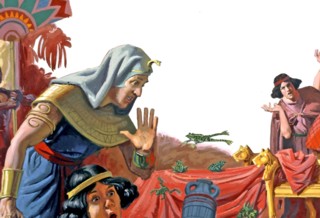
The Lord was very deliberate, as is always the case, in His choices of the particular forms of plagues that he would introduce through Moses and Aaron.  Though we might not fully understand them all, it is clear that the “gods” of the Egyptians were being mocked, and thus shown not to be the real God.  The first one of this chapter (the second plague) – of frogs – in verses 1-15 was obviously chosen to show the foolishness of worshiping their false god Heket (or Heqet), the Egyptian frog-goddess.

"...shall come up into your house and into your bedroom..."

The cycle that will be repeated in other plagues begins:

  1. The hardship on Pharaoh and the people (just think about v. 3-4, and later about verse 13!)
  2. Pharaoh sees God’s power, promises to Moses, and asks him to “plead with the Lord” (v. 8)
  3. The respite (v. 12-13)
  4. Pharaoh then hardens his heart again and will not listen (v. 15).

Once again, the “magicians” do their thing; and again, they are powerless to reverse the plague – hence number 2 above, as the Lord intended. They were unable to mimic the third plague in v. 16-19, and tell Pharaoh that “This is the finger of God”, but he just returns to step 4 above.  Many believe that the fourth plague of v. 20 ff was of the “biting” type of fly.  The difference with this plague in v. 22-24 was that God would bring this upon the Egyptians, and not His people – so that they would “know that I am the Lord in the midst of the earth.”

(Side Note: Interesting articles about the mythological frog goddess can be found at “Ancient Egypt Online” and at “Ancient Egypt: the Mythology“.  Both sites also have information on the mythological “god” Khephera, which may have to do with the insect plagues.)  For this writer’s interpretation of the references that these chapters make to the “hardening of Pharaoh’s heart,” please see previous post for  Exodus 7, but especially tomorrow’s posting for Exodus 9.

Read or listen to audio of ESV version of this selection from this link.

/Robert
___________________
image © V. Gilbert & Arlisle F. Beers

Please note: I did not design the reading plan that I am following in my blog.  All of my comments in this blog, however, are solely my responsibility.  When reading ANY commentary, you should ALWAYS refer first to the scripture, which is God’s unchanging and unfailing word. Reading schedules, as well as a link to the site where you can get the reading plan that I’m currently following for yourself can be found on the “Bible Reading Schedules” page of my website at http://graceofourlord.com.  For questions and help, please see the “FAQ” and “Summaries” pages there.
Exodus 6 – God Promises Deliverance

Speaking of Himself in third person in verse 1, God tells Moses that he will see what the Lord will do, as he delivers them with “a strong hand”.  God is very patient with Moses and his doubt, as He is building faith – the faith, not only of Moses and Aaron, but of the people of Israel as a whole.   He restates His covenant with them in verses 3-4.

God is specific about what He wants Moses to say to the people in this chapter, as others.  But verse 9 says that “they did not listen to Moses, because of their broken spirit and harsh slavery”.  This did not come as a surprise to Lord.  He knew they would not listen at that point, but He also knew that they and their children’s children would remember the things that He had Moses tell them over and over (as in verses 6-8) – “I am the Lord” — “I will redeem you” — “I will take you to be my people” — “I will deliver you”  — “and you shall know that I am the Lord your God”.

Moses is discouraged, but God tells him to go again to Pharaoh, and tells him in no uncertain terms that he and Aaron will in fact be bringing the people of Israel out of Egypt (verse 13)!  The genealogies beginning in verse 14 are intended to demonstrate to the reader how Moses and Aaron descend from the house of Israel (Jacob), just like any one of more than 600, 000 others (Exodus 12:37).

Verse 30 shows that Moses is still not convinced that anyone will listen to him now.

Read or listen to audio of ESV version of this selection from this link.

/Robert
___________________
image © V. Gilbert & Arlisle F. Beers

Please note: I did not design the reading plan that I am following in my blog.  All of my comments in this blog, however, are solely my responsibility.  When reading ANY commentary, you should ALWAYS refer first to the scripture, which is God’s unchanging and unfailing word. Reading schedules, as well as a link to the site where you can get the reading plan that I’m currently following for yourself can be found on the “Bible Reading Schedules” page of my website at http://graceofourlord.com.  For questions and help, please see the “FAQ” and “Summaries” pages there.

Genesis 41 – Joseph Interprets Pharaoh’s Dreams

We come to a lengthy, but crucially important chapter of the Bible – two years after Pharaoh has his chief baker hanged.  Pharaoh has two dreams of his own.  When his wise men were unable to tell him what the dreams mean, his cupbearer (undoubtedly hoping to gain favor) had a sudden improvement in his memory, and told him about Joseph rightly predicting the baker’s fate and his own by interpreting their dreams.  So Joseph is quickly brought out of prison (verse 14), cleaned up, and brought before Pharaoh, who repeats his dreams to him.

Joseph is quick to point out before interpreting (verse 15), that it is God who will give Pharaoh the answers he is looking for, not Joseph himself.  Then throughout the interpretation, he makes it clear that God has shown Pharaoh through these dreams the reality of what He is about to do.  Joseph says that the “doubling” (verse 32) of the dreams (for they both mean the same thing) means that they will be fulfilled soon.  There will be seven years of great abundance, followed by seven years of severe famine.  He tells Pharaoh that he should appoint overseers over the land and take “one-fifth of the produce” from the plentiful years into reserves “so that the land may not perish through the famine” (verse 36).

So begins Joseph’s rise to power, as the Pharaoh decides that he will be that overseer.  He declares that Joseph will be second only to Pharaoh himself in all the land (verse 40).  To complete his acceptance as such in the land, Pharaoh gives him an Egyptian name (Zaphenath-paneah) and the hand of “Asenath, the daughter of Potiphera priest of On” in marriage.  It is from this marriage that Joseph’s sons, Manasseh and Ephraim are born.  We will see these two names figure prominently throughout the Old Testament, as their descendants become the famed “half-tribes” destined to go with the descendants of Joseph’s 11 brothers, as the “Twelve Tribes of Israel” are led by Moses, and finally by Joshua to the Promised Land ~400 years later.

For now though, Joseph’s choice of names for the two in verses 51-52 (the name Manasseh ironically relates to “forget” and Ephraim sounds like the Hebrew for “make fruitful”) reflects his acknowledgement throughout the chapter that God is in control, and that by His power Joseph’s life has been blessed.

The boy who was 17 years old (in Gen 37:2) before his brothers threw him away is 30 years old when he begins with Pharaoh (verse 46); and after the famine began 7 years later, “all the earth came to Egypt to Joseph to buy grain, because the famine was severe over all the earth” (verse 57).

Now, thanks to God, the young Hebrew has just become the second most powerful man in the world!

Read or listen to audio of ESV version of this selection from this link.

Please note: I did not design the reading plan that I am following in my blog.  All of my comments in this blog, however, are solely my responsibility.  When reading ANY commentary, you should ALWAYS refer first to the scripture, which is God’s unchanging and unfailing word. Reading schedules, as well as a link to the site where you can get the reading plan that I’m currently following for yourself can be found on the “Schedules” page of my website at http://graceofourlord.com.  For questions and help, please see the “FAQ” and “Summaries” pages there.
/Robert

Genesis 40 – Joseph Interprets Two Prisoners’ Dreams

Joseph has already been in prison for a long enough time to have earned great confidence from his keeper,  and now he is joined by Pharaoh’s chief cupbearer and baker (roles important to any Pharaoh, should he not wish to be poisoned), who are imprisoned for an unnamed “offense against their lord of Egypt.”  These men would be accustomed to a better lifestyle and to having access to the magicians and “wise men” in Pharaoh’s court.  It would seem that the Lord has inspired them to be very curious about the dreams they have had; and the scripture tells us that these dreams did in fact each have its own interpretation (verse 5).

But now they have nobody to turn to in order to try to find out what these dreams mean.  Joseph, seeing their distress, persuades them to tell him about the dreams.  After hearing each one, he says “This is its interpretation” – as someone speaking with authority,  as indeed he was.  In verses 20-22 both prophecies are fulfilled, proving him correct (unfortunate for the baker).

But the cupbearer does not honor Joseph’s request to “remember” him to Pharaoh, and Joseph remains in prison.  But note his confidence that he can interpret those dreams, and the knowledge of where that gift comes from (verse 8).  After all he has endured – and still in prison, he clearly knows that God is helping him.

When circumstances in life are such that our own outlook seems dim, do we tend to wonder why the Lord has turned His back on us?  If we do our very best to serve Him, we can sometimes examine some of those times and see for ourselves how He has enriched us – or someone else through us.

In those situations, I have often found great comfort in the book of James, and am fond of the New American Standard version’s translation of James 1:2-4 ” Consider it all joy, my brethren, when you encounter various trials, 3 knowing that the testing of your faith produces endurance. 4 And let endurance have its perfect result, so that you may be perfect and complete, lacking in nothing.”

Read or listen to audio of ESV version of this selection from this link.

Please note: I did not design the reading plan that I am following in my blog.  All of my comments in this blog, however, are solely my responsibility.  When reading ANY commentary, you should ALWAYS refer first to the scripture, which is God’s unchanging and unfailing word. Reading schedules, as well as a link to the site where you can get the reading plan that I’m currently following for yourself can be found on the “Schedules” page of my website at http://graceofourlord.com.  For questions and help, please see the “FAQ” and “Summaries” pages there.
/Robert

Genesis 22 – The Sacrifice of Isaac

The Testing of Abraham

Contrary to some previous chapters, Genesis 22 shows us that Abraham has really come to trust the Lord.  This is a hard chapter for many to understand. It should be pointed out, especially to children, that God never would have allowed Isaac to be harmed because it is against His very nature (one might even wonder if that certainty was actually part of Abraham’s faith). God finds the sacrifice of humans, especially children (a practice common to worshiping the idol Moloch), to be an abomination; and he makes that clear in other scripture.  Lev 18:21 and 2 kings 23:10 are two of many verses we can refer to.

It is hard to miss the irony of Abraham being willing to sacrifice his only son for God. The second half of God’s promise to him afterward is of an offspring of Abraham in whom all nations will be blessed.  That is Jesus, His only son, who He sacrificed for us. That offspring is referred to in Galatians 3:16-28, when Paul is explaining how we are all heirs to this promise. Reading that passage right after this chapter is enlightening. The genealogies of the last couple of verses may seem irrelevant until we read chapter 24.

Read or listen to audio of ESV version of this selection from this link.

___________________

Please note: I did not design the reading plan that I am following in my blog.  All of my comments in this blog, however, are solely my responsibility.  When reading ANY commentary, you should ALWAYS refer first to the scripture, which is God’s unchanging and unfailing word. Reading schedules, as well as a link to the site where you can get the reading plan that I’m currently following for yourself can be found on the “Schedules” page of my website at http://graceofourlord.com.  For questions and help, please see the “FAQ” and “Summaries” pages there.
/Robert

Genesis 17 – Abraham and the Covenant of Circumcision / Isaac’s Birth Promised

Genesis 17

Another very important chapter in the Bible. God continues his promises to Abram, and he changes his name to Abraham because he will be the “father of a multitude of nations.”  Sarai’s name is changed to Sarah, and God promises that she will bear him a son the next year. God also establishes the practice of circumcision, stating that every male will be circumcised at the age of 8 days. That very day, Abraham and all his household were circumcised as a sign of his covenant with God. Abraham’s immediate obedience is noteworthy.

(Side note: There is an interesting article on the significance of the 8th day at the website of Apologetics Press).

Read or listen to audio of ESV version of this selection from this link.

___________________

Please note: I did not design the reading plan that I am following in my blog.  All of my comments in this blog, however, are solely my responsibility.  When reading ANY commentary, you should ALWAYS refer first to the scripture, which is God’s unchanging and unfailing word. Reading schedules, as well as a link to the site where you can get the reading plan that I’m currently following for yourself can be found on the “Schedules” page of my website at http://graceofourlord.com.  For questions and help, please see the “FAQ” and “Summaries” pages there.
/Robert