Exodus 2 – The Birth of Moses

Now the daughter of Pharaoh came down to bathe at the river, while her young women walked beside the river. She saw the basket among the reeds and sent her servant woman, and she took it.

After he is born, Moses’ mother is unable to hide him after three months, and places him in a basket in the reeds by the riverbank (verse 3).  After Pharaoh’s daughter “draws” him out, Moses’ own sister summons the courage to ask her if she should get a Hebrew woman to nurse the child for her (verse 7).  So of course, she fetches Moses’ own mother for the task!

Stephen tells us in Acts 7:23, that Moses was 40 years old when verses 11-15 take place; and Moses flees for his life to Midian (where he will stay for another 40 years, as we are told in Acts 7:30).  The father of the woman who will become his wife is referred to as Reuel in verse 18, but we will come to know him as Jethro.

 God Hears Israel’s Groaning – As the people cry out because of their slavery, verse 24 says that “God remembered his covenant with Abraham, with Isaac, and with Jacob”.  God never forgets.  When the scripture says “God remembered,” it means He has decided the time has come for what He wants to happen next concerning that person or event (as in Gen 8:1).

Read or listen to audio of ESV version of this selection from this link.

/Robert
___________________
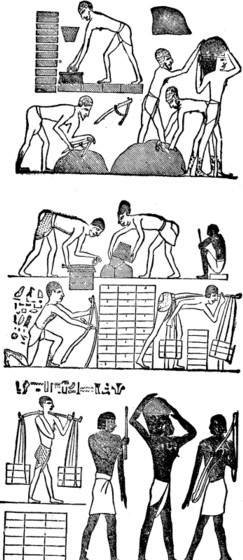
image © V. Gilbert & Arlisle F. Beers

Please note: I did not design the reading plan that I am following in my blog.  All of my comments in this blog, however, are solely my responsibility.  When reading ANY commentary, you should ALWAYS refer first to the scripture, which is God’s unchanging and unfailing word. Reading schedules, as well as a link to the site where you can get the reading plan that I’m currently following for yourself can be found on the “Bible Reading Schedules” page of my website at http://graceofourlord.com.  For questions and help, please see the “FAQ” and “Summaries” pages there.
 

Exodus 1 – Israel Increases Greatly in Egypt

Highlights we have passed over in Genesis – As Israel (Jacob) nears death, he takes Joseph’s sons, Ephraim and Manasseh as his own (Gen 48:5). That is why there is not tribe of Joseph in the “Twelve Tribes of Israel”.  These two make up the “half-tribes”.  Jacob sets Joseph and Ephraim apart, and once again the younger is blessed above the first-born as he says that “his offspring shall become a multitude of nations” (Gen 48:19). He makes it clear that he is to be buried in Canaan, where his people shall end up, and blesses all of his sons. Chapter 49 is full of poetic imagery and prophecy, much of it (particularly verses 8-12) pointing to the empire of King David, and ultimately, the Lord Jesus, the Messiah.  In chapter 50, Pharaoh allows Joseph to bury his father in Canaan, and Genesis concludes with the death of Joseph.  And so, God’s word picks up 400 years later…

Genesis 15:13-14:
Then the Lord said to Abram, “Know for certain that your offspring will be sojourners in a land that is not theirs and will be servants there, and they will be afflicted for four hundred years. 14 But I will bring judgment on the nation that they serve, and afterward they shall come out with great possessions.

Pharaoh Oppresses Israel

The 12 sons of Israel (Jacob) (and Joseph’s sons, Ephraim and Manasseh) have long since died; and their descendants, now referred to as “the people of Israel” have multiplied greatly – to the extent that the ruler of Egypt fears their numbers.  So they are ruthlessly made slaves (verse 13), and the mid-wives instructed to kill all newborn sons.  But the midwives feared God (verse 17), and they let them live.  “And the people multiplied greatly and grew very strong” (verse 20), as God had promised Abraham in Genesis 13:16.  Pharaoh then ordered his people to cast every son that is born to the Hebrews into the Nile.

Read or listen to audio of ESV version of this selection from this link.

/Robert
___________________
image © V. Gilbert & Arlisle F. Beers

Please note: I did not design the reading plan that I am following in my blog.  All of my comments in this blog, however, are solely my responsibility.  When reading ANY commentary, you should ALWAYS refer first to the scripture, which is God’s unchanging and unfailing word. Reading schedules, as well as a link to the site where you can get the reading plan that I’m currently following for yourself can be found on the “Bible Reading Schedules” page of my website at http://graceofourlord.com.  For questions and help, please see the “FAQ” and “Summaries” pages there.

 

Genesis 46 – Joseph Brings His Family to Egypt

The Lord tells Israel in verse 2 that Egypt is where he should now go, and where he will become a great nation. Remember, God had forbidden his father Isaac to go there during a previous famine (Gen 26:1-5).  So Jacob, his sons and daughters, and all of their families set out for Egypt.  The Lord, through Moses, remembers his sons – and their sons in the text; and verse 26 tells us that the number of Jacob’s descendants (not including his sons’ wives) was 66.  Add Israel himself, Joseph and his two sons, and there were 70 (verse 27).  That number will multiply by more that 80,000 – to over 600,000 at Sinai (Num 1:44-46) after Moses has led them out of Egypt in Exodus 12:51.

Joseph and Israel have an emotional reunion in Goshen, and Joseph reveals how they will be (for now) left to their own devices there in verses 31-34 because “every shepherd is an abomination to the Egyptians”.

(Side note: “Ferrell’s Travel Blog” has several articles, accompanied with some photographs, concerning Goshen.  Two that I find interesting are “Why were shepherds detestable to Egyptians?” and “The Land of Rameses“)

Read or listen to audio of ESV version of this selection from this link.

/Robert
___________________
image © V. Gilbert & Arlisle F. Beers

Please note: I did not design the reading plan that I am following in my blog.  All of my comments in this blog, however, are solely my responsibility.  When reading ANY commentary, you should ALWAYS refer first to the scripture, which is God’s unchanging and unfailing word. Reading schedules, as well as a link to the site where you can get the reading plan that I’m currently following for yourself can be found on the “Bible Reading Schedules” page of my website at http://graceofourlord.com.  For questions and help, please see the “FAQ” and “Summaries” pages there.


Genesis 45 – Joseph Provides for His Brothers and Family

Judah’s speech evokes high emotion in Joseph, and he finally reveals himself to his now speechless brothers.  When they were brought back to this governor accused of theft, they must have thought that life had turned about as badly as it could get.  Now they find out that this powerful ruler is the brother they sold into slavery!  But Joseph is quick to reassure them in verses 5 and 7 that God is working through him and intends to continue to do so through their descendants. This does not absolve them of their guilt, but it shows God’s power to use even the worst actions of men for good!

With Pharaoh’s pleasure, and even his own instruction for providing for them generously (verses 16-18), Joseph sends them back to bring their father, Israel and the rest of their families to Egypt to dwell in the land of Goshen.  Israel is unbelieving at first, but when convinced, is very happy (verse 28).

Read or listen to audio of ESV version of this selection from this link.

/Robert
___________________
image © V. Gilbert & Arlisle F. Beers

Please note: I did not design the reading plan that I am following in my blog.  All of my comments in this blog, however, are solely my responsibility.  When reading ANY commentary, you should ALWAYS refer first to the scripture, which is God’s unchanging and unfailing word. Reading schedules, as well as a link to the site where you can get the reading plan that I’m currently following for yourself can be found on the “Bible Reading Schedules” page of my website at http://graceofourlord.com.  For questions and help, please see the “FAQ” and “Summaries” pages there.


Genesis 44 – Joseph Tests His Brothers

When Joseph sends them away, he has his steward once again place their money in their sacks.  But this time, he has his silver cup placed in Benjamin’s bag and he has them followed, accused of theft, and brought back.  The brothers who have carried the burden of their guilt for so long are convinced that God himself has brought this on them for what they did to Joseph so many years ago.

Joseph tells them that the rest of them can go, but Benjamin will remain as his slave.  The brothers are purposely placed in the position of losing their younger brother – and facing Jacob’s (Israel’s) devastation.  Judah begins a passionate plea of repentance in verse 18, offering himself in his younger brother’s place.  Remember, it was Judah’s idea to have Joseph sold instead of killing him in Gen 37:26-28.

The change that has taken place in his brothers is no doubt what Joseph was looking (and hoping) for.

(Side note: Here is a link to a lengthy, but very interesting article from the publishers of “Bible and Spade” magazine calledThe Joseph Narrative (Genesis 37, 39–50)that includes information about Egyptian captives from Canaan)

Read or listen to audio of ESV version of this selection from this link.

___________________

Please note: I did not design the reading plan that I am following in my blog.  All of my comments in this blog, however, are solely my responsibility.  When reading ANY commentary, you should ALWAYS refer first to the scripture, which is God’s unchanging and unfailing word. Reading schedules, as well as a link to the site where you can get the reading plan that I’m currently following for yourself can be found on the “Bible Reading Schedules” page of my website at http://graceofourlord.com.  For questions and help, please see the “FAQ” and “Summaries” pages there.
/Robert

Genesis 43 – Joseph’s Brothers Return to Egypt

The grain that Joseph’s brothers brought back from Egypt has run out.  Jacob (who is referred to as “Israel” more times in this chapter than previously) knows that the brothers must go back for more, but it is Judah who speaks up convinces his father to entrust Benjamin to him (verse 9).  In stark contrast to Reuben, he places the responsibility for the boy’s safety on his own shoulders; and Israel is resigned that there just is no choice, and fears he may not see them again (verse 14).  So he sends them with gifts and a double portion of money, and they return to Joseph.

When they are brought to Joseph’s house, their fears mount (verse 18), but instead of harsh treatment, they are fed and treated well.  Joseph’s love and compassion for his younger brother is great, and Benjamin receives five times the amount of food that his brothers get.  Joseph has plans for little brother.

Read or listen to audio of ESV version of this selection from this link.

___________________

Please note: I did not design the reading plan that I am following in my blog.  All of my comments in this blog, however, are solely my responsibility.  When reading ANY commentary, you should ALWAYS refer first to the scripture, which is God’s unchanging and unfailing word. Reading schedules, as well as a link to the site where you can get the reading plan that I’m currently following for yourself can be found on the “Schedules” page of my website at http://graceofourlord.com.  For questions and help, please see the “FAQ” and “Summaries” pages there.
/Robert

Genesis 42 – Joseph’s Brothers Go to Egypt

With the famine in full swing now, Jacob  hears that there is grain for sale in Egypt and sends all of his sons except Benjamin to buy some.  Having already suffered the loss of Joseph, he is not willing to risk his youngest.  The brothers appear before their brother, who is the governor.  But Joseph was just a teenager the last time they saw him and they have no reason to think he may still be alive.  Moreover, this powerful “Egyptian” governor who speaks to them through an interpreter (verse 23) commands and receives respect from all of the hungry masses who come to him.  Joseph has no trouble recognizing them, however, as the dream he told them about in Gen 37:5 comes to pass in verse 6, and verse 9 tells us that he remembered those dreams as they bowed down to him.  He accuses them of being spies and has them confined for three days to show them his power.

Joseph then sends all but Simeon back to return with the younger brother they mentioned as proof they are not spies, holding Simeon “hostage” until they return.  When he sends them on their way, he does so with the grain they came for – and has their money placed back in their bags.  The discovery of the money brings great fear to them and to their father, Jacob, when they return.  Is this the work of God upon them for what they did to their brother (verse  28)?  If they were caught with it, what then?  Jacob has to wonder himself why they still have money – and perhaps, what has really become of Simeon.  And now they say they have to take Benjamin with them.  Reuben’s statement about his own sons in verse 37 would not exactly inspire Jacob to trust him with the safe return of his youngest.  Jacob flatly refuses to allow it (verse 38).

The brothers spoke to one another of their guilt concerning Joseph (and even of Joseph having begged in verse 21) as being the reason that this predicament fell on them, not knowing that “the governor” understood them.  Joseph then had turn away to weep, as he was keeping his hard front up to them.  Their sin is weighing heavily on them, as sin often does – and hearing so undoubtedly stirs many emotions in Joseph.

Read or listen to audio of ESV version of this selection from this link.

___________________

Please note: I did not design the reading plan that I am following in my blog.  All of my comments in this blog, however, are solely my responsibility.  When reading ANY commentary, you should ALWAYS refer first to the scripture, which is God’s unchanging and unfailing word. Reading schedules, as well as a link to the site where you can get the reading plan that I’m currently following for yourself can be found on the “Schedules” page of my website at http://graceofourlord.com.  For questions and help, please see the “FAQ” and “Summaries” pages there.
/Robert

Genesis 41 – Joseph Interprets Pharaoh’s Dreams

We come to a lengthy, but crucially important chapter of the Bible – two years after Pharaoh has his chief baker hanged.  Pharaoh has two dreams of his own.  When his wise men were unable to tell him what the dreams mean, his cupbearer (undoubtedly hoping to gain favor) had a sudden improvement in his memory, and told him about Joseph rightly predicting the baker’s fate and his own by interpreting their dreams.  So Joseph is quickly brought out of prison (verse 14), cleaned up, and brought before Pharaoh, who repeats his dreams to him.

Joseph is quick to point out before interpreting (verse 15), that it is God who will give Pharaoh the answers he is looking for, not Joseph himself.  Then throughout the interpretation, he makes it clear that God has shown Pharaoh through these dreams the reality of what He is about to do.  Joseph says that the “doubling” (verse 32) of the dreams (for they both mean the same thing) means that they will be fulfilled soon.  There will be seven years of great abundance, followed by seven years of severe famine.  He tells Pharaoh that he should appoint overseers over the land and take “one-fifth of the produce” from the plentiful years into reserves “so that the land may not perish through the famine” (verse 36).

So begins Joseph’s rise to power, as the Pharaoh decides that he will be that overseer.  He declares that Joseph will be second only to Pharaoh himself in all the land (verse 40).  To complete his acceptance as such in the land, Pharaoh gives him an Egyptian name (Zaphenath-paneah) and the hand of “Asenath, the daughter of Potiphera priest of On” in marriage.  It is from this marriage that Joseph’s sons, Manasseh and Ephraim are born.  We will see these two names figure prominently throughout the Old Testament, as their descendants become the famed “half-tribes” destined to go with the descendants of Joseph’s 11 brothers, as the “Twelve Tribes of Israel” are led by Moses, and finally by Joshua to the Promised Land ~400 years later.

For now though, Joseph’s choice of names for the two in verses 51-52 (the name Manasseh ironically relates to “forget” and Ephraim sounds like the Hebrew for “make fruitful”) reflects his acknowledgement throughout the chapter that God is in control, and that by His power Joseph’s life has been blessed.

The boy who was 17 years old (in Gen 37:2) before his brothers threw him away is 30 years old when he begins with Pharaoh (verse 46); and after the famine began 7 years later, “all the earth came to Egypt to Joseph to buy grain, because the famine was severe over all the earth” (verse 57).

Now, thanks to God, the young Hebrew has just become the second most powerful man in the world!

Read or listen to audio of ESV version of this selection from this link.

Please note: I did not design the reading plan that I am following in my blog.  All of my comments in this blog, however, are solely my responsibility.  When reading ANY commentary, you should ALWAYS refer first to the scripture, which is God’s unchanging and unfailing word. Reading schedules, as well as a link to the site where you can get the reading plan that I’m currently following for yourself can be found on the “Schedules” page of my website at http://graceofourlord.com.  For questions and help, please see the “FAQ” and “Summaries” pages there.
/Robert

Genesis 40 – Joseph Interprets Two Prisoners’ Dreams

Joseph has already been in prison for a long enough time to have earned great confidence from his keeper,  and now he is joined by Pharaoh’s chief cupbearer and baker (roles important to any Pharaoh, should he not wish to be poisoned), who are imprisoned for an unnamed “offense against their lord of Egypt.”  These men would be accustomed to a better lifestyle and to having access to the magicians and “wise men” in Pharaoh’s court.  It would seem that the Lord has inspired them to be very curious about the dreams they have had; and the scripture tells us that these dreams did in fact each have its own interpretation (verse 5).

But now they have nobody to turn to in order to try to find out what these dreams mean.  Joseph, seeing their distress, persuades them to tell him about the dreams.  After hearing each one, he says “This is its interpretation” – as someone speaking with authority,  as indeed he was.  In verses 20-22 both prophecies are fulfilled, proving him correct (unfortunate for the baker).

But the cupbearer does not honor Joseph’s request to “remember” him to Pharaoh, and Joseph remains in prison.  But note his confidence that he can interpret those dreams, and the knowledge of where that gift comes from (verse 8).  After all he has endured – and still in prison, he clearly knows that God is helping him.

When circumstances in life are such that our own outlook seems dim, do we tend to wonder why the Lord has turned His back on us?  If we do our very best to serve Him, we can sometimes examine some of those times and see for ourselves how He has enriched us – or someone else through us.

In those situations, I have often found great comfort in the book of James, and am fond of the New American Standard version’s translation of James 1:2-4 ” Consider it all joy, my brethren, when you encounter various trials, 3 knowing that the testing of your faith produces endurance. 4 And let endurance have its perfect result, so that you may be perfect and complete, lacking in nothing.”

Read or listen to audio of ESV version of this selection from this link.

Please note: I did not design the reading plan that I am following in my blog.  All of my comments in this blog, however, are solely my responsibility.  When reading ANY commentary, you should ALWAYS refer first to the scripture, which is God’s unchanging and unfailing word. Reading schedules, as well as a link to the site where you can get the reading plan that I’m currently following for yourself can be found on the “Schedules” page of my website at http://graceofourlord.com.  For questions and help, please see the “FAQ” and “Summaries” pages there.
/Robert

Genesis 39 – Joseph and Potiphar’s Wife

We move past Genesis 38 and the story of Judah and Tamar, who are related (pun intended) in the genealogy of Jesus Christ, as told in Mt 1:3 – and into chapter 39.  Potiphar, an officer of Pharaoh and captain of the guard, had bought Joseph from Ishmaelites.  Joseph was successful in this Egyptians master’s home because the Lord was with him; and because of that,  Potiphar enjoyed prosperity (v 5).  Verse 6 says “Joseph was handsome in form and appearance” (exactly as his mother, Rachel was described in Gen 29:17); and Potiphar’s wife would not leave him alone, trying to persuade him to “lie with” her. Unable to slip her grasp, Joseph just leaves her holding the garment and puts some “gone” between him and the master’s wife.

Considering her behavior, it’s not too surprising that she makes up the story that gets Joseph thrown in prison (v 17-18).  She places an interesting play on the term “laugh” in this chapter to drive the stake in deep.  She first uses the contempt that the men of the household would have for Joseph both as a slave, and by not being Egyptian of birth, to make the “attack” on her personal to them (v 14 “See, he has brought among us a Hebrew to laugh at us”).  Since the “he” in that statement is Potiphar, the whole thing then becomes partly his fault – further pushing any suspicion from herself.  In verse 17, she uses “laugh” in the intimate form as when Abimilech discovered “Isaac laughing with Rebekah his wife” in Gen 26:8,  and knew she was not his sister.

Joseph again goes from a “most favored” status to fellowship with the king’s prisoners. But the Lord showed him steadfast love (v 21) and he succeeded in whatever he did there as he again won favor, this time with the prison keeper.

Two things are remarkable about Joseph in this chapter. The first is obvious – a young man being seduced by a desirable woman, yet he does the right thing.  Contrast his character with his brothers (Reuben with his father’s concubine in ch 35, and Judah with his own daughter-in-law – thinking he was visiting a prostitute as her face was covered in ch 38).  The other notable thing about Joseph is his statement to Potiphar’s wife that he could not do “this great wickedness and sin against God.” It is his recognition of what sin really means that has meaning for us today.  We sometimes hurt ourselves when we sin, and we often hurt other people because of it.  But it always hurts the Lord.

Notice as was the case with Potiphar, Joseph’s success with the Lord’s help was such that the prison keeper did not have to think about any of the things he was in charge of.

Read or listen to audio of ESV version of this selection from this link.

___________________

Please note: I did not design the reading plan that I am following in my blog.  All of my comments in this blog, however, are solely my responsibility.  When reading ANY commentary, you should ALWAYS refer first to the scripture, which is God’s unchanging and unfailing word. Reading schedules, as well as a link to the site where you can get the reading plan that I’m currently following for yourself can be found on the “Schedules” page of my website at http://graceofourlord.com.  For questions and help, please see the “FAQ” and “Summaries” pages there.
/Robert