Matthew 24 – Jesus Foretells Destruction of the Temple

Chapters 24 and 25 are known as the Olivet discourse (Verse 3 – “As he sat on the Mount of Olives…”); and chapter 24 is the source of much discussion and confusion.  The disciples were impressed with the buildings of the temple, and pointed them out to Jesus.  But He tells them in verse 2 that “there will not be left here one stone upon another that will not be thrown down.”  Now the total destruction of this temple was such a dramatic thing to envision, that the only thing they could think of to associate it with was the end of the world.  So their question to Jesus was when all of these things would happen.

Old city of Jerusalem, the Temple, and Dome of the Rock, as seen from the Mount of Olives.

The key to understanding this chapter (as is the case with all scripture) is to first examine the context, and then apply what follows using your God-given logic.  In chapter 23, Jesus had just delivered a very vocal rebuke of the scribes and Pharisees in the temple, calling them the “sons of those who murdered the prophets,” and saying “you brood of vipers, how are you to escape being sentenced to hell?”  He finishes up in verses 37-38 with His broken-hear-ted lament for the coming fate of Jerusalem:

“O Jerusalem, Jerusalem, the city that kills the prophets and stones those who are sent to it! How often would I have gathered your children together as a hen gathers her brood under her wings, and you were not willing! See, your house is left to you desolate.”

In verses 4-35 of chapter 24, Jesus tells them privately of the fate that awaits Jerusalem, as well as what will become of them (they will be persecuted and put to death).  he even tells them of things that will happen before that Roman army does its work in AD 70 – many examples of which Josephus and other historians confirm.  If these verses were speaking of the end of the world rather than the destruction of Jerusalem, it would not matter if it was in the winter (verse 20) – much less, what day it was!  In verse 34, He tells them that all of these things will happen during their generation.  It is not until verse 36 that Jesus begins speaking of  the final judgment – “But concerning that day and hour no one knows, not even the angels of heaven, nor the Son, but the Father only.”  The apocalyptic language throughout the chapter is what makes it difficult to separate.  But such imagery when the scripture prophesies destruction is common (see Isaiah 13:10-13 and Ezekiel 32:7-8, for example).  It is helpful to relate the chapter to Luke’s account in chapter 21, particularly as Matthew 24:15-16 relate to Luke 21:20-21.

For an excellent in-depth analysis, please refer to the article in this link.

Read or listen to audio of ESV version of this selection from this link.

/Bob’s boy
___________________
some images © V. Gilbert & Arlisle F. Beers

Please note: I did not design the reading plan that I am following in my blog.  All of my comments in this blog, however, are solely my responsibility.  When reading ANY commentary, you should ALWAYS refer first to the scripture, which is God’s unchanging and unfailing word. Reading schedules, as well as a link to the site where you can get the reading plan that I’m currently following for yourself can be found on the “Bible Reading Schedules” page of my website at http://graceofourlord.com.  For questions and help, please see the “FAQ” and “Summaries” pages there.

John 12 – The Unbelief of the People

Spikenard

In John’s account of Jesus’ entry into Jerusalem during the final days, we get some more details, including the account of Mary anointing Jesus (verse 3).  Some commentators get this confused with a similar event in Luke 7:35-39, but that is a different woman and occasion.  Verse 7 seems to mean that Mary had kept the ointment to use to prepare Jesus for burial – but this was the time to use it.   In verses 4-6, we learn from John that Judas had been stealing money from the money bag he was charged with carrying. 3oo denarii would be almost a year of a laborer’s wages.  The expensive nard (from spikenard) was imported from northern India.

In verses 9-11, Jesus raising Lazarus from the dead had achieved two very different results.  First, a large number of Jews had been attracted to come and see for themselves that he was now indeed alive.  But incredibly, the chief priests were plotting the death of Lazarus because it was causing many to believe in Jesus.  They simply did not want it to be so; and their frustration grows, as in verse 19 they say to one another “Look, the world has gone after him.”  This was at John’s account of the triumphal entry on Sunday of Jesus’ last week.

In verses 2-26, Gentiles come to worship and request to see Jesus; and Jesus acknowledges both that it is time for Him to be glorified, and removes all doubt that anyone – Jew or Gentile – that sacrifices himself to follow Jesus will be saved.    In verse 27, we again see that Jesus had come to earth as flesh and with human emotion, as he was troubled that the time of His death was approaching.  But he acknowledges that this was the reason He had come.  As God speaks to Him, some thought it was thunder, but Jesus made it clear that the voice had been intended for those who would believe (verse 30).  People do not understand why the Christ must be “lifted up,”  and was going to die.  Their understanding of the Christ remaining forever was one they had always related to an earthly reign.  They still did not understand His kingdom.

John quotes Isaiah 53:1 in verse 38, and Isaiah 6:10  in verse 40, as he notes the continued unbelief of many despite the signs Jesus had given them.  In verses 44-50, Jesus tells them that He has come to save the world – those who are not blinded by the hardness of their hearts.  Those who reject Him are rejecting God and the light that He has sent into the world.   Even miracles will not convince those who are bent on self-deception.

Read or listen to audio of ESV version of this selection from this link.

/Bob’s boy
___________________
some images © V. Gilbert & Arlisle F. Beers

Please note: I did not design the reading plan that I am following in my blog.  All of my comments in this blog, however, are solely my responsibility.  When reading ANY commentary, you should ALWAYS refer first to the scripture, which is God’s unchanging and unfailing word. Reading schedules, as well as a link to the site where you can get the reading plan that I’m currently following for yourself can be found on the “Bible Reading Schedules” page of my website at http://graceofourlord.com.  For questions and help, please see the “FAQ” and “Summaries” pages there.

A Busy Week For Jesus \ Week 34 summary posted

Sunset over Jerusalem from a distance

This week and for the next couple of weeks, we will continue to examine the last week of Jesus’ life on earth from the perspective of each of the gospels beginning with John, as we prepare for the greatest sacrifice of all time on a hill far away by Jerusalem.  Then, by month end, we will be in the book of Acts, as we continue in this year to get the big picture of the Bible from beginning to end.

Summing Up

Each weekend, I am now posting a small PDF of one week of chapter summaries (on the website’s “Summaries” page), current to the beginning of the previous week.  I have posted the summary for Week 34 (August Week 3) of the schedule I am following.  This short PDF document contains condensed comments about Mark 6, Matthew 16, Luke 9, 10, and 15, with hyperlinks to the ESV version of each chapter for listening or reading, and joins the summaries for other weeks already posted there.

/Bob’s boy
___________________
image © V. Gilbert & Arlisle F. Beers

Please note: I did not design the reading plan that I am following in my blog.  All of my comments in this blog, however, are solely my responsibility.  When reading ANY commentary, you should ALWAYS refer first to the scripture, which is God’s unchanging and unfailing word. Reading schedules, as well as a link to the site where you can get the reading plan that I’m currently following for yourself can be found on the “Bible Reading Schedules” page of my website at http://graceofourlord.com.  For questions and help, please see the “FAQ” and “Summaries” pages there.
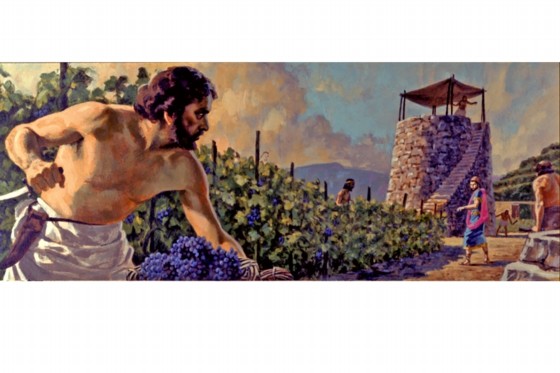
Luke 20 – The Wicked Tenants

In Jesus’ parable; wicked vineyard tenants murdered servants the owner had sent, and eventually murdered the owner’s son. This was an illustration of the wicked leaders who would murder God’s own Son, Jesus (Matthew 21:33-46).

In the parable of the wicked tenants in verses 9-16 , the word for owner in the “owner of the vineyard” is the same as “lord.”  The three servants he sent to the tenants represent the prophets.  The fruit of the vineyards they are seeking represents Israel’s obedience to God.  Then, sending his “beloved son” reminds us of what God said (“This is my beloved Son…”) at Jesus’ baptism in Matthew 3:17.  The tenants killing the owner’s son alludes to His coming death.  When Jesus says that the vineyard owner would come and destroy those tenants, it seems likely to be referring first to the destruction of Jerusalem that will come in A.D. 70. But in a larger sense, it speaks to the final judgment.  Those hearing the parable say “Surely not!” as they perceive that the parable applies to the people of Israel.  Would God take away the land and give it to other people?  But He looks directly at them and says ““What then is this that is written:
“The stone that the builders rejected
has become the cornerstone?”
This is from Psalm 118:22, referred to as well in Isaiah 28:16, and is quoted by Peter in Acts 4:11 and 1 Peter 2:7.

A denarius minted circa 18 BC. Obverse: CAESAR...

A denarius minted circa 18 BC. Obverse: CAESAR AVGVSTVS; reverse: DIVVSIVLIV(S) (Photo credit: Wikipedia)

In verse 19, the scribes and chief priests were predictably angry, as they knew the parable was directed at them.  So they sent people to try to trap him with sedition against the Roman government.  Jesus’ answer in verse 25 was “render to Caesar the things that are Caesar’s, and to God the things that are God’s.” This can be read in different ways, given that He had asked whose image was on the denarius.  One interpretation is that we are made in God’s image, and thus we must render ourselves to God’s service.

The Sadducees do not believe in the resurrection, so they try to test him in verses 27-33 with a scenario revolving around the teaching of Moses.  But in verse 37 (and in Matthew 22:31-32) Jesus quotes Moses’ encounter with God at the burning bush in Exodus 3:6, explaining that God is the God of the living.

Read or listen to audio of ESV version of this selection from this link.

/Bob’s boy
___________________
some images © V. Gilbert & Arlisle F. Beers

Please note: I did not design the reading plan that I am following in my blog.  All of my comments in this blog, however, are solely my responsibility.  When reading ANY commentary, you should ALWAYS refer first to the scripture, which is God’s unchanging and unfailing word. Reading schedules, as well as a link to the site where you can get the reading plan that I’m currently following for yourself can be found on the “Bible Reading Schedules” page of my website at http://graceofourlord.com.  For questions and help, please see the “FAQ” and “Summaries” pages there.

Mark 11 – The Triumphal Entry

As Jesus approached Jerusalem by way of Bethphage and Bethany, He sent two disciples to get a colt for Him to ride on – fulfilling Zechariah 9:9.  Jesus tells them where it will be and what to say when someone asks why they are untying it (including that it will be returned immediately).  On the way, He is hailed as the Messiah (verses 9-10).  “Hosanna” in verses 9 and 10 comes from an expression found in Psalm 118:25 (“Save us, we pray, O Lord”), which when translated into Greek becomes “Hosanna.”  In verse 11, He entered the Temple in Jerusalem, just to look around, then they left for the day.  When He returned the next day, He would again cleanse the Temple, driving out the money-changers and those who sold animals.  Verse 17 quotes both Isaiah 56:7 and Jeremiah 7:11.

The following day, He saw a fig tree in leaf, even though it was not the season for figs.  But the leaves were an outward sign that promised fruit.  Yet there was none.  The analogy of this to God’s people is hard to dispute.  So Jesus declared that no one would eat fruit from it again; and in verses 20-21, His disciples saw that it withered  to its roots.  Verses 23-25 do not mean that everything we want will be given to us if we pray with enough faith.  We must remember what the scripture says about motives in prayer (James 4:3), and about praying according to God’s will (1 John 5:14).

Bethphage area, on the eastern slope of the Mount of Olives, near Bethany. This was on the way from Jerusalem to Jericho.

The chief priests, scribes and the elders all come to challenge Jesus, demanding to know what gives him the authority to do the things he is doing.  He cleansed the Temple of what was going on right under their noses.  But more than that, the question also seems to be of a general nature, in order to strengthen their case against Him.  His refusal to answer unless they told Him by what authority John the Baptist had baptized was calculated, as He knew they would not answer (verses 29-33).  By saying that the baptism was of man, they would anger the crowds who believed John to be a prophet.  But if they said it was of God, they would be admitting that John spoke the truth when he said that he was the one preparing the way for the Messiah (John 1:23 and Mark 1:7-8).

Read or listen to audio of ESV version of this selection from this link.

/Bob’s boy
___________________
some images © V. Gilbert & Arlisle F. Beers

Please note: I did not design the reading plan that I am following in my blog.  All of my comments in this blog, however, are solely my responsibility.  When reading ANY commentary, you should ALWAYS refer first to the scripture, which is God’s unchanging and unfailing word. Reading schedules, as well as a link to the site where you can get the reading plan that I’m currently following for yourself can be found on the “Bible Reading Schedules” page of my website at http://graceofourlord.com.  For questions and help, please see the “FAQ” and “Summaries” pages there.

Mark 10 – Jesus Came to Serve

Here, Jesus was teaching the crowds that gathered around Him; and once again the Pharisees came to test Him.  As He once again condemns divorce in verses 2-12, the exception for adultery is not mentioned here as it is in Matthew 5:32 and Matthew 19:9.  This is because there was no disagreement about adultery where divorce was concerned in Jewish, Greek or Roman cultures.  But the message is clear – God has always taken marriage seriously, intending one man for one woman from the beginning (Genesis 2:24).

Jesus heals blind Bartimaeus (Matthew 20:29-32; Mark 10:46-52; Luke 18:35-43).

The rich man in verse 17 wants to know what he needs to do to inherit eternal life.  In verse 21, Jesus tells him to “sell all that you have and give to the poor.”  This is not a command for everyone to give away all of their possessions, nor does it mean that being wealthy is wrong.  Jesus knew what was in the man’s heart, and his wealth was his god – his idol; and no one can serve two masters (Matthew 6:24).  The reason that He says it is difficult for a rich person to enter the kingdom of heaven is because of the tendency of man to love earthly possessions so much that they come to believe in their own self-sufficiency.  This makes us believe we do not need God.  When the Israelites were wandering the desert, God was providing the manna for them (Exodus 16) daily, teaching them to depend on the Lord.  It is when we forget how much we need Him that we lose our way, and fall away from God.  Most of us are not wealthy, right?  Maybe so, but just remember – a person today making less than $50,000 per year is still very wealthy compared to the majority of earth’s population.  And we still have our “idols” today.

Jesus again foretells His death in verses 32-34 – this time giving His apostles even more detail – “they will mock him and spit on him, and flog him and kill him. And after three days he will rise.”   But apparently they still aren’t “getting it.”  In verses 35-37, James and John ask Jesus to give them each a special place beside him when He comes into His glory.  It is hard to imagine all that is going through their minds, particularly following Jesus’ last prediction of His death.  But clearly they have a mistaken understanding of the Kingdom.  Jesus tells them they don’t know what they are asking.  The baptism he is speaking of in verse 39 is of suffering. Jesus uses the occasion to explain that serving others is the work of His Kingdom (verses 42-45) – a point He will continue to drive home before His death.  Verse 45 is a fitting summary – “For even the Son of Man came not to be served but to serve, and to give his life as a ransom for many.”

Read or listen to audio of ESV version of this selection from this link.

/Bob’s boy
___________________
some images © V. Gilbert & Arlisle F. Beers

Please note: I did not design the reading plan that I am following in my blog.  All of my comments in this blog, however, are solely my responsibility.  When reading ANY commentary, you should ALWAYS refer first to the scripture, which is God’s unchanging and unfailing word. Reading schedules, as well as a link to the site where you can get the reading plan that I’m currently following for yourself can be found on the “Bible Reading Schedules” page of my website at http://graceofourlord.com.  For questions and help, please see the “FAQ” and “Summaries” pages there.

John 11 – Jesus Raises Lazarus

When Jesus receives word that Lazarus is ill, he obviously knows that he is going to die.  So some Bible versions are confusing in verse 4.  The New American Standard has the best translation – “This sickness is not to end in death, but for the glory of God, so that the Son of God may be glorified by it.”  Verse 6 may mean that Jesus wanted to give the sisters time to mourn after the death of their brother before He arrived to raise him – all the more effective when the Lord’s power over death is demonstrated.  Verses 9-10 are difficult to understand.  The most likely meaning is that since He is the light of the world, those who seek to kill Him will not be able to do so until his “day” – His time among them – is over.  His disciples do not understand in verse 11 when He says “Lazarus has fallen asleep,” so He tells them plainly in verse 14 that he has died, and that He is glad for their sakes, so that they will believe. Their witness of Him raising Lazarus will be a powerful memory for them.

The site that is almost certainly Bethany of John 11 – about two miles east of Jerusalem, on the east slope of the Mount of Olives. Jesus often visited his friends, Mary, Martha and Lazarus here. Jesus raised Lazarus after four days, one of the greatest of his miracles. The modern village, called Azariyeh, el-Azariyeh, Lazariyeh, or el-Lazariyeh to honor Lazarus, has about 1,000 people and is near the ancient village. The tower of the New Church of St. Lazarus rises next to the ruins of Christian churches from the Crusader period, about 1100-1300 A.D.

After He raised Lazarus, the Jews that did not want to believe that He was the Christ went to the Pharisees to tell them what had happened.  Their concern about people believing in Jesus as the Messiah was based on the same misguided expectation that the coming of the Messiah would mean he would be a powerful political and military leader.  A Messiah that would lead believers in a revolt against Roman rule would result in the coming of the Romans to crush it and remove the leaders (and thus, the Sanhedrin itself) from any position of power.  Caiaphas, the high priest of that time (about 18 – 36 AD), proposed that killing Jesus would be best for them all (verse 50).  His prophecy in the following verses was unknowingly very foretelling of His resurrection and its effect on God’s people.

Jesus did not walk freely among the Jews after that (verse 54); and in verse 56, many were wondering if He would come to the Passover feast at all.  Of course He would – He always followed God’s commandments.

Read or listen to audio of ESV version of this selection from this link.

/Bob’s boy
___________________
some images © V. Gilbert & Arlisle F. Beers

Please note: I did not design the reading plan that I am following in my blog.  All of my comments in this blog, however, are solely my responsibility.  When reading ANY commentary, you should ALWAYS refer first to the scripture, which is God’s unchanging and unfailing word. Reading schedules, as well as a link to the site where you can get the reading plan that I’m currently following for yourself can be found on the “Bible Reading Schedules” page of my website at http://graceofourlord.com.  For questions and help, please see the “FAQ” and “Summaries” pages there.

John 9 – Jesus Heals a Man Born Blind

Upon passing a man who was born blind, some of Jesus’ disciples ask a question in verse 2 that seems strange to most of us now – “who sinned, this man or his parents…?”  But this mistaken belief about sin and suffering was not uncommon; and we see in verse 34 that the religious leaders that opposed Jesus held the view that the man was born in sin.  We know differently, and Ezekiel 18:20 specifically says otherwise, so they should have known as well.  Jesus corrects them, letting them know in verses 3-4 that his disability will be used for the glory of God.

The Blind Man Washes in the Pool of Siloam

The Blind Man Washes in the Pool of Siloam (Photo credit: Wikipedia)

We know (and have already read of specific examples) that Jesus could have given the man his sight without even touching him.  Some writers have postulated several theories as to why He used the mud that He made from His spittle, before sending the man to the pool of Siloam to wash.  Some see a symbolic connection between the scripture’s use of the Verb for the word “anoint” to describe how Jesus applied it to his eyes (“Christ” and “Messiah” mean “anointed one”). Others see Jesus purposely making mud (or clay) using his spittle as an analogy to kneading dough, in order to challenge the Pharisees. But we really do not know.  There was purpose in everything that Jesus did; and as this was once again on the Sabbath, the point He was making no doubt had its desired effect at that time on those around Him – and the religious leaders that it angered.

At any rate, there is division among these religious leaders at one point (verse 16); and his parents are sent for, and questioned.  They confirmed that the man was their son and that he had been born blind.  But despite the previously mentioned division, the leaders had made it known that anyone who said that Jesus was the Christ (Messiah), they would be put out of the synagogue.  So the man’s parents in verses 21-23 seem to be disingenuous as to knowing how he gained his vision; and they pass the buck back to their son. The blind man is interviewed by the Pharisees and other religious leaders for the second time, and was “cast out” of the synagogue for his comments in verses 30-33.  He found it amazing that they did not know where Jesus came from.  So do we…

Side note: Details and pictures of discoveries at the excavations at the Pool of Siloam are in this article at BiblePlaces.com.  That one is a well-written, but older article.  A more recent article can be found at this link to BiblicalArchaeology.org.

Read or listen to audio of ESV version of this selection from this link.

/Bob’s boy
___________________
some images © V. Gilbert & Arlisle F. Beers

Please note: I did not design the reading plan that I am following in my blog.  All of my comments in this blog, however, are solely my responsibility.  When reading ANY commentary, you should ALWAYS refer first to the scripture, which is God’s unchanging and unfailing word. Reading schedules, as well as a link to the site where you can get the reading plan that I’m currently following for yourself can be found on the “Bible Reading Schedules” page of my website at http://graceofourlord.com.  For questions and help, please see the “FAQ” and “Summaries” pages there.
Week 33 summary posted


Entry into Jerusalem from the large cycle in t...

Entry into Jerusalem from the large cycle in the Scrovegni Chapel by Giotto, c. 1266. (Photo credit: Wikipedia)


This week, we continue reading in Mark, Luke and John and will read of more miracles, and rising opposition to Jesus among the Pharisees and Sadducees in spite of the miracles.   Even witnessing a miracle wouldn’t convince anyone that  doesn’t want to believe.  Denial and self-deception work just fine right in the face of the evidence.  We will also read more fulfilling of prophecy, as Jesus makes His triumphal entry into Jerusalem.


Summing Up


Each weekend, I am now posting a small PDF of one week of chapter summaries (on the website’s “Summaries” page), current to the beginning of the previous week.  I have posted the summary for Week 33 (August Week 2) of the schedule I am following.  This short PDF document contains condensed comments about John 4, Luke 6, Luke 7, Matthew 13, and Matthew 15, with hyperlinks to the ESV version of each chapter for listening or reading, and joins the summaries for other weeks already posted there.


/Bob’s boy


___________________


image © V. Gilbert & Arlisle F. Beers


Please note: I did not design the reading plan that I am following in my blog.  All of my comments in this blog, however, are solely my responsibility.  When reading ANY commentary, you should ALWAYS refer first to the scripture, which is God’s unchanging and unfailing word. Reading schedules, as well as a link to the site where you can get the reading plan that I’m currently following for yourself can be found on the “Bible Reading Schedules” page of my website at http://graceofourlord.com.  For questions and help, please see the “FAQ” and “Summaries” pages there.


Luke 15 – The Parable of the Prodigal Son

As Jesus was teaching, the tax collectors and sinners had gathered around him.  We are not told what the latter were guilty of, but they obviously had a dubious reputation because of it.  The Pharisee and scribes, of course, were looking for anything to use against Jesus; and they began grumbling about the company He was keeping.  Of the three parables Jesus then tells in this chapter, the parable of the prodigal son is the most famous.  But all three make the point about those who are lost, best stated in verse 7 by Jesus – “there will be more joy in heaven over one sinner who repents than over ninety-nine righteous persons who need no repentance.”

Frans Francken (II) - The Parable of the Prodi...

Frans Francken (II) – The Parable of the Prodigal Son – WGA8205 (Photo credit: Wikipedia)

The image in verse 20 of the father running to his son to embrace him when he returned should be comforting to anyone who has fallen away from the Lord and wants to return.  No matter what we have done, God wants us to come back to Him, and will receive us gladly.  The elder son is upset that his father is celebrating the return of his prodigal brother who, in verse 30,  he does not even want to acknowledge as such (“this son”) because of his anger.  After all, he had remained behind and did not “devour” his father’s “property with prostitutes” (verse 30).   Why should his brother deserve to be received that way?  God will forgive in the same way; and we must realize that it is not because any of us deserve that forgiveness.

Read or listen to audio of ESV version of this selection from this link.

/Bob’s boy
___________________
some images © V. Gilbert & Arlisle F. Beers

Please note: I did not design the reading plan that I am following in my blog.  All of my comments in this blog, however, are solely my responsibility.  When reading ANY commentary, you should ALWAYS refer first to the scripture, which is God’s unchanging and unfailing word. Reading schedules, as well as a link to the site where you can get the reading plan that I’m currently following for yourself can be found on the “Bible Reading Schedules” page of my website at http://graceofourlord.com.  For questions and help, please see the “FAQ” and “Summaries” pages there.