Out of the Wilderness – John the Baptist

Luke chapter 3 opens with some information that allows for some dating – and some confusion. The subject of the first three verses is when it was that the word of God came to John the Baptist in the wilderness. Although there are a lot of names of historical figures mentioned, as well as their titles and domains, the most telling is in the first phrase of the opening verse.

English: "Saint John the Baptist" (c...

English: “Saint John the Baptist” (c.1560) by Joan de Joanes (1523-1579). Joan J. Gavara Collection (Valencia) Español: “San Juan Bautista” (c.1560) por Joan de Joanes (1523-1579). Colección Joan J. Gavara (Valencia) (Photo credit: Wikipedia)

It was in the fifteenth year of the reign of Tiberius Caesar. He ascended to the throne as emperor on September 17, 14. A.D., with the Senate validating his position as “Princeps” – a title first given to his predecessor, Augustus – on September 18. So, depending on the literal meaning of “the fifteenth year,” it was likely between 28 and 29 A.D. Attempts at applying this to the date of the birth of Jesus, however, have generated less agreement. Forgetting the errors in the calendar, which is beyond the scope of this study, there are a number of scholars who believe that “reign” in this case may have been applied to Tiberius’ rule over other provinces as well – which may have begun about 11 A.D.  It all becomes much too overwhelming, and there is no real proof. It is sufficient to say that Jesus birth was not in the year “1” (there was no year “0”), and in any case, best estimates are that it was between 4-6 B.C, based on the death of Herod the great.

What does all of this have to do with the calling of John the Baptist from the wilderness by the Lord?  Not much really. The most important thing is told to us in verse 3 – that “he went into all the region around the Jordan, proclaiming a baptism of repentance for the forgiveness of sins.” It is in this manner, as a result of his calling, that he “prepared the way” for Jesus. Verses 4-6 quote the prophet Isaiah from Isaiah 40:3-5:

“The voice of one crying in the wilderness:
‘Prepare the way of the Lord,
make his paths straight.
Every valley shall be filled,
and every mountain and hill shall be made low,
and the crooked shall become straight,
and the rough places shall become level ways,
and all flesh shall see the salvation of God.’”

(This year’s reading plan for Luke, Acts, and 1 and 2 Chronicles averages just 15 verses per day – 5 days per week!)
Schedule for this week
Read or listen to audio of today’s selection from Luke here
Read or listen to audio of today’s selection from 1 Chronicles here

/Bob’s boy
___________________
some images © V. Gilbert & Arlisle F. Beers

All of my comments in this blog, however, are solely my responsibility.  When reading ANY commentary, you should ALWAYS refer first to the scripture, which is God’s unchanging and unfailing word. Reading schedules can be found on the “Bible Reading Schedules” page of my website at http://graceofourlord.com.

Enhanced by Zemanta

Growing Daily By Prayer

Rejoice always, pray without ceasing, give thanks in all circumstances; for this is the will of God in Christ Jesus for you.
1 Thessalonians 5:16-18

By making daily Bible reading a part of our lives, we hear from God each day, and our lives are enriched. The other half of that communication occurs when we talk to Him in prayer. This year, we have committed to developing our prayer life so that we can pray more effective prayers that are pleasing to our Lord. To begin that effort this month, we have decided to dust off the old prayer box and pull out one of the oldest outlines for prayer method we know about – the ACTS method.

Jesus in Pray

Jesus in Pray (Photo credit: Wikipedia)

It is unknown where this originated, but it has been repeated countless times by innumerable evangelists. While it is true that there is no set of rules or structure for prayer that God wants us to use or has mandated, this method contains very good key elements to prayer that are easily remembered. No, we are not referring to the Book of the Acts of the Apostles. People love acronyms because when they are not too complex, they help us remember things.  With that in mind, the elements of prayer represented by the ACTS method are adoration, confession, thanksgiving, and supplication.

The element of adoration is to recognize the greatness of our Creator and that He is worthy of our praise, our worship, and our love for His majesty, His holiness, and His omnipotence. By loving acknowledgement of His awesome power, His boundless goodness and loving care, and the majesty of all that He has created, we give Him the glory of which He is worthy, and we focus our minds and hearts in the right frame of mind for the rest of our prayer.

Through confession in our prayers, we acknowledge our weaknesses to God, admitting that we are in need of His forgiveness to keep our hearts pure. And as Christians, this helps us to stay focused on the reason that we even have the privilege of being able to obtain forgiveness in prayer. We have a “High Priest,” who gave His life so that we could have that forgiveness, and by whom we can approach our heavenly Father in prayer.

Thanksgiving is so integral and important to prayer that we cannot emphasize it enough. We must recognize the love and care that God has shown for us – and continuously does so in all that He does for us. God has given us so many material and spiritual blessings in this world that He has created – not because we deserve any of it, but because He loves us even though we are not worthy of that love.

By making supplication to God, we recognize our dependence on Him for all things. We give Him our petitions, acknowledging and addressing not only our own needs, but the needs of others as well – a key component of prayer. Expressing our love and concern for others to God in prayer builds our faith, and helps us to grow as His children, reflecting the love that His Son had for all people and which He charged us to have as well.

There are many ways to pray, and this method is not the only one that will work.  Also, there is no prescribed order to these elements, nor are they all required in every prayer. But they can serve as a great frame of reference for planning our prayer. That planning – the preparation for prayer is an important aspect that we plan to focus more upon in our study of prayer this year.

We will more closely examine the first element in this method (adoration) next month, as we continue our study in prayer life.

/Bob’s boy
___________________
some images © V. Gilbert & Arlisle F. Beers

Please note: I did not design the reading plan that I am following in my blog.  All of my comments in this blog, however, are solely my responsibility.  When reading ANY commentary, you should ALWAYS refer first to the scripture, which is God’s unchanging and unfailing word. Reading schedules, as well as a link to the site where you can get the reading plan that I’m currently following for yourself can be found on the “Bible Reading Schedules” page of my website at http://graceofourlord.com.  

Enhanced by Zemanta

The Boy Jesus In the Temple

After the blessing by Simeon in the temple 40 days after the birth of Jesus, Luke 2:39 has Mary and Joseph returning to Nazareth. Verse 40 says that he grew and became strong, “filled with wisdom. And the favor of God was upon him.”

Luke then “fast-forwards” to the age of 12. The text says that his parents went up to Jerusalem every year for the Feast of the Passover. Of course they did – Joseph and Mary would observe all of the required feasts. By the Law of Moses, all males were required to attend the feast (Exodus 23:14-17, Deuteronomy 16:1), and the whole family usually made the journey together. This year, when they left to return home, Jesus stayed in Jerusalem. As a matter of expediency, to help each other, and for greater safety, people who had to go long distances for the feast would travel together in caravans with their extended families and friends. So they had gone a day’s journey (likely the end of the day) before they began looking for him among their relatives and friends.

When Jesus was twelve, Mary and Joseph took him to the Passover feast in Jerusalem. But Jesus remained behind to talk with the teachers in the temple. Mary and Joseph searched for him throughout the caravan with which they were traveling, then returned to Jerusalem to find him

When Jesus was twelve, Mary and Joseph took him to the Passover feast in Jerusalem. But Jesus remained behind to talk with the teachers in the temple. Mary and Joseph searched for him throughout the caravan with which they were traveling, then returned to Jerusalem to find him

Not finding him, they went back to Jerusalem to search for him there. After three days (likely meaning a day before missing him, a day to return, and a day of searching) they found him in the temple listening to the teachers and asking questions. The text says that all who heard him were amazed at his understanding. And when Mary told him how they had been searching for him, he said “Did you not know that I must be in my Father’s house?”

Verse 50 says that Mary and Joseph did not understand what he had said. We might wonder what difficulty they would have with the statement. Jesus at that age was fully aware of who He was (if not before this Passover, then certainly now that it had ended, that was so). But were Mary and Joseph really fully aware of who Jesus was yet? Certainly they knew that He was a gift from God, and the angel Gabriel had told Mary that He was to be the Son of God. But they had nevertheless been raising a child that in all physical aspects was thoroughly human. He had the same needs and dependencies as any other child, and he had required the same sort of nurturing as other children.

Any parent goes through moments of pride and moments of wistful sadness at watching their child grow up. Imagine the added complexity of raising the Son of God! As verse 51 says, Mary treasured all these things in her heart. Naturally, the text also says that he came with them to Nazareth and was submissive to them.

(This year’s reading plan for Luke, Acts, and 1 and 2 Chronicles averages just 15 verses per day – 5 days per week!)
Schedule for this week
Read or listen to audio of today’s selection from Luke here
Read or listen to audio of today’s selection from 1 Chronicles here

/Bob’s boy
___________________
some images © V. Gilbert & Arlisle F. Beers

All of my comments in this blog, however, are solely my responsibility.  When reading ANY commentary, you should ALWAYS refer first to the scripture, which is God’s unchanging and unfailing word. Reading schedules can be found on the “Bible Reading Schedules” page of my website at http://graceofourlord.com.
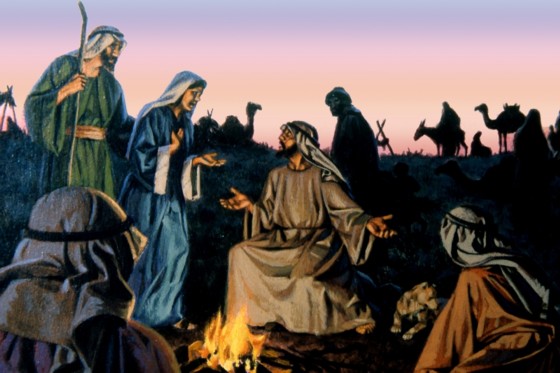
1 Chronicles, Judah to Levi

1 Chronicles chapter 2 begins with the 12 children of Jacob (Israel). It quickly begins to focus in on Judah, as this is the tribe of David, and it continues doing so in chapter 3 and chapter four all the way through to verse 23. Chapter 2 is a genealogy of David, and chapter 3 is a record of the descendants of David all the way up through the post-exilic period in which the Chronicles are written.

English: English translation of hebrew version...

English: English translation of hebrew version. Map of the twelve tribes of Israel, before the move of Dan to the North (Photo credit: Wikipedia)

Chapter four then continues the genealogy of the other clans of the tribe of Judah until we reach verse 23. The rest of the fourth chapter is a record of the tribe of Simeon. Simeon is probably chosen next because its territory resided within the borders of Judah. In fact, it had largely been swallowed up by Judah, but there was still a genealogical and tribal identification that most Simeonites would hold on to.

Chapter five records the genealogy of the Trans-jordanian tribes – Reuben, Gad, and the half-tribe of Manasseh. Although the tribes had been virtually wiped out by the Assyrian invasion in the eighth century B.C., there were still those who identified with these tribes. Verses 18-22 record an important victory in battle that occurred before the exile that we do not have recorded anywhere else in the Bible. It accentuates that they were still God’s people and the text says that “many fell, because the war was of God.”

Chapter six a is a very long chapter. It was especially important to get this genealogy just right, as this was about the tribe of Levi. Since the Levites were not allotted their own territory, it was also important to document various tribal territories where different Levite clans were settled, and what they were given in those areas. Verse 28 identifies the prophet Samuel as a Kohathite.

(This year’s reading plan for Luke, Acts, and 1 and 2 Chronicles averages just 15 verses per day – 5 days per week!)
Schedule for this week
Read or listen to audio of today’s selection from Luke here
Read or listen to audio of today’s selection from 1 Chronicles here

/Bob’s boy
___________________
some images © V. Gilbert & Arlisle F. Beers

All of my comments in this blog, however, are solely my responsibility.  When reading ANY commentary, you should ALWAYS refer first to the scripture, which is God’s unchanging and unfailing word. Reading schedules can be found on the “Bible Reading Schedules” page of my website at http://graceofourlord.com.

Enhanced by Zemanta

In the Presence of All Peoples

In verses 22-24 of Luke chapter 2, we learn that Mary and Joseph have brought Jesus to Jerusalem to make an offering once the days of her purification following childbirth are complete. This is in accord with the Law of Moses given in Leviticus 12:3-8, and it means that it was 40 days after his birth. The offering is to be a lamb and a turtle-dove or pigeon unless she cannot afford a lamb, in which case it would be two turtle-doves or two pigeons. Since Joseph was not a man with much wealth, the offering would be the latter.

St Joseph with the Infant Jesus (c. 1635), at ...

St Joseph with the Infant Jesus (c. 1635), at the Hermitage, in St. Petersburg. Oil on canvas, 126 x 101 cm. (Photo credit: Wikipedia)

Beginning in verse 25, we are told of a righteous and devout man who was there that was filled with the Holy Spirit. The text says that he was waiting for”the consolation of Israel,” which is to say that he was waiting for God to send the Messiah to redeem His people. In fact, verse 26 says that the Holy Spirit had revealed that he would see the Christ in his lifetime. There are some scholars (particularly Dr. John Lightfoot) that believed this Simeon was the son of a great philosopher and doctor of that day, Hillel, and that Simeon was also president of the Sanhedrin. If true, this would mean that he was also the father of Gamaliel, who Saul of Tarsus studied under. All very interesting, and we are sure, quite educated calculations, but still historically unsubstantiated.

As he took the child in his arms, he offered his blessing to God, saying “…that you have prepared in the presence of all peoples, a light for revelation to the Gentiles, and for glory to your people Israel.”  Filled with the Holy Spirit, Simeon already knew what many would not figure out until after Jesus’ death and resurrection – that he had come for the Gentiles as well. He then blessed the parents, and addressed Mary with some prophecy in verses 34-35 that points to the rise of many ordinary men to be His apostles, the fall of unbelievers such as Annas and Caiaphas, and a darker prophecy of Mary’s heartbreaking witness of her son’s death (“a sword will pierce through your own soul”).

In verses 36-38, we are told of a prophetess named Anna, who was “advanced in years.” The words “did not depart from the temple” simply refer to the fact that despite her age, she did not forsake her temple duties. Verse 38 says of her: “and coming up at that very hour she began to give thanks to God and to speak of him to all who were waiting for the redemption of Jerusalem.” “To speak of him” refers to Jesus, not God, as is obvious from the context.

So we can deduce from these two accounts, that a number of people were being told of the fact that this child was the long-awaited Messiah.

(This year’s reading plan for Luke, Acts, and 1 and 2 Chronicles averages just 15 verses per day – 5 days per week!)
Schedule for this week
Read or listen to audio of today’s selection from Luke here
Read or listen to audio of today’s selection from 1 Chronicles here

/Bob’s boy
___________________
some images © V. Gilbert & Arlisle F. Beers

All of my comments in this blog, however, are solely my responsibility.  When reading ANY commentary, you should ALWAYS refer first to the scripture, which is God’s unchanging and unfailing word. Reading schedules can be found on the “Bible Reading Schedules” page of my website at http://graceofourlord.com.

Enhanced by Zemanta

A Savior, Who Is Christ the Lord

The Birth of Our Lord Jesus Christ

The Birth of Our Lord Jesus Christ (Photo credit: Wikipedia)

Verse 8 of Luke chapter 2 picks up with the shepherds who are out in their field at night. Depending on the version you read, they were in the same region as Mary and Joseph or in the same country. The translation has the same effect in either case – so that we are not sure exactly how far away they are, but certainly not in a separate country. When the angel of the Lord appeared to them, “the glory of the Lord shone around them and they were filled with fear.” Any time that term is used, it is accompanied by great light – whatever else it means. In this case, certainly not as bright as what Paul (Saul) encountered on the road to Damascus (Acts 9), but in a dark field in a time when there were no distant city lights, it would be quite substantial and unnerving.

Gabriel making the Annunciation to the Virgin ...

Gabriel making the Annunciation to the Virgin Mary. Painting by El Greco, 1575 (Museo del Prado, Madrid). (Photo credit: Wikipedia)

Calming them, the angel told them of the good news of the birth in the city of David of “a Savior, who is Christ the Lord,” and old them how they would know him when they went to see. The sudden appearance with the angel of “a multitude of the heavenly host”  raises the question of what makes up a heavenly host. Generally, a “host” is a military term, where the collective group is associated with fighting a battle or guarding something. In the case of the Lord, they are associated as being at His side, praising Him, and ready to do his bidding (Psalm 103:21, Daniel 7:10). And verse 15 gives us the answer. After they finished praising the Lord Jesus, the verse tells us that the “angels” went away into heaven. Since only one angel had appeared before the heavenly host came, that tells us what sort of multitude they were.

When they arrived and saw Jesus, verse 17 says they “made known” what had been told to them by the angel, which created an understandable stir. But Mary, it said, treasured all of these things in her heart – no doubt recalling the visit from the angel Gabriel before the conception. And then on the eighth day, he was circumcised according to the Law of Moses and given the name Jesus, just as Gabriel had told her. And just like that, the will of God that He made known to the serpent way back in Genesis 3:15 was brought to fruition:

I will put enmity between you and the woman,
and between your offspring and her offspring

(This year’s reading plan for Luke, Acts, and 1 and 2 Chronicles averages just 15 verses per day – 5 days per week!)
Schedule for this week
Read or listen to audio of today’s selection from Luke here
Read or listen to audio of today’s selection from 1 Chronicles here

/Bob’s boy
___________________
some images © V. Gilbert & Arlisle F. Beers

All of my comments in this blog, however, are solely my responsibility.  When reading ANY commentary, you should ALWAYS refer first to the scripture, which is God’s unchanging and unfailing word. Reading schedules can be found on the “Bible Reading Schedules” page of my website at http://graceofourlord.com.

Enhanced by Zemanta

Unremarkably Momentous

English: A statue of the first Roman Emperor A...

English: A statue of the first Roman Emperor Augustus (r. 27 BC – 14 AD) as a younger Octavian, this sculpted artwork dated to around 30 BC. It is located in the Museo Capitolino of Rome, Italy. (Photo credit: Wikipedia)

Luke chapter 2 opens the story of the birth of Jesus with two verses that skeptics, always quick to pounce on perceived biblical contradictions, are happy to use in their repertoire. The verses in the NKJV read “And it came to pass in those days that a decree went out from Caesar Augustus that all the world should be registered. This census first took place while Quirinius was governing Syria.”

The problems with the two verses are two-fold. First, Quirinius was the governor of Syria beginning in 6 A.D. Herod the Great died in 4 B.C., and we know from scripture that Jesus was born during the reign of Herod. Secondly, although there is secular record of the census during the governorship of Quirinius, no historical record of the previous census has been found.

There are several answers that have been proposed to this supposed dilemma that include the fact that it is recorded in the “Acts of Augustus” that he authorized censuses throughout the empire in 28 B.C., 8 B.C., and 14 A.D. Further, it is known that provincial censuses were held in 14 year intervals, which would fit with the known census of 6 A.D. Jesus was born sometime from 7 B.C. to 4 B., which would fit the beginning date in 8 B.C. for that census. Also, Publius Sulpicius Quirinius, served at the favored pleasure of Augustus as governor of Crete and Cyrene, as a soldier, and as consul beginning about 14 B.C.

We do well to note the meticulous detail and accuracy of Luke’s writings throughout both of his books. For example, he knew about and acknowledged the 6. A.D. census in Acts 5:37. In the second place, we must remember that the Bible, as God’s inspired word, has stood the test of time, and has been found historically accurate numerous times, even when previous secular history showed no corroboration. Take for example, the fact that skeptics once believed that Pontius Plate was a mythological concoction of the Bible until the Italian archaeologists found the “Pilate Stone” in 1961.

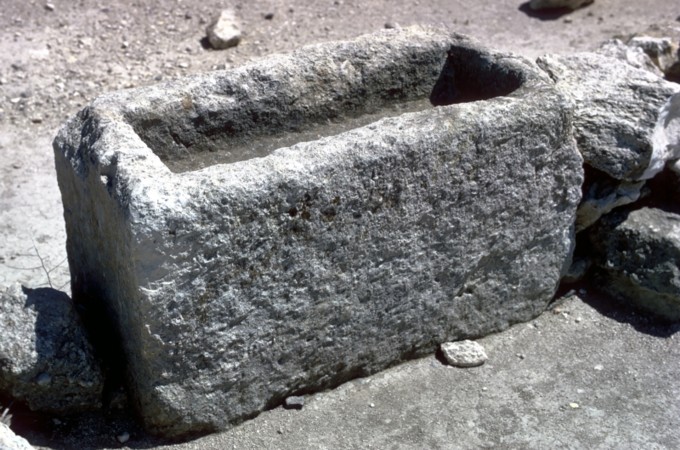
Stone manger from Bible times, perhaps similar to the one that cradled the baby Jesus in Bethlehem. The manger held food for animals.

Stone manger from Bible times, perhaps similar to the one that cradled the baby Jesus in Bethlehem. The manger held food for animals.

“All the world” in verse one means all of the roman Empire, of course. Since everyone went to register in their home town, this is how Jesus came to be born in Bethlehem instead of Nazareth – thus fulfilling prophecies such as that of Micah 5:2. This is because Joseph was of the house of David. When Joseph and Mary arrived there, there was no room in the inn. So when she gave birth, she wrapped our Lord in swaddling clothes, and put him in a manger (a feeding trough for animals) for his bed. It is here in just 2 verses (5-7) that we learn of the birth of the most important person ever born in this world – with absolutely no fanfare.

(This year’s reading plan for Luke, Acts, and 1 and 2 Chronicles averages just 15 verses per day – 5 days per week!)
Schedule for this week
Read or listen to audio of today’s selection from Luke here
Read or listen to audio of today’s selection from 1 Chronicles here

/Bob’s boy
___________________
some images © V. Gilbert & Arlisle F. Beers

All of my comments in this blog, however, are solely my responsibility.  When reading ANY commentary, you should ALWAYS refer first to the scripture, which is God’s unchanging and unfailing word. Reading schedules can be found on the “Bible Reading Schedules” page of my website at http://graceofourlord.com.

Enhanced by Zemanta

The Events of the Days

The Books of I and II Chronicles, like Kings and Samuel, were originally one book. The Hebrew title for the book (“Dibre Hayyamim“) is often translated “The events (or annals) of the days.” We like the fact that the Septuagint calls it “the things omitted,” as that seems the very best description – for it contains much that Samuel and Kings do not.  But the overriding message throughout the book is the faithfulness of God to his covenant with His people through the house of David.

English: Table of nations according to genesis...

English: Table of nations according to genesis 10 Nederlands: Volkerenlijst naar genesis 10 (Photo credit: Wikipedia)

1 Chronicles 3:17-24 contains the names of a list of descendants of David that is at least 5 generations beyond the exile, and so it seems reasonable to date the beginning of the writings to at least 400 B.C., and possibly a few decades afterward. With the fall of Jerusalem and the destruction of the temple by the Babylonians under Nebuchadnezzar, the Davidic kingdom was overthrown, and there was no longer a nation of Judah. Babylon, however, fell to the Persians in 538 B.C., and after the decree of Cyrus, the returning exiles (with much help from Ezra and Nehemiah) eventually got the temple rebuilt, as well as the walls around Jerusalem. But where did that leave God’s people if there was no more monarchy of David’s house? What was God’s plan, and where did that leave the covenant made to David in 2 Samuel 7?

This is the main purpose of the Book of Chronicles – to reinforce faith in the promise of the Davidic throne through a clear and precise record of the nation’s history from the perspective of the remnant of the southern kingdom and its rulers. As the book was written, a start in rebuilding had been made in the temple and in Jerusalem, but the people must not repeat the mistakes of the past. And so those who had not been there must learn all about it.

The genealogy of the first nine chapters of 1 Chronicles begins in verses 1-3 of chapter one – from Adam to Noah and his three sons, Shem, Ham, and Japeth. From here, it begins to read very much like what we know now as “The Table of Nations” in Genesis 10. Verses 5-24 give us the sons of each of Noah’s sons, etc. down to Abraham, and thus the names of nations – many of which are very familiar to us now through geography, history, and other biblical reference, such as Canaan, Egypt, Cush, and Uz (from Job).

Verses 28-54 give us the generations from Abraham to Jacob (Israel), but only Jacob’s brother Esau is the focus of the genealogical record from verse 35 onward in this chapter. Jacob’s descendants will be covered at great length beginning in chapter 2. These 29 verses are all devoted to the nation of Edom, which Esau fathered, many of which would be bitter enemies with Israel and Judah in times to come.

(This year’s reading plan for Luke, Acts, and 1 and 2 Chronicles averages just 15 verses per day – 5 days per week!)
Schedule for this week

/Bob’s boy
___________________
some images © V. Gilbert & Arlisle F. Beers

Please note: I did not design the reading plan that I am following in my blog.  All of my comments in this blog, however, are solely my responsibility.  When reading ANY commentary, you should ALWAYS refer first to the scripture, which is God’s unchanging and unfailing word. Reading schedules, as well as a link to the site where you can get the reading plan that I’m currently following for yourself can be found on the “Bible Reading Schedules” page of my website at http://graceofourlord.com.  

Enhanced by Zemanta

The Birth of John the Baptist

In Luke 1:57, Elizabeth  bears a son, and all of their friends and relatives rejoiced with her. On the eighth day, they came to circumcise him, according to Mosaic Law (Genesis 17:12, Leviticus 12:3). Everyone fully expected the child to be named Zechariah after his father, but when Elizabeth told them that his name was John, they appealed to Zechariah to make a sign – as he was still mute.

When Zechariah wrote that the child’s name was John as well, he then became able to speak again, praising God. This event, together with the very fact that this couple beyond child-bearing years now had a son, spread news and wonder throughout the hill country that God’s hand was surely involved. This child, they knew, was going to be special.

Birth of St. John the Baptist, depicting Zecha...

Birth of St. John the Baptist, depicting Zechariah writing, “His name is John”. (Photo credit: Wikipedia)

Zechariah, filled with the Holy Spirit, began to prophesy and from verses 68-79, he says a great deal about his son and his calling, as well as the coming savior, that he would not have known without such divine guidance. In verse 69, the “horn of salvation” that God has raised up is of course, Jesus. The horn was a symbol of strength and power, and is referred to in many Bible passages, including Hannah’s song in 1 Samuel 2. In the ensuing verses, he continues to speak of this salvation in terms of the covenant with Abraham and his descendants.

Then, in verse 79, he addresses the child, saying that he “will be called the prophet of the Most High; for you will go before the Lord to prepare his ways, to give knowledge of salvation to his people in the forgiveness of their sins…” The first part is in keeping with what is foretold in Malachi 3:1, and Isaiah 40:3. And true forgiveness of sins is part of the new covenant that was promised in Jeremiah 31:31-34, which is affirmed by Jesus during the institution of the Lord’s Supper in Matthew 26:28, when he spoke of “my blood of the covenant, which is poured out for many for the forgiveness of sins.

In confirmation of just how special this child was to be, verse 80 tells the reader that he “grew and became strong in spirit, and he was in the wilderness until the day of his public appearance to Israel.” John the Baptist would wait for his calling from the Lord.

(This year’s reading schedule for Luke, Acts, and 1 and 2 Chronicles averages just 15 verses per day – 5 days per week!)
Read or listen to audio of today’s selection from Luke here
Read or listen to audio of today’s selection from 1 Chronicles here

/Bob’s boy
___________________
some images © V. Gilbert & Arlisle F. Beers

All of my comments in this blog, however, are solely my responsibility.  When reading ANY commentary, you should ALWAYS refer first to the scripture, which is God’s unchanging and unfailing word. Reading schedules can be found on the “Bible Reading Schedules” page of my website at http://graceofourlord.com.
Enhanced by Zemanta

Gabriel Appears To Mary

Gabriel making the Annunciation to the Virgin ...

Gabriel making the Annunciation to the Virgin Mary. Painting by El Greco, 1575 (Museo del Prado, Madrid). (Photo credit: Wikipedia)

Verse 26 of Luke chapter one begins ” in the sixth month,” which refers to the time following Elizabeth’s conception of John the Baptist. Note that the description of Nazareth’s location by Luke is further evidence of his intended Gentile audience. Any Jew would know very well where Nazareth was. The angel Gabriel was sent by God to a virgin named Mary, who was betrothed to Joseph, of the house of David. Betrothal in those days was nothing like the sense in which we imagine such a term. Rather, it was a negotiated agreement that was binding upon both the bride and the groom to the extent that they were legally and religiously married in all respects – except that of living together.

Gabriel told Mary, who did not “know a man,”  that she would bear a son by the power of the Holy Spirit and the “Most High” (verse 35), and name Him Jesus. This  reference to God as “Most High” (Elyon, used seven times in Luke) is seen first in Genesis 14:18-20 when Abram met Melchizedek, and was used quite often thereafter – seen often in the Psalms, Numbers 24:16, and Daniel 3:26, and 4:24,34. He also told her some very important things about Jesus: 1) that He will be called holy – the Son of God, 2) that God will give Him the throne of David, his father, from which He will reign over the house of Jacob forever and 3) that of His kingdom there shall be no end. Before he left, Gabriel told Mary of the pregnancy of her elderly relative, Elizabeth, which was his offering of a sign for Mary’s encouragement in what he had told her.

John the baptist Church in Ein Karem Jerusalem...

John the baptist Church in Ein Karem Jerusalem, Israel, 2006 (Photo credit: Wikipedia)

Mary went to see her relative, and when she arrived, we are told that Elizabeth’s baby (who was filled with the holy Spirit) leaped for joy in her womb at the presence of the Lord – providing yet another affirmation for the Christian of the sanctity of life in the womb. Mary stayed with her for about three months before returning home. Verses 47-55 contain Mary’s song – a psalm of praise to God that has come to be known at the “Magnificat” – a title which comes from the Latin translation.

Side note: In verse 39, when Mary went to see Elizabeth, the text says that she went “into the hill country to a town in Judah.” We do not really know where in that area it actually was, but traditional belief widely held is that the home of John the Baptist was in Ein Karem, about 5 miles west of Jerusalem. There is an interesting article with some pictures of the area in this feature at Ferrell’s Travel Blog.

(This year’s reading plan for Luke, Acts, and 1 and 2 Chronicles averages just 15 verses per day – 5 days per week!)
Read or listen to audio of today’s selection from Luke here
Read or listen to audio of today’s selection from 1 Chronicles here

/Bob’s boy
___________________
some images © V. Gilbert & Arlisle F. Beers

All of my comments in this blog, however, are solely my responsibility.  When reading ANY commentary, you should ALWAYS refer first to the scripture, which is God’s unchanging and unfailing word. Reading schedules can be found on the “Bible Reading Schedules” page of my website at http://graceofourlord.com.

Enhanced by Zemanta