Communion and Preparation – Luke 22

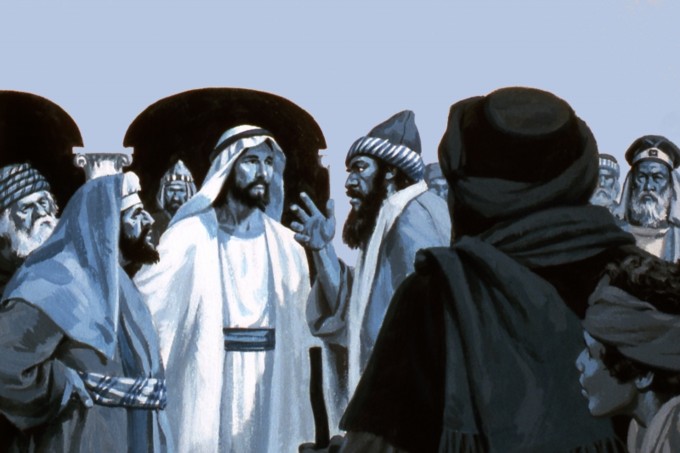
As Jesus and his disciples reclined at table to eat the Passover, he told them how much he had looked forward to having this opportunity- his truly last until “it is fulfilled in the kingdom of God” – after his resurrection. He took the cup of the fruit of the vine and the bread, and He had them divide it between them. Note that He gave thanks for the bread and the fruit of the vine separately before doing so, just as is our custom in observing this Lord’s supper which he instituted here.

The Last Supper

The Last Supper (Photo credit: elmas156)

After he explained to them the meaning that these elements now had – his body and his blood, they ate. It was then that he broke the news to them that one of those who were present would betray him. He said that the fact that he was going to go was already determined. But He  told them that it would not go well for the one who betrayed him. This got their attention, and they questioned each other, trying to determine who it was.

Then an odd dispute came up – odd in light of the news that Jesus had just given them. The dispute was over which one of them would be the greatest in Jesus’ kingdom. This goes to show that it still just wasn’t sinking in. It reminds us of the third time that Jesus foretold His death to them in Luke 18:34. The scripture said “this saying was hidden from them, and they did not grasp what was said. It seems clear that they still were not “grasping” it. They were still imagining that Jesus was to become the earthly king of the Jews, and that they were wondering just how high on the “totem pole” each of them was going to be.

So then Jesus turned upside down their notions of greatness and leadership completely. He pointed out that He is one among them who serves. Luke does not recount here the lesson that Jesus taught them about serving when He washed their feet, as John detailed in John 13:12-15. But it is clear that at this point He had given it to them. He also told them that those who would be the “greatest” must become as the youngest – that is, those who were more often traditionally called to serve others. Yet he said that He assigns to them – those who were with Him thru His trials – a place at his table in his kingdom. They just still do not know what “the kingdom” really will mean at this point.

Then Jesus’ conversation turns to Peter, and that deserves some attention. Note verses 31-32:

31 “Simon, Simon, behold, Satan demanded to have you, that he might sift you like wheat, 32 but I have prayed for you that your faith may not fail. And when you have turned again, strengthen your brothers.”

Judas at the Last Supper

Judas at the Last Supper (Photo credit: Lawrence OP)

It is significant that the word translated as you twice in verse 31 is plural. So the verse is emphasizing Satan’s determination to shake the faith of all of the apostles. In verse 32, the word is plural, as Jesus is addressing Peter. Jesus knew by now that Judas was lost, and he knew that Peter was Satan’s next target. But He says, that He has prayed that Peter’s faith would not fail. He knew that the Holy Spirit would fill Peter at the proper time, and that he would strengthen the others. Peter, of course, said he was ready to go to prison or die, but Jesus told him of his coming denial.

He then reminds them of when he sent them out without a moneybag or knapsack (Luke 9:1-6), and asks if they lacked for anything. They answered that they had not. Then he told them:

“But now let the one who has a moneybag take it, and likewise a knapsack. And let the one who has no sword sell his cloak and buy one.

This passage generates much debate. Some see the sword as having a figurative meaning – as in arming themselves for spreading the gospel. But if that were the case, wouldn’t the moneybag and knapsack also be figurative? But how else to explain it? Jesus obviously did not want them to use these swords against the authorities when they came to arrest him. But note that when Peter does cut the ear from one of them when they come to arrest Jesus, Jesus rebukes him – but he does not have him get rid of the sword either.

The most reasonable explanation is that Jesus knows that their lives are about to change. They were safe as long as they were all together with him. But many would scatter and become separated. They would need their moneybags, their knapsacks, and they would need their swords for protection against robbers, and maybe even wild animals. Remember, they weren’t checking into La Quinta on their travels, and seldom were lucky enough to be taken into someone’s home.


(This year’s reading plan for Luke, Acts, and 1 and 2 Chronicles averages just 15 verses per day – 5 days per week!)
Schedule for this week
Read or listen to audio of today’s selection from Luke here
Read or listen to audio of today’s selection from 2 Chronicles here


/Bob’s boy


___________________


some images © V. Gilbert & Arlisle F. Beers


Please note: I did not design the reading plan that I am following in my blog.  All of my comments in this blog, however, are solely my responsibility.  When reading ANY commentary, you should ALWAYS refer first to the scripture, which is God’s unchanging and unfailing word. Reading schedules, as well as a link to the site where you can get the reading plan that I’m currently following for yourself can be found on the “Bible Reading Schedules” page of my website at http://graceofourlord.com.  


Enhanced by Zemanta

Preparing For Passover – Luke 22

English: Judas Iscariot The face of Judas Isca...

English: Judas Iscariot The face of Judas Iscariot peers from carved foliage whilst carvings of the other 11 disciples adorn the pulpit in St.James’ church http://www.geograph.org.uk/photo/740582 (Photo credit: Wikipedia)

The members of the Sanhedrin council (chief priests) were already trying to figure out how to kill Jesus. And now one of the reasons he has come to Jerusalem – the Passover Feast was approaching. Verse 3 says that Satan already entered into Judas Iscariot, and he slipped off to meet with the chief priests to make plans for his betrayal of Jesus.  They agreed on payment for his part in the deed to come.  Now all he had to do was find the right time and place away from the crowds. Judas would be just as afraid of what the crowds around Jesus might do as the Sanhedrin had already proved to be.

On the day of unleavened bread, the Passover lamb had to be killed. It was on this day that Jesus sent Peter and John to find a place for them to prepare the Passover. He described a man carrying a jar that would meet them and take them to an upper room where they could do so. And when they went where Jesus had told them to go, they found the man just as He had said. They told him what Jesus had told them to say, and he did indeed take them to the upper room Jesus had spoken of.

On proper reflection, the reader should realize something about all of that. Since Jesus could foresee these details so clearly, he surely saw what was soon to be done to him just as clearly. What a chilling burden to carry around!

(This year’s reading plan for Luke, Acts, and 1 and 2 Chronicles averages just 15 verses per day – 5 days per week!)
Schedule for this week
Read or listen to audio of today’s selection from Luke here
Read or listen to audio of today’s selection from 1 Chronicles here

/Bob’s boy
___________________
some images © V. Gilbert & Arlisle F. Beers

Please note: I did not design the reading plan that I am following in my blog.  All of my comments in this blog, however, are solely my responsibility.  When reading ANY commentary, you should ALWAYS refer first to the scripture, which is God’s unchanging and unfailing word. Reading schedules, as well as a link to the site where you can get the reading plan that I’m currently following for yourself can be found on the “Bible Reading Schedules” page of my website at http://graceofourlord.com.  

Enhanced by Zemanta

Solomon Furnishes the Temple – 2 Chronicles 4-5

Moses Consecrates Aaron and His Sons and Offer...

Moses Consecrates Aaron and His Sons and Offers Their Sin Offering (illustration from the 1728 Figures de la Bible) (Photo credit: Wikipedia)

Solomon had an altar made of bronze. Depending on the size of the cubit in 2 Chronicles 4:1, it could have been as big as 30 ft. long, 30 ft. wide, and 15 ft. high! To this, one commentator we read concerning this chapter, said: “What was wrong with this? Ten cubits was a height of something like fifteen feet, which required that steps would have to be used by the priests in making sacrifices upon it; and God had specifically commanded Israel, “Neither shalt thou go up by steps unto my altar'” (Exodus 20:26).

This commentator also said that there were “also countless concessions to paganism, as seen in the images of the bulls (politely called oxen here) placed under the layer. The bulls, calves, oxen, whatever they were called, were the usual images under which the old Canaanite fertility god Baal was worshiped. Even the Jewish historian Josephus condemned Solomon for what he did in this (Antiquities of the Jews p. 255).”

Could it be that Solomon had sinned so greatly in furnishing the Temple? Let us take the commandment not to go up steps to the altar. If you read Exodus 20:26, it actually says “And you shall not go up by steps to my altar, that your nakedness be not exposed on it.’” This problem was alleviated, however, in Exodus 28:42, when God told Moses “You shall make for them linen undergarments to cover their naked flesh. They shall reach from the hips to the thighs; and they shall be on Aaron and on his sons when they go into the tent of meeting or when they come near the altar…”

Moses with the tablets of the Ten Commandments...

Moses with the tablets of the Ten Commandments, painting by Rembrandt (1659) (Photo credit: Wikipedia)

As for the oxen, the Decalogue (Ten Commandments) forbade making a graven image – but as an object of worship. These twelve oxen that held up the “sea” were obviously representative of the twelve tribes. They were in no way part of the act of worship. Also, we know that later, the “glory of the Lord” filled the Temple after the dedication. So obviously, God approved of the construction and the furnishings.

The “sea” in verse 10 was a large circular water tank used by priests for ceremonial cleansing, just like the bronze basin of Exodus 30:18-21. In chapter 5, the ark of the covenant was brought into the “Most Holy Place” under the wings of the cherubim. Verse 10 says that there was nothing inside the ark except the two tablets (it had once contained Aaron’s rod and a jar of manna).

(This year’s reading plan for Luke, Acts, and 1 and 2 Chronicles averages just 15 verses per day – 5 days per week!)
Schedule for this week
Read or listen to audio of today’s selection from Luke here
Read or listen to audio of today’s selection from 2 Chronicles here

/Bob’s boy
___________________
some images © V. Gilbert & Arlisle F. Beers

Please note: I did not design the reading plan that I am following in my blog.  All of my comments in this blog, however, are solely my responsibility.  When reading ANY commentary, you should ALWAYS refer first to the scripture, which is God’s unchanging and unfailing word. Reading schedules, as well as a link to the site where you can get the reading plan that I’m currently following for yourself can be found on the “Bible Reading Schedules” page of my website at http://graceofourlord.com.  

Enhanced by Zemanta

Like a Trap – Luke 21

So the last few verses of this chapter in which Jesus has been predicting the fall of Jerusalem contain further warning, beginning in verse 34:

But watch yourselves lest your hearts be weighed down with dissipation and drunkenness and cares of this life, and that day come upon you suddenly like a trap.

Titus Destroying Jerusalem by Wilhelm von Kaulbach

Titus Destroying Jerusalem by Wilhelm von Kaulbach (Photo credit: Wikipedia)

It will be more than 30 years after this warning that judgment will come upon Jerusalem, and there will be plenty of time for His followers to become complacent, even sinful, and wrapped up in the cares of this life. But if they are not careful and vigilant, they will fall victim to the devastation. Many of Jesus’ disciples escaped the judgment on Jerusalem that came in 70 A.D. because they had been warned here of things that would happen that would signal the coming destruction. So those disciples lived to bear witness to others.

Jesus then adds, in verse 35, that “…it will come upon all who dwell on the face of the whole earth.” The rest of the world will not experience the destruction of Jerusalem, but we will all see destruction come one day. So His next warning comes for the people of that generation in Jerusalem, and for all of us: “stay awake at all times, praying that you may have strength to escape all these things that are going to take place, and to stand before the Son of Man.” Like His disciples there at that time, we have been given the knowledge of what to do with our lives to prepare for the day that will surely come for all of us. They will stand before the Son of Man in another sense – that their escape will make them available as a living testament to His authority. We can stand before Him justified because of His grace – not by our own doing (Ephesians 2:8).

Verses 37-38 conclude this chapter with Luke telling us that Jesus spent His time these last days teaching in the temple every day. But at night, He went “and lodged on the mount called Olivet.” The Greek word for “lodged” here literally means to lodge in the open. So it is very likely that He slept under His stars until early morning, when He would already be in the temple again as the people came to hear Him.

(This year’s reading plan for Luke, Acts, and 1 and 2 Chronicles averages just 15 verses per day – 5 days per week!)
Schedule for this week
Read or listen to audio of today’s selection from Luke here
Read or listen to audio of today’s selection from 2 Chronicles here

/Bob’s boy
___________________
some images © V. Gilbert & Arlisle F. Beers

Please note: I did not design the reading plan that I am following in my blog.  All of my comments in this blog, however, are solely my responsibility.  When reading ANY commentary, you should ALWAYS refer first to the scripture, which is God’s unchanging and unfailing word. Reading schedules, as well as a link to the site where you can get the reading plan that I’m currently following for yourself can be found on the “Bible Reading Schedules” page of my website at http://graceofourlord.com.  

Enhanced by Zemanta

The Coming of the Son of Man – Luke 21

"Son of man" appears 25 times in Luk...

“Son of man” appears 25 times in Luke, a copy (c. 800) shown here. (Photo credit: Wikipedia)

Up through verse 24, most of chapter 21 is pretty easy to understand, and most people get it. But enter verse 25, and the wheels start to come off for a lot of commentators. In fairness, verses 25-28 are among the most difficult verses to understand when it comes to Jesus’ quotations. And it is verse 27 that creates the confusion. As always, context is everything. So let us first back up and remember what the preceding verses are about.

Verses 5-24 are clearly about the coming destruction of the temple and of Jerusalem itself in 70 A.D. Now let’s just take verses 25-26 by themselves:

“And there will be signs in sun and moon and stars, and on the earth distress of nations in perplexity because of the roaring of the sea and the waves, people fainting with fear and with foreboding of what is coming on the world. For the powers of the heavens will be shaken.”

These two verses align perfectly with the signs and the upheaval that Jesus describes in verses 20-24. Now verses 27-28:

And then they will see the Son of Man coming in a cloud with power and great glory. Now when these things begin to take place, straighten up and raise your heads, because your redemption is drawing near.”

Sounds like Jesus is talking about His own second coming, right? Well, not so fast… Let’s continue on, as Jesus immediately tells them the parable of the fig tree in verses 29-30. Then in verse 32, He says Truly, I say to you, this generation will not pass away until all has taken place. Wait a minute, there will still be people of that generation that are still living when all of this happens! He has to be still talking about the signs and the upheaval surrounding the events of A.D. 70.

But what about “the Son of Man coming in a cloud with power and great glory?” Think of it as similar to “the day of the Lord.” We see those words often, especially in the Old Testament, and it always signifies a time when God will take decisive action – when some sort of judgment will come to people for their actions. But not all decisive action is of the end time – not all judgment is “the final judgment.”

The figurative language used in verse 27 is much like what we see in Isaiah 19:1:

An oracle concerning Egypt.
Behold, the Lord is riding on a swift cloud
and comes to Egypt;
and the idols of Egypt will tremble at his presence,
and the heart of the Egyptians will melt within them

The Siege and Destruction of Jerusalem by the ...

The Siege and Destruction of Jerusalem by the Romans Under the Command of Titus, A.D. 70, Oil on canvas, 1850 (Photo credit: Wikipedia)

In this case, the Son of Man (Jesus) will have already ascended to heaven. Now it is His turn for judgment. Remember in Luke 19:41-44, when Jesus was weeping for Jerusalem as He entered? He was talking about the destruction that would come: “And they will not leave one stone upon another in you, because you did not know the time of your visitation.” The judgment is coming this time because of their rejection of the Son of God.

OK, so what about the part that says “your redemption is drawing near?” Let’s look at the parable of the fig tree:

“Look at the fig tree, and all the trees. As soon as they come out in leaf, you see for yourselves and know that the summer is already near. So also, when you see these things taking place, you know that the kingdom of God is near.”


As Adam Clarke put it, “After the destruction of the Jewish state, the doctrine of Christ crucified shall be preached every where, and every where prevail.”


(This year’s reading plan for Luke, Acts, and 1 and 2 Chronicles averages just 15 verses per day – 5 days per week!)
Schedule for this week
Read or listen to audio of today’s selection from Luke here
Read or listen to audio of today’s selection from 2 Chronicles here


/Bob’s boy


___________________


some images © V. Gilbert & Arlisle F. Beers


Please note: I did not design the reading plan that I am following in my blog.  All of my comments in this blog, however, are solely my responsibility.  When reading ANY commentary, you should ALWAYS refer first to the scripture, which is God’s unchanging and unfailing word. Reading schedules, as well as a link to the site where you can get the reading plan that I’m currently following for yourself can be found on the “Bible Reading Schedules” page of my website at http://graceofourlord.com.  


Enhanced by Zemanta

Not A Hair of Your Head Will Perish – Luke 21

In verses 5-25, Jesus foretells the destruction of the Temple and of Jerusalem. Because of this, some scholars are naturally anxious to place the writing of the gospel after A.D. 70 (as well as Matthew 24:1-2). But there are problems with that (besides the fact that we know these gospels to be inspired), particularly with Matthew.

The destruction of the Temple of Jerusalem.

The destruction of the Temple of Jerusalem. (Photo credit: Wikipedia)

In verses 10-19, Jesus tells them of wars, famines, pestilence and earthquakes which we certainly know did happen in that time period. As for the signs from heaven that verse 11 speaks of, there have been some secular writings of some unusual events that occurred in that time frame. We must be careful about referring to secular writings of such things, and some of those that Josephus reported were quite strange indeed. But at that the same time, we should remember that Josephus was not a Christian and did not believe that Jesus was the Son of God – or even a mere prophet. So he had no vested interest (“Wars of the Jews,” Book VI, Chapter 5, Section 3 (Entire)).

The romanticized woodcut engraving of Flavius ...

The romanticized woodcut engraving of Flavius Josephus appearing in William Whiston’s translation of his works. (Photo credit: Wikipedia)

Jesus also tells them that before all of these things happen, people will lay their hands upon them and persecute them, and they will be brought before kings and governors for His name’s sake. But He tells them to “settle it in their minds” not to think too hard about what to say because He will “give you a mouth and wisdom, which none of your adversaries will be able to withstand or contradict.” But then He tells them that they will be betrayed even by their friends and closest relatives; and some of them will be put to death. He then tells them that not a hair of your head will perish. This is true, of course, in the context of their eternal lives, as Jesus intended it.

This warning from Jesus underscores quite graphically the difference of what being a true follower of Jesus meant in the first century compared to today. Even today, though, Christians all over the world are persecuted to varying degrees. Currently, most people in the Americas do not have to fear for their lives in service of the Lord, however. But will that always be the case? We should not count on it. The USA is a strong world power. But that could be said about the Assyrians, Babylonians, and other empires of the past, who are no more.

(This year’s reading plan for Luke, Acts, and 1 and 2 Chronicles averages just 15 verses per day – 5 days per week!)
Schedule for this week
Read or listen to audio of today’s selection from Luke here
Read or listen to audio of today’s selection from 2 Chronicles here

/Bob’s boy
___________________
some images © V. Gilbert & Arlisle F. Beers

Please note: I did not design the reading plan that I am following in my blog.  All of my comments in this blog, however, are solely my responsibility.  When reading ANY commentary, you should ALWAYS refer first to the scripture, which is God’s unchanging and unfailing word. Reading schedules, as well as a link to the site where you can get the reading plan that I’m currently following for yourself can be found on the “Bible Reading Schedules” page of my website at http://graceofourlord.com.  

Enhanced by Zemanta

The Poor Widow – Luke 21

Verse one says that Jesus saw the rich putting their gifts into the offering box. This was one of thirteen collection chests that were shaped like trumpets. A very good description of this arrangement can be found in this article at Ferrell’s Travel Blog. Jesus also saw a poor widow put in two small copper coins. The coins are known by most people as the widow’s “mites.”

Lepton

Lepton

There was no coin at that time called a mite, but when the King James Bible was created there was one. But the Greek word for the coins in the scripture was a Lepton (pl. Lepta), which means “small” or “the thin one.” The Lepton was reportedly minted by Alexander Janneaus, who was king of Judea from 103-76 B.C. The coins were only about one centimeter in diameter, and were worth only about 1/128 of a denarius. A denarius was a day’s wages for the common worker.

According to Pharisaical law of the day, it was not acceptable to put in less than two gifts. So this poor widow literally contributed, on that occasion, the smallest gifts possible. But Jesus said that she had contributed more than any of the rich that He had seen making their contributions. They had given just a minute portion of the wealth that they had, whereas the widow had literally given all that she had to live on.

The widow’s actions demonstrated not only her selfless heart, but also her great faith that the Lord would take care of her.

(This year’s reading plan for Luke, Acts, and 1 and 2 Chronicles averages just 15 verses per day – 5 days per week!)
Schedule for this week
Read or listen to audio of today’s selection from Luke here
Read or listen to audio of today’s selection from 1 Chronicles here

/Bob’s boy
___________________
some images © V. Gilbert & Arlisle F. Beers

Please note: I did not design the reading plan that I am following in my blog.  All of my comments in this blog, however, are solely my responsibility.  When reading ANY commentary, you should ALWAYS refer first to the scripture, which is God’s unchanging and unfailing word. Reading schedules, as well as a link to the site where you can get the reading plan that I’m currently following for yourself can be found on the “Bible Reading Schedules” page of my website at http://graceofourlord.com.  

Enhanced by Zemanta

Knowledge and Self-Control – 2 Peter

In his second letter, Peter uses his standard form of opening, identifying himself in this case as Simeon Peter, an apostle of Jesus Christ. In the opening chapter, he also declares his witnessing of the transfiguration (2 Peter 1:16-18), which was recorded in Matthew 17:1-8.  It is evident that Peter knows that his death is eminent, as we can see from 2 Peter 1:12-15. Many scholars believe that he wrote this second letter during the Roman persecution which occurred before Nero’s death in 68 A.D. This would make for a date of the writing of this letter from 64-67 A.D.

16th-century map of Anatolia from Münster's Co...

16th-century map of Anatolia from Münster’s Cosmographia showing “Capadocia” (Photo credit: Wikipedia)

It is a shorter letter, and a passionate one, as Peter probably knows that it will be his last communication to these churches. He is addressing the same churches that he wrote to in the first epistle (Pontus, Galatia, Cappadocia, Asia, and Bithynia), as we can see from 2 Peter 3:1. The second chapter may be the source of Peter’s urgency in writing this letter before his martyrdom. In that chapter, he warns of false prophets and teachers that have already been a problem in other churches. And there is a reference to some sort of sensual activity that is being held up as an acceptable lifestyle for Christianity.

Most of the rest of the letter deals with the requirement for the Christian to endure in their godly lives, and to reassure them that “the day of the Lord” will come. He reminds them also in the first chapter of his eyewitness account of the things they have been taught; and that he and his fellow apostles can be trusted to have delivered to them the truth – not the myths of man.

He reminds them also of the precious gift of godliness that has allowed them an escape “from the corruption that is in the world because of sinful desire.” In verses 5-9 of the first chapter, Peter gives a most beautiful summary of the timeless advice for Christian living:

“For this very reason, make every effort to supplement your faith with virtue, and virtue with knowledge, and knowledge with self-control, and self-control with steadfastness, and steadfastness with godliness, and godliness with brotherly affection, and brotherly affection with love.
For if these qualities are yours and are increasing, they keep you from being ineffective or unfruitful in the knowledge of our Lord Jesus Christ. For whoever lacks these qualities is so nearsighted that he is blind, having forgotten that he was cleansed from his former sins.”


(This year’s reading plan for Luke, Acts, and 1 and 2 Chronicles averages just 15 verses per day – 5 days per week!)
Schedule for this week


/Bob’s boy


___________________


some images © V. Gilbert & Arlisle F. Beers


Please note: I did not design the reading plan that I am following in my blog.  All of my comments in this blog, however, are solely my responsibility.  When reading ANY commentary, you should ALWAYS refer first to the scripture, which is God’s unchanging and unfailing word. Reading schedules, as well as a link to the site where you can get the reading plan that I’m currently following for yourself can be found on the “Bible Reading Schedules” page of my website at http://graceofourlord.com.


Enhanced by Zemanta

The Lord Said To My Lord – Luke 20

Verse 41 begins with “but He said to them…” This shows that Jesus is still addressing the Sadducees after He convincingly answered their question about resurrection. he asks them “How can they say that the Christ is David’s son?” As He points out, David himself said in Psalm 110:1:

The Lord said to my Lord,
Sit at my right hand,
until I make your enemies your footstool

English: David's Love for God's House, as in 1...

English: David’s Love for God’s House, as in 1 Chronicles 22:6-16, illustration from a Bible card published by the Providence Lithograph Company (Photo credit: Wikipedia)

Jesus brought this question up to the Sadducees to give them the opportunity to see the truth about the Christ from the scriptures themselves. As he points out, “David thus calls him Lord, so how is he his son?” The answer, we of course know, is that the Christ is God, and thus is Lord over David. But in the flesh, he was a son (descendant) of David. But their eyes were not open to the truth.

Seeing that fact, Jesus said to the disciples (within the hearing of all) that they should beware of the scribes. He then warns of their hypocrisy and their unjust treatment of others – including “devouring” widows’ houses. Luke does not tell us what exactly it was they did to these widows, but we can be sure they had dealt miserably with some, else Jesus would not be making a fuss about it here.

One way or another, throughout this chapter, Jesus had made stronger enemies out of all three major groups of religious leaders. And all He had done was tell the truth and try to teach them what was right.

(This year’s reading plan for Luke, Acts, and 1 and 2 Chronicles averages just 15 verses per day – 5 days per week!)
Schedule for this week
Read or listen to audio of today’s selection from Luke here
Read or listen to audio of today’s selection from 2 Chronicles here

/Bob’s boy
___________________
some images © V. Gilbert & Arlisle F. Beers

Please note: I did not design the reading plan that I am following in my blog.  All of my comments in this blog, however, are solely my responsibility.  When reading ANY commentary, you should ALWAYS refer first to the scripture, which is God’s unchanging and unfailing word. Reading schedules, as well as a link to the site where you can get the reading plan that I’m currently following for yourself can be found on the “Bible Reading Schedules” page of my website at http://graceofourlord.com.  

Enhanced by Zemanta

The God of the Living – Luke 20

Jewish leaders of Jesus' time were mostly Pharisees, Sadducees, or Scribes. They were against Jesus, hating him so much that they wanted to kill him, for they were afraid they would lose their authority and their jobs.

Jewish leaders of Jesus’ time were mostly Pharisees, Sadducees, or Scribes. They were against Jesus, hating him so much that they wanted to kill him, for they were afraid they would lose their authority and their jobs.

In verse 27, the Sadducees get in on the act of trying to best the Lord with their questions. The Sadducees did not believe in a resurrection.  So they pose a question designed to prove that point where God’s own word is concerned. Had they known they were speaking to “the word” (John 1:1-2;14), they would have realized how futile the attempt was.

The “trick question” concerned a woman whose husband had died. According to the Law of Moses (Deuteronomy 25:5):

“If brothers dwell together, and one of them dies and has no son, the wife of the dead man shall not be married outside the family to a stranger. Her husband’s brother shall go in to her and take her as his wife and perform the duty of a husband’s brother to her.”

So the Sadducees extend that scenario out into the realm of absurdity. In their story, the man who died had six brothers. Each one took the woman as his wife and died without giving her a child. So after the resurrection, whose wife would she be – seeing that all seven brothers had been her husband? They were sure they had Him on this point, because none of the brothers would have a greater claim on the woman than any of the others. Surely that proves by God’s own law that there is no resurrection.

Three angels visiting Abraham

Three angels visiting Abraham (Photo credit: Wikipedia)

Jesus ignores the absurdity, and addresses the crux of the matter. He explains that “the sons of this age” (and daughters) marry and are “given in marriage,” but those who “attain to that age”- and to the resurrection – do neither. He says that they can no longer die, and are equal to angels in that respect. Notice He does not say that they are angels. Nowhere does the Bible teach that we become angels after we die. They are separate and distinct beings. But we become Sons of God and sons of the resurrection.

He goes on to assure them that there is a resurrection according to the word of God. He points out that even Moses said in the passage about the burning bush (Exodus 3-4:17) that the Lord is the God of Abraham and the God of Isaac and the God of Jacob. God is not the God of the dead, but of the living. The Sadducees could only then say that Jesus had answered very well.

They had taken their best shot, and came up empty.

(This year’s reading plan for Luke, Acts, and 1 and 2 Chronicles averages just 15 verses per day – 5 days per week!)
Schedule for this week
Read or listen to audio of today’s selection from Luke here
Read or listen to audio of today’s selection from 2 Chronicles here

/Bob’s boy
___________________
some images © V. Gilbert & Arlisle F. Beers

Please note: I did not design the reading plan that I am following in my blog.  All of my comments in this blog, however, are solely my responsibility.  When reading ANY commentary, you should ALWAYS refer first to the scripture, which is God’s unchanging and unfailing word. Reading schedules, as well as a link to the site where you can get the reading plan that I’m currently following for yourself can be found on the “Bible Reading Schedules” page of my website at http://graceofourlord.com.  

Enhanced by Zemanta