Job 20 – Out of My Understanding

Job's Comforters, from the Butts set. Pen and ...

Job’s Comforters, from the Butts set. Pen and black ink, gray wash, and watercolour, over traces of graphite (Photo credit: Wikipedia)


Zophar is taken aback at Job’s responses to his friends’ criticisms and says so:


“I hear censure that insults me, and out of my understanding a spirit answers me.”


So, being unable to answer Job’s legitimate question as to what his sin might be, Zophar, goes on the attack, making things up as he goes along.  Since Job had been a man of means in the past, he uses his position of wealth as the basis for imagining his crimes (verses 10, 15, 17 and 19).   He predicts Job’s violent death, the destruction of his house, and heaven and earth rising up against him (verse 27).


Poetic though he may be, Zophar is cruel and his speech is in the evil spirit.  He supposes that Job must have been greedy and oppressed the poor, and losing everything – indeed his very life – is just reward.


Read or listen to audio of ESV version of this selection from this link.


/Bob’s boy


___________________


some images © V. Gilbert & Arlisle F. Beers


Please note: I did not design the reading plan that I am following in my blog.  All of my comments in this blog, however, are solely my responsibility.  When reading ANY commentary, you should ALWAYS refer first to the scripture, which is God’s unchanging and unfailing word. Reading schedules, as well as a link to the site where you can get the reading plan that I’m currently following for yourself can be found on the “Bible Reading Schedules” page of my website at http://graceofourlord.com.  For questions and help, please see the “FAQ” and “Summaries” pages there.


Job 18 – Bildad: God Punishes the Wicked

Bildad’s anger at Job for his rebuke of the three friends comes out in this chapter, and he comes out swinging, saying “Why are we counted as cattle? Why are we stupid in your sight?”   He at first basically says that Job should shut his mouth and listen to them as they in their wisdom explain how his troubles can only be a result of Job’s own wickedness.

His rhetoric is beyond compassion-less – it is cruel and vindictive, using words that condemned Job as one that could not get punishment sufficient for his evil ways.  All of this comes without a single accusation.  Instead, he continues the diatribe that he and the others started concerning their great knowledge of the fate of the wicked.

But his description of all of the bad things that happen to the wicked are completely wrong, as Job has already pointed out. Some of the imagery of this darkly poetic rhetoric may be appropriate to the fate of the wicked after death, and in the judgment.  But it is even more obvious to us today that the wicked do not always suffer such fates during their lifetimes.   Bildad’s assessment is an unfortunate reflection of the attitudes many people of that time had toward others who were less fortunate – but is it so different today?

Read or listen to audio of ESV version of this selection from this link.

/Bob’s boy
___________________
some images © V. Gilbert & Arlisle F. Beers

Please note: I did not design the reading plan that I am following in my blog.  All of my comments in this blog, however, are solely my responsibility.  When reading ANY commentary, you should ALWAYS refer first to the scripture, which is God’s unchanging and unfailing word. Reading schedules, as well as a link to the site where you can get the reading plan that I’m currently following for yourself can be found on the “Bible Reading Schedules” page of my website at http://graceofourlord.com.  For questions and help, please see the “FAQ” and “Summaries” pages there.

Job 14 – Man Flees Like a Shadow

Job concludes his fourth speech with a soliloquy on the brevity of life.  Although, as we have said before, it is often dark in these early chapters, the poetry in Job is clearer and more beautifully eloquent and evident the further along we go.  Of man being few of days and full of trouble, verse 2 says

He comes out like a flower and withers;
he flees like a shadow and continues not

Job still does not understand; and he continues to wonder why God seems to be angry with him.

Oh …that you would conceal me until your wrath be past,
that you would appoint me a set time, and remember me…
All the days of my service I would wait,
till my renewal should come

rushing waterJob feels totally hopeless and is mistakenly certain that it is God who has brought him to this state.  His pitiful condition elicits a heart-wrenching cry of desperation:

But the mountain falls and crumbles away,
and the rock is removed from its place;
the waters wear away the stones;
the torrents wash away the soil of the earth;
so you destroy the hope of man

Job still has not cursed God, but the words are certainly accusatory.  We have to wonder whether God will tire of this.  To that question at least, we will at last get an answer.  But not just yet.

Read or listen to audio of ESV version of this selection from this link.

/Bob’s boy
___________________
some images © V. Gilbert & Arlisle F. Beers

Please note: I did not design the reading plan that I am following in my blog.  All of my comments in this blog, however, are solely my responsibility.  When reading ANY commentary, you should ALWAYS refer first to the scripture, which is God’s unchanging and unfailing word. Reading schedules, as well as a link to the site where you can get the reading plan that I’m currently following for yourself can be found on the “Bible Reading Schedules” page of my website at http://graceofourlord.com.  For questions and help, please see the “FAQ” and “Summaries” pages there.

Job 11 – Zophar Speaks: You Deserve Worse

English: Job's Sons and Daughters Overwhelmed ...

English: Job’s Sons and Daughters Overwhelmed by Satan, by William Blake. (Photo credit: Wikipedia)

Zophar decides it is his turn to speak.  Unlike Bildad and Eliphaz, this third of Job’s friends cannot be traced to any particular land or tribe of people, and no close permutation of the name “Naamah” is mentioned anywhere else in scripture.  With friends like this, Job hardly needs enemies.  Not only is Zophar unimpressed and unpersuaded by Job’s claims of innocence, but it is Zophar’s contention that it constitutes defiance of God and therefore, Job deserves even more punishment.

Zophar is certain that he knows Job is a sinner, but the only evidence he has is God’s own omniscience.  It is ironic that he uses his accusing tone alluding to Job’s ignorance of God’s power and Job’s obvious guilt, while his entire presumptive knowledge of the Almighty’s purpose is based on the ultimate in logical fallacies.

Read or listen to audio of ESV version of this selection from this link.

/Bob’s boy
___________________
some images © V. Gilbert & Arlisle F. Beers

Please note: I did not design the reading plan that I am following in my blog.  All of my comments in this blog, however, are solely my responsibility.  When reading ANY commentary, you should ALWAYS refer first to the scripture, which is God’s unchanging and unfailing word. Reading schedules, as well as a link to the site where you can get the reading plan that I’m currently following for yourself can be found on the “Bible Reading Schedules” page of my website at http://graceofourlord.com.  For questions and help, please see the “FAQ” and “Summaries” pages there.

Job 10 – A Plea to God

Job-004Job continues his answer to Bildad, reiterating that he has a right to complain, but showing in verse 2 that he still trusts the Lord to do the right thing.  Job does not deny being a sinner, but insists that he is not wicked; and he pleads with God to tell him what his sin might be that is causing this harsh judgment on him.  To his credit, he does still give praise to God and recognize His loving care in verse 12:

You have granted me life and steadfast love,
and your care has preserved my spirit

In verse 15, Job points out that his pitiful condition contradicts his protestation of innocence – that it brings him shame because others perceive that his afflictions are due to his own sin.  He restates his wish to die (verses 18-19).  Some see many of Job’s statements as accusatory to God, and bordering on blasphemy.  But if you look closely, you can see great faith and praise in many of these verses (verse 11, for example).

Chapters like this one can be very difficult to keep reading, and at times are filled with very dark poetry:

“…before I go—and I shall not return—
to the land of darkness and deep shadow,
the land of gloom like thick darkness,
like deep shadow without any order,
where light is as thick darkness.”

Do not get discouraged, keep on studying the Book of Job.  It has so much more to offer than mere gloom and suffering, as we will continue to see more and more.  One of the challenges is to recognize the insight it gives us to the mindset of many people who truly are suffering, and even at times see a reflection of ourselves when our faith and our endurance is tested – how we succeed in “staying the course,” as well as how we often fail to do so.

Read or listen to audio of ESV version of this selection from this link.

/Bob’s boy
___________________
some images © V. Gilbert & Arlisle F. Beers

Please note: I did not design the reading plan that I am following in my blog.  All of my comments in this blog, however, are solely my responsibility.  When reading ANY commentary, you should ALWAYS refer first to the scripture, which is God’s unchanging and unfailing word. Reading schedules, as well as a link to the site where you can get the reading plan that I’m currently following for yourself can be found on the “Bible Reading Schedules” page of my website at http://graceofourlord.com.  For questions and help, please see the “FAQ” and “Summaries” pages there.

Job 8 – Bildad Speaks: Job Should Repent

Job's Comforters, from the Butts set. Pen and ...

Job’s Comforters, from the Butts set. Pen and black ink, gray wash, and watercolour, over traces of graphite (Photo credit: Wikipedia)

It is supposed by some that Bildad, as a Shuhite, is a descendant of Shuah, who was a son of Abraham and his wife Keturah (Genesis 25:1-2).  He does not waste any time, but starts right away into a stern rebuke of Job, calling his words a great wind.  He even  makes more than a mere suggestion that his children got what they deserved for their sins!  He tells Job that if he will repent and plead for God’s mercy, he will be restored.   In verses 11-19, he waxes eloquent (Job’s friends all seem to have a gift with words, if not with comfort).

Bildad then tells Job that God will not reject a truly blameless man, but neither will he “take the hand of evildoers.”  If Job will just repent of his sins, God, he says, “will fill your mouth with laughter, and your lips with shouting.”

It is hard to imagine how Job can listen to this from his friend and hold back his anger, but truly his misery is great, and he obviously is trying to consider whether his friend may actually be right, in spite of his own convictions.

Read or listen to audio of ESV version of this selection from this link.

/Bob’s boy
___________________
some images © V. Gilbert & Arlisle F. Beers

Please note: I did not design the reading plan that I am following in my blog.  All of my comments in this blog, however, are solely my responsibility.  When reading ANY commentary, you should ALWAYS refer first to the scripture, which is God’s unchanging and unfailing word. Reading schedules, as well as a link to the site where you can get the reading plan that I’m currently following for yourself can be found on the “Bible Reading Schedules” page of my website at http://graceofourlord.com.  For questions and help, please see the “FAQ” and “Summaries” pages there.

Introducing Job – Chapter 1

Tennyson, as Poet Laureate, used verse to prom...

Among the books of the Bible widely classified as “wisdom and poetry literature,” one would naturally think of Psalms among the poetry.  But the book of Job is not one that comes to the mind of most people when they think of poetry.  The great poet Alfred Lord Tennyson, however, would disagree.  Tennyson called Job “the greatest poem, whether of ancient or modern literature.”  A common statement made about Job is that it is about the question of why good people suffer.

Well, that question certainly was raised in Job, but there is a problem with that description after a careful reading – that question was never really answered.  Oswald Chambers said it better when presenting a summary of all five of the wisdom books.  Speaking of Job, he said it describes “how to suffer.”   And that is just about as good of a description as you will get, for much of the book does teach us how the righteous should face suffering, when it comes into their lives.  And in fact, Job is overflowing with poetry, as well as wisdom.  Every Thursday this year, we will read a chapter from this great book.

One question that constantly comes up about Job is whether it is fiction or history.  Defending the (correct, I solemnly believe) view that the Book of Job is the real story of a real man who suffered unimaginably difficult times is beyond the scope of this blog – except maybe to point out that God’s word treats it as such, and His inspired writers in other books refer to Job as a historic figure (Ezekiel 14:14, 20 and James 5:11, for example).  For a more in-depth  look at the historicity of Job, please see this article at ApologeticsPress.org.
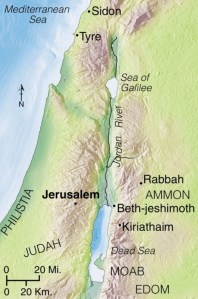
Ammon, Moab, Edom, and Philistia, although once united with Judah against Babylon, had abandoned Judah and rejoiced to see its ruin. But these nations were as sinful as Judah and would also feel the sting of God's judgment.

Ammon, Moab, Edom, and Philistia, although once united with Judah against Babylon, had abandoned Judah and rejoiced to see its ruin. But these nations were as sinful as Judah and would also feel the sting of God’s judgment.

We will start off chapter one by stating that there is much we do not know.  We do not know who the author was or when it was written.  The absence of reference to a Levitical priesthood (as demonstrated in verse 5) along with Job’s longevity (see Job 42:16), however, suggest roughly a time in Genesis after the flood.  We also do not know where, geographically, Job’s home in Uz was either, other than it was in the east (verse 3) and near a desert (verse 19).  It could be related to the northern home of Uz, the grandson of Shem (Genesis 10:22-23), Noah’s son, of whom the historian Josephus wrote in “Antiquities of the Jews” (book 1, chapter 6, paragraph 4), crediting him with the founding of Trachonitis and Damascus.  It could also be the land of Abraham’s nephew Uz (Genesis 22:20-21).  It could even be the land of the Uz the descendant of Seir, who had been related to Esau by marriage (Genesis 36:28).  It could also be the same land spoken of in Jeremiah 25:17-29 and Lamentations 4:21, which would be near or even include Edom to the south and east of the Dead Sea.

There is a lot of speculation also about verses 6-12.  Some say that the “sons of God” in verse 6 were angels.  Others make the perfectly good point that the term “sons of God” is used elsewhere in the scriptures to speak of people who serve the Lord (e.g. Romans 8:14 “For all who are led by the Spirit of God are sons of God”).  Along those lines, it is noteworthy that six times in these six verses, the Tetragrammaton (the Hebrew letters usually transliterated as YHWH or JHVH, which many refer to as Jehovah, rather than Yahweh) are used for God.  This use of the proper covenental name of God would seem to suggest a gathering of worshipers in which Satan asserted himself.

What we do know is that Job was a wealthy man who lived an upright life in the fear of the Lord (verses 1-3),

Messengers tell Job of his losses.

Messengers tell Job of his losses.

even to the point of offering sacrifices to God for his ten children (verse 5).  He seemed to have everything one could desire in life.  Then came the news from messengers, one after another, each telling of the great calamities that had fallen upon Job.  The Sabeans came from the south and killed his oxen and donkeys, and then murdered his servants that were with them (verses 14-15).  Then what we could assume as lightning had struck and killed his sheep and the servants that tended them (verse 16).  Before the second messenger had finished, another came and told Job that the Chaldeans, coming from the north, had taken his camels and killed the servants that were with them as well (verse 17).  The worst blow came again before the third messenger finished delivering his news.  All of his children, having been at the feast at his oldest son’s house had been killed by what must have been a great tornado that destroyed the house (verse 19).

Of Job’s immense grief at all of this loss, we get only a sense, as he tore his robe and shaved his head (signs of mourning) in verse 20.  He then fell upon the ground and worshiped God, rather than cursing him as Satan had hoped.  Verses 21-22 begin the real lesson of this book:

“And he said, ‘Naked I came from my mother’s womb, and naked shall I return. The Lord gave, and the Lord has taken away; blessed be the name of the Lord.’  In all this Job did not sin or charge God with wrong.”

Many have suffered great loss in this world (though few as great as this in such a short time), but who has not known someone who blamed God for their troubles, even those that were really self-inflicted?  How often have we been inclined to do the same?  Any loss, however great, is not the end of eternity.  Not for us, nor for any of the loved ones we may have lost.  Every blessing we have received in this life has come from God (James 1:17), unearned by us, and all of those blessings will be only a memory by the end of this life.  But as James, the Lord’s brother, also wrote in 1:12:

“Blessed is the man who remains steadfast under trial, for when he has stood the test he will receive the crown of life, which God has promised to those who love him.”

But Job’s story is only beginning.  We will take up chapter 2 next Thursday.

Read or listen to audio of ESV version of this selection from this link.

/Bob’s boy

Please “like” us on Facebook at  https://www.facebook.com/bobsboy01

___________________
some images © V. Gilbert & Arlisle F. Beers

Please note: I did not design the reading plan that I am following in my blog.  All of my comments in this blog, however, are solely my responsibility.  When reading ANY commentary, you should ALWAYS refer first to the scripture, which is God’s unchanging and unfailing word. Reading schedules, as well as a link to the site where you can get the reading plan that I’m currently following for yourself can be found on the “Bible Reading Schedules” page of my website at http://graceofourlord.com.  For questions and help, please see the “FAQ” and “Summaries” pages there.

January 2013 Reading Schedule Posted!

A big thank you to all who have read this blog during 2012!  While this blog is certainly not ever going to be the most popular WordPress “hangout,” we did just receive some statistics that are encouraging.  For example, the post on Peter’s rescue in Acts 12 received 652 views in one day. Not what we expected in the first year!  Thank you!

Here is the link to the 2013 reading schedule for January (January 2013 Reading Schedule).  In 2013, this blog will focus on the “Wisdom Literature” with a unique approach to Proverbs, Psalms, Song of Solomon, Ecclesiastes, Job, and as a special was to end 2013 the last week in December, the Book of James (often referred to as the “Proverbs of the New Testament”).  The first two weeks (beginning tomorrow 01/01/2013) we will read the first 9 chapters of Proverbs.  Theses chapters introduce the book, and what we actually know as “proverbs” do not really begin until chapter 10.

Psalm 1, Verse 1 and 2 in Biblia Hebraica Stut...

Psalm 1, Verse 1 and 2 in Biblia Hebraica Stuttgartensia (Photo credit: Wikipedia)

After those two weeks, we will settle into a schedule that adds variety to the five days per week of reading these books.  Each Monday in the first half of the year, we will read 8 verses of the longest chapter in the entire Bible – the 119th Psalm (with other, shorter Psalms included on many of those days).  This is a great Psalm that praises God and His word; and it is very rich in inspiration.  We will take a second look at these verses (and other Psalms) in the second half of the year from a fresh perspective. On Tuesdays, we will be reading from Proverbs with a similar approach.

On Wednesdays, we will be reading what are commonly called “lament” Psalms.  These are tremendously valuable in helping us with learning to call upon the Lord when life becomes very difficult, and even as tragedy and pain come our way.  Thursdays, we will read from the Book of Job, and on Fridays, we will be reading from other Psalms.

We will take a break at the end of June through July, and read through Ecclesiastes and Song of Solomon in their entirety, gaining much value learning about life, service to God, and the relationship of husbands and wives to each other.  Then we will resume the previously outlined schedule.

We are looking forward to what promises to be a very rewarding experience in God’s word in 2013!

/Bob’s boy
___________________
some images © V. Gilbert & Arlisle F. Beers

Please note: I did not design the reading plan that I am following in my blog.  All of my comments in this blog, however, are solely my responsibility.  When reading ANY commentary, you should ALWAYS refer first to the scripture, which is God’s unchanging and unfailing word. Reading schedules, as well as a link to the site where you can get the reading plan that I’m currently following for yourself can be found on the “Bible Reading Schedules” page of my website at http://graceofourlord.com.  For questions and help, please see the “FAQ” and “Summaries” pages there.

Sneak Preview of 2013! \ Week 49 summary posted

What a year it’s been pointing to the cross!  We started this blog in January with a Bible reading plan that caught our interest, and went from the creation in Genesis all the way to the death, burial, and resurrection of our Lord, Jesus the Christ – one chapter a day, five days per week.  As we finish the year with the Scriptures pointing the way to His return and our salvation, we hope you have grown and benefited as much as we have from God’s word this year!

Cross-003But, alas the year is soon ending; and the question of what this blog will be focused on in 2013 must now be answered.  Well, fortunately, we recently figured that out.  A very different reading plan has come to our attention that is just too hard to resist.  As of this writing, the designers of this plan (again, not us) are working on the finishing touches of the schedule – which will be ready by the end of the year.  What we can tell you right now is that next year’s reading schedule for this blog will be focused on what is commonly called “The Wisdom Literature,” or sometimes “The Poetry and Wisdom Books of the Bible!”

More details to come before January, but we are excited about a year of an in-depth look into Psalms, Proverbs, the Song of Solomon, Ecclesiastes, the Book of Job and, as an added bonus, the Book of James!  The latter is not included in the list of “Wisdom books” normally, but it is often called the “Proverbs of the New Testament;” and we think it is a fabulous choice to end the year with in 2013!

So that brings us to the subject of the approaching date of December 21, 2012 and that pesky Mayan calendar.  We were recently treated to a very well-written article on that very subject.  Please enjoy it at the following link in its title – “What does the Bible say about the Mayan Calendar and Doomsday on December 21?”

Summing Up

Each weekend, I am now posting a small PDF of one week of chapter summaries (on the website’s “Summaries” page), current to the beginning of the previous week.  I have posted the summary for Week 49 (December Week 1) of the schedule I am following.  This short PDF document contains condensed comments about Ephesians 2, 3, 4, 5, and 6, with hyperlinks to the ESV version of each chapter for listening or reading, and joins the summaries for other weeks already posted there.

/Bob’s boy
___________________
image © V. Gilbert & Arlisle F. Beers

Please note: I did not design the reading plan that I am following in my blog.  All of my comments in this blog, however, are solely my responsibility.  When reading ANY commentary, you should ALWAYS refer first to the scripture, which is God’s unchanging and unfailing word. Reading schedules, as well as a link to the site where you can get the reading plan that I’m currently following for yourself can be found on the “Bible Reading Schedules” page of my website at http://graceofourlord.com.  For questions and help, please see the “FAQ” and “Summaries” pages there.