Acts 22 – Paul and the Roman Tribune

Paul bound with chains

Paul, having been arrested and beaten, had at the close of chapter 22 convinced the Roman tribune to allow him to speak to the mob.  When he spoke in Hebrew, it settled them down and they listened.  He then gave them a history of himself as a Jew, “educated at the feet of Gamaliel” (a Pharisee and renowned teacher, who was also a member of the Sanhedrin council – see Acts 5:34).  He also recounted his own persecution of Christians and the “Way ” (see previous post here for more information on “the Way”); and then told of his encounter with the Lord in Acts 9:3-8, in which he was blinded.   The re-telling of that event here in verses 6-11 is not contradictory at all, despite what some say.  Those who were with Paul on that road could hear what was said, but were not made to understand.

Paul then turns to Ananias restoring his sight and his subsequent baptism in verses 12-16.  But when he told them of his encounter with the Lord, and how He had told Paul that He was sending him to the Gentiles (verses 17-21), the crowd became wild with anger again.  The tribune ordered him to be flogged in order to find out why they were shouting out against him.  But as he was stretched out, Paul told the tribune that he was a Roman citizen by birth (verses 25-28); and the Roman tribune became fearful (Roman law forbade flogging a Roman citizen without a hearing or a formal condemnation).  So in verse 30, the chapter ends with the tribune having Paul brought before the Sanhedrin, since scourging was not an option.

Read or listen to audio of ESV version of this selection from this link.

/Bob’s boy
___________________
some images © V. Gilbert & Arlisle F. Beers

Please note: I did not design the reading plan that I am following in my blog.  All of my comments in this blog, however, are solely my responsibility.  When reading ANY commentary, you should ALWAYS refer first to the scripture, which is God’s unchanging and unfailing word. Reading schedules, as well as a link to the site where you can get the reading plan that I’m currently following for yourself can be found on the “Bible Reading Schedules” page of my website at http://graceofourlord.com.  For questions and help, please see the “FAQ” and “Summaries” pages there.

Acts 21 – Paul Goes to Jerusalem

We left the book of Acts after chapter 20, as Paul was in Miletus, with his tearful goodbye to the Ephesian elders.  While in that area, Paul wrote the letters to the Corinthians and to the Romans.  Now, as he said in his letter to the latter, he is leaving for Jerusalem.  They sailed past Cos, Rhodes, Patera, Cyprus and landed at Tyre, where they remained for seven days, then on to Ptolemais and finally Caesarea  before setting off on foot to Jerusalem.  While in Caesarea, they stayed at the house of Philip, who Luke says was “one of the seven.”  Most likely he means that he was one of the seven chosen to serve in Acts 6:1-6, and was the same Philip who converted the Ethiopian eunuch.   And after that event, he did end up in Caesarea (Acts 8:40).

Agabus (the prophet who predicted the famine in Acts 11:2-28) came from Judea to tell how the Jews at Jerusalem will bind and deliver Paul into the hands of the Gentiles (verses 10-14).  Luke and the others present tried to persuade Paul not to go, but he told them that he was not only ready for prison, but even to die for the Lord Jesus.  Notice though, that the words from the prophet were not quoted in these verses as a warning to prevent him from going – but as a statement of fact (verse 11); and Luke and the others finally said “Let the will of the Lord be done.”

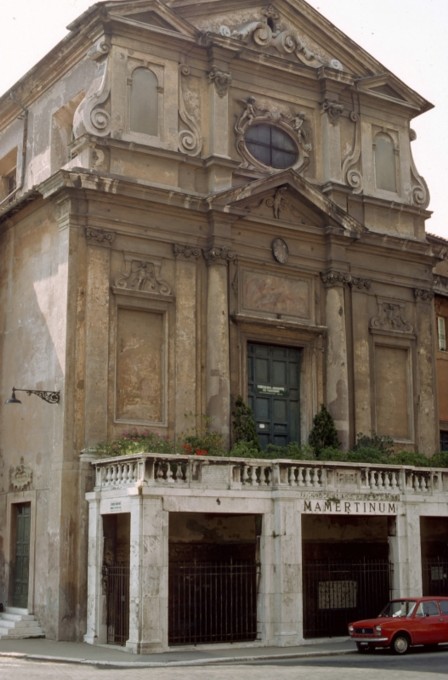
Mamertine Prison, Rome, Italy. Carcere Mamertino according to tradition was the jail where St Peter and St Paul was imprisoned. It consists of two levels and was the most horrible part of the ancient state prison located in the caves under the Capitoline Hill. Numerous illustrious enemies of Rome died here. The higher part of the prison was built in the 2nd century BC and was named Mamertino.

After arriving in Jerusalem, Paul went to see James and told him and the elders about his travels and the many Gentile conversions, for which they glorified God.  They then asked Paul to demonstrate that he was not preaching that Jews had to become like Gentiles and give up all of their customs in order to be a Christian, as many were falsely reporting.  So Paul participated with four men under a vow in a purification ritual.  This event is the subject of much confusion and controversy.  But it does not have to be.  Paul never preached that Jews had to give up their entire way of life or never participate in any ritual or feast (remember Romans 14 and 15), nor that they should not circumcise their young.  Remember that he circumcised Timothy to avoid offending the Jews they were going to visit in Acts 16:3.

But still Paul was arrested, having been dragged from the temple first and beaten by a mob that had gone wild with accusations and fervor.   Until Paul spoke Greek to him, the tribune that arrested him was under the impression that he was an Egyptian revolutionary (verse 38).  The event he mentions in that verse was written about by the historian, Josephus.  At Paul’s urging, the tribune allows him to speak to the mob; and he does so in Hebrew, as the chapter closes.

Read or listen to audio of ESV version of this selection from this link.

/Bob’s boy
___________________
some images © V. Gilbert & Arlisle F. Beers

Please note: I did not design the reading plan that I am following in my blog.  All of my comments in this blog, however, are solely my responsibility.  When reading ANY commentary, you should ALWAYS refer first to the scripture, which is God’s unchanging and unfailing word. Reading schedules, as well as a link to the site where you can get the reading plan that I’m currently following for yourself can be found on the “Bible Reading Schedules” page of my website at http://graceofourlord.com.  For questions and help, please see the “FAQ” and “Summaries” pages there.

Acts 20 – Paul Speaks to the Ephesian Elders

A riot in Ephesus sent Paul to Troas, then through Macedonia to the region of Achaia. In Achaia he went to Corinth to deal with problems there. Paul had planned to sail from Corinth straight to Antioch in Syria, but a plot against his life was discovered. So he retraced his steps through Macedonia.

After the riot in Ephesus had passed, Paul said his farewells and went to Macedonia, then to Greece where he spent three months until a plot against him by the Jews was discovered.  So he headed back to Macedonia accompanied by others, including Timothy, Aristarchus and Gaius (two victims of the riot from Acts 19:29), all of whom were sent on to Troas.  It is in verse 5 that Luke again begins speaking in the first person plural, indicating he accompanied Paul as they sailed from Philippi to meet the others at Troas.  The seaport of Troas was located at near the site of the ancient city of Troy, and was rebuilt by Alexander the Great’s successors and renamed Alexandria Troas.

It is there that Paul broke bread with them on the first day of the week and, preaching to midnight, a young man named Eutychus fell asleep and fell from a third-story window.  But Paul took him in his arms, and in verse 12 “they took the youth away alive, and were not a little comforted.”  Indeed, excitement over this resurrection would no doubt have contributed to their staying up until daybreak (verse 11).  Then, Luke says that he and the others set sail for Assos, while Paul went by land and met them there.  From there, they sailed to To Chios, Samos and Miletus, as Luke says that Paul had decided not to stop at Ephesus because he wanted to get to Jerusalem by Pentecost.

But while at Miletus, Paul called the elders at Ephesus to come to him, a journey of perhaps 30 miles or so.  Verses 18-37 end with a tearful goodbye, as he tells them that he knows he will never see their faces again.  He tells them that he is going to Jerusalem and that he does not know what will happen to him “except that the Holy Spirit testifies to me in every city that imprisonment and afflictions await me.”  He recounts his faithfulness to preaching and teaching the word in the three years that he had spent with them, declaring that he was “innocent of the blood of all.”

Ruins at Miletus, Turkey. Paul visited here during his Third Missionary Journey, Acts 20:15-17.

These very emotional parting words have an important point besides the obvious.  In his letter to the Thessalonians, Paul had stressed the importance of the local church members having respect for those who had been appointed as elders of their congregation (1 Thessalonians 5:12-13).  Here in Acts 20, he is making it clear to these elders – and to all elders of the church everywhere – that they have the responsibility to shepherd the flock among them.  Fierce wolves, he says,  will come in “not sparing the flock,” and that “from among your own selves will arise men speaking twisted things, to draw away the disciples after them.”  The elders of the local church everywhere have an awesome responsibility, and must always be on guard for the souls of those in their midst.  It was true then, as it is now.

In the middle of all this, Paul quotes to these elders one of Jesus’ most famous sayings in verse 35 “It is more blessed to give than to receive.”  The words are actually not found in any of the gospels.  But it is good to remember the words that John wrote in John 21:25.  Jesus did and said so much more in His time on earth than what was written in the gospels.  It is appropriate that some words the Lord used in His teachings are reported to us by Paul – who wrote so much of the Bible!

Side Note:  This article at Ferrell’s Travel Blog has good info on, and a shot of the ruins at, Miletus.

Read or listen to audio of ESV version of this selection from this link.

/Bob’s boy
___________________
some images © V. Gilbert & Arlisle F. Beers

Please note: I did not design the reading plan that I am following in my blog.  All of my comments in this blog, however, are solely my responsibility.  When reading ANY commentary, you should ALWAYS refer first to the scripture, which is God’s unchanging and unfailing word. Reading schedules, as well as a link to the site where you can get the reading plan that I’m currently following for yourself can be found on the “Bible Reading Schedules” page of my website at http://graceofourlord.com.  For questions and help, please see the “FAQ” and “Summaries” pages there.

Acts 19 – A Riot at Ephesus

from Ephesus

Priscilla and Aquilla’s encounter with Apollos in Acts 18:24-28 would certainly appear to be providential, as the man knew the scriptures concerning the Christ well, taught many, and spoke eloquently.  But it would seem that all of the good news of Jesus had not yet reached him, so the two set him on the right course.  Now becoming a powerful worker for the Lord, Apollos had gone to Corinth.  Paul came to Ephesus and found some disciples that had likely been taught by Apollos previously.  They, like Apollos, only knew of the baptism of John.  After being baptized, Paul layed his hands on them and they received the Holy Spirit.

Paul taught in the synagogue there for three months (verse 8), but some were not persuaded and some unbelievers began “speaking evil of the Way before the congregation.”  “The Way” was a name used for Christianity during those times, as by Luke several times in Acts (Acts 19:9,23;22:4;24:14,22) and in secular history as well (such as written by Josephus, for example).

So Paul removed himself and took the disciples with him, teaching “in the hall of Tyrannus” daily (verse 9).  This continued for two years (verse 10), and the following Scriptures speak of the great miracles God worked there through Paul in verses 11-17, including an account in 13-16 of the sons of the Jewish high priest, Sceva, being overpowered by an evil spirit they tried to cast out themselves.   Note the key in verse 13 where they said “I adjure you by the Jesus whom Paul proclaims.”  This was not only a lack of authority, but of faith – and it ends badly for them.  But the miracles the Lord had worked had a mighty effect on the people listening to the word that Paul and the disciples were preaching.

from Ephesus

Paul stayed for a while but sent Timothy and Erastus to Macedonia, resolving to go there as well as Achaia, where Apollos had gone (Acts 18:27), as well as Rome (verse 21).  But then things turned ugly in Ephesus.  A silversmith named Demetrius made silver shrines to the Greek “goddess” Artemis (her Roman counterpart in mythology was “Diana”).  Paul’s preaching against idols was costing Demetrius money. He gathered similar tradesmen and merchants, and provoked a riot.

Mob violence and confusion ruled, as the disturbance grew large enough that most involved didn’t even know what it was about.  They dragged Paul’s companions, Gaius and Aristarchus, into the theater.  Paul wanted to go in, but the disciples (and some Asiarchs – high-ranking officials of the Roman province) prevented him.  It was the Ephesian town clerk that finally was able to disperse the crowds, pointing out that they were in danger of being charged with rioting by Roman authorities.

Side note: A picture of the ruins at Ephesus is in this article at Ferrell’s Travel Blog; and several great pictures, including what is left of the temple of Artemis, as well as the theater involved in the riot are in this article at BiblePlaces.com.

Read or listen to audio of ESV version of this selection from this link.

/Bob’s boy
___________________
some images © V. Gilbert & Arlisle F. Beers

Please note: I did not design the reading plan that I am following in my blog.  All of my comments in this blog, however, are solely my responsibility.  When reading ANY commentary, you should ALWAYS refer first to the scripture, which is God’s unchanging and unfailing word. Reading schedules, as well as a link to the site where you can get the reading plan that I’m currently following for yourself can be found on the “Bible Reading Schedules” page of my website at http://graceofourlord.com.  For questions and help, please see the “FAQ” and “Summaries” pages there.

Acts 18 – Paul In Corinth

Paul left Athens, and went to Corinth, which was 46 miles away.  He met with Aquila and Priscilla there, who had come from Italy after the Roman emperor Claudius had ordered all Jews to leave Roman (we know this to have been issued in 49 AD).  At that time, they made no distinction between Jews and Christians.  Aquila and Priscilla were tent makers by trade, like Paul, and he stayed with them.  They became faithful friends, and he mentions them again a few times in Scripture (Romans 16:3-5, for example).  As always, he reasoned in the synagogue every Sabbath, preaching Jesus as the Christ.  But when they opposed him, he went to the home of Titius Justis, about whom we know nothing.  Crispus, the ruler of the synagogue, was one of the Corinthians that we know Paul baptized himself (1 Corinthians 1:14).

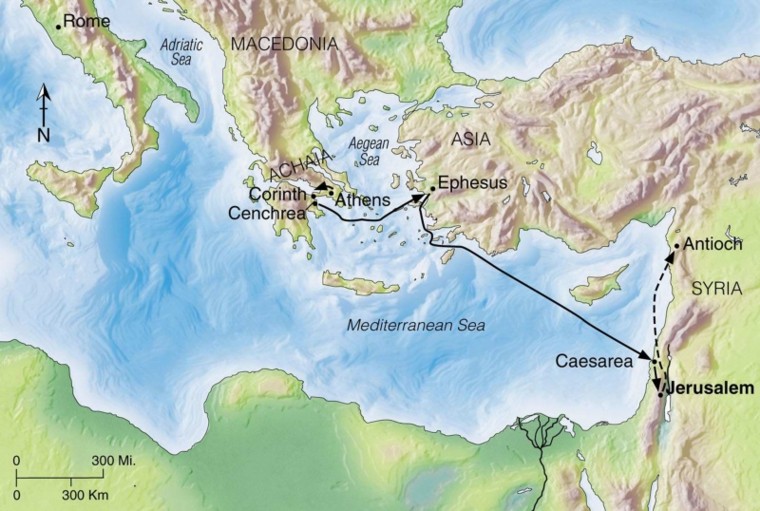
Paul left Athens and traveled on to Corinth, one of the greatest commercial centers of the empire, located on a narrow neck of land offering direct passage between the Aegean and Adriatic seas. When Paul left from the port of Corinth at Cenchrea, he visited Ephesus. He then traveled to Caesarea, from where he went on to Jerusalem to report on his trip before returning to Antioch.

The Lord spoke to Paul in a vision, telling him to keep teaching, and that no harm would come to him there.  So he remained for a year and a half (verse 11).  The proconsul was the chief judicial officer.  In this case, it was Gallio (verses 12-14) that held that position when the Jewish leaders there, in a united assault, had Paul brought before the tribunal.  We know from fragments of a letter from Claudius (the Delphi Inscription, found in 1905 by a French expedition) that he began this office in 51 AD.  He was a brother of the philosopher, Seneca, who was an advisor to Nero. Born as “Marcus Annaeus Novatus”, he took the full name “Lucius Junius Gallio Annaeus,” after the rich man who adopted him.But before Paul could defend himself, Gallio ruled that this was a religious matter between the Jews and ran them out of the tribunal.

Sosthenes, who was beaten in verse 17, may have succeeded Crispus after he became a Christian.   Sosthenes may have become a Christian himself, and could be the same one mentioned by Paul in his first letter to the Corinthians (1 Corinthians 1:1), but we do not know for sure.  At Corinth’s eastern port of Cenchrea, Paul had cut his hair at the completion of a vow (likely a Nazirite vow, as in Numbers 6:2).    It is speculated, that Paul would have kept some of his observances of ceremonial law, which would not be inappropriate at all.  He would not, however, bind such on others.

Paul then set sail for Syria, taking Priscilla and Aquila with him.  Stopping to establish the church at Ephesus, he left Priscilla and Aquila there, promising to return “if God wills.”   He then set sail to Caesarea, traveled to report to the church in Jerusalem and up to Antioch of Syria, ending his second missionary journey in verse 22.  Verse 23 then begins Paul’s third missionary journey, going up though Galatia and Phyrgia, “strengthening all the disciples” at the churches he had begun.

Paul’s third journey began in Acts 18:23. He hurried north, then west, returning to many of the cities he had previously visited. This time, however, he stayed on a more direct westward route toward Ephesus.

Meanwhile, a Jew named Apollos came to Ephesus from Alexandria.  He was a learned and eloquent man, well-versed in the Old Testament.  Luke says that “he spoke and taught accurately the things concerning Jesus, though he knew only the baptism of John,” meaning that he taught accurately what he knew, but Aquila and Priscilla filled in for him, teaching him “the way of God more accurately.”  It is likely that Aquila baptized him into Christ.  Wishing to go into Achaia, he was encouraged by the brothers, and became a powerful speaker of the gospel.

Side note: A modern photo of the port of Cenchrea can be found in this article at Ferrell’s Travel Blog.

Read or listen to audio of ESV version of this selection from this link.

/Bob’s boy
___________________
some images © V. Gilbert & Arlisle F. Beers

Please note: I did not design the reading plan that I am following in my blog.  All of my comments in this blog, however, are solely my responsibility.  When reading ANY commentary, you should ALWAYS refer first to the scripture, which is God’s unchanging and unfailing word. Reading schedules, as well as a link to the site where you can get the reading plan that I’m currently following for yourself can be found on the “Bible Reading Schedules” page of my website at http://graceofourlord.com.  For questions and help, please see the “FAQ” and “Summaries” pages there.

Acts 17 – Paul Addresses the Areopagus

Areopagus from the Acropolis (Athens)

Areopagus from the Acropolis (Athens) (Photo credit: Wikipedia)

Luke has now dropped the use of the first person plural in the text, suggesting that he may have remained in Philippi as Paul and Silas pass through Amphipolis and Apollonia to Thessalonica.  Neither the reference to “three sabbath days” in verse 2, nor the fact that they left the city after only 9 verses of this chapter should  be construed as the an indication of the length of their stay in Thessalonica.  Indications from 1 Thessalonians 2:9 and Philippians 4:16, for example, are that their ministry there was much longer.  The Jewish religious leaders, once again, became jealous and stirred up a mob until they attacked the house of  a believer – hoping to lay hands on Paul, no doubt.  Not finding them, they dragged the man (Jason) and some other believers before authorities, falsely claiming they were touting Jesus as an earthly king and a threat to Caesar.

In verse 10, the brothers sent Paul and Silas away, but it should be noted that their mission there was successful, as some of the Jews had been converted, and “a great many of the devout Greeks and not a few of the leading women.”  This explains the jealousy of the Jewish religious leaders there.   They arrived in Berea, and had even more success (verses 10-12), but the Jews in Thessalonica learned of Paul teaching there, and came to stir crowds again.  Paul was sent off by sea to Athens, but Silas and Timothy remained in Berea.  After arriving in Athens, Paul sent word back with those who had accompanied him for Silas and Timothy to join him .
Athens – Acropolis

Finding himself in this great pagan capital, Paul saw idol after idol.  He “reasoned” in the synagogue of course, but verse 17 says that he did so also in the marketplace every day.  Speaking with men of the two prominent philosophies of the day, Stoicism and Epicurean-ism, attracted great attention, and they brought him to the authorities at the Areopagus – this time with interest and curiosity in this speaker of “foreign divinity,” rather than hostility.  The Areopagus held a body of men with civil. moral, and religious authority over the city. Paul would have addressed them either on the “hill of Ares” (Mars Hill, where a temple to their “god” of war had been built in ancient times), or southwest of the Acropolis in the northwest corner of the Agora.  There, this body held meetings in the Royal Colonnade.

Paul preached to this body in verses 22-30 with one of his most eloquent speeches that we have recorded.  He opens in verses 22-24 with:

“Men of Athens, I perceive that in every way you are very religious. For as I passed along and observed the objects of your worship, I found also an altar with this inscription, ‘To the unknown god.’ What therefore you worship as unknown, this I proclaim to you…”

The translation of the word “religious” is too generous, but the word used falls a bit short of “superstitious,” as Paul was trying to evangelize, not demean.  He goes on to say that the God, who made the world and everything in it, is not contained in temples made by men – that He made, from one man, every nation of mankind “that they should seek God, and perhaps feel their way toward him and find him. Yet he is actually not far from each one of us…”  He told these idol worshipers that God should not be thought of as an image of stone or precious metals formed by the imagination of man.    He concludes with what we would expect – an excellent message of the gospel:

Engraved plaque containing Apostle Paul's serm...

Engraved plaque containing Apostle Paul’s sermon, at the Areopagus, Athens, Greece. (Photo credit: Wikipedia)

“The times of ignorance God overlooked, but know he commands all people everywhere to repent, because he has fixed a day on which he will judge the world in righteousness by a man whom he has appointed; and of this he has given assurance to all by raising him from the dead.”

Some mocked him at the reference to the resurrection, but others wanted to hear more, some being converted (verse 34) including Dionysius the Areopagite, one of the judges of the Areopagus.  That being the case, even Paul’s visit to this pagan city was a success!

 Side note: Photos, and article of “The Via Egnatia in Thessalonica” are in this article at Ferrell’s Travel Blog.  Also, great pictures and history of Amphipolis in this article from Todd Bolen’s BiblePlaces.org.

Read or listen to audio of ESV version of this selection from this link.

/Bob’s boy
___________________
some images © V. Gilbert & Arlisle F. Beers

Please note: I did not design the reading plan that I am following in my blog.  All of my comments in this blog, however, are solely my responsibility.  When reading ANY commentary, you should ALWAYS refer first to the scripture, which is God’s unchanging and unfailing word. Reading schedules, as well as a link to the site where you can get the reading plan that I’m currently following for yourself can be found on the “Bible Reading Schedules” page of my website at http://graceofourlord.com.  For questions and help, please see the “FAQ” and “Summaries” pages there.

Acts 16 – The Philippian Jailer Converted

After arriving again at Lystra, Paul wanted a disciple there named Timothy to come with him.  Some wonder why Paul chose to circumcise Timothy, but clearly states in Galatians 2:3 that Titus was not circumcised.   The answer is that Timothy, before becoming a Christian, was raised by a Jewish mother (though his father was Greek).  So, as verse 3 says, it was because of the Jews in those places.  Having an uncircumcised Jew with him could pose a distraction by having some focus on that fact rather than the important teaching of Jesus Christ.

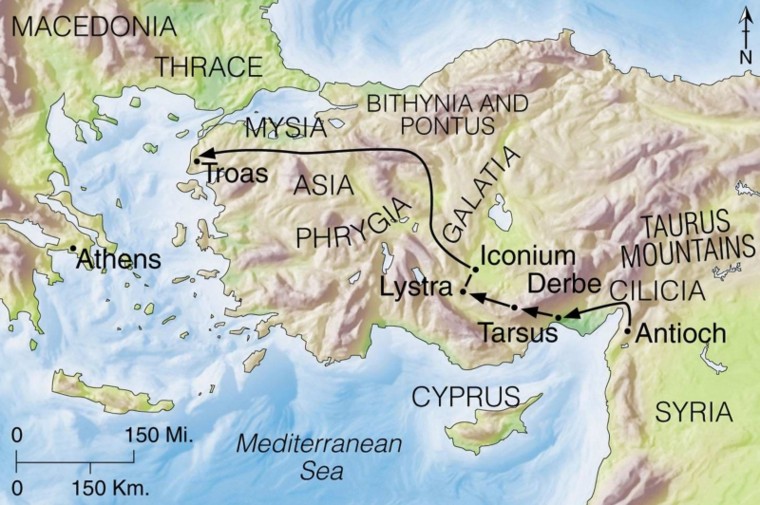
Paul and Silas set out on a second missionary journey to visit the cities Paul had preached in earlier. This time they set out by land rather than sea, traveling the Roman road through Cilicia and the Cilician Gatesa gorge through the Taurus Mountains, then northwest toward Derbe, Lystra, and Iconium. The Spirit told them not to go into Asia, so they turned northward toward Bithynia. Again the Spirit said no, so they turned west through Mysia to the harbor city of Troas.

As they went along, the brethren at various places were encouraged by the relating of the events of the Jerusalem Conference.  In verse 6, as they passed through the region of Phrygia and Galatia, it says that they had been forbidden by the Holy Spirit to preach the word in Asia.  This is not a reference to the continent of Asia, but to a Roman province in what was called Asia Minor – Ephesus being the capital.  For whatever reason, the people there were not ready to receive the word yet.  The same was true of Bithynia in verse 7, as they went through Mysia to Troas.  Then Paul had a vision of a man telling him to come to Macedonia to help them.

In verse 10, Luke speaks for the first time in the first person plural – “we sought to go on into Macedonia, concluding that God had called us to preach the gospel to them”  – from which we can conclude that Luke had been preaching the gospel for a while already, as he includes himself with Paul, Silas and Timothy.  So they set sail to Philippi, a leading city in Macedonia.  There was no synagogue there, so on the Sabbath they found women gathered for prayer by the river.  One was “Lydia, from the city of Thyatira, a seller of purple goods.”  These goods would have been made from an expensive dye made from the murex shell.  Note that Luke says that God opened her heart to pay attention to what Paul said, and she was baptized.

Traditional site of Paul’s prison at Philippi

After Paul drove the demon from the slave girl in verses 16-18, her owners drug Paul and Silas before the magistrates with false accusations.  In verses 20-22, they were beaten with rods and put in jail.  Paul and Silas prayed and sang hymns while the other prisoners listened until an earthquake shook the prison, opening the doors and freeing the bonds.  The jailer, readied to kill himself as he supposed they had escaped.  But Paul stopped him, and he and his family were all baptized. The magistrates sent the police the next day, telling the jailer to let them go, but Paul declared his Roman citizenship, and practically demanded an apology  – which he ended up getting, as the magistrates were then afraid.   They were asked to leave the city, though, so they visited and encouraged Lydia and the brothers before leaving.

Side note: This article at Ferrell’s Travel Blog has a unique photo and a bit of information about Philippi.

Read or listen to audio of ESV version of this selection from this link.

/Bob’s boy
___________________
some images © V. Gilbert & Arlisle F. Beers

Please note: I did not design the reading plan that I am following in my blog.  All of my comments in this blog, however, are solely my responsibility.  When reading ANY commentary, you should ALWAYS refer first to the scripture, which is God’s unchanging and unfailing word. Reading schedules, as well as a link to the site where you can get the reading plan that I’m currently following for yourself can be found on the “Bible Reading Schedules” page of my website at http://graceofourlord.com.  For questions and help, please see the “FAQ” and “Summaries” pages there.

Acts 14 – Paul and Barnabas at Iconium and Lystra

At the Jewish synagogue in Iconium, Paul and Barnabas preached in such a way that a great number of Jews and Greeks believed.  But the unbelieving Jews stirred up the Gentiles and “poisoned their minds” against the believing brothers and sisters.  They stayed for a long time, performing many signs and wonders.  But the divided city resulted in a conspiracy of both Jews and Gentiles to persecute and to stone Paul and Barnabas.  When they learned of this, they fled the city.

Paul and Barnabas, thrown out of Antioch in Pisidia, descended the mountains, going east into Lycaonia. They went first to Iconium, a commercial center on the road between Asia and Syria. After preaching there, they had to flee to Lystra, 25 miles south. Paul was stoned in Lystra, but he and Barnabas traveled the 50 miles to Derbe, a border town. The pair then boldly retraced their steps.

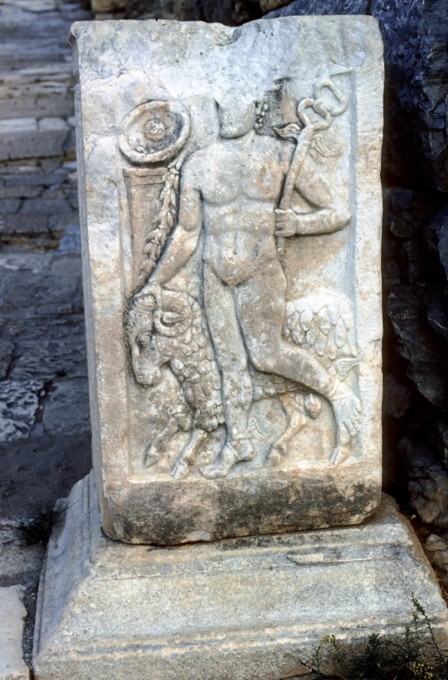
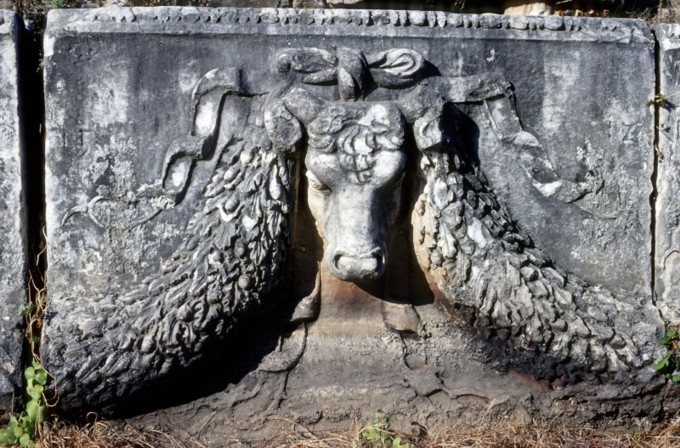
One of the places they went to from there was Lystra.  There Paul healed a man who was crippled from birth.  When he began walking, many people started calling Paul and Barnabas gods, referring to Paul as Hermes, and Barnabas as Zeus; and the crowds wanted to offer sacrifices.  When they saw this, they were tremendously distressed and, assuring the people that they were just men, preached to these polytheists about the one true God and how he is evidenced in all the things of this world.

But Jews came from Antioch and Iconium, and they turned the minds of the crowds.  They stoned Paul and dragged him from the city, leaving him for dead.  In verse 20, the disciples gathered around him and he rose up and went into the city.  The Scripture does not tell us that this was a miracle, or even what Paul’s actual condition had been.  Enough to say that the Spirit was with him, and he was not deterred.  The next day, he and Barnabas went to Derbe.  After preaching and making many new disciples there, they returned to Lystra and Iconium, and to Antioch.  They encouraged and strengthened the disciples in those places and appointed elders for them in every church.

They went back to speak the word in Perga, and then to Attalia.  From there, they sailed back to Antioch of Syria, where they had started their journey, telling all the brethren about the new “door of faith”  that had been opened to the Gentiles.

Side note: This article from Ferrell’s Travel Blog contains interesting information about the connection that the people in Lystra made to Hermes and Zeus.  This second article there is interesting in light of the sacrificial element.

Read or listen to audio of ESV version of this selection from this link.

/Bob’s boy
___________________
some images © V. Gilbert & Arlisle F. Beers

Please note: I did not design the reading plan that I am following in my blog.  All of my comments in this blog, however, are solely my responsibility.  When reading ANY commentary, you should ALWAYS refer first to the scripture, which is God’s unchanging and unfailing word. Reading schedules, as well as a link to the site where you can get the reading plan that I’m currently following for yourself can be found on the “Bible Reading Schedules” page of my website at http://graceofourlord.com.  For questions and help, please see the “FAQ” and “Summaries” pages there.

Acts 13 – Barnabas and Saul Sent Off

It is in verse 9 of this chapter that the Bible first mentions that Saul was also called Paul.  The inference from that statement is that he had been called by that name, at least to some extent, for possibly a while.  Some have theorized that the name change was by choice – in order to be more identifiable to the gentiles to which Paul was called to proclaim the word of God.  But that speculation ignores the fact that others were known by different names (Peter, for example, was known also as Simon and Cephas).

Paul, Barnabas, and John Mark left Paphos and landed at Perga in the humid region of Pamphylia, a narrow strip of land between the sea and the Taurus Mountains. John Mark left them in Perga, but Paul and Barnabas traveled up the steep road into the higher elevation of Pisidia in Galatia. When the Jews rejected his message, Paul preached to Gentiles, and the Jews drove Paul and Barnabas out of the Pisidian city of Antioch.

Barnabas and Saul were sent out by the Holy Spirit from the church at Antioch.  This journey of Paul’s is thought to have lasted about a year and a half.  They traveled down first to Seleucia, then set sail  to Cyprus  where Barnabas was from, taking John Mark with them.  They started proclaiming the word of God in the synagogue at Salamis.  Then they went 90 miles to Paphos, the seat of Roman government on Cyprus.  The proconsul was the highest ranking official in a Roman province.  This one summoned Saul and Barnabas, wishing to hear the word of God.  But a magician, a false prophet who was with him, was working against them, trying to turn the proconsul away.  Paul, filled with the Holy Spirit, rebuked the man and caused him to lose his sight.  The proconsul believed after seeing this.

They then set sail again to Perga, where John Mark left them to return to Jerusalem.  Paul and Barnabas continued on to Antioch of Pisidia.  This is a long way from the Antioch that they started from – in Syria.  This Galatian city was one of 16 cities that the Syrian king Seleucus had named for his father Antiochus.  In verse 16-41, Paul delivers a sermon that begins with the wilderness wanderings, and ties the Scriptures to Jesus, his death, and his resurrection.  They were received well and encouraged, and they begged them to come back on the next Sabbath to preach again.  But the Jews saw the great crowds and were jealous.  They started contradicting them and reviling Paul.  Paul answered  as follows:

“It was necessary that the word of God be spoken first to you. Since you thrust it aside and judge yourselves unworthy of eternal life, behold, we are turning to the Gentiles. For so the Lord has commanded us, saying,
I have made you a light for the Gentiles,
that you may bring salvation to the ends of the earth‘”

When the gentiles heard this, They were rejoicing and glorifying the Lord.  And many became believers.  But the Jews stirred up persecution against them, and they were driven out,  From there they went to Iconium, rejoicing over the success with the Gentiles, and filled with the Holy Spirit.

Side note: This article at Ferrell’s Travel Blog is about Pisidian Antioch and contains a modern photo of an ancient street there.  Here is another with good pictures of the ruins there.

Read or listen to audio of ESV version of this selection from this link.

/Bob’s boy
___________________
some images © V. Gilbert & Arlisle F. Beers

Please note: I did not design the reading plan that I am following in my blog.  All of my comments in this blog, however, are solely my responsibility.  When reading ANY commentary, you should ALWAYS refer first to the scripture, which is God’s unchanging and unfailing word. Reading schedules, as well as a link to the site where you can get the reading plan that I’m currently following for yourself can be found on the “Bible Reading Schedules” page of my website at http://graceofourlord.com.  For questions and help, please see the “FAQ” and “Summaries” pages there.

Acts 12 – Peter Is Rescued

Verse one begins with “About that time Herod the king laid violent hands on some who belonged to the church.”  The words “about that time” obviously refer to a time period in which the events of the end of chapter 11 occurred.  Secular history accurately dates the death of this Herod (Herod Agrippa I – grandson of “Herod the Great”) in 44 A.D.  Verse 2 continues in the KJV with:

“And he killed James the brother of John with the sword…”

When Jesus was transfigured on a mountain. Moses and Elijah join him. Jesus had brought his closest 3 disciples with him – Peter, James and John –Matthew 17: 1-13; Mark 9: 1-13; Luke 9: 28-36.

Burton Coffman wrote concerning this verse: Only seven words in the Greek, translated by eleven in English, recount the martyrdom of the first apostle; and such restraint by the sacred historian shows how different are the words of inspiration from those of ordinary writers.

Indeed.  If one was simply writing a story rather than the word of God, one would certainly have more to say about the death of one of Jesus’ “inner circle,” James the son of Zebedee, than these few words.  The rest of the verse states that “…when he saw that it pleased the Jews, he proceeded to arrest Peter also.”  The Jewish religious leaders – certainly much of the Sanhedrin – would have been pleased to have gotten rid of one the twelve men who were so instrumental in proclaiming that Jesus was the risen Lord.  This was during the Feast of Unleavened Bread; and Herod intended to bring Peter out after Passover and undoubtedly do the same with him as he had done with John’s brother.

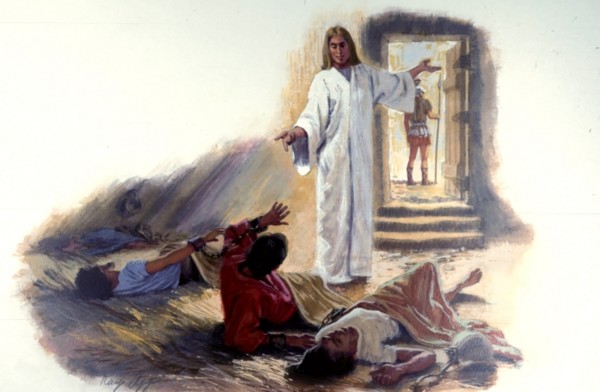
But on the night before Herod was to bring him out, an angel of the Lord came to Peter as he slept between two soldiers, made the chains fall off of him, led him past two guards and compelled the iron gate to open on its own, as they walked through.  And with that, the angel left.  Up to this point, Peter had been thinking that he was having another vision.  But in verse 11, he realizes that the Lord had sent his angel to rescue him “from the hand of Herod and from all that the Jewish people were expecting.”

Although sixteen soldiers guarded Peter when he was thrown into prison, an angel came personally to rescue Peter (Acts 12).

Peter heads to the house of Mary, the mother of John Mark (verse 12).  The consensus of scholars is that this may be because of the personal attachment Peter had for John Mark, who would write the gospel of Mark (of which writing there are convincing arguments that Peter stood behind).  At any rate, many of the church are gathered there.  At first, none of them believed the servant girl that it was Peter at the gate.  When they opened it, he cautioned them to be silent, then told them how he had been freed from prison.  As he left, he told them to tell James (this James would be the Lord’s brother) and the brothers what had happened.

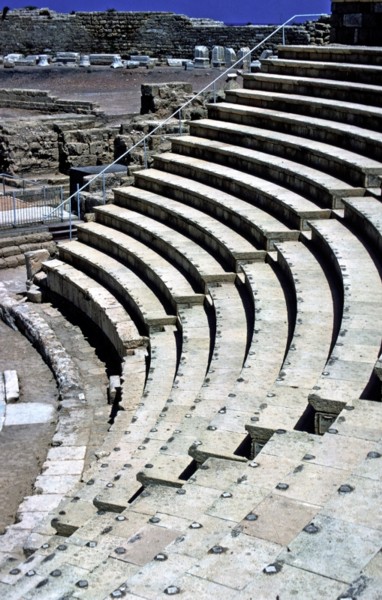
The first Herod, called The Great, wanted to honor his patron, Augustus Caesar, with a fine harbor. He spent twelve years building a magnificent harbor and naming it Caesarea. Ruins of the Roman theater, built before the time of Jesus.

When it was discovered that Peter was gone, Herod had the sentries executed.  The he went to Caesarea, where verses 20-23 describe the events of his death, relating that an angel of the Lord struck him down and in the end “he was eaten by worms.”  Some suggest that both he and his grandfather died of Fournier’s gangrene, but the Scripture gives no other information that would verify this.  His vanity and acceptance of the praise proclaiming him to be a god led to his death.  Another purpose was served though, as he had already proved to be a dangerous enemy to the apostles.

Side note: In this article by Todd Bolen of BiblePlaces.com, the author makes some very convincing arguments for the actual location of Herod Agrippa, when he was struck down, to have been at the city amphitheater, rather than the theater itself (where the historian Josephus  wrote that it occurred).  He also makes some interesting observations about the ruler and his predecessor’s and the practice of the emperor being honored as a god.  Very interesting reading.

Read or listen to audio of ESV version of this selection from this link.

/Bob’s boy
___________________
some images © V. Gilbert & Arlisle F. Beers

Please note: I did not design the reading plan that I am following in my blog.  All of my comments in this blog, however, are solely my responsibility.  When reading ANY commentary, you should ALWAYS refer first to the scripture, which is God’s unchanging and unfailing word. Reading schedules, as well as a link to the site where you can get the reading plan that I’m currently following for yourself can be found on the “Bible Reading Schedules” page of my website at http://graceofourlord.com.  For questions and help, please see the “FAQ” and “Summaries” pages there.