Acts 14 – Paul and Barnabas at Iconium and Lystra

At the Jewish synagogue in Iconium, Paul and Barnabas preached in such a way that a great number of Jews and Greeks believed.  But the unbelieving Jews stirred up the Gentiles and “poisoned their minds” against the believing brothers and sisters.  They stayed for a long time, performing many signs and wonders.  But the divided city resulted in a conspiracy of both Jews and Gentiles to persecute and to stone Paul and Barnabas.  When they learned of this, they fled the city.

Paul and Barnabas, thrown out of Antioch in Pisidia, descended the mountains, going east into Lycaonia. They went first to Iconium, a commercial center on the road between Asia and Syria. After preaching there, they had to flee to Lystra, 25 miles south. Paul was stoned in Lystra, but he and Barnabas traveled the 50 miles to Derbe, a border town. The pair then boldly retraced their steps.

One of the places they went to from there was Lystra.  There Paul healed a man who was crippled from birth.  When he began walking, many people started calling Paul and Barnabas gods, referring to Paul as Hermes, and Barnabas as Zeus; and the crowds wanted to offer sacrifices.  When they saw this, they were tremendously distressed and, assuring the people that they were just men, preached to these polytheists about the one true God and how he is evidenced in all the things of this world.

But Jews came from Antioch and Iconium, and they turned the minds of the crowds.  They stoned Paul and dragged him from the city, leaving him for dead.  In verse 20, the disciples gathered around him and he rose up and went into the city.  The Scripture does not tell us that this was a miracle, or even what Paul’s actual condition had been.  Enough to say that the Spirit was with him, and he was not deterred.  The next day, he and Barnabas went to Derbe.  After preaching and making many new disciples there, they returned to Lystra and Iconium, and to Antioch.  They encouraged and strengthened the disciples in those places and appointed elders for them in every church.

They went back to speak the word in Perga, and then to Attalia.  From there, they sailed back to Antioch of Syria, where they had started their journey, telling all the brethren about the new “door of faith”  that had been opened to the Gentiles.

Side note: This article from Ferrell’s Travel Blog contains interesting information about the connection that the people in Lystra made to Hermes and Zeus.  This second article there is interesting in light of the sacrificial element.

Read or listen to audio of ESV version of this selection from this link.

/Bob’s boy
___________________
some images © V. Gilbert & Arlisle F. Beers

Please note: I did not design the reading plan that I am following in my blog.  All of my comments in this blog, however, are solely my responsibility.  When reading ANY commentary, you should ALWAYS refer first to the scripture, which is God’s unchanging and unfailing word. Reading schedules, as well as a link to the site where you can get the reading plan that I’m currently following for yourself can be found on the “Bible Reading Schedules” page of my website at http://graceofourlord.com.  For questions and help, please see the “FAQ” and “Summaries” pages there.

Paul’s 2nd Journey \ Week 40 summary posted

Lystra area, Turkey. Paul visited on his First and Second Missionary Journeys.

This week, we open with Paul and Barnabas wrapping up Paul’s first missionary journey with an interesting visit to Lystra, followed by the historic Jerusalem Conference in Acts 15.  We will then start reading of Paul beginning his 2nd missionary journey; and break for a couple of chapters of his letter to the Galatians before coming back to it, as we learn that Luke is himself preaching the gospel with Paul and Silas.

Side note: This article at Ferrell’s Travel Blog is an interesting story of the method used to identify the site of Lystra, along with a picture of the stone inscription now housed at the archaeological museum in Konya (biblical Iconium).

Summing Up

Each weekend, I am now posting a small PDF of one week of chapter summaries (on the website’s “Summaries” page), current to the beginning of the previous week.  I have posted the summary for Week 40 (October Week 1) of the schedule I am following.  This short PDF document contains condensed comments about Acts 6, 7, 8, 9, and 10, with hyperlinks to the ESV version of each chapter for listening or reading, and joins the summaries for other weeks already posted there.

/Bob’s boy
___________________
image © V. Gilbert & Arlisle F. Beers

Please note: I did not design the reading plan that I am following in my blog.  All of my comments in this blog, however, are solely my responsibility.  When reading ANY commentary, you should ALWAYS refer first to the scripture, which is God’s unchanging and unfailing word. Reading schedules, as well as a link to the site where you can get the reading plan that I’m currently following for yourself can be found on the “Bible Reading Schedules” page of my website at http://graceofourlord.com.  For questions and help, please see the “FAQ” and “Summaries” pages there.

Acts 13 – Barnabas and Saul Sent Off

It is in verse 9 of this chapter that the Bible first mentions that Saul was also called Paul.  The inference from that statement is that he had been called by that name, at least to some extent, for possibly a while.  Some have theorized that the name change was by choice – in order to be more identifiable to the gentiles to which Paul was called to proclaim the word of God.  But that speculation ignores the fact that others were known by different names (Peter, for example, was known also as Simon and Cephas).

Paul, Barnabas, and John Mark left Paphos and landed at Perga in the humid region of Pamphylia, a narrow strip of land between the sea and the Taurus Mountains. John Mark left them in Perga, but Paul and Barnabas traveled up the steep road into the higher elevation of Pisidia in Galatia. When the Jews rejected his message, Paul preached to Gentiles, and the Jews drove Paul and Barnabas out of the Pisidian city of Antioch.

Barnabas and Saul were sent out by the Holy Spirit from the church at Antioch.  This journey of Paul’s is thought to have lasted about a year and a half.  They traveled down first to Seleucia, then set sail  to Cyprus  where Barnabas was from, taking John Mark with them.  They started proclaiming the word of God in the synagogue at Salamis.  Then they went 90 miles to Paphos, the seat of Roman government on Cyprus.  The proconsul was the highest ranking official in a Roman province.  This one summoned Saul and Barnabas, wishing to hear the word of God.  But a magician, a false prophet who was with him, was working against them, trying to turn the proconsul away.  Paul, filled with the Holy Spirit, rebuked the man and caused him to lose his sight.  The proconsul believed after seeing this.

They then set sail again to Perga, where John Mark left them to return to Jerusalem.  Paul and Barnabas continued on to Antioch of Pisidia.  This is a long way from the Antioch that they started from – in Syria.  This Galatian city was one of 16 cities that the Syrian king Seleucus had named for his father Antiochus.  In verse 16-41, Paul delivers a sermon that begins with the wilderness wanderings, and ties the Scriptures to Jesus, his death, and his resurrection.  They were received well and encouraged, and they begged them to come back on the next Sabbath to preach again.  But the Jews saw the great crowds and were jealous.  They started contradicting them and reviling Paul.  Paul answered  as follows:

“It was necessary that the word of God be spoken first to you. Since you thrust it aside and judge yourselves unworthy of eternal life, behold, we are turning to the Gentiles. For so the Lord has commanded us, saying,
I have made you a light for the Gentiles,
that you may bring salvation to the ends of the earth‘”

When the gentiles heard this, They were rejoicing and glorifying the Lord.  And many became believers.  But the Jews stirred up persecution against them, and they were driven out,  From there they went to Iconium, rejoicing over the success with the Gentiles, and filled with the Holy Spirit.

Side note: This article at Ferrell’s Travel Blog is about Pisidian Antioch and contains a modern photo of an ancient street there.  Here is another with good pictures of the ruins there.

Read or listen to audio of ESV version of this selection from this link.

/Bob’s boy
___________________
some images © V. Gilbert & Arlisle F. Beers

Please note: I did not design the reading plan that I am following in my blog.  All of my comments in this blog, however, are solely my responsibility.  When reading ANY commentary, you should ALWAYS refer first to the scripture, which is God’s unchanging and unfailing word. Reading schedules, as well as a link to the site where you can get the reading plan that I’m currently following for yourself can be found on the “Bible Reading Schedules” page of my website at http://graceofourlord.com.  For questions and help, please see the “FAQ” and “Summaries” pages there.

James 2 – Faith Without Works Is Dead

This chapter begins with the warning about showing favoritism to the wealthy, or more to the point, less partiality to those of lesser means.  God has always made it abundantly clear how much He cares for the poor.  Besides idolatry, oppression of the poor was one of the main reasons for God’s judgment of destruction and captivity on His people in the Old Testament (Amos 2:6-7).  If we are the most Christ-like in all things, but show favor to some over others because of their station in life, we become accountable for all sin (verse 10).

James continues the same point in verses 10-13.  God’s word is to be followed in all things.  Christians do not have the luxury of ignoring part of God’s word.  The example of one person abstaining from adultery but committing murder makes the point in the extreme.

Abraham’s supreme example of obeying God (Genesis 22)

Verses 14-26 are often misquoted and more often misunderstood.  Paul says that we are justified by faith –  James says by works.  The problem, as is often the case, is that people tend to “section off” passages of God’s word and either pretend that supplementary passages do not exist, or that they are in conflict.  Coffman summarized these verses best:

This paragraph is perhaps the most disputed and misunderstood passage in the New Testament; but the interpretation presented here flows out of deep convictions: (1) that here indeed we have the inspired word of God; (2) that this portion of the New Testament is as easily understood as any other; (3) that the simple answers are the true ones; (4) that there is not the slightest contradiction between Paul and James; (5) that Paul’s affirmation that we are justified “by faith” and James’ declaration that we are justified “by works” mean simply that we are indeed justified “by both,” and that it is a sin to assert that men are justified either (a) “by faith alone,” or (b) “by works alone”; (6) that all of the alleged contradiction between the sacred writers James and Paul derives not from what either of them said, but from the false allegations of theologians concerning what they meant…

The point, as expressed in verse 17 is that “faith by itself, if it does not have works, is dead.”  Abraham’s works referred to in verses 21-23 did not occur without faith, but rather they occurred because of his faith.

Read or listen to audio of ESV version of this selection from this link.

/Bob’s boy
___________________
some images © V. Gilbert & Arlisle F. Beers

Please note: I did not design the reading plan that I am following in my blog.  All of my comments in this blog, however, are solely my responsibility.  When reading ANY commentary, you should ALWAYS refer first to the scripture, which is God’s unchanging and unfailing word. Reading schedules, as well as a link to the site where you can get the reading plan that I’m currently following for yourself can be found on the “Bible Reading Schedules” page of my website at http://graceofourlord.com.  For questions and help, please see the “FAQ” and “Summaries” pages there.
James 1 – Testing of Your Faith

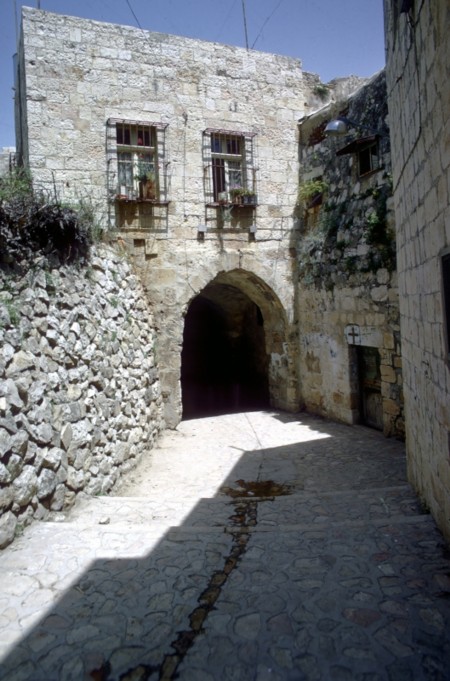
A house in old Jerusalem today, a reminder of Bible-time houses

We break away for the next two readings from the book of the Acts of the Apostles to the book of James.  The majority of scholars believe that this epistle was written by James, the Lord’s brother – rather than John’s brother, who was the first of the apostles to be martyred (likely beheaded) in Acts 12:1-2 about 14 years after Jesus’ resurrection.  According to the historian Josephus (“Antiquities of the Jews“, Book 20, Chapter 9, 1), James the Lord’s brother was stoned; and the historical accounts surrounding that event allow his death to be reliably dated around 62 A.D.  The book is only 5 chapters long, but its wisdom and encouragement of faith has been written about in many volumes (James is often called the “Proverbs of the New Testament”).

Verses 2-4 are a perfect example of the way that James so beautifully reminds of the teachings of Jesus (Matthew 5:11-12).  The trials to which James refers are both the temptations of sin, and the adversities that one faces in this world due to hardship, persecution, and sometimes even tragedy.  Macarthur noted that it is these trials “which Satan persistently uses to try to make Christians doubt they are indeed God’s children and fellow heirs with Jesus Christ.”  As verses 13-15 remind us, God does not bring misfortune or temptation upon us.

The phrase “let steadfastness have its full effect” recognizes that we have a choice.  We can “throw in the towel,” giving in to temptation or deciding that there is no point – no hope – in our faith.  But if we face even the afflictions that bring pain into our lives with the determination to persevere and remain faithful to the Lord, we gain strength and the patience of courageous endurance that brings us closer to the perfection that Jesus taught us in Matthew 5:48.

The wisdom to bear these burdens and to know how to persevere is available simply for the asking.  But one must have faith, and this means learning to trust in the Lord, and not in the world or in our own capability.  That does not mean that there is no need for action on our part.  Neither does it mean that God will instruct us specifically on every decision we make it life.  It means that He will give us what we need to know in order to bear our burdens, escape from temptation, and learn the divine truth of the way to our salvation.

Covetousness and the rich man, a story Jesus told — Luke 12: 15-21

Satan uses the “double-mindedness” that James refers to in verse 8 in other ways as well.  Verses 9-11 refer to different mind-sets of Christians in regard to wealth or the lack of same.  Those in humble circumstances are not forsaken by God, and the wealthy are not blessed by God.   Barclay noted that “…the great peril of riches is that they tend to bring to a man a false sense of security. He feels that he is safe; he feels that he has the resources to cope with anything; he feels that he can buy anything he wants, and buy himself out of any situation which he may wish to escape or to avoid.”   We are reminded in Luke 12:15-21 of the brevity of life, and the poverty of a different sort that awaits those who value the wrong things in life.  Conversely, verse 17 assures us that “every good gift and every perfect gift is from above.”   So we must never neglect giving thanks to Him for any good thing that comes to us.

The chapter concludes in verses 19-27 with the admonition that hearing (or reading, for that matter) is not enough if one does not do as the word of God says.  One must stay unstained from the world, and a big emphasis is placed on keeping the tongue bridled.  Verses 19-20 (be quick to hear, slow to speak, slow to anger) remind us of  Ecclesiastes 5:2,  Proverbs 10:19 and Proverbs 14:29.

Read or listen to audio of ESV version of this selection from this link.

/Bob’s boy
___________________
some images © V. Gilbert & Arlisle F. Beers

Please note: I did not design the reading plan that I am following in my blog.  All of my comments in this blog, however, are solely my responsibility.  When reading ANY commentary, you should ALWAYS refer first to the scripture, which is God’s unchanging and unfailing word. Reading schedules, as well as a link to the site where you can get the reading plan that I’m currently following for yourself can be found on the “Bible Reading Schedules” page of my website at http://graceofourlord.com.  For questions and help, please see the “FAQ” and “Summaries” pages there.

Acts 12 – Peter Is Rescued

Verse one begins with “About that time Herod the king laid violent hands on some who belonged to the church.”  The words “about that time” obviously refer to a time period in which the events of the end of chapter 11 occurred.  Secular history accurately dates the death of this Herod (Herod Agrippa I – grandson of “Herod the Great”) in 44 A.D.  Verse 2 continues in the KJV with:

“And he killed James the brother of John with the sword…”

When Jesus was transfigured on a mountain. Moses and Elijah join him. Jesus had brought his closest 3 disciples with him – Peter, James and John –Matthew 17: 1-13; Mark 9: 1-13; Luke 9: 28-36.

Burton Coffman wrote concerning this verse: Only seven words in the Greek, translated by eleven in English, recount the martyrdom of the first apostle; and such restraint by the sacred historian shows how different are the words of inspiration from those of ordinary writers.

Indeed.  If one was simply writing a story rather than the word of God, one would certainly have more to say about the death of one of Jesus’ “inner circle,” James the son of Zebedee, than these few words.  The rest of the verse states that “…when he saw that it pleased the Jews, he proceeded to arrest Peter also.”  The Jewish religious leaders – certainly much of the Sanhedrin – would have been pleased to have gotten rid of one the twelve men who were so instrumental in proclaiming that Jesus was the risen Lord.  This was during the Feast of Unleavened Bread; and Herod intended to bring Peter out after Passover and undoubtedly do the same with him as he had done with John’s brother.

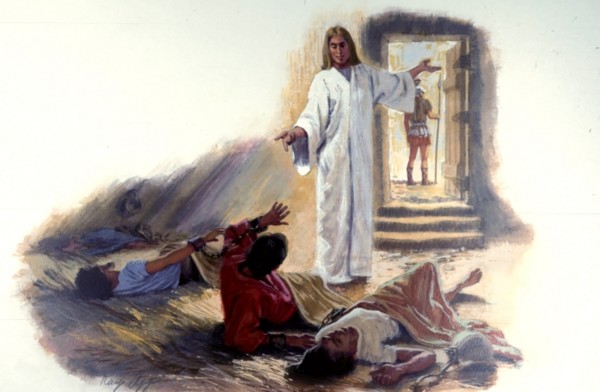
But on the night before Herod was to bring him out, an angel of the Lord came to Peter as he slept between two soldiers, made the chains fall off of him, led him past two guards and compelled the iron gate to open on its own, as they walked through.  And with that, the angel left.  Up to this point, Peter had been thinking that he was having another vision.  But in verse 11, he realizes that the Lord had sent his angel to rescue him “from the hand of Herod and from all that the Jewish people were expecting.”

Although sixteen soldiers guarded Peter when he was thrown into prison, an angel came personally to rescue Peter (Acts 12).

Peter heads to the house of Mary, the mother of John Mark (verse 12).  The consensus of scholars is that this may be because of the personal attachment Peter had for John Mark, who would write the gospel of Mark (of which writing there are convincing arguments that Peter stood behind).  At any rate, many of the church are gathered there.  At first, none of them believed the servant girl that it was Peter at the gate.  When they opened it, he cautioned them to be silent, then told them how he had been freed from prison.  As he left, he told them to tell James (this James would be the Lord’s brother) and the brothers what had happened.

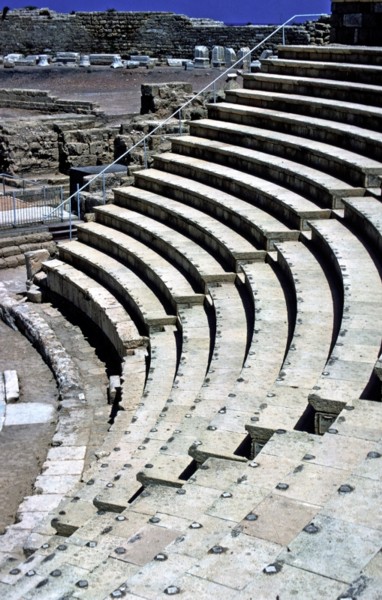
The first Herod, called The Great, wanted to honor his patron, Augustus Caesar, with a fine harbor. He spent twelve years building a magnificent harbor and naming it Caesarea. Ruins of the Roman theater, built before the time of Jesus.

When it was discovered that Peter was gone, Herod had the sentries executed.  The he went to Caesarea, where verses 20-23 describe the events of his death, relating that an angel of the Lord struck him down and in the end “he was eaten by worms.”  Some suggest that both he and his grandfather died of Fournier’s gangrene, but the Scripture gives no other information that would verify this.  His vanity and acceptance of the praise proclaiming him to be a god led to his death.  Another purpose was served though, as he had already proved to be a dangerous enemy to the apostles.

Side note: In this article by Todd Bolen of BiblePlaces.com, the author makes some very convincing arguments for the actual location of Herod Agrippa, when he was struck down, to have been at the city amphitheater, rather than the theater itself (where the historian Josephus  wrote that it occurred).  He also makes some interesting observations about the ruler and his predecessor’s and the practice of the emperor being honored as a god.  Very interesting reading.

Read or listen to audio of ESV version of this selection from this link.

/Bob’s boy
___________________
some images © V. Gilbert & Arlisle F. Beers

Please note: I did not design the reading plan that I am following in my blog.  All of my comments in this blog, however, are solely my responsibility.  When reading ANY commentary, you should ALWAYS refer first to the scripture, which is God’s unchanging and unfailing word. Reading schedules, as well as a link to the site where you can get the reading plan that I’m currently following for yourself can be found on the “Bible Reading Schedules” page of my website at http://graceofourlord.com.  For questions and help, please see the “FAQ” and “Summaries” pages there.

Acts 11 – Peter Reports to the Church

The old city of Jerusalem and the Temple area is at the right. At the left is Mount Zion, the City of David. The gold-domed building is the Dome of the Rock

Chapter 10 ended with Cornelius, his family, and friends receiving the Holy Spirit; and then “they asked him (Peter) to remain for some days.”  Just how long “some days” turned out to be we are not told.  But by the time Peter returned to Jerusalem, news that the “Gentiles also had received the word of God” had already spread back to the other apostles and the brothers and sisters throughout Judea.  In verse 2, Peter was getting criticism from the “circumcision party.”  This would be a group of Christians who probably had a strict “Pharisaic” background either personally or by association.  They would likely expect that Gentiles who wanted to be Christians would have to first convert to Judaism, even going so far as to be circumcised and would need to live according to Jewish ritual law.  Their indignation was at Peter having eaten with these uncircumcised Gentiles after he left Joppa for Caesarea.

Peter responds by first telling them of his own vision, then that of Cornelius.  He then relates how “the Holy Spirit fell on them” just as had happened to the apostles at Pentecost.  That settled the matter – there were none present who could consider any alternative to the obvious conclusion.  So “they glorified God, saying, “Then to the Gentiles also God has granted repentance that leads to life.”  Though the matter would still be debated, God’s will was clearly going to be done.

Persecution scattered the believers into Phoenicia, Cyprus, and Antioch, and the gospel went with them. Most spoke only to Jews, but in Antioch some Gentiles were converted. The church sent Barnabas to investigate, and he was pleased with what he found. Barnabas went to Tarsus to bring Saul (Paul) back to Antioch.

Verses 19-21 relate how a great number of those who had been scattered from Jerusalem after the stoning of Stephen had preached the word to others.  But some had not exclusively taught Jews.  Instead, many coming to Antioch had preached the word of Jesus to the Hellenists; and many had believed.  When word of this reached Jerusalem, they sent Barnabas, who found them faithful.  Barnabas, encouraged and full of the Spirit, went to Tarsus to find Paul; and together they taught in Antioch for a year.  It was in Antioch, according to verse 26, where the disciples were first called Christians.

One of the gifts of the Holy Spirit, given to others by the Apostles during those days, was the gift of prophecy.  One disciple with that gift foretold a great famine (verse 28).  Historians believe that this famine that took place during the reign of Claudius (Tiberius Claudius Caesar Augustus Germanicus, Roman emperor from A.D. 41-54) was in the years 45–47 A.D.  This would be confirmed by Galatians 2:1, where Paul states that his second visit to Jerusalem referred to in verse 30 was 14 years after his conversion, which would be circa 47 A.D.

Read or listen to audio of ESV version of this selection from this link.

/Bob’s boy
___________________
some images © V. Gilbert & Arlisle F. Beers

Please note: I did not design the reading plan that I am following in my blog.  All of my comments in this blog, however, are solely my responsibility.  When reading ANY commentary, you should ALWAYS refer first to the scripture, which is God’s unchanging and unfailing word. Reading schedules, as well as a link to the site where you can get the reading plan that I’m currently following for yourself can be found on the “Bible Reading Schedules” page of my website at http://graceofourlord.com.  For questions and help, please see the “FAQ” and “Summaries” pages there.
Paul and Barnabas Week \ Week 39 summary posted

Derbe is southeast of Lystra some thirty miles, in modern Turkey. In the Lycaonian District, this town was at the extreme edge of cities considered “Galatian”. The town was small, but the work of Paul and Barnabas yielded a number of followers. Among them, Gaius was converted and much later joined Paul’s team on the Third Missionary Journey.

Last week, in just five chapters of the book of Acts, we saw so much growth and movement in the Lord’s church.  Now things are starting to happen quickly; and this week will be no different.  By the time we end chapter 11, more than a decade will have passed since Saul was converted.  We’ll see more integration of Gentiles into Christianity –  Apostles arrested, stoned and even killed.  Then we will end the week with what will come to be known as the Jerusalem conference.

Summing Up

Each weekend, I am now posting a small PDF of one week of chapter summaries (on the website’s “Summaries” page), current to the beginning of the previous week.  I have posted the summary for Week 39 September Week 4) of the schedule I am following.  This short PDF document contains condensed comments about Matthew 27, 28, John 20, 21, and Luke 24, with hyperlinks to the ESV version of each chapter for listening or reading, and joins the summaries for other weeks already posted there.

/Bob’s boy
___________________
image © V. Gilbert & Arlisle F. Beers

Please note: I did not design the reading plan that I am following in my blog.  All of my comments in this blog, however, are solely my responsibility.  When reading ANY commentary, you should ALWAYS refer first to the scripture, which is God’s unchanging and unfailing word. Reading schedules, as well as a link to the site where you can get the reading plan that I’m currently following for yourself can be found on the “Bible Reading Schedules” page of my website at http://graceofourlord.com.  For questions and help, please see the “FAQ” and “Summaries” pages there.
Acts 10 – Peter’s Vision

The book of Acts just continues to present us with such momentous occasions; and chapter 10 is clearly one of special significance.  Cornelius of Caesarea was a Gentile soldier of an Italian cohort.  a cohort could consist of from 600 – 1000 men, with 6 centurions in charge.  A centurion was paid anywhere from 5 to as much as 20 times as much as the average Roman soldier, so Cornelius was likely considered wealthy.  Identified in several verses as a God-fearer, he would have been attached to a synagogue and a believer in God, but not circumcised.  An angel came to him in a vision telling him to have Peter brought to him, as well as where to find him.

Joppa, today called Jaffa, was once the seaport for Jerusalem. Hiram sent cedar logs from Lebanon to King Solomon for the Temple, floating them to Joppa (2 Chronicles 2:15). From Joppa the prophet Jonah ran away from God ( Book of Jonah), sailing from there toward Tarshish. Here Peter raised Tabitha, or Dorcas, from the dead (Acts 9:36-42). Later he was staying here at the house of Simon the Tanner when he saw a vision of unclean animals, which led him to visit Cornelius’ house in Caesarea and win him to Christ. This is the traditional site of the home of Simon the Tanner.

Meanwhile, on the housetop at the home of  Simon the tanner, Peter had a vision of his own (verses 9-16) that was perplexing to him at first.  The vision occurred three times of all sorts of animals descending from heaven that he was commanded to eat – some of whom were unclean by Jewish law.  Peter argued at first, but the voice said to him “What God has made clean, do not call common.”  Peter would come to understand that this landmark vision was not referring just to animals and food, but also to men.  While he was still sorting through this, the Spirit told him about Cornelius’s men who were now at his gate – that he was to go with them.

Being led by the Spirit, Peter judiciously took some of the brothers with them for witnesses of what was to occur.  When they arrived from Joppa into Caesarea, Cornelius had gathered his friends and family and fell at Peter’s feet.  Whatever was in Cornelius’ heart, Peter knew it was wrong to allow that sort of worship, and rebuked him in verse 26.  In verses 28-29, Peter acknowledges that under Jewish tradition, coming to the house of a Gentile (let alone, eating with them) would make one ceremonially unclean, but says that God has told him that he “should not call any person common or unclean.”  So, he asks why Cornelius has sent for him.

When Peter visited the Roman centurion Cornelius, this important soldier fell at Peter’s feet.

So Cornelius tells him of his vision and that all present were commanded to hear what Peter has to say.  With that, Peter preaches to them about Jesus and forgiveness of sins through His name.  It was then that the Holy Spirit fell upon all present.  The baptism of the Holy Spirit had previously been done directly from God to only the apostles, with it given to others only through the apostles laying on hands.  But now, to the amazement of all circumcised believers who had come with Peter (verse 45), this second baptism was being poured out even to Gentiles.

Peter, acknowledging the gift that was given to them, then commanded that they be baptized with water as well.  Peter’s perspective had changed forever concerning non-Jews.  Now the Lord’s Kingdom would grow even faster!  But this new perspective would not come without some resistance to change.

Read or listen to audio of ESV version of this selection from this link.

/Bob’s boy
___________________
some images © V. Gilbert & Arlisle F. Beers

Please note: I did not design the reading plan that I am following in my blog.  All of my comments in this blog, however, are solely my responsibility.  When reading ANY commentary, you should ALWAYS refer first to the scripture, which is God’s unchanging and unfailing word. Reading schedules, as well as a link to the site where you can get the reading plan that I’m currently following for yourself can be found on the “Bible Reading Schedules” page of my website at http://graceofourlord.com.  For questions and help, please see the “FAQ” and “Summaries” pages there.

Acts 9 – The Conversion of Saul

The Scripture now turns back to Saul, and states that he is “still breathing threats and murder against the disciples of the Lord.”  Then we are told of him going to the high priest for letters to give to the synagogues in Damascus to aid him in arresting men and women there.  It is in verse 2 that we get our first mention of Christianity having been referred to as “the Way.”  The reference also occurs in Acts 19:9,23, 22:4, and 24:14,22.

the Conversion of Saul on the road to Damascus...

the Conversion of Saul on the road to Damascus as painted by Michelangelo. (Photo credit: Wikipedia)

On the way to Damascus, Jesus appeared with a light from heaven that shone all around Saul, asking why he was persecuting him and told him to go into the city and wait to be told what to do.  The Ananias that was sent to Saul is obviously not the same one in chapter 5.  The Lord had come to him in a vision and told him what to do about Saul.  Ananias at first argued with the Lord because of Saul’s well-known reputation, but He told him that “he is a chosen instrument of mine to carry my name before the Gentiles and kings and the children of Israel.”  Saul had been left blinded and had to be led into Damascus, where he remained for three days before Ananias laid his hands on him and restored his sight.  And with that done, the worst persecutor of the church was then baptized!

His conversion complete, the man who just recently had been having Christians arrested and even murdered was now proclaiming Jesus as the Son of God.  Naturally, this created quite a stir among both believers and the Jewish religious leaders, the latter of whom were now plotting to kill Saul.  But word of this plot came to Saul, and his disciples helped him escape “through an opening in the wall, lowering him in a basket.”  This was in verse 25.  In verse 26, he enters Jerusalem, but we learn in Galatians 1:15-24 that 3 years had passed before that happened.  A good deal of that time he spent proclaiming the gospel back in Damascus a second time.

Joppa, or Jaffa. Location of Simon the tanner’s home.

When he did arrive in Jerusalem, they were at first afraid of him.  But Barnabas (who we met at the end of chapter 4) brought him to the apostles and told them his story.  After that he came and went among them  as he preached.  But again his life was threatened.  So the brothers “brought him down to Caesarea and sent him off to Tarsus.”

In verses 32-42, we read of Peter’s miraculous healing of Aeneas, who was paralyzed, and raising Tabitha (Dorcas) from the dead – and “it became known throughout all Joppa, and many believed in the Lord.”  Verse 43 tells us that Peter stayed in Joppa for many days with a tanner named Simon.

Side note:  The street named Straight mentioned in verse 11 is the subject of an article with photos at this link to Ferrell’s Travel Blog.  And this other article there has a picture of the traditional house of Simon the tanner.

Read or listen to audio of ESV version of this selection from this link.

/Bob’s boy
___________________
some images © V. Gilbert & Arlisle F. Beers

Please note: I did not design the reading plan that I am following in my blog.  All of my comments in this blog, however, are solely my responsibility.  When reading ANY commentary, you should ALWAYS refer first to the scripture, which is God’s unchanging and unfailing word. Reading schedules, as well as a link to the site where you can get the reading plan that I’m currently following for yourself can be found on the “Bible Reading Schedules” page of my website at http://graceofourlord.com.  For questions and help, please see the “FAQ” and “Summaries” pages there.