1 Thessalonians 5 – Final Instructions and Benediction

In this portion of Paul’s first letter, he continues speaking of the Lord’s return by reminding them that they already have been taught that the time is unknown and will come like a “thief in the night,” catching the unrighteous unaware and unready.  Paul refers to them in verse 5 as “children of light” (some translations say “sons of light”) and “children of the day.”  Jesus refers to believers as “sons of light” in a parable in Luke 16:8 and in John 12:35-36, as He is “the light.”  As Paul speaks here of the difference between they who know the Lord and the unrighteous, his words about not being “of the darkness,” along with those about the sins that take place at night, obviously show that being “of the light” has  other meaning as well (verses 6-7).  But his military imagery in verse 8 , is in the context of always being ready – which is the main point he is driving home.

Paul’s message of faith, hope, and love continues as he admonishes them to encourage and build one another up.  But in the middle of this, in verses 12-13, he says “We ask you, brothers, to respect those who labor among you and are over you in the Lord and admonish you, and to esteem them very highly in love because of their work.”   This is clearly a reference to elders of the church; and we know from Acts 14:23 that he and Barnabas had appointed elders in every church on their journey through the area.  These verses and those following may have been to address specific concerns Paul had for signs of turmoil to which he was made aware (“be at peace among yourselves”).  But as “all Scripture is inspired by God and profitable for teaching, for reproof, for correction, for training in righteousness” (2 Timothy 3:16), the commands and principles through verse 22 apply to Christians everywhere (“Admonish the idle, the fainthearted, help the weak, be patient with them all”).
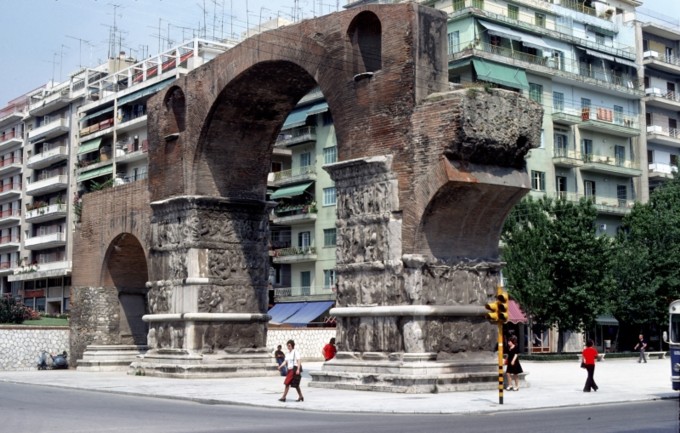
Thessalonica Arch of Galerius

Not repaying evil for evil (verse 15) is not a mandate against punishment by the justice system, but a limit that a Christian has to put on his personal life, difficult as it may be – instead, we must “seek to do good to one another and to everyone.”  “Rejoice always, pray without ceasing, give thanks in all circumstances” are the will of the Father through Christ Jesus.  “Do not quench the Spirit” and “Do not despise prophecies” would appear to be speaking to the Spiritual gifts that were to end after the apostolic age, but the Spirit that one acquires from baptism can also be quenched by false teaching, and by the sins of not following these important principles.  “Abstain from every form of evil” ( the KJV incorrectly asserts “the appearance of evil”) in this context , as Coffman comments is: “having tested what is true and false, the believer should cling to the true and abstain from the false.”

He closes, wishing them the peace and grace of the Lord, exhorting them to keep their  “whole spirit and soul and body” blameless, looking toward the coming of the Lord.  He then charges them to have this circular letter read to all the brethren.

Side note: Good information and photos of Thessalonica (Thessaloniki) in this article at BiblePlaces.com.

Read or listen to audio of ESV version of this selection from this link.

/Bob’s boy
___________________
some images © V. Gilbert & Arlisle F. Beers

Please note: I did not design the reading plan that I am following in my blog.  All of my comments in this blog, however, are solely my responsibility.  When reading ANY commentary, you should ALWAYS refer first to the scripture, which is God’s unchanging and unfailing word. Reading schedules, as well as a link to the site where you can get the reading plan that I’m currently following for yourself can be found on the “Bible Reading Schedules” page of my website at http://graceofourlord.com.  For questions and help, please see the “FAQ” and “Summaries” pages there.

1 Thessalonians 4 – A Life Pleasing to God

This chapter begins with Paul urging the brothers and sisters at Thessalonica to remain pure and to abstain from sexual immorality.  Having been converted from the paganism and idolatry that the city was corrupt with, sexual immorality would have gone hand in hand (as it always had) with such practices, and they would need to be on their guard to keep each other from slipping.  It is believed that Paul was writing the letter from Corinth (the patron “goddess” of which was Venus), where promiscuity abounded.  D. D. Whedon said of social impurity that “heathenism had made sexual immorality trivial, jocular, rather smart, and even religious and right”.  Sounds very similar to the so-called “new morality” of this day and age, does it not?  But the brothers there were strong, and an inspiration to all Macedonians in the region.  They just needed some extra encouragement.

Paul is continuing this admonition against sexual immorality in verse 6 with “…that no one transgress and wrong his brother in this matter…,” rather than beginning a new thought.  The word translated “wrong” in the ESV is better translated “defraud” and “exploit” in other versions.  The sexual relationship that God intended for a man and his wife, when used otherwise, often hurts someone in the here and now; and the fleeting pleasure is always at the ultimate expense of both parties.

Finally, it is implied, as Paul addresses them, that there had been several deaths of brethren at Thessalonica since he left; and those remaining seemed to be sure that Christ was going to return during their lifetimes.  Their grief for their departed appears to have included the misguided notion that those who have died were going to “miss out” on Christ’s return.  Paul offers some encouragement for them, saying that those who are alive when Christ returns will go with Him after He has gathered those who have “fallen asleep.”

It is Jesus’ victory over death, he reminds in verse 14, that assures us that God will, through Jesus, bring with Him those who have fallen asleep.  This use of the term “asleep” occurs in several passages in Scripture, a few of which include Matthew 27:52, John 11:11, Luke 8:49-56, and 1 Corinthians 15:20.   While some of Paul’s Apocalyptic description of that great and spectacular day is figurative, his assurance of the resurrection of the dead is not.  One of the most beautiful reminders of that fact in Scripture is Jesus’ conversation with Martha in John 11:23-27, before he raises her brother Lazarus from the dead:

Jesus said to her, “Your brother will rise again.” Martha said to him, “I know that he will rise again in the resurrection on the last day.” Jesus said to her, “I am the resurrection and the life. Whoever believes in me, though he die, yet shall he live, and everyone who lives and believes in me shall never die. Do you believe this?” She said to him, “Yes, Lord; I believe that you are the Christ, the Son of God, who is coming into the world.”

As Paul says of Jesus’ return to us in 1 Corinthians 15:26, “The last enemy to be destroyed is death.”

Read or listen to audio of ESV version of this selection from this link.

/Bob’s boy
___________________
some images © V. Gilbert & Arlisle F. Beers

Please note: I did not design the reading plan that I am following in my blog.  All of my comments in this blog, however, are solely my responsibility.  When reading ANY commentary, you should ALWAYS refer first to the scripture, which is God’s unchanging and unfailing word. Reading schedules, as well as a link to the site where you can get the reading plan that I’m currently following for yourself can be found on the “Bible Reading Schedules” page of my website at http://graceofourlord.com.  For questions and help, please see the “FAQ” and “Summaries” pages there.
1 Thess 1 – The Thessalonians’ Faith and Example

Thessalonica waterfront

Known today as Salonica, it is the second largest city in Greece, and a thriving commercial port.  In the 4th century BC, it was founded by Cassander of Macedonia beginning from the city of Therma (or Therme), named for hot springs in the area.  His wife was named Thessalonica, and was sister of Alexander the Great.

Silvanus, in Paul’s opening greeting to the Christians at Thessalonica refers to Silas.  The church there was founded in Acts 17:1-9 on Paul’s second missionary journey.  In this portion of the epistle, Paul praises and encourages them for their faith and the example that they have been for Christians elsewhere, as word of their conversion and faith in the Lord Jesus has spread throughout the region by reason of the comings and going of people doing trade there, and possibly evangelistic efforts on their part.    They had moved from pagan idol worship to deep faith in the resurrected Lord, while at the same time facing tremendous persecution for doing so (Acts 17:5-8).

Side note:This article at Ferrell’s Travel Blog shows pictures of the ruins of the Roman forum there.

Read or listen to audio of ESV version of this selection from this link.

/Bob’s boy
___________________
some images © V. Gilbert & Arlisle F. Beers

Please note: I did not design the reading plan that I am following in my blog.  All of my comments in this blog, however, are solely my responsibility.  When reading ANY commentary, you should ALWAYS refer first to the scripture, which is God’s unchanging and unfailing word. Reading schedules, as well as a link to the site where you can get the reading plan that I’m currently following for yourself can be found on the “Bible Reading Schedules” page of my website at http://graceofourlord.com.  For questions and help, please see the “FAQ” and “Summaries” pages there.

Acts 18 – Paul In Corinth

Paul left Athens, and went to Corinth, which was 46 miles away.  He met with Aquila and Priscilla there, who had come from Italy after the Roman emperor Claudius had ordered all Jews to leave Roman (we know this to have been issued in 49 AD).  At that time, they made no distinction between Jews and Christians.  Aquila and Priscilla were tent makers by trade, like Paul, and he stayed with them.  They became faithful friends, and he mentions them again a few times in Scripture (Romans 16:3-5, for example).  As always, he reasoned in the synagogue every Sabbath, preaching Jesus as the Christ.  But when they opposed him, he went to the home of Titius Justis, about whom we know nothing.  Crispus, the ruler of the synagogue, was one of the Corinthians that we know Paul baptized himself (1 Corinthians 1:14).

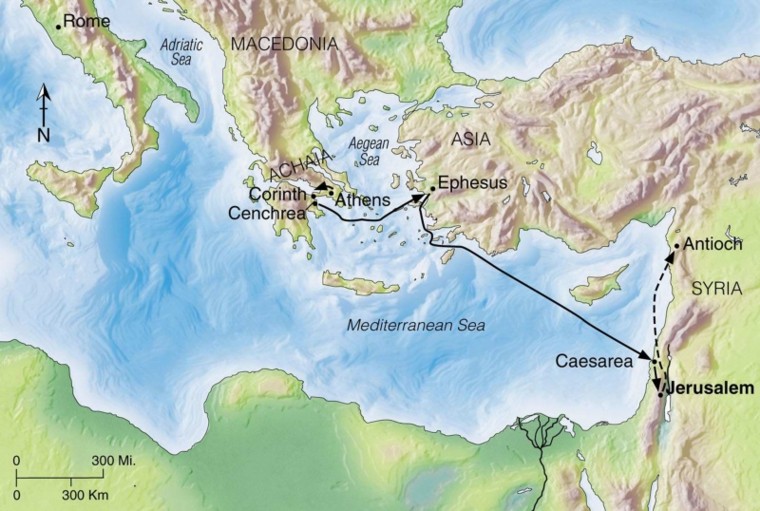
Paul left Athens and traveled on to Corinth, one of the greatest commercial centers of the empire, located on a narrow neck of land offering direct passage between the Aegean and Adriatic seas. When Paul left from the port of Corinth at Cenchrea, he visited Ephesus. He then traveled to Caesarea, from where he went on to Jerusalem to report on his trip before returning to Antioch.

The Lord spoke to Paul in a vision, telling him to keep teaching, and that no harm would come to him there.  So he remained for a year and a half (verse 11).  The proconsul was the chief judicial officer.  In this case, it was Gallio (verses 12-14) that held that position when the Jewish leaders there, in a united assault, had Paul brought before the tribunal.  We know from fragments of a letter from Claudius (the Delphi Inscription, found in 1905 by a French expedition) that he began this office in 51 AD.  He was a brother of the philosopher, Seneca, who was an advisor to Nero. Born as “Marcus Annaeus Novatus”, he took the full name “Lucius Junius Gallio Annaeus,” after the rich man who adopted him.But before Paul could defend himself, Gallio ruled that this was a religious matter between the Jews and ran them out of the tribunal.

Sosthenes, who was beaten in verse 17, may have succeeded Crispus after he became a Christian.   Sosthenes may have become a Christian himself, and could be the same one mentioned by Paul in his first letter to the Corinthians (1 Corinthians 1:1), but we do not know for sure.  At Corinth’s eastern port of Cenchrea, Paul had cut his hair at the completion of a vow (likely a Nazirite vow, as in Numbers 6:2).    It is speculated, that Paul would have kept some of his observances of ceremonial law, which would not be inappropriate at all.  He would not, however, bind such on others.

Paul then set sail for Syria, taking Priscilla and Aquila with him.  Stopping to establish the church at Ephesus, he left Priscilla and Aquila there, promising to return “if God wills.”   He then set sail to Caesarea, traveled to report to the church in Jerusalem and up to Antioch of Syria, ending his second missionary journey in verse 22.  Verse 23 then begins Paul’s third missionary journey, going up though Galatia and Phyrgia, “strengthening all the disciples” at the churches he had begun.

Paul’s third journey began in Acts 18:23. He hurried north, then west, returning to many of the cities he had previously visited. This time, however, he stayed on a more direct westward route toward Ephesus.

Meanwhile, a Jew named Apollos came to Ephesus from Alexandria.  He was a learned and eloquent man, well-versed in the Old Testament.  Luke says that “he spoke and taught accurately the things concerning Jesus, though he knew only the baptism of John,” meaning that he taught accurately what he knew, but Aquila and Priscilla filled in for him, teaching him “the way of God more accurately.”  It is likely that Aquila baptized him into Christ.  Wishing to go into Achaia, he was encouraged by the brothers, and became a powerful speaker of the gospel.

Side note: A modern photo of the port of Cenchrea can be found in this article at Ferrell’s Travel Blog.

Read or listen to audio of ESV version of this selection from this link.

/Bob’s boy
___________________
some images © V. Gilbert & Arlisle F. Beers

Please note: I did not design the reading plan that I am following in my blog.  All of my comments in this blog, however, are solely my responsibility.  When reading ANY commentary, you should ALWAYS refer first to the scripture, which is God’s unchanging and unfailing word. Reading schedules, as well as a link to the site where you can get the reading plan that I’m currently following for yourself can be found on the “Bible Reading Schedules” page of my website at http://graceofourlord.com.  For questions and help, please see the “FAQ” and “Summaries” pages there.

Acts 17 – Paul Addresses the Areopagus

Areopagus from the Acropolis (Athens)

Areopagus from the Acropolis (Athens) (Photo credit: Wikipedia)

Luke has now dropped the use of the first person plural in the text, suggesting that he may have remained in Philippi as Paul and Silas pass through Amphipolis and Apollonia to Thessalonica.  Neither the reference to “three sabbath days” in verse 2, nor the fact that they left the city after only 9 verses of this chapter should  be construed as the an indication of the length of their stay in Thessalonica.  Indications from 1 Thessalonians 2:9 and Philippians 4:16, for example, are that their ministry there was much longer.  The Jewish religious leaders, once again, became jealous and stirred up a mob until they attacked the house of  a believer – hoping to lay hands on Paul, no doubt.  Not finding them, they dragged the man (Jason) and some other believers before authorities, falsely claiming they were touting Jesus as an earthly king and a threat to Caesar.

In verse 10, the brothers sent Paul and Silas away, but it should be noted that their mission there was successful, as some of the Jews had been converted, and “a great many of the devout Greeks and not a few of the leading women.”  This explains the jealousy of the Jewish religious leaders there.   They arrived in Berea, and had even more success (verses 10-12), but the Jews in Thessalonica learned of Paul teaching there, and came to stir crowds again.  Paul was sent off by sea to Athens, but Silas and Timothy remained in Berea.  After arriving in Athens, Paul sent word back with those who had accompanied him for Silas and Timothy to join him .

Athens – Acropolis

Finding himself in this great pagan capital, Paul saw idol after idol.  He “reasoned” in the synagogue of course, but verse 17 says that he did so also in the marketplace every day.  Speaking with men of the two prominent philosophies of the day, Stoicism and Epicurean-ism, attracted great attention, and they brought him to the authorities at the Areopagus – this time with interest and curiosity in this speaker of “foreign divinity,” rather than hostility.  The Areopagus held a body of men with civil. moral, and religious authority over the city. Paul would have addressed them either on the “hill of Ares” (Mars Hill, where a temple to their “god” of war had been built in ancient times), or southwest of the Acropolis in the northwest corner of the Agora.  There, this body held meetings in the Royal Colonnade.

Paul preached to this body in verses 22-30 with one of his most eloquent speeches that we have recorded.  He opens in verses 22-24 with:

“Men of Athens, I perceive that in every way you are very religious. For as I passed along and observed the objects of your worship, I found also an altar with this inscription, ‘To the unknown god.’ What therefore you worship as unknown, this I proclaim to you…”

The translation of the word “religious” is too generous, but the word used falls a bit short of “superstitious,” as Paul was trying to evangelize, not demean.  He goes on to say that the God, who made the world and everything in it, is not contained in temples made by men – that He made, from one man, every nation of mankind “that they should seek God, and perhaps feel their way toward him and find him. Yet he is actually not far from each one of us…”  He told these idol worshipers that God should not be thought of as an image of stone or precious metals formed by the imagination of man.    He concludes with what we would expect – an excellent message of the gospel:

Engraved plaque containing Apostle Paul's serm...

Engraved plaque containing Apostle Paul’s sermon, at the Areopagus, Athens, Greece. (Photo credit: Wikipedia)

“The times of ignorance God overlooked, but know he commands all people everywhere to repent, because he has fixed a day on which he will judge the world in righteousness by a man whom he has appointed; and of this he has given assurance to all by raising him from the dead.”

Some mocked him at the reference to the resurrection, but others wanted to hear more, some being converted (verse 34) including Dionysius the Areopagite, one of the judges of the Areopagus.  That being the case, even Paul’s visit to this pagan city was a success!

 Side note: Photos, and article of “The Via Egnatia in Thessalonica” are in this article at Ferrell’s Travel Blog.  Also, great pictures and history of Amphipolis in this article from Todd Bolen’s BiblePlaces.org.

Read or listen to audio of ESV version of this selection from this link.

/Bob’s boy
___________________
some images © V. Gilbert & Arlisle F. Beers

Please note: I did not design the reading plan that I am following in my blog.  All of my comments in this blog, however, are solely my responsibility.  When reading ANY commentary, you should ALWAYS refer first to the scripture, which is God’s unchanging and unfailing word. Reading schedules, as well as a link to the site where you can get the reading plan that I’m currently following for yourself can be found on the “Bible Reading Schedules” page of my website at http://graceofourlord.com.  For questions and help, please see the “FAQ” and “Summaries” pages there.

Paul Preaches Profoundly \ Week 41 summary posted

Athens Mars Hill from Acropolis.

We will open this week with Paul in Athens at Mars Hill, and his eloquent address to the Areopagus, before he heads to Corinth.  While preaching there, he writes a letter to the brethren at Thessalonica – some of which we will also read this week.

Summing Up

Each weekend, I am now posting a small PDF of one week of chapter summaries (on the website’s “Summaries” page), current to the beginning of the previous week.  I have posted the summary for Week 41 (October Week 2) of the schedule I am following.  This short PDF document contains condensed comments about Acts 11 and 12, James 1 and 2, and Acts 13, with hyperlinks to the ESV version of each chapter for listening or reading, and joins the summaries for other weeks already posted there.

/Bob’s boy
___________________
image © V. Gilbert & Arlisle F. Beers

Please note: I did not design the reading plan that I am following in my blog.  All of my comments in this blog, however, are solely my responsibility.  When reading ANY commentary, you should ALWAYS refer first to the scripture, which is God’s unchanging and unfailing word. Reading schedules, as well as a link to the site where you can get the reading plan that I’m currently following for yourself can be found on the “Bible Reading Schedules” page of my website at http://graceofourlord.com.  For questions and help, please see the “FAQ” and “Summaries” pages there.


Acts 16 – The Philippian Jailer Converted

After arriving again at Lystra, Paul wanted a disciple there named Timothy to come with him.  Some wonder why Paul chose to circumcise Timothy, but clearly states in Galatians 2:3 that Titus was not circumcised.   The answer is that Timothy, before becoming a Christian, was raised by a Jewish mother (though his father was Greek).  So, as verse 3 says, it was because of the Jews in those places.  Having an uncircumcised Jew with him could pose a distraction by having some focus on that fact rather than the important teaching of Jesus Christ.

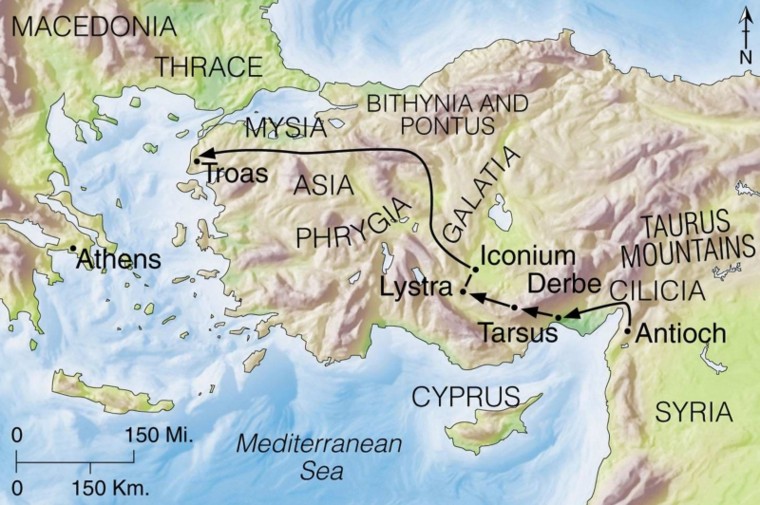
Paul and Silas set out on a second missionary journey to visit the cities Paul had preached in earlier. This time they set out by land rather than sea, traveling the Roman road through Cilicia and the Cilician Gatesa gorge through the Taurus Mountains, then northwest toward Derbe, Lystra, and Iconium. The Spirit told them not to go into Asia, so they turned northward toward Bithynia. Again the Spirit said no, so they turned west through Mysia to the harbor city of Troas.

As they went along, the brethren at various places were encouraged by the relating of the events of the Jerusalem Conference.  In verse 6, as they passed through the region of Phrygia and Galatia, it says that they had been forbidden by the Holy Spirit to preach the word in Asia.  This is not a reference to the continent of Asia, but to a Roman province in what was called Asia Minor – Ephesus being the capital.  For whatever reason, the people there were not ready to receive the word yet.  The same was true of Bithynia in verse 7, as they went through Mysia to Troas.  Then Paul had a vision of a man telling him to come to Macedonia to help them.

In verse 10, Luke speaks for the first time in the first person plural – “we sought to go on into Macedonia, concluding that God had called us to preach the gospel to them”  – from which we can conclude that Luke had been preaching the gospel for a while already, as he includes himself with Paul, Silas and Timothy.  So they set sail to Philippi, a leading city in Macedonia.  There was no synagogue there, so on the Sabbath they found women gathered for prayer by the river.  One was “Lydia, from the city of Thyatira, a seller of purple goods.”  These goods would have been made from an expensive dye made from the murex shell.  Note that Luke says that God opened her heart to pay attention to what Paul said, and she was baptized.

Traditional site of Paul’s prison at Philippi

After Paul drove the demon from the slave girl in verses 16-18, her owners drug Paul and Silas before the magistrates with false accusations.  In verses 20-22, they were beaten with rods and put in jail.  Paul and Silas prayed and sang hymns while the other prisoners listened until an earthquake shook the prison, opening the doors and freeing the bonds.  The jailer, readied to kill himself as he supposed they had escaped.  But Paul stopped him, and he and his family were all baptized. The magistrates sent the police the next day, telling the jailer to let them go, but Paul declared his Roman citizenship, and practically demanded an apology  – which he ended up getting, as the magistrates were then afraid.   They were asked to leave the city, though, so they visited and encouraged Lydia and the brothers before leaving.

Side note: This article at Ferrell’s Travel Blog has a unique photo and a bit of information about Philippi.

Read or listen to audio of ESV version of this selection from this link.

/Bob’s boy
___________________
some images © V. Gilbert & Arlisle F. Beers

Please note: I did not design the reading plan that I am following in my blog.  All of my comments in this blog, however, are solely my responsibility.  When reading ANY commentary, you should ALWAYS refer first to the scripture, which is God’s unchanging and unfailing word. Reading schedules, as well as a link to the site where you can get the reading plan that I’m currently following for yourself can be found on the “Bible Reading Schedules” page of my website at http://graceofourlord.com.  For questions and help, please see the “FAQ” and “Summaries” pages there.

Galatians 2 – Justified By Faith

Paul continues in this chapter with two important purposes – to defend his apostleship, and by doing so, to reinforce the correct teaching of the gospel of Jesus Christ that he had done there previously.  Some see the visit to Jerusalem referred to in verse one as being the famine relief effort of Acts 11:29-30.  But that occurred at a time of great persecution in Jerusalem (Acts 12) – so much so that James the son of Zebedee was executed, and Peter was thrown in prison.  It was no time for the type of conference described in verses 1-5.  Clearly, these events correspond more closely with the Jerusalem Conference outlined in Acts 15:1-5.  Verse 9 confirms the conviction of Peter and James, the Lord’s brother, that bringing the gospel to the Gentiles was indeed God’s will.  Had this been the case with the trip in Acts 11, the matter would have been settled then – with no need for the Jerusalem Conference to take place at all.

Paul reports the decision of the Jerusalem council to the Christians at Antioch (Acts 15:1-35)

There are aspects of Paul’s rebuke of Peter in verses 11-14 that are much debated.  Did Peter’s hypocrisy about occur before or after the Jerusalem Conference?  What did Paul mean when speaking of the men of the circumcision party who “came from James?” We do not all of the answers.  We know from Acts 15:13-19 that James was certain of God’s will toward the Gentiles.  Paul’s relating of these facts to the Galatians showed not only that he was equal to the other apostles, but that this truly was the Lord’s will.

Paul then underscores all of this in verses 15-21 by pointing out that we as Christians are not justified (counted as righteous) by works of the law.  Through the faith in Christ (some translations more accurately say “faith OF Christ”) we have died to the law (verse 19, Romans 7:4-6).  As Paul says in verse 20, we “have been crucified with Christ. It is no longer I who live, but Christ who lives in me.” We were “buried therefore with him by baptism” (Romans 6:4-6).   He settles the matter in verse 24 by pointing out that “if righteousness were through the law, then Christ died for no purpose.”  If we could earn our salvation through works of the law, we would have no need of the grace that we have in Christ.

Read or listen to audio of ESV version of this selection from this link.

/Bob’s boy
___________________
some images © V. Gilbert & Arlisle F. Beers

Please note: I did not design the reading plan that I am following in my blog.  All of my comments in this blog, however, are solely my responsibility.  When reading ANY commentary, you should ALWAYS refer first to the scripture, which is God’s unchanging and unfailing word. Reading schedules, as well as a link to the site where you can get the reading plan that I’m currently following for yourself can be found on the “Bible Reading Schedules” page of my website at http://graceofourlord.com.  For questions and help, please see the “FAQ” and “Summaries” pages there.
Galatians 1 – Paul Called by God

Paul’s letter to the Galatians was one of the earliest written epistles; and there is much speculation as to which Galatians it was written.  It was a circular letter, almost certainly written to the churches of southern Galatia that he established on his first missionary journey with Barnabas.  The context of the letter can be understood best if one keeps in mind that many of the circumcision party – Judaizers – had come after Paul teaching, as was their custom, that in order to be saved, the Gentiles had to be circumcised, and had to keep the law of Moses.  In effect, they were being taught that they first had to be converted to Judaism.

Paul visited several cities in Galatia on each of his three missionary journeys. On his first journey he went through Antioch in Pisidia, Iconium, Lystra, and Derbe, and then retraced his steps; on his second journey he went by land from Antioch of Syria through the four cities in Galatia; on his third journey he also went through those cities on the main route to Ephesus.

It is clear from Paul’s writing in the first chapter that these Judaizers had also suggested, if not outright declaring, that Paul was not really an apostle – certainly not on the level of the original twelve.  He opens the letter with a greeting that immediately declares his apostleship – something he only does in his letters to churches that were unfamiliar with him or where his authority was questioned (Romans, Corinthians, Ephesians, and Colossians), as opposed to the letters to Philippians and Thessalonians.  He goes to some length in chapter one to be candid about his background as a persecutor of the church, and to declare that he was called by the Lord himself to proclaim the gospel to the Gentiles (verses 11-16).

Paul often opens his letters with a commendation, but instead he opens with a rebuke here, as he declares his astonishment at hearing that many of them had accepted this false teaching.  He strongly proclaims that if anyone (even he himself, or an angel from heaven) would proclaim to them a different gospel than was preached to them previously, they were to be accursed.  This false teaching threatened the very foundation of Christianity and had to be quashed immediately and thoroughly.

One final note on this chapter is worthy of comment.  Verses 17-20 contain statements affirming (strongly underscored in verse 20) that Paul had not been among apostles other than Peter and James, the Lord’s brother, in the first years after the Lord had called him.  This point was important because efforts to disparage his apostleship had also suggested that he had merely been approved by them, or had been given his knowledge of the gospel by them.  The reference to James, the Lord’s brother, as an apostle should be understood in light of 1) his relationship to Jesus and/or 2) the fact that James became the official leader of the church in Jerusalem.  As Coffman pointed out, this James was not a plenary apostle, as were the twelve and Paul.

Read or listen to audio of ESV version of this selection from this link.

/Bob’s boy
___________________
some images © V. Gilbert & Arlisle F. Beers

Please note: I did not design the reading plan that I am following in my blog.  All of my comments in this blog, however, are solely my responsibility.  When reading ANY commentary, you should ALWAYS refer first to the scripture, which is God’s unchanging and unfailing word. Reading schedules, as well as a link to the site where you can get the reading plan that I’m currently following for yourself can be found on the “Bible Reading Schedules” page of my website at http://graceofourlord.com.  For questions and help, please see the “FAQ” and “Summaries” pages there.

Acts 15 – The Jerusalem Council

Despite Peter’s vision, and the fact that the Holy Spirit was given to the Gentiles in chapter 10, the acceptance of Gentiles in the church was still meeting resistance. In Acts 6:7, we are told of a significant number of priests that believed and were added to the church.  Many of these would be of the Pharisaic party referred to in verse 5.  There were people being taught that all had to be circumcised and to keep the law of Moses, causing Christianity to be looked upon as a sect of Judaism (and to some, a sect that had gone very wrong).  The time had come to deal with this issue once and for all.

Paul had been given his revelation on the matter, as the Lord had told Ananias in Acts 9:15 that “he is a chosen instrument of mine to carry my name before the Gentiles…”  He and Barnabas and others were appointed to go to Jerusalem to speak to the apostles and elders about the matter.  In verse 3, we have them passing through Phoenicia and Samaria, bringing great joy as they describe the conversion of the Gentiles.

Peter spoke to the council in verses 7-11, reminding them of the gift of the Holy Spirit.  Then Paul and Barnabas related the signs and wonders God had done through them on their journey.  James, the Lord’s brother, then affirms by quoting Amos 9:11-12 in verses 16-18.  The apostles then chose men to go with Paul and Barnabas to Antioch, and sent a letter with them, affirming with one accord that the Gentiles were not to be burdened with the requirements that the circumcision party was trying to impose.  The stipulations referred to in verses 20 and 29 were to make clear that they were to abstain from behavior that would make them  appear to the world as the idol-worshipers that were so common (sexual immorality was a predominant theme in idol worship).

Pamphylia hill country, Turkey, a small Roman province in southern Asia Minor during Paul’s time. Paul preached here on his First Missionary Journey. Later, John Mark left Paul and Barnabas and went home.

Paul and Barnabas stayed in Antioch (of Syria) preaching for a while, then prepared to re-visit the cities where they had been.  Verse 39 describes “a sharp disagreement” between the two.  Barnabas wanted to take Mark with them.  But verse 38 says that “Paul thought best not to take with them one who had withdrawn from them in Pamphylia and had not gone with them to the work.”  Separating, Barnabas and Mark went to Cyprus, and Paul took Silas and went through Syria and Cilicia.  The Scripture does not elaborate on this, but it has been pointed out that the disagreement had the end result of making their efforts doubly fruitful.

Read or listen to audio of ESV version of this selection from this link.

/Bob’s boy
___________________
some images © V. Gilbert & Arlisle F. Beers

Please note: I did not design the reading plan that I am following in my blog.  All of my comments in this blog, however, are solely my responsibility.  When reading ANY commentary, you should ALWAYS refer first to the scripture, which is God’s unchanging and unfailing word. Reading schedules, as well as a link to the site where you can get the reading plan that I’m currently following for yourself can be found on the “Bible Reading Schedules” page of my website at http://graceofourlord.com.  For questions and help, please see the “FAQ” and “Summaries” pages there.