Proverbs 3 – Trust in the Lord with All Your Heart

Moses with Radiant Face (1638 painting by José...

Moses with Radiant Face (1638 painting by José de Ribera) (Photo credit: Wikipedia)

As the reader is admonished to “keep my commandments…,” verse 3 begins with “Let not steadfast love and faithfulness forsake you.”  As this chapter heavily emphasizes trusting in the Lord, this would seem to refer to the steadfast love and faithfulness of the Lord Himself, as declared to Moses in Exodus 34:6, as He affirmed His covenantal relationship at Sinai.  Verses 5-7 contain the best timeless advice perhaps of the whole chapter – trust in the Lord with all your heart, lean not on your own understanding, and be not wise in your own eyes.  The folly of man in ignoring these three things (while believing that our own knowledge and our own understanding of the world is not flawed) has no doubt cost many their very souls – and will likely continue to do so.  The word of God, however, is unchanging and perfect.

But then, come verses 11-12.  These should not be taken to mean that God causes afflictions and trials to come upon us (as we will see in Job), but simply mean that He does allow those things to happen; and that in no way detracts from the fact that He loves us, as a father loves his children.  Building character and discipline through these trials gives us strength, integrity, and produces steadfastness in us as well (James 1:2-4).

Part of the rest of this chapter’s message of wisdom is in how we treat others, and how righteous living has an effect on them and, ultimately, on our own well-being.  And these points are all tied back to verse 4, which says that by living in such a manner, we “will find favor and good success in the sight of God and man.”

Read or listen to audio of ESV version of this selection from this link.

/Bob’s boy
___________________
some images © V. Gilbert & Arlisle F. Beers

Please note: I did not design the reading plan that I am following in my blog.  All of my comments in this blog, however, are solely my responsibility.  When reading ANY commentary, you should ALWAYS refer first to the scripture, which is God’s unchanging and unfailing word. Reading schedules, as well as a link to the site where you can get the reading plan that I’m currently following for yourself can be found on the “Bible Reading Schedules” page of my website at http://graceofourlord.com.  For questions and help, please see the “FAQ” and “Summaries” pages there.

Proverbs 2 – The Value of Wisdom

English: Judgement of Solomon

English: Judgement of Solomon (Photo credit: Wikipedia)

It is generally thought by many that Solomon in these verses that contain the words “my son” is addressing his direct offspring in particular.  While that may certainly be the case, it is good to remember that these are the Spirit-inspired words of God; and they are meant for sons (and daughters) descended from this Davidic line (and that of Abraham) which includes all Christians, as confirmed in Galatians 3:29.

The seeking of wisdom that is being referred to in the verses here is done by getting to know God by studying His word.  If we diligently and earnestly seek that knowledge like the treasure that it is (verse 4), we will gain the understanding that we need.  But it takes more than that – we must apply it to our lives – holding fast and cherishing our integrity like a treasure as well (verse 7), for it is that sort of life, coupled with the thirst for knowledge of Him, that will bring wisdom into our hearts and make that knowledge pleasant to our souls (verse 10).  If we live in an upright manner, with integrity (verse 21) , we will have a home – in heaven – forever.

Read or listen to audio of ESV version of this selection from this link.

/Bob’s boy
___________________
some images © V. Gilbert & Arlisle F. Beers

Please note: I did not design the reading plan that I am following in my blog.  All of my comments in this blog, however, are solely my responsibility.  When reading ANY commentary, you should ALWAYS refer first to the scripture, which is God’s unchanging and unfailing word. Reading schedules, as well as a link to the site where you can get the reading plan that I’m currently following for yourself can be found on the “Bible Reading Schedules” page of my website at http://graceofourlord.com.  For questions and help, please see the “FAQ” and “Summaries” pages there.

Proverbs 1 – The Beginning of Knowledge

The first 9 verses set the tone, and are widely regarded as the introduction of the entire purpose of the Book of Proverbs.  Coffman wrote “Wisdom is the ability to use knowledge aright,” and that the Christian has an advantage in that respect as 1 Corinthians 1:30 tells us that “because of him you are in Christ Jesus, who became to us wisdom from God, righteousness and sanctification and redemption.”  Verse 7 is the key: “The fear of the Lord is the beginning of knowledge; fools despise wisdom and instruction.”  Coffman’s comment on this is dead on:

English: Scroll of the Book of Proverbs

English: Scroll of the Book of Proverbs (Photo credit: Wikipedia)

“This is not a reference to abject craven fear, or terror, but to the awesome respect, honor, and deference to God and his will which automatically come to every mind that contemplates the omnipotence, glory, and holiness of Almighty God. This expression is found fourteen times in Proverbs.”  This latter fact is not inconsequential.  Every one of these fourteen passages containing those words conveys the richness of life and wisdom that comes to those that have this proper reverence and awe, and know the Almighty and the importance He places on things such as good, evil, and discipline (for reference, the others are Proverbs 1:29, 2:5, 8:13, 9:10, 10:27, 14:26, 14:27, 15:16, 15:33, 16:6, 19:23, 22:4, and 23:17).  The word “instruction” in verse 7 appears 26 times in the book, and the Hebrew incorporates “discipline” into its meaning.  This is central to understanding the “instruction” in verse seven and referenced elsewhere.

Verses 18 and 31 drive home the point, making clear that one’s actions contrary to good and righteousness mete out their own punishment to them.  The application of this instruction and wisdom to the young, as emphasized in  verses 4 and 8-9, are underscored in Ephesians 6:1-4 as well.

Read or listen to audio of ESV version of this selection from this link.

/Bob’s boy
___________________
some images © V. Gilbert & Arlisle F. Beers

Please note: I did not design the reading plan that I am following in my blog.  All of my comments in this blog, however, are solely my responsibility.  When reading ANY commentary, you should ALWAYS refer first to the scripture, which is God’s unchanging and unfailing word. Reading schedules, as well as a link to the site where you can get the reading plan that I’m currently following for yourself can be found on the “Bible Reading Schedules” page of my website at http://graceofourlord.com.  For questions and help, please see the “FAQ” and “Summaries” pages there.

January 2013 Reading Schedule Posted!

A big thank you to all who have read this blog during 2012!  While this blog is certainly not ever going to be the most popular WordPress “hangout,” we did just receive some statistics that are encouraging.  For example, the post on Peter’s rescue in Acts 12 received 652 views in one day. Not what we expected in the first year!  Thank you!

Here is the link to the 2013 reading schedule for January (January 2013 Reading Schedule).  In 2013, this blog will focus on the “Wisdom Literature” with a unique approach to Proverbs, Psalms, Song of Solomon, Ecclesiastes, Job, and as a special was to end 2013 the last week in December, the Book of James (often referred to as the “Proverbs of the New Testament”).  The first two weeks (beginning tomorrow 01/01/2013) we will read the first 9 chapters of Proverbs.  Theses chapters introduce the book, and what we actually know as “proverbs” do not really begin until chapter 10.

Psalm 1, Verse 1 and 2 in Biblia Hebraica Stut...

Psalm 1, Verse 1 and 2 in Biblia Hebraica Stuttgartensia (Photo credit: Wikipedia)

After those two weeks, we will settle into a schedule that adds variety to the five days per week of reading these books.  Each Monday in the first half of the year, we will read 8 verses of the longest chapter in the entire Bible – the 119th Psalm (with other, shorter Psalms included on many of those days).  This is a great Psalm that praises God and His word; and it is very rich in inspiration.  We will take a second look at these verses (and other Psalms) in the second half of the year from a fresh perspective. On Tuesdays, we will be reading from Proverbs with a similar approach.

On Wednesdays, we will be reading what are commonly called “lament” Psalms.  These are tremendously valuable in helping us with learning to call upon the Lord when life becomes very difficult, and even as tragedy and pain come our way.  Thursdays, we will read from the Book of Job, and on Fridays, we will be reading from other Psalms.

We will take a break at the end of June through July, and read through Ecclesiastes and Song of Solomon in their entirety, gaining much value learning about life, service to God, and the relationship of husbands and wives to each other.  Then we will resume the previously outlined schedule.

We are looking forward to what promises to be a very rewarding experience in God’s word in 2013!

/Bob’s boy
___________________
some images © V. Gilbert & Arlisle F. Beers

Please note: I did not design the reading plan that I am following in my blog.  All of my comments in this blog, however, are solely my responsibility.  When reading ANY commentary, you should ALWAYS refer first to the scripture, which is God’s unchanging and unfailing word. Reading schedules, as well as a link to the site where you can get the reading plan that I’m currently following for yourself can be found on the “Bible Reading Schedules” page of my website at http://graceofourlord.com.  For questions and help, please see the “FAQ” and “Summaries” pages there.
Looking to new Schedule \ Weeks 51 and 52 summaries posted

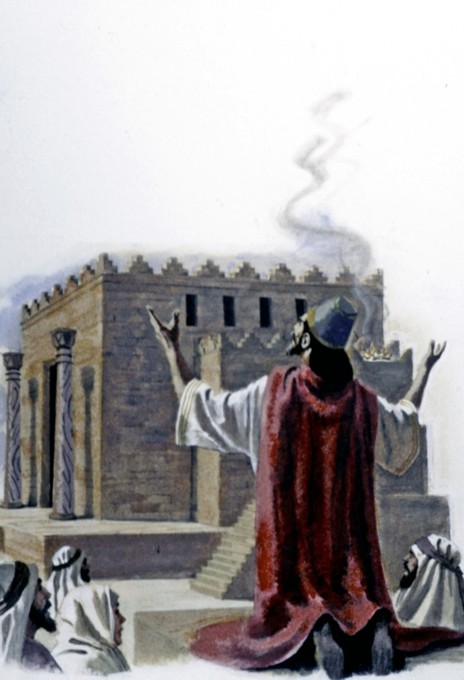
In Solomon's early years as king, when he built the Temple, he was a very godly man, offering a prayer of devotion to dedicate his finished Temple (1 Kings 8:22-61; 2 Chronicles 6:12--7:3).

In Solomon’s early years as king, when he built the Temple, he was a very godly man, offering a prayer of devotion to dedicate his finished Temple (1 Kings 8:22-61; 2 Chronicles 6:12–7:3).

In 2012, we have gone from the creation in Genesis to the end of Revelation studying the highlights of the Bible as the one story that it is (one chapter a day). What a year it has been!  This week, we will take a break from our reading in God’s word on Monday, and begin the new schedule of studying the “Wisdom Literature” in 2013 on New Year’s Day.  It is going to be a great year, and another very unique and, we trust, rewarding reading experience. We expect to see the completed schedule before Monday, and will post it then.  But we have reason to believe that we will start out in the Book of Proverbs.

We credit Solomon with the writing of Proverbs (we won’t debate the possibility of additional authors here), Ecclesiastes and Song of Solomon in particular, but much “non-inspired” literature is attributed to this king as well.  And we know that to be fact from what we are told in passages such as 1 Kings 4:29-34.  This passage starts with the great wisdom that God gave him (“And God gave Solomon wisdom and understanding beyond measure, and breadth of mind like the sand on the seashore) as a result of his request, which pleased the Lord (1 Kings 3:10-12).  Solomon reigned as king from about 970 – 931 B.C., and was the last king before the kingdom divided.

Summing Up

Each weekend, I post a small PDF of one week of chapter summaries (on the website’s “Summaries” page), current to the beginning of the previous week.  I have posted the summaries for Week 51 (December Week 3) and for Week 52 (December Week 4) of the schedule I have followed this year – the final two weeks for 2012!  The first of these short PDF documents contains condensed comments about Hebrews 6, 7, 8, 9, and 10, and the second about Hebrews 11, and Revelation 4, 5, 21, and 22 with hyperlinks to the ESV version of each chapter for listening or reading, and join the summaries for other weeks already posted there.

/Bob’s boy
___________________
image © V. Gilbert & Arlisle F. Beers

Please note: I did not design the reading plan that I am following in my blog.  All of my comments in this blog, however, are solely my responsibility.  When reading ANY commentary, you should ALWAYS refer first to the scripture, which is God’s unchanging and unfailing word. Reading schedules, as well as a link to the site where you can get the reading plan that I’m currently following for yourself can be found on the “Bible Reading Schedules” page of my website at http://graceofourlord.com.  For questions and help, please see the “FAQ” and “Summaries” pages there.
Revelation 22 – Jesus Is Coming

The imagery used here to describe heaven, the dwelling place of God and our Lord Jesus (and one day us as well) in these first few verses harkens back to Ezekiel 47:1-12.  No longer will there be anything accursed, verse 3 says; and the tree of life will be there (see Genesis 2:9).  This seems to be a symbol for the restored condition of things as they were between man and God before the fall (Genesis 3).

cross-005Verse 6 is a reminder that the other events spoken of in this book are to occur soon, but Jesus reminds that He is coming back (verse 7).  John affirms in verse 8 that it was he that received all of these visions; and he fell down to worship the angel who showed him, but was rebuked for doing so, as the angel reminded him that only the Lord was to be worshiped.

Jesus again promises that He is coming to bring his recompense for each of us for what we have done (Isaiah 62:11).  Verse 13 (“I am the Alpha and the Omega, the first and the last, the beginning and the end”) signifies the eternal supremacy of God and His Son.  Verse 17 repeats the promise that eternal life is available freely to all who will come – Jesus paid the price for it already.

John finishes the New Testament with the yearning call to Jesus as Lord to come.  Then finally, and appropriately: “The grace of the Lord Jesus be with all. Amen.”

Amen, indeed!

Read or listen to audio of ESV version of this selection from this link.

/Bob’s boy
___________________
some images © V. Gilbert & Arlisle F. Beers

Please note: I did not design the reading plan that I am following in my blog.  All of my comments in this blog, however, are solely my responsibility.  When reading ANY commentary, you should ALWAYS refer first to the scripture, which is God’s unchanging and unfailing word. Reading schedules, as well as a link to the site where you can get the reading plan that I’m currently following for yourself can be found on the “Bible Reading Schedules” page of my website at http://graceofourlord.com.  For questions and help, please see the “FAQ” and “Summaries” pages there.

Revelation 21 – The New Jerusalem

With all of the imagery amid these chapters, just what is meant by a new heaven and a new earth is highly debated.  Many see it as a literal renewal of earth after the old has passed away.  But much about what is spoken of in this chapter simply does not fit into such a notion.  2 Peter 3:10-13 affirms that the earth and the heavenly bodies will be destroyed – burned up  – after the judgment.  Just how this imagery of a new heaven and a new earth does fit into the coming of the faithful to heaven is uncertain.  What is certain is that there will be a literal new home for the faithful that is so wonderful than our minds probably could not grasp it without the imagery contained here that is full of references to precious metals and jewels and such.

Alexander building a wall against Gog and Magog

Alexander building a wall against Gog and Magog (Photo credit: Wikipedia)

No sun or moon will be needed because “the glory of God gives it light, and its lamp is the Lamb.”  No temple is there because God will be in the midst of his faithful, and they shall be His people.  This is an echo of the prophetic language in Isaiah 60:19-20.  The description of John being carried away in the Spirit to the high mountain to view the new Jerusalem is reminiscent of the time after “Gog and Magog’s” destruction Ezekiel 38-39, when Ezekiel was transported to “a very high mountain” (Ezekiel 40:2-3) to see the future temple of God.  The measurements done this time are enormous (a stadia was about 185 meters) and all are multiples of twelve; and the number is repeated in other descriptions here as both the twelve apostles and the twelve tribes of Israel are mentioned.  Both of these groups were important, after all, in both the old covenant and the new covenant.

The last word of comfort in this chapter for these first century Christians – and for us – is that once in heaven, no longer will they have to live among those who do evil in the world or, most especially, do evil to them, as verse 27 says “…nothing unclean will ever enter it, nor anyone who does what is detestable or false, but only those who are written in the Lamb’s book of life.”

Read or listen to audio of ESV version of this selection from this link.

/Bob’s boy
___________________
some images © V. Gilbert & Arlisle F. Beers

Please note: I did not design the reading plan that I am following in my blog.  All of my comments in this blog, however, are solely my responsibility.  When reading ANY commentary, you should ALWAYS refer first to the scripture, which is God’s unchanging and unfailing word. Reading schedules, as well as a link to the site where you can get the reading plan that I’m currently following for yourself can be found on the “Bible Reading Schedules” page of my website at http://graceofourlord.com.  For questions and help, please see the “FAQ” and “Summaries” pages there.

Revelation 5 – The Scroll and the Lamb

The lion is the symbol of the Tribe of Judah. ...

The lion is the symbol of the Tribe of Judah. It is often represented in Jewish art, such as this sculpture outside a synagogue (Photo credit: Wikipedia)

The image here of God holding the scroll that no one in heaven or on earth was worthy to open is certainly a symbol of the fulfillment of God’s plan for the redemption of man and our salvation.  Jesus is the only one that could fill that post.  The image of the Lamb who is the Lion of Judah ( a reference to Genesis 49:9) from the root of David all point back to Isaiah (Isaiah 11:1, 10, Isaiah 53:4-7).  Taking the scroll from the hand of God is clearly symbolic of Jesus, the Lamb, having been crucified, thereby fulfilling God’s plan and taking His place there with God, having proved himself worthy to be praised and worshiped as God was in the previous chapter (verses 9-11).

Read or listen to audio of ESV version of this selection from this link.

/Bob’s boy
___________________
some images © V. Gilbert & Arlisle F. Beers

Please note: I did not design the reading plan that I am following in my blog.  All of my comments in this blog, however, are solely my responsibility.  When reading ANY commentary, you should ALWAYS refer first to the scripture, which is God’s unchanging and unfailing word. Reading schedules, as well as a link to the site where you can get the reading plan that I’m currently following for yourself can be found on the “Bible Reading Schedules” page of my website at http://graceofourlord.com.  For questions and help, please see the “FAQ” and “Summaries” pages there.
Revelation 4 – The Throne in Heaven

John’s vision here begins with a door open into heaven.  The first voice he hears in verse one is generally accepted to be that of Jesus.  John had heard that voice on earth.  As John is then aware of being fully in the manifested presence of the Holy Spirit, the visions that occur after that remind us of a similar reference in Ezekiel 3:12-15.   Much interpretation of the detail of the imagery that follows has been made to the point of extremity.  One writer noted: One who adapts Biblical images as freely as he (John) has in this chapter should not be expected to preserve an undeviating consistency in his pictures. They are for kindling the imagination, not for transference to the drawing board.

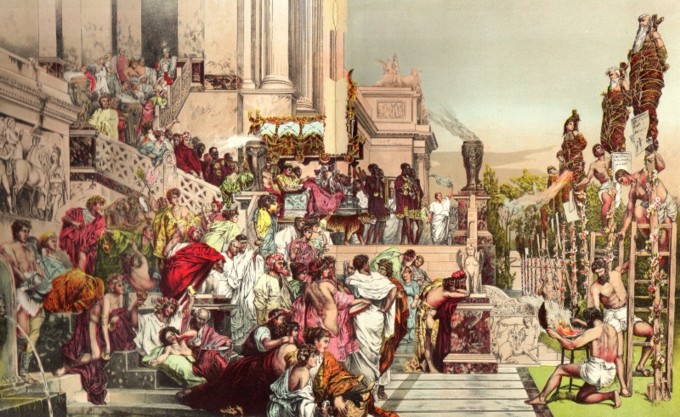
Nero's human torches of Christians

Nero’s human torches of Christians

No matter what interpretation you give each of these eleven verses, keep in mind the original audience.  These were persecuted Christians, many of whom may have known people – even had loved ones – that had been killed because of their faith in the Lord.  But they were holding on to that faith while looking toward heaven.  Here, as instructed by the Lord in Revelation 1:10-11, John gives them a grand glimpse of that splendor in the sort of literary imagery that was common to their day.  In the middle of the Lord’s battle with Satan, John gets that look at the throne of our Creator in heaven, and the worship that He worthily receives there.

Read or listen to audio of ESV version of this selection from this link.

/Bob’s boy
___________________
some images © V. Gilbert & Arlisle F. Beers

Please note: I did not design the reading plan that I am following in my blog.  All of my comments in this blog, however, are solely my responsibility.  When reading ANY commentary, you should ALWAYS refer first to the scripture, which is God’s unchanging and unfailing word. Reading schedules, as well as a link to the site where you can get the reading plan that I’m currently following for yourself can be found on the “Bible Reading Schedules” page of my website at http://graceofourlord.com.  For questions and help, please see the “FAQ” and “Summaries” pages there.

Hebrews 11 – By Faith

Shadrach, Meshach, and Abednego refused to bow to the Babylonian king's golden statue, so the king ordered them thrown into a fiery furnace. But God protected them (Daniel 3)

Shadrach, Meshach, and Abednego refused to bow to the Babylonian king’s golden statue, so the king ordered them thrown into a fiery furnace. But God protected them (Daniel 3)

Famous for the great description of faith in verse 1 (“faith is the assurance of things hoped for, the conviction of things not seen”), Hebrews 11 is (arguably most unfortunately) often called the “Hall of Faith” or the “Faith Hall of Fame.” Most of the accounts of people in this chapter are familiar to most people.  Some of the references are not so clear, and some maybe not so familiar.  Verse 33’s reference to those who “quenched the power of fire” is likely of Shadrach, Meshach, and Abednego from Daniel 2:49-3:30.  Verse 35’s women who “received back their dead by resurrection” is likely (among others) of Elijah raising the son of the widow of Zarephath (1 Kings 17:17-24) and Elisha raising the son of a Shunammite woman (2 Kings 4:18-37).  Verse 37’s gruesome deaths may refer to the extra-biblical accounts of the deaths of Jeremiah and Isaiah.

But this chapter is not an account of extraordinary men and women with supreme faith.  It is rather the story of ordinary men and women like you and me, who because of their faith in God, were blessed with the power and grace of His mighty hand.  It is the story of their endurance and perseverance through all manner of evil against them and bitter times, and how that endurance saw them through it by their faith.  It is the assurance that the recipients of this letter can persevere by their faith through the endurance the writer encouraged them to have in chapter 10.  It is the assurance that we can do it as well.  We have a better promise, through a better covenant, and if we are faithful, we will receive our reward – which will be the same perfect reward those mentioned in this chapter will ultimately receive (verses 39-40).

Read or listen to audio of ESV version of this selection from this link.

/Bob’s boy
___________________
some images © V. Gilbert & Arlisle F. Beers

Please note: I did not design the reading plan that I am following in my blog.  All of my comments in this blog, however, are solely my responsibility.  When reading ANY commentary, you should ALWAYS refer first to the scripture, which is God’s unchanging and unfailing word. Reading schedules, as well as a link to the site where you can get the reading plan that I’m currently following for yourself can be found on the “Bible Reading Schedules” page of my website at http://graceofourlord.com.  For questions and help, please see the “FAQ” and “Summaries” pages there.