Understanding the Cross of Christ (Part 1)

cross-004Recently, a young person asked me why God sent His only son to die – why was it necessary? Not a real unusual question for someone learning about Christianity to ask. And as someone who was “raised in the church,” it seemed so basic to our Christianity that I remember thinking that it should be a relatively easy question for me to answer. But to my surprise, I found that the spontaneous explanation I was able to come up with in an admittedly brief time seemed wholly inadequate to me – and I vowed to prepare myself to do a better job. What question could be more important for us as Christians to answer? So, as I begin to study and prepare for that “better answer,” I am beginning this series on “Understanding the Cross,” which will be featured on selected Sundays for the next few weeks.

To be sure, the first thing that popped into my head (“to save us from our sins”) was absolutely the correct answer. But it was also one that my young student in his own limited study of God’s word, already knew. After all, the words are in practically every prayer he has ever heard. But standing by itself, it really isn’t much of an answer, is it?

Admittedly, a real study of this question could be made into countless individual lessons, articles, and discussions. It is, after all, what the entire Bible from the Genesis to Revelation is all about, right? So let’s begin in part one of this series, with a brief outline and some more questions; and see if we can provide a meaningful answer to my young friend’s question that is not too difficult to call up to memory when needed. Let’s start by separating the questions into four categories:

What is the problem with sin?

  • What is sin, and how does it affect us?
  • Why does sin matter so much to God?
  • What is its importance to us?

What is God’s response to sin?

  • What are the consequences to us?
  • How was sin dealt with in the Old Testament?
  • Why does God demand a price to be paid for our sin?

How does Jesus fit into God’s plan?

  • Where did Jesus come from?
  • Was He all that everyone expected the Messiah to be?
  • What did his death on the cross accomplish?

What must we do to be saved?

  • What \ Who is a sinner?
  • What can a sinner do to earn salvation?
  • What is the importance of baptism?

Be watching for part 2 of this series, where we will examine the first category of questions above: “What is the problem with sin?”

/Bob’s boy
___________________
image © V. Gilbert & Arlisle F. Beers

Please note: I did not design the reading plan that I am following in my blog.  All of my comments in this blog, however, are solely my responsibility.  When reading ANY commentary, you should ALWAYS refer first to the scripture, which is God’s unchanging and unfailing word. Reading schedules, as well as a link to the site where you can get the reading plan that I’m currently following for yourself can be found on the “Bible Reading Schedules” page of my website at http://graceofourlord.com.  For questions and help, please see the “FAQ” and “Summaries” pages there.

Psalm 25 – Remember Not the Sins of My Youth

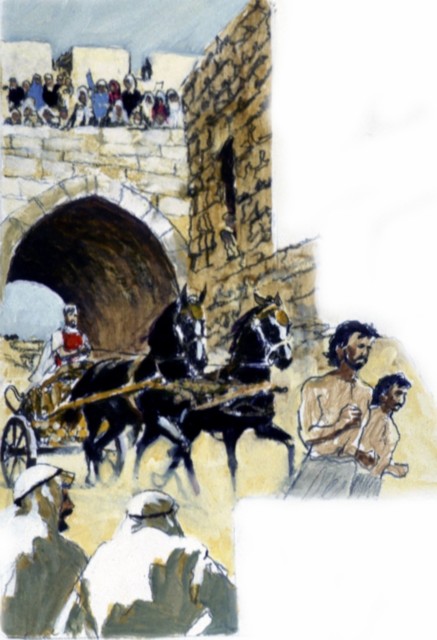
David's son Absalom plotted to rebel against David, seize his father's throne and become king. To win favor with the people, he bought a beautiful chariot and horses and rode through the streets of Jerusalem in great honor (2 Samuel 15:1-6).

David’s son Absalom plotted to rebel against David, seize his father’s throne and become king. To win favor with the people, he bought a beautiful chariot and horses and rode through the streets of Jerusalem in great honor (2 Samuel 15:1-6).

Because of the line this blog’s title, it is generally thought that David wrote this psalm in his latter years.  Some claim it to not be a psalm of personal penitence, but rather one that was meant to be used by anyone in distress.  But a time frame just before the Absalom conspiracy is quite likely when considering the penitential aspect of David’s sin with Bathsheba, as well as the mention of strength and number of his foes (verse 19).  It is otherwise a very recognizable psalm as one of the more well-known hymns still sung today – “Unto thee O Lord.”  It is one of the acrostic psalms, although some commentators state that it is imperfect.  But Spurgeon disagrees, stating that in the original text, the twenty-two verses follow the Aleph-bet in perfect order.

Read or listen to audio of ESV version of this selection from this link.

/Bob’s boy
___________________
some images © V. Gilbert & Arlisle F. Beers

Please note: I did not design the reading plan that I am following in my blog.  All of my comments in this blog, however, are solely my responsibility.  When reading ANY commentary, you should ALWAYS refer first to the scripture, which is God’s unchanging and unfailing word. Reading schedules, as well as a link to the site where you can get the reading plan that I’m currently following for yourself can be found on the “Bible Reading Schedules” page of my website at http://graceofourlord.com.  For questions and help, please see the “FAQ” and “Summaries” pages there.

Job 7 – Job Continues: My Life Has No Hope

This is one of the more difficult chapters to read in the book of Job, as we get some sense of Job’s current suffering.  He speaks of his skin healing, and then breaking out afresh; and he describes what could very well be some type parasitic influence as well (verse 5).  He transitions from speaking to his friends, to speaking of God in the third person, to speaking directly to God.

seaHe considers the extent of his suffering to be so great that he asks God if He regards him as large of a threat as a sea monster or the seal itself, so that he needs to be afflicted in this manner to “set a guard” over him.  He has come to believe, clearly, that it is God’s will for him to suffer, and wonders aloud why He won’t forgive whatever transgression Job might be guilty of doing.  Job’s suffering has brought him to the point of losing hope and he again wishes for death to overtake him.

Read or listen to audio of ESV version of this selection from this link.

/Bob’s boy
___________________
some images © V. Gilbert & Arlisle F. Beers

Please note: I did not design the reading plan that I am following in my blog.  All of my comments in this blog, however, are solely my responsibility.  When reading ANY commentary, you should ALWAYS refer first to the scripture, which is God’s unchanging and unfailing word. Reading schedules, as well as a link to the site where you can get the reading plan that I’m currently following for yourself can be found on the “Bible Reading Schedules” page of my website at http://graceofourlord.com.  For questions and help, please see the “FAQ” and “Summaries” pages there.

Psalm 30 – Joy Comes with the Morning

The superscript for this psalm generates some discussion because David, of course, was not around for the dedication of the temple.  That happened during Solomon’s reign.  This of course would not preclude the psalm from having been used on that occasion, but that context is not the nature way that these superscripts are generally phrased.  Others have suggested that it was actually during re-dedication of David’s palace after reclaiming it from Absalom.  One other school of thought is that the psalm was composed during dedication of the threshing floor of Araunah (2 Samuel 24:18-25), after the terrible pestilence that claimed the lives of 70,000.

David instructs Joab to number the people.

David instructs Joab to number the people.

This latter seems quite likely, and the reference to the Lord’s anger does lend some credence to it.  David referred to his former view of his prosperity in verse 6, and the fact that it was his own self-glorification that had led to his command for the numbering of his forces makes for a convincing argument for this explanation. The lesson for us could also be in how quickly our fortunes may be turned when we forget to depend upon the Lord.  As Clarke noted “Peace and prosperity had seduced the heart of David, and led him to suppose that his mountain – his dominion, stood so strong, that adversity could never affect him.”  We must never forget that all that we are blessed with comes from the Lord, and any or all of it could be lost in the twinkling of an eye.  Entire life savings have been wiped out by recent economic tragedy, loved ones we depend on sometimes die.  It is the Lord that is always our rock and our salvation.

Read or listen to audio of ESV version of this selection from this link.

/Bob’s boy
___________________
some images © V. Gilbert & Arlisle F. Beers

Please note: I did not design the reading plan that I am following in my blog.  All of my comments in this blog, however, are solely my responsibility.  When reading ANY commentary, you should ALWAYS refer first to the scripture, which is God’s unchanging and unfailing word. Reading schedules, as well as a link to the site where you can get the reading plan that I’m currently following for yourself can be found on the “Bible Reading Schedules” page of my website at http://graceofourlord.com.  For questions and help, please see the “FAQ” and “Summaries” pages there.

Proverbs 16 – Commit Your Work to the Lord

“All the ways of a man are pure in his own eyes,

but the Lord weighs the spirit.”  (Proverbs 16:2)

English: Head-piece to the first epistle of Pa...

English: Head-piece to the first epistle of Paul the apostle to the Corinthians, vignette with water pouring from a crucifix standing over a flaming bowl on a ledge with grain in clouds; letterpress in two columns below and on verso. 1800. Inscriptions: Lettered below image with production detail: “P J de Loutherbourg invt et delt”, “J. Heath direx”. Print made by James Heath. Dimensions: height: 480 millimetres; width: 380 millimetres. (Photo credit: Wikipedia)

Nobody I know begins their day with the intention of conducting themselves in their daily routine in a manner that will be harmful to others, or displeasing to the Lord.  This is not to say that none of us ever do wrong willfully, but most of the time we believe that we are doing what is right.  Being pure of actions in our own eyes can also mean that we try to get what we need, and do what we must, with as little thought to others as possible.  But Paul says in 1 Corinthians 4:4:

For I am not aware of anything against myself,

but I am not thereby acquitted. It is the Lord who judges me.

So how then should we go about our business?  The answer comes in verse three:

Commit your work to the Lord,

and your plans will be established.

If we begin each day in prayer to God for His divine guidance to direct our hearts in conducting our daily affairs, He will not withhold the wisdom we need in doing so.

Read or listen to audio of ESV version of this selection from this link.

/Bob’s boy
___________________

5VB2BPSBSZV4

some images © V. Gilbert & Arlisle F. Beers

Please note: I did not design the reading plan that I am following in my blog.  All of my comments in this blog, however, are solely my responsibility.  When reading ANY commentary, you should ALWAYS refer first to the scripture, which is God’s unchanging and unfailing word. Reading schedules, as well as a link to the site where you can get the reading plan that I’m currently following for yourself can be found on the “Bible Reading Schedules” page of my website at http://graceofourlord.com.  For questions and help, please see the “FAQ” and “Summaries” pages there.

Psalm 119:49-56; Psalm 26 – Your Promise Gives Me Life

ZayinToday’s stanza of Psalm 119 is brought to you by the seventh letter of the Aleph-Bet, Zayin.  The pictograph is sometimes represented as a sword with a crown or sometimes as a plow or a sickle .   It is interesting that in light of the fact that most commentators disagree on the time frame for authorship of this psalm, some cannot even agree with their own assessment.  Adam Clarke, for example, was convinced at one point that it was written during Babylonian captivity, yet at other times thought that it may well have come from David’s hand after all.  Both views have merit especially in this stanza, or strophe.  Verses 49-50 certainly hint at one who is eagerly looking forward to the promised return from captivity, which is his comfort in this time of affliction.

It is better in our case to apply it to ourselves as was no doubt the intent in the first place.  We take comfort in the promises that God has made to us all in His Son, Jesus Christ.  It is His victory over death that should make the promise of eternal life a burning fire within our souls.    And our love for the Lord should give us righteous indignation at a wicked world that ignores His commandments and glorifies sin as if it were something to be admired.

Psalm 26 is sometimes thought to be written by David when he was accused of treachery against then king, Saul.  He prays to the Lord for vindication against his accusers, and declares his adherence to God’s rule and to his own integrity, which he refers to again in verse 11.  He humbly pleads with the Lord to “Prove me, O Lord, and try me; test my heart and my mind.”  Integrity is a watchword for David in many of his psalms, and it comes through loud and clear in this one, as he expresses his confidence in his commitment to it, all made possible by the faithfulness of the Lord and His graciousness to his servant.

Read or listen to audio of ESV version of this selection from this link.

/Bob’s boy
___________________
some images © V. Gilbert & Arlisle F. Beers

Please note: I did not design the reading plan that I am following in my blog.  All of my comments in this blog, however, are solely my responsibility.  When reading ANY commentary, you should ALWAYS refer first to the scripture, which is God’s unchanging and unfailing word. Reading schedules, as well as a link to the site where you can get the reading plan that I’m currently following for yourself can be found on the “Bible Reading Schedules” page of my website at http://graceofourlord.com.  For questions and help, please see the “FAQ” and “Summaries” pages there.

What I Learned From a Pit Bull

Let me start by saying that I am unapologetically a carnivore.  If you are a vegetarian for reasons you feel strongly about, that is your right.  But I refuse to debate it with you.  I love my chicken fried steak, regular steak, and lots more chicken these days; and will continue to enjoy them all as long as I still have teeth.

Cheza-01Something else I won’t debate with you about is the question of whether we will see our pets in heaven.  I am quite familiar with Genesis 1-26: “Let us make man in our image, after our likeness. And let them have dominion over the fish of the sea and over the birds of the heavens and over the livestock and over all the earth and over every creeping thing that creeps on the earth.”   And I understand that we have an eternal soul and are a higher life form than other animals.  There are a lot of convincing commentaries explaining why you should not expect to see Fido there.  And I have been reluctant in times past to tell my grandchildren otherwise when asked that question.  I now have several problems with that.

  1. For every scripture citation you give me that leads you to believe otherwise, I can point you to a website with dozens more that convince me that there are likely to be plenty of animals in Heaven, and I’m not just talking about horses taking Elijah in a whirlwind to heaven (2 Kings 2:9-12).  I don’t pretend to know exactly what that means, but I am sure (and hope sincerely) that it does not include cockroaches.  I fear I would still stomp on them without regret.
  2. However strong your convictions are on the subject, you do not have the slightest idea what heaven is going to be like in the first place, much less what the rest of us should expect to see there.   So get over it.  Nobody’s salvation will ever depend on whether or not they believe their pets are going to be in heaven.   Yes Virginia, I do believe Fido will be there.
  3. God gave Job a sampling of the many ways that he cares for his animals (part of which is in Job 38:39-41).  You can rest assured that whatever He decides their fate will be, He in His wisdom will make sure that it is “good.”  “Good” is how He started this world out, and “very good” is surely the way that everything will be when we cross over to be with our Lord.

A few years ago, one of my daughter’s friends died suddenly and quite unexpectedly.  She left behind a big white pit bull with brown markings.  When those entrusted to care for her failed to do so properly, my daughter took the dog in.  But a small apartment was no place for a big dog like that, so my wife and I reluctantly decided she had to stay with us.  OK, I was the reluctant one.  I mean, we are talking about a pit bull after all.  They can turn vicious without warning, right?  And we have small grandchildren (one actually not yet even born at the time).   And she came with baggage.  She had cancer.  Some tumors had already been removed, but the estimate was that she would only live another year or so.

Five years later, she had become the darling of our family.  The only trouble we ever had with her was keeping her out of the pool in the summer time.  How she loved to swim!  The minute our backs were turned, we would hear a splash and know that it was her again.  As for turning vicious, the closest she ever came to that was when (at my wife’s command) she encouraged a young man to quickly scale our fence when he came into our back yard looking for something to steal.

Cheza-02She shared our home with two Miniature Schnauzers who she was content to allow the illusion that they were the ones in charge.  Made no difference to her.  She just wanted to be accepted as one of them.  In her mind’s eye, that was all she was – just another little Schnauzer.  And my wife allowed this baby girl the illusion that she was just another lap dog.  Spoiled rotten?  Perhaps so.  But she was that lovable, and she (as man’s best friend is so often inclined) asked for nothing but to be loved.   As for the grandchildren, she and our 12-year-old had become adoring friends, the younger ones – even our one year old got in her face most annoyingly at times, but she never so much as growled.

But alas, a tumor grew that was inoperable.  It was in the joint of her shoulder and underarm, growing to massive size almost overnight, and was spreading internally as well.  Steroids beat it back for a while, but it came back even bigger, and soon the steroids simply were making her more overweight than was good for her.  But her time had not yet come, so my wife kept this leaky tumor bandaged and changed (it was now large enough to put a sock around it), washed her bedding several times daily, and mopped up the blood droplets that leaked from the wound.  She was still happy and so very loving, and we had pain medicine for her that helped.

Today she took a turn decidedly for the worse, and she “told us” that it was time.  This gentle giant that I never wanted in the first place had stolen our hearts, and now letting her go has broken them.  Knowing that it was the right thing to do is little consolation.

So what else did I learn from this pit bull?  For one thing, I learned that I should not be so quick to judge others.   In truth, I am not so different from that pit bull.    I am a very quiet, most often bashful, man with what some describe as a very dry sense of humor (I’m not sure what a wet sense of humor is, but I do get it – other people just sometimes don’t know how to “take me”).  Add to that the fact that I am not an outgoing person, and I have no doubt that I am often perceived much differently than I would like to be.  How often have I misjudged someone else?  Now, whenever I encounter someone that I think of as a “pit bull”, I am more inclined to consider that they have a different perception of themselves, and that they are worth giving an opportunity to prove my perception wrong.  “Love your neighbor”… hmmm…sounds so familiar…

As for heaven, will I be surprised if I am greeted by a white and brown pit bull, with tail wagging as she looks up at me with devotion in her eyes?  Not really.


/Bob’s boy
___________________
image © V. Gilbert & Arlisle F. Beers

Please note: I did not design the reading plan that I am following in my blog. All of my comments in this blog, however, are solely my responsibility. When reading ANY commentary, you should ALWAYS refer first to the scripture, which is God’s unchanging and unfailing word. Reading schedules, as well as a link to the site where you can get the reading plan that I’m currently following for yourself can be found on the “Bible Reading Schedules” page of my website at http://graceofourlord.com. For questions and help, please see the “FAQ” and “Summaries” pages there.

The Lord Is My Shepherd – The King of Glory!

Shepherd tending his flock.

Shepherd tending his flock.

Psalm 23 is the most well-known of all psalms – perhaps the only one that many of us know by heart.  It is truly a great prayer and the source of several excellent hymns we sing even today.  The reference to the Lord as the shepherd is most appropriate and carries over to Jesus in the New Testament, for sure.  But it is also used to describe the job of the apostles – we are certainly reminded of Jesus’ words to Peter – “Feed my sheep” (John 21:15-19).

The elders of the church are always refereed to as shepherds as well, because they care for the flock – the Christians who they are responsible for in caring for their spiritual nourishment.  In the sense that the term is used here, though, God is the one who brings the care, the restoration of one’s soul- his vitality.  The image of Him as the protector should be of great comfort to us.

The comfort and beauty of these eight verses is stirring for sure.  But it is the opinion of this blogger that one does himself a great disservice by passing over the next 10 verses in psalm 24.  As a prayer, its beauty and poetry are equal in every way to the 23rd psalm.  Read how the last few verses conclude this great benediction:

He will receive blessing from the Lord
and righteousness from the God of his salvation.
Such is the generation of those who seek him,
who seek the face of the God of Jacob.

Who is this King of glory?
The Lord, strong and mighty,
the Lord, mighty in battle!
Lift up your heads, O gates!
And lift them up, O ancient doors,
that the King of glory may come in.
Who is this King of glory?
The Lord of hosts,
he is the King of glory!

Read or listen to audio of ESV version of this selection from this link.

/Bob’s boy
___________________
some images © V. Gilbert & Arlisle F. Beers

Please note: I did not design the reading plan that I am following in my blog.  All of my comments in this blog, however, are solely my responsibility.  When reading ANY commentary, you should ALWAYS refer first to the scripture, which is God’s unchanging and unfailing word. Reading schedules, as well as a link to the site where you can get the reading plan that I’m currently following for yourself can be found on the “Bible Reading Schedules” page of my website at http://graceofourlord.com.  For questions and help, please see the “FAQ” and “Summaries” pages there.

Job 6 – Job Replies: My Complaint Is Just

Job begins his response to Eliphaz with the contention that his vexations far outweigh what Eliphaz characterizes as rashness of words on his part.  For the first time, he seems to agree that God must be the author his troubles, but for what he does not know.  And furthermore, he contends, even the wild donkey is allowed to bray at his discomfort, so what is man that he should not be allowed to do the same?

Job and friends 03In verses 8-13, he re-affirms his wish that God would just crush him – end his life.  His conscience is clean and he has nothing to fear in death, so why will God not take him home (verse 11).  In verses 14-23, he then turns to his friends.  They showed up for him physically, yet gave him not an ounce of sympathy.  In verse 14, he even declared that such sympathy and kindness should be extended even to one who had forsaken God – but Eliphaz especially had already let him down.  In verses 15-19, Job accuses his friends of being fair-weather in nature.  They were kind and loyal in his prosperity, but now that he was struck down with suffering, they rejected him.

Verse 21 was his way of saying that his friends were worthless as far as being any comfort to him.  He then accuses them of being afraid that if they show any compassion on him, they will be struck by God like Job.  Then in verses 24 -30, he demands that they show him where he has done wrong.  Verse 29 seems to indicate that his friends are about to get up and leave, but Job pleads with them not to abandon him, for he had done no wickedness deserving of such treatment.

Better to have the company of those who seem to care in some measure than none at all, one supposes.  But Job wants more from these friends.  Will he get what he needs?

Read or listen to audio of ESV version of this selection from this link.

/Bob’s boy
___________________
some images © V. Gilbert & Arlisle F. Beers

Please note: I did not design the reading plan that I am following in my blog.  All of my comments in this blog, however, are solely my responsibility.  When reading ANY commentary, you should ALWAYS refer first to the scripture, which is God’s unchanging and unfailing word. Reading schedules, as well as a link to the site where you can get the reading plan that I’m currently following for yourself can be found on the “Bible Reading Schedules” page of my website at http://graceofourlord.com.  For questions and help, please see the “FAQ” and “Summaries” pages there.

Psalm 22 – Why Have You Forsaken Me?

And about the ninth hour Jesus cried out with a loud voice, saying, “Eli, Eli, lema sabachthani?” that is, “My God, my God, why have you forsaken me?”  Matthew 27:44

From Halley’s Handbook of the Bible (Halley, Henry H., Zondervan, 1961)

The Crucifixion, seen from the Cross, by James...

The Crucifixion, seen from the Cross, by James Tissot, 19th century. (Photo credit: Wikipedia)

“This sounds like a cry of anguish from David, but though written a thousand years before Jesus, it is so vivid a description of the crucifixion of Jesus that one would think of the writer as being personally present at the Cross. Jesus’ dying words (Psalms 22:1 Matthew 27:44), the sneers of his enemies (Psalms 22:7-8, Matthew 27:39-40, the piercing of his hands and feet (Psalms 22:16, John 20:25) and the casting of lots for his garments (Psalms 22:18, Matthew 27:39) are some of the events here described. None of these statements are applicable to David, or to any other known event or person in the history of mankind, except the crucifixion of the Son of God.”

Peter (Acts 2:30-35) preached: ‘David, being a prophet … he foresaw and spoke of … the Christ.’ This basic truth is reiterated again and again in the inspired New Testament.  There are than nine New Testament references which tie the meaning of this psalm irrevocably to the prophecy of our Lord’s crucifixion.  And then, regarding the resurrection, Hebrews 2:12 recounts verses 22-24.

But what of Jesus’ cry in verse one to the Lord.  Why would he speak of God forsaking Him? Burton Coffman’s summary of his thoughts on the subject ring very true:

“Jesus’ quoting the first line of this Psalm during his agony upon the Cross has led to many opinions. It has been supposed that Christ here merely quoted these words from the psalm to call attention to the whole bundle of prophecies in it which were being fulfilled literally at that very time. It is also believed by many that God Himself did indeed, for a little while, withdraw his presence from Christ in order to make it possible for Christ to die. There is much in the sacred Scriptures to commend this view.

Christ is spoken of in Heb. 2:9 as the One, who by the grace of God did indeed, ‘Taste of death for every man.’ Isaiah tells us that, ‘God laid upon him (Jesus) the iniquity of us all’ (Isaiah 53:6). Paul mentioned that God Himself ‘Set forth the Christ to be a propitiation’ (Romans 3:25), or an atonement, for the sins of all men. ‘Christ died for our sins’ (1 Corinthians 15:3); and ‘Him (Christ) who knew no sin, God made to be sin on our behalf; that we might become the righteousness of God in Him’ (2 Corinthians 5:21).

The ultimate consequence of sin is separation from God; and, in Christ’s becoming a substitute for sinful men upon the cross, he not only tasted of death, but also tasted the terrible consequences of sin in that soul-torturing experience of separation from the Creator. It is our understanding of Christ’s plaintive cry, ‘My God, why hast thou forsaken me,’ that Jesus did indeed, momentarily, taste the awful agony of separation from the Father. ‘For a moment in that last agony, the Perfect Man was alone with the sins of the whole world.'”

Read or listen to audio of ESV version of this selection from this link.

/Bob’s boy
___________________
some images © V. Gilbert & Arlisle F. Beers

Please note: I did not design the reading plan that I am following in my blog.  All of my comments in this blog, however, are solely my responsibility.  When reading ANY commentary, you should ALWAYS refer first to the scripture, which is God’s unchanging and unfailing word. Reading schedules, as well as a link to the site where you can get the reading plan that I’m currently following for yourself can be found on the “Bible Reading Schedules” page of my website at http://graceofourlord.com.  For questions and help, please see the “FAQ” and “Summaries” pages there.