Psalms 72 – Blessed Be His Glorious Name Forever

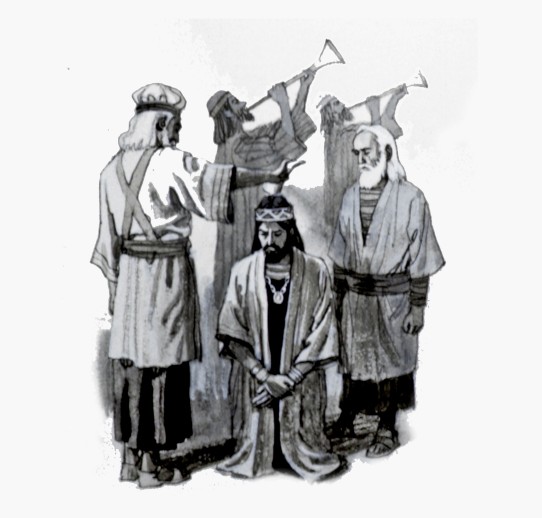
While David was still living, he arranged for his son Solomon to become king

While David was still living, he arranged for his son Solomon to become king

Psalm 72 is the last psalm in “book 2” of the Psalms, and contains the books doxology at the end.  The superscription deems it a song “of” Solomon, obviously as the young heir to David’s throne.  Some have attributed authorship to Solomon himself, but Matthew Henry’s view that it is David’s prayer on behalf of Solomon is likely correct.

There are some obvious Messianic aspects to the psalm in addition to the obvious parts in which there is fervent prayer for the earthly king.  The care for the poor and the needy in verse 4 certainly sounds like Jesus during His ministry; and verses 12-14 referring to one who delivers and redeems are pointing to Him as well.

The prayer ends with the doxology and praise to the Lord:  “Blessed be his glorious name forever; may the whole earth be filled with his glory!  Amen and Amen!”  The last line – “The prayers of David, the son of Jesse, are ended” could refer to this psalm, but could also refer to the assembling of this section of the psalms by the psalter.  Matthew Henry took the view that it referred to the ending of Psalms 71 and 72 as a whole, having been written in David’s old age.  Now with a young king to take his place, his “prayers have ended.”

Read or listen to audio of ESV version of this selection from this link.

/Bob’s boy
___________________
some images © V. Gilbert & Arlisle F. Beers

Please note: I did not design the reading plan that I am following in my blog.  All of my comments in this blog, however, are solely my responsibility.  When reading ANY commentary, you should ALWAYS refer first to the scripture, which is God’s unchanging and unfailing word. Reading schedules, as well as a link to the site where you can get the reading plan that I’m currently following for yourself can be found on the “Bible Reading Schedules” page of my website at http://graceofourlord.com.  For questions and help, please see the “FAQ” and “Summaries” pages there.

Job 19 – “My Redeemer Lives”

English: An early engraving by Blake for the B...

English: An early engraving by Blake for the Book of Job (Photo credit: Wikipedia)

We’ve said before that reading the Book of Job can be challenging.  By the time you reach this chapter, even with all of the poetry, it can be difficult to stay focused on getting meaning from all of the speeches by Job and his friends.  If you aren’t careful, you can totally miss “the point” in some chapters.  This is one such chapter.

In verses 1-22, he begs his friends to stop tormenting him with their words of judgment, not even being able to name what his sin might be.  He eloquently, but sadly, speaks of his pitiful state, and all of the abuse, abandonment, and even mockery by friends, family, strangers – even children.  He speaks at some length at how God has allowed all of this to befall him.

Then in verse 23 it takes a different turn, and in 25-26 (the NASB has the most accurate translation here), he says:

“As for me, I know that my Redeemer lives,
And at the last He will take His stand on the earth.
Even after my skin is destroyed,
Yet from my flesh I shall see God”

There are several things to note here.  First, the Book of Job is part of the inspired word of God,; and as such, it’s author (possibly Job himself) was guided by the Holy Spirit. Secondly, with some notable exceptions, the Old Testament is less vocal on the subject of life after death, but it seems clear here that Job believes in a physical resurrection.  Abraham believed in physical resurrection as well (Hebrews 11:19).  Third, the certainty Job has that his “redeemer lives” has been a gradual progression through these chapters.  In Job 9:33 he begins to wish for an arbiter or “umpire” between himself and God.  In Job 16:19, he says:

“Even now, behold, my witness is in heaven,
and he who testifies for me is on high.”

In Job 17:3, he asks God to be his surety, his guarantor. In Job 16:20-21, he says “my eye pours out tears to God, that he would argue the case of a man with God.”  As Peter told us in 1 Peter 1:10-12, the prophets of the Old Testament did not always know the full ultimate development of all of their prophecies, but Job’s insight grows slowly each chapter.  He would have no way of knowing about Jesus, but he now sees God Himself as his Redeemer – the one who would stand for Him in the end before God Himself.

Read or listen to audio of ESV version of this selection from this link.

/Bob’s boy
___________________
some images © V. Gilbert & Arlisle F. Beers

Please note: I did not design the reading plan that I am following in my blog.  All of my comments in this blog, however, are solely my responsibility.  When reading ANY commentary, you should ALWAYS refer first to the scripture, which is God’s unchanging and unfailing word. Reading schedules, as well as a link to the site where you can get the reading plan that I’m currently following for yourself can be found on the “Bible Reading Schedules” page of my website at http://graceofourlord.com.  For questions and help, please see the “FAQ” and “Summaries” pages there.

Psalm 61 – Lead Me to the Rock

As a lament, Psalm 61, though very short,  is one of the more beautiful, and one of the better known hymns that come from it is  “The Rock that is Higher than I” (verse 2).  Most scholars believe that this psalm was written during the time of Absalam’s conspiracy and David’s flight from Jerusalem (2 Samuel 15-18).  It is viewed as an individual lament, as David is asking the Lord to “hear my cry” (verse 1) and “prolong the life of the king” (verse 6).

mountain_003But as short as it is, it obviously is more than that, and it is easy to see why it has been popular for so long as both a congregational song and morning prayer.  Consider verse 2 “from the end of the earth I call to you when my heart is faint. Lead me to the rock that is higher than I.”  Then consider verse 5: “you have given me the heritage of those who fear your name.” 

That heritage is the covenant God made with David in 2 Samuel 7 – that of our Lord Jesus coming through the Davidic line.  The rest of verse 6 and verse 7 cinch it, as David finishes his prayer making it obvious that it was written after that covenant was made: “Prolong the life of the king; may his years endure to all generations! May he be enthroned forever before God…”

Read or listen to audio of ESV version of this selection from this link.

/Bob’s boy
___________________
some images © V. Gilbert & Arlisle F. Beers

Please note: I did not design the reading plan that I am following in my blog.  All of my comments in this blog, however, are solely my responsibility.  When reading ANY commentary, you should ALWAYS refer first to the scripture, which is God’s unchanging and unfailing word. Reading schedules, as well as a link to the site where you can get the reading plan that I’m currently following for yourself can be found on the “Bible Reading Schedules” page of my website at http://graceofourlord.com.  For questions and help, please see the “FAQ” and “Summaries” pages there.

Proverbs 28 – Character

Sunrise_over_MauiThis chapter has plenty of verses comparing the righteous to the unrighteous.  Verse 1 (“The wicked flee when no one pursues, but the righteous are bold as a lion”) and verse 6 (“Better is a poor man who walks in his integrity than a rich man who is crooked in his ways”) caught our attention.  The former perhaps having more to do with conscience than the latter.  But both obviously addressing matters of character.

Always trying to do the right thing definitely has multiple benefits from the perspective of both verses.  Peace of mind, confidence, and never having to look over your shoulder are worth a lot.  The satisfaction that  comes from having that kind of character is priceless.  By “walking in integrity,” we come out ahead now, and we surely will come out ahead when our walk in this world is done.  Many radio and TV show “man on the street” type of interviews often revolve around the question of  “what would you do for a million dollars?”  Money can’t buy any of those important things we just mentioned, so why should our integrity be for sale?

Read or listen to audio of ESV version of this selection from this link.

/Bob’s boy
___________________
some images © V. Gilbert & Arlisle F. Beers

Please note: I did not design the reading plan that I am following in my blog.  All of my comments in this blog, however, are solely my responsibility.  When reading ANY commentary, you should ALWAYS refer first to the scripture, which is God’s unchanging and unfailing word. Reading schedules, as well as a link to the site where you can get the reading plan that I’m currently following for yourself can be found on the “Bible Reading Schedules” page of my website at http://graceofourlord.com.  For questions and help, please see the “FAQ” and “Summaries” pages there.

Psalm 119:145-152; Psalm 93 – The Lord Reigns

qophThis stanza of Psalm 119 begins each verse with the Hebrew letter “qoph,” the 19th letter of the Aleph-Bet.  The origin of the letter, which resembles the English letter “P,” is sometimes said to be a sewing needle.  Others say it is the human neck and head.  The focus of the stanza is on calling on the Lord  in times of trouble, and of assurance that He is near always.

Psalm 93 is a song of praise to God as King and ruler of the universe, similar to the longer Psalm 29.  It has the distinct air of having been written at a time when God’s people had been in peril from an outside enemy or enemies (the “floods” of verse 3), recognizing that God is “mightier than the waves of the sea” (verse 4).  It gives God the glory for holding the universe in stability (verses 1-2), and for the absolute truth of His word (verse 5).

Read or listen to audio of ESV version of this selection from this link.

/Bob’s boy
___________________
some images © V. Gilbert & Arlisle F. Beers

Please note: I did not design the reading plan that I am following in my blog.  All of my comments in this blog, however, are solely my responsibility.  When reading ANY commentary, you should ALWAYS refer first to the scripture, which is God’s unchanging and unfailing word. Reading schedules, as well as a link to the site where you can get the reading plan that I’m currently following for yourself can be found on the “Bible Reading Schedules” page of my website at http://graceofourlord.com.  For questions and help, please see the “FAQ” and “Summaries” pages there.

Old Testament Facts – Why Read Leviticus?

The third book of the Pentateuch (the Books of Law) – Leviticus – is one of the least understood books of the Bible and, not surprisingly, one of the least read.  Many “read the whole Bible in a year” reading plans have come to a dead stop in the early chapters of this book.  And without question, it can be a difficult book to get through.  But there is much to learn from it that is very relevant to our understanding of the worship of the Lord and the ultimate coming of Jesus the Christ.

Leviticus

In the Septuagint, this book is called “leyitikon,” which means “things concerning Levites.”  There is much that applies to God’s people in general, both with moral and ethical values, as well as with ritual purity.  But the name is appropriate because the Levites were those that were charged with seeing that ritual adherence was maintained. 

It is important for those who read these Scriptures today to remember that although some aspects of these rituals seem strange and difficult at times to understand, it is still the word of God, and there is much we can learn from it.  This is especially true as we relate it to the sacrifice of Jesus Christ, which unlike these offerings, provides for true forgiveness.  A close study of the different offerings will give the reader a deeper understanding and appreciation of the cross.  It is important in that study to know that ritual “uncleanness” and purity have nothing to do with hygiene; and equally important to know the difference (as well as the connection) with moral purity.

So what can we possibly learn from Leviticus that is relevant to New Testament Christianity?

The answer, it turns out, is plenty:

  • The Lord is to dwell with them (Exodus 40:34), so it is the duty of His people to deal with their sins and drive themselves toward holiness.
  • The Lord expects worship to Him to be done according to His will, and He does “sweat the details” (Leviticus 22:17-30)
  • As per the Day of Atonement ritual (Leviticus 16), the cleansing of sins is impossible from the human side.
  • Spiritual leaders bear a heavy burden of responsibility (Leviticus 4, Lev 21).  Compare to elders in 1 Timothy 5:17-25, for example.
  • Sin is dealt with by the grace of the Lord (Leviticus 17:11).

   Key Concepts and Events

/Bob’s boy
___________________
image © V. Gilbert & Arlisle F. Beers


Psalm 69 – Deliver Me

depression_002This psalm is another of those that apply both to David and to Jesus.  Whether from a time when David was on the run from Saul, we do not know, nor does it matter.  He is crying out to God, clearly suffering and just as clearly afraid.  Many appeals contained in this psalm are appropriate for prayer today at times when life is bleak:

Save me, O God!
For the waters have come up to my neck.
I sink in deep mire,
where there is no foothold;
I have come into deep waters,
and the flood sweeps over me.

But the psalm is indicative of the Messiah’s plight in places as well.  Verse 4 (“They hated me without a cause”) is quoted by Jesus in John 15:25.  Verse 9 (zeal for your house has consumed me) is quoted in John 2:17.  And verse 21 (“They gave me poison for food,and for my thirst they gave me sour wine to drink”) is referred to in all four gospels (such as Luke 23:36).   Indeed, this psalm is quoted by Paul in Romans 15:3 (69:9b), Romans 11:9 (69:22), Romans 11:10 (69:23), and Acts 1:20 (69:25).

Read or listen to audio of ESV version of this selection from this link.

/Bob’s boy
___________________
some images © V. Gilbert & Arlisle F. Beers

Please note: I did not design the reading plan that I am following in my blog.  All of my comments in this blog, however, are solely my responsibility.  When reading ANY commentary, you should ALWAYS refer first to the scripture, which is God’s unchanging and unfailing word. Reading schedules, as well as a link to the site where you can get the reading plan that I’m currently following for yourself can be found on the “Bible Reading Schedules” page of my website at http://graceofourlord.com.  For questions and help, please see the “FAQ” and “Summaries” pages there.

Job 18 – Bildad: God Punishes the Wicked

Bildad’s anger at Job for his rebuke of the three friends comes out in this chapter, and he comes out swinging, saying “Why are we counted as cattle? Why are we stupid in your sight?”   He at first basically says that Job should shut his mouth and listen to them as they in their wisdom explain how his troubles can only be a result of Job’s own wickedness.

His rhetoric is beyond compassion-less – it is cruel and vindictive, using words that condemned Job as one that could not get punishment sufficient for his evil ways.  All of this comes without a single accusation.  Instead, he continues the diatribe that he and the others started concerning their great knowledge of the fate of the wicked.

But his description of all of the bad things that happen to the wicked are completely wrong, as Job has already pointed out. Some of the imagery of this darkly poetic rhetoric may be appropriate to the fate of the wicked after death, and in the judgment.  But it is even more obvious to us today that the wicked do not always suffer such fates during their lifetimes.   Bildad’s assessment is an unfortunate reflection of the attitudes many people of that time had toward others who were less fortunate – but is it so different today?

Read or listen to audio of ESV version of this selection from this link.

/Bob’s boy
___________________
some images © V. Gilbert & Arlisle F. Beers

Please note: I did not design the reading plan that I am following in my blog.  All of my comments in this blog, however, are solely my responsibility.  When reading ANY commentary, you should ALWAYS refer first to the scripture, which is God’s unchanging and unfailing word. Reading schedules, as well as a link to the site where you can get the reading plan that I’m currently following for yourself can be found on the “Bible Reading Schedules” page of my website at http://graceofourlord.com.  For questions and help, please see the “FAQ” and “Summaries” pages there.

Psalm 60 – Vain Is The Salvation of Man

A desolate wasteland south of the Dead Sea, which may have been the Valley of Salt

A desolate wasteland south of the Dead Sea, which may have been the Valley of Salt

The rather long superscription instructs the singing of this psalm to be to the tune of “Shushan Eduth” which is usually translated “the Lily of the Testimony,” which some suppose is the same song mentioned in the superscription of Psalms 45, 69, and 80.    There is no record in Scripture of the battles referred to in the first part of this superscription, which is understandable if (as some suppose from the first few verses) that they were defeats for Israel.  The victory in the last part that is ascribed to Joab (for he was David’s commander) in “the Valley of Salt” is accounted in 2 Samuel 8:13-14 and 1 Chronicles 18:12-13.   In the former, David was given the victory and in the latter, Abishai – David was his king and Joab was his commander.  So, although the superscriptions are not part of the inspired word, there is no inconsistency on that account.  As for the difference in the number of Edomites struck down, we will of course refer to the inspired word for the correct final count.

In any case, the psalm appears to be referring to the defeats mentioned above.  Verses 1-5 begin with the suggestion of God’s displeasure with them, as well as the confidence that He would come through for them in the end.  What follows in verses 6-8 is a recital by specific name of various lands that God had promised His people by general reference to Canaan.  Verses 9-12 look forward to the victory at Edom.

For us, verse 11 is the lesson (“Oh, grant us help against the foe, for vain is the salvation of man!”).  It has always been mankind’s folly to rely solely on his own capabilities.  Whether he acknowledges it or not, eventually man is dependent on God.

Read or listen to audio of ESV version of this selection from this link.

/Bob’s boy
___________________
some images © V. Gilbert & Arlisle F. Beers

Please note: I did not design the reading plan that I am following in my blog.  All of my comments in this blog, however, are solely my responsibility.  When reading ANY commentary, you should ALWAYS refer first to the scripture, which is God’s unchanging and unfailing word. Reading schedules, as well as a link to the site where you can get the reading plan that I’m currently following for yourself can be found on the “Bible Reading Schedules” page of my website at http://graceofourlord.com.  For questions and help, please see the “FAQ” and “Summaries” pages there.

Proverbs 27 – On Trusted Friends

Proverbs 18:24 reads: “A man of many companions may come to ruin, but there is a friend who sticks closer than a brother.”  We all know that there are different degrees of friendship.  There are some that are little more than acquaintances in reality.  At different times in our lives, there may be those whose company we enjoy immensely; and we may we even spend countless hours with such.  But when times get tough, can these friends be counted on to stand by us?  The truth is – not always.  Verse 10 of chapter 27 advises:

“Do not forsake your friend and your father’s friend,
and do not go to your brother’s house in the day of your calamity

friendship01The first part of the verse has a couple of things to take away from it.  First, it entreats us to know our true friends.  “Your friend and your father’s friend” exemplifies a very long-standing relationship.  Fair-weather friends and mere companions will come and they will certainly go.  But one who remains our friend over a very long time has stood the test of time because that friend will have been there through the good times as well as the bad.  The other thing to take away from it is more important – that we do not forsake such friends.  We are to be the sort of friend that stands the test of time for them, for there will come a time when they need us to be there for them.   How sad if we should fail them in that time.

Having understood and lived according to the first part of the verse, the second part is self-evident.   When we have built such a relationship in concert with such a friend, it is to that friend that we will turn in time of tragedy, and often that may means doing so rather than turning to a relative.  How much better for the Christian today, if the friendship has been built with a “brother” (or sister) in Christ -with the type of friend that will encourage us, as well as hold us accountable to our commitment to the Lord?

Read or listen to audio of ESV version of this selection from this link.

/Bob’s boy
___________________
some images © V. Gilbert & Arlisle F. Beers

Please note: I did not design the reading plan that I am following in my blog.  All of my comments in this blog, however, are solely my responsibility.  When reading ANY commentary, you should ALWAYS refer first to the scripture, which is God’s unchanging and unfailing word. Reading schedules, as well as a link to the site where you can get the reading plan that I’m currently following for yourself can be found on the “Bible Reading Schedules” page of my website at http://graceofourlord.com.  For questions and help, please see the “FAQ” and “Summaries” pages there.