Psalm 136 – Give Thanks To the God of Heaven

English: An image of Psalm 23 (King James' Ver...

English: An image of Psalm 23 (King James’ Version), frontispiece to the 1880 omnibus printing of The Sunday at Home. Scanned at 800 dpi. Français : Illustration du Psaume 23 (version autorisée par le roi Jacques), en frontispice de l’édition omnibus du Sunday at home. Version numérisée à 800 dpi. (Photo credit: Wikipedia)

Ok, so I blew it. In a recent blog about another psalm, I had the choice of several ways to go in choosing a title. But I chose “His Steadfast Love Endures Forever” because of the repetition of the phrase in the psalm.  Well guess what? I should have remembered that was true of other chapters of books in the Bible. Psalm 136 repeats this phrase in every one of its 26 verses! So I went with the opening line of its 26th verse – “Give thanks to the God of heaven.” Since this is indeed what the entire psalm actually does, I think it works anyway.

The psalm is very much a psalm of praise and thanksgiving; and like Psalm 135, it goes through several key events in the history of God’s people to do so. It is a very easy and fulfilling psalm to read; and it gives us much to be thankful and praise God for today as well. As verse 24-25 say “It is he who remembered us in our low estate,…and rescued us from our foes,…he who gives food to all flesh,

For his steadfast love endures forever.”

Read or listen to audio of ESV version of this selection from this link.

/Bob’s boy
___________________
some images © V. Gilbert & Arlisle F. Beers

Please note: I did not design the reading plan that I am following in my blog.  All of my comments in this blog, however, are solely my responsibility.  When reading ANY commentary, you should ALWAYS refer first to the scripture, which is God’s unchanging and unfailing word. Reading schedules, as well as a link to the site where you can get the reading plan that I’m currently following for yourself can be found on the “Bible Reading Schedules” page of my website at http://graceofourlord.com.  

Job 34:16-37 – For You Must Choose

The Wrath of Elihu, from the Butts set. Pen an...

The Wrath of Elihu, from the Butts set. Pen and black ink, gray wash, and watercolour, over traces of graphite (Photo credit: Wikipedia)


When writing about this chapter, Coffman made the observation that the entire Book of Job appears to have the purpose of showing man that it is a fallacy to believe that God immediately punishes man on this earth for his sins. That does indeed ring out as a clear assessment of one of the biggest lessons we learn from the book. And Elihu does himself make a substantial contribution to that outlook, as his reasoning and his accusations are both more hurtful to Job, and greatly indicative of an outlook on God and His ways that is simply and terribly wrong.


But it is Elihu’s statements attacking Job’s character that are the most surprising about Elihu’s mistakes. He says in verse 35 that “‘Job speaks without knowledge; his words are without insight.’” Then, at the end of the chapter, Elihu makes what are perhaps his cruelest statements considering Job:


Would that Job were tried to the end,
because he answers like wicked men.
For he adds rebellion to his sin;
he claps his hands among us
and multiplies his words against God.”


Read or listen to audio of ESV version of this selection from this link.


/Bob’s boy


___________________


some images © V. Gilbert & Arlisle F. Beers


Please note: I did not design the reading plan that I am following in my blog.  All of my comments in this blog, however, are solely my responsibility.  When reading ANY commentary, you should ALWAYS refer first to the scripture, which is God’s unchanging and unfailing word. Reading schedules, as well as a link to the site where you can get the reading plan that I’m currently following for yourself can be found on the “Bible Reading Schedules” page of my website at http://graceofourlord.com.  For questions and help, please see the “FAQ” and “Summaries” pages there.


Psalm 102 – In the Day of My Distress

Hebrew Psalmist from the Brooklyn Museum

Hebrew Psalmist from the Brooklyn Museum (Photo credit: Wikipedia)

As one reads Psalm 102, there can be no doubt that it was written during the time of Babylonian captivity. Verses 13-21 particularly make it clear that this was the time and setting in which the psalmist lived. And this psalmist must have remembered Jeremiah’s prediction of 70 years in captivity (Jeremiah 25:8-11), as he says in verse 13, confident that the end of captivity is near:

You will arise and have pity on Zion;
it is the time to favor her;
the appointed time has come

Coffman describes three divisions to the psalm: “(1) Psalms 102:1-11 describes the terrible sufferings of the afflicted one. (2) Psalms 102:12-22 dwells upon the hopes for relief. (3) And Psalms 102:23-28 speaks of the unchanging God as contrasted with the changing world.”

Below are verses 25-27 containing the comforting words the psalmist with regards to that third point in relation to the oppressors:

Of old you laid the foundation of the earth,
and the heavens are the work of your hands.
They will perish, but you will remain;
they will all wear out like a garment.
You will change them like a robe, and they will pass away,
but you are the same, and your years have no end.

Read or listen to audio of ESV version of this selection from this link.

/Bob’s boy
___________________
some images © V. Gilbert & Arlisle F. Beers

Please note: I did not design the reading plan that I am following in my blog.  All of my comments in this blog, however, are solely my responsibility.  When reading ANY commentary, you should ALWAYS refer first to the scripture, which is God’s unchanging and unfailing word. Reading schedules, as well as a link to the site where you can get the reading plan that I’m currently following for yourself can be found on the “Bible Reading Schedules” page of my website at http://graceofourlord.com.  
Proverbs 22 – Words of the Wise

Verse 17-19 of Proverbs 22 make up the prologue to what some call “The Thirty Words” or “Thirty Sayings” that will continue from verse 22 all the way through to the end of Proverbs 24. Here are the writer’s words that introduce them:

Incline your ear, and hear the words of the wise,
and apply your heart to my knowledge,
for it will be pleasant if you keep them within you,
if all of them are ready on your lips.
That your trust may be in the Lord,
I have made them known to you today, even to you.
Have I not written for you thirty sayings
of counsel and knowledge,
to make you know what is right and true,
that you may give a true answer to those who sent you?

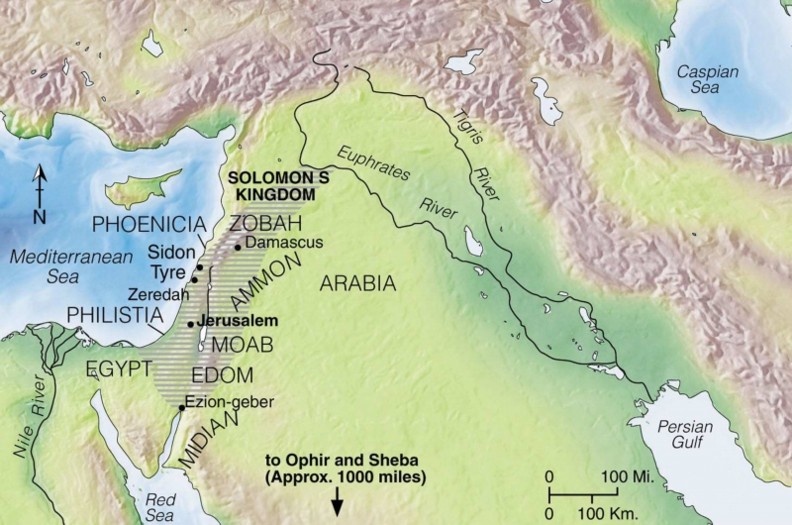
Solomon's fame regarding his wisdom and wealth spread throughout the ancient world, even as far away as Ophir and Sheba. It is not certain where Sheba is exactly, but many scholars believe it may have been located along the Red Sea on the Arabian peninsula.The Temple that Solomon built for the Lord drew upon the vast wealth of his enormous kingdom. Once it was completed, Solomon's Temple was no doubt one of the great wonders of its time. Solomon's reputation brought acclaim and riches from many nations, but he disobeyed God, marrying pagan women and worshiping their gods. So God raised up enemies like Hadad from Edom and Rezon from Zobah (modern-day Syria). Jeroboam from Zeredah was another enemy who would eventually divide this mighty kingdom.

Solomon’s fame regarding his wisdom and wealth spread throughout the ancient world, even as far away as Ophir and Sheba. It is not certain where Sheba is exactly, but many scholars believe it may have been located along the Red Sea on the Arabian peninsula.
The Temple that Solomon built for the Lord drew upon the vast wealth of his enormous kingdom. Once it was completed, Solomon’s Temple was no doubt one of the great wonders of its time. Solomon’s reputation brought acclaim and riches from many nations, but he disobeyed God, marrying pagan women and worshiping their gods. So God raised up enemies like Hadad from Edom and Rezon from Zobah (modern-day Syria). Jeroboam from Zeredah was another enemy who would eventually divide this mighty kingdom.

These verses state the purpose of the “thirty words” – that the reader, or those who hear them, will apply them to their heart, know that they are true, and trust in the Lord.  Thus the reader will be able to communicate these truths to others with clarity and confidence. These thirty sayings are two line couplets admonishing the reader to pay heed to advice about many matters that are important to the Lord, and that are beneficial to one’s well-being in navigating life. They each also contain the desired and expected result that will come from heeding or not heeding these admonitions.

Saying one, in verse 22, begins with one that is most dear to the Lord’s heart – and hammered home again and again by our Lord and Savior, Jesus Christ. We are expected (commanded) to treat the poor with dignity, love and respect – making it clear, as all scripture does, that the Lord values the poor, and that He abhors those who mistreat them.

“Do not rob the poor, because he is poor, or crush the afflicted at the gate, for the Lord will plead their cause and rob of life those who rob them.”

Read or listen to audio of ESV version of this selection from this link.

/Bob’s boy
___________________
some images © V. Gilbert & Arlisle F. Beers

Please note: I did not design the reading plan that I am following in my blog.  All of my comments in this blog, however, are solely my responsibility.  When reading ANY commentary, you should ALWAYS refer first to the scripture, which is God’s unchanging and unfailing word. Reading schedules, as well as a link to the site where you can get the reading plan that I’m currently following for yourself can be found on the “Bible Reading Schedules” page of my website at http://graceofourlord.com.  For questions and help, please see the “FAQ” and “Summaries” pages there.
Psalm 138 – Give Thanks To the Lord

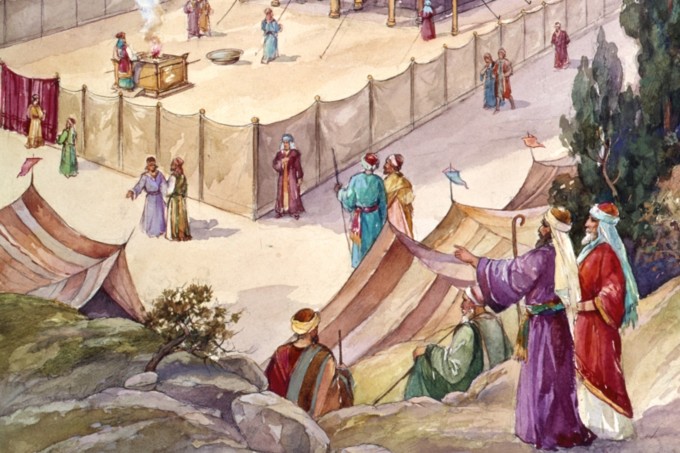
Moses makes the tabernacle in the wilderness -- Exodus 35-40.

Moses makes the tabernacle in the wilderness — Exodus 35-40.

This is another psalm of David to which there has been dispute concerning the authorship – mainly because of this one’s reference to the Lord’s Holy Temple. It seems clear, however, that the psalmist could just as easily be referring to the Tabernacle as to Solomon’s temple – the terms are inter-changeable throughout the scriptures.

The psalm is only eight verses long, but is powerfully written as a hymn of thanksgiving. The second part of verse one is a bit disturbing to some, as it finishes out the verse of praise with the phrase “before the gods I sing your praise.” But it must be remembered that this term “gods” refers not to deity, but to rulers, elders, and such that are held in higher esteem than others (as in Psalm 95:3 and Psalm 82:6). Verse 8 seems to solidify Davidic authorship, with what appears to be a reference to God’s promises to him in 2 Samuel 7:

The Lord will fulfill his purpose for me;
your steadfast love, O Lord, endures forever

Read or listen to audio of ESV version of this selection from this link.

/Bob’s boy
___________________
some images © V. Gilbert & Arlisle F. Beers

Please note: I did not design the reading plan that I am following in my blog.  All of my comments in this blog, however, are solely my responsibility.  When reading ANY commentary, you should ALWAYS refer first to the scripture, which is God’s unchanging and unfailing word. Reading schedules, as well as a link to the site where you can get the reading plan that I’m currently following for yourself can be found on the “Bible Reading Schedules” page of my website at http://graceofourlord.com.  

Major Prophets (part 5) – Book of Daniel

English: Shadrach, Meshach and Abednego in the...

English: Shadrach, Meshach and Abednego in the Furnace (Dan. 3:23-24,91-98) Русский: Седрах, Мисах и Авденаго в раскалённой печи (Дан. 3:23-24,91-98) (Photo credit: Wikipedia)

In 605 B.C., Nebuchadnezzar brought young men of noble heritage in Judah back for service in the king’s court. Daniel and his friends were part of one of these groups (Daniel 1:3). So his life in captivity was quite different from that of Ezekiel and many others less fortunate. According to Daniel 1:21, he served there until the first year of the reign of Cyrus, which would be about 538 B.C.

Daniel is a very important book in the Old Testament. It contains much prophecy that was fulfilled with undeniable accuracy (critics and skeptics notwithstanding). As has always been the case, even disputed passages have held up under the test of time (take, for example, Daniel’s use of the name Belshazzar in Daniel 5). It also teaches through Daniel’s life and that of his friends, Shadrach, Meshach,, and Abednego, a great deal about living faithfully under very great adversity. Finally, and most importantly, it teaches us much about the power of God, and His faithfulness to His word.

Daniel's Answer to the King

Daniel’s Answer to the King (Photo credit: Wikipedia)

The fulfilled prophecies from the Book of Daniel are a great source of assurance to believers for their accuracy. Skeptics and critics, as is always the case, dispute much concerning them of course. But they too have stood the test of time. A detailed account and analysis of all of these in one blog would be an exercise in futility. But for some great analysis of two of them, as well as answers for critics, take a look at this article from Apologetics Press concerning Daniel 2, and this article concerning prophecies in Daniel 8.

Belshazzar's Feast depicts a vision described ...

Belshazzar’s Feast depicts a vision described in the biblical Book of Daniel. –31&src= Daniel 5:1–31 (Photo credit: Wikipedia)

Summary

/Bob’s boy
___________________
image © V. Gilbert & Arlisle F. Beers

Please note: I did not design the reading plan that I am following in my blog.  All of my comments in this blog, however, are solely my responsibility.  When reading ANY commentary, you should ALWAYS refer first to the scripture, which is God’s unchanging and unfailing word. Reading schedules, as well as a link to the site where you can get the reading plan that I’m currently following for yourself can be found on the “Bible Reading Schedules” page of my website at http://graceofourlord.com.  

Psalm 135 – Whatever the Lord Pleases

English: Scroll of the Psalms

English: Scroll of the Psalms (Photo credit: Wikipedia)


This is another “Hallelujah Psalm,” but not to be confused with one of the “Hallel” (Psalms 113-118). It begins and ends by praising and blessing God. The praise covers several times and events in the history of Israel, beginning with God choosing Jacob (Israel) for His own (verse 4).


Verses 5-7 praise God for His majesty and power over earth wind, sea and sky. Verses 8-9 contain specific praise for God’s signs and works against Egypt and Pharaoh, while verses 10-12 speak of his victories over the kings in Canaan, giving their land to Israel. Verses 15-18 praise God, while pointing out silliness of worshiping idols, which are unreal, nonliving, and unintelligent.


The psalm is called a mosaic (Spurgeon said a “tessellated pavement) because there are so many parts of it that are found or quoted in other books of the Old Testament. Verses 1-2 are taken from Psalm 134:1-3, verse 5 from Exodus 18:11,  verse 7 is like Jeremiah 10:13, and verses 15-18 are like Psalm 115:4-8. There are several others.


This harmonious and  poetic arrangement of praise verses was compared also by one writer to flowers arranged in a bouquet. It is a fitting description, and a just reason for the servant of God to present such to the Lord. As Barnes said, “the whole design of the psalm is to excite praise to God, and to show reasons for doing so.” To this end, the psalm does a very good job indeed.


Read or listen to audio of ESV version of this selection from this link.


/Bob’s boy


___________________


some images © V. Gilbert & Arlisle F. Beers


Please note: I did not design the reading plan that I am following in my blog.  All of my comments in this blog, however, are solely my responsibility.  When reading ANY commentary, you should ALWAYS refer first to the scripture, which is God’s unchanging and unfailing word. Reading schedules, as well as a link to the site where you can get the reading plan that I’m currently following for yourself can be found on the “Bible Reading Schedules” page of my website at http://graceofourlord.com.  


Job 34:1-15 – The Almighty Will Not Pervert Justice

Elihu continues his rebuke of Job, beginning with a call for the wise men to test his words with their ears. He says that Job has claimed that he is in the right, and that God has taken that away from him, so that now he is counted as a liar, even though he is right.  At this, Elihu becomes even more insulting to Job that any of the others had been in the previous chapters. Verses 7 and 8 pose the insulting statement/questions:

What man is like Job,
who drinks up scoffing like water,
who travels in company with evildoers
and walks with wicked men?

The Wrath of Elihu, from the Butts set. Pen an...

The Wrath of Elihu, from the Butts set. Pen and black ink, gray wash, and watercolour, over traces of graphite (Photo credit: Wikipedia)

Although Job has made the point that the wicked and the righteous suffer the same fates in life on this earth, he did not make the statement that Elihu claims he made in verse 9: “For he has said, ‘It profits a man nothing that he should take delight in God.’” He uses this deception to spring into his defense of God, making observations that nobody – not even Job – has dispute with. He says that God does not do wickedly, and will not pervert justice. And it is here that he does sound like the three friends, as he says in verse 11: “For according to the work of a man he will repay him, and according to his ways he will make it befall him.”

Read or listen to audio of ESV version of this selection from this link.

/Bob’s boy
___________________
some images © V. Gilbert & Arlisle F. Beers

Please note: I did not design the reading plan that I am following in my blog.  All of my comments in this blog, however, are solely my responsibility.  When reading ANY commentary, you should ALWAYS refer first to the scripture, which is God’s unchanging and unfailing word. Reading schedules, as well as a link to the site where you can get the reading plan that I’m currently following for yourself can be found on the “Bible Reading Schedules” page of my website at http://graceofourlord.com.  For questions and help, please see the “FAQ” and “Summaries” pages there.

Psalm 94 – The Lord Will Not Forsake His People

Babylonian captivity

Babylonian captivity (Photo credit: jimforest)

This psalm appears not to have been written during a time of oppression by a foreign foe, but rather it sounds more like the sufferings due to the wickedness and oppression of Israel’s own rulers. No date or author can be reliably gleaned from the words therein, but if one had to make a guess, then a time preceding the Babylonian captivity would fit the descriptions very well. A time during the reign of Manasseh would fit very well indeed (2 Kings 21).

It describes an arrogant group of sinners that have become so secure in their evil, that they do not believe that God will punish them for such depravity. But it also describes the trust that the faithful have that God will take His vengeance with those evil-doers, and that He will remain faithful to His promises to the righteous who are suffering. Many of the comforting verses are most suitable for prayer today:

For the Lord will not forsake his people;
he will not abandon his heritage;
for justice will return to the righteous,
and all the upright in heart will follow it

When I thought, “My foot slips,”
your steadfast love, O Lord, held me up.
When the cares of my heart are many,
your consolations cheer my soul.
…But the Lord has become my stronghold,
and my God the rock of my refuge.

Read or listen to audio of ESV version of this selection from this link.

/Bob’s boy
___________________
some images © V. Gilbert & Arlisle F. Beers

Please note: I did not design the reading plan that I am following in my blog.  All of my comments in this blog, however, are solely my responsibility.  When reading ANY commentary, you should ALWAYS refer first to the scripture, which is God’s unchanging and unfailing word. Reading schedules, as well as a link to the site where you can get the reading plan that I’m currently following for yourself can be found on the “Bible Reading Schedules” page of my website at http://graceofourlord.com.  

Proverbs 21 – Finding Life, Righteousness, and Honor

The truths proclaimed in the proverbs often can be found in other scriptures, sometimes worded perhaps a little differently, but with the same meaning. That’s the thing about truth – it is consistently true. What a blessing it is that we can depend on God’s word to always be so consistent for the same reasons! Consider verse 21 of this chapter in the Book of Proverbs:

Whoever pursues righteousness and kindness
will find life, righteousness, and honor

Church of the Beatitudes, located on one traditional site where Jesus gave the Sermon on the Mount.

Church of the Beatitudes, located on one traditional site where Jesus gave the Sermon on the Mount.

Sound familiar? It should. Jesus said it again a bit differently in what we call the Beatitudes – Matthew 5:6“Blessed are those who hunger and thirst for righteousness, for they shall be satisfied.” Like the Beatitudes, The Book of Proverbs gives us wonderful truths and great instructions for how to navigate through life in a fallen world.

Notice that the verse above includes kindness with righteousness. Jesus spoke of both, but he made it clear that each of them of a necessity includes the other. We were brought into this world to serve – to serve God and to serve each other. There are many such passages that tell us so. One of them is found in Galatians 5:13: “For you were called to freedom, brothers. Only do not use your freedom as an opportunity for the flesh, but through love serve one another.” We are blessed in so many ways, only one of which is that we have a God – a God who knows what is best for us, and what will bring us true happiness.

When we direct our lives about the business of sowing righteousness and kindness, we will reap exactly those things. Honor comes by itself as a gift without seeking it – a further blessing for simply doing the right thing in all that we do.

Read or listen to audio of ESV version of this selection from this link.

/Bob’s boy
___________________
some images © V. Gilbert & Arlisle F. Beers

Please note: I did not design the reading plan that I am following in my blog.  All of my comments in this blog, however, are solely my responsibility.  When reading ANY commentary, you should ALWAYS refer first to the scripture, which is God’s unchanging and unfailing word. Reading schedules, as well as a link to the site where you can get the reading plan that I’m currently following for yourself can be found on the “Bible Reading Schedules” page of my website at http://graceofourlord.com.  For questions and help, please see the “FAQ” and “Summaries” pages there.