Numbers 13 – Spies Sent into Canaan

English: The Spies Return from Canaan, engravi...

Image via Wikipedia

We take the story of God’s word up now almost half way into the Book of Numbers.  The people of Israel left Sinai in chapter 10 and the Lord makes the command for one leader from each of the tribes of their fathers to be sent into the land of Canaan to spy.  Notice the reminder in verse 2 that this is the Land that He is giving to the people of Israel.  But except for Joshua and Caleb, the spies forget the promise.  After 40 days travel through the Negeb (or Negev), Hebron. Ahiman, Sheshai, and Talmai, they bring back a report that the land is indeed good.  But their description of the way the land is defended, and indeed the people themselves (verses 32-33) is calculated to persuade the people that taking the land would be impossible.

(Side note: Some background on the Negeb (or Negev) along with a modern photo are provided in this article at Ferrell’s Travel Blog)

Read or listen to audio of ESV version of this selection from this link.

/Robert
___________________
some images © V. Gilbert & Arlisle F. Beers

Please note: I did not design the reading plan that I am following in my blog.  All of my comments in this blog, however, are solely my responsibility.  When reading ANY commentary, you should ALWAYS refer first to the scripture, which is God’s unchanging and unfailing word. Reading schedules, as well as a link to the site where you can get the reading plan that I’m currently following for yourself can be found on the “Bible Reading Schedules” page of my website at http://graceofourlord.com.  For questions and help, please see the “FAQ” and “Summaries” pages there.

Exodus 40 – The Tabernacle Erected

The Tabernacle, Camp, & c.

Image via Wikipedia

Chapter 40 is extremely momentous in the story of God’s people and our salvation.  After the golden calf disaster, the covenant with the Lord has been renewed, the instructions for the construction of the Tabernacle were given; and in verses 16-19, it was erected as the Lord commanded a year after they came to Sinai (verse 17 – “the first month in the second year, on the first day of the month”).  The previous chapters were rich with the description of the tabernacle in every particle, showing us that God does indeed care about the details of his commands.  Here too, in verses 18-33 much detail is given; and the important preparations for Aaron and his sons to assume the role of priests for generations to come is given.  This is described further in Leviticus 8:1-13.

The Glory of the Lord in verses 34-38 is an important sign that the Lord is now dwelling among His people after He approves of the Tabernacle.  It is a presence that the people will cherish as their relationship with Him has been restored, and this momentous occasion will be repeated with much celebration after Solomon builds the Temple in 1 Kings 8:10-11.

Read or listen to audio of ESV version of this selection from this link.

/Robert
___________________
some images © V. Gilbert & Arlisle F. Beers

Please note: I did not design the reading plan that I am following in my blog.  All of my comments in this blog, however, are solely my responsibility.  When reading ANY commentary, you should ALWAYS refer first to the scripture, which is God’s unchanging and unfailing word. Reading schedules, as well as a link to the site where you can get the reading plan that I’m currently following for yourself can be found on the “Bible Reading Schedules” page of my website at http://graceofourlord.com.  For questions and help, please see the “FAQ” and “Summaries” pages there.

Exodus 33 – The Command to Leave Sinai

Climbing the trail near the summit of Mount Sinai.

Image via Wikipedia

The Lord tells Moses to take the people and leave Mount Sinai for Canaan; and again tells him that He will send an angel, but He will not go with them.  The people feel the loss in this proclamation (verse 4), and Moses intercedes.  Moses has matured, and has found favor with God, and their relationship reminds us of that of the Lord with Abraham – as verse 11 even uses the comparison of their conversations to that which occurs between friends.  God’s favor with Abraham as friend is recounted in Isaiah 41:8, where He reassures His people; as well as in James 2:23.

Moses also brings Abraham’s bargaining intercession to mind (from Genesis 18:22-33), as he pleads for the people in verses 12-16.  the Lord agrees in verse 17 because Moses has “found favor in my sight, and I know you by name.”  Despite His very real and righteous anger, the Lord seems to be training Moses as the leader that He wants him to be.  His request in verse 18 should be understood as desire for an outward sign of his favor with the Lord as His chosen leader of the people.

Read or listen to audio of ESV version of this selection from this link.

/Robert
___________________
some images © V. Gilbert & Arlisle F. Beers

Please note: I did not design the reading plan that I am following in my blog.  All of my comments in this blog, however, are solely my responsibility.  When reading ANY commentary, you should ALWAYS refer first to the scripture, which is God’s unchanging and unfailing word. Reading schedules, as well as a link to the site where you can get the reading plan that I’m currently following for yourself can be found on the “Bible Reading Schedules” page of my website at http://graceofourlord.com.  For questions and help, please see the “FAQ” and “Summaries” pages there.

Exodus 32 – The Golden Calf

English: Worshiping the golden calf, as in Exo...

Image via Wikipedia

It is hard to believe that these are the people who in Exodus 20:18-19 were so fearful and in awe of the Lord; and that in Exodus 20:23 were explicitly warned not to make idols.  Could it be any coincidence that the disaster of Jeroboam I making the two idols was done with him using almost the exact words of verse 4, when he said in 1 Kings 12:28 “Behold your gods, O Israel, who brought you up out of the land of Egypt”?  The golden calf was probably the Egyptian bull “deity” Apis.  Sadly, Aaron’s confession to Moses about what they had done is so lame in verses 22-24 – He just threw their gold into the fire, and out comes this calf!  Does any of that remind you of Adam in Genesis 3:12, as it does me?

Joshua had been waiting for Moses at his post on the mountain when he remarked to Moses that the noise from the people below sounded like war.  Notice that Moses, having been informed by the Lord, asks in verse 26 “Who is on the Lord’s side?”  When the sons of Levi come to his side, he orders them to put to death a number of those who did not come at that time – an easy detail to miss with so much happening.  In verse 29, he blesses them, saying that they have been ordained for the Lord.

But the Lord is rightfully hot with anger at this “stiff-necked people” and He wants nothing more to do with them.  Stephen refers to those who had rejected Jesus in the same way in Acts 7:51, before he is stoned.

(Side note: more information about the Egyptian idol that the calf may have been fashioned after can be found in this Wikipedia article)

Read or listen to audio of ESV version of this selection from this link.

/Robert
___________________
image © V. Gilbert & Arlisle F. Beers

Please note: I did not design the reading plan that I am following in my blog.  All of my comments in this blog, however, are solely my responsibility.  When reading ANY commentary, you should ALWAYS refer first to the scripture, which is God’s unchanging and unfailing word. Reading schedules, as well as a link to the site where you can get the reading plan that I’m currently following for yourself can be found on the “Bible Reading Schedules” page of my website at http://graceofourlord.com.  For questions and help, please see the “FAQ” and “Summaries” pages there.
Preview – In Exodus \ March Week 1 Summary Posted

Indeed, all who desire to live a godly life in Christ Jesus will be persecuted” – 2 Timothy 3:12

Today, most of us never know real persecution for our Christianity (although I assure you that even in this land that claims to be the hallmark of freedom, people and even entire organizations are persecuted every day for speaking the truth).  But the reminder for this day is that we are incredibly blessed by the many means available to us to read the Bible – in print, on the Internet, and even on our phones!

It hasn’t always been that way.  There were times not so long ago that people even had to meet secretly to hear someone read from a portion of God’s word.  Do some search engine look-ups on persecution for Bible translation and publishing, and stories of people like John Wycliffe and many others will tell you much.

We need to thank the Lord every day for the privilege we have today of having His word so easily ready for us to learn from!

Summing Up

Each weekend, I am now posting a small PDF of one week of chapter summaries (on the website’s “Summaries” page), current to the beginning of the previous week.  I have posted the summary for Week 10 (March Week 1) of the schedule I am following.  This short PDF document contains condensed comments about Exodus chapters 8, 9, 10, 11-12, and 13:17-14:31, with hyperlinks to the ESV version of each chapter for listening or reading, and joins the summaries for other weeks already posted there.

/Robert
___________________
image © V. Gilbert & Arlisle F. Beers

Please note: I did not design the reading plan that I am following in my blog.  All of my comments in this blog, however, are solely my responsibility.  When reading ANY commentary, you should ALWAYS refer first to the scripture, which is God’s unchanging and unfailing word. Reading schedules, as well as a link to the site where you can get the reading plan that I’m currently following for yourself can be found on the “Bible Reading Schedules” page of my website at http://graceofourlord.com.  For questions and help, please see the “FAQ” and “Summaries” pages there.

Exodus 24 – The Covenant Confirmed

English: The Covenant Confirmed, by John Steep...

Image via Wikipedia

Today, we move on to the 24th chapter of Exodus at the end of what is known as the Book of the Covenant, which began in chapter 20.  The covenant with the Lord is confirmed with blood (verses 6 and 8).  In verses 9-11, man eats in God’s presence – the closest yet to the relationship man had with Him in the garden of Eden.  Verse 4 is our first reference to Moses writing down the words of the Lord.

Verse 13 is our first reference to Joshua as Moses’ assistant, as he accompanies Moses until he finishes the journey into the mountain of God, where he remains for 40 days and nights.  Aaron, his sons Nadab and Abihu, and the rest of the elders also remain below, as the Lord commanded.

Read or listen to audio of ESV version of this selection from this link.

/Robert
___________________
image © V. Gilbert & Arlisle F. Beers

Please note: I did not design the reading plan that I am following in my blog.  All of my comments in this blog, however, are solely my responsibility.  When reading ANY commentary, you should ALWAYS refer first to the scripture, which is God’s unchanging and unfailing word. Reading schedules, as well as a link to the site where you can get the reading plan that I’m currently following for yourself can be found on the “Bible Reading Schedules” page of my website at http://graceofourlord.com.  For questions and help, please see the “FAQ” and “Summaries” pages there.

Exodus 20 – The Ten Commandments

English: The Ten Commandments, illustration fr...

Image via Wikipedia

The ten commandments that are given in this chapter begin with the lord reminding His people who He is that has delivered them, and that they are to revere Him as the holy one that He is.  The covenant that He makes with them demands that they worship only Him – the one true and living God.  The command not to make any idols or images for worship extends both to those representing other “gods” as well as any to Him.  This is because any image meant to reflect Him would never be sufficient to adequately represent the Lord, and man’s imperfections would only reflect badly on His perfection.

In verse 5, the reference to visiting the iniquity of the fathers on the children of other generations is a reminder to us that it is our sin that causes pain and suffering, and those consequences can often be more far-reaching than we ever imagined.  god prepared them for his command in verse 8 about the Sabbath with the introduction of the manna in chapter 16, and now shows its relation to His work in the creation.  Verse 12’s command to honor your mother and father goes far beyond simply respectful children.  It extends to how the way we live our lives reflects on them (Deuteronomy 21:18-21), as well as how we care for them as they age (Mark 7:1-13).   Verse 13 is clearly about murder and the unjust taking of life, thought man has tried to make it into many things. We all know what adultery, theft, and bearing false witness really are.  Coveting something (verse 17) encompasses the desire for what another has that becomes so strong as to bring that person to contemplate or even do unrighteous things to obtain it.

Finally, in verses 22-26, the commands about the altars with which to worship the Lord again admonish against molding images for that purpose. No hewn (or chiseled) stones are to be used in making them; and they are not to go up by steps to it and expose their nakedness – profaning worship, as the Canaanites do.  But more than that, it show that God cares very deeply about how He is worshiped by giving commands of doing it in strict detail.

Read or listen to audio of ESV version of this selection from this link.

/Robert
___________________
some images © V. Gilbert & Arlisle F. Beers

Please note: I did not design the reading plan that I am following in my blog.  All of my comments in this blog, however, are solely my responsibility.  When reading ANY commentary, you should ALWAYS refer first to the scripture, which is God’s unchanging and unfailing word. Reading schedules, as well as a link to the site where you can get the reading plan that I’m currently following for yourself can be found on the “Bible Reading Schedules” page of my website at http://graceofourlord.com.  For questions and help, please see the “FAQ” and “Summaries” pages there.

Exodus 19 – Israel at Mount Sinai

Deutsch: Sinai Halbinsel, Aussicht vom Mosesbe...

Image via Wikipedia

Verses 1-3 tell us how Israel arrives at Sinai to worship the Lord on the mountain as God told Moses they would in Exodus 3:12.  Peter refers to verses 5-6 in 1 Peter 2:9-10, as he applies what is said of the Lord’s people here to the church.  The instructions to Moses to consecrate the people and to set boundaries they cannot cross (verses 10-13, and 23-24) prepare them for life as it will be when the tabernacle is built.  The instructions for abstaining from sexual relations are merely part of the consecration at this time, and should not be construed as more.

As we have learned from other passages, the Lord could manifest Himself in any number of ways that He sees fitting.  In this case, the spectacle He creates in verses 16-20 serves to demonstrate that He has been speaking to Moses from the mountain, which is made holy because of His presence – and that the people would do well to listen to Moses.

The sights and sounds – the smoke, fire, and trembling of the mountain (verse 18) bring fear and expectation for the Lord’s people, as though something great was happening here.  And indeed it was.  The words that the Lord conveyed to Moses would shape the very lives of His people, and things would never be the same as they once were.

Read or listen to audio of ESV version of this selection from this link.

/Robert
___________________
image via Wikipedia

Please note: I did not design the reading plan that I am following in my blog.  All of my comments in this blog, however, are solely my responsibility.  When reading ANY commentary, you should ALWAYS refer first to the scripture, which is God’s unchanging and unfailing word. Reading schedules, as well as a link to the site where you can get the reading plan that I’m currently following for yourself can be found on the “Bible Reading Schedules” page of my website at http://graceofourlord.com.  For questions and help, please see the “FAQ” and “Summaries” pages there.
Exodus 17 – Water from the Rock

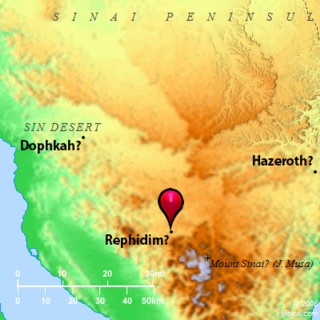
The events of this chapter, especially as referred to in verse 7, are referred to in Psalm 95:7-9.  The quarreling with Moses about water and the water from the rock are sometimes confused with what occurs in Numbers 20:2-13, wherein the Lord responds to Moses by telling him that he will not lead His people into Canaan.  The difference is that here, Moses did as God told him.  In Numbers, he disregards the Lord’s instruction, and brings the water forth in the manner that he pleases. Paul is probably alluding to the water from the rock in this chapter in relation to Jesus in 1 Corinthians 10:4.

The people of Israel face their first battle, and it is the Amalekites that attack them. The references to Moses’ hands in verses 9-12 serve as illustrations of at least a couple of things that we can learn from. It is Moses that the Lord is working though to bless the people and guide and protect them.  But Moses is just a man, and he grows weary and Aaron and Hur must help hold his hands up with the staff.  The Lord is the one with the power and He is delivering them.  But I think that we can also be reminded here that when we face difficult situations in our lives, we need to learn to lean on our brethren, and draw strength from them as we grow weary.

In verses 14-16, the Lord’s gives His judgment on the Amalekites and His statement that He “will utterly blot out the memory of Amalek from under heaven” will indeed come to pass when He is ready to do so.  The reason for His harsh judgment is not spelled out completely here, but His displeasure with them is made clear in Deuteronomy 25:17-19.

.

Read or listen to audio of ESV version of this selection from this link.

/Robert
___________________
image © V. Gilbert & Arlisle F. Beers

Please note: I did not design the reading plan that I am following in my blog.  All of my comments in this blog, however, are solely my responsibility.  When reading ANY commentary, you should ALWAYS refer first to the scripture, which is God’s unchanging and unfailing word. Reading schedules, as well as a link to the site where you can get the reading plan that I’m currently following for yourself can be found on the “Bible Reading Schedules” page of my website at http://graceofourlord.com.  For questions and help, please see the “FAQ” and “Summaries” pages there.
Exodus 16 – Bread from Heaven

Wilderness

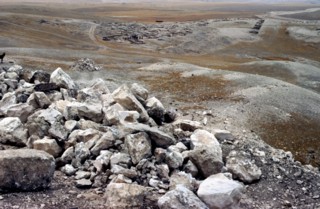
The people are hungry as they travel though the wilderness, and their grumbling begins again as they remind Moses yet again how “good” they had it back in Egypt (verse 3).  A ridiculous assertion that tends to make us shake our heads, but we weren’t wandering in that barren land.  Moses rebukes them well when he makes the Lord’s intentions known to them in verses 6-8, letting them know that they are really grumbling against the one who delivered them.  The “glory of the Lord” in verse 10 is “just” another physical manifestation of God that we will read of again in many passages.  It may be helpful to remember these passages when someone is struggling (wrestling?) with the passage about Jacob wrestling with the Lord in Genesis 32:22-30.

We still do not know what it is, but the “manna” (which sounds like “what is it”) that the lord rained down is referred to as bread.  It served the obvious purpose of feeding them for 40 years (almost as amazing as the way it was provided), but also was part of the “testing” that the Lord referred to in verse 4. They are being prepared for the way of life that God intends to present to them in the ten commandments later.  The sabbath is to be a day of rest with no gathering.  When some tried to save some for the following day, contrary to instructions, it would stink and grow worms (verse 20).   But not so with the manna they gathered the day before the sabbath – when no manna would fall (verse 27).  They would have to learn for themselves, though.

Paul quotes verse 18 in 2 Corinthians 8:15, when he is admonishing the Christians there to use their abundance to help supply the needs of other Christians.  Jesus refers to the manna in John 6:41-58, where He says that He is the bread that came down from heaven, foreshadowing His death and our salvation.  The manna was more than just nourishment for the people of Israel.  Jesus came to earth to be more than just a teacher or just a “good man,” as some would claim.

Read or listen to audio of ESV version of this selection from this link.

/Robert
___________________
image © V. Gilbert & Arlisle F. Beers

Please note: I did not design the reading plan that I am following in my blog.  All of my comments in this blog, however, are solely my responsibility.  When reading ANY commentary, you should ALWAYS refer first to the scripture, which is God’s unchanging and unfailing word. Reading schedules, as well as a link to the site where you can get the reading plan that I’m currently following for yourself can be found on the “Bible Reading Schedules” page of my website at http://graceofourlord.com.  For questions and help, please see the “FAQ” and “Summaries” pages there.