Psalm 119:89-96; Psalm 52 – The Steadfast Love of God Endures

lamedhToday’s stanza of Psalm 119 is brought to you by the letter Lamedh, the twelfth letter of the Aleph-bet.  It’s pictographic representation is that of a shepherd’s staff.  This stanza praises God for his perfection that is without limits, and for His enduring faithfulness to His promises throughout all generations.

Psalm 52 is a song of David that, according to the superscript, was written when Doeg the Edomite had betrayed David, lied to Saul, and slaughtered the priests of Nob ( Psalm 22:6-20).  Verse one would seem to be a very sarcastic statement concerning Doeg being a mighty man, as the act certainly displayed extreme cowardice.  Verses 2-4 refer to Doeg’s false report to Saul.  Ahimelech had been led by David to believe that he was on the king’s business (1 Samuel 21:1-3), yet Doeg reported it as a conspiracy between the two (1 Samuel 22:9-10).

The remainder of the psalm praises God for His righteousness and justice, declaring that people like Doeg will get their just rewards for their works of destruction.  But David expresses his confidence in trusting in God – that the faithful, who wait on Him will be vindicated and cared for.

Read or listen to audio of ESV version of this selection from this link.

/Bob’s boy
___________________
some images © V. Gilbert & Arlisle F. Beers

Please note: I did not design the reading plan that I am following in my blog.  All of my comments in this blog, however, are solely my responsibility.  When reading ANY commentary, you should ALWAYS refer first to the scripture, which is God’s unchanging and unfailing word. Reading schedules, as well as a link to the site where you can get the reading plan that I’m currently following for yourself can be found on the “Bible Reading Schedules” page of my website at http://graceofourlord.com.  For questions and help, please see the “FAQ” and “Summaries” pages there.

Understanding the Cross of Christ – Part 3 (God’s Response To Sin)

cross03In part 1 of this series, we began looking for a more informative answer to my young friend’s question (“Why would God send His only son to die?”).  The answer is of course that it was God’s plan for our salvation all along.  But a better explanation would really be aided by a better understanding of sin, atonement, and ultimately, propitiation.  In part 2, we looked at what sin is, why it matters so much to God, and why it should matter to us.  And now we turn to God’s response to sin – which, come to that, is also one of the reasons that it matters to us.

What are the consequences of sin?
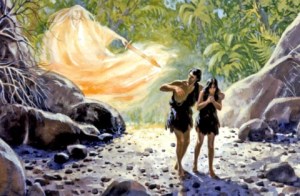
Adam and Eve expelled

When Adam and Eve obeyed Satan instead of God, God sent them from the Garden of Eden and posted an angelic being at the doorway of Eden to prevent them from entering it again (Genesis 3).

Of course, God’s first response to sin was to Adam and Eve after the fall of man, but He has given man many other earthly responses to sin.  God was so grieved by man’s wickedness that He “struck down every living creature” (that wasn’t on the ark) in a global flood in Genesis 6-8. God promised His judgment on the Canaanites in Genesis 15:13-21 and again in Deuteronomy 9:4-5 , well in advance of the Israelites’ entry into the promised land in Joshua 3.  And just as he warned them 1,000 years earlier in Deuteronomy 28:49-63, God had His people removed and taken captive for their continued disobedience, and their cherished holy city was burned (2 Kings 17, 2 Kings 24, 2 Chronicles 36:17-21).  Of course, all of these, and many other earthly judgments God has brought to pass, pale in comparison to God’s promise of eternal separation from Him and the punishment that awaits the sinful in the end – in contrast to the reward that awaits the faithful (Matthew 8:11-12, Matthew 25:45-46).

Why does God require a price to be paid for sin?

Abraham covenant-01

The Lord spoke personally with Abraham, entering into a lasting covenant with him (Genesis 17).

It is a fact that it is no accident that the Creator of life demands discipline, and that the blueprints He gives us for living our lives result in the best that life has to offer for us.  Godly living in the long and short-term always has born out that constant truth – His ways are best for us.  And it is His will for all of us to be saved (1 Timothy 2:3-4) So why does God demand a price for sin?  As we noted in part 2, God is too pure to tolerate sin (Habakkuk 1:13).  But just as importantly, He is a fair and just God (Psalm 25:8-14, 2 Thessalonians 1:6-10, Deuteronomy 32:4).  He has promised to reward us for our righteousness, just as He has promised to punish sin. He is faithful and true to all of His promises.  If it were not so – if He simply turned a blind eye to sin – how could we count on Him to keep the other promises He has made to us?

How was sin dealt with in the Old Testament?

Sacrifices and offerings to God were made by presenting them to a Levitical priest (a descendant of Levi, one of the 12 sons of Jacob).  Non-priests could not make an approach to God.  The different types of offerings are described in Leviticus 1-7.  Only the High Priest – from Aaron through the end of Eleazor’s line – approached God in the innermost part of the Tabernacle (the Most Holy place), as they did to make offering on the Day of Atonement.  This occurrence simply put off the judgment of the Lord for their sins in the past year (Leviticus 16:34).  These sacrifices and the old law were merely a shadow of the promise of what was to come (Hebrews 10:1-4).

Levitical_priesthood_diagram-01

The Levitical Priesthood

God had set apart the Levites (Numbers 3:12) and established the priesthood for His people through the lines of the three sons of Levi – all with special duties.  These were the Gershonites (Numbers 4:24-26; 7:7-8), Kohathites (Numbers 3:29-32, 1 Chron 15:1-15), and the Merarites (Numbers 3:36-37; 4:29-33).  Moses and Aaron were sons of Kohath; and it was through Aaron’s line that the priesthood continued until the destruction of Jerusalem in 70 A.D., by way of his sons Eleazor, Ithamar, and Nadab and Abihu. The latter two met their end (and that of their lines) in Leviticus 10.  Ithamar’s line ended  in 2 Kings 2:26-27 with Abiathar.  Eleazor’s line lived on until the destruction of Jerusalem in 70 A.D.

All through these ages, the promise loomed ahead of something better.  A promise that was made first in Genesis 3:15-17, and would be repeated and expounded throughout the Old Testament.  We will look closer at that promise as this series continues in part 4, taking a look at how Jesus fits into God’s plan for our salvation.

/Bob’s boy
___________________
image © V. Gilbert & Arlisle F. Beers

Please note: I did not design the reading plan that I am following in my blog.  All of my comments in this blog, however, are solely my responsibility.  When reading ANY commentary, you should ALWAYS refer first to the scripture, which is God’s unchanging and unfailing word. Reading schedules, as well as a link to the site where you can get the reading plan that I’m currently following for yourself can be found on the “Bible Reading Schedules” page of my website at http://graceofourlord.com.  For questions and help, please see the “FAQ” and “Summaries” pages there.

Psalms 46-47 – A Mighty Fortress

An early printing of Luther's hymn A Mighty Fo...

An early printing of Luther’s hymn A Mighty Fortress Is Our God (Ein feste Burg ist unser Gott) (Photo credit: Wikipedia)

Psalm 46 is famous for its first verse, which inspired Martin Luther’s hymn “A Mighty Fortress Is Our God.”  Spurgeon said of this: “There were times when Martin Luther was threatened with discouragement; but he would say, ‘Come, Philip, let us sing the 46th Psalm’; and they would sing it in Luther’s own version…This psalm is both historical and prophetic. It refers to things that happened in Israel; and it is a prophecy concerning the New Testament Church.”

In “The Tyndale Old Testament Commentary,” Old Testament scholar Frank Derek Kidner (Kidner, Derek “Psalms 1-72” Volume 1 ) outlined the psalm as being divided into three sections: 1) The Most High’s ascendancy over nature (verses 1-3); 2) His ascendancy over the attackers of His city (verses 4-7); and 3) His ascendancy over the whole warring world (verses 8-11).

From verse 10, we have another hymn, “Be Still and Know That I Am God,” which commands all to give glory and reverence to the almighty, who “will be exalted in the earth.”

Psalm 47 is another song of the “Sons of Korah,” celebrating God’s rule over all the earth.  It is supposed by some that this psalm has its roots in the transport of the Ark of the Covenant to Jerusalem, citing 2 Samuel 6:15.  Otheres see it as celebrating the deliverance of the people from Sennacherib in 701 B.C. (2 Kings 19:20-36).

Coffman says of verse 8: “This verse enables us to know the identity of God who went up (verse 5). He is the God who rules over the Gentiles (the `nations’) in his kingdom, and who during that time is `sitting upon his holy throne.’ The special application of this terminology to Jesus Christ is well known to every Christian, the same being a strong indication that Ps. 47:5 is indeed a prophecy of Christ’s ascension.”  Verse 9 (“The princes of the peoples gather as the people of the God of Abraham”) aligns with Paul’s reminder that we are all Abraham’s offspring (Galatians 3:28-29).

5 God has gone up with a shout,
the Lord with the sound of a trumpet.
8 God reigns over the nations;
God sits on his holy throne.

Read or listen to audio of ESV version of this selection from this link.

/Bob’s boy
___________________
some images © V. Gilbert & Arlisle F. Beers

Please note: I did not design the reading plan that I am following in my blog.  All of my comments in this blog, however, are solely my responsibility.  When reading ANY commentary, you should ALWAYS refer first to the scripture, which is God’s unchanging and unfailing word. Reading schedules, as well as a link to the site where you can get the reading plan that I’m currently following for yourself can be found on the “Bible Reading Schedules” page of my website at http://graceofourlord.com.  For questions and help, please see the “FAQ” and “Summaries” pages there.

Job 11 – Zophar Speaks: You Deserve Worse

English: Job's Sons and Daughters Overwhelmed ...

English: Job’s Sons and Daughters Overwhelmed by Satan, by William Blake. (Photo credit: Wikipedia)

Zophar decides it is his turn to speak.  Unlike Bildad and Eliphaz, this third of Job’s friends cannot be traced to any particular land or tribe of people, and no close permutation of the name “Naamah” is mentioned anywhere else in scripture.  With friends like this, Job hardly needs enemies.  Not only is Zophar unimpressed and unpersuaded by Job’s claims of innocence, but it is Zophar’s contention that it constitutes defiance of God and therefore, Job deserves even more punishment.

Zophar is certain that he knows Job is a sinner, but the only evidence he has is God’s own omniscience.  It is ironic that he uses his accusing tone alluding to Job’s ignorance of God’s power and Job’s obvious guilt, while his entire presumptive knowledge of the Almighty’s purpose is based on the ultimate in logical fallacies.

Read or listen to audio of ESV version of this selection from this link.

/Bob’s boy
___________________
some images © V. Gilbert & Arlisle F. Beers

Please note: I did not design the reading plan that I am following in my blog.  All of my comments in this blog, however, are solely my responsibility.  When reading ANY commentary, you should ALWAYS refer first to the scripture, which is God’s unchanging and unfailing word. Reading schedules, as well as a link to the site where you can get the reading plan that I’m currently following for yourself can be found on the “Bible Reading Schedules” page of my website at http://graceofourlord.com.  For questions and help, please see the “FAQ” and “Summaries” pages there.

Psalms 38 – O Lord, My Salvation!

From the rooftop of his palace, David looked down on Bath-sheba, lusting for her, the beginning of a long series of sins (2 Samuel 11:2-27).

From the rooftop of his palace, David looked down on Bath-sheba, lusting for her, the beginning of a long series of sins (2 Samuel 11:2-27).

This song of David is a lament psalm.  It is a lament of the type that is especially appropriate for prayer to God when one’s sins have resulted in one’s own suffering.  Not all suffering is due to sin, but when it is, we should recognize our culpability for the consequences that have come our way.  Some commentators believe this psalm describes some terrible disease that David contracted, but we agree with Coffman, who describes it as  “a figurative description of the terrible mental anguish, emotional despair, oppressive sense of guilt, and mortal fear of David that his sins would result in God’s rejection of him and the consequent triumph over him of his bitter enemies.”

It is a stark reminder to us that our sins do often have consequences; and some of those consequences can be a grievously hard burden to bear.  It is secondly a reminder that our God is a loving and forgiving God to whom we can turn for repentance.  But it is also a reminder that we can turn to Him in our times of sorrow and despair for comfort, and that he will hear our cry.

Read or listen to audio of ESV version of this selection from this link.

/Bob’s boy
___________________
some images © V. Gilbert & Arlisle F. Beers

Please note: I did not design the reading plan that I am following in my blog.  All of my comments in this blog, however, are solely my responsibility.  When reading ANY commentary, you should ALWAYS refer first to the scripture, which is God’s unchanging and unfailing word. Reading schedules, as well as a link to the site where you can get the reading plan that I’m currently following for yourself can be found on the “Bible Reading Schedules” page of my website at http://graceofourlord.com.  For questions and help, please see the “FAQ” and “Summaries” pages there.

Proverbs 20 – Like Deep Water

Sometimes the proverbs of these chapters come at us so fast that our eyes want to glaze over, and we can miss any point whatsoever quite easily in any one of them.  Then we read the same set on another occasion, and something just clicks, and we so “oh yeah…i think I get it now!”  Verse 5 of this chapter was one such proverb for me:

“The purpose in a man’s heart is like deep water,
but a man of understanding will draw it out.”

Humpback_WhaleSolomon presses us in these proverbs, particularly in the first few chapters, to pray for and to seek wisdom for many good reasons.  One of those reasons is to gain a deeper understanding of life, and of the heart.  Along those lines, so many of these proverbs speak of the value and wisdom to be gained by just listening.  By listening to others, we gain experience with the ways of the mind and of the heart – we acquire understanding.  The reference to deep water here is to say that what lies at the heart of a man’s (or a woman’s) intentions, desires, or even something that may really be bothering them is sometime not so obvious.

But by learning to listen, we can also learn what questions to ask to get to the heart of the matter.  And if the heart is up to no good, that will come out as well.  How do we know what questions to ask?  We ask those questions that help us gain a better understanding of what we are listening to.  And how does this help us with our walk with God?  If we truly are to love our neighbor, we must care enough about him to seek some insight into his heart.

Read or listen to audio of ESV version of this selection from this link.

/Bob’s boy
___________________
some images © V. Gilbert & Arlisle F. Beers

Please note: I did not design the reading plan that I am following in my blog.  All of my comments in this blog, however, are solely my responsibility.  When reading ANY commentary, you should ALWAYS refer first to the scripture, which is God’s unchanging and unfailing word. Reading schedules, as well as a link to the site where you can get the reading plan that I’m currently following for yourself can be found on the “Bible Reading Schedules” page of my website at http://graceofourlord.com.  For questions and help, please see the “FAQ” and “Summaries” pages there.

Psalm 119:81-88; Psalm 45

kafToday’s stanza of Psalm 119 is brought to you by the eleventh letter of the Aleph-bet, “kaph” or “kaf.”  In the first three verses the psalmist’s endurance is running low and he prays for God’s help and strength in his persecution.  A wineskin is a “bottle” made of leather or some other skin for holding wine.  The analogy of the wineskin being dried up in smoke is in relation to his distress and sorrow.

Psalm 45 has in its superscript a musical direction to sing the psalm to the tune of a song called “Lilies.”  The king in this psalm clearly points to the Messiah, and his princess bride is His church.  Verse 2 begins with a description of Him that is also referred to in Isaiah 33:17, and Paul refers to the second part of the verse (“God has blessed you forever”) concerning Jesus in Romans 9:5.  Verses 6-7, referring to His throne lasting forever, are cited by the Hebrew writer in Hebrews 1:8-9.  In verse 10, “Forget also thine own people, and thy father’s house” is just what Jesus said to his disciples in Luke 14:26, 33.  Verses 13-15 refer to the end of days when the saints will join the Savior in heaven, and is prophesied also in Isaiah 35:10.

Read or listen to audio of ESV version of this selection from this link.

/Bob’s boy
___________________
some images © V. Gilbert & Arlisle F. Beers

Please note: I did not design the reading plan that I am following in my blog.  All of my comments in this blog, however, are solely my responsibility.  When reading ANY commentary, you should ALWAYS refer first to the scripture, which is God’s unchanging and unfailing word. Reading schedules, as well as a link to the site where you can get the reading plan that I’m currently following for yourself can be found on the “Bible Reading Schedules” page of my website at http://graceofourlord.com.  For questions and help, please see the “FAQ” and “Summaries” pages there.

Basic Old Testament Facts (Part 1)

A couple of years ago, I was privileged to participate in a Bible study series that concentrated on revisiting and strengthening knowledge of basic Bible facts – literally just hitting the highlights.  Here is part 1 of an outline of part of the Old testament portion of that study that I find useful from time to time for reference.  I hope you find it useful as well.  We may do some more of this with the New Testament later on.

Here are some book and chapter citings, as well as dates of key Old Testament events

In part 2, we will attempt a one or two sentence description of the 39 books of the OT.

/Bob’s boy
___________________
image © V. Gilbert & Arlisle F. Beers

Please note: I did not design the reading plan that I am following in my blog.  All of my comments in this blog, however, are solely my responsibility.  When reading ANY commentary, you should ALWAYS refer first to the scripture, which is God’s unchanging and unfailing word. Reading schedules, as well as a link to the site where you can get the reading plan that I’m currently following for yourself can be found on the “Bible Reading Schedules” page of my website at http://graceofourlord.com.  For questions and help, please see the “FAQ” and “Summaries” pages there.

Psalms 40 – My Help and My Deliverer

Rembrandt - Simeon and Anna Recognize the Lord...

Rembrandt – Simeon and Anna Recognize the Lord in Jesus – WGA19102 (Photo credit: Wikipedia)


There is some disagreement over whether this psalm is more about David praying for his own predicament, or about the Lord Jesus as Messiah.  It seems clear to this blogger that both are the case.  Consider the fact that verses 6-8 are quoted by the Hebrew writer in Hebrews 10:5-8.  The audience of the latter verses was considering abandoning its Jewish Christianity to return to traditional Judaism.  Coffman suggested that verse 3 points to the New Covenant of Jeremiah:31-35.  Verse 4 suggests a reference to worshiping false gods:


“Blessed is the man who makes
the Lord his trust,
who does not turn to the proud,
to those who go astray after a lie!”


Verses 16-17 reminds us of the loving care of a Creator and God who considers each and every one of us important enough to watch over and care for us, his children.


“As for me, I am poor and needy,
but the Lord takes thought for me.
You are my help and my deliverer;
do not delay, O my God!”


Read or listen to audio of ESV version of this selection from this link.


/Bob’s boy


___________________


some images © V. Gilbert & Arlisle F. Beers


Please note: I did not design the reading plan that I am following in my blog.  All of my comments in this blog, however, are solely my responsibility.  When reading ANY commentary, you should ALWAYS refer first to the scripture, which is God’s unchanging and unfailing word. Reading schedules, as well as a link to the site where you can get the reading plan that I’m currently following for yourself can be found on the “Bible Reading Schedules” page of my website at http://graceofourlord.com.  For questions and help, please see the “FAQ” and “Summaries” pages there.


Job 10 – A Plea to God

Job-004Job continues his answer to Bildad, reiterating that he has a right to complain, but showing in verse 2 that he still trusts the Lord to do the right thing.  Job does not deny being a sinner, but insists that he is not wicked; and he pleads with God to tell him what his sin might be that is causing this harsh judgment on him.  To his credit, he does still give praise to God and recognize His loving care in verse 12:

You have granted me life and steadfast love,
and your care has preserved my spirit

In verse 15, Job points out that his pitiful condition contradicts his protestation of innocence – that it brings him shame because others perceive that his afflictions are due to his own sin.  He restates his wish to die (verses 18-19).  Some see many of Job’s statements as accusatory to God, and bordering on blasphemy.  But if you look closely, you can see great faith and praise in many of these verses (verse 11, for example).

Chapters like this one can be very difficult to keep reading, and at times are filled with very dark poetry:

“…before I go—and I shall not return—
to the land of darkness and deep shadow,
the land of gloom like thick darkness,
like deep shadow without any order,
where light is as thick darkness.”

Do not get discouraged, keep on studying the Book of Job.  It has so much more to offer than mere gloom and suffering, as we will continue to see more and more.  One of the challenges is to recognize the insight it gives us to the mindset of many people who truly are suffering, and even at times see a reflection of ourselves when our faith and our endurance is tested – how we succeed in “staying the course,” as well as how we often fail to do so.

Read or listen to audio of ESV version of this selection from this link.

/Bob’s boy
___________________
some images © V. Gilbert & Arlisle F. Beers

Please note: I did not design the reading plan that I am following in my blog.  All of my comments in this blog, however, are solely my responsibility.  When reading ANY commentary, you should ALWAYS refer first to the scripture, which is God’s unchanging and unfailing word. Reading schedules, as well as a link to the site where you can get the reading plan that I’m currently following for yourself can be found on the “Bible Reading Schedules” page of my website at http://graceofourlord.com.  For questions and help, please see the “FAQ” and “Summaries” pages there.