Psalms 62, 64 – My Soul Waits for God Alone

Psalm 13:5

Psalm 13:5 (Photo credit: [Share the Word])

The superscription of Psalm 62 reads “according to Jeduthun,” who along with his sons was set aside by David for musical service (1 Chronicles 16:7-42, 1 Chronicles 25:1-4).  The poetry of this psalm is so obviously David’s that there can be no doubt who wrote it (“my rock and my salvation, my fortress”).  This is sometimes known as the “only” psalm.  Some translations use the word “alone” in place of “only,” but it is used often: “For God alone my soul waits in silence.  He alone is my rock and my salvation.”  The psalm ends with the sweet prayer of praise:

“Once God has spoken;
twice have I heard this:
that power belongs to God,
and that to you, O Lord, belongs steadfast love”

In Psalm 64, David asks for God’s help against those who plot against him.  “The secret plots of the wicked” could refer to the early days of Absalom’s conspiracy (2 Samuel 15).  The message he bears to those who hear the song is one of hope.

Let the righteous one rejoice in the Lord
and take refuge in him!
Let all the upright in heart exult

Read or listen to audio of ESV version of this selection from this link.

/Bob’s boy
___________________
some images © V. Gilbert & Arlisle F. Beers

Please note: I did not design the reading plan that I am following in my blog.  All of my comments in this blog, however, are solely my responsibility.  When reading ANY commentary, you should ALWAYS refer first to the scripture, which is God’s unchanging and unfailing word. Reading schedules, as well as a link to the site where you can get the reading plan that I’m currently following for yourself can be found on the “Bible Reading Schedules” page of my website at http://graceofourlord.com.  For questions and help, please see the “FAQ” and “Summaries” pages there.

Proverbs 29 – Arguing With a Fool

Proverbs 29:9 reads:  “If a wise man has an argument with a fool, the fool only rages and laughs, and there is no quiet.”

English:

English: (Photo credit: Wikipedia)

Almost everyone has heard some “wise sayings” that might sound similar to this verse.  One that was popular a few years ago was “Never argue with an idiot.  They drag you down to their level; and then they beat you with experience.”  Another one that has been attributed to everyone from Mark Twain to George Bernard Shaw is “Never wrestle with a pig.  You both just get dirty, and the pig likes it.”  Both have a ring of truth in them that makes them a bit appealing for their humor.

In the book of Proverbs, the word “fool” is sometimes used simply for an unbeliever.  Sometimes it is used for a person who lacks good sense, or who uses poor judgment. Sometimes they are interchangeable.   But whether the “opponent” is a fool by reason of his non-belief in the truth, or because of a stubborn will, or whatever reason, it really makes no difference.  No good comes from arguing with them.  2 Timothy 2:23 tells us “Have nothing to do with foolish, ignorant controversies; you know that they breed quarrels.”  The 24th and 25th verse explain that “the Lord’s servant must not be quarrelsome but kind to everyone, able to teach, patiently enduring evil, correcting his opponents with gentleness.” When discussion becomes an argument, listening comes to an end, and with that, opportunity for salvation can get lost.

Read or listen to audio of ESV version of this selection from this link.

/Bob’s boy
___________________
some images © V. Gilbert & Arlisle F. Beers

Please note: I did not design the reading plan that I am following in my blog.  All of my comments in this blog, however, are solely my responsibility.  When reading ANY commentary, you should ALWAYS refer first to the scripture, which is God’s unchanging and unfailing word. Reading schedules, as well as a link to the site where you can get the reading plan that I’m currently following for yourself can be found on the “Bible Reading Schedules” page of my website at http://graceofourlord.com.  For questions and help, please see the “FAQ” and “Summaries” pages there.

Psalm 119:153-160; Psalm 97 – The Reign of the Lord

resh

This stanza of Psalm 119 begins each verse with the twentieth letter of the Aleph-Bet, “resh.”  Like the previous stanza, it contains verses with pleas to the Lord for help, with the psalmist declaring his love for God’s word, as well as some that remind of God’s promises and His love for the righteous.  Like the previous stanza, it concludes with the eternal truth of God’s word.

Psalm 97 is a beautiful song of praise to God for His power, authority, and supremacy over the heavens, the earth, and mankind.  The psalmist is believed by many to be David, although just as many attribute the writing to some time after the Babylonian captivity.  The psalm does have the “feel” of celebration concerning some victory or similar grand event.

In fact, it reminds us quite a bit of the “Song of Moses” – particularly Exodus 15:6-18, which praised God for His deliverance after the crossing of the Red Sea, as well as sights and sounds from the mountain after their arrival at Mount Sinai in Exodus 19:16-20, with a dash of Psalm 19 for good measure.

The Lord reigns, let the earth rejoice;
let the many coastlands be glad!
Clouds and thick darkness are all around him;
righteousness and justice are the foundation of his throne

Read or listen to audio of ESV version of this selection from this link.

/Bob’s boy
___________________
some images © V. Gilbert & Arlisle F. Beers

Please note: I did not design the reading plan that I am following in my blog.  All of my comments in this blog, however, are solely my responsibility.  When reading ANY commentary, you should ALWAYS refer first to the scripture, which is God’s unchanging and unfailing word. Reading schedules, as well as a link to the site where you can get the reading plan that I’m currently following for yourself can be found on the “Bible Reading Schedules” page of my website at http://graceofourlord.com.  For questions and help, please see the “FAQ” and “Summaries” pages there.

Book of Numbers (Part 1) – Census and Dedication

English: Model of the tabernacle, as seen in I...

English: Model of the tabernacle, as seen in Israel, Timna Park Deutsch: Modell der Stiftshütte in Israel, Timna Park. Originalgetreu nachgebaut und begehbar. (Photo credit: Wikipedia)

The Book of Numbers is integral to the other 5 Books of the Law.  The events overlap a great deal with what is written in Leviticus.  In Hebrew, this book is most appropriately named Bemidbar, which loosely translated, means “in the desert – or wilderness.”  The key events for chapters 1 through 10:10 are as follows:

Census and Levite Instructions

  • Chapter 1 – God commanded Moses to take a census in the Sinai wilderness of all of the people of Israel; and specifically exempted the Levites from this census, appointing them care over the tabernacle and its furnishings – including responsibility for taking it down and setting it back up when camp is moved (Numbers 1:47-51).
  • Chapter 2 – The Lord reveals the arrangement of the tribes when encamped around the Tabernacle.
  • Chapter 3 – The Lord gives Moses commandments about the Levites; claiming Levites for His own to be priests in Israel, and redeeming all of the first born of the tribes (Numbers 3:44-51).
  • Chapter 4 – The Lord orders a census of the Kohathites, Gershonites, and Merarites, and spells out the duties for the sons of Kohath in Numbers 4:4-15, the sons of Gershon in Numbers 4:24-28, and the sons of Merari in Numbers 4:31-33.

Cleansing of the camp

Completion of the tabernacle

/Bob’s boy

___________________
image © V. Gilbert & Arlisle F. Beers

Please note: I did not design the reading plan that I am following in my blog.  All of my comments in this blog, however, are solely my responsibility.  When reading ANY commentary, you should ALWAYS refer first to the scripture, which is God’s unchanging and unfailing word. Reading schedules, as well as a link to the site where you can get the reading plan that I’m currently following for yourself can be found on the “Bible Reading Schedules” page of my website at http://graceofourlord.com.  For questions and help, please see the “FAQ” and “Summaries” pages there.
Psalms 72 – Blessed Be His Glorious Name Forever

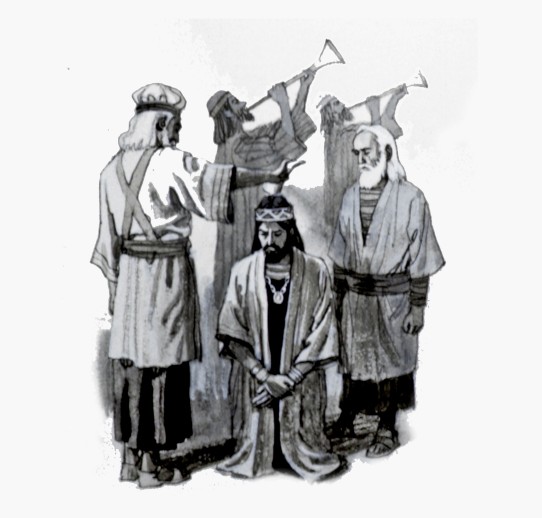
While David was still living, he arranged for his son Solomon to become king

While David was still living, he arranged for his son Solomon to become king

Psalm 72 is the last psalm in “book 2” of the Psalms, and contains the books doxology at the end.  The superscription deems it a song “of” Solomon, obviously as the young heir to David’s throne.  Some have attributed authorship to Solomon himself, but Matthew Henry’s view that it is David’s prayer on behalf of Solomon is likely correct.

There are some obvious Messianic aspects to the psalm in addition to the obvious parts in which there is fervent prayer for the earthly king.  The care for the poor and the needy in verse 4 certainly sounds like Jesus during His ministry; and verses 12-14 referring to one who delivers and redeems are pointing to Him as well.

The prayer ends with the doxology and praise to the Lord:  “Blessed be his glorious name forever; may the whole earth be filled with his glory!  Amen and Amen!”  The last line – “The prayers of David, the son of Jesse, are ended” could refer to this psalm, but could also refer to the assembling of this section of the psalms by the psalter.  Matthew Henry took the view that it referred to the ending of Psalms 71 and 72 as a whole, having been written in David’s old age.  Now with a young king to take his place, his “prayers have ended.”

Read or listen to audio of ESV version of this selection from this link.

/Bob’s boy
___________________
some images © V. Gilbert & Arlisle F. Beers

Please note: I did not design the reading plan that I am following in my blog.  All of my comments in this blog, however, are solely my responsibility.  When reading ANY commentary, you should ALWAYS refer first to the scripture, which is God’s unchanging and unfailing word. Reading schedules, as well as a link to the site where you can get the reading plan that I’m currently following for yourself can be found on the “Bible Reading Schedules” page of my website at http://graceofourlord.com.  For questions and help, please see the “FAQ” and “Summaries” pages there.

Job 19 – “My Redeemer Lives”

English: An early engraving by Blake for the B...

English: An early engraving by Blake for the Book of Job (Photo credit: Wikipedia)

We’ve said before that reading the Book of Job can be challenging.  By the time you reach this chapter, even with all of the poetry, it can be difficult to stay focused on getting meaning from all of the speeches by Job and his friends.  If you aren’t careful, you can totally miss “the point” in some chapters.  This is one such chapter.

In verses 1-22, he begs his friends to stop tormenting him with their words of judgment, not even being able to name what his sin might be.  He eloquently, but sadly, speaks of his pitiful state, and all of the abuse, abandonment, and even mockery by friends, family, strangers – even children.  He speaks at some length at how God has allowed all of this to befall him.

Then in verse 23 it takes a different turn, and in 25-26 (the NASB has the most accurate translation here), he says:

“As for me, I know that my Redeemer lives,
And at the last He will take His stand on the earth.
Even after my skin is destroyed,
Yet from my flesh I shall see God”

There are several things to note here.  First, the Book of Job is part of the inspired word of God,; and as such, it’s author (possibly Job himself) was guided by the Holy Spirit. Secondly, with some notable exceptions, the Old Testament is less vocal on the subject of life after death, but it seems clear here that Job believes in a physical resurrection.  Abraham believed in physical resurrection as well (Hebrews 11:19).  Third, the certainty Job has that his “redeemer lives” has been a gradual progression through these chapters.  In Job 9:33 he begins to wish for an arbiter or “umpire” between himself and God.  In Job 16:19, he says:

“Even now, behold, my witness is in heaven,
and he who testifies for me is on high.”

In Job 17:3, he asks God to be his surety, his guarantor. In Job 16:20-21, he says “my eye pours out tears to God, that he would argue the case of a man with God.”  As Peter told us in 1 Peter 1:10-12, the prophets of the Old Testament did not always know the full ultimate development of all of their prophecies, but Job’s insight grows slowly each chapter.  He would have no way of knowing about Jesus, but he now sees God Himself as his Redeemer – the one who would stand for Him in the end before God Himself.

Read or listen to audio of ESV version of this selection from this link.

/Bob’s boy
___________________
some images © V. Gilbert & Arlisle F. Beers

Please note: I did not design the reading plan that I am following in my blog.  All of my comments in this blog, however, are solely my responsibility.  When reading ANY commentary, you should ALWAYS refer first to the scripture, which is God’s unchanging and unfailing word. Reading schedules, as well as a link to the site where you can get the reading plan that I’m currently following for yourself can be found on the “Bible Reading Schedules” page of my website at http://graceofourlord.com.  For questions and help, please see the “FAQ” and “Summaries” pages there.

Psalm 61 – Lead Me to the Rock

As a lament, Psalm 61, though very short,  is one of the more beautiful, and one of the better known hymns that come from it is  “The Rock that is Higher than I” (verse 2).  Most scholars believe that this psalm was written during the time of Absalam’s conspiracy and David’s flight from Jerusalem (2 Samuel 15-18).  It is viewed as an individual lament, as David is asking the Lord to “hear my cry” (verse 1) and “prolong the life of the king” (verse 6).

mountain_003But as short as it is, it obviously is more than that, and it is easy to see why it has been popular for so long as both a congregational song and morning prayer.  Consider verse 2 “from the end of the earth I call to you when my heart is faint. Lead me to the rock that is higher than I.”  Then consider verse 5: “you have given me the heritage of those who fear your name.” 

That heritage is the covenant God made with David in 2 Samuel 7 – that of our Lord Jesus coming through the Davidic line.  The rest of verse 6 and verse 7 cinch it, as David finishes his prayer making it obvious that it was written after that covenant was made: “Prolong the life of the king; may his years endure to all generations! May he be enthroned forever before God…”

Read or listen to audio of ESV version of this selection from this link.

/Bob’s boy
___________________
some images © V. Gilbert & Arlisle F. Beers

Please note: I did not design the reading plan that I am following in my blog.  All of my comments in this blog, however, are solely my responsibility.  When reading ANY commentary, you should ALWAYS refer first to the scripture, which is God’s unchanging and unfailing word. Reading schedules, as well as a link to the site where you can get the reading plan that I’m currently following for yourself can be found on the “Bible Reading Schedules” page of my website at http://graceofourlord.com.  For questions and help, please see the “FAQ” and “Summaries” pages there.

Proverbs 28 – Character

Sunrise_over_MauiThis chapter has plenty of verses comparing the righteous to the unrighteous.  Verse 1 (“The wicked flee when no one pursues, but the righteous are bold as a lion”) and verse 6 (“Better is a poor man who walks in his integrity than a rich man who is crooked in his ways”) caught our attention.  The former perhaps having more to do with conscience than the latter.  But both obviously addressing matters of character.

Always trying to do the right thing definitely has multiple benefits from the perspective of both verses.  Peace of mind, confidence, and never having to look over your shoulder are worth a lot.  The satisfaction that  comes from having that kind of character is priceless.  By “walking in integrity,” we come out ahead now, and we surely will come out ahead when our walk in this world is done.  Many radio and TV show “man on the street” type of interviews often revolve around the question of  “what would you do for a million dollars?”  Money can’t buy any of those important things we just mentioned, so why should our integrity be for sale?

Read or listen to audio of ESV version of this selection from this link.

/Bob’s boy
___________________
some images © V. Gilbert & Arlisle F. Beers

Please note: I did not design the reading plan that I am following in my blog.  All of my comments in this blog, however, are solely my responsibility.  When reading ANY commentary, you should ALWAYS refer first to the scripture, which is God’s unchanging and unfailing word. Reading schedules, as well as a link to the site where you can get the reading plan that I’m currently following for yourself can be found on the “Bible Reading Schedules” page of my website at http://graceofourlord.com.  For questions and help, please see the “FAQ” and “Summaries” pages there.

Psalm 119:145-152; Psalm 93 – The Lord Reigns

qophThis stanza of Psalm 119 begins each verse with the Hebrew letter “qoph,” the 19th letter of the Aleph-Bet.  The origin of the letter, which resembles the English letter “P,” is sometimes said to be a sewing needle.  Others say it is the human neck and head.  The focus of the stanza is on calling on the Lord  in times of trouble, and of assurance that He is near always.

Psalm 93 is a song of praise to God as King and ruler of the universe, similar to the longer Psalm 29.  It has the distinct air of having been written at a time when God’s people had been in peril from an outside enemy or enemies (the “floods” of verse 3), recognizing that God is “mightier than the waves of the sea” (verse 4).  It gives God the glory for holding the universe in stability (verses 1-2), and for the absolute truth of His word (verse 5).

Read or listen to audio of ESV version of this selection from this link.

/Bob’s boy
___________________
some images © V. Gilbert & Arlisle F. Beers

Please note: I did not design the reading plan that I am following in my blog.  All of my comments in this blog, however, are solely my responsibility.  When reading ANY commentary, you should ALWAYS refer first to the scripture, which is God’s unchanging and unfailing word. Reading schedules, as well as a link to the site where you can get the reading plan that I’m currently following for yourself can be found on the “Bible Reading Schedules” page of my website at http://graceofourlord.com.  For questions and help, please see the “FAQ” and “Summaries” pages there.

Old Testament Facts – Why Read Leviticus?

The third book of the Pentateuch (the Books of Law) – Leviticus – is one of the least understood books of the Bible and, not surprisingly, one of the least read.  Many “read the whole Bible in a year” reading plans have come to a dead stop in the early chapters of this book.  And without question, it can be a difficult book to get through.  But there is much to learn from it that is very relevant to our understanding of the worship of the Lord and the ultimate coming of Jesus the Christ.

Leviticus

In the Septuagint, this book is called “leyitikon,” which means “things concerning Levites.”  There is much that applies to God’s people in general, both with moral and ethical values, as well as with ritual purity.  But the name is appropriate because the Levites were those that were charged with seeing that ritual adherence was maintained. 

It is important for those who read these Scriptures today to remember that although some aspects of these rituals seem strange and difficult at times to understand, it is still the word of God, and there is much we can learn from it.  This is especially true as we relate it to the sacrifice of Jesus Christ, which unlike these offerings, provides for true forgiveness.  A close study of the different offerings will give the reader a deeper understanding and appreciation of the cross.  It is important in that study to know that ritual “uncleanness” and purity have nothing to do with hygiene; and equally important to know the difference (as well as the connection) with moral purity.

So what can we possibly learn from Leviticus that is relevant to New Testament Christianity?

The answer, it turns out, is plenty:

  • The Lord is to dwell with them (Exodus 40:34), so it is the duty of His people to deal with their sins and drive themselves toward holiness.
  • The Lord expects worship to Him to be done according to His will, and He does “sweat the details” (Leviticus 22:17-30)
  • As per the Day of Atonement ritual (Leviticus 16), the cleansing of sins is impossible from the human side.
  • Spiritual leaders bear a heavy burden of responsibility (Leviticus 4, Lev 21).  Compare to elders in 1 Timothy 5:17-25, for example.
  • Sin is dealt with by the grace of the Lord (Leviticus 17:11).

   Key Concepts and Events

/Bob’s boy
___________________
image © V. Gilbert & Arlisle F. Beers