Psalms 42-43 – As the Deer Panteth

Mount Hermon is one traditional site for Jesus' transfiguration, and is near the site of mount Mizar, mentioned in Psalm 42

Mount Hermon is one traditional site for Jesus’ transfiguration, and is near the site of mount Mizar, mentioned in Psalm 42

Psalms 42-43 compose Book 2 of the Psalms; and many believe that 42 and 43 are actually a single psalm that was divided in error. The case for that claim is strengthened by the fact that the two share a couple of refrains – 42:9 and 43:2 are mostly the same, as are 42:11 and 43:5. When the two psalms are read together, they flow quite smoothly.

Psalm 42 is the basis for the  hymn “As the Deer Panteth,” by Martin Nystrom. It is the song of a child of God who is separated by miles from the place where worship was done. The psalmist longs to be in the presence of God to worship and praise Him in song. It is believed that the psalm was written by David, and Psalm 42’s superscription supports that belief – at least where chapter 42 is concerned. But the circumstances and verses well fit a psalmists possible words during the Babylonian captivity. It is the timeless nature of God’s word that makes these possibilities equally credible.

Read or listen to audio of ESV version of this selection from this link.

/Bob’s boy
___________________
some images © V. Gilbert & Arlisle F. Beers

Please note: I did not design the reading plan that I am following in my blog.  All of my comments in this blog, however, are solely my responsibility.  When reading ANY commentary, you should ALWAYS refer first to the scripture, which is God’s unchanging and unfailing word. Reading schedules, as well as a link to the site where you can get the reading plan that I’m currently following for yourself can be found on the “Bible Reading Schedules” page of my website at http://graceofourlord.com.  

Proverbs 13 – Always Rejoicing

In verses 7-9, the Holy Spirit teaches us that which is of the greatest value in life, yet is seldom seen as such by most people. Nobody begins life as an adult by seeking to be unsuccessful. We get the best education that we can. We try to earn our wages in a field in which we possess some skill; and if possible, we try to put some away for our later years when we are no longer able to work. For some, success at doing these things comes very easily. Others do not always find that to be the case.

early 1890sV. 7
One pretends to be rich, yet has nothing;
another pretends to be poor, yet has great wealth.
V. 8
The ransom of a man’s life is his wealth,
but a poor man hears no threat.
v. 9
The light of the righteous rejoices,
but the lamp of the wicked will be put out

Are the wealthy always so much better off than the poor indeed? The accumulation of such great wealth, though appealing to most of us, does not always result in the best quality of life. Mountains of money and endless possessions did not seem to make life joyous for Howard Hughes. Elvis Presley’s fame and fortune often kept him from going out in public, and he died seemingly “before his time” as did Michael Jackson.

family reunionMy parents were “products” of the Great Depression, and knew first-hand what poverty was like. My father had to leave school in the 8th great to go to work just so the family could survive. They never had much in worldly possessions when they were growing up; and after the Great War, life was still a struggle. We never had great wealth even after I was born, but I and my siblings never knew what it was like to be truly hungry or to do without any of what most people would consider to be the real necessities of life. All the way into my teenage years, I often marveled at the simple life my grandparents still lived in a house no larger in square footage than the game room in my current home.

But who is rich, and who is poor really? My grandparents and their siblings made up a large extended family that was always close through the years before and after the “baby boom.” And though they had little in the way of material wealth, they were incredibly happy because they had been given a precious gift – great love for the Lord, and for each other. and nearly 60 years later, the family reunions have remained large in numbers.

Paul’s words in 2 Corinthians 6:8-10 come to mind:

…We are treated as impostors, and yet are true; as unknown, and yet well known; as dying, and behold, we live; as punished, and yet not killed; as sorrowful, yet always rejoicing; as poor, yet making many rich; as having nothing, yet possessing everything.

Read or listen to audio of ESV version of this selection from this link.

/Bob’s boy
___________________
some images © V. Gilbert & Arlisle F. Beers

Please note: I did not design the reading plan that I am following in my blog.  All of my comments in this blog, however, are solely my responsibility.  When reading ANY commentary, you should ALWAYS refer first to the scripture, which is God’s unchanging and unfailing word. Reading schedules, as well as a link to the site where you can get the reading plan that I’m currently following for yourself can be found on the “Bible Reading Schedules” page of my website at http://graceofourlord.com.  For questions and help, please see the “FAQ” and “Summaries” pages there.

Psalm 110 – The Lord Says To My Lord

War came to the land in the days of Abram and Lot when five subject kings rebelled against Chedorlaomer, or Kedorlaomer and Lot was captured (Genesis 13:5--14:24). Abraham rallied his men, attacked at night, conquered the enemy, and rescued Lot. In this painting, he is sharing the spoils of battle with Melchizedek, king of Salem.

War came to the land in the days of Abram and Lot when five subject kings rebelled against Chedorlaomer, or Kedorlaomer and Lot was captured (Genesis 13:5–14:24). Abraham rallied his men, attacked at night, conquered the enemy, and rescued Lot. In this painting, he is sharing the spoils of battle with Melchizedek, king of Salem.

This short psalm is cited, or is referred to in several important New Testament passages concerning the Lord Jesus Christ. We find verse one in Matthew 22:44, Mark 12:36, Luke 20:42-43, and Acts 2:34-35, and Hebrews 10:13. Verse 4 (the Lord has sworn and will not change his mind, “You are a priest forever after the order of Melchizedek.”) is cited in Hebrews 7:17-21 and Hebrews 5:6. In Genesis 14:17-18, we learn that Melchizedek was “priest of God Most High,” though he was not even a Jew.

In the gospels, Jesus draws attention to the fact that David called the king “my Lord,” meaning that the king (the Messiah) was greater than David.  Verses 2-7 look to the Davidic king’s rule over God’s people, even when threatened by hostile powers (rule in the midst of your enemies). The people of God will offer themselves freely on the day of your power – as in on the day God exerts his power to bring the Gentiles into the fold (verse 7).

Read or listen to audio of ESV version of this selection from this link.

/Bob’s boy
___________________
some images © V. Gilbert & Arlisle F. Beers

Please note: I did not design the reading plan that I am following in my blog.  All of my comments in this blog, however, are solely my responsibility.  When reading ANY commentary, you should ALWAYS refer first to the scripture, which is God’s unchanging and unfailing word. Reading schedules, as well as a link to the site where you can get the reading plan that I’m currently following for yourself can be found on the “Bible Reading Schedules” page of my website at http://graceofourlord.com.  
1 Chronicles – The Annals of the Times

David bringing the Ark to Jerusalem

David bringing the Ark to Jerusalem

Like the Book of Samuel, 1 & 2 Chronicles were originally one book. The Hebrew title is “Dibre Hayyamim” (meaning “Events of the Times” or “Annals”), which can be assumed to have been abbreviated from “Sepher Dibre Hayyamim,” for “The Book of the Events of the Times.”  In the Septuagint, it is known as “Paraleipomena,” or “The Things Omitted,” suggesting information supplemental to The Books of Samuel and Kings. In fact, so much of the Scripture in the Books of Chronicles can be found in Kings that many people wonder why God would have wanted two such similar records.

There are a couple of very good answers to that question. As always, it is good to remember that any time we see something repeated in Scripture, it is a pretty good indication that it is important. Secondly, unlike Kings, the Books of Chronicles have little at all to say about the northern kingdom, but instead they are centered almost totally around Judah, or the southern kingdom. It is also argued that the perspective in the Chronicles is less from a historical viewpoint than it is for edification.

As an act of pride, King David forced Joab to take a census of men of military age. The Lord was displeased with David for this and sent a great plague.

As an act of pride, King David forced Joab to take a census of men of military age. The Lord was displeased with David for this and sent a great plague.

Jewish tradition holds that Ezra was the author, although there is nothing in the books to verify this. It was once believed that the Chronicles along with Ezra and Nehemiah were once one book, but most scholars now recognize them as separate works of approximately the same period. A post-exilic date of 450-400 BC for the Book seems to be validated by the mention of several descendants of David from the period in places such as 1 Chronicles 3:17-24.

The first nine chapters of 1 Chronicles are a lengthy list of genealogies that begin with Adam and conclude with that of the returning exiles. Such a long and tedious (to us) list provokes questions about the reason for them to be there at all.  In fact, they are important for more than one reason. First, it would be important to identify the Levites after returning from captivity in order to properly preserve the priesthood. Secondly, the proper heirs for the land could be identified for distribution to those returning to Jerusalem from captivity. Finally, it preserves the record of the lineage of David – important to validate the lineage of the Messiah.

Outline of 1 Chronicles

 /Bob’s boy

___________________
image © V. Gilbert & Arlisle F. Beers

Please note: I did not design the reading plan that I am following in my blog.  All of my comments in this blog, however, are solely my responsibility.  When reading ANY commentary, you should ALWAYS refer first to the scripture, which is God’s unchanging and unfailing word. Reading schedules, as well as a link to the site where you can get the reading plan that I’m currently following for yourself can be found on the “Bible Reading Schedules” page of my website at http://graceofourlord.com.  

Psalm 99, 100, 101

Moses and Aaron before Pharaoh (painting by Be...

Moses and Aaron before Pharaoh (painting by Benjamin West) (Photo credit: Wikipedia)

Psalm 99 celebrates the supremacy of God over His creation, enthroned upon the cherubim. Note that the text says that although He is great in Zion, He is exalted over all the peoples of the earth. The verses refer to Jacob, Moses, Aaron and Samuel by name – reminding the reader of the pillar of the cloud (Exodus 13:21),  the holy priesthood, God’s own holiness, his forgiving nature, and the promise of Him avenging wrongs. Psalm 100 is another hymn for giving thanks to God for His faithfulness to all generations, and His shepherding of us, the sheep of His pasture.

Psalm 101 is another royal hymn of David, making music to Lord, declaring his love to the Father for His holy justice, and pledging his faithfulness to Him. David promises to serve the people with integrity of heart and the expectation – yes even the requirement – that they respect one another as well as the Lord Himself.

No one who practices deceit
shall dwell in my house;
no one who utters lies
shall continue before my eyes.

Read or listen to audio of ESV version of this selection from this link.

/Bob’s boy
___________________
some images © V. Gilbert & Arlisle F. Beers

Please note: I did not design the reading plan that I am following in my blog.  All of my comments in this blog, however, are solely my responsibility.  When reading ANY commentary, you should ALWAYS refer first to the scripture, which is God’s unchanging and unfailing word. Reading schedules, as well as a link to the site where you can get the reading plan that I’m currently following for yourself can be found on the “Bible Reading Schedules” page of my website at http://graceofourlord.com.  


Job 25 – Born of Woman

An outer view of the Druze shrine of Prophet Job

An outer view of the Druze shrine of Prophet Job (Photo credit: Wikipedia)

This brief chapter sums up the crux of the discussion so far. Job’s friends’ arguments with him have so far included only two possibilities – either God is wrong about Job, or else Job is himself in the wrong. Since the former is an impossibility, the situation is puzzlingly unacceptable in the realm of possible reconciliations. How can it be that he who is “born of woman” be right in such a case, if that means that God is in the wrong? There must be some mistake! No other possibility than these two exists in their eyes, and that leaves much to consider for the three companions – and for Job himself.

Read or listen to audio of ESV version of this selection from this link.

/Bob’s boy
___________________
some images © V. Gilbert & Arlisle F. Beers

Please note: I did not design the reading plan that I am following in my blog.  All of my comments in this blog, however, are solely my responsibility.  When reading ANY commentary, you should ALWAYS refer first to the scripture, which is God’s unchanging and unfailing word. Reading schedules, as well as a link to the site where you can get the reading plan that I’m currently following for yourself can be found on the “Bible Reading Schedules” page of my website at http://graceofourlord.com.  For questions and help, please see the “FAQ” and “Summaries” pages there.

Psalm 83 – Most High Over All the Earth

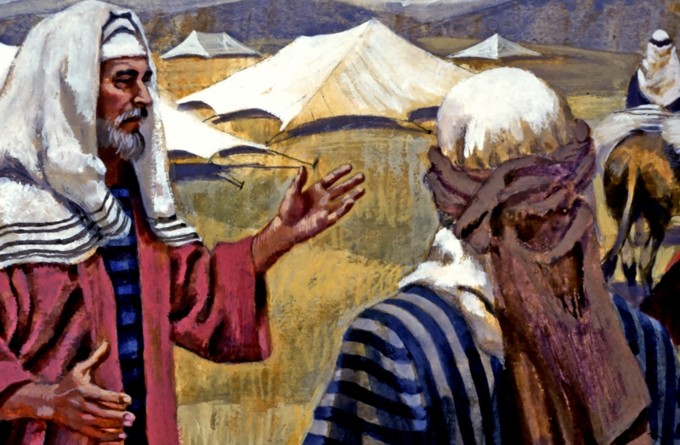
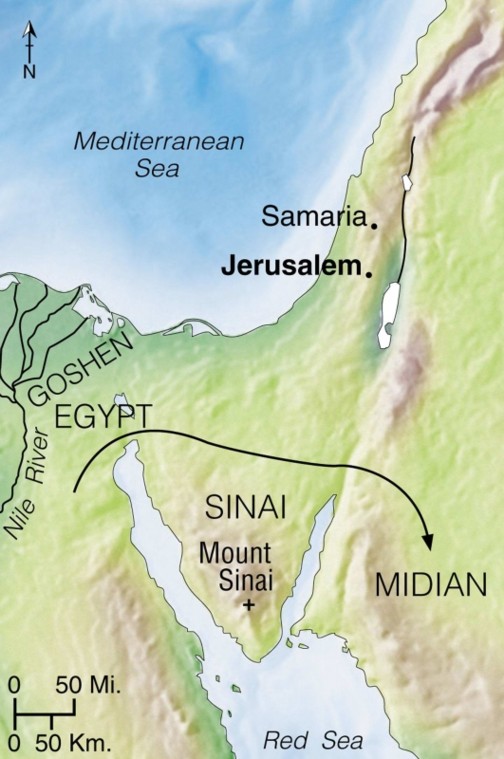
After murdering an Egyptian, Moses escaped into Midian. There he married Zipporah and became a shepherd.

After murdering an Egyptian, Moses escaped into Midian. There he married Zipporah and became a shepherd.

When reading this chapter of Psalms, one could feel as if it were written about the Israel of today. Speaking of the enemies of the nation, the psalmist allows how they would gladly wipe out God’s people:

They say, “Come,let us wipe them out as a nation;
let the name of Israel be remembered no more

Among the conspirators mentioned are such as the Amelikites, the Moabites and Ammonites who are referred to correctly here as the children of Lot (Genesis 19:36-38), the Edomites, the Philistines, and the inhabitants of Tyre. All are Gentile persecutors of God’s people. Today, there are those people who would take joy in the persecution of Christians – a phenomenon that many would argue is beginning to make a somewhat surprising comeback in North America, as well as other parts of the world. The prayer of the chapter which glorifies the Lord is relevant today:

…that they may know that you alone,
whose name is the Lord,
are the Most High over all the earth.

Read or listen to audio of ESV version of this selection from this link.

/Bob’s boy
___________________
some images © V. Gilbert & Arlisle F. Beers

Please note: I did not design the reading plan that I am following in my blog.  All of my comments in this blog, however, are solely my responsibility.  When reading ANY commentary, you should ALWAYS refer first to the scripture, which is God’s unchanging and unfailing word. Reading schedules, as well as a link to the site where you can get the reading plan that I’m currently following for yourself can be found on the “Bible Reading Schedules” page of my website at http://graceofourlord.com.  

Proverbs 12 – According To Good Sense

Nelson Mandela was born Rolihlahla Mandela in July of 1918 in the village of Mvezo, in Transkei, South Africa. “Rolihlahla” in the language of his country means “pulling the branch of a tree,” but more commonly translates as “troublemaker,” and it fit like a glove. Before the death of his father when he was nine years old, he was baptized into the Methodist Church. He went on to become the first in his family to attend school. After the death of his father (and probably because of the prejudice of the British ruling class educational system) he was coerced into taking the first name “Nelson.”

Nelson Mandela & Mikhail Gorbatchov

Nelson Mandela & Mikhail Gorbatchov (Photo credit: Anastasios Fakinos)

At the law firm where he clerked, Mandela befriended a member of the ANC and Communist Party, as well as Nat Bregman, a Jewish communist who became his first white friend. Attending communist talks and parties, Mandela was encouraged that whites and blacks were blending together as equals. However, he said later that he did not join the Party because its atheism conflicted with his Christian faith, and because the South African “Apartheid” struggle was racially based rather than a product of class warfare.

Becoming increasingly political, Mandela marched in support of a successful bus boycott, and continued his higher education, working on his BA at night. Deciding that armed resistance was inevitable, he was arrested for subversive activities, and served 27 years in prison before public pressure brought an end to the oppression and persecution of the South African’s he so dearly loved. After his release, he then became the first black President in the history of the nation, and quickly became the patron saint of the oppressed people of the world.

Nelson Mandela outlasted Communism, as well as the oppression and persecution of Apartheid, and his story brings to mind the wisdom of at least two of the Proverbs in chapter 12:

The wicked are overthrown and are no more,
but the house of the righteous will stand.

A man is commended according to his good sense,
but one of twisted mind is despised.

Read or listen to audio of ESV version of this selection from this link.

/Bob’s boy
___________________
some images © V. Gilbert & Arlisle F. Beers

Please note: I did not design the reading plan that I am following in my blog.  All of my comments in this blog, however, are solely my responsibility.  When reading ANY commentary, you should ALWAYS refer first to the scripture, which is God’s unchanging and unfailing word. Reading schedules, as well as a link to the site where you can get the reading plan that I’m currently following for yourself can be found on the “Bible Reading Schedules” page of my website at http://graceofourlord.com.  For questions and help, please see the “FAQ” and “Summaries” pages there.
Psalm 98 – Let the Sea Roar!

sea_004The 98th psalm is another song of praise in the same vein as the 96th, in that it encourages the singing of “a new song” to the Lord. The psalm is composed of three stanzas of three verses each. The first set of verses extol the marvelous things that the Lord has done. His right hand and holy arm have worked salvation. He has kept His promises with faithfulness to His people; and all the ends of the earth have seen that salvation.

The second set of verses encourage making a joyful noise to the Lord over all the earth and breaking forth in joyous song, singing praises to the Lord. Then the third set of verses call forth to the created wonders of the earth itself to roar their own joyous noise. Jesus Himself, quoting Habakkuk 2:11, said in Luke 19:40 that the very stones would cry out if the people were silent. All creation should sing out in praise to the Creator of all, who will judge the earth with righteousness – and with fairness and equity to the people. This settles forever the question of for whom God’s word was written. It is for everyone!

Read or listen to audio of ESV version of this selection from this link.

/Bob’s boy
___________________
some images © V. Gilbert & Arlisle F. Beers

Please note: I did not design the reading plan that I am following in my blog.  All of my comments in this blog, however, are solely my responsibility.  When reading ANY commentary, you should ALWAYS refer first to the scripture, which is God’s unchanging and unfailing word. Reading schedules, as well as a link to the site where you can get the reading plan that I’m currently following for yourself can be found on the “Bible Reading Schedules” page of my website at http://graceofourlord.com.  

Book of Judges – The Ultimate “Vicious Cycle”

English: Historiated initial from the Stavelot...

English: Historiated initial from the Stavelot Bible, Book of Judges, depicting Yael killing Sisera. Folio 84. (Photo credit: Wikipedia)

If we add up the times listed in the Book of Judges for the periods of oppression and the periods of rest, we come up with about 410 years. But many of the events of the book overlap in time, occurring in different locations. The Exodus is most reliably believed to have occurred around 1450, followed by 40 years of wandering. We also know that King Saul’s reign began about 1050 BC. So, a period of 300 -350 years is probably more accurate for events of this book.

Any time there is a serious discussion of the Book of Judges, the term “Cycle of the Judges” comes up. This refers to the pattern that is repeated over and over throughout the book. That pattern is as follows: (1) the people do what is evil in the sight of God, (2) God allows them to be oppressed, (3) they cry out to God, (4) God sends a judge to deliver them, (5) there is a period of rest, before the apostasy begins the cycle again.

English: Delilah betraying Samson, and turns h...

English: Delilah betraying Samson, and turns him over to the Philistines (Photo credit: Wikipedia)

Judges 1:27-36 tells the story of failure after failure of various tribes to obey the Lord’s command to drive out all of the Canaanites that still dwelled in their allotted lands. Then in Judges 2:1-4, God’s tells them of the consequences for their disobedience “So now I say, I will not drive them out before you, but they shall become thorns in your sides, and their gods shall be a snare to you.” It was a defining fact of the history of the Israelites. The cycle began with a generation after them who did not know the Lord or the work that he had done for Israel” (chapter 2:10). Abandoning the Lord, they sank into idolatry and other great evils.

The judges that God “raised up” to deliver the people during these cycles were not perfect servants of God. Indeed, in many cases, some could behave in very ungodly manners, and the Scripture shows them “warts and all.” But the Lord guided them for His purposes with the Holy Spirit, and they accomplished what He needed them to get done. Below are the names of the judges and their places of appearance in the book. The story of Samson is the longest, the most famous, and the most understood. Many people actually believe that Samson’s strength came from his hair, and that he lost that strength due to it being cut. Unfortunately, this misunderstanding fuels the view of his story as some sort of fable. For perhaps some better insight, see this previous post.

Othniel (Judges 3: 7-11)
Ehud (Judges 3:12-30)
Shamgar (Judges 3:31)
Deborah (Judges 4-5)
Gideon (Judges 6-8)
Tola (Judges 10:1-2)
Jair (Judges 10:3-5)
Jephthah (Judges 10:6-12:7)
Ibzan (Judges 12:8-10)
Elon (Judges 12:11-12)
Abdon (Judges 12:13-15)
Samson (Judges 13-16)

/Bob’s boy
___________________
image © V. Gilbert & Arlisle F. Beers

Please note: I did not design the reading plan that I am following in my blog.  All of my comments in this blog, however, are solely my responsibility.  When reading ANY commentary, you should ALWAYS refer first to the scripture, which is God’s unchanging and unfailing word. Reading schedules, as well as a link to the site where you can get the reading plan that I’m currently following for yourself can be found on the “Bible Reading Schedules” page of my website at http://graceofourlord.com.