Psalm 137 – By the Waters of Babylon

Destruction of Jerusalem under the Babylonian ...

Destruction of Jerusalem under the Babylonian rule. Illustration from the Nuremberg Chronicle (Photo credit: Wikipedia)


This psalm is one that is often misunderstood. It is also one that skeptics and critics like to quote to “prove” that the Bible, of all things, is somehow evil (he says, rolling eyes toward heaven). Verses 1-3 make it clear – psalm 137 is obviously written either during the time of Babylonian captivity or just afterward, making it some time between 587 BC and 537 BC.


It is a lament for the destruction of Jerusalem, and for all that was lost in human life, in heritage, in freedom, and in dignity. It is lament of a people who were taken off forcibly and with certain ferocity, while others they knew – and loved – were killed violently.


What causes the misunderstanding – even among some of those scholars who are genuinely faithful – is verse 9. First it should be pointed out that the word that is translated “blessed” in some versions (here and in other parts of the Bible) is more accurately translated as “happy.” Secondly, verses 8-9 are not recounting what has happened, but they are a prediction of what will be.


“Happy shall he be who repays you with what you have done to us! Happy shall he be who takes your little ones and dashes them against the rock!” The third thing to remember is that the prediction in this passage is of what the Medes and the Persians are going to do to the Babylonians. God is not instructing them to do so (nor does He condone it), but His word accurately predicts what will happen – the same atrocities the Babylonians committed. And the invading soldiers in this prediction will be just as joyful in their cruel conquest as the Babylonians were.


Read or listen to audio of ESV version of this selection from this link.


/Bob’s boy


___________________


some images © V. Gilbert & Arlisle F. Beers


Please note: I did not design the reading plan that I am following in my blog.  All of my comments in this blog, however, are solely my responsibility.  When reading ANY commentary, you should ALWAYS refer first to the scripture, which is God’s unchanging and unfailing word. Reading schedules, as well as a link to the site where you can get the reading plan that I’m currently following for yourself can be found on the “Bible Reading Schedules” page of my website at http://graceofourlord.com.  


Proverbs 23 – Who Has Woe?

As part of the Wisdom literature, the Book of Proverbs is literally full of wisdom. Chapter 23 is certainly no exception. Having already given warning about hanging around with drunkards in verses 21-22, the author turns his attention back to the subject of alcohol for the last several verses of the chapter. No other subject has captured the attention of the author for such an extended contiguous writing so far in these proverbs.


Drunkenness of Noah

Drunkenness of Noah (Photo credit: Wikipedia)


The Bible has plenty of examples of the folly and lasting consequences that man can bring on himself (and others) when he voluntarily surrenders his wisdom to drunkenness. For example, one need only read about the depravity of Lot with his daughters (Genesis 19:30-38), or the death of King Elah of Israel (1 Kings 16:8-10) for very costly examples. But this chapter’s attention to the subject does a pretty good job with advice on drunkenness. Part of the passage is included below, including a couple of better known verses on the subject.


We see clear examples today all of the time in broken marriages, unwanted pregnancies, domestic violence, and many other social ills. Alcohol abuse has destroyed the earthly happiness of so many lives for thousands of years; and still man is drawn to the “sparkle” that lies to him.


Who has woe? Who has sorrow?
Who has strife? Who has complaining?
Who has wounds without cause?
Who has redness of eyes?


Those who tarry long over wine;
those who go to try mixed wine.


Do not look at wine when it is red,
when it sparkles in the cup
and goes down smoothly.


In the end it bites like a serpent
and stings like an adder.


Read or listen to audio of ESV version of this selection from this link.


/Bob’s boy


___________________


some images © V. Gilbert & Arlisle F. Beers


Please note: I did not design the reading plan that I am following in my blog.  All of my comments in this blog, however, are solely my responsibility.  When reading ANY commentary, you should ALWAYS refer first to the scripture, which is God’s unchanging and unfailing word. Reading schedules, as well as a link to the site where you can get the reading plan that I’m currently following for yourself can be found on the “Bible Reading Schedules” page of my website at http://graceofourlord.com.  For questions and help, please see the “FAQ” and “Summaries” pages there.


Psalm 144 – O Lord, What Is Man?

German theologian Hermann Gunkel

German theologian Hermann Gunkel (Photo credit: Wikipedia)

Psalm 144 is one of the 10 psalms that Hermann Gunkel (a German scholar of the Old Testament) classified as “Royal Psalms” because of their subject matter of the king and his role in the worship of God. Other psalms have been placed in this category by other scholars. This one is very similar to Psalm 18 (which is another psalm on Gunkel’s list). The style of both is unquestionably that of David, as the superscription states. But Psalm 18 was written during the time when David was rescued by the Lord “from the hand of Saul” (see that psalm’s superscription), whereas Psalm 144 is generally believed to have been written following the defeat of Absalom.

David praises God as his fortress, stronghold, and deliverer. He is with him in times of battle (verses 1-2, 10-11), and He blesses him and his people with abundance in their daily lives (verses 12-15). Some of the most beautiful, humble, and poetic praise in the chapter occurs in verses 3-4:

O Lord, what is man that you regard him,
or the son of man that you think of him?
Man is like a breath;
his days are like a passing shadow.

Read or listen to audio of ESV version of this selection from this link.

/Bob’s boy
___________________
some images © V. Gilbert & Arlisle F. Beers

Please note: I did not design the reading plan that I am following in my blog.  All of my comments in this blog, however, are solely my responsibility.  When reading ANY commentary, you should ALWAYS refer first to the scripture, which is God’s unchanging and unfailing word. Reading schedules, as well as a link to the site where you can get the reading plan that I’m currently following for yourself can be found on the “Bible Reading Schedules” page of my website at http://graceofourlord.com.  

Minor Prophets Part 1 – Hosea

As the Book of Hosea tells us in the opening verses, Hosea was called by God as a prophet during the time of Jeroboam II (whose last year of reign was ~753 BC) and Hezekiah (who reigned from about 729-687 BC, the first 14 years of which were as a co-regent with his father, Ahaz). Hosea was a prophet from the northern kingdom, prophesying to the people of the northern kingdom. It was a time of rampant and wanton idolatry that was beyond control, leading to Hezekiah’s reforms (2 Chronicles 29-32).

Temple of Baal at Palmyra, Syria. (III)

Temple of Baal at Palmyra, Syria. (III) (Photo credit: isawnyu)

The message in this book is about the betrayal and grief that God feels because of the unfaithfulness to him (idolatry) by the people of Israel. Hosea lived the message, as the Lord commanded him to marry a temple prostitute. Verse 2 of chapter 1 summarizes God’s feeling on that very well: “When the Lord first spoke through Hosea, the Lord said to Hosea, ‘Go, take to yourself a wife of whoredom and have children of whoredom, for the land commits great whoredom by forsaking the Lord.'” And again in Hosea 3:1: “And the Lord said to me, ‘Go again, love a woman who is loved by another man and is an adulteress, even as the Lord loves the children of Israel, though they turn to other gods and love cakes of raisins.'” Raisin cakes were used in fertility rites during idol worship, The cakes were sometimes molded into the shape of a female goddess.

To make Israel’s betrayal of the Lord worse, their idolatry had become so much a part of the culture that they mixed their worship of the “god” Baal with their worship of God, referring to the Lord Himself as Baal, and crediting Baal with all of the things that God had done for them (see, for example, Hosea 2:16-20).   Both Paul and Peter cite Hosea 2:23 to illustrate the inclusion of Gentiles in Christianity (Romans 9:25-26 and 1 Peter 2:9-10). Even their sacrifices to the lord had become so ceremonially polluted that they were offensive, rather than pleasing God. Hosea 6:6 sums up the Lord’s attitude toward their sacrifice: “for I desire steadfast love and not sacrifice, the knowledge of God rather than burnt offerings.”

Hosea ministered during the latter half of the eighth century. This was a very volatile time in Israel’s history, and saw the rise of the Assyrian king Tiglath-pileser III, followed by several other kings that would bring Assyrian dominance. Israel had a succession of kings until Hoshea (732-722 BC), whose rebellion against the Assyrians led to the end of the northern kingdom (2 Kings 17). Hosea’s message centered on the worship of Baal which he obviously believed to be the reason for Israel’s doom. Baal was the weather god that idolaters believed to have control over agriculture, fertility, and rainfall. Israel being a largely agricultural society, they were always ripe for Baal worship.

Hosea and Gomer, from the Bible Historiale. De...

Hosea and Gomer, from the Bible Historiale. Den Haag, MMW, 10 B 23 426r (Photo credit: Wikipedia)

Baal was worshiped at various shrines where he was called by names such as Baal-peor (Hosea 9:10) and Baal-gad (Joshua 11:17). Sometimes the scripture refers to “them” as “the Baals” (Judges 2:11, 3:7, and 8:33). Beyond the supposed fertility and weather aspects, such worship had a tremendous appeal to sexuality (hence the ritual prostitution), and also such things as drunkenness, incest, bestiality, and even human sacrifice. Sexual acts were believed to make Baal respond favorably to the subject.

The Book of Hosea helps us view idolatry from God’s perspective, so we can apply it to our lives. Today, our “gods” do not seem much like the gods and goddesses of those days. But Idolatry is the act or lifestyle that places someone or something in the central and prominent place in our lives that rightly belongs to God. Our betrayals hurt the Lord just as much. The prophet in this book, makes it clear that God will punish such idolatry, and illustrates Israel’s unfaithfulness in many different ways. Hosea portrays Israel as an adulterous wife, an ungrateful son, a stubborn heifer, and more. But the book shows us as well that even Israel’s unfaithfulness and stubbornness are no match for God’s capacity for redeeming love.

/Bob’s boy
___________________
image © V. Gilbert & Arlisle F. Beers

Please note: I did not design the reading plan that I am following in my blog.  All of my comments in this blog, however, are solely my responsibility.  When reading ANY commentary, you should ALWAYS refer first to the scripture, which is God’s unchanging and unfailing word. Reading schedules, as well as a link to the site where you can get the reading plan that I’m currently following for yourself can be found on the “Bible Reading Schedules” page of my website at http://graceofourlord.com.  

Psalm 136 – Give Thanks To the God of Heaven

English: An image of Psalm 23 (King James' Ver...

English: An image of Psalm 23 (King James’ Version), frontispiece to the 1880 omnibus printing of The Sunday at Home. Scanned at 800 dpi. Français : Illustration du Psaume 23 (version autorisée par le roi Jacques), en frontispice de l’édition omnibus du Sunday at home. Version numérisée à 800 dpi. (Photo credit: Wikipedia)

Ok, so I blew it. In a recent blog about another psalm, I had the choice of several ways to go in choosing a title. But I chose “His Steadfast Love Endures Forever” because of the repetition of the phrase in the psalm.  Well guess what? I should have remembered that was true of other chapters of books in the Bible. Psalm 136 repeats this phrase in every one of its 26 verses! So I went with the opening line of its 26th verse – “Give thanks to the God of heaven.” Since this is indeed what the entire psalm actually does, I think it works anyway.

The psalm is very much a psalm of praise and thanksgiving; and like Psalm 135, it goes through several key events in the history of God’s people to do so. It is a very easy and fulfilling psalm to read; and it gives us much to be thankful and praise God for today as well. As verse 24-25 say “It is he who remembered us in our low estate,…and rescued us from our foes,…he who gives food to all flesh,

For his steadfast love endures forever.”

Read or listen to audio of ESV version of this selection from this link.

/Bob’s boy
___________________
some images © V. Gilbert & Arlisle F. Beers

Please note: I did not design the reading plan that I am following in my blog.  All of my comments in this blog, however, are solely my responsibility.  When reading ANY commentary, you should ALWAYS refer first to the scripture, which is God’s unchanging and unfailing word. Reading schedules, as well as a link to the site where you can get the reading plan that I’m currently following for yourself can be found on the “Bible Reading Schedules” page of my website at http://graceofourlord.com.  

Job 34:16-37 – For You Must Choose

The Wrath of Elihu, from the Butts set. Pen an...

The Wrath of Elihu, from the Butts set. Pen and black ink, gray wash, and watercolour, over traces of graphite (Photo credit: Wikipedia)


When writing about this chapter, Coffman made the observation that the entire Book of Job appears to have the purpose of showing man that it is a fallacy to believe that God immediately punishes man on this earth for his sins. That does indeed ring out as a clear assessment of one of the biggest lessons we learn from the book. And Elihu does himself make a substantial contribution to that outlook, as his reasoning and his accusations are both more hurtful to Job, and greatly indicative of an outlook on God and His ways that is simply and terribly wrong.


But it is Elihu’s statements attacking Job’s character that are the most surprising about Elihu’s mistakes. He says in verse 35 that “‘Job speaks without knowledge; his words are without insight.’” Then, at the end of the chapter, Elihu makes what are perhaps his cruelest statements considering Job:


Would that Job were tried to the end,
because he answers like wicked men.
For he adds rebellion to his sin;
he claps his hands among us
and multiplies his words against God.”


Read or listen to audio of ESV version of this selection from this link.


/Bob’s boy


___________________


some images © V. Gilbert & Arlisle F. Beers


Please note: I did not design the reading plan that I am following in my blog.  All of my comments in this blog, however, are solely my responsibility.  When reading ANY commentary, you should ALWAYS refer first to the scripture, which is God’s unchanging and unfailing word. Reading schedules, as well as a link to the site where you can get the reading plan that I’m currently following for yourself can be found on the “Bible Reading Schedules” page of my website at http://graceofourlord.com.  For questions and help, please see the “FAQ” and “Summaries” pages there.


Psalm 102 – In the Day of My Distress

Hebrew Psalmist from the Brooklyn Museum

Hebrew Psalmist from the Brooklyn Museum (Photo credit: Wikipedia)

As one reads Psalm 102, there can be no doubt that it was written during the time of Babylonian captivity. Verses 13-21 particularly make it clear that this was the time and setting in which the psalmist lived. And this psalmist must have remembered Jeremiah’s prediction of 70 years in captivity (Jeremiah 25:8-11), as he says in verse 13, confident that the end of captivity is near:

You will arise and have pity on Zion;
it is the time to favor her;
the appointed time has come

Coffman describes three divisions to the psalm: “(1) Psalms 102:1-11 describes the terrible sufferings of the afflicted one. (2) Psalms 102:12-22 dwells upon the hopes for relief. (3) And Psalms 102:23-28 speaks of the unchanging God as contrasted with the changing world.”

Below are verses 25-27 containing the comforting words the psalmist with regards to that third point in relation to the oppressors:

Of old you laid the foundation of the earth,
and the heavens are the work of your hands.
They will perish, but you will remain;
they will all wear out like a garment.
You will change them like a robe, and they will pass away,
but you are the same, and your years have no end.

Read or listen to audio of ESV version of this selection from this link.

/Bob’s boy
___________________
some images © V. Gilbert & Arlisle F. Beers

Please note: I did not design the reading plan that I am following in my blog.  All of my comments in this blog, however, are solely my responsibility.  When reading ANY commentary, you should ALWAYS refer first to the scripture, which is God’s unchanging and unfailing word. Reading schedules, as well as a link to the site where you can get the reading plan that I’m currently following for yourself can be found on the “Bible Reading Schedules” page of my website at http://graceofourlord.com.  

Proverbs 22 – Words of the Wise

Verse 17-19 of Proverbs 22 make up the prologue to what some call “The Thirty Words” or “Thirty Sayings” that will continue from verse 22 all the way through to the end of Proverbs 24. Here are the writer’s words that introduce them:

Incline your ear, and hear the words of the wise,
and apply your heart to my knowledge,
for it will be pleasant if you keep them within you,
if all of them are ready on your lips.
That your trust may be in the Lord,
I have made them known to you today, even to you.
Have I not written for you thirty sayings
of counsel and knowledge,
to make you know what is right and true,
that you may give a true answer to those who sent you?

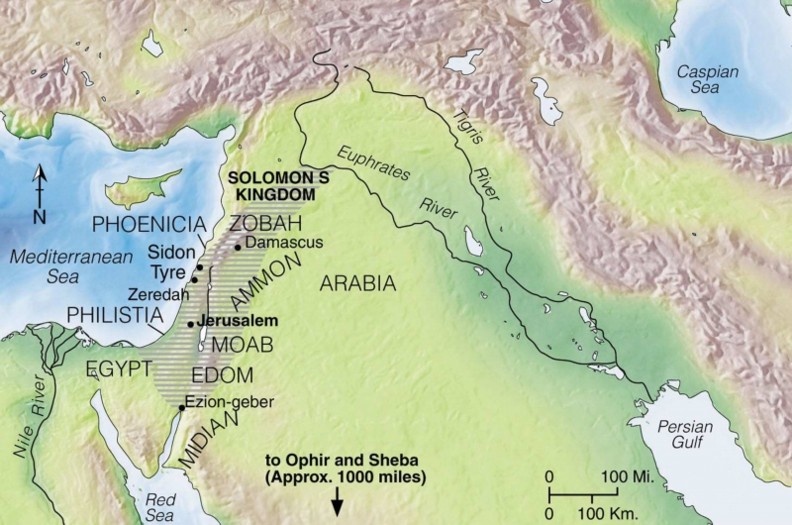
Solomon's fame regarding his wisdom and wealth spread throughout the ancient world, even as far away as Ophir and Sheba. It is not certain where Sheba is exactly, but many scholars believe it may have been located along the Red Sea on the Arabian peninsula.The Temple that Solomon built for the Lord drew upon the vast wealth of his enormous kingdom. Once it was completed, Solomon's Temple was no doubt one of the great wonders of its time. Solomon's reputation brought acclaim and riches from many nations, but he disobeyed God, marrying pagan women and worshiping their gods. So God raised up enemies like Hadad from Edom and Rezon from Zobah (modern-day Syria). Jeroboam from Zeredah was another enemy who would eventually divide this mighty kingdom.

Solomon’s fame regarding his wisdom and wealth spread throughout the ancient world, even as far away as Ophir and Sheba. It is not certain where Sheba is exactly, but many scholars believe it may have been located along the Red Sea on the Arabian peninsula.
The Temple that Solomon built for the Lord drew upon the vast wealth of his enormous kingdom. Once it was completed, Solomon’s Temple was no doubt one of the great wonders of its time. Solomon’s reputation brought acclaim and riches from many nations, but he disobeyed God, marrying pagan women and worshiping their gods. So God raised up enemies like Hadad from Edom and Rezon from Zobah (modern-day Syria). Jeroboam from Zeredah was another enemy who would eventually divide this mighty kingdom.

These verses state the purpose of the “thirty words” – that the reader, or those who hear them, will apply them to their heart, know that they are true, and trust in the Lord.  Thus the reader will be able to communicate these truths to others with clarity and confidence. These thirty sayings are two line couplets admonishing the reader to pay heed to advice about many matters that are important to the Lord, and that are beneficial to one’s well-being in navigating life. They each also contain the desired and expected result that will come from heeding or not heeding these admonitions.

Saying one, in verse 22, begins with one that is most dear to the Lord’s heart – and hammered home again and again by our Lord and Savior, Jesus Christ. We are expected (commanded) to treat the poor with dignity, love and respect – making it clear, as all scripture does, that the Lord values the poor, and that He abhors those who mistreat them.

“Do not rob the poor, because he is poor, or crush the afflicted at the gate, for the Lord will plead their cause and rob of life those who rob them.”

Read or listen to audio of ESV version of this selection from this link.

/Bob’s boy
___________________
some images © V. Gilbert & Arlisle F. Beers

Please note: I did not design the reading plan that I am following in my blog.  All of my comments in this blog, however, are solely my responsibility.  When reading ANY commentary, you should ALWAYS refer first to the scripture, which is God’s unchanging and unfailing word. Reading schedules, as well as a link to the site where you can get the reading plan that I’m currently following for yourself can be found on the “Bible Reading Schedules” page of my website at http://graceofourlord.com.  For questions and help, please see the “FAQ” and “Summaries” pages there.

Psalm 138 – Give Thanks To the Lord

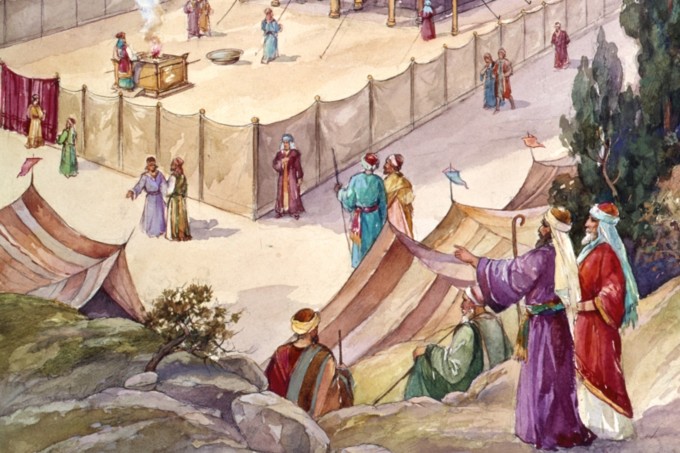
Moses makes the tabernacle in the wilderness -- Exodus 35-40.

Moses makes the tabernacle in the wilderness — Exodus 35-40.

This is another psalm of David to which there has been dispute concerning the authorship – mainly because of this one’s reference to the Lord’s Holy Temple. It seems clear, however, that the psalmist could just as easily be referring to the Tabernacle as to Solomon’s temple – the terms are inter-changeable throughout the scriptures.

The psalm is only eight verses long, but is powerfully written as a hymn of thanksgiving. The second part of verse one is a bit disturbing to some, as it finishes out the verse of praise with the phrase “before the gods I sing your praise.” But it must be remembered that this term “gods” refers not to deity, but to rulers, elders, and such that are held in higher esteem than others (as in Psalm 95:3 and Psalm 82:6). Verse 8 seems to solidify Davidic authorship, with what appears to be a reference to God’s promises to him in 2 Samuel 7:

The Lord will fulfill his purpose for me;
your steadfast love, O Lord, endures forever

Read or listen to audio of ESV version of this selection from this link.

/Bob’s boy
___________________
some images © V. Gilbert & Arlisle F. Beers

Please note: I did not design the reading plan that I am following in my blog.  All of my comments in this blog, however, are solely my responsibility.  When reading ANY commentary, you should ALWAYS refer first to the scripture, which is God’s unchanging and unfailing word. Reading schedules, as well as a link to the site where you can get the reading plan that I’m currently following for yourself can be found on the “Bible Reading Schedules” page of my website at http://graceofourlord.com.  

Major Prophets (part 5) – Book of Daniel

English: Shadrach, Meshach and Abednego in the...

English: Shadrach, Meshach and Abednego in the Furnace (Dan. 3:23-24,91-98) Русский: Седрах, Мисах и Авденаго в раскалённой печи (Дан. 3:23-24,91-98) (Photo credit: Wikipedia)

In 605 B.C., Nebuchadnezzar brought young men of noble heritage in Judah back for service in the king’s court. Daniel and his friends were part of one of these groups (Daniel 1:3). So his life in captivity was quite different from that of Ezekiel and many others less fortunate. According to Daniel 1:21, he served there until the first year of the reign of Cyrus, which would be about 538 B.C.

Daniel is a very important book in the Old Testament. It contains much prophecy that was fulfilled with undeniable accuracy (critics and skeptics notwithstanding). As has always been the case, even disputed passages have held up under the test of time (take, for example, Daniel’s use of the name Belshazzar in Daniel 5). It also teaches through Daniel’s life and that of his friends, Shadrach, Meshach,, and Abednego, a great deal about living faithfully under very great adversity. Finally, and most importantly, it teaches us much about the power of God, and His faithfulness to His word.

Daniel's Answer to the King

Daniel’s Answer to the King (Photo credit: Wikipedia)

The fulfilled prophecies from the Book of Daniel are a great source of assurance to believers for their accuracy. Skeptics and critics, as is always the case, dispute much concerning them of course. But they too have stood the test of time. A detailed account and analysis of all of these in one blog would be an exercise in futility. But for some great analysis of two of them, as well as answers for critics, take a look at this article from Apologetics Press concerning Daniel 2, and this article concerning prophecies in Daniel 8.

Belshazzar's Feast depicts a vision described ...

Belshazzar’s Feast depicts a vision described in the biblical Book of Daniel. –31&src= Daniel 5:1–31 (Photo credit: Wikipedia)

Summary

/Bob’s boy
___________________
image © V. Gilbert & Arlisle F. Beers

Please note: I did not design the reading plan that I am following in my blog.  All of my comments in this blog, however, are solely my responsibility.  When reading ANY commentary, you should ALWAYS refer first to the scripture, which is God’s unchanging and unfailing word. Reading schedules, as well as a link to the site where you can get the reading plan that I’m currently following for yourself can be found on the “Bible Reading Schedules” page of my website at http://graceofourlord.com.