Psalm 99, 100, 101

Moses and Aaron before Pharaoh (painting by Be...

Moses and Aaron before Pharaoh (painting by Benjamin West) (Photo credit: Wikipedia)

Psalm 99 celebrates the supremacy of God over His creation, enthroned upon the cherubim. Note that the text says that although He is great in Zion, He is exalted over all the peoples of the earth. The verses refer to Jacob, Moses, Aaron and Samuel by name – reminding the reader of the pillar of the cloud (Exodus 13:21),  the holy priesthood, God’s own holiness, his forgiving nature, and the promise of Him avenging wrongs. Psalm 100 is another hymn for giving thanks to God for His faithfulness to all generations, and His shepherding of us, the sheep of His pasture.

Psalm 101 is another royal hymn of David, making music to Lord, declaring his love to the Father for His holy justice, and pledging his faithfulness to Him. David promises to serve the people with integrity of heart and the expectation – yes even the requirement – that they respect one another as well as the Lord Himself.

No one who practices deceit
shall dwell in my house;
no one who utters lies
shall continue before my eyes.

Read or listen to audio of ESV version of this selection from this link.

/Bob’s boy
___________________
some images © V. Gilbert & Arlisle F. Beers

Please note: I did not design the reading plan that I am following in my blog.  All of my comments in this blog, however, are solely my responsibility.  When reading ANY commentary, you should ALWAYS refer first to the scripture, which is God’s unchanging and unfailing word. Reading schedules, as well as a link to the site where you can get the reading plan that I’m currently following for yourself can be found on the “Bible Reading Schedules” page of my website at http://graceofourlord.com.  
 

Psalm 83 – Most High Over All the Earth

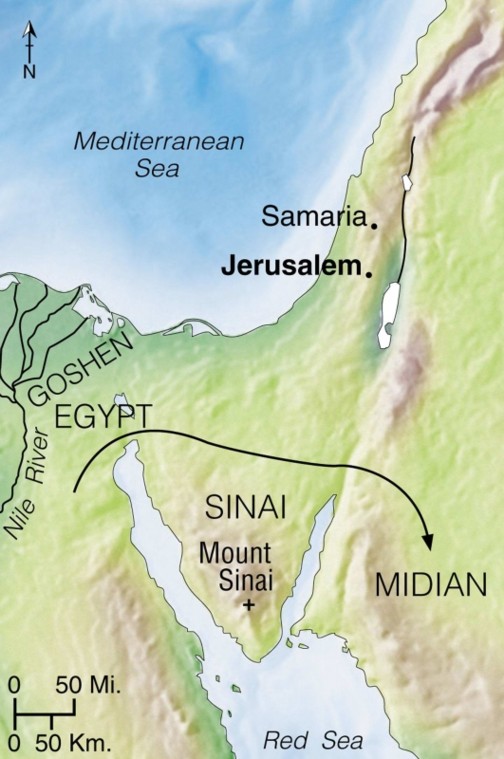
After murdering an Egyptian, Moses escaped into Midian. There he married Zipporah and became a shepherd.

After murdering an Egyptian, Moses escaped into Midian. There he married Zipporah and became a shepherd.

When reading this chapter of Psalms, one could feel as if it were written about the Israel of today. Speaking of the enemies of the nation, the psalmist allows how they would gladly wipe out God’s people:

They say, “Come,let us wipe them out as a nation;
let the name of Israel be remembered no more

Among the conspirators mentioned are such as the Amelikites, the Moabites and Ammonites who are referred to correctly here as the children of Lot (Genesis 19:36-38), the Edomites, the Philistines, and the inhabitants of Tyre. All are Gentile persecutors of God’s people. Today, there are those people who would take joy in the persecution of Christians – a phenomenon that many would argue is beginning to make a somewhat surprising comeback in North America, as well as other parts of the world. The prayer of the chapter which glorifies the Lord is relevant today:

…that they may know that you alone,
whose name is the Lord,
are the Most High over all the earth.

Read or listen to audio of ESV version of this selection from this link.

/Bob’s boy
___________________
some images © V. Gilbert & Arlisle F. Beers

Please note: I did not design the reading plan that I am following in my blog.  All of my comments in this blog, however, are solely my responsibility.  When reading ANY commentary, you should ALWAYS refer first to the scripture, which is God’s unchanging and unfailing word. Reading schedules, as well as a link to the site where you can get the reading plan that I’m currently following for yourself can be found on the “Bible Reading Schedules” page of my website at http://graceofourlord.com.  

Psalm 98 – Let the Sea Roar!

sea_004The 98th psalm is another song of praise in the same vein as the 96th, in that it encourages the singing of “a new song” to the Lord. The psalm is composed of three stanzas of three verses each. The first set of verses extol the marvelous things that the Lord has done. His right hand and holy arm have worked salvation. He has kept His promises with faithfulness to His people; and all the ends of the earth have seen that salvation.

The second set of verses encourage making a joyful noise to the Lord over all the earth and breaking forth in joyous song, singing praises to the Lord. Then the third set of verses call forth to the created wonders of the earth itself to roar their own joyous noise. Jesus Himself, quoting Habakkuk 2:11, said in Luke 19:40 that the very stones would cry out if the people were silent. All creation should sing out in praise to the Creator of all, who will judge the earth with righteousness – and with fairness and equity to the people. This settles forever the question of for whom God’s word was written. It is for everyone!

Read or listen to audio of ESV version of this selection from this link.

/Bob’s boy
___________________
some images © V. Gilbert & Arlisle F. Beers

Please note: I did not design the reading plan that I am following in my blog.  All of my comments in this blog, however, are solely my responsibility.  When reading ANY commentary, you should ALWAYS refer first to the scripture, which is God’s unchanging and unfailing word. Reading schedules, as well as a link to the site where you can get the reading plan that I’m currently following for yourself can be found on the “Bible Reading Schedules” page of my website at http://graceofourlord.com.  

Psalms 96 – The Splendor of Holiness

ark_of_covenant_002Psalm 96 is part of David’s “Song of Thanks” to the Lord, which he had Asaph and his brothers sing after the arrival of the Ark in Jerusalem.  The psalm is found virtually word for word in 1 Chronicles 16:23-33.  The rest of that song, in verses 8-22 is taken from Psalms 105 and 106.

Like the previous psalm, this one urges praise to the Lord in song, and does so three times in the first two verses.  The notable theme throughout the psalm is its inclusion of all nations – all people – in praising and making offerings to the one true God.  The entirety of the nations, all the people of the world, are included 9 times in these 13 verses as belonging to, and ruled by, the Creator of the world.  The Gentiles and all people are called on to worship “in the splendor of holiness” the God, who unlike their “worthless idols,” will judge the world in righteousness and according to His faithfulness.

It is a testimony to the fact that is illustrated throughout the Bible that God’s people were given custodial responsibility for God’s word, but all nations were always intended to receive it, and His name would be great in all the world (Malachi 1:11).

Read or listen to audio of ESV version of this selection from this link.

/Bob’s boy
___________________
some images © V. Gilbert & Arlisle F. Beers

Please note: I did not design the reading plan that I am following in my blog.  All of my comments in this blog, however, are solely my responsibility.  When reading ANY commentary, you should ALWAYS refer first to the scripture, which is God’s unchanging and unfailing word. Reading schedules, as well as a link to the site where you can get the reading plan that I’m currently following for yourself can be found on the “Bible Reading Schedules” page of my website at http://graceofourlord.com.  For questions and help, please see the “FAQ” and “Summaries” pages there.

Psalms 80, 120 – In My Distress I Called

Thought to have been written during the time of captivity, the community lament of Psalm 80 makes pleas to the “Shepherd of Israel” to come and save them.  Verse 2’s mention of Ephraim, Benjamin, and Manasseh serves to include the whole of Israel.  Ephraim and Manasseh represent the northern kingdom, while the tribe of Benjamin remained with Judah after the division.  The phrase “let your face shine” in verses 3 and 7 remind of Aaron’s blessing in Numbers 6:24-25.   The psalm speaks of Israel as a vine, a metaphor that the Scriptures use often (Isaiah 5:1-3, Jeremiah 2:21, Jeremiah 12:10, Ezekiel 17:6).  Then in John 15:1-5, Jesus speaks of Himself as the true vine.

Ruins of the southern wall of the ancient Temple of Jerusalem which date from Herod's time.

Ruins of the southern wall of the ancient Temple of Jerusalem which date from Herod’s time.

Psalm 120 is the first of 15 psalms with the superscription “a song of ascents” (Psalms 120-134).  They are a widely varied collection of psalms, ranging from laments to thanksgiving psalms to royal psalms.  We are unsure what is the significance of the word, although many say that these were songs that were sung on “the steps,” which is one meaning for the word.

The best guess we have read is that they were songs that were sung during pilgrimage to the various feasts of the year, which would indicate the “ascent” to Jerusalem for worship.  Still, the most interesting view is the belief of some Jews that there are 15 of them because there were 15 steps from the “Court of the Women” to the “Court of the Men” in the Temple.

This one is an individual lament from someone who has been living among ungodly people who are hostile to him.  In verse 5, Meschech and Kedar are thought by most to represent places of barbarians.  Meshech was in Asia Minor near the Black Sea, and Kedar was in the Syrian desert to the south of Damascus.

Read or listen to audio of ESV version of this selection from this link.

/Bob’s boy
___________________
some images © V. Gilbert & Arlisle F. Beers

Please note: I did not design the reading plan that I am following in my blog.  All of my comments in this blog, however, are solely my responsibility.  When reading ANY commentary, you should ALWAYS refer first to the scripture, which is God’s unchanging and unfailing word. Reading schedules, as well as a link to the site where you can get the reading plan that I’m currently following for yourself can be found on the “Bible Reading Schedules” page of my website at http://graceofourlord.com.  For questions and help, please see the “FAQ” and “Summaries” pages there.

Psalm 95 – Make a Joyful Noise

mountains_004Psalms 95 – 100 are six of the psalms from Book 4 that eloquently express the divine kingship of God, and almost all of them urge praise to him in song – the phrase “make a joyful noise” is repeated in some of them.   It is a call to worship that is still appropriate for churches today, and that phrase is used over and over in hymns and religious themes for worship.  This psalm is a celebration of God most high as Creator and God over all.  It is He who owns the mountains, the depths of the Earth, as well as the sea.  The song calls upon the people to bow down and submit to the Maker, as the sheep of His pasture.

But the psalm is also a reminder to Israel and even to God’s people today of the displeasure of the Lord at disobedience, as it recounts how, barely out of the bondage in Egypt, they tested the Lord at Meribah, so quickly had they forgotten His mighty works on their behalf.  The psalm points out that though He spared them, he “loathed  that generation” for forty years, and in His anger He swore that they would not enter the promised land. It was a mistake for them, for those in the time this psalm was written, and for people today to think that because judgment does not come now, it will not ever come.

Read or listen to audio of ESV version of this selection from this link.

/Bob’s boy
___________________
some images © V. Gilbert & Arlisle F. Beers

Please note: I did not design the reading plan that I am following in my blog.  All of my comments in this blog, however, are solely my responsibility.  When reading ANY commentary, you should ALWAYS refer first to the scripture, which is God’s unchanging and unfailing word. Reading schedules, as well as a link to the site where you can get the reading plan that I’m currently following for yourself can be found on the “Bible Reading Schedules” page of my website at http://graceofourlord.com.  For questions and help, please see the “FAQ” and “Summaries” pages there.

Psalms 92 – How Great Are Your Works!

English: Palm Tree in Sundankottai,Tamilnadu,India

English: Palm Tree in Sundankottai,Tamilnadu,India (Photo credit: Wikipedia)

The superscription of this psalm proclaims it to be “a song for the Sabbath,” which indeed means it is most appropriate for praise and worship to the Lord.  It is a song which while praising the mighty works of the lord, acknowledges the pleasure and joy that worshiping him brings to the hearts of the righteous (verse 4).  The text rightly says that this is something that the fool (unbeliever) simply cannot understand (verse 6), and is to be pitied for it.

The horn in verse 10 is a symbol of power, stature and prosperity; and relates to the grace and generosity of the lord toward His servant.  The psalmist proclaims that the enemies of the Lord will perish, and notes that the righteous will “flourish like the palm tree and grow like a cedar in Lebanon.”  The significant statement on this (verse 23) is that they are”planted” in the house of the Lord (worship), but they flourish in the “courts of our God” (in His divine presence).

Read or listen to audio of ESV version of this selection from this link.

/Bob’s boy
___________________
some images © V. Gilbert & Arlisle F. Beers

Please note: I did not design the reading plan that I am following in my blog.  All of my comments in this blog, however, are solely my responsibility.  When reading ANY commentary, you should ALWAYS refer first to the scripture, which is God’s unchanging and unfailing word. Reading schedules, as well as a link to the site where you can get the reading plan that I’m currently following for yourself can be found on the “Bible Reading Schedules” page of my website at http://graceofourlord.com.  For questions and help, please see the “FAQ” and “Summaries” pages there.

Psalms 123, 79 – Help us, O God!

These two psalms are community laments.  It is hard to judge which one sounds the most desperate.  Psalm 123 seems to be  written at a time when the shame of God’s people before others is at a height, which may indicate a time long into the period of captivity.  The pleas for mercy from God are mixed with the picture of a servant to to his master for comfort.

Temple domePsalm 79 has the air of having been written just following a great defeat of the magnitude of Jerusalem’s destruction before captivity.  There is still some incredulity at the wanton destruction and the defilement of house of the Lord, not to mention the bloody massacre of friends and family members.  The cries from God’s people are not just for mercy for the “sheep of His pasture,” but for vengeance:

“Let the avenging of the outpoured blood of your servants
be known among the nations before our eyes!
Let the groans of the prisoners come before you;
according to your great power, preserve those doomed to die!
Return sevenfold into the lap of our neighbors
the taunts with which they have taunted you, O Lord!”


Read or listen to audio of ESV version of this selection from this link.

/Bob’s boy
___________________
some images © V. Gilbert & Arlisle F. Beers

Please note: I did not design the reading plan that I am following in my blog.  All of my comments in this blog, however, are solely my responsibility.  When reading ANY commentary, you should ALWAYS refer first to the scripture, which is God’s unchanging and unfailing word. Reading schedules, as well as a link to the site where you can get the reading plan that I’m currently following for yourself can be found on the “Bible Reading Schedules” page of my website at http://graceofourlord.com.  

Psalms 91 – My Refuge and My Fortress

Moses_003Psalm 91 is generally considered to be another psalm of Moses; and even Spurgeon (who almost always ascribes authorship of all psalms to David) concedes the possibility.  Satan misapplied a quotation of verses 11-12 in one of his temptations of Jesus (see Luke 4:10-11) – “For he will command his angels concerning you to guard you in all your ways. On their hands they will bear you up, lest you strike your foot against a stone.”

This psalm speaks to the care and protection that children of God enjoy under his watch, an example of which is from verse 10 – “no evil shall be allowed to befall you, no plague come near your tent.”  This does not mean that Christians are exempt from any misfortune or harm in this life.  It simply means that under God’s watchful care, the faithful will be safely delivered through every situation, even that of death, safely into His loving arms. Consider verses 7-8:

A thousand may fall at your side,
ten thousand at your right hand,
but it will not come near you.
You will only look with your eyes
and see the recompense of the wicked.

This, along with the language of verses 3-6 (deliverance from “the snare of the fowler” and pestilence – and, in verse 10, plague), lend credence to Mosaic authorship, as well as explain the perspective. In the time of God’s judgment on man, those who “dwell in His shelter” have nothing to fear, for He is their refuge and fortress.

Read or listen to audio of ESV version of this selection from this link.

/Bob’s boy
___________________
some images © V. Gilbert & Arlisle F. Beers

Please note: I did not design the reading plan that I am following in my blog.  All of my comments in this blog, however, are solely my responsibility.  When reading ANY commentary, you should ALWAYS refer first to the scripture, which is God’s unchanging and unfailing word. Reading schedules, as well as a link to the site where you can get the reading plan that I’m currently following for yourself can be found on the “Bible Reading Schedules” page of my website at http://graceofourlord.com.  For questions and help, please see the “FAQ” and “Summaries” pages there.

Psalm 90 – From Everlasting to Everlasting

Psalm 90 begins Book 4 of the Book of Psalms.  It is one of four psalms classified as penitential in this book – the other three being 91, 94, and 101.  The superscription says it is “a prayer of Moses, a man of God.”  This is disputed by some commentators mainly because of verse 10, which says “The years of our life are seventy, or even by reason of strength eighty,” while Moses lived to be 120.

Wilderness through which the Israelites crossed on their way to the Promised Land.

Wilderness through which the Israelites crossed on their way to the Promised Land.

But that argument is completely without merit.  First of all, after the great flood, God Himself said that man’s years would be 120 (Genesis 6:3).  That of course was not intended to be an exact hard and fast number, and certainly at the upper end of the scale, especially as more degeneration in the genome came to pass. We hear of people over 110 even today, even though 70 -80 is certainly a more realistic expectation.  Secondly, although Aaron also lived to be over 100, most of the young men 30 -40 years old died after 40 years of the wandering. Moses, obviously not dead when he wrote the psalm, was speaking in general terms.

Now that we’ve spoken our mind on that matter, verse 10 is certainly not the point of this psalm, however.  The psalmist begins with noting the timelessness of the Lord, (“from everlasting to everlasting you are God”).   It is in verse 4 that a misunderstanding of the text leads some to try to count the days of Genesis 1 as being possibly eons of time For a thousand years in your sight are but as yesterday when it is past, or as a watch in the night.”  Not only does this ignore the context of the verse, but it also ignores the fact that every other occurrence of the word for “day” in Scripture that is connected to a number is most certainly a 24 hour period. A thousand years are not a significant amount to God, certainly. But the same does not apply to us.

The point of this poetic passage is to note the brevity of man’s life compared to the ageless God and His creation.  And the plea is for the favor of the Lord, and the gift of wisdom to make the best use of the years that we have by being in His service.

Read or listen to audio of ESV version of this selection from this link.

/Bob’s boy
___________________
some images © V. Gilbert & Arlisle F. Beers

Please note: I did not design the reading plan that I am following in my blog.  All of my comments in this blog, however, are solely my responsibility.  When reading ANY commentary, you should ALWAYS refer first to the scripture, which is God’s unchanging and unfailing word. Reading schedules, as well as a link to the site where you can get the reading plan that I’m currently following for yourself can be found on the “Bible Reading Schedules” page of my website at http://graceofourlord.com.  For questions and help, please see the “FAQ” and “Summaries” pages there.