Psalm 8 – How Majestic Is Your Name

Isaac Watts wrote hymns from this psalm. It is also a great example of chiastic structure (ABC, CBA). The first sentence and last are identical.  Sandwiched in between, first comes God’s greatness, followed by the main points in verses 4 and 5, and then man’s position in the world because of God.   It is also a great passage written about God’s created man that is so easily applied to Jesus – this time by the Hebrew writer (Hebrews 2:6-8).  Jesus quotes verse two (“out of the mouths of babes”) in Matthew 21:16, when the chief priests and scribes became indignant from the shouts of the children of “Hosanna to the Son of David!” when he cleansed the Temple after his triumphal entry.

moneychangers

Jesus cleanses the temple; throwing moneychangers out and upsetting the tables with animals and birds –John 2: 12-22.

Verse two also clearly indicates that the psalmist’s praise to God comes on the heels of some victory over foes, but the psalm praises God’s majesty because of his creation of the heavens and the moon and stars which he set in place (Genesis 1:17).   Then he expresses wonder that this same great God made man “a little lower” than the heavenly beings (Genesis 1:26), and gave him dominion over all his works.

But Hebrews 2:10 ties both Old and New Testament together with such grace and beauty that we can only marvel:

For it was fitting that he, for whom and by whom all things exist, in bringing many sons to glory, should make the founder of their salvation perfect through suffering.

Read or listen to audio of ESV version of this selection from this link.

/Bob’s boy
___________________
some images © V. Gilbert & Arlisle F. Beers

Please note: I did not design the reading plan that I am following in my blog.  All of my comments in this blog, however, are solely my responsibility.  When reading ANY commentary, you should ALWAYS refer first to the scripture, which is God’s unchanging and unfailing word. Reading schedules, as well as a link to the site where you can get the reading plan that I’m currently following for yourself can be found on the “Bible Reading Schedules” page of my website at http://graceofourlord.com.  For questions and help, please see the “FAQ” and “Summaries” pages there.
Psalm 5-6 – Lead Me In Your Righteousness

Both of these Psalms are regarded generally as Psalms of Lament.  Both have the quite frequent musical direction in the superscript.  In Psalm 5, some versions say that it is “for the flute(s),” but that is far from settled.  The Hebrew word is “Nehiloth.”  Easton’s Bible Dictionary says: “It is probably derived from a root meaning “to bore,” “perforate,” and hence denotes perforated wind instruments of all kinds. The psalm may be thus regarded as addressed to the conductor of the temple choir which played on flutes and such-like instruments.”

Psalm 5’s label as a lament, though technically correct is unfortunate.  It is ascribed to David, and we do not know the time or circumstances that it occurred in his life, but like many other “Lament” psalms, it does contain pleas for deliverance from enemies.  But it is often called a “morning prayer” because of verse three, where he tells the Lord that He hears his voice in the morning as he offers his sacrifice – his worship to the Lord.

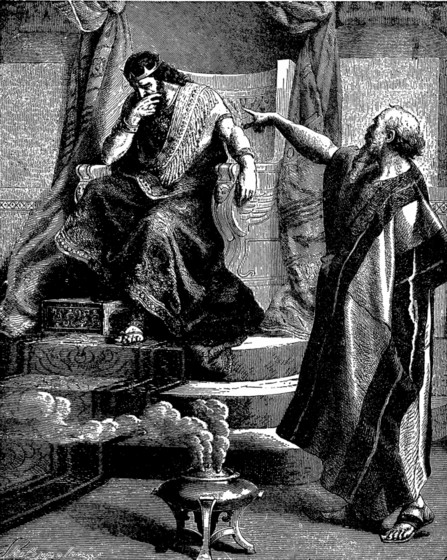
Nathan condemns David because of Bathsheba.

Nathan condemns David because of Bathsheba.

It is a reminder for us of the importance of personal prayer, and of worship.  Notice the repeated use (six times) of the word “my” in the first three verses – “give ear to my words…the sound of my cry…my King and my God…”   In verses 4-6, he acknowledges how God hates wickedness, the deceitful, the proud or boastful – all evildoers – and how they will not stand before him as the righteous (see also Psalm 1:5).  Clearly in verse 7, he considers the privilege he has to be able to come and worship Him, because of the Lord’s “steadfast love.”

Psalm 6 is one that many classify as one of penitence, although we are not told of what sin for which he is repenting.  It seems clear in verses 2-5 that he is ill – so much so that he believes he could die from whatever the illness might be.   It may, as some are often prone to think, that he feared his illness was God’s punishment for that sin (Job’s friends being a case in point).  In any case, he is not only gravely ill, and possibly in peril from his enemies (verses 8, 10), but he is also deeply ashamed of whatever wrong he has done.  But he knows that now that he has repented, “the Lord has heard my plea; the Lord accepts my prayer.” 

Both psalms serve as models of prayer and the privilege we have to worship the Lord and to receive His forgiveness and His care in times of trouble because of His “steadfast love” (5:7, 6:9).

Read or listen to audio of ESV version of this selection from this link.

/Bob’s boy
___________________
some images © V. Gilbert & Arlisle F. Beers

Please note: I did not design the reading plan that I am following in my blog.  All of my comments in this blog, however, are solely my responsibility.  When reading ANY commentary, you should ALWAYS refer first to the scripture, which is God’s unchanging and unfailing word. Reading schedules, as well as a link to the site where you can get the reading plan that I’m currently following for yourself can be found on the “Bible Reading Schedules” page of my website at http://graceofourlord.com.  For questions and help, please see the “FAQ” and “Summaries” pages there.

Psalm 119:9-16; Psalm 2 – Guarding Our Hearts By His Word

Note: Every Monday in 2013, along with another short chapter from the Book of Psalms, we are reading a stanza from Psalm 119.

Isaac Watts.

Isaac Watts. (Photo credit: Wikipedia)

Today’s reading of the second stanza, or strophe, of Psalm 119 is brought to you by the letter “Beth” or “Bet.”  The pictograph for this letter is of a house, and the letter is recognizable in several biblical places – such as Bethel (house of God), Bethlehem (house of bread), and Bethesda (house of grace).  The great Isaac Watts hymn “How Shall the Young Secure Their Hearts” is based on these verses.

In verses 9-10, the author calls upon the Lord to help him live his life according to God’s word because he realizes that only by giving our whole hearts to His will can we make our way through life remaining holy and pure from the world.   The emphasis in verse 11 is on thorough study of God’s word (storing it in our hearts). This was done by many of God’s people then by memorizing these psalms in days when the written word was of God was not so readily available as it is today.   We are encouraged to value His word as some would value riches, and mediate on what the Lord wants from us (verses 14-15).  We are to share His word with others (verse 13), and by our deeds make known that we delight in doing so because of His care for us (verses 13, 16).

Psalm 2 is one of the Messianic (sometimes called “royal”) psalms.  It starts out with the declaration of the foolishness of those who will reject God and His “anointed.”   We even see the actions of verse three today, as people in leadership positions, or who are considered wise, claim to be freeing people from “bonds” by having them reject God and His Son.  And though even entire nations rebel against Him, God will bring His judgment upon them in His time (verses 4-5).

Verse 6 prophesies the Messiah coming to His “holy hill” – Jerusalem.  Verse 7 is in the voice of the Messiah declaring that God is pleased with His Son, which is fulfilled in Matthew 3:17.  Verse 8 erases any doubt that these verses may be speaking of David as king, rather than being about the Messiah.  Verses 10-12 are a warning to rulers and leaders of nations that they should lead people in service to God, but these are often the very same people who lead others astray.

Read or listen to audio of ESV version of this selection from this link.

/Bob’s boy
___________________
some images © V. Gilbert & Arlisle F. Beers

Please note: I did not design the reading plan that I am following in my blog.  All of my comments in this blog, however, are solely my responsibility.  When reading ANY commentary, you should ALWAYS refer first to the scripture, which is God’s unchanging and unfailing word. Reading schedules, as well as a link to the site where you can get the reading plan that I’m currently following for yourself can be found on the “Bible Reading Schedules” page of my website at http://graceofourlord.com.  For questions and help, please see the “FAQ” and “Summaries” pages there.

The “Golden Alphabet” Psalm

Note: Every Monday in 2013, along with another short chapter from the Book of Psalms, we are reading a stanza from Psalm 119.  

Hinterglasbild Psalm 119, 22 (Text) Hammerhof,...

Hinterglasbild Psalm 119, 22 (Text) Hammerhof, Deggenhausertal (Photo credit: Wikipedia)

Psalm 119 is the longest Psalm, as well as the longest chapter in the Bible (176 verses), and is a literary marvel of God’s majestic word.  If you use a search engine on the Internet, you will find many interesting things about this psalm of all psalms.  Charles Spurgeon, in his seven volume “Treasury of David,” said “The Germans called it ‘The Christian’s golden A B C of the praise, love, power, and use of the Word of God’.”  It is the ultimate acrostic, separated into 22 stanzas (or strophes), each containing eight verses.  Each of those stanzas begins every single verse of the stanza with the same letter of the Hebrew alphabet, using all 22 letters of that alphabet in succession.  In most translations, the name of the Hebrew letter that a stanza represents serves as a heading over each stanza (Aleph, Beth, Gimel, Daleth, Heh, Vav, Zayin, Cheth, Teth, Yod, Kaph, Lamed, Mem, Nun, Samekh, Ayin, Peh, Tzaddi, Qoph, Resh, Shin, Tav).

The author and date that the psalm was written is unknown.  Spurgeon, Matthew Henry, and others extolled it as the work of David.  Others place the date sometime after Ezra, or in the days of Ezra and Nehemiah.  Still others (such as Adam Clarke) favor at least a pre-Exilic date, if not Davidian authorship.  Some commentators have stated that the rigid acrostic structure which the author imposed upon himself made it difficult to maintain continuity of thought and theme.  Others who have been more diligent in their study come to a very different conclusion!

The structure makes it in actuality a compilation of 22 psalms that come together in harmony with one central theme.  It contains ten synonyms for the “law” or word of God (eleven, if you count “truth”) that are repeated in almost every single verse.  It is a guide-book to God’s word,  It teaches us (among other things) about the love of God, what His word is, what it means for us, how we should live in view of His word, how our lives are affected by it, and how others are affected by the way we treat God’s word.

Hebrew children in Jesus Christ’s time and before were taught to memorize this great psalm; and the acrostic structure, along with the element of song, made that task easier.  If God had so much work put into writing something as complex as this psalm, He must have had a good reason.  He did indeed.  A careful study of this psalm over the course of this year – or any year – will be certain to enrich your life!

Summing Up

Each weekend, I post a small PDF of one week of chapter summaries (on the website’s “Summaries” page), current to the beginning of the previous week.  I have posted the summary for Week 2 (January 2013 Week 2) of the schedule I am following this year.  This short PDF documents contains condensed comments about Proverbs 5, 6, 7, 8, and 9, with hyperlinks to the ESV version of each chapter for listening or reading, and joins the summaries for other weeks already posted there.

/Bob’s boy
___________________
image © V. Gilbert & Arlisle F. Beers

Please note: I did not design the reading plan that I am following in my blog.  All of my comments in this blog, however, are solely my responsibility.  When reading ANY commentary, you should ALWAYS refer first to the scripture, which is God’s unchanging and unfailing word. Reading schedules, as well as a link to the site where you can get the reading plan that I’m currently following for yourself can be found on the “Bible Reading Schedules” page of my website at http://graceofourlord.com.  For questions and help, please see the “FAQ” and “Summaries” pages there.

Psalm 9 – What about those Psalm Titles?

Psalm 9 has some notable characteristics, and is the subject of some disagreement among scholars, although toward minor matters.  To begin with, the psalm is an acrostic, though certainly not on the level of Psalm 119.  It uses the first eleven letters of the Hebrew alphabet,although one is missing.  There have been some that suggest Psalm 9 and 10 were once a single psalm because the latter is also an acrostic.  But they are much too different.  The insignificance of an acrostic in this case is such that some scholars have even questioned that as an intent. Then, there is the matter of the superscription or title.  As noted in this blog previously, these titles are not part of the inspired word, but they are ancient.  There are critics that dispute the accuracy of these titles when they explicitly link a psalm to a particular historical event in scripture or a location (such as being written when David was in the wilderness of Judah).  But such critics have not given convincing reason for such doubt.

It is important to remember that the Psalms were written for song and prayer, and have been used for both since the time they were written.  In the ESV, this one reads “To the choirmaster: according to Muth-labben. A Psalm of David.”  Those first three words occur 55 times in the superscriptions of chapters of the Book of Psalms.  Other translations read “For the chief musician…”  What follows is usually obvious musical instruction, such as “with stringed instrument.”

Smith's Bible Dictionary 1863

Smith’s Bible Dictionary 1863 (Photo credit: Wikipedia)

But occasionally, what follows may be simply be “a psalm of David,” which was undoubtedly instruction enough at one time as to its musical execution. Or, as in this case, what follows may be a phrase suggesting that it be sung a particular way, or set to the tune of another song known at the time the superscription was written.  Scholars do not agree on what the Hebrew letters that were transposed as Muth-labben actually mean.  The NKJV and RIV both take the stance that this means that the psalm is to be sung “to the tune of “Death of the Son.'”

Two other instructions are within the body of this Psalm.  One is “Selah,” which according to Smith’s Bible Dictionary:

“is found only in the poetical books of the Old Testament, occurs seventy-one times in the Psalms and three times in Habakkuk. It is probably a term which had a meaning in the musical nomenclature of the Hebrews, though what that meaning may have been is now a matter of pure conjecture. (Gesenius and Ewald and others think it has much the same meaning as our interlude,–a pause in the voices singing, while the instruments perform alone.)”

Before the word “Selah” in verse 16, we have another word (“Higgaion”), which is generally accepted as instruction for a pause of meditation (more info at this link to Topical Bible“).  Together with “Selah,” this would suggest a longer period of pause with musical direction and meditation following verse 16’s praise of God for what He has done, before continuing the psalm.

When Nahash, king of the Ammonites, died, David sent some men to his son Hanun to comfort them. Hanun insulted David's men by shaving their beards and cutting their robes off at the buttocks (2 Samuel 10:1-5)

When Nahash, king of the Ammonites, died, David sent some men to his son Hanun to comfort them. Hanun insulted David’s men by shaving their beards and cutting their robes off at the buttocks (2 Samuel 10:1-5)

Which brings us to another point over which there is some disagreement.  That is whether the psalm is about an actual victory already won over an enemy (see verse 4), a plea for God to grant such a victory (e.g. verse 13), or a statement of certainty by the psalmist that such victory would come (e.g. verse 3).  According to Coffman, George Rawlinson believed that the psalm is about David’s victory over Ammon and Syria (2 Samuel 10:6-14).

What the psalm is really about is thanksgiving and praise to God.  With the exception of the petitions in verses 19-20, almost the entire psalm praises God and thanks Him for all that He has done, and for His constant care.  That is the lesson of this psalm, what its words are to be used for, and how we should do the same:

“I will give thanks to the Lord with my whole heart;
I will recount all of your wonderful deeds.
I will be glad and exult in you;
I will sing praise to your name, O Most High.”

Read or listen to audio of ESV version of this selection from this link.

/Bob’s boy

Please “like” us on Facebook at  https://www.facebook.com/bobsboy01

___________________
some images © V. Gilbert & Arlisle F. Beers

Please note: I did not design the reading plan that I am following in my blog.  All of my comments in this blog, however, are solely my responsibility.  When reading ANY commentary, you should ALWAYS refer first to the scripture, which is God’s unchanging and unfailing word. Reading schedules, as well as a link to the site where you can get the reading plan that I’m currently following for yourself can be found on the “Bible Reading Schedules” page of my website at http://graceofourlord.com.  For questions and help, please see the “FAQ” and “Summaries” pages there.
Psalm 3-4 – Save Me, O My God

Chapter 3 is the first of the Psalms with a title (sometimes called a sub-script or superscription).  These titles are not part of the inspired word, but they are ancient.  And they have had their critics who question their accuracy, although we have been given no good reason for doing so.  This one reads “A Psalm of David, when he fled from Absalom his son,”  which refers to the events of 2 Samuel 15-17 (here, particularly to 2 Samuel 15:13-17).

How quickly and completely David’s fortunes had changed!  He was king, but his own son had conspired so successfully against him that David had to flee from Jerusalem, fearing that even the city he had built and loved would be destroyed if he remained, as Absalom now commanded more of his army than he did.  David was a hunted man, now in danger of losing even his life.  Yet the remarkable lesson for us in verses 1-6 is that this unbelievably painful crisis brought him closer to God, rather than leaving him feeling abandoned.

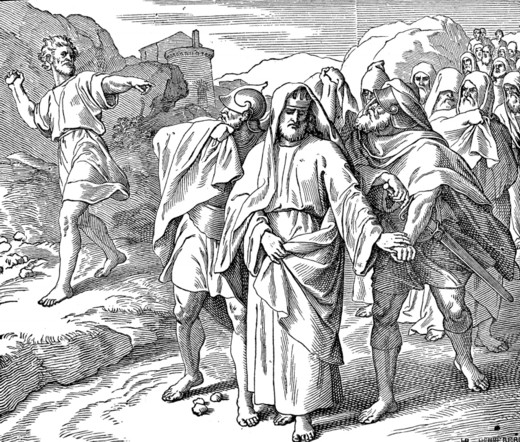
Shimei throwing stones at David.

Shimei throwing stones at David.

When reading in verse 2 that “many are saying of my soul, there is no salvation for him in God,” one cannot help but think of Shimei in 2 Samuel 16:7-8.  But David professes his faith that his enemies cannot stand against him with the Lord on his side (verses 7-8) – the same kind of faith Paul encourages in Romans 8:31 (“If God is for us, who can be against us?”).  As David gives all glory to the Lord, he unselfishly asks blessings on all His people (verse 8).

In verses 4 -5 of chapter 4, he tells us not to let our agitation and distress cause us to turn away from God into sin (see also Ephesians 4:26).  He calls upon us to put our trust in the Lord, and finishes the chapter praising God and declaring his confidence in verse 8: “In peace I will both lie down and sleep; for you alone, O Lord, make me dwell in safety.”

Though his situation was dire and the odds against him, David took comfort in knowing the Lord heard his cry, and He will hear ours.  He always does!

Read or listen to audio of ESV version of this selection from this link.

/Bob’s boy

Please “like” us on Facebook at  https://www.facebook.com/bobsboy01

___________________
some images © V. Gilbert & Arlisle F. Beers

Please note: I did not design the reading plan that I am following in my blog.  All of my comments in this blog, however, are solely my responsibility.  When reading ANY commentary, you should ALWAYS refer first to the scripture, which is God’s unchanging and unfailing word. Reading schedules, as well as a link to the site where you can get the reading plan that I’m currently following for yourself can be found on the “Bible Reading Schedules” page of my website at http://graceofourlord.com.  For questions and help, please see the “FAQ” and “Summaries” pages there.
Psalm 119:1-8; Psalm 1 – The Way of the Righteous

English: Aleph is the first letter of hebrew A...

English: Aleph is the first letter of hebrew Alphabet Deutsch: Aleph ist der Erste Buchstabe des Hebräischen Alphabets (Photo credit: Wikipedia)

Today we begin our reading of Psalm 119 with the first 8 verses.  It is the longest chapter in the Bible (176 verses), and it is one of a few acrostics in the Bible, employing all 22 letters of the Hebrew alphabet in its structure.  We will have more to say about this incredible structure in this weekends preview of the coming week.  But for now we’ll focus on the Scripture itself.  These eight verses are brought to you by the letter “Aleph.”

As with the other 21 stanzas, these eight verses employ different synonyms for the word “law” (testimonies, precepts, statutes, commandments, rules).  These verses declare not only that God wants us to be diligent in keeping His commandments (verse 4), but also that by doing so our lives are blessed, and we can worship Him with our hearts in the right place.  It doesn’t mean that we can ever be truly blameless,  but our intentions to live according to His word will give us an “upright heart” (verses 5-7).

Psalm 1 begins in the first verse speaking instead on the path that the righteous do not take.  Two kinds of people are spoken of throughout the Bible – the servants of God and the enemies of the Lord.  It is the heart that chooses which of those paths one will not take that makes him part of the other group.  There is no middle ground.  Those who choose not to take the advice and example of the wicked are happy living under God’s law (verse 2).  Their lives endure the test of time by choosing righteousness (verse 3), but evil will not triumph in the long course of time (verses 4-6).

Read or listen to audio of ESV version of this selection from this link.

/Bob’s boy

Please “like” us on Facebook at  https://www.facebook.com/bobsboy01

___________________
some images © V. Gilbert & Arlisle F. Beers

Please note: I did not design the reading plan that I am following in my blog.  All of my comments in this blog, however, are solely my responsibility.  When reading ANY commentary, you should ALWAYS refer first to the scripture, which is God’s unchanging and unfailing word. Reading schedules, as well as a link to the site where you can get the reading plan that I’m currently following for yourself can be found on the “Bible Reading Schedules” page of my website at http://graceofourlord.com.  For questions and help, please see the “FAQ” and “Summaries” pages there.

Happy Thanksgiving!

English: "The First Thanksgiving at Plymo...

English: “The First Thanksgiving at Plymouth” (1914) By Jennie A. Brownscombe (Photo credit: Wikipedia)

Today, many of us will eat too much food, watch a lot of football, and enjoy the company of friends and family that we love.  This tradition that we call Thanksgiving Day is most often associated with the Pilgrims at Plymouth Rock as they celebrated the “first Thanksgiving”  Others argue that it was actually Spaniards in the 16th century that celebrated the first Thanksgiving feast in America. One thing we know for certain is that the first official Thanksgiving celebration that became a yearly tradition was proclaimed by Abraham Lincoln in 1863 – right in the middle of the Civil War.  He called this national day of celebration one of  “Thanksgiving and Praise to our beneficent Father who dwelleth in the Heavens.”

Most of us living in the United States have much to be thankful for as, by and large, we have so much more materially than a great percentage of the population of the rest of the world – so much so that even some of the poorest in this country would be considered rich by those standards.  As we enjoy the grace that God has extended to us so richly today, let us remember to give great thanks to him daily, and share the joy and hope that we have in Jesus Christ with others, and pray that they will share in His salvation, which is freely given.

With love and best wishes, I leave you today with three verses from a great Psalm of thanksgiving to the Lord (Psalm 105):

Oh give thanks to the Lord; call upon his name;

make known his deeds among the peoples!

 Sing to him, sing praises to him;

tell of all his wondrous works!

Glory in his holy name;

let the hearts of those who seek the Lord rejoice!

/Bob’s boy
___________________
some images © V. Gilbert & Arlisle F. Beers

Please note: I did not design the reading plan that I am following in my blog.  All of my comments in this blog, however, are solely my responsibility.  When reading ANY commentary, you should ALWAYS refer first to the scripture, which is God’s unchanging and unfailing word. Reading schedules, as well as a link to the site where you can get the reading plan that I’m currently following for yourself can be found on the “Bible Reading Schedules” page of my website at http://graceofourlord.com.  For questions and help, please see the “FAQ” and “Summaries” pages there.