Psalm 119:65-72; Psalm 36 – With You is the Fountain of Life

tethToday’s reading of the ninth strophe of Psalm 119 is brought to you by the letter “teth” or “tet.”   The psalmist continues to praise God’s word, but here he acknowledges his sins and  his tendency to be ensnared by wicked ways.

Of verse 66 (“Teach me good judgment and knowledge”), Spurgeon, who advocated David as the author, said: “Since God had dealt well with him, he is encouraged to pray for judgment to appreciate the Lord’s goodness. Good judgment is the form of goodness which the godly man most needs and most desires, and it is one which the Lord is most ready to bestow. David felt that he had frequently failed in judgment in the matter of the Lord’s dealings with him: from want of knowledge he had misjudged the chastening hand of the heavenly Father, and therefore he now asks to be better instructed, since he perceives the injustice which he had done to the Lord by his hasty conclusions.”

Psalm 36 – This psalm is most often labelled a lament, but it is more importantly a prayer and song of praise.  It starts in verses 1-4 with the description of deeply sinful people who know better.  They flatter themselves that they will not be found out, have stopped trying to act wisely or to do good, for sin has penetrated their hearts.  In verses 5-10, David thanks God for His steadfast love, the refuge of His loving wings, and the abundance of His love and mercy.

“For with you is the fountain of life;
in your light do we see light”

This fountain of life makes us think of Jesus at the well with the Samaritan woman in John 4:10, and his light of John 8:12: “I am the light of the world. Whoever follows me will not walk in darkness, but will have the light of life.”

Read or listen to audio of ESV version of this selection from this link.

/Bob’s boy
___________________
some images © V. Gilbert & Arlisle F. Beers

Please note: I did not design the reading plan that I am following in my blog.  All of my comments in this blog, however, are solely my responsibility.  When reading ANY commentary, you should ALWAYS refer first to the scripture, which is God’s unchanging and unfailing word. Reading schedules, as well as a link to the site where you can get the reading plan that I’m currently following for yourself can be found on the “Bible Reading Schedules” page of my website at http://graceofourlord.com.  For questions and help, please see the “FAQ” and “Summaries” pages there.

Psalm 34 – Taste and See That the Lord Is Good

The superscript here refers to David feigning madness in the  presence of Achish, otherwise known by the Philistine title of Abimelech in 1 Samuel 21:10-14 (not to be confused with Ahimelech, the priest of the previous few verses).   Barnes identified the following four paragraphs in the psalm: (1) thanksgiving for deliverance (Psalm 34:1-6); (2) from his experience, he invites others to join in praise (Psalm 34:7-10); (3) special instructions and exhortations for the young to trust in God (Psalms 34:11-14); (4) a general summary of the security, joys, and protection for those who truly rely upon God (Psalms 34:15-22).

Don’t misunderstand verses 17-19:

“When the righteous cry for help, the Lord hears
and delivers them out of all their troubles.
The Lord is near to the brokenhearted
and saves the crushed in spirit.
Many are the afflictions of the righteous,
but the Lord delivers him out of them all.”

Those who have a contrite heart (crushed in spirit) – those who truly repent instead of continuing to do wrong – will be delivered in the end.  God has no regard for the prayers of those who have no intention of changing their ways.   The righteous will indeed suffer, but their salvation and their comfort is promised.

Of this, Coffman wrote:

“Our Lord himself was a man of sorrows and acquainted with grief; and he is the ever ready comforter and Saviour of those whose hearts have been broken by the soul’s tragic encounter with the wicked world in which we live.

NSRW Rudyard Kipling

NSRW Rudyard Kipling (Photo credit: Wikipedia)

The words of Kipling come to mind:

‘The tumult and the shouting dies;
The Captains and the Kings depart.
Still stands Thine ancient sacrifice,
An humble and a contrite heart.
Lord God of Hosts, be with us yet,
Lest we forget; lest we forget!’

— Rudyard Kipling (The Recessional)”

Regarding verse 8’s first half “Oh, taste and see that the Lord is good!, Coffman rightly stated: “God has made it possible for men to know whether or not his word is true. The person who receives it, obeys it, and trusts its promises will shortly come to know, Whom he has believed, having tasted the good Word of God and the powers of the age to come…”   Peter repeated it in 1 Peter 2:1-3.  When we dedicate our lives to serving the Lord and continue  to grow in prayer and learning from His word, our lives are better because of the goodness of the Lord and the assurance of His promises.

Of verses 9-10 (“those who seek the Lord lack no good thing”), one must not think that the scripture promises that those who fear the Lord will never have any of their earthly needs or desires lacking in satisfaction, for not all things are good for everyone – nor is what may be good for one person necessarily good for another.  Instead, we trust that the Lord will provide what we truly need.  Just come and taste for yourself!

Read or listen to audio of ESV version of this selection from this link.

/Bob’s boy
___________________
some images © V. Gilbert & Arlisle F. Beers

Please note: I did not design the reading plan that I am following in my blog.  All of my comments in this blog, however, are solely my responsibility.  When reading ANY commentary, you should ALWAYS refer first to the scripture, which is God’s unchanging and unfailing word. Reading schedules, as well as a link to the site where you can get the reading plan that I’m currently following for yourself can be found on the “Bible Reading Schedules” page of my website at http://graceofourlord.com.  For questions and help, please see the “FAQ” and “Summaries” pages there.

Psalm 27-28 – Wait For the Lord

An early printing of Luther's hymn A Mighty Fo...

An early printing of Luther’s hymn A Mighty Fortress Is Our God (Ein feste Burg ist unser Gott) (Photo credit: Wikipedia)

The great hymn “A Mighty Fortress Is Our God” is based upon this psalm.  It begins in verses 1-3 with confidence and trust in God.  The words of verse one bring to mind Paul’s letter to the Romans in 8:31. “If God is for us, who can be against us?”  Verse 10’s statement “For my father and my mother have forsaken me, but the Lord will take me in” probably refers to their deaths, meaning “My parents were my protectors for a time; but the Lord will be my Protector always.”  Verse 14 brings a chiastic end to psalm 27, with trust as the word again:

“Wait for the Lord; be strong, and let your heart take courage; wait for the Lord!” 

It is not easy, but we must trust in God and have patience.  He does His work, as He sees fit –  in His time.

Kyle Yates’ commentary appropriately titled the 28th psalm “The Answered Prayer” as it has just two sections: the prayer (verses -15) and the answer (verses 6-9).  The occasion has been identified by Delitzsch as the time of Absalom’s rebellion; and he says that it is third psalm of that time of persecution.  In verse 7, David says that he trusts the Lord with his heart, not just his lips; and he closes the psalm with the image of a shepherd who often have to carry their sheep.

How many occasions in your life can you look back upon, knowing that God must have “carried” you?  It is something I seldom recognize when He is about the business of doing it.  I am quick to pray for God’s help.  But how often when things eventually worked out well have I failed to recognize that it was His work?  Too often, I fail to praise Him as I should.

Read or listen to audio of ESV version of this selection from this link.

/Bob’s boy
___________________
some images © V. Gilbert & Arlisle F. Beers

Please note: I did not design the reading plan that I am following in my blog.  All of my comments in this blog, however, are solely my responsibility.  When reading ANY commentary, you should ALWAYS refer first to the scripture, which is God’s unchanging and unfailing word. Reading schedules, as well as a link to the site where you can get the reading plan that I’m currently following for yourself can be found on the “Bible Reading Schedules” page of my website at http://graceofourlord.com.  For questions and help, please see the “FAQ” and “Summaries” pages there.

Psalm 119:57-64; Psalm 32 – The Earth is Full of Thy Mercy

hethToday’s reading of the eighth strophe of Psalm 119 is brought to you by the letter “heth” or “het.”   regarding verse 64, Spurgeon summons this poem

“Why bursts such melody from tree and bush,
The overflowing of each songster’s heart,
So filling mine that it can scarcely hush
Awhile to listen, but would take its part?
It is but one song I hear where ever I rove,
Though countless be the notes, that God is Love.
“Why leaps the streamlet down the mountainside?
Hasting so swiftly to the vale beneath,
To cheer the shepherd’s thirsty flock, or glide
Where the hot sun has left a faded wreath,
Or, rippling, aid the music of a grove?
Its own glad voice replies, that God is Love!”
“Is it a fallen world on which I gaze?
Am I as deeply fallen as the rest,
Yet joys partaking, past my utmost praise,
Instead of wandering forlorn, unblessed?
It is as if an unseen spirit strove
To grave upon my heart, that God is Love!” Thomas Davis, 1864

Psalm 32 is a psalm of thanksgiving for God’s forgiving grace. David speaks in verses 3-4 of how heavily the burden of guilt weighed upon him before he acknowledged his sins to the Lord (verse 5), and he praises God’s steadfast love and forgiveness.  He then turns in verse 8 to those he would instruct, to rejoice and trust in the Lord.  Spurgeon wrote of the forgiveness which David refers to here:

“We may lull the soul asleep with carnal delights, but the virtue of that opium will be soon spent. All those joys are but stolen waters, and bread eaten in secret—a poor sorry peace that dares not come to the light and endure the trial; a sorry peace that is soon disturbed by a few serious and sober thoughts of God and the world to come; but when once sin is pardoned, then you have true joy indeed. ‘Be of good cheer; thy sins be forgiven thee (Matthew 9:2).'”

Read or listen to audio of ESV version of this selection from this link.

/Bob’s boy
___________________
some images © V. Gilbert & Arlisle F. Beers

Please note: I did not design the reading plan that I am following in my blog.  All of my comments in this blog, however, are solely my responsibility.  When reading ANY commentary, you should ALWAYS refer first to the scripture, which is God’s unchanging and unfailing word. Reading schedules, as well as a link to the site where you can get the reading plan that I’m currently following for yourself can be found on the “Bible Reading Schedules” page of my website at http://graceofourlord.com.  For questions and help, please see the “FAQ” and “Summaries” pages there.
Psalm 25 – Remember Not the Sins of My Youth

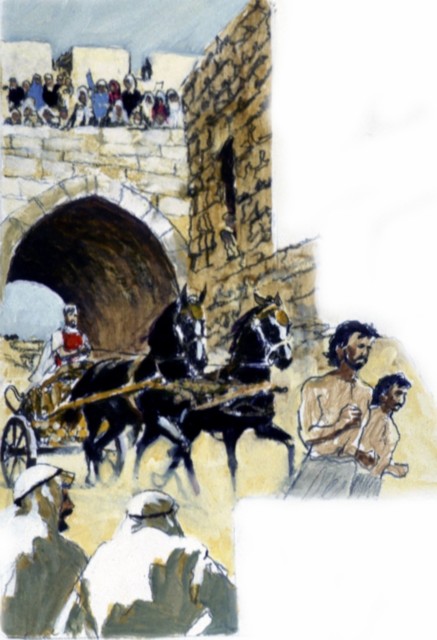
David's son Absalom plotted to rebel against David, seize his father's throne and become king. To win favor with the people, he bought a beautiful chariot and horses and rode through the streets of Jerusalem in great honor (2 Samuel 15:1-6).

David’s son Absalom plotted to rebel against David, seize his father’s throne and become king. To win favor with the people, he bought a beautiful chariot and horses and rode through the streets of Jerusalem in great honor (2 Samuel 15:1-6).

Because of the line this blog’s title, it is generally thought that David wrote this psalm in his latter years.  Some claim it to not be a psalm of personal penitence, but rather one that was meant to be used by anyone in distress.  But a time frame just before the Absalom conspiracy is quite likely when considering the penitential aspect of David’s sin with Bathsheba, as well as the mention of strength and number of his foes (verse 19).  It is otherwise a very recognizable psalm as one of the more well-known hymns still sung today – “Unto thee O Lord.”  It is one of the acrostic psalms, although some commentators state that it is imperfect.  But Spurgeon disagrees, stating that in the original text, the twenty-two verses follow the Aleph-bet in perfect order.

Read or listen to audio of ESV version of this selection from this link.

/Bob’s boy
___________________
some images © V. Gilbert & Arlisle F. Beers

Please note: I did not design the reading plan that I am following in my blog.  All of my comments in this blog, however, are solely my responsibility.  When reading ANY commentary, you should ALWAYS refer first to the scripture, which is God’s unchanging and unfailing word. Reading schedules, as well as a link to the site where you can get the reading plan that I’m currently following for yourself can be found on the “Bible Reading Schedules” page of my website at http://graceofourlord.com.  For questions and help, please see the “FAQ” and “Summaries” pages there.

Psalm 30 – Joy Comes with the Morning

The superscript for this psalm generates some discussion because David, of course, was not around for the dedication of the temple.  That happened during Solomon’s reign.  This of course would not preclude the psalm from having been used on that occasion, but that context is not the nature way that these superscripts are generally phrased.  Others have suggested that it was actually during re-dedication of David’s palace after reclaiming it from Absalom.  One other school of thought is that the psalm was composed during dedication of the threshing floor of Araunah (2 Samuel 24:18-25), after the terrible pestilence that claimed the lives of 70,000.

David instructs Joab to number the people.

David instructs Joab to number the people.

This latter seems quite likely, and the reference to the Lord’s anger does lend some credence to it.  David referred to his former view of his prosperity in verse 6, and the fact that it was his own self-glorification that had led to his command for the numbering of his forces makes for a convincing argument for this explanation. The lesson for us could also be in how quickly our fortunes may be turned when we forget to depend upon the Lord.  As Clarke noted “Peace and prosperity had seduced the heart of David, and led him to suppose that his mountain – his dominion, stood so strong, that adversity could never affect him.”  We must never forget that all that we are blessed with comes from the Lord, and any or all of it could be lost in the twinkling of an eye.  Entire life savings have been wiped out by recent economic tragedy, loved ones we depend on sometimes die.  It is the Lord that is always our rock and our salvation.

Read or listen to audio of ESV version of this selection from this link.

/Bob’s boy
___________________
some images © V. Gilbert & Arlisle F. Beers

Please note: I did not design the reading plan that I am following in my blog.  All of my comments in this blog, however, are solely my responsibility.  When reading ANY commentary, you should ALWAYS refer first to the scripture, which is God’s unchanging and unfailing word. Reading schedules, as well as a link to the site where you can get the reading plan that I’m currently following for yourself can be found on the “Bible Reading Schedules” page of my website at http://graceofourlord.com.  For questions and help, please see the “FAQ” and “Summaries” pages there.

Psalm 119:49-56; Psalm 26 – Your Promise Gives Me Life

ZayinToday’s stanza of Psalm 119 is brought to you by the seventh letter of the Aleph-Bet, Zayin.  The pictograph is sometimes represented as a sword with a crown or sometimes as a plow or a sickle .   It is interesting that in light of the fact that most commentators disagree on the time frame for authorship of this psalm, some cannot even agree with their own assessment.  Adam Clarke, for example, was convinced at one point that it was written during Babylonian captivity, yet at other times thought that it may well have come from David’s hand after all.  Both views have merit especially in this stanza, or strophe.  Verses 49-50 certainly hint at one who is eagerly looking forward to the promised return from captivity, which is his comfort in this time of affliction.

It is better in our case to apply it to ourselves as was no doubt the intent in the first place.  We take comfort in the promises that God has made to us all in His Son, Jesus Christ.  It is His victory over death that should make the promise of eternal life a burning fire within our souls.    And our love for the Lord should give us righteous indignation at a wicked world that ignores His commandments and glorifies sin as if it were something to be admired.

Psalm 26 is sometimes thought to be written by David when he was accused of treachery against then king, Saul.  He prays to the Lord for vindication against his accusers, and declares his adherence to God’s rule and to his own integrity, which he refers to again in verse 11.  He humbly pleads with the Lord to “Prove me, O Lord, and try me; test my heart and my mind.”  Integrity is a watchword for David in many of his psalms, and it comes through loud and clear in this one, as he expresses his confidence in his commitment to it, all made possible by the faithfulness of the Lord and His graciousness to his servant.

Read or listen to audio of ESV version of this selection from this link.

/Bob’s boy
___________________
some images © V. Gilbert & Arlisle F. Beers

Please note: I did not design the reading plan that I am following in my blog.  All of my comments in this blog, however, are solely my responsibility.  When reading ANY commentary, you should ALWAYS refer first to the scripture, which is God’s unchanging and unfailing word. Reading schedules, as well as a link to the site where you can get the reading plan that I’m currently following for yourself can be found on the “Bible Reading Schedules” page of my website at http://graceofourlord.com.  For questions and help, please see the “FAQ” and “Summaries” pages there.

The Lord Is My Shepherd – The King of Glory!

Shepherd tending his flock.

Shepherd tending his flock.

Psalm 23 is the most well-known of all psalms – perhaps the only one that many of us know by heart.  It is truly a great prayer and the source of several excellent hymns we sing even today.  The reference to the Lord as the shepherd is most appropriate and carries over to Jesus in the New Testament, for sure.  But it is also used to describe the job of the apostles – we are certainly reminded of Jesus’ words to Peter – “Feed my sheep” (John 21:15-19).

The elders of the church are always refereed to as shepherds as well, because they care for the flock – the Christians who they are responsible for in caring for their spiritual nourishment.  In the sense that the term is used here, though, God is the one who brings the care, the restoration of one’s soul- his vitality.  The image of Him as the protector should be of great comfort to us.

The comfort and beauty of these eight verses is stirring for sure.  But it is the opinion of this blogger that one does himself a great disservice by passing over the next 10 verses in psalm 24.  As a prayer, its beauty and poetry are equal in every way to the 23rd psalm.  Read how the last few verses conclude this great benediction:

He will receive blessing from the Lord
and righteousness from the God of his salvation.
Such is the generation of those who seek him,
who seek the face of the God of Jacob.

Who is this King of glory?
The Lord, strong and mighty,
the Lord, mighty in battle!
Lift up your heads, O gates!
And lift them up, O ancient doors,
that the King of glory may come in.
Who is this King of glory?
The Lord of hosts,
he is the King of glory!

Read or listen to audio of ESV version of this selection from this link.

/Bob’s boy
___________________
some images © V. Gilbert & Arlisle F. Beers

Please note: I did not design the reading plan that I am following in my blog.  All of my comments in this blog, however, are solely my responsibility.  When reading ANY commentary, you should ALWAYS refer first to the scripture, which is God’s unchanging and unfailing word. Reading schedules, as well as a link to the site where you can get the reading plan that I’m currently following for yourself can be found on the “Bible Reading Schedules” page of my website at http://graceofourlord.com.  For questions and help, please see the “FAQ” and “Summaries” pages there.

Psalm 22 – Why Have You Forsaken Me?

And about the ninth hour Jesus cried out with a loud voice, saying, “Eli, Eli, lema sabachthani?” that is, “My God, my God, why have you forsaken me?”  Matthew 27:44

From Halley’s Handbook of the Bible (Halley, Henry H., Zondervan, 1961)

The Crucifixion, seen from the Cross, by James...

The Crucifixion, seen from the Cross, by James Tissot, 19th century. (Photo credit: Wikipedia)

“This sounds like a cry of anguish from David, but though written a thousand years before Jesus, it is so vivid a description of the crucifixion of Jesus that one would think of the writer as being personally present at the Cross. Jesus’ dying words (Psalms 22:1 Matthew 27:44), the sneers of his enemies (Psalms 22:7-8, Matthew 27:39-40, the piercing of his hands and feet (Psalms 22:16, John 20:25) and the casting of lots for his garments (Psalms 22:18, Matthew 27:39) are some of the events here described. None of these statements are applicable to David, or to any other known event or person in the history of mankind, except the crucifixion of the Son of God.”

Peter (Acts 2:30-35) preached: ‘David, being a prophet … he foresaw and spoke of … the Christ.’ This basic truth is reiterated again and again in the inspired New Testament.  There are than nine New Testament references which tie the meaning of this psalm irrevocably to the prophecy of our Lord’s crucifixion.  And then, regarding the resurrection, Hebrews 2:12 recounts verses 22-24.

But what of Jesus’ cry in verse one to the Lord.  Why would he speak of God forsaking Him? Burton Coffman’s summary of his thoughts on the subject ring very true:

“Jesus’ quoting the first line of this Psalm during his agony upon the Cross has led to many opinions. It has been supposed that Christ here merely quoted these words from the psalm to call attention to the whole bundle of prophecies in it which were being fulfilled literally at that very time. It is also believed by many that God Himself did indeed, for a little while, withdraw his presence from Christ in order to make it possible for Christ to die. There is much in the sacred Scriptures to commend this view.

Christ is spoken of in Heb. 2:9 as the One, who by the grace of God did indeed, ‘Taste of death for every man.’ Isaiah tells us that, ‘God laid upon him (Jesus) the iniquity of us all’ (Isaiah 53:6). Paul mentioned that God Himself ‘Set forth the Christ to be a propitiation’ (Romans 3:25), or an atonement, for the sins of all men. ‘Christ died for our sins’ (1 Corinthians 15:3); and ‘Him (Christ) who knew no sin, God made to be sin on our behalf; that we might become the righteousness of God in Him’ (2 Corinthians 5:21).

The ultimate consequence of sin is separation from God; and, in Christ’s becoming a substitute for sinful men upon the cross, he not only tasted of death, but also tasted the terrible consequences of sin in that soul-torturing experience of separation from the Creator. It is our understanding of Christ’s plaintive cry, ‘My God, why hast thou forsaken me,’ that Jesus did indeed, momentarily, taste the awful agony of separation from the Father. ‘For a moment in that last agony, the Perfect Man was alone with the sins of the whole world.'”

Read or listen to audio of ESV version of this selection from this link.

/Bob’s boy
___________________
some images © V. Gilbert & Arlisle F. Beers

Please note: I did not design the reading plan that I am following in my blog.  All of my comments in this blog, however, are solely my responsibility.  When reading ANY commentary, you should ALWAYS refer first to the scripture, which is God’s unchanging and unfailing word. Reading schedules, as well as a link to the site where you can get the reading plan that I’m currently following for yourself can be found on the “Bible Reading Schedules” page of my website at http://graceofourlord.com.  For questions and help, please see the “FAQ” and “Summaries” pages there.

Psalm 119:41-48; Psalm 29 – The Glory Due His Name

vavThe sixth letter of the Hebrew Aleph-Beth is Waw or Vav.  The pictograph looks like a tent-peg, whereas meaning of the word Vav is “hook,” and is associated with the hooks used for the curtains of the tabernacle in Exodus 27:9-18.  The key memory verse here appears to be in 41-42, where the psalmist remembers that the promise of the Lord’s salvation will give him the answer when he is taunted by the wicked.  as ever, trusting in God’s word is foremost.

Psalm 29 is a hymn of praise to the power and glory of the Lord.  The descriptions of his awesome power throughout these verses have suggested to some that it describes not only a storm that included lightning, but also possibly an earthquake event in the region.  It shakes the wilderness of Kadesh (a key place in Numbers where Moses struck the rock – Numbers 20:2-13).  (“He makes Lebanon to skip like a calf,and Sirion like a young wild ox”)  – Sirion is another name for Mount Lebanon.  the psalmist concludes the hymn in verses 10-11 with a description of the Lord in His place enthroned above the majesty of his creation.

The Lord sits enthroned over the flood;Kadesh
the Lord sits enthroned as king forever.
May the Lord give strength to his people!
May the Lord bless his people with peace!

Read or listen to audio of ESV version of this selection from this link.

/Bob’s boy
___________________
some images © V. Gilbert & Arlisle F. Beers

Please note: I did not design the reading plan that I am following in my blog.  All of my comments in this blog, however, are solely my responsibility.  When reading ANY commentary, you should ALWAYS refer first to the scripture, which is God’s unchanging and unfailing word. Reading schedules, as well as a link to the site where you can get the reading plan that I’m currently following for yourself can be found on the “Bible Reading Schedules” page of my website at http://graceofourlord.com.  For questions and help, please see the “FAQ” and “Summaries” pages there.