Job 5 – To God Would I Commit My Cause

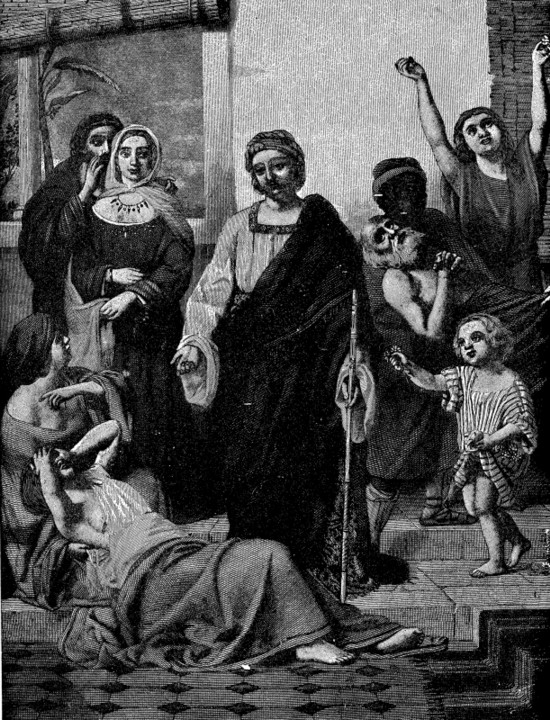
Job-003In chapter 5, Job’s friend Eliphaz concludes his first speech.  To be fair, he did point out some of Job’s good qualities.  But as a real friend, he would have to rate pretty low in our esteem, when it comes to consolation.  His suggestion is plain in verse 4 that Job is responsible for the deaths of his children.  He then sinks to a new low – that of the high and mighty – as he proclaims how different he is from Job in verse 8, committing his cause to God.  His praise of the Lord’s power and generosity smacks hard and seems shallow in the face of his continuing to rub salt in Job’s wounds.

He concludes by declaring how blessed Job should consider himself for being reproved by God and how the Lord’s discipline of him will give him redemption from his wicked ways, if only he will learn the lessons that God has surely taught him by his reproach.

Could Job’s other two friends can be a bit more sympathetic?  One should hope.  But Job will answer this one first.

Read or listen to audio of ESV version of this selection from this link.

/Bob’s boy
___________________
some images © V. Gilbert & Arlisle F. Beers

Please note: I did not design the reading plan that I am following in my blog.  All of my comments in this blog, however, are solely my responsibility.  When reading ANY commentary, you should ALWAYS refer first to the scripture, which is God’s unchanging and unfailing word. Reading schedules, as well as a link to the site where you can get the reading plan that I’m currently following for yourself can be found on the “Bible Reading Schedules” page of my website at http://graceofourlord.com.  For questions and help, please see the “FAQ” and “Summaries” pages there.

Job 4 – The Innocent Prosper?

The ancient kingdom of Edom. The Land of Uz pr...

The ancient kingdom of Edom. The Land of Uz probably lay on the darkened area. Suomi: Muinaisen Edomin alue (Photo credit: Wikipedia)

Job’s friend Eliphaz is called a Temanite.  Teman was an important city of Edom and is referred to in Amos 1:12.  He was probably not the same Eliphaz that is mentioned in Genesis 36:15, but as the first-born of Esau, his son was himself named Teman, which is where the name for the city probably came from.

After seven days of silence, he offers his opening speech, beginning with a compliment to Job’s integrity, but quickly we see that deteriorate to the same sort of rhetoric common to the day.  Satan has already counted on Job becoming a hypocrite, and Eliphaz suggests that he has become one by way of his complaining.  His self-righteous speech must have sorely aggravated Job, as he clearly demonstrates his total misunderstanding of Job’s plight, as well as the reasons for it to be happening to a man who by all other accounts had been judged innocent by his deeds.  The conclusion then, from his point of view, can only be that Job is, in fact that hypocrite, for “who that was innocent ever perished?”

Eliphaz’s “vision” begins and ends with a tale from a point of view that God Himself will declare as folly, and was true only in the imagination of Eliphaz.  As Coffman noted: “No one could make a bigger mistake than to suppose that God really spoke to Eliphaz in a dream or vision. Commentators differ on just where the vision ends; but we accept the opinion that it was concluded only by the end of this chapter.”

Read or listen to audio of ESV version of this selection from this link.

/Bob’s boy
___________________
some images © V. Gilbert & Arlisle F. Beers

Please note: I did not design the reading plan that I am following in my blog.  All of my comments in this blog, however, are solely my responsibility.  When reading ANY commentary, you should ALWAYS refer first to the scripture, which is God’s unchanging and unfailing word. Reading schedules, as well as a link to the site where you can get the reading plan that I’m currently following for yourself can be found on the “Bible Reading Schedules” page of my website at http://graceofourlord.com.  For questions and help, please see the “FAQ” and “Summaries” pages there.

Job 3 – Whatever I dread befalls me

Job finally breaks the silence of the last week as it would seem he can no longer bear it.    We have no way of knowing what has been going through his mind in the last week, but surely he has been tempted to turn his anger toward God.  Still, he does not sin and curse God, as God  in His wisdom already knew he would not.  True enough that he did greatly lament his own birth, but even the great prophet Jeremiah did so (Jeremiah 20:14-18) in his sorrow over his persecution.

Still, it is all too easy for us to be tempted to judge Job and others, for who among us has not himself suffered?  And is our suffering not just as severe for us at times?  When we have been hurt, do we cry out and long for death?  If we do not, does that make our grief and pain less significant?

We all do suffer – some more than others – at times, and if we are truthful, as great as our pain may be; and as bad as it may get for many of us, it is doubtful that we go through the degree of anguish and pain that Job has already experienced in the first two chapters of this book.

Job's happy days.

Job’s happy days.

But who is anyone else to judge this, and what yardstick will they use to do so?  That of what we read of Job – or (more likely) their own?  We will get to know Job’s friends much better in the coming days, but if you cut through all of the criticism that we and others direct at those friends (and truly they will show their own flaws as well), we should not lose sight of the fact that they came and stayed with Job when he was at his lowest, spoke not a word until he spoke, and only now will speak as they believe they may be able to help him understand why these terrible things have happened to him – as well how he might “fix it.”

Our desire to think of ourselves as compassionate, and “being there” for our friends as Job’s three friends are there is admirable, but we must not presume to “know how they feel.”  No matter how seemingly large or small the trial or pain, no two people handle grief, depression, or pain in the same way.  All Job knows, is that when all that he has lost began to go wrong, it just kept coming!  And his worst fears and dreads became realized again and again (verse 25-26):

“For the thing that I fear comes upon me,
and what I dread befalls me.
I am not at ease, nor am I quiet;
I have no rest, but trouble comes.”

Re: Job 2:10 “In all this Job did not sin with his lips.”  He epitomized Jesus’ words; and with of all their faults, Job’s friends did show compassion, for as much as he still obeyed Matthew 22:37 (cited from Deuteronomy 6:5), they demonstrated their love for him as in Matthew 22:39: “You shall love your neighbor as yourself.”  

Read or listen to audio of ESV version of this selection from this link.

/Bob’s boy
___________________
some images © V. Gilbert & Arlisle F. Beers

Please note: I did not design the reading plan that I am following in my blog.  All of my comments in this blog, however, are solely my responsibility.  When reading ANY commentary, you should ALWAYS refer first to the scripture, which is God’s unchanging and unfailing word. Reading schedules, as well as a link to the site where you can get the reading plan that I’m currently following for yourself can be found on the “Bible Reading Schedules” page of my website at http://graceofourlord.com.  For questions and help, please see the “FAQ” and “Summaries” pages there.

Job 2 ( or Just When You Thought Things Were Bad Enough…)

"Job covered in boils" - from Martin Luther's Bible

“Job covered in boils” – from Martin Luther’s Bible

The opening of the second chapter of Job is exactly as written in Job 1:6-8.  These encounters between God and Satan, especially when one interjects the “sons of God,” are the subject of lots of varying interpretations among commentators; and trying to sort through those may well overwhelm you as much as it does this blogger.  Some see these “sons of God” as angels, and some see them as worshipers.  It is pointed out that in no part of the scriptures does it say that these events take place in heaven.  The righteous are said to come before the Lord every time we worship him.  It is also true that Jesus said that the angels see the face of God every day (Matthew 18:10), so they would hardly need to “present” themselves before Him.

Matthew Poole saw these encounters between God and Satan as parabolic, and it is also possible that he could be partially right about that.   But the question in the end is – Does it really matter?  Okay so here, admittedly, is one more opinion.  <Insert disclaimer here> The discourse between God and Satan is told in the word of God by His inspired writer, just as a prophet would tell us in a book that is both history and poetry.

The conversations between God and Satan in Job have three purposes in my view.  First, they tell us that Satan is a real adversary.  (“Be sober-minded; be watchful. Your adversary the devil prowls around like a roaring lion, seeking someone to devour.” 1 Peter 5:8).   Secondly, they serve to demonstrate that although God does not cause us to suffer, it is not His will to prevent evil from be-falling us at all times.  Third,  they assure us that Satan’s power is not unlimited.  God does have dominion over him.

So Satan struck Job with “loathsome sores” (some versions say “boils”) literally from head to toe.  Attempts have been made to assign a medical condition using the description of the breath and other symptoms in other chapters.  But again, does it matter?  The point is that he was in so much agony that he was using broken pottery to “scrape” himself (verse 8).  And he was so disfigured that his three friends (Eliphaz, Bildad, and Zophar, who we will get to know better) did not even recognize him, cried when they saw how bad he really was, and sat with him for a week without anyone even speaking.

The question of why Satan did not take the life of Job’s wife is answered in verse nine, as she tries to persuade Job to curse God, to give up, and to take his own life.

We will resume Job’s story next Thursday.  I think I need me some Psalms and Proverbs before then.

Read or listen to audio of ESV version of this selection from this link.

/Bob’s boy
___________________
some images © V. Gilbert & Arlisle F. Beers

Please note: I did not design the reading plan that I am following in my blog.  All of my comments in this blog, however, are solely my responsibility.  When reading ANY commentary, you should ALWAYS refer first to the scripture, which is God’s unchanging and unfailing word. Reading schedules, as well as a link to the site where you can get the reading plan that I’m currently following for yourself can be found on the “Bible Reading Schedules” page of my website at http://graceofourlord.com.  For questions and help, please see the “FAQ” and “Summaries” pages there.

Introducing Job – Chapter 1

Tennyson, as Poet Laureate, used verse to prom...

Among the books of the Bible widely classified as “wisdom and poetry literature,” one would naturally think of Psalms among the poetry.  But the book of Job is not one that comes to the mind of most people when they think of poetry.  The great poet Alfred Lord Tennyson, however, would disagree.  Tennyson called Job “the greatest poem, whether of ancient or modern literature.”  A common statement made about Job is that it is about the question of why good people suffer.

Well, that question certainly was raised in Job, but there is a problem with that description after a careful reading – that question was never really answered.  Oswald Chambers said it better when presenting a summary of all five of the wisdom books.  Speaking of Job, he said it describes “how to suffer.”   And that is just about as good of a description as you will get, for much of the book does teach us how the righteous should face suffering, when it comes into their lives.  And in fact, Job is overflowing with poetry, as well as wisdom.  Every Thursday this year, we will read a chapter from this great book.

One question that constantly comes up about Job is whether it is fiction or history.  Defending the (correct, I solemnly believe) view that the Book of Job is the real story of a real man who suffered unimaginably difficult times is beyond the scope of this blog – except maybe to point out that God’s word treats it as such, and His inspired writers in other books refer to Job as a historic figure (Ezekiel 14:14, 20 and James 5:11, for example).  For a more in-depth  look at the historicity of Job, please see this article at ApologeticsPress.org.
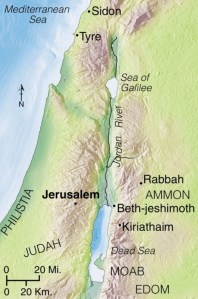
Ammon, Moab, Edom, and Philistia, although once united with Judah against Babylon, had abandoned Judah and rejoiced to see its ruin. But these nations were as sinful as Judah and would also feel the sting of God's judgment.

Ammon, Moab, Edom, and Philistia, although once united with Judah against Babylon, had abandoned Judah and rejoiced to see its ruin. But these nations were as sinful as Judah and would also feel the sting of God’s judgment.

We will start off chapter one by stating that there is much we do not know.  We do not know who the author was or when it was written.  The absence of reference to a Levitical priesthood (as demonstrated in verse 5) along with Job’s longevity (see Job 42:16), however, suggest roughly a time in Genesis after the flood.  We also do not know where, geographically, Job’s home in Uz was either, other than it was in the east (verse 3) and near a desert (verse 19).  It could be related to the northern home of Uz, the grandson of Shem (Genesis 10:22-23), Noah’s son, of whom the historian Josephus wrote in “Antiquities of the Jews” (book 1, chapter 6, paragraph 4), crediting him with the founding of Trachonitis and Damascus.  It could also be the land of Abraham’s nephew Uz (Genesis 22:20-21).  It could even be the land of the Uz the descendant of Seir, who had been related to Esau by marriage (Genesis 36:28).  It could also be the same land spoken of in Jeremiah 25:17-29 and Lamentations 4:21, which would be near or even include Edom to the south and east of the Dead Sea.

There is a lot of speculation also about verses 6-12.  Some say that the “sons of God” in verse 6 were angels.  Others make the perfectly good point that the term “sons of God” is used elsewhere in the scriptures to speak of people who serve the Lord (e.g. Romans 8:14 “For all who are led by the Spirit of God are sons of God”).  Along those lines, it is noteworthy that six times in these six verses, the Tetragrammaton (the Hebrew letters usually transliterated as YHWH or JHVH, which many refer to as Jehovah, rather than Yahweh) are used for God.  This use of the proper covenental name of God would seem to suggest a gathering of worshipers in which Satan asserted himself.

What we do know is that Job was a wealthy man who lived an upright life in the fear of the Lord (verses 1-3),

Messengers tell Job of his losses.

Messengers tell Job of his losses.

even to the point of offering sacrifices to God for his ten children (verse 5).  He seemed to have everything one could desire in life.  Then came the news from messengers, one after another, each telling of the great calamities that had fallen upon Job.  The Sabeans came from the south and killed his oxen and donkeys, and then murdered his servants that were with them (verses 14-15).  Then what we could assume as lightning had struck and killed his sheep and the servants that tended them (verse 16).  Before the second messenger had finished, another came and told Job that the Chaldeans, coming from the north, had taken his camels and killed the servants that were with them as well (verse 17).  The worst blow came again before the third messenger finished delivering his news.  All of his children, having been at the feast at his oldest son’s house had been killed by what must have been a great tornado that destroyed the house (verse 19).

Of Job’s immense grief at all of this loss, we get only a sense, as he tore his robe and shaved his head (signs of mourning) in verse 20.  He then fell upon the ground and worshiped God, rather than cursing him as Satan had hoped.  Verses 21-22 begin the real lesson of this book:

“And he said, ‘Naked I came from my mother’s womb, and naked shall I return. The Lord gave, and the Lord has taken away; blessed be the name of the Lord.’  In all this Job did not sin or charge God with wrong.”

Many have suffered great loss in this world (though few as great as this in such a short time), but who has not known someone who blamed God for their troubles, even those that were really self-inflicted?  How often have we been inclined to do the same?  Any loss, however great, is not the end of eternity.  Not for us, nor for any of the loved ones we may have lost.  Every blessing we have received in this life has come from God (James 1:17), unearned by us, and all of those blessings will be only a memory by the end of this life.  But as James, the Lord’s brother, also wrote in 1:12:

“Blessed is the man who remains steadfast under trial, for when he has stood the test he will receive the crown of life, which God has promised to those who love him.”

But Job’s story is only beginning.  We will take up chapter 2 next Thursday.

Read or listen to audio of ESV version of this selection from this link.

/Bob’s boy

Please “like” us on Facebook at  https://www.facebook.com/bobsboy01

___________________
some images © V. Gilbert & Arlisle F. Beers

Please note: I did not design the reading plan that I am following in my blog.  All of my comments in this blog, however, are solely my responsibility.  When reading ANY commentary, you should ALWAYS refer first to the scripture, which is God’s unchanging and unfailing word. Reading schedules, as well as a link to the site where you can get the reading plan that I’m currently following for yourself can be found on the “Bible Reading Schedules” page of my website at http://graceofourlord.com.  For questions and help, please see the “FAQ” and “Summaries” pages there.