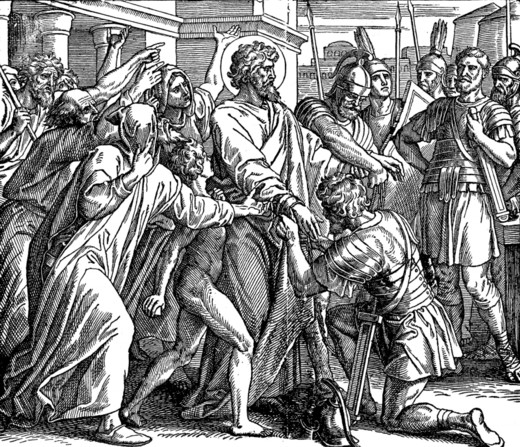
The Genealogy and Birth of Jesus – Matt 1

The first 17 verses of chapter one Matthew’s gospel are devoted to the genealogy of Jesus. Matthew’s gospel was written primarily to a Jewish audience. Therefore, the lineage of the husband of Mary (although not biologically Jesus’ father) would be important to Jews in fulfilling prophecy because it would be the “father’s” lineage that would be most important to them. But in this previous post, as well as my book, “An Orderly Account: A Tour of Luke’s Gospel,” I explained how Luke chapter 3 seems to clearly give us an account of Mary’s lineage also from David’s house.

But this genealogy in Matthew was so important that it consumed all but eight verses in the chapter. Those eight verses are devoted to the birth of our Lord and Savior.

/Bob’s boy

Bible Reading Schedule for this month
Click links below to read or listen to audio of one of this week’s chapters in Colossians and Luke

Matt 1, Matt 2, Matt 3, Matt 4, Matt 5

___________________

some images © V. Gilbert & Arlisle F. Beers

Please visit this site’s menu item “The Author’s Books” for info on the author’s books, website, and Facebook page.

All of my comments in this blog are solely my responsibility. When reading any commentary, you should always refer first to the scripture, which is God’s unchanging and unfailing word.


The Book of Jude


Surprisingly enough, there is little disagreement concerning the authorship of the Epistle of Jude; and it was accepted as canonical in the early days of the church. This also indicates its apostolic acceptance. As indicated in the first verse, it was written by Jude, a brother of James and of the Lord Jesus (although he rightly calls himself a servant of Jesus Christ). The date of this writing is largely held to be from 64-67 A.D., partly because of some perceived similarities with 2 Peter.

English: Colophon at the Epistle of Jude in th...

English: Colophon at the Epistle of Jude in the Codex Alexandrinus (Photo credit: Wikipedia)

The book consists of one chapter and only 25 verses. The recipient of the letter cannot be determined from the content of the text, but is assumed to be written to a congregation that included both Jew and Gentile members. The purpose of the letter is to express grave concern and even put forth a rebuke because of apostasy resulting from false teaching that has crept into the church. Verse 4 says “certain people have crept in unnoticed…ungodly people, who pervert the grace of God into sensuality and deny our only master and Lord, Jesus Christ.”

So, the problems that Jude addressed in this letter were no small matter at all, and we get the sense that some have allowed things to get so bad because they were too timid to stand for the truth. Verse 3 says that Jude “found it necessary to write appealing to you to contend for the faith that was once for all delivered to the saints.” In verses 22-23, Jude urges them to “have mercy on those who doubt; save others by snatching them out of the fire; to others show mercy with fear, hating even the garment stained by the flesh.” Those who know the truth need to step up and provide the needed leadership to get them back on track.

There is much counsel contained in this short epistle, and some “bonuses” thrown in by Jude, such as verse 14’s clear confirmation that Enoch was the seventh generation from Adam (Genesis 5:18). One other interesting note is in verse 5, where Jude confirms Jesus as having been with God from the beginning, as John wrote in John 1:3.

/Bob’s boy

Bible Reading Schedule for this month
Click links below to read or listen to audio of one of this week’s chapters in Colossians and Luke

Titus 1, Titus 2, Titus 3, Philemon, Jude

___________________

some images © V. Gilbert & Arlisle F. Beers

Please visit this site’s menu item “The Author’s Books” for info on the author’s books, website, and Facebook page.

All of my comments in this blog are solely my responsibility. When reading any commentary, you should always refer first to the scripture, which is God’s unchanging and unfailing word.


Paul’s Letter to Philemon

Paul’s letter to Philemon was a personal one, but it was also one that he intended to be read to the entire church, as they met in his home (verse 2). Philemon was a wealthy Christian in Colossae, and Paul probably befriended him during his three years in Ephesus, which was about 161 kilometers away. One of his bondservants, Onesimus, had run away, possibly even stealing some money from him (verses 18-19).

Philemon (New Testament person)

Philemon (New Testament person) (Photo credit: Wikipedia)

In a fortuitous coincidence, or more probably God’s providence, Onesimus had ended up in Rome while he was hiding, and had come into contact with Paul while he was in prison there. Presumably, it was during his first imprisonment there, and the letter was probably written about 62 A.D. – about the time that he wrote to Ephesus. After meeting Paul, Onesimus had become a Christian. Now Paul was sending him back to Philemon with the request that he receive his bondservant as he would receive Paul, and that he now should consider him a beloved brother.

Paul would have liked for Onesimus to stay and continue to help him while he was in prison, but he needed things to be made right between the two of them. Paul’s confidence that Philemon would respect his wishes and go beyond even what Paul was asking of him comes though loud and clear in this letter. Secular tradition has it that this same Onesimus became an important leader in the church. Whether that is true, we do not know for sure. But it seems that it was God’s will for Philemon’s forgiveness, the growth of brotherly love, and the service of Onesimus to make a difference in their lives, and in the lives of those in the church there. It was a great lesson in the providence and power of God in the lives of all those Christians.

/Bob’s boy

Bible Reading Schedule for this month
Click links below to read or listen to audio of one of this week’s chapters in Colossians and Luke

Titus 1, Titus 2, Titus 3, Philemon, Jude

___________________

some images © V. Gilbert & Arlisle F. Beers

Please visit this site’s menu item “The Author’s Books” for info on the author’s books, website, and Facebook page.

All of my comments in this blog are solely my responsibility. When reading any commentary, you should always refer first to the scripture, which is God’s unchanging and unfailing word.


Paul’s Letter to Titus – Titus 1-3

It seems clear that Paul wrote this letter to Titus sometime between the first and second letters to Timothy — before his final imprisonment. In the first chapter, we find that Paul has been to Crete, where he left Titus to help appoint some elders in the towns where they had established churches. this chapter again lists the qualification elders should have, which (not surprisingly) pretty much mirror those listed in 1 Timothy. The reason for the urgency in establishing elders all around is that Paul is aware that there are false teachers there, and he warns Titus to be prepared.

Sometimes known as Candia, Bible-time Crete is a large island in the Mediterranean Sea, about 150 miles long and 50 miles wide. The ship carrying Paul to Rome passed along the southern coast of Crete, where it encountered a storm (Acts 27: 7-11). People of Crete were among those at Pentecost (Acts 2: 11). Between Paul's first and second imprisonments, he and Titus visited Crete (Titus 1: 5). Tradition says that Titus was bishop of Crete and that he died there in his old age. In one ancient writing, Titus is called Bishop of Gortyna. Paul's letter to Titus talks about the conditions on Crete. A village near Ionion.

Sometimes known as Candia, Bible-time Crete is a large island in the Mediterranean Sea, about 150 miles long and 50 miles wide. The ship carrying Paul to Rome passed along the southern coast of Crete, where it encountered a storm (Acts 27: 7-11). People of Crete were among those at Pentecost (Acts 2: 11). Between Paul’s first and second imprisonments, he and Titus visited Crete (Titus 1: 5). Tradition says that Titus was bishop of Crete and that he died there in his old age. In one ancient writing, Titus is called Bishop of Gortyna. Paul’s letter to Titus talks about the conditions on Crete. A village near Ionion.

In the second chapter, he also advises the young preacher on preaching sound doctrine, conducting himself as a good example, and encouraging the young men to do so as well. He speaks of the importance of the influence of the older women, and even admonishes bondservants about “showing good faith so that in everything they may adorn the doctrine of God our Savior.

In chapter 3, Paul tells Titus to remind everyone to submit to the authorities and be obedient. He also stresses that they should not be quarrelsome, particularly where the law is concerned. It would seem here that he is speaking of the law of Moses, as he mentions it in the context of arguing about genealogies. He finishes the letter telling Titus to come to him in Nicopolis (Greece), where he has decided to spend the winter.

/Bob’s boy

Bible Reading Schedule for this month
Click links below to read or listen to audio of one of this week’s chapters in Colossians and Luke

Titus 1, Titus 2, Titus 3, Philemon, Jude

___________________

some images © V. Gilbert & Arlisle F. Beers

Please visit this site’s menu item “The Author’s Books” for info on the author’s books, website, and Facebook page.

All of my comments in this blog are solely my responsibility. When reading any commentary, you should always refer first to the scripture, which is God’s unchanging and unfailing word.


All Scripture Is Breathed Out By God- 2 Tim 3-4

Chapter 3 of 2 Timothy contains two well-known verses that are very important (verses 16-17): “All Scripture is breathed out by God and profitable for teaching, for reproof, for correction, and for training in righteousness,  that the man of God may be complete, equipped for every good work.” This, of course, was written by Paul at a time when there was not much around in the way of New Testament scripture. But that does not mean it is excluded. Many people wonder why we need the Old Testament at all, since we are not under the Law of Moses any longer. Those who ask that question can find the answer by studying it in earnest. It does not take long to find that it truly is “profitable.”

Paul begins chapter 4 by encouraging Timothy in his preaching and his example to others. The remainder of the chapter contains his greetings for others, as well as the clear message that Paul knows he is not going to be around much longer. He asks his young friend to come see him.

/Bob’s boy

Bible Reading Schedule for this month
Click links below to read or listen to audio of one of this week’s chapters in Colossians and Luke

1 Tim 6, 2 Tim 1, 2 Tim 2, 2 Tim 3, 2 Tim 4

___________________

some images © V. Gilbert & Arlisle F. Beers

Please visit this site’s menu item “The Author’s Books” for info on the author’s books, website, and Facebook page.

All of my comments in this blog are solely my responsibility. When reading any commentary, you should always refer first to the scripture, which is God’s unchanging and unfailing word.


Paul Back in Chains – 2 Tim 1-2

In Paul’s first letter to Timothy, it is apparent that Paul is free, which leads many to believe that he was writing while on a fourth missionary journey, having been released from the Roman prison that we find him in during the latter part of the Book of Acts. In the first chapter of his second letter,  it is clear that he is once again in prison. It seems obvious that this is a second imprisonment in Rome, and that he would be executed there. He speaks of those in Asia who had “turned away” from him, as well as one who had been kind and cared for him while in his chains.

Paul_in_chains-01In chapter 2, Paul tells Timothy to “share in suffering as a good soldier.” He then says that “no soldier gets entangled in civilian pursuits, since his aim is to please the one who enlisted him.” He continues this thought later in the chapter in verses 23-25:

Have nothing to do with foolish, ignorant controversies; you know that they breed quarrels. And the Lord’s servant must not be quarrelsome but kind to everyone, able to teach, patiently enduring evil, correcting his opponents with gentleness.

While we should not fear speaking against evil, we will certainly have to endure it at times. Doing so “patiently” may not be so easy. Where do we draw the line at speaking out against evil, while not being too quarrelsome? Perhaps not an easy question to answer.

/Bob’s boy

Bible Reading Schedule for this month
Click links below to read or listen to audio of one of this week’s chapters in Colossians and Luke

1 Tim 6, 2 Tim 1, 2 Tim 2, 2 Tim 3, 2 Tim 4

___________________

some images © V. Gilbert & Arlisle F. Beers

Please visit this site’s menu item “The Author’s Books” for info on the author’s books, website, and Facebook page.

All of my comments in this blog are solely my responsibility. When reading any commentary, you should always refer first to the scripture, which is God’s unchanging and unfailing word.


The Love of Money – 1 Timothy 6

In chapter 6, Paul speaks to Timothy of those who are bondservants. This would include those who were akin to indentured servants, as well as those who were actual slaves. Slavery abounded in those times, and the Roman empire was built upon it. Whatever lot they were in, Paul’s point was that they should regard their masters as n”worthy of honor” and conduct themselves in such a manner that unbelievers would see that Christians were honorable themselves.

Rembrandt's Timothy and his grandmother, 1648.

Rembrandt’s Timothy and his grandmother, 1648. (Photo credit: Wikipedia)

Paul urges Timothy to teach and be an example to all that godliness and humility are worthy characteristics, and much more important than anything of the world. He says in verse 6 that “godliness with contentment is great gain,  for we brought nothing into the world, and we cannot take anything out of the world.” And it is in verse 10 that the oft misquoted verse about money is given “the love of money is the root of all kinds of evil.” He closes in verse 20, repeating the theme that has been stated in scripture so often about not leaning on one’s own understanding: “avoid the irreverent babble and contradictions of what is falsely called “knowledge,” for by professing it some have swerved from the faith.

/Bob’s boy

Bible Reading Schedule for this month
Click links below to read or listen to audio of one of this week’s chapters in Colossians and Luke

1 Tim 6, 2 Tim 1, 2 Tim 2, 2 Tim 3, 2 Tim 4

___________________

some images © V. Gilbert & Arlisle F. Beers

Please visit this site’s menu item “The Author’s Books” for info on the author’s books, website, and Facebook page.

All of my comments in this blog are solely my responsibility. When reading any commentary, you should always refer first to the scripture, which is God’s unchanging and unfailing word.


Paul’s Instructions to Timothy on Teaching and Leadership – 1 Timothy 4-5

Just as Jesus warned of false teachers (Matthew 7:15), Paul warns Timothy while he was at Ephesus of such men in chapter four. As he exhorts Timothy in his teaching, Paul says in verse 12: “let no one despise you for your youth, but set the believers tan example in speech, in conduct, in love, in faith, in purity.” This is one of the passages that lead many to believe Timothy to be much younger than he probably was. Paul is speaking here in relative terms. Timothy was old enough by the time of this writing to have had much experience at teachings, having traveled a great deal with and without Paul to do so.

Ephesus-003In chapter five, Paul tells him that the church should take care of its widows, but those who have others to care for them should be taken care of by their own people — the right thing to do, of course. Verse 23 is used by some to excuse all sorts of alcohol use. The verse actually says “No longer drink only water, but use a little wine for the sake of your stomach and your frequent ailments.” The words “a little” are key here, and such wine was not so strong as what people drink today anyway. Water was often not very pure in many places, and anyone who had “frequent ailments,” as Timothy apparently did, would benefit from the substitution.

/Bob’s boy

Bible Reading Schedule for this month
Click links below to read or listen to audio of one of this week’s chapters in Colossians and Luke

1 Tim 1, 1 Tim 2, 1 Tim 3, 1 Tim 4, 1 Tim 5

___________________

some images © V. Gilbert & Arlisle F. Beers

Please visit this site’s menu item “The Author’s Books” for info on the author’s books, website, and Facebook page.

All of my comments in this blog are solely my responsibility. When reading any commentary, you should always refer first to the scripture, which is God’s unchanging and unfailing word.


Qualifications for Deacons and Overseers – 1 Timothy 3

In the third chapter of Paul’s first letter to his young charge, Paul talks about the qualities that should be found in men who serve as elders and deacons. Referring to them here as overseers, Paul says that elders should be the husband of one wife, above reproach, hospitable, and (among other things) able to manage his household well. Otherwise, he says, how can they be expected to care for God’s church?

Painting of a Russian Orthodox deacon leading ...

Painting of a Russian Orthodox deacon leading an ektenia (litany). (Photo credit: Wikipedia)

The qualities he lists for deacons are very similar, and notice that how their wives conduct themselves is judged to be important as well. The role of women in the Lord’s church is not one to be taken lightly; and it is (unfortunately) often under-valued by men and women alike. In the case of the wives of deacons and elders, one can see that in a well-functioning congregation, these women play a critical role in assuring the instruction of the young, caring for men and women of all ages, and instructing and leading young women in their walk with the Lord. Indeed, it is a fact that the Lord’s church could not function properly at all without the aid of godly women.

/Bob’s boy

Bible Reading Schedule for this month
Click links below to read or listen to audio of one of this week’s chapters in Colossians and Luke

1 Tim 1, 1 Tim 2, 1 Tim 3, 1 Tim 4, 1 Tim 5

___________________

some images © V. Gilbert & Arlisle F. Beers

Please visit this site’s menu item “The Author’s Books” for info on the author’s books, website, and Facebook page.

All of my comments in this blog are solely my responsibility. When reading any commentary, you should always refer first to the scripture, which is God’s unchanging and unfailing word.


Paul’s Opening to Timothy – 1 Timothy 1-2

In Paul’s first letter to Timothy, he calls him “my true child in the faith.”  paul had great affection for Timothy, and had entrusted him with much important work. He had sent him to the Thessalonians when he had been concerned about their faith. He had left him at Ephesus, where one of his most cherished bodies of brethren dwelled. Now his encouragement for his young companion in this letter comes not only with discussion of the mistakes and sins of those they both know, but also with instruction for those things the brethren will most need from Timothy.

Rembrandt's Timothy and his grandmother, 1648.

Rembrandt’s Timothy and his grandmother, 1648. (Photo credit: Wikipedia)

Chapter two contains scripture that is most often misunderstood, and even maligned or flatly ignored — especially in this age. In the middle of telling Timothy how men should behave, he talks about how women should adorn themselves modestly. Of course, dressing modestly is certainly expected of both men and women even today. But the description Paul gives here is a warning against the way that women were dressing and behaving in those days as part of a “new Roman woman” movement of the day.

The movement was one that encouraged such women to both dress and behave in a sexually provocative manner, as well as assert themselves into situations that were taboo for the times. The admonishment for women not to teach or exercise authority over a man (verse 12) clearly refers to the assembly (worship) — not in everyday life. This can be seen from the context, which is set in verse 8.

/Bob’s boy

Bible Reading Schedule for this month
Click links below to read or listen to audio of one of this week’s chapters in Colossians and Luke

1 Tim 1, 1 Tim 2, 1 Tim 3, 1 Tim 4, 1 Tim 5

___________________

some images © V. Gilbert & Arlisle F. Beers

Please visit this site’s menu item “The Author’s Books” for info on the author’s books, website, and Facebook page.

All of my comments in this blog are solely my responsibility. When reading any commentary, you should always refer first to the scripture, which is God’s unchanging and unfailing word.