Job 38:1-21 – The Lord Answers Job

A whirlwind in the ancient territory of Galatia, or modern Ankara, Turkey

A whirlwind in the ancient territory of Galatia, or modern Ankara, Turkey

Because of the length of chapter 38, we will examine it in two parts – the first of which in this blog will be verses 1-21. All throughout the book, Job has been requesting an audience with God, in order to plead his case. And God comes abruptly to him in this chapter. The first verse starts out -with Then the Lord answered Job out of the whirlwind and said:…” But it is the second verse that is the source of some debate.

The second verse reads “Who is this that darkens counsel by words without knowledge?” At first reading, it appears that in that sentence, He is referring to Job, and that seems to be the majority opinion. But some good arguments have been made that God is actually referring to the words of Elihu. As one commentator wrote, assigning these words to Job is a direct contradiction of Job 42:7-8, which clearly states that Job has spoken correctly of God. The debate goes on, and there are merits to both arguments (although some have even questioned the authenticity of the Elihu speeches, alleging that they were not part of the original text. We flatly reject that suggestion).

Arguments on both sides of this question are compelling, and although we lean toward the position that the Lord was indeed addressing Elihu, we must confess uncertainty. In the end, despite some truth, Elihu just got too much wrong (see previous posts on Chapters 35 and 37). Either way, the lessons of chapter 38 are the same, so the point is largely academic. That Elihu’s speeches add value to the book, is a concept we support for reasons listed in previous posts on those chapters.

earth003The Lord begins His dialog with Job, asking in several different ways where Job was when he gave birth to the universe, and what Job understands about the undertaking. Some take the statements about the earth’s foundation, where its “bases” were sunk, and the cornerstone being laid (verse 6) to mean that the Bible is assuming the world is flat. But like much of the “Wisdom Literature” the Book of Job is full of imagery; and like any poetry, one should consider that when studying these verses. Written long before mankind in general knew the word was round, many passages in the Bible demonstrate that God’s word was far ahead scientifically. For examples of passages about a round earth, see Job 26:10 and Isaiah 40:22.

Verse 7 speaks of the “sons of God” shouting for joy when God created the world. For this term, we can refer back to Job 1:6, which makes the same reference. See this previous post about chapter one for our comments about that. Keep in mind also that there is much we would like to know about many things not of this world, such as angels and demons, cherubim and seraphim, and urum and thummin that the Bible does not fully explain. God has His own reasons for what is included in the Scriptures and what is not. Such explanation is not necessary for salvation and instruction in same.

At first look at the remaining verse leading to verse 21, we may think that we know much more about some of those things than they did in Job’s time. But verse 17 reminds us that we know nothing about the experience of such things as death, and the state of our awareness in the immediate time afterward:

“Have you entered into the springs of the sea,
or walked in the recesses of the deep?
Have the gates of death been revealed to you,
or have you seen the gates of deep darkness?
Have you comprehended the expanse of the earth?
Declare, if you know all this.”

When we take up this chapter again, we will begin at verse 22.

Read or listen to audio of ESV version of this selection from this link.

/Bob’s boy
___________________
some images © V. Gilbert & Arlisle F. Beers

Please note: I did not design the reading plan that I am following in my blog.  All of my comments in this blog, however, are solely my responsibility.  When reading ANY commentary, you should ALWAYS refer first to the scripture, which is God’s unchanging and unfailing word. Reading schedules, as well as a link to the site where you can get the reading plan that I’m currently following for yourself can be found on the “Bible Reading Schedules” page of my website at http://graceofourlord.com.  For questions and help, please see the “FAQ” and “Summaries” pages there.

Amos, Shepherd of Tekoa (Minor Prophets Part 3)

Historical marker outside Hazor.

Historical marker outside Hazor.

We continue to stress the fact that the minor prophets are called such because of the short books of the Bible that they represent, not their importance. The Book of Amos is a great illustration of that. Though not the shortest book of the Old Testament, it only consists of nine chapters, and with the exception of chapter 5, none of them contain more than 17 verses (chapter 5 has a whopping 27). But we could take many more pages to comment on this book than would suit the purpose of this series (that purpose being to present a general overview of each of the books of the minor prophets).

The best place to begin is in the very first verse of the book, which tells us that Amos was one of the shepherds of Tekoa. Situated about 20 kilometers south of Jerusalem, Tekoa was referred to in 2 Samuel 14 as the place that the wise woman came from – the one that Joab used to deceive David, convincing him to let Absalom come home.  The same verse tells us that Amos made these prophecies during the days of Uzziah, king of Judah and Jeraboam, the son of Joash, king of Israel during the two years before “the earthquake.”

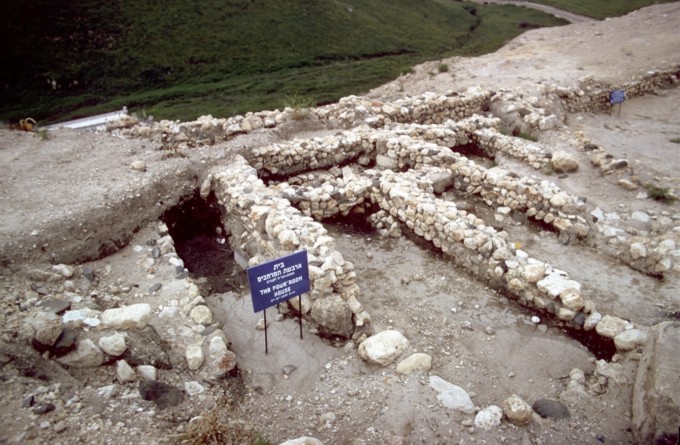
Before we get to the matter of the earthquake, let us address the date of the reigns of these two kings. Estimates of the reigns of these two kings range from about 800 B.C down to Uzziah’s death in about 739 B.C., leaving us with about a 60 year period when the prophecies could have occurred. Then there is the matter of this earthquake. The one mentioned is obviously one that was great in magnitude, as it was eventful enough to be used as a time reference here, and it is mentioned also in Zechariah 14:5. Excavations around Hazor in 1955 revealed evidence of an earthquake in the 8th century B.C. (some estimates are at 750 B.C. with a possible variance of 30 years). More than 50 years later, earthquake damage was still being discovered. More information can be found in this article at ICR.ORG and this article at the Jewish Virtual Library.

Hazor, house foundation

Hazor, house foundation

The book addresses the people of the northern kingdom, Through verse 5 of chapter 2, the judgment of the Lord against Israel’s enemies  (which the people expected) is prophesied. But what they did not expect, and had not counted on, was the judgment that would come to them for their injustice to the poor, and their pretense of worship to the Lord while they were actually doing nothing of the sort (the sarcasm in Amos 4:1-5 underscores this point). The Lord’s patience with them has come to an end (Amos 8:1-2). But He speaks in chapter 9 of a time when restoration will occur (note Amos 9:11, which is cited in Acts 15:16).

During this time, the northern kingdom was experiencing much prosperity, which they translated as a sign that God was pleased with them, and was blessing them. Amos’s message to them was exactly the opposite. A great deal of their wealth had been accumulated by their oppression of the poor. And their worship was more like an attempt at manipulating events in much of the same way that pagans worshiped their “gods.” Amos’s message was most unwelcome because it made the prediction that the “day of the Lord,” that they were expecting to usher in their further rise to power, would actually bring the end of their kingdom.

/Bob’s boy
___________________
image © V. Gilbert & Arlisle F. Beers

Please note: I did not design the reading plan that I am following in my blog.  All of my comments in this blog, however, are solely my responsibility.  When reading ANY commentary, you should ALWAYS refer first to the scripture, which is God’s unchanging and unfailing word. Reading schedules, as well as a link to the site where you can get the reading plan that I’m currently following for yourself can be found on the “Bible Reading Schedules” page of my website at http://graceofourlord.com.  


Major Prophets (part 5) – Book of Daniel

English: Shadrach, Meshach and Abednego in the...

English: Shadrach, Meshach and Abednego in the Furnace (Dan. 3:23-24,91-98) Русский: Седрах, Мисах и Авденаго в раскалённой печи (Дан. 3:23-24,91-98) (Photo credit: Wikipedia)

In 605 B.C., Nebuchadnezzar brought young men of noble heritage in Judah back for service in the king’s court. Daniel and his friends were part of one of these groups (Daniel 1:3). So his life in captivity was quite different from that of Ezekiel and many others less fortunate. According to Daniel 1:21, he served there until the first year of the reign of Cyrus, which would be about 538 B.C.

Daniel is a very important book in the Old Testament. It contains much prophecy that was fulfilled with undeniable accuracy (critics and skeptics notwithstanding). As has always been the case, even disputed passages have held up under the test of time (take, for example, Daniel’s use of the name Belshazzar in Daniel 5). It also teaches through Daniel’s life and that of his friends, Shadrach, Meshach,, and Abednego, a great deal about living faithfully under very great adversity. Finally, and most importantly, it teaches us much about the power of God, and His faithfulness to His word.

Daniel's Answer to the King

Daniel’s Answer to the King (Photo credit: Wikipedia)

The fulfilled prophecies from the Book of Daniel are a great source of assurance to believers for their accuracy. Skeptics and critics, as is always the case, dispute much concerning them of course. But they too have stood the test of time. A detailed account and analysis of all of these in one blog would be an exercise in futility. But for some great analysis of two of them, as well as answers for critics, take a look at this article from Apologetics Press concerning Daniel 2, and this article concerning prophecies in Daniel 8.

Belshazzar's Feast depicts a vision described ...

Belshazzar’s Feast depicts a vision described in the biblical Book of Daniel. –31&src= Daniel 5:1–31 (Photo credit: Wikipedia)

Summary

/Bob’s boy
___________________
image © V. Gilbert & Arlisle F. Beers

Please note: I did not design the reading plan that I am following in my blog.  All of my comments in this blog, however, are solely my responsibility.  When reading ANY commentary, you should ALWAYS refer first to the scripture, which is God’s unchanging and unfailing word. Reading schedules, as well as a link to the site where you can get the reading plan that I’m currently following for yourself can be found on the “Bible Reading Schedules” page of my website at http://graceofourlord.com.  

Major Prophets (part 4) – Ezekiel, the Captive’s Prophet

Engraved illustration of the "chariot vis...

Engraved illustration of the “chariot vision” of the Biblical book of Ezekiel, chapter 1, after an earlier illustration by Matthaeus (Matthäus) Merian (1593-1650), for his “Icones Biblicae” (a.k.a. “Iconum Biblicarum”). (Photo credit: Wikipedia)

Ezekiel was taken captive by the Babylonians in 597 B.C. and it was there that he was called to be a prophet of God to the other captives. It is uncertain what the “thirtieth year” (spoken of in the first verse) refers to. The best possibility we have heard is that it is the thirtieth year of his life. We learn in Numbers 4:46-49 that the span of a priest’s service is from the ages of thirty to fifty. Separated from the Temple by his captivity, Ezekiel would complete his entire priestly service there. His final vision (Ezekiel 40:1) is dated the 25th year of the exile, which would coincide with the timeline, making him fifty years old.

The first 24 chapters are of his preaching before the fall of Jerusalem. Chapters 25-32 are prophecies of how foreign nations must fall as well. Chapters 33-48 are his preaching and prophecies after the fall of Jerusalem. There were false prophets that were telling the people that the captivity would not last long, and that Jerusalem itself would stand. So the first 24 chapters are Ezekiel’s prophecies that such was not the case at all. Ezekiel continually preached for the full repentance of all, so that there would be some benefit to the years of captivity to come. But his message was not often well received.

Vision of Ezekiel

Vision of Ezekiel (Photo credit: Wikipedia)

The opening vision in chapters 1-3 describes the awesome picture of the coming of the glory of God (Ezekiel 1:1-28), and his call to prophecy which features the swallowing of the scroll that God gives to him (Ezekiel 3:1-3). This signifies God’s word permeating entirely through him, so that he would speak the will of God. But just as the Lord tells him, they will not listen to his message (Ezekiel 3:4-7).  The destruction that he prophecies to the people concerning Jerusalem is often as symbolic as his visions (see chapter 5 for example), but nonetheless graphic. In Ezekiel 3:16-27, God cast him in his role as “the watchman.”

As much of it is apocalyptic literature, some of Ezekiel’s prophecies in this book can be difficult to understand. As such, they are often misinterpreted and misused – like much of the Book of Daniel and the Book of Revelation. When reading, one should not lose sight of the intended audience – the captives in Babylon and those remaining free back in Judah. Context, as always, means everything. Though apocalyptic literature would become more popular in later times, there have been some who believe that Ezekiel’s writings made a significant contribution to the formation of such a genre.

Other highlights include the parable of the eagles and the vine (Ezekiel 17), the parable of the swords (Ezekiel 21), the vision of dry bones (Ezekiel 37:1-14), Gog and Magog (Ezekiel 38-39), the vision of the new temple (Ezekiel 40-42), and the flowing river (Ezekiel 46:17-47:12),

For some great reading on the stunning accuracy of Ezekiel’s prophecy of the fate of Tyre in chapter 26, see this article at Apologetics Press.

/Bob’s boy
___________________
image © V. Gilbert & Arlisle F. Beers

Please note: I did not design the reading plan that I am following in my blog.  All of my comments in this blog, however, are solely my responsibility.  When reading ANY commentary, you should ALWAYS refer first to the scripture, which is God’s unchanging and unfailing word. Reading schedules, as well as a link to the site where you can get the reading plan that I’m currently following for yourself can be found on the “Bible Reading Schedules” page of my website at http://graceofourlord.com.  

Proverbs 20 – The Lamp of the Lord

Creation07Some of the most obvious external evidences to “see” that God exists are the manifestations of the fact that God created man in His own image. The non-believer who truly believes that man is just chemicals and cells that have magically evolved over time into the intricate and intelligent human beings that we are will never be able to adequately explain these things. But we get the answers over and over again from the Bible; and verse 27 is another such example:

The spirit of man is the lamp of the Lord,
searching all his innermost parts

The unbeliever cannot account for the concepts of good and evil, right and wrong, beauty, love, or even how we have a conscience. The knowledge of such things are because of the reflection of our Creator; and along with our eternal souls, they are His gifts to us.

Read or listen to audio of ESV version of this selection from this link.

/Bob’s boy
___________________
some images © V. Gilbert & Arlisle F. Beers

Please note: I did not design the reading plan that I am following in my blog.  All of my comments in this blog, however, are solely my responsibility.  When reading ANY commentary, you should ALWAYS refer first to the scripture, which is God’s unchanging and unfailing word. Reading schedules, as well as a link to the site where you can get the reading plan that I’m currently following for yourself can be found on the “Bible Reading Schedules” page of my website at http://graceofourlord.com.  For questions and help, please see the “FAQ” and “Summaries” pages there.

Proverbs 16 – Steadfast Love and Faithfulness

Albert Barnes commented on the first seven verses of chapter 16, saying that they “have, more than any other group, an especially religious character impressed upon them. The name of Yahweh as Giver, Guide, Ruler, or Judge, meets us in each of them” (Barnes, Albert. “Barnes’ Notes on the New Testament” Kregel Classics; 8th edition (June 30, 1962). And verses 5, 6, and 7, which we will examine here, do indeed refer to God as Ruler, Judge, and as Guide.

Isaac refuses to fight the Philistines for his wells -- Genesis 26:17-33

Isaac refuses to fight the Philistines for his wells — Genesis 26:17-33

In verse 6, Solomon tells us that “by steadfast love and faithfulness iniquity is atoned for, and by the fear of the Lord one turns away from evil.” One must understand that the first clause does not refer to the actions of man. The atonement by sacrifice that is referred to here (just like forgiveness of our sins through the blood of Jesus Christ) comes by the grace of God’s steadfast love for us, and His faithfulness to his promises.

Verse seven points out the truth that “when a man’s ways please the Lord, he makes even his enemies to be at peace with him.” This does not mean that the righteous will never be harmed by their enemies. But in general, living life according to God’s commands presents a different view to the world, and inspires trust and respect. A good example of this is given to us in Genesis 26:26-28, where Abimelech makes such a covenant Isaac.

Verse 5 states that “Everyone who is arrogant in heart is an abomination to the Lord; be assured, he will not go unpunished.” In fact, this very sin is the first in the list given of things that God hates in Proverbs 6:16-19.  This is just one of many examples of consistency in God’s word that exists in detail that is so great and widespread in such a long book. That is just one of many facts that reinforce the Christian’s faith in the Bible as the word of God. Obviously, that is the way God intended it!

Read or listen to audio of ESV version of this selection from this link.

/Bob’s boy
___________________
some images © V. Gilbert & Arlisle F. Beers

Please note: I did not design the reading plan that I am following in my blog.  All of my comments in this blog, however, are solely my responsibility.  When reading ANY commentary, you should ALWAYS refer first to the scripture, which is God’s unchanging and unfailing word. Reading schedules, as well as a link to the site where you can get the reading plan that I’m currently following for yourself can be found on the “Bible Reading Schedules” page of my website at http://graceofourlord.com.  For questions and help, please see the “FAQ” and “Summaries” pages there.

Proverbs 30 – Lest He Rebuke You

Chapter 30 begins another section of the book of Proverbs, actually ending the format that began in chapter 10.  The superscription says that these are “the words of Agur son of Jakeh.”  Some believe this may be a nickname for Solomon, but that seems unlikely, as the writing style is completely dissimilar.  There is nothing else in the scriptures that mentions this Agur.  The claim by this writer that he is stupid is surely not true.  The wisest thing that this blogger notes in his writing is from verses 5-6:

Every word of God proves true;
he is a shield to those who take refuge in him.
Do not add to his words,
lest he rebuke you and you be found a liar.

Creation_005All of the word of God is important without question.  But when word tells us essentially the same thing more than once in different Scriptures, it behooves us to take notice that it must be singularly important. Deuteronomy 4:2 says “You shall not add to the word that I command you, nor take from it, that you may keep the commandments of the Lord your God that I command you.”  Deuteronomy 12:32: “Everything that I command you, you shall be careful to do. You shall not add to it or take from it.”  The warning becomes much stronger in Revelation 22:18-19, and the consequences are spelled out in no uncertain terms.

No matter what the intentions, people have often found themselves in precarious positions by trying to “help God out.”  That goes for trying to so by our actions (as Abraham did by going into Hagar in an effort to fulfill God’s promise of offspring.  And it can be justifiably applied to the interpretation of Scriptures.  God’s word tells us plainly that God created the heavens and the earth by speaking it into existence (Genesis 1, Psalm 33:9, Romans 4:17).  Yet some people, because of either their weakness of faith in God and His divine word, and/or a desire to please men in their vanity about their own wisdom feel the need to suggest that God needed to use evolution to achieve His purpose.

Since the beginning, man has never gone wrong by putting his faith in the unchanging word of God, and that time-tested truth can always be counted on.

Read or listen to audio of ESV version of this selection from this link.

/Bob’s boy
___________________
some images © V. Gilbert & Arlisle F. Beers

Please note: I did not design the reading plan that I am following in my blog.  All of my comments in this blog, however, are solely my responsibility.  When reading ANY commentary, you should ALWAYS refer first to the scripture, which is God’s unchanging and unfailing word. Reading schedules, as well as a link to the site where you can get the reading plan that I’m currently following for yourself can be found on the “Bible Reading Schedules” page of my website at http://graceofourlord.com.  For questions and help, please see the “FAQ” and “Summaries” pages there.

How do we know the Bible is God’s Word?

The following illustration of memory technique for this subject has been attributed to the “Stand to Reason” folks, e.g. Greg Koukl.  We’re not sure this is exactly correct, as the pretext has been passed around for many years, but we’re happy to make that attribution nonetheless.

handIf you are reading this blog, the chances are that you already believe that the Bible is the word of God.  But what about those times when the subject comes up with our friends and acquaintances that aren’t so convinced?  We know from 2 Timothy 2:16 that “All Scripture is breathed out by God and profitable for teaching, for reproof, for correction, and for training in righteousness.” But the world is full of people who believe the Bible is little more than myths and fairy tales.

And rarely do we carry around for ready recollection a list of convincing arguments or evidences for what we ourselves know to be the truth of the matter.  And it’s true also that we are not likely to be able to do that even with the following memory aids.  But we should be prepared (1 Peter 3:15)  to present some general truths for which we can later provide examples in evidence in a meaningful manner; and it’s as plain as the hand in front of our face.

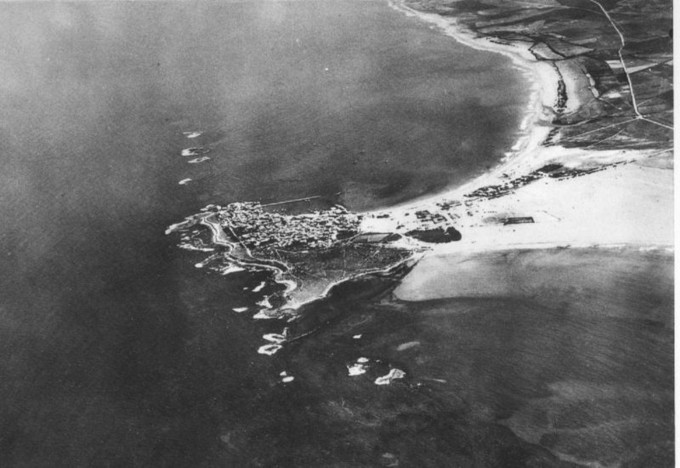
pinkySo let’s start with the pinkie.  When you think of this digit, thing “P” for prophecy.  The Bible has many examples of fulfilled prophecy.  And none other than Moses gave us the measure of how easy it is to know true prophecy (Deuteronomy 18:22).  How about some examples of those?  Take Daniel chapter 8, which was written around 550 B.C and accurately predicted the rise of several empires to Belshazzar in interpretation of his dream.  Validated as far as time goes by the historian Josephus, this prophecy predicted even the rise of Alexander the Great.  For an expanded dissertation, please see this article at ApologeticsPress.org.  Here’s more.  Read about Ezekiel’s stunningly accurate prediction of the fate of the city of Tyre in this article.  Here is an aerial photo of the site taken by the French military in 1934.800px-Tyre-aerial-photo-by-France-Military-1934  This aerial view of Tyre vividly shows the land bridge that Alexander the Great created. Much silt and sand has accumulated over the years to widen the area of the original causeway.

Then there’s Isaiah’s prediction written almost two hundred years in advance of Cyrus’ conquest of Babylon (539 B.C.) –  “The Prophecy of Cyrus.”

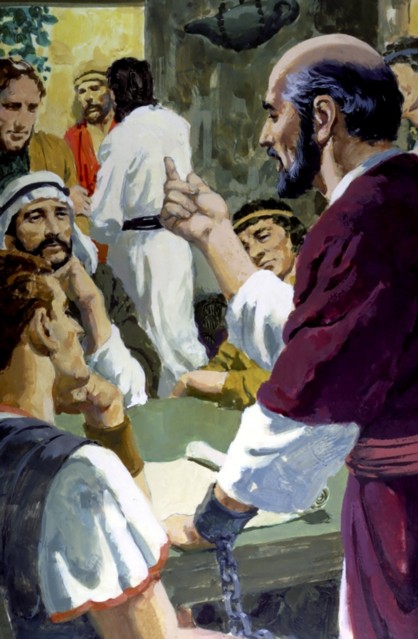
Paul was a prisoner in Rome, under house arrest, but he was free to preach the Gospel to many who came to listen (Acts 28:7-31).

Paul was a prisoner in Rome, under house arrest, but he was free to preach the Gospel to many who came to listen (Acts 28:7-31).

ring_fingerNext, we take the ring finger.  This represents the unity of the Scriptures.  Written over the course of thousands of years with diverse authorship, and in a variety of writing conditions such as battlefields, dungeons, prisons and caves, all showing pieces of the same puzzle and still when assembled together they all tell the same story of God’s plan for the salvation of mankind – none of which was fully even known by all of the authors.  Kings, tax collectors, physicians, servants, shepherds, and warriors were all guided by the Spirit of the Lord to record His word in amazing unity. A substantial portion of the new Testament was even written by Saul of Tarsus, who before his conversion, was known to have hated the Lord Jesus so much at one time, that he was responsible for the persecution and cruel murders of many of his disciples. It is impossible for anyone to truly read and study this entire book (for it is one book, in the end) in honesty of heart and open-mindedness without realizing that this cannot be the work of mere men.

big fingerLet’s not skip the big finger.  The Bible has the answers to the important epistemological, moral, ethical, and scientific questions of our age and any age.  No other religion and no other collection of writings can provide the answers to the big questions that have been on the minds of philosophers, educators, kings and yes, even clergy throughout the ages in the way that the Bible clearly reasons.  Genesis provides the answers to the great questions of where the universe came from, how man fits into that universe, how things such as love beauty, laws of logic and other universals are possible.

What makes something right or wrong?  Is it the mere acceptance of society concerning moral absolutes.  If so, why should one society’s view of those morality or right and wrong over truly that of another – like say that of Nazi Germany? The Bible gives us the answers to these and other truths, such as uniformity of nature.  We fully expect that scientific experiments can be repeated with accuracy because we know that certain physical things occur with expected results.  But what gives us the reason to know and believe that this will continue to be the case?  Our creator gives us the answers, as he has promised to “hold things together” (Colossians 1:17).  And why do we recognize human dignity, have funerals, etc? Could it be because we recognize that man was indeed created in God’s image?  To paraphrase the late Dr. Greg Bahnsen, without the Christian world view, whether you acknowledge it or not, you couldn’t make sense out of anything – you cannot provide the preconditions of intelligibility.   What are laws of logic anyway, and how can an atheist account for them?  They certainly are not just the way the human brain thinks because my gray matter is not the same as yours.  And if one claims that they are conventions, then I should be able to claim my own conventions, and be just as logical.

pointerNext we have the index of the pointer finger that points the way to history, archaeology, and even scientific fore-knowledge (see  this article for that information).  Even scientists and archaeologists who do not believe the Bible is the word of God consult it when they want to know where to dig, and it proves itself historically time after time.  Just type in “archaeology” in the search box on this page, and you will be rewarded with one example after another of this truth.  If it is written in the Bible, and it is possible to validate or invalidate what is written, the bible has always been proven correct.  The Bible is the only book that can look to historical evidence to support its unique theological claims.  The New Testament documents are the best historical documents of the ancient world when approached using the standard cannons of historical research untainted by naturalistic presuppositions.  Time and again even in recent decades, the Bible has been proven correct in such controversies as who Pilate actually was, whether he actually lived and what his title actually had been – and much more.

thumb2Next, we move on to the thumb.  In olden times, an emperor would give a thumb up or thumb down to spare or condemn a man.  The Bible has the power to change lives no other medium, and no other way of life.  Those life changes do not occur because of something we’ve done.  God changes us in a way we never could change ourselves when we obey the Scriptures.  This experience is universal, is the same everywhere in the world in which it is taught. It transcends all economic, ethnic, and even geographical boundaries.

Finally, we have the fist.  The Bible is from God, who fights for us (the name of Israel actually translates “God fights”).  He has protected His word for centuries.  There are no “lost books” of the Bible.  We have copies today that are older even than those we had 100 years ago, and there are no substantive differences in any of them.    How does it compare with other historical manuscripts?  The works of Plato, for example, written 427-347 B.C . The earliest copy we have today is about 900 A.D. Tacitus wrote around 100 A.D, and the earliest copy is about 1100 A.D. Only about 20 manuscripts exist.  Homer’s “Iliad” was written about 900 B.C .  The earliest copy from about 400 B.C.  Number of manuscripts – 643.  The New Testament was written 40-100 A.D.  The earliest copy about 125 A.D.  Number of manuscripts – 24,000.  The Bible stands the test of time.

fistNo other book has been so thoroughly censored throughout the ages, yet it cannot be destroyed. Just as so-called “renowned” atheists of today disparage faith they cannot even comprehend, and make it their mission in life to destroy that faith in others, men throughout the ages have attempted to silence God’s word. Virtually all of the apostles were martyred for proclaiming the Lord Jesus crucified.  From A.D. 303-311, the Roman emperor Diocletian, during the empire’s bloodiest persecution of Christians, ordered every Bible burned, thinking he could destroy Christianity by executing anyone who was apprehended in possession of a Bible. Just 25 years later, the Roman emperor Constantine ordered that 50 perfect copies of the Bible be made at government expense, and Christianity became the empire’s officially preferred religion. The French philosopher Voltaire, a skeptic  who attempted to destroy the faith of many people boasted that within 100 years of his death, the Bible would disappear from the face of the earth. Voltaire died in 1728, but ironically, 50 years after his death, the Geneva Bible Society moved into his former house and used his printing presses to print thousands of Bibles.  William Tyndale was executed by strangulation and burned at the stake for heresy for his crime of translating the Bible from Greek to English.  Hundreds of years later, Joan Bridgman made the comment in the Contemporary Review that, “He (Tyndale) is the mainly unrecognized translator of the most influential book in the world. Although the Authorized King James Version is ostensibly the production of a learned committee of churchmen, it is mostly cribbed from Tyndale with some reworking of his translation.”

The Hammer and the Anvil

Last eve I passed beside a blacksmith’s door
And heard the anvil ring the vesper chime;
When looking in, I saw upon the floor,
Old hammers worn with beating years of time.

“How many anvils have you had,” said I,
“To wear and batter these hammers so?”
“Just one,” said he; then with a twinkling eye,
“The anvil wears the hammers out, you know.”

And so, I thought, the anvil of God’s Word,
For ages, skeptics blows have beat upon;
Yet, though the noise of falling blows was heard,
The anvil is unharmed – the hammers gone.

~ John Clifford

/Bob’s boy
___________________
image © V. Gilbert & Arlisle F. Beers

Please note: I did not design the reading plan that I am following in my blog.  All of my comments in this blog, however, are solely my responsibility.  When reading ANY commentary, you should ALWAYS refer first to the scripture, which is God’s unchanging and unfailing word. Reading schedules, as well as a link to the site where you can get the reading plan that I’m currently following for yourself can be found on the “Bible Reading Schedules” page of my website at http://graceofourlord.com.  For questions and help, please see the “FAQ” and “Summaries” pages there.

Romans 1 – God’s Wrath on Unrighteousness

Paul opens this letter affirming his apostleship, as was his custom with letters to churches that were not so familiar with him. He reinforces that in verses 4-6 by stating that, through Jesus, he and the other apostles “received grace and apostleship to bring about the obedience of faith for the sake of his name among all the nations, including you who are called to belong to Jesus Christ…”    The long introduction also affirms that Jesus is the Son of God, and that he was descended from David, fulfilling Old Testament prophecy (verse 4); and he declares the mission to the Gentiles (verse 13).  He also expresses, at some length, his eagerness to go to Rome for fellowship and sharing the gospel with them.

The Arch of Titus from outside the Forum, Rome, Italy. Located at the highest point of the Via Sacra which leads to the Roman Forum, this triumphal arch, with only one passageway, commemorates Titus’ conquest of Judea which ended the Jewish Wars (66-70). Engaged fluted columns frame the passageway.

Not much is known for certain about the church at Rome.  But by virtue of it being in Rome, its fame would have been considerable and, like the other churches, it was composed of both Jews and Gentiles.  The remainder of this chapter focuses on the need for righteousness on the part of the Gentiles, and Paul does not mince words in pointing out the history of unrighteousness on their part.  But as the letter continues, it will become apparent that McGarvey’s assessment is largely correct.  He writes:

“The Judaizing tendencies which had recently appeared in Corinth and Galatia were sure eventually to appear in other churches, perhaps ultimately in all, and the attitude assumed by a church already so influential and destined to increase in power was sure to carry great weight in deciding the controversy. Therefore, to set the church of Rome right as to the design and nature of the gospel was a work of supreme importance…”

Heading off such a crevasse in this church was of great concern, to be sure.  McGarvey further expounds most aptly:

“The purpose of the letter is to set forth, as Baur rightly expresses it, ‘both the relation of Judaism and heathenism to each other, and the relation of both to Christianity;’  primarily, for the instruction of the Christians in Rome, and, secondarily, for the benefit of all the churches by the establishment of peace between their Jewish and Gentile elements, and, ultimately, for the enlightening of the kingdom of God in all ages.”

Though verses 18-24 are here specifically directed at those Gentiles, they contain some of the most profound (and certainly definitive) statements applicable to all people everywhere concerning God’s existence, and thus they provide the very basis of sound apologetics.  The “wrath of God” in verse 18 represents his holiness, judgment, and yet loving response to the unrighteousness of mankind.  When Paul says that all mankind knows God, he is not speaking of the concept of a god or of deity in general.  Man knows the one true and living God because the evidence abounds in everything He created, yet he suppresses the truth in unrighteousness.  His attributes, including His eternal power and divine nature have been clearly perceived since the creation of the world, so that everyone is without excuse.

And God said, “Let the waters under the heavens be gathered together into one place, and let the dry land appear.” And it was so. Gen 1:9

Man has always tended to be full of himself because of the material knowledge he acquires, only made possible by God; and “claiming to be wise, they became fools…”  Man’s desire for sin and all that is an abomination to his Creator moves him to exchange the truth about God for a lie (verse 25) and worship the creature rather than the Creator even to this day.  People who deny Him do so by conscious choice in a futile attempt to justify their own unrighteousness.  The “shameful acts” Paul lists as driving this begins with unnatural relations of men and women with others of the same gender, and in verse 29 runs from gossips to murderers and “all manner of evil” in between – as God makes no distinction between what man considers “small” or large sins.

Any claim by someone who says they would believe if the evidence was there is hogwash.   Blindness to the more than substantial evidence is entirely willful.

Read or listen to audio of ESV version of this selection from this link.

/Bob’s boy
___________________
some images © V. Gilbert & Arlisle F. Beers

Please note: I did not design the reading plan that I am following in my blog.  All of my comments in this blog, however, are solely my responsibility.  When reading ANY commentary, you should ALWAYS refer first to the scripture, which is God’s unchanging and unfailing word. Reading schedules, as well as a link to the site where you can get the reading plan that I’m currently following for yourself can be found on the “Bible Reading Schedules” page of my website at http://graceofourlord.com.  For questions and help, please see the “FAQ” and “Summaries” pages there.

John 9 – Jesus Heals a Man Born Blind

Upon passing a man who was born blind, some of Jesus’ disciples ask a question in verse 2 that seems strange to most of us now – “who sinned, this man or his parents…?”  But this mistaken belief about sin and suffering was not uncommon; and we see in verse 34 that the religious leaders that opposed Jesus held the view that the man was born in sin.  We know differently, and Ezekiel 18:20 specifically says otherwise, so they should have known as well.  Jesus corrects them, letting them know in verses 3-4 that his disability will be used for the glory of God.

The Blind Man Washes in the Pool of Siloam

The Blind Man Washes in the Pool of Siloam (Photo credit: Wikipedia)

We know (and have already read of specific examples) that Jesus could have given the man his sight without even touching him.  Some writers have postulated several theories as to why He used the mud that He made from His spittle, before sending the man to the pool of Siloam to wash.  Some see a symbolic connection between the scripture’s use of the Verb for the word “anoint” to describe how Jesus applied it to his eyes (“Christ” and “Messiah” mean “anointed one”). Others see Jesus purposely making mud (or clay) using his spittle as an analogy to kneading dough, in order to challenge the Pharisees. But we really do not know.  There was purpose in everything that Jesus did; and as this was once again on the Sabbath, the point He was making no doubt had its desired effect at that time on those around Him – and the religious leaders that it angered.

At any rate, there is division among these religious leaders at one point (verse 16); and his parents are sent for, and questioned.  They confirmed that the man was their son and that he had been born blind.  But despite the previously mentioned division, the leaders had made it known that anyone who said that Jesus was the Christ (Messiah), they would be put out of the synagogue.  So the man’s parents in verses 21-23 seem to be disingenuous as to knowing how he gained his vision; and they pass the buck back to their son. The blind man is interviewed by the Pharisees and other religious leaders for the second time, and was “cast out” of the synagogue for his comments in verses 30-33.  He found it amazing that they did not know where Jesus came from.  So do we…

Side note: Details and pictures of discoveries at the excavations at the Pool of Siloam are in this article at BiblePlaces.com.  That one is a well-written, but older article.  A more recent article can be found at this link to BiblicalArchaeology.org.

Read or listen to audio of ESV version of this selection from this link.

/Bob’s boy
___________________
some images © V. Gilbert & Arlisle F. Beers

Please note: I did not design the reading plan that I am following in my blog.  All of my comments in this blog, however, are solely my responsibility.  When reading ANY commentary, you should ALWAYS refer first to the scripture, which is God’s unchanging and unfailing word. Reading schedules, as well as a link to the site where you can get the reading plan that I’m currently following for yourself can be found on the “Bible Reading Schedules” page of my website at http://graceofourlord.com.  For questions and help, please see the “FAQ” and “Summaries” pages there.