Jesus appears to Disciples – Luke 24

The disciples that Jesus met on the way to Emmaus went back to Jerusalem and found the eleven, who confirmed to the two traveler’s that yes, Jesus has risen (verse 34) and has appeared to Simon (Peter). No details here or in the other three gospels are given of that appearance to Peter (although Paul does speak of it in 1 Corinthians 15:5). But given Peter’s intense grief over his denial of Jesus, it was important to reach him quickly; and it was important to get to the rest of the eleven this day as well.

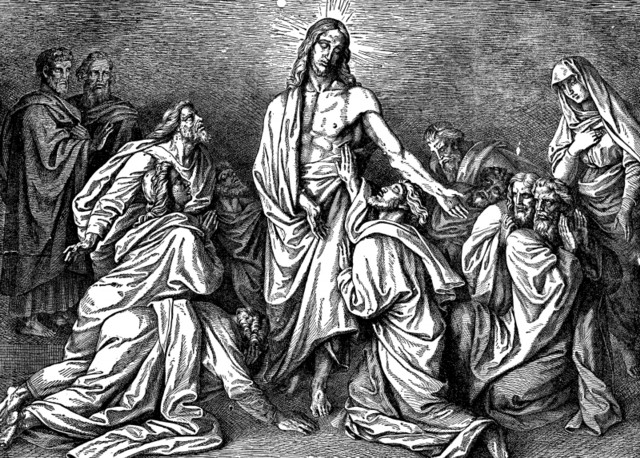
Jesus shows His wounds to Thomas.

Jesus shows His wounds to Thomas.

Jesus then entered while the men were talking, and they were frightened, as if He was a spirit. He had them touch him, and even ate some fish in front of them – spending some time to assure them both that he was a living man, and the same Jesus they had known. He then opened their minds to the Scriptures concerning Him. Jesus then tells them a bit about the witness they will bear to the world in the great commission, but he says they must stay in Jerusalem until they are “clothed with power from on high” (the coming of the Holy Spirit in Acts). When He tells them to stay in Jerusalem, he means after he is gone. They will be with him at the Sea of Galilee (John 21:1), and on a mountain in Galilee that He has directed them to (Matthew 28:16) before his ascension. Galilee is three days journey from Jerusalem.

(This year’s reading plan for Luke, Acts, and 1 and 2 Chronicles averages just 15 verses per day – 5 days per week!)
Schedule for this week
Read or listen to audio of today’s selection from Luke here
Read or listen to audio of today’s selection from 2 Chronicles here

/Bob’s boy
___________________
some images © V. Gilbert & Arlisle F. Beers

All of my comments in this blog, however, are solely my responsibility.  When reading ANY commentary, you should ALWAYS refer first to the scripture, which is God’s unchanging and unfailing word. Reading schedules, as well as a link to the site where you can get the reading plan that I’m currently following for yourself can be found on the “Bible Reading Schedules” page of my website at http://graceofourlord.com.  

Enhanced by Zemanta

Emmaus Revisited – Luke 24

 Well, I pulled the trigger on this a couple of weeks early :-). We had written a blog a year or so ago on the Road to Emmaus, a portion of Luke 24 that we are reading this week. So we’ll provide some excerpts of that to supplement the remainder of our reading of the chapter.

The Road to Emmaus appearance, based on Luke 2...

The Road to Emmaus appearance, based on Luke 24:13-32, painted by Joseph von Führich, 1830. (Photo credit: Wikipedia)

It is still Sunday, the day that Jesus rose; and two of His disciples were traveling to the village of Emmaus.  One was named Cleopas, but we do not know the name of the other.  We are told in verse 16 that “their eyes were kept from recognizing him” when Jesus drew near.  When He asks them about the conversation they are having, the two men proceed to tell him about Jesus of Nazareth.  They speak of how great he was, how the chief priests and rulers condemned and crucified him.  And now, they say, some women of their company had been to his tomb and found it empty – a fact which others confirmed!  They are clearly distressed.

Jesus then gave them a mild rebuke for being slow to believe what the prophets had spoken.  He then interpreted Scriptures from Moses and the prophets concerning the Christ.   As they reached the village, they urged him to stay with them, as the evening would be coming soon.  He blessed and broke bread with them, and it was at this point that their eyes were opened and they recognized him.  Jesus then vanished from their sight.

Such a mysterious and dramatic revelation of Himself to these two disciples would appear to serve one purpose above any other – a proper eyewitness account.

(This year’s reading plan for Luke, Acts, and 1 and 2 Chronicles averages just 15 verses per day – 5 days per week!)
Schedule for this week
Read or listen to audio of today’s selection from Luke here
Read or listen to audio of today’s selection from 2 Chronicles here


/Bob’s boy


___________________


some images © V. Gilbert & Arlisle F. Beers


All of my comments in this blog, however, are solely my responsibility.  When reading ANY commentary, you should ALWAYS refer first to the scripture, which is God’s unchanging and unfailing word. Reading schedules, as well as a link to the site where you can get the reading plan that I’m currently following for yourself can be found on the “Bible Reading Schedules” page of my website at http://graceofourlord.com.  


Enhanced by Zemanta

The Empty Tomb – Luke 24

Luke says  in chapter 24 that they went at early dawn to Jesus’ tomb. “They” refers to the women who had come with him from Galilee (Luke 23:55). Matthew tells us that two of them were Mary Magdalene and “the other Mary” (Matthew 28:1). In Matthew 27:56. This other Mary is identified as the mother of James and Joses (Joseph).

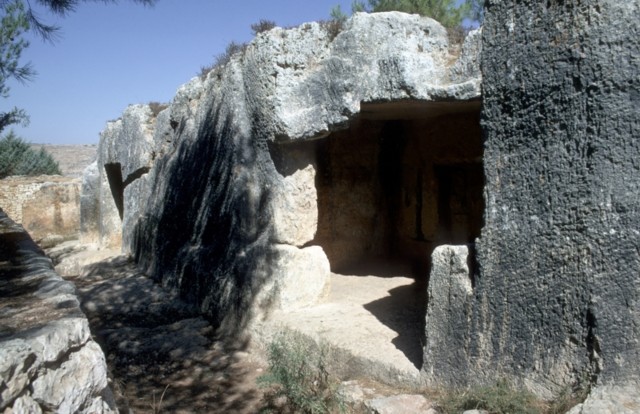
A large opening to the Sanhedrin tombs in Jerusalem, where members of the Jewish high court were buried.

A large opening to the Sanhedrin tombs in Jerusalem, where members of the Jewish high court were buried.

The way the rest of the verse is worded, it is unclear whether this Mary is also the mother of the sons of Zebedee, but most believe that the reference is of yet another of the women. A good case can be made that Salome was the mother of James and John, the sons of Zebedee (see Matthew 27:55-56, Mark 15:40, and John 19:25). But we cannot be certain one way or another. We do know from harmonizing the gospels that Susannah and Joanna were among the women.

The women were met there by two men in “dazzling apparel,” who asked them ““Why do you seek the living among the dead?” They then reminded them how Jesus had told them that he would “be delivered into the hands of sinful men” and be killed and rise on the third day. Verse 8 said “they remembered His words,” which seems to be further evidence of the fact that Jesus’ words to the disciples about what would happen had been “hidden” from them, and that they just couldn’t understand it (Luke 18:31-34).

When they went to tell the eleven, the men did not believe them. But it was Peter that ran to the tomb and looked in with amazement. We know from John’s gospel the he also went with Peter (John 20:3-6). John refers to himself there as “the other disciple.”

(This year’s reading plan for Luke, Acts, and 1 and 2 Chronicles averages just 15 verses per day – 5 days per week!)
Schedule for this week
Read or listen to audio of today’s selection from Luke here
Read or listen to audio of today’s selection from 2 Chronicles here

/Bob’s boy
___________________
some images © V. Gilbert & Arlisle F. Beers

All of my comments in this blog, however, are solely my responsibility.  When reading ANY commentary, you should ALWAYS refer first to the scripture, which is God’s unchanging and unfailing word. Reading schedules, as well as a link to the site where you can get the reading plan that I’m currently following for yourself can be found on the “Bible Reading Schedules” page of my website at http://graceofourlord.com.  

Enhanced by Zemanta

God is Love – 1 John

There is no convincing evidence that the thee epistles that we call 1st, 2nd, and 3rd John were written by any other person than the apostle John who wrote the fourth gospel. In fact, the literary style and key elements are much too similar to think otherwise, and the early church fathers all agree that it was he who wrote them. It is widely believed that he wrote them after leaving Jerusalem, which is believed to be around 67 A. D., before the Roman destruction.

John is supposed to have written this letter from Ephesus, and it may well have been intended for the church there, as well as some of the same churches that the Book of Revelation was written for – Smyrna, Pergamum, Thyatira, Sardis, Philadelphia, and Laodicea. The letters could have been written after the 70 A. D. destruction, but are generally considered to have been delivered before 90 A. D.

The writing style and tone of the opening part of this first letter is highly similar to the opening of John’s gospel, and is highly indicative of an eyewitness account, as seen here:

“That which was from the beginning, which we have heard, which we have seen with our eyes, which we looked upon and have touched with our hands, concerning the word of life— the life was made manifest, and we have seen it, and testify to it and proclaim to you the eternal life, which was with the Father and was made manifest to us— that which we have seen and heard we proclaim also to you…”

The theme and message of this epistle includes the character of God (God is love – 1 John 4:8), what it means to have been born again, and “born of God”(1 John 2:29, 1 John 5:1), and most importantly, what God’s love for us means in terms of our daily lives (1 John 3:16, 1 John 5:11).

(This year’s reading plan for Luke, Acts, and 1 and 2 Chronicles averages just 15 verses per day – 5 days per week!)
Schedule for this week

/Bob’s boy
___________________
some images © V. Gilbert & Arlisle F. Beers

All of my comments in this blog, however, are solely my responsibility.  When reading ANY commentary, you should ALWAYS refer first to the scripture, which is God’s unchanging and unfailing word. Reading schedules, as well as a link to the site where you can get the reading plan that I’m currently following for yourself can be found on the “Bible Reading Schedules” page of my website at http://graceofourlord.com.

Enhanced by Zemanta

Solomon’s Prayer Answered – 2 Chronicles 7

Chapter 7 contains God’s response to Solomon’s prayer. It starts with God sending fire down from heaven that consumes the burnt offering and sacrifices. Then the glory of the Lord filled the temple, and the priests could not even go inside. What a sight it must have been! Then

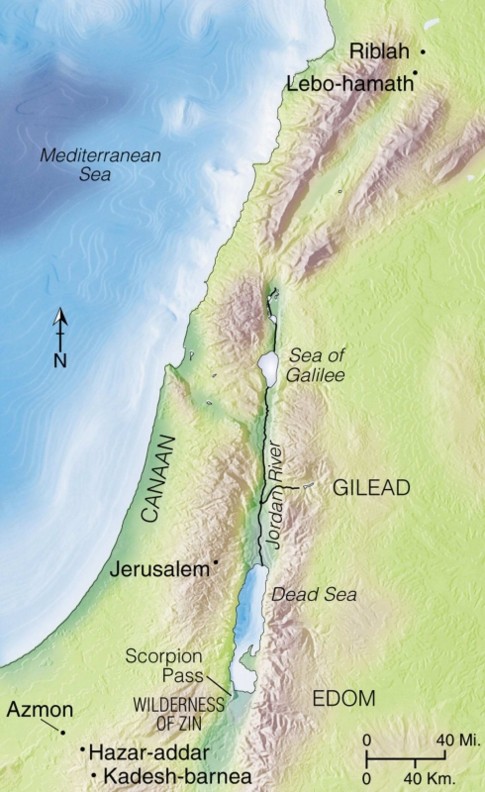
The borders of the Promised Land stretched from the wilderness of Zin and Kadesh-barnea in the south to Lebo-hamath and Riblah in the north, and from the Mediterranean seacoast on the west to the Jordan River on the east. The land of Gilead was also included.

The borders of the Promised Land stretched from the wilderness of Zin and Kadesh-barnea in the south to Lebo-hamath and Riblah in the north, and from the Mediterranean seacoast on the west to the Jordan River on the east. The land of Gilead was also included.

King Solomon and all of the people offered up 22,000 oxen and 120,000 sheep as a sacrifice. There had not been anything like it since David had the ark of the covenant brought to Jerusalem. So vast was the celebration that verses 7-8 says:

“Solomon consecrated the middle of the court that was before the house of the Lord, for there he offered the burnt offering and the fat of the peace offerings, because the bronze altar Solomon had made could not hold the burnt offering and the grain offering and the fat.” At that time Solomon held the feast for seven days, and all Israel with him, a very great assembly, from Lebo-hamath to the Brook of Egypt. And on the eighth day they held a solemn assembly, for they had kept the dedication of the altar seven days and the feast seven days.

Then God answered Solomon’s prayer, and He did tell Him all of the ways that He would bless them as Solomon had prayed. But He also made this promise:

“But if you turn aside and forsake my statutes and my commandments that I have set before you, and go and serve other gods and worship them, then I will pluck you up from my land that I have given you, and this house that I have consecrated for my name, I will cast out of my sight, and I will make it la proverb and a byword among all peoples.”

Of course, the post-exillic people that the chronicler was addressing here would know very well that the Lord meant to keep even these last promises. So9me of them had experienced it first-hand.


(This year’s reading plan for Luke, Acts, and 1 and 2 Chronicles averages just 15 verses per day – 5 days per week!)
Schedule for this week
Read or listen to audio of today’s selection from Luke here
Read or listen to audio of today’s selection from 2 Chronicles here

/Bob’s boy
___________________
some images © V. Gilbert & Arlisle F. Beers

All of my comments in this blog, however, are solely my responsibility.  When reading ANY commentary, you should ALWAYS refer first to the scripture, which is God’s unchanging and unfailing word. Reading schedules, as well as a link to the site where you can get the reading plan that I’m currently following for yourself can be found on the “Bible Reading Schedules” page of my website at http://graceofourlord.com.  

Enhanced by Zemanta

The Death of Jesus – Luke 23

Joseph of Arimathaea Seeks Pilate to Beg Permi...

Joseph of Arimathaea Seeks Pilate to Beg Permission to Remove the Body of Jesus (Photo credit: Wikipedia)

Luke tells us that it was about the sixth hour, and darkness came over the land until the ninth as the sun’s light failed. Then the Temple curtain was torn in two. This grand event obviously orchestrated by God was certainly very symbolic. No longer  would there be a need for a high priest, as Jesus is now our new high priest (Hebrews 4:14). Jesus gave up His spirit as He said “Father, into your hands, I commend my spirit.”

A centurion who saw all of these things, glorified God and said that surely this man is innocent. And all the crowds who witnessed these things returned home “beating their breasts.” Indeed, how many people witnessed all of these things that had shouted “crucify him,” and were now afraid for what they had done? Luke also says that Jesus’ “acquaintances” watched all these things and the women who had followed from Galilee  This would likely include those written about in Luke 8:1-3.

Joseph of Arimathea was a member of the Sanhedrin council who had not consented to their decision to railroad the Lord. Luke says that he was a good and righteous man, and was looking for the kingdom. He got custody of the body of Jesus from Pilate, and wrapped it in a linen shroud. Then he placed it in a tomb that was cut in stone and had never been used for burial. The women prepared ointment and spices. And then they rested on the Sabbath rested as commanded.

(This year’s reading plan for Luke, Acts, and 1 and 2 Chronicles averages just 15 verses per day – 5 days per week!)
Schedule for this week
Read or listen to audio of today’s selection from Luke here
Read or listen to audio of today’s selection from 2 Chronicles here

/Bob’s boy
___________________
some images © V. Gilbert & Arlisle F. Beers

All of my comments in this blog, however, are solely my responsibility.  When reading ANY commentary, you should ALWAYS refer first to the scripture, which is God’s unchanging and unfailing word. Reading schedules, as well as a link to the site where you can get the reading plan that I’m currently following for yourself can be found on the “Bible Reading Schedules” page of my website at http://graceofourlord.com.  

Enhanced by Zemanta

To Paradise – Luke 23

One traditional site of Golgotha is this hill with hollow eye sockets to look like the place of the skull. Another traditional site is in present-day Jerusalem, which in Jesus' time was just outside the wall. It is called the Church of the Holy Sepulcher.

One traditional site of Golgotha is this hill with hollow eye sockets to look like the place of the skull. Another traditional site is in present-day Jerusalem, which in Jesus’ time was just outside the wall. It is called the Church of the Holy Sepulcher.

As Jesus was taken away to be crucified, there were two criminals taken with him to be put to death. This fulfilled Isaiah 53:12, which said he would be numbered with transgressors. Luke says that they came to a place known as the skull. It is also known as Golgatha which comes from an Aramaic word for skull. There, they crucified Him and the criminals with one on each side of Him. Jesus said “Father forgive them, for they know not what they do.”

The soldiers cast lots and divided his garments among them, which fulfilled what was written in Psalm 22:18.  People watched and the rulers scoffed at Him, saying  “He saved others; let him save himself, if he is the Christ of God, his Chosen One!” The soldiers also mocked, offering Him sour wine to drink.

North door of iconostasis. Icon of Paradise: A...

North door of iconostasis. Icon of Paradise: Abraham’s Bosom with the Good Thief entering to the left (Photo credit: Wikipedia)

One prisoner began to mock as well, but the other rebuked him and asked Jesus to remember him when He came into His kingdom. Jesus told him that this day he would be with Him in paradise (verse 43). Jesus, as we saw in other passages, did have the authority to forgive sins, and He exercised it there. So what did Jesus mean by that? Since His body was to be in the tomb for three days, after which He would arise from the dead, how could He be with this criminal in Paradise that day? And just what is this Paradise?

This is a point that many of us have spent some time reflecting upon, as much confusion is caused surrounding this topic. Does the soul merely sleep after the body dies until resurrection day? Paul wrote in 1 Thessalonians 4:13: “…we do not want you to be uninformed, brothers, about those who are asleep, that you may not grieve…” Or was that merely a statement that they are not really dead? When Jesus raised Jairus’ daughter from the dead (Luke 8:54-55), he had told those present that she was merely sleeping.

The birth of Benjamin was a time of joy and sorrow--joy that a new son, held by the midwife, was born; mourning for Rachel who died in childbirth (Genesis 35:16-20).

The birth of Benjamin was a time of joy and sorrow–joy that a new son, held by the midwife, was born; mourning for Rachel who died in childbirth (Genesis 35:16-20).

The scripture also says that on the occasion of that girl’s resurrection, her spirit returned. We have other scripture where people are dying, saying their souls departed (such as Jacob’s wife Rachel in Genesis 35:18). There is, of course, much we do not yet know, but we can surmise from all of this that there is a place indeed called Paradise that our souls do go to when we die. Paul also spoke of it in 2 Corinthians 12:2-4.

The parable Jesus told in Luke 16:22-26 about the poor man, Lazarus, who died and was at Abraham’s bosom may be allegorical, but it certainly contains some truths about death and what happens to the soul thereafter. Jesus told parables to instruct. This writer does not believe that He would have done so with misleading or even incorrect facts in those parables. The rich man of that parable was consciously aware of what was going on in the place where his soul went. And he saw Lazarus in his place also alert to his surroundings. I believe that at the very least, this depiction of their states must be a fair representation of the status of the soul upon death of the body.

It appears then, that the Christian can take comfort in knowing that faithful loved ones who have gone on before are not just unconscious souls waiting for judgment day. Like Lazarus in Luke 16:25, they are being comforted there. And because of Jesus’ victory over death, we will be raised in a new spiritual body one day.

(This year’s reading plan for Luke, Acts, and 1 and 2 Chronicles averages just 15 verses per day – 5 days per week!)
Schedule for this week
Read or listen to audio of today’s selection from Luke here
Read or listen to audio of today’s selection from 2 Chronicles here

/Bob’s boy
___________________
some images © V. Gilbert & Arlisle F. Beers

All of my comments in this blog, however, are solely my responsibility.  When reading ANY commentary, you should ALWAYS refer first to the scripture, which is God’s unchanging and unfailing word. Reading schedules, as well as a link to the site where you can get the reading plan that I’m currently following for yourself can be found on the “Bible Reading Schedules” page of my website at http://graceofourlord.com.  

Enhanced by Zemanta

The Green Wood – Luke 23

Pilate was ready to release Jesus (following a sound beating, of course), but the chief priests and the rulers and the people that he had called to give this news to all cried out to him to take Jesus away and release Barrabas. Barrabas was in prison for insurrection and murder, but the Romans by custom would release one prisoner on Passover. Pilate tried again to reason with them, as he wanted to release Jesus. But the shouting to crucify him began.

Jesus helped by Simon of Cyrene, part of a ser...

Jesus helped by Simon of Cyrene, part of a series depicting the stations of the Cross. Chapel Nosso Senhor dos Passos, Santa Casa de Misericórdia of Porto Alegre, Brazil. Oil on canvas, XIXth century, unknown author. (Photo credit: Wikipedia)

Pilate tried again, saying “Why? what evil has he done? I have found in him no guilt deserving death. I will therefore punish and release him.” But they grew more demanding, and eventually he released Barrabas and gave in to their demands. As they led Him to His fate, they got Simon of Cyrene to carry His cross. (Cyrene is now an archeological site in present-day Lybia. It was a settlement of the Greeks, but became Roman Province in 74 B. C.). There was a great crowd of people following Him, and women who were weeping for Him. But Jesus then said to them:

“Daughters of Jerusalem, do not weep for me, but weep for yourselves and for your children. For behold, the days are coming when they will say, ‘Blessed are the barren and the wombs that never bore and the breasts that never nursed!’ Then they will begin to say to the mountains, ‘Fall on us,’ and to the hills, ‘Cover us.’ For if they do these things when the wood is green, what will happen when it is dry?”

Part of this, Jesus quotes from Zechariah 12:10-14, which speaks of mourning for “him whom they have pierced.” For the second time (the first being when He arrived at Jerusalem in Luke 19:41-44), Jesus is foretelling the destruction of Jerusalem which will occur about 40 years from then. “They” in that last sentence means the Romans. The green wood represents the innocent savior, and the dry is what will be left of that Jerusalem generation after He is gone.

(This year’s reading plan for Luke, Acts, and 1 and 2 Chronicles averages just 15 verses per day – 5 days per week!)
Schedule for this week
Read or listen to audio of today’s selection from Luke here
Read or listen to audio of today’s selection from 2 Chronicles here

/Bob’s boy
___________________
some images © V. Gilbert & Arlisle F. Beers

Please note: I did not design the reading plan that I am following in my blog.  All of my comments in this blog, however, are solely my responsibility.  When reading ANY commentary, you should ALWAYS refer first to the scripture, which is God’s unchanging and unfailing word. Reading schedules, as well as a link to the site where you can get the reading plan that I’m currently following for yourself can be found on the “Bible Reading Schedules” page of my website at http://graceofourlord.com.  

Enhanced by Zemanta

The Sanhedrin Sham – Luke 23

Verse one says that the “whole company of them arose and brought him before Pilate.” The Sanhedrin council was delivering the Son of God to Pilate. During his first questioning, Pilate could not find anything to accuse Him about, despite the Sanhedrin’ s urging – and even a lie they told him. Jesus never told anyone that they should not pay tribute to Caesar.  But when Pilate found out He was from Galilee, he decided to send Him to Herod because that was his jurisdiction, and he knew that Herod was in Jerusalem at the time.

Christ before Pontius Pilate, Mihály Munkácsy,...

Christ before Pontius Pilate, Mihály Munkácsy, 1881 (Photo credit: Wikipedia)

Herod had been wanting to meet Jesus for a long time, so he was very glad to see him. He wanted to see some sort of “sign” from Him. But Jesus was not participating in some dog and pony show for Herod. Verse 9 says that he questioned Him at some length, but got no answer from Him. This fulfilled the prophecy in Isaiah 53:7:

He was oppressed, and he was afflicted,
yet he opened not his mouth;
like a lamb that is led to the slaughter,
and like a sheep that before its shearers is silent,
so he opened not his mouth

Unamused with the Lord, Herod and his soldiers treated Him with contempt and mocked Him. Then they dressed Him in “splendid” clothing – solely as mockery of His claim to be king of the Jews. He was then sent back to Pilate (who the scripture says became good friends with Herod that day). But Pilate called the chief priests and elders in and told them that neither he nor Herod had found Jesus guilty of their charges. Nothing deserving death had been done, he said. So he was going to punish Him and release Him.

This not what the Sanhedrin had in mind at all.

(This year’s reading plan for Luke, Acts, and 1 and 2 Chronicles averages just 15 verses per day – 5 days per week!)
Schedule for this week
Read or listen to audio of today’s selection from Luke here
Read or listen to audio of today’s selection from 2 Chronicles here

/Bob’s boy
___________________
some images © V. Gilbert & Arlisle F. Beers

Please note: I did not design the reading plan that I am following in my blog.  All of my comments in this blog, however, are solely my responsibility.  When reading ANY commentary, you should ALWAYS refer first to the scripture, which is God’s unchanging and unfailing word. Reading schedules, as well as a link to the site where you can get the reading plan that I’m currently following for yourself can be found on the “Bible Reading Schedules” page of my website at http://graceofourlord.com.  

Enhanced by Zemanta

Luke 24 – On the Road to Emmaus

R K Bingham's avatarBob's boy's Christianity blog

(Note: for a summary of the events of this chapter from the resurrection at dawn to Jesus’ first appearances to Mary Magdalene and the other women, please see post at this link.  After the resurrection, Jesus – as He had told the disciples in Matthew 26:32 that He would meet them there – would be with them at the Sea of Galilee, and at a mountain there that He directs them to.  But several other events occur before and after this, the details of which are interspersed throughout the gospels in Matthew 28 and John 20.  And events in a single chapter are in some cases separated by days, and even weeks, as Jesus remained for forty days before the ascension.)

El Kubeibeh, also spelled el-Qubeibeh, is the most likely, of the four traditional sites, as the site of Bible-time Emmaus, on the road to which Jesus appeared to Cleopas…

View original post 741 more words