Be Not Ashamed – Mark 6-8

Continuing with our reading of Mark this week, we read in chapter 6 of Jesus being rejected in His home town and how Herod had John the baptist killed. He was afraid of him, but he had made an oath around witnesses to give Herodias’s daughter whatever she wished. To his dismay, she followed her mother’s wishes and asked for John’s head on a platter. Jesus then went on to feed the 5,000.

Saint John the Baptist and the Pharisees

Saint John the Baptist and the Pharisees (Photo credit: Wikipedia)

In chapter 7, the Pharisees confront Him because his disciples did not follow the washing rituals they prescribed as though they were God’s laws. Jesus exposed them for their many hypocrisies, such as how they manipulate words and deeds to shirk their duty to take care of their parents.

In chapter 8, He feeds the 4,000 with seven loaves of bread and a few small fish– ending up with more food than they started with in the first place. In Dalmanutha, the Pharisees confronted Him again and demanded a sign from heaven. Jesus, of course, gave them none; and he even said that no sign would be given to “this generation.” God’s people were given all the signs they needed.

It was after this that Jesus told His disciples to beware of the “leaven” of the Pharisees and of Herod. As they wondered about bread, jesus became impatient with them. They still did not understand, it seems. But in verse 29, Peter did make it clear that he knew that Jesus was the Christ.

He finishes the chapter with a sermon to the crowds; and verse 39 says:

For whoever is ashamed of me and of my words in this adulterous and sinful generation, of him will the Son of Man also be ashamed when he comes in the glory of his Father with the holy angels.

Those words are easy to read, and they are just as easy for us to nod our heads and say “that’s right.” But we must beware living in an increasingly pagan land, as we do. How easy is it to keep our mouths shut, when perhaps we should be speaking up for the Lord?


Bible Reading Schedule for this month
Click here to read or listen to audio of this week’s chapters in Mark

/Bob’s boy
___________________

some images © V. Gilbert & Arlisle F. Beers

Please visit this site’s menu item “The Author’s Books” for info on the author’s books, website, and Facebook page.

All of my comments in this blog are solely my responsibility. When reading any commentary, you should always refer first to the scripture, which is God’s unchanging and unfailing word.


The Love of Jesus

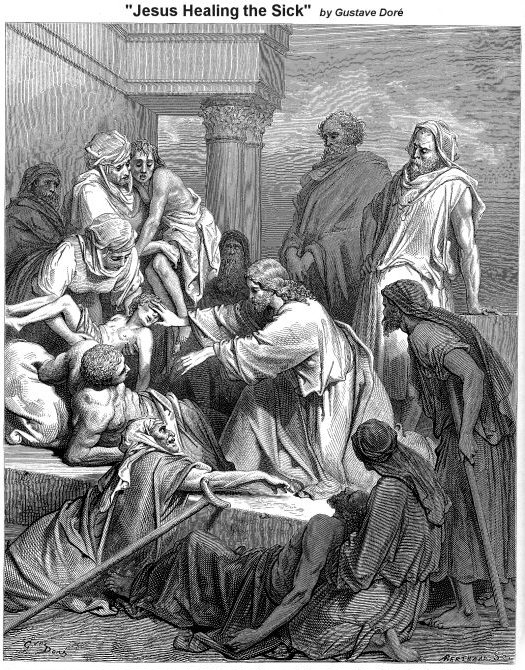
English: Jesus healing the sick by Gustave Dor...

English: Jesus healing the sick by Gustave Dore, 19th century Source: http://www.morethings.com/god_and_country/jesus/healing-jesus-240.jpg (Photo credit: Wikipedia)

This week, we read Mark 6-10 as we go through the entire New Testament this year. I took at peek at Mark 6, just to refresh my memory of where we are currently. As you read that chapter, notice the last verse, verse 56. Jesus is healing the sick in Gennesaret, and the text reads:

And wherever he came, in villages, cities, or countryside, they laid the sick in the marketplaces and implored him that they might touch even the fringe of his garment. And as many as touched it were made well.

There was nothing special about Jesus’ clothing. It was the same clothing that anyone there in that place and time could have been wearing. But there were so many people bringing their sick in the hope of being healed. Jesus, though He was the Son of God was here also as a man. There simply was not time to personally interact with each one of these. But knowing what they were coming for, He also knew their hearts. These people believed that His healing power was so great that a mere touch of His garment could heal.

They were right of course. But it wasn’t the garment. Jesus made it so because He wanted them to have what they came for. It was their faith that enabled them to receive the gift that He wanted them to have. Jesus said in Matthew 7:11:

If you then, who are evil, know how to give good gifts to your children, how much more will your Father who is in heaven give good things to those who ask him!

The Lord wants to give us what we need. Sometimes that is in conflict with what we think we want. But we “touch His garment” in manner of speaking when we pray because we know that if it is His will, He can make it so. What a blessing it is to have a “High Priest” (Hebrews 4:14-16) that loves us so much!

Bible Reading Schedule for this month
Click here to read or listen to audio of this week’s chapters in Mark

/Bob’s boy
___________________

some images © V. Gilbert & Arlisle F. Beers

Please visit this site’s menu item “The Author’s Books” for info on the author’s books, website, and Facebook page.

All of my comments in this blog are solely my responsibility. When reading any commentary, you should always refer first to the scripture, which is God’s unchanging and unfailing word.


Parables, Miracles and Blessed Assurance – Mark 3-5

In Mark 3, Jesus heals the man with the withered hand. The pharisees reacted by trying to figure out how to destroy Him. It is the same in this day and age. When people have their hearts and minds set against believing in the Lord, even miracles such as those witnessed by the Pharisees will not convince them. He performed other miracles and cast out demons; and the crowds continued to grow. Bu verse 13 of the third chapter, He is naming His apostles. Notice verses 20-21. It is clear from these verses that many of Jesus’ family were not yet convinced that He was truly the Lord.

Then he went home, and the crowd gathered again, so that they could not even eat. And when his family heard it, they went out to seize him, for they were saying, “He is out of his mind.”

Christ and The Pharisees

Christ and The Pharisees (Photo credit: Wikipedia)

Verses 28-29 speak of blasphemy against the Holy Spirit. This is not a certain kind of sin that one commits that is just unforgivable. Many people have misinterpreted these verses to make themselves believe that they can have no forgiveness. Verse 28 sates that “ALL sins will be forgiven the children of man, AND whatever blasphemies they utter.” No sin is unforgivable if one repents. Verse 29 is not a contradiction of that. It simply means that one who blasphemes against the Holy Spirit has denied God. It is those whose hearts have turned against the Lord AND who do not repent that will perish. It is, as always, a matter of the heart.

Chapter 4 has several of the parables contained in Matthew. When Jesus explained in verses 10-12 about why He was speaking in parables, He quoted Isaiah 6:9-10. What is all means, is that those who hear and want to learn and understand will be able to do so. But those who do not thirst for this knowledge will not comprehend.

Chapter 5 begins with the man possessed by many demons, who Jesus healed in Gerasenes. When the people heard of what He had done, they became afraid, rather than being in awe of the Lord. When they begged Him to leave their land, He complied. It is the same with us. If we do not want the Lord in our lives, He will give us what we want in that respect.

The chapter ends with Jesus raising the daughter of Jairus from the dead. The girl was clearly dead, but Jesus said in verse 39 that she was only sleeping. This should be an encouragement to us. Paul also speaks of the dead in this way in 1 Thessalonians 4:13. It is an assurance to all of us that death is not the finality of our being.


Bible Reading Schedule for this month
Click here to read or listen to audio of this week’s chapters in Mark

/Bob’s boy
___________________

some images © V. Gilbert & Arlisle F. Beers

Please visit this site’s menu item “The Author’s Books” for info on the author’s books, website, and Facebook page.

All of my comments in this blog are solely my responsibility. When reading any commentary, you should always refer first to the scripture, which is God’s unchanging and unfailing word.


Jesus Begins His Ministry – Mark 1-2

First page of the Gospel of Mark, by Sargis Pi...

First page of the Gospel of Mark, by Sargis Pitsak, a Medieval Armenian scribe and miniaturist (Photo credit: Wikipedia)

The Gospel of Mark is the shortest of the synoptic gospels, and was likely written to a Roman audience. Therefore, it does not focus on Jesus’ birth; and there is no need for the genealogy that is found in Matthew and in Luke. Lineage was important in Matthew because it was written to the Jews. And it would be important in Luke because a significant number of the gentiles would have been “God-fearers,” and would thus be familiar with the prophecy of the House of David.

The gospel opens with John the baptist in the wilderness, proclaiming a baptism for repentance and forgiveness of sins. This is a new concept for Jews, and for the Bible itself. But it is one that Jesus fully embraces, as John is preparing the way for The Son of God to become the “Lamb of God,” which will enhance the meaning and significance of baptism. John, as the messenger, did not come up with the idea all on his own, we realize. Verses 2-3 state:

Behold, I send my messenger before your face,
who will prepare your way,
the voice of one crying in the wilderness:
‘Prepare the way of the Lord,
make his paths straight,’

Isaiah is cited as the source because most of the quote does come from the better known prophet (Isaiah 40:3), but part of it also comes from Malachi 3:1.

By verse 12 of the first chapter, John has already baptized our Lord, and He is led by the Spirit out into the wilderness to be tempted by the devil. Mark uses the Greek word “euthys,” a total of 41 times in his gospel. It means “immediately,” or “at once.” But it should be remembered that certain words have different connotations in different ages. The Book of Mark is a short and fast-paced gospel, and the word helps to set the tempo of the book.

This gospel is intended to show the power, authority, and decisiveness of the Lord and His actions. The word for Immediately here usually denotes the introduction of new and significant event — sometimes within the context of another. It is enough to know that when it is used, no other significant events occurred between the two on “each side” of the word for “immediately.”

Jesus begins His ministry then, preaching that the kingdom is at hand, and that people should believe the gospel, or “good news.” The quick pace has him picking up his apostles quickly in chapters one and two; and it is often, I believe, wrongly assumed that he just happened upon Peter, Andrew, James and John (and later, Levi, or Matthew), and that they followed Him at a word without having ever laid eyes on Him. It is more likely that they had spoken with each other on several occasions by then, and that they knew each other quite well.

Jesus preaches from town to town, healing the sick and lame, and even cleanses a leper. By the end of the first chapter, his fame had spread far and wide. In chapter two, Mark begins to establish Jesus’ power and authority in earnest. The crowd around Him at Capernaum was very large at the chapter’s beginning. Some men were carrying a paralyzed man to be healed, so they lowered him through the roof. Jesus then told the man that his sins were forgiven. This was the most important thing He could do for the man.
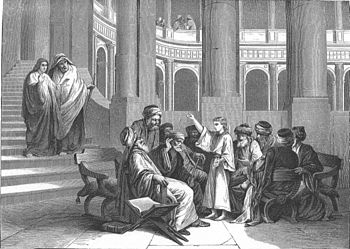
Christ and The Pharisees

Christ and The Pharisees (Photo credit: Wikipedia)

But when that statement brought murmurings of blasphemy from the scribes who were present, he then told the man to stand up, carry his bed, and go home. When the paralyzed man did exactly that, Jesus established that He had the power to both forgive sins and perform a miracle.

Jesus then comes upon Levi and adds him to the number that would be His apostles. The rest of chapter two is then filled with encounters with the Pharisees. First, they complain that Jesus eats with sinners. He counters that with the fact that He came to call sinners. When asked why his disciples did not fast as John’s did, he gives the examples of the new cloth on an old garment, and new wine in old wineskins (as well as the “bridegroom” analogy). The point of these two examples is that He has brought the new gospel, or “good news,” and that the kingdom of God is not just a patch or an extension for the Mosaic law. It is doubtful that the Pharisees he addressed understood what he meant, much less believed it.

In verses 23-28, the disciples’ act of plucking the heads of grain to eat was not work or unlawful by the Law of Moses. It was counter to the rules that the Pharisees had established themselves. When accused, he gave them the example of David and his men eating the bread of the presence in 1 Samuel 21:1-6. Although this act by David was clearly unlawful, Jesus knew that the Pharisees would not say so. Jesus then refers to Himself as “lord even of the Sabbath.” Here is one of several instances that prove wrong those who claim Jesus never claimed to be anything but a mere man.


Bible Reading Schedule for this month
Click here to read or listen to audio of this week’s chapters in Mark

/Bob’s boy
___________________

some images © V. Gilbert & Arlisle F. Beers

Please visit this site’s menu item “The Author’s Books” for info on the author’s books, website, and Facebook page.

All of my comments in this blog are solely my responsibility. When reading any commentary, you should always refer first to the scripture, which is God’s unchanging and unfailing word.


Bob’s Boy’s Plans for 2015

This year, I’m reading the entire New Testament. One chapter per day and five days per week. My blog will still be published on Tuesdays and Fridays, with frequent Sunday editions as always. In addition to commenting on the week’s Bible reading chapters, I will be working on growing in faith and in my relationship to the Lord. I hope that you will join me, and that you may be enriched in your walk with God, as I know I will be.

One of the books I am currently writing is about the subject of apologetics. I don’t know how long that one will take to write, as I am just beginning it. But my 2015 blogs will be sure to have much to say on Christian evidences and such, as a result. I am in the editing stages of publishing my 5th book on the Gospel of Luke. The title has been selected, and I will reveal it in this blog before publication.

Reading the New Testament in one year will certainly enrich your life. The average chapter in the New Testament is 30 verses (7956 verses divided by 260 chapters). I selected a chapter with about 30 verses and clicked the link to listen to a reader who reads it at a leisurely pace. It took 3 minutes and 37 seconds. Less than 4 minutes per day out of your life – five days a week – to enrich your life for years to come.

Join me this year, as we strive to get closer to the Lord and make a real difference in our lives,as we prepare for a home with Him!


Bible Reading Schedule for this month
Click here to read or listen to audio of this week’s chapters in Mark

/Bob’s boy
___________________

some images © V. Gilbert & Arlisle F. Beers

Please visit this site’s menu item “The Author’s Books” for info on the author’s books, website, and Facebook page.

All of my comments in this blog are solely my responsibility. When reading any commentary, you should always refer first to the scripture, which is God’s unchanging and unfailing word.


Paul Arrives in Rome – Acts 28

Forum Romanum in Rome. Columns of the Temple o...

Forum Romanum in Rome. Columns of the Temple of Castor and Pollux are to the right and the remaining columns of the Temple of Vesta are to the left. (Photo credit: Wikipedia)

Luke picked up the account after the shipwreck, where they learned that the island they had safely reached is called Malta. He said that the natives were kind and welcoming, and even helped them with a fire. But a snake came out because of the heat, and fastened himself to Paul’s hand. The sight of the deadly creature hanging from his limb just after he had been rescued from a life-threatening shipwreck made them suppose that he must be a murderer, getting his just reward (Greek and Roman tales had long spoken of just such events – “The Argonautica”, for example). But God was certainly not going to let anything happen to him. When he neither died nor showed any ill effects from the bite, they then thought Paul himself to be a god.

Publius in verse 7, is described as a “chief man” – the Greek term for which is “protos,” of which term several inscriptions have been found. Several references to Publius and this chapter, along with photographs can be found in this article at BiblePlaces.com. Publius’ father was ill with fever and dysentery (the description of which ills fit those of an infection caused by goat’s milk called “Malta fever”). Paul healed him, as well as others of the island with diseases that were brought to him afterward (verses 8-9).

After three months, they again set sail in a ship from Alexandria that had been wintering there. Luke describes the ship as having a figurehead of the “twin gods” (Castor and Pollux, the mythological twin sons of Zeus and Leda, were seen as the protectors of seamen). They put in at Syracuse for three days, then ended up in Puteoli, where they stayed with brethren they had found for seven days, then to Rome. The brethren there heard, and came from as far away as “The Three Taverns” and the “Forum of Appius” (hence, the name, the Appian Way) (verses 12-16).

Paul spent considerable time preaching and trying to convince the Jews there of the good news of Jesus through the words of Moses and the prophets. Some believed, but others did not – the latter leaving disagreeably (verses 23-25). Paul quoted Isaiah 6:9-10 to them in verses 26-27; and then told them that now this news of the salvation of God will be brought to the Gentiles, for they will listen.

Verses 30-31 close out the book of Acts with the word that Paul remained there two full years, at his own expense, “teaching about the Lord Jesus Christ with all boldness and without hindrance.” No further word is given of Paul’s appearance before Caesar, or any confirmation of secular writings that suggest he fulfilled his desire to go and preach in Spain, nor of a second imprisonment before his martyrdom. As much as we would like to know of the rest of Paul’s story, the inspired word of God does not tell us because the book of Acts is not Paul’s biography, but the word “breathed out by God and profitable for teaching, for reproof, for correction, and for training in righteousness…” (2 Timothy 3:16).

So, one might wonder, if it was so important for Paul to appear before Caesar, why is there nearly a chapter and a half about the journey and shipwreck, and not a word about what was so important about that appearance? The answer is that first, God had some reason for Paul to go to stand before Caesar that fulfilled His purpose, but there have been countless events since creation important to Him that are not important for us to know about for teaching, for reproof, for correction, or for training in righteousness. But the journey and shipwreck teach a couple of important lessons. One is that when God wants something done, it gets done, period! Nothing will stop it from completion. The other is that God, as we have seen since Genesis, always keeps His promises. Paul was imprisoned, betrayed, the target of assassination, 2,000 miles away from his destination, shipwrecked, stranded on an island, and had a deadly snake bite him severely enough to have hung from his hand. Yet God wanted him to be in Rome, and had promised that he would get there safely. We can take comfort, knowing that His will is going to be done, and that He has promised salvation for His faithful.


Schedule for this week
Read or listen to audio of this week’s selection from Acts here
Read or listen to audio of this weeks selection from 2 Chronicles here

/Bob’s boy
___________________

some images © V. Gilbert & Arlisle F. Beers

Please visit this site’s menu item “The Author’s Books” for info on the author’s books, website, and Facebook page.

All of my comments in this blog are solely my responsibility. When reading any commentary, you should always refer first to the scripture, which is God’s unchanging and unfailing word.


The End of the Southern Kingdom – 2 Chronicles 36

Jehoiachin-Jeconiah was a king of Judah. He wa...

Jehoiachin-Jeconiah was a king of Judah. He was the son of Jehoiakim with Nehushta, the daughter of Elnathan of Jerusalem. (Photo credit: Wikipedia)

Josiah’s son, Jehoahaz, reigned next at the age of 23. His reign lasted for three months, when “the king of Egypt deposed him in Jerusalem and laid on the land a tribute of a hundred talents of silver and a talent of gold.” Neco then made his brother, Eliakim, king and changed his name to Jehoiakim. Then he carried Jehoahaz off to Egypt.

Jehoiakim was 25 years old when he began his reign, and he reigned eleven years. The scripture simply says that he did evil in the sight of the Lord. Whatever that means, you can be sure that idolatry was involved somewhere. Then Nebuchadnezzar, king of Babylon, bound him in chains and took him to Babylon. he also took some vessels from the house of the Lord, and brought them to his palace.

Then Jehoiachin, Jehoiakim’s son, began his reign, which lasted just over three months. Then Nebuchadnezzar also sent for him, and brought him to Babylon, making his brother, Zedekiah, king. He was twenty-one when he began his reign, and he also reigned for eleven years. He also did evil in God’s eyes.  It was a ruinous time. Zedekiah rebelled against Nebuchadnezzar, and he turned away from God, so there was no help for him. Next comes the capture and burning of Jerusalem by the Chaldeans.

The Books of Chronicles ends with the Proclamation of Cyrus, in which he says that God has charged him with building a house in Jerusalem. Thus ends the Book of Chronicles, which was written to give the remnant of the southern kingdom, who had returned from captivity, hope for the future and an understanding of the past. It shows that the line of David remained intact and kept the necessary records of their heritage and lineages, so that God’s people could begin to rebuild the land, the temple, and their lives.

(This year’s reading plan for Luke, Acts, and 1 and 2 Chronicles averages just 15 verses per day – 5 days per week!)
Schedule for this week

/Bob’s boy
___________________

some images © V. Gilbert & Arlisle F. Beers

Please visit this site’s menu item “The Author’s Books” for info on the author’s books, website, and Facebook page.

All of my comments in this blog are solely my responsibility. When reading any commentary, you should always refer first to the scripture, which is God’s unchanging and unfailing word.


Paul’s Shipwreck – Acts 27

The mention of the men taking a “sounding” refers to measuring the depth of the water by use of a “sounding line.” When they found that they were nearing land, the sailors (afraid of the ship hitting rocks) were lowering boats to abandon ship under the pretense of laying anchors. But Paul warned the centurion, saying that they would not make it if the sailors left the ship. So the soldiers cut the boats loose from the ship to prevent escape.

Having conserved all they could, the fourteenth day without having eaten approached, and Paul urged them all to eat, in order to gather their strength. He did so himself, giving thanks to God; and they were encouraged, and all ate some. There were 276 aboard (verse 27) – about the right amount for the vessel to have been a large grain ship , meaning it was probably not worthy of such a voyage.

Verses 39-44 detail the horrific shipwreck on the reefs, and the escape to land that all of them made safely, hanging on to the wreckage. Verses 42-43 tell us that the soldiers had planned to kill the prisoners, so that none could escape. But the centurion, wishing to save Paul, prevented them. God had, as always, made good on his promise to save them.

Schedule for this week
Read or listen to audio of this week’s selection from Acts here
Read or listen to audio of this weeks selection from 2 Chronicles here

/Bob’s boy
___________________

some images © V. Gilbert & Arlisle F. Beers

Please visit this site’s menu item “The Author’s Books” for info on the author’s books, website, and Facebook page.

All of my comments in this blog are solely my responsibility. When reading any commentary, you should always refer first to the scripture, which is God’s unchanging and unfailing word.


Paul Being Transported to Rome By Ship – Acts 27

Roman conquest of Asia minor

Roman conquest of Asia minor (Photo credit: Wikipedia)

Once again, Luke begins the chapter speaking in the first person plural, indicating that he was with Paul all the way to Rome as they set sail for Italy. The centurion, Julius, that Paul and the other prisoners were delivered to is said to have been “of the Augustan Cohort.” A cohort generally consisted of six hundred men under the command of six centurions. However, auxiliary forces of the cohort could push the numbers up to a thousand men. The cohorts were given names – this one likely given the name for the imperially dedicated regiment founded by the emperor, Augustus, who reigned from 27 BC to 14 AD.

Don’t get confused by verse 2’s statement “embarking in a ship of Adramyttium.” The ship was from Adramyttium (the Latin name for Edremit), an ancient port city of Mysia in the Roman province of Asia Minor (see first map), near present-day Edremit – Turkey. But it was carrying them from their starting point in Caesarea – the next stop being Sidon (see second map). Aristarchus, mentioned as accompanying them in the same verse, is one of the disciples that was dragged into the theater during the riot in Ephesus (Acts 19:29).

Verse 9’s “the Fast” refers to the Day of Atonement, which would have been in October. From this time to about April, Mediterranean sailing is (and was) most dangerous; and Paul was already warning them that the voyage would result in “injury and much loss” (verse 10). But the centurion sided with the captain and the rest of the crew, who judged the harbor at Fair Havens to be unsuitable for the winter. So they decided to try to make it to “Phoenix, a harbor of Crete,” (probably present day Phineka Bay) to spend the winter. This was, after all, a 2,000 mile voyage to Rome.

When a northeaster – a fearsome storm – arrived, it tossed them about so badly that they began jettisoning cargo and tossing the ship’s “tackle” overboard (the tackle may have been the beam supporting the ship’s mainsail). Most had lost hope when Paul told them that “an angel of the God to whom I belong and whom I worship” had appeared and told him not to be afraid – that he must stand before Caesar, so they would all be spared. But, he told them, they would have to run the ship aground on “some island” (verse 26).

Schedule for this week
Read or listen to audio of this week’s selection from Acts here
Read or listen to audio of this weeks selection from 2 Chronicles here

/Bob’s boy
___________________

some images © V. Gilbert & Arlisle F. Beers

Please visit this site’s menu item “The Author’s Books” for info on the author’s books, website, and Facebook page.

All of my comments in this blog are solely my responsibility. When reading any commentary, you should always refer first to the scripture, which is God’s unchanging and unfailing word.


Josiah Reign Ends – 2 Chronicles 35

Chapter 35 is somewhat puzzling because we do not have all of the answers we might wish to have about it. It begins with Josiah keeping the Passover. And this time it was done so that the scripture says that there had not been one like it since the days of Samuel. But then Pharaoh Neco came up from Egypt to fight at Carchemish on the Euphrates. Josiah went out to meet him, but Neco sent envoys to meet him, telling him that he had no quarrel with him.  He told Josiah that he had been sent by God to hurry, and that if he interfered, he would be destroyed.

But Josiah didn’t listen, and he disguised himself and went in to fight. He was shot by Neco’s archers. Badly wounded, he was carried out by chariot to Jerusalem, where he died. And so ends the reign of one of the best kings Judah had seen. Why was Neco sent by God? A mystery we cannot know.


(This year’s reading plan for Luke, Acts, and 1 and 2 Chronicles averages just 15 verses per day – 5 days per week!)
Schedule for this week


/Bob’s boy


___________________


some images © V. Gilbert & Arlisle F. Beers


Please visit this site’s menu item “The Author’s Books” for info on the author’s books, website, and Facebook page.


All of my comments in this blog are solely my responsibility. When reading any commentary, you should always refer first to the scripture, which is God’s unchanging and unfailing word.