Job 37 – By the Breath of God

waterfall_003Chapter 37 brings the conclusion of Elihu’s speech, and (thankfully, one might say) the end of the speeches of all of Job’s companions. Like in the last chapter, Elihu has much to say about God and about His power that are appropriate in their awe for God, but not so in the context of the situation.

Again, Elihu uses his knowledge of the world (so fond is he of using examples of the weather, one would think he might be some sort of teacher) to attempt to validate his assessment of Job’s guilt. Although, God will in the next chapter pick up some of Elihu’s ideas in His questioning of Job, one should not take that to signify God’s approval of Elihu’s speech. It is, however, beautiful poetry; and it provides great imagery and material for prayer, as well as praise to God, as shown in this snip from verses 10-13:

By the breath of God ice is given,
and the broad waters are frozen fast.
He loads the thick cloud with moisture;
the clouds scatter his lightning.

They turn around and around by his guidance,
to accomplish all that he commands them
on the face of the habitable world.
Whether for correction or for his land
or for love, he causes it to happen

Read or listen to audio of ESV version of this selection from this link.

/Bob’s boy
___________________
some images © V. Gilbert & Arlisle F. Beers

Please note: I did not design the reading plan that I am following in my blog.  All of my comments in this blog, however, are solely my responsibility.  When reading ANY commentary, you should ALWAYS refer first to the scripture, which is God’s unchanging and unfailing word. Reading schedules, as well as a link to the site where you can get the reading plan that I’m currently following for yourself can be found on the “Bible Reading Schedules” page of my website at http://graceofourlord.com.  For questions and help, please see the “FAQ” and “Summaries” pages there.

Psalm 143 – I Stretch Out My Hands To You

Absalom

Absalom (Photo credit: Wikipedia)


This psalm of David is one of  those which are referred to as “the penitentials.” It still has all the elements of a lament, however, and as such it is clear that it was one written during his flight from Jerusalem during Absalom’s rebellion. The penance in his prayer is far too deep and genuine to be of the time of Saul’s persecution. Franz Delitzsch wrote of this psalm that it:


“is certainly composed as coming out of the situation of David who was persecuted by Absalom; and it is distinguished from those of the time of Saul’s persecution by the psalmist’s deep melancholy, founded upon the penitential sorrow of David’s consciousness of his own guilt.”


David is paying the price for his sin with Bathsheba, and his atrocious murder of his loyal friend, Uriah the Hittite – of which Nathan warned him to be prepared for in 2 Samuel 12:7-12.  Psalm 143 is another great model of prayer for us today. In the midst of praying for his deliverance, David also prays not only for deliverance, but for strength to serve God better:


Teach me to do your will,
for you are my God!
Let your good Spirit lead me
on level ground!

For your name’s sake, O Lord, preserve my life!
In your righteousness bring my soul out of trouble!


Read or listen to audio of ESV version of this selection from this link.


/Bob’s boy


___________________


some images © V. Gilbert & Arlisle F. Beers


Please note: I did not design the reading plan that I am following in my blog.  All of my comments in this blog, however, are solely my responsibility.  When reading ANY commentary, you should ALWAYS refer first to the scripture, which is God’s unchanging and unfailing word. Reading schedules, as well as a link to the site where you can get the reading plan that I’m currently following for yourself can be found on the “Bible Reading Schedules” page of my website at http://graceofourlord.com.  


Proverbs 24:19-34 – Build Your House

preparing02The first reading of verse 27 of Proverbs 24 can be a little puzzling:

Prepare your work outside;
get everything ready for yourself in the field,
and after that build your house.

Wouldn’t even someone living in a farming community want to build a place to live while they are working the field? Some commentaries on the subject suggest that some of the meaning is actually lost in translation, and that a better interpretation would be “build up your house.”

At any rate, the meaning seems to be more related to the preparation one is making for his future. the practical advice and custom of working to accumulate some measure of wealth before proposing marriage fits this very well. But the principle applies to just about anything in this life. One must do their due diligence to prepare for the future in all things, including having children. Humans are one of the few species that seem to forget about “making their nest” first.

Read or listen to audio of ESV version of this selection from this link.

/Bob’s boy
___________________
some images © V. Gilbert & Arlisle F. Beers

Please note: I did not design the reading plan that I am following in my blog.  All of my comments in this blog, however, are solely my responsibility.  When reading ANY commentary, you should ALWAYS refer first to the scripture, which is God’s unchanging and unfailing word. Reading schedules, as well as a link to the site where you can get the reading plan that I’m currently following for yourself can be found on the “Bible Reading Schedules” page of my website at http://graceofourlord.com.  For questions and help, please see the “FAQ” and “Summaries” pages there.

Psalm 148 – Hallelujah, Praise Jehovah!

William J. Kirkpatrick

William J. Kirkpatrick

Another of the “Hallelujah Psalms,” Psalm 148 is certainly one of the most familiar to people in song. The ever-popular hymn “Hallelujah, Praise Jehovah!” by William J. Kirkpatrick is practically taken word for word from this psalm; and it is a personal favorite of this blogger.

The psalm calls on all of God’s creatures to praise Him, but it goes further – declaring that all of His creation should sing His praises as well.  Parts of this psalm bring to mind the Triumphal Entry of Jesus into Jerusalem (Luke 19:28-44). When the Pharisees suggested that Jesus should silence His disciples who were shouting praises to Him, he answered in verse 40 “I tell you, if these were silent, the very stones would cry out.”

Praise the Lord!
Praise the Lord from the heavens;
praise him in the heights!

Praise him, all his angels;
praise him, all his hosts!

Praise him, sun and moon,
praise him, all you shining stars!

Praise him, you highest heavens,
and you waters above the heavens!
Let them praise the name of the Lord!
For he commanded and they were created.

Read or listen to audio of ESV version of this selection from this link.

/Bob’s boy
___________________
some images © V. Gilbert & Arlisle F. Beers

Please note: I did not design the reading plan that I am following in my blog.  All of my comments in this blog, however, are solely my responsibility.  When reading ANY commentary, you should ALWAYS refer first to the scripture, which is God’s unchanging and unfailing word. Reading schedules, as well as a link to the site where you can get the reading plan that I’m currently following for yourself can be found on the “Bible Reading Schedules” page of my website at http://graceofourlord.com.  

Amos, Shepherd of Tekoa (Minor Prophets Part 3)

Historical marker outside Hazor.

Historical marker outside Hazor.

We continue to stress the fact that the minor prophets are called such because of the short books of the Bible that they represent, not their importance. The Book of Amos is a great illustration of that. Though not the shortest book of the Old Testament, it only consists of nine chapters, and with the exception of chapter 5, none of them contain more than 17 verses (chapter 5 has a whopping 27). But we could take many more pages to comment on this book than would suit the purpose of this series (that purpose being to present a general overview of each of the books of the minor prophets).

The best place to begin is in the very first verse of the book, which tells us that Amos was one of the shepherds of Tekoa. Situated about 20 kilometers south of Jerusalem, Tekoa was referred to in 2 Samuel 14 as the place that the wise woman came from – the one that Joab used to deceive David, convincing him to let Absalom come home.  The same verse tells us that Amos made these prophecies during the days of Uzziah, king of Judah and Jeraboam, the son of Joash, king of Israel during the two years before “the earthquake.”

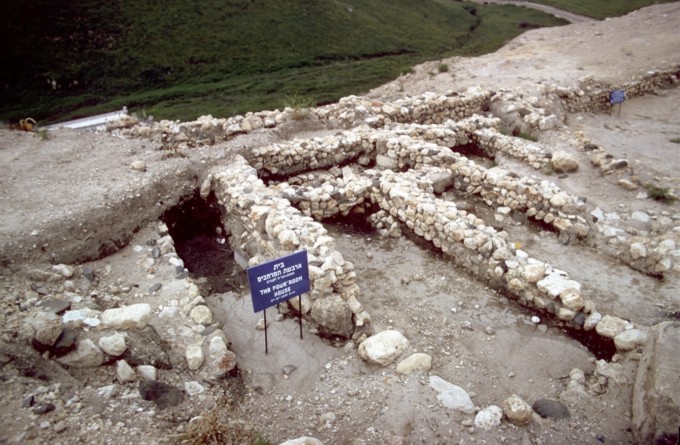
Before we get to the matter of the earthquake, let us address the date of the reigns of these two kings. Estimates of the reigns of these two kings range from about 800 B.C down to Uzziah’s death in about 739 B.C., leaving us with about a 60 year period when the prophecies could have occurred. Then there is the matter of this earthquake. The one mentioned is obviously one that was great in magnitude, as it was eventful enough to be used as a time reference here, and it is mentioned also in Zechariah 14:5. Excavations around Hazor in 1955 revealed evidence of an earthquake in the 8th century B.C. (some estimates are at 750 B.C. with a possible variance of 30 years). More than 50 years later, earthquake damage was still being discovered. More information can be found in this article at ICR.ORG and this article at the Jewish Virtual Library.

Hazor, house foundation

Hazor, house foundation

The book addresses the people of the northern kingdom, Through verse 5 of chapter 2, the judgment of the Lord against Israel’s enemies  (which the people expected) is prophesied. But what they did not expect, and had not counted on, was the judgment that would come to them for their injustice to the poor, and their pretense of worship to the Lord while they were actually doing nothing of the sort (the sarcasm in Amos 4:1-5 underscores this point). The Lord’s patience with them has come to an end (Amos 8:1-2). But He speaks in chapter 9 of a time when restoration will occur (note Amos 9:11, which is cited in Acts 15:16).

During this time, the northern kingdom was experiencing much prosperity, which they translated as a sign that God was pleased with them, and was blessing them. Amos’s message to them was exactly the opposite. A great deal of their wealth had been accumulated by their oppression of the poor. And their worship was more like an attempt at manipulating events in much of the same way that pagans worshiped their “gods.” Amos’s message was most unwelcome because it made the prediction that the “day of the Lord,” that they were expecting to usher in their further rise to power, would actually bring the end of their kingdom.

/Bob’s boy
___________________
image © V. Gilbert & Arlisle F. Beers

Please note: I did not design the reading plan that I am following in my blog.  All of my comments in this blog, however, are solely my responsibility.  When reading ANY commentary, you should ALWAYS refer first to the scripture, which is God’s unchanging and unfailing word. Reading schedules, as well as a link to the site where you can get the reading plan that I’m currently following for yourself can be found on the “Bible Reading Schedules” page of my website at http://graceofourlord.com.  


Psalm 145 – I Will Extol You

Hebrew letter "nun"

Hebrew letter “nun”

Psalm 145 is the last of the psalms of David in Book 5, and is followed by the “Hallelujah Psalms” (Psalms 146-150). It is an acrostic, but like a couple of other acrostics, there is a letter missing – at least in some manuscripts – the letter “nun.” But both the Septuagint and the Dead Sea Scrolls supply the line with the missing letter (the second part of verse 13 – “the Lord is faithful in all his words and kind in all his works.”, and it flows perfectly, suggesting evidence of an earlier manuscript that matches.

It is a song of praise, and in its acrostic style, it uses a variety of words for communicating the idea of praise (extol, comment, pour forth, etc.), as well as the timeless continuity of this praise and of God’s grace, love, and mercy (forever and ever, everlasting, throughout all generations, etc. The theme of praising God for His righteousness and faithfulness continues throughout the acrostic. It points out that God is in control of even the most minute details of the world – down to even the various supplies of food He makes available to all His creatures.

Read or listen to audio of ESV version of this selection from this link.

/Bob’s boy
___________________
some images © V. Gilbert & Arlisle F. Beers

Please note: I did not design the reading plan that I am following in my blog.  All of my comments in this blog, however, are solely my responsibility.  When reading ANY commentary, you should ALWAYS refer first to the scripture, which is God’s unchanging and unfailing word. Reading schedules, as well as a link to the site where you can get the reading plan that I’m currently following for yourself can be found on the “Bible Reading Schedules” page of my website at http://graceofourlord.com.  

Job 36 – On God’s Behalf

rain_003While there is some truth to some of what Elihu says in this chapter, he is using it in the context of condemning Job and ascribing Job’s suffering to God’s punishment – just like the first three of Job’s friends. Presumptuously, he begins by stating that he is speaking on God’s behalf (verse 2), as if God needed someone to defend Him. But his words are meant to wound Job and disparage his integrity; and God would have no part of such. Worse still, Elihu claims to be “perfect in knowledge” (verse 4) concerning God, His will, and how he deals with the righteous and the wicked. This arrogance is certainly not unnoticed by God, as we will see.

Elihu speaks correctly about God’s might, and even shows some knowledge of the scientific processes for rain, evaporation, and storms. But Satan moves him to use this knowledge to give the false impression that his knowledge in the matter of Job’s guilt, and God’s actions toward him are equally correct – which they certainly are not. This tactic of using the truth to lay down false authority for a lie is timeless, and certainly still used by Satan today.

Read or listen to audio of ESV version of this selection from this link.

/Bob’s boy
___________________
some images © V. Gilbert & Arlisle F. Beers

Please note: I did not design the reading plan that I am following in my blog.  All of my comments in this blog, however, are solely my responsibility.  When reading ANY commentary, you should ALWAYS refer first to the scripture, which is God’s unchanging and unfailing word. Reading schedules, as well as a link to the site where you can get the reading plan that I’m currently following for yourself can be found on the “Bible Reading Schedules” page of my website at http://graceofourlord.com.  For questions and help, please see the “FAQ” and “Summaries” pages there.

Psalm 141 – My Eyes Are Toward You

English: Michal Watching David from a Window, ...

English: Michal Watching David from a Window, as in 2 Samuel 6:16: “And it was so, as the ark of the Lord came into the city of David, that Michal the daughter of Saul looked out at the window, and saw king David leaping and dancing before the Lord; and she despised him in her heart.”; watercolor circa 1896–1902 by James Tissot (Photo credit: Wikipedia)


This lament, according to the superscription, is a psalm of David. And it does have the “flavor” of one of David’s psalms. There is no clue given as to the occasion of the writing. It could be during his flight from Saul or from the Absalom rebellion. It is likely the former, as this period was a long one in David’s life, and would provide the most opportunities for writing such laments.


Unlike imprecatory psalms, David is not praying for God to strike down his enemies. Nor is he praying for God to give him might against them. Instead, he is asking for the strength to withstand what his enemies would do to him, and to restrain his lips against speaking evil of them (verses 3-5).


He tells the Lord that he will continue praying against their evil deeds, asks God to be his defense and his refuge, and prays that his enemies will be the cause of their own demise (verse 10), rather than having him fall victim to them. What a great model of prayer from one who is so persecuted!


Read or listen to audio of ESV version of this selection from this link.


/Bob’s boy


___________________


some images © V. Gilbert & Arlisle F. Beers


Please note: I did not design the reading plan that I am following in my blog.  All of my comments in this blog, however, are solely my responsibility.  When reading ANY commentary, you should ALWAYS refer first to the scripture, which is God’s unchanging and unfailing word. Reading schedules, as well as a link to the site where you can get the reading plan that I’m currently following for yourself can be found on the “Bible Reading Schedules” page of my website at http://graceofourlord.com.  


Proverbs 24:1-18 – Eat Honey!

Honey in honeycombs

Honey in honeycombs (Photo credit: Wikipedia)

Chapter 24 concludes the “thirty sayings” portion of the Book of Proverbs that was begun in chapter 22 (see this previous post for more information). Verse 13 is one that is natural for the reader to just skip over:

My son, eat honey, for it is good,
and the drippings of the honeycomb are sweet to your taste

When one is reading through verse after verse of some of the greatest wisdom, a verse stating that honey is sweet does not really register as being terribly wise. The lesson is in verse 14, which expounds on that thought:

Know that wisdom is such to your soul;
if you find it, there will be a future,
and your hope will not be cut off.

Wisdom is to the soul like honey is to the taste. The key is to find it; and what the writer has been telling us over and over again throughout this entire book is that the beginning of all knowledge is the fear of the Lord. The greatest source of wisdom is in God’s word. It is there that we find both our hope and our future, but the keywords are “if you find it.” Like finding the honeycomb, we must search the scriptures to find that wisdom. The writer is telling us to read our Bible – regularly!

Read or listen to audio of ESV version of this selection from this link.

/Bob’s boy
___________________
some images © V. Gilbert & Arlisle F. Beers

Please note: I did not design the reading plan that I am following in my blog.  All of my comments in this blog, however, are solely my responsibility.  When reading ANY commentary, you should ALWAYS refer first to the scripture, which is God’s unchanging and unfailing word. Reading schedules, as well as a link to the site where you can get the reading plan that I’m currently following for yourself can be found on the “Bible Reading Schedules” page of my website at http://graceofourlord.com.  For questions and help, please see the “FAQ” and “Summaries” pages there.

Psalm 146 – The Lord Lifts Up!

benedictionConsidered by some as a part of the Hallel (Psalms 113-118), the last five psalms of the book (Psalms 146-150) are often called the “Hallelujah Psalms.” Each one of them starts and ends with the sentence “Praise the Lord!” The message of this song is simple. It tells the us not to put our trust in those in positions of political or ruling authority, but to put all of our trust in the Lord.

The psalm is obviously a song sung by the entire congregation; and it emphasizes the everlasting authority of God as the Creator of heaven and earth, and the giver of life. It also praises God for His love and care for the righteous, the oppressed, the hungry, and all of those who depend on Him. It declares that He is a just God, who will take care of the wicked in His own way and in His time (verse 9).

Read or listen to audio of ESV version of this selection from this link.

/Bob’s boy
___________________
some images © V. Gilbert & Arlisle F. Beers

Please note: I did not design the reading plan that I am following in my blog.  All of my comments in this blog, however, are solely my responsibility.  When reading ANY commentary, you should ALWAYS refer first to the scripture, which is God’s unchanging and unfailing word. Reading schedules, as well as a link to the site where you can get the reading plan that I’m currently following for yourself can be found on the “Bible Reading Schedules” page of my website at http://graceofourlord.com.