Proverbs 3 – Trust in the Lord with All Your Heart

Moses with Radiant Face (1638 painting by José...

Moses with Radiant Face (1638 painting by José de Ribera) (Photo credit: Wikipedia)

As the reader is admonished to “keep my commandments…,” verse 3 begins with “Let not steadfast love and faithfulness forsake you.”  As this chapter heavily emphasizes trusting in the Lord, this would seem to refer to the steadfast love and faithfulness of the Lord Himself, as declared to Moses in Exodus 34:6, as He affirmed His covenantal relationship at Sinai.  Verses 5-7 contain the best timeless advice perhaps of the whole chapter – trust in the Lord with all your heart, lean not on your own understanding, and be not wise in your own eyes.  The folly of man in ignoring these three things (while believing that our own knowledge and our own understanding of the world is not flawed) has no doubt cost many their very souls – and will likely continue to do so.  The word of God, however, is unchanging and perfect.

But then, come verses 11-12.  These should not be taken to mean that God causes afflictions and trials to come upon us (as we will see in Job), but simply mean that He does allow those things to happen; and that in no way detracts from the fact that He loves us, as a father loves his children.  Building character and discipline through these trials gives us strength, integrity, and produces steadfastness in us as well (James 1:2-4).

Part of the rest of this chapter’s message of wisdom is in how we treat others, and how righteous living has an effect on them and, ultimately, on our own well-being.  And these points are all tied back to verse 4, which says that by living in such a manner, we “will find favor and good success in the sight of God and man.”

Read or listen to audio of ESV version of this selection from this link.

/Bob’s boy
___________________
some images © V. Gilbert & Arlisle F. Beers

Please note: I did not design the reading plan that I am following in my blog.  All of my comments in this blog, however, are solely my responsibility.  When reading ANY commentary, you should ALWAYS refer first to the scripture, which is God’s unchanging and unfailing word. Reading schedules, as well as a link to the site where you can get the reading plan that I’m currently following for yourself can be found on the “Bible Reading Schedules” page of my website at http://graceofourlord.com.  For questions and help, please see the “FAQ” and “Summaries” pages there.

Proverbs 1 – The Beginning of Knowledge

The first 9 verses set the tone, and are widely regarded as the introduction of the entire purpose of the Book of Proverbs.  Coffman wrote “Wisdom is the ability to use knowledge aright,” and that the Christian has an advantage in that respect as 1 Corinthians 1:30 tells us that “because of him you are in Christ Jesus, who became to us wisdom from God, righteousness and sanctification and redemption.”  Verse 7 is the key: “The fear of the Lord is the beginning of knowledge; fools despise wisdom and instruction.”  Coffman’s comment on this is dead on:

English: Scroll of the Book of Proverbs

English: Scroll of the Book of Proverbs (Photo credit: Wikipedia)

“This is not a reference to abject craven fear, or terror, but to the awesome respect, honor, and deference to God and his will which automatically come to every mind that contemplates the omnipotence, glory, and holiness of Almighty God. This expression is found fourteen times in Proverbs.”  This latter fact is not inconsequential.  Every one of these fourteen passages containing those words conveys the richness of life and wisdom that comes to those that have this proper reverence and awe, and know the Almighty and the importance He places on things such as good, evil, and discipline (for reference, the others are Proverbs 1:29, 2:5, 8:13, 9:10, 10:27, 14:26, 14:27, 15:16, 15:33, 16:6, 19:23, 22:4, and 23:17).  The word “instruction” in verse 7 appears 26 times in the book, and the Hebrew incorporates “discipline” into its meaning.  This is central to understanding the “instruction” in verse seven and referenced elsewhere.

Verses 18 and 31 drive home the point, making clear that one’s actions contrary to good and righteousness mete out their own punishment to them.  The application of this instruction and wisdom to the young, as emphasized in  verses 4 and 8-9, are underscored in Ephesians 6:1-4 as well.

Read or listen to audio of ESV version of this selection from this link.

/Bob’s boy
___________________
some images © V. Gilbert & Arlisle F. Beers

Please note: I did not design the reading plan that I am following in my blog.  All of my comments in this blog, however, are solely my responsibility.  When reading ANY commentary, you should ALWAYS refer first to the scripture, which is God’s unchanging and unfailing word. Reading schedules, as well as a link to the site where you can get the reading plan that I’m currently following for yourself can be found on the “Bible Reading Schedules” page of my website at http://graceofourlord.com.  For questions and help, please see the “FAQ” and “Summaries” pages there.

January 2013 Reading Schedule Posted!

A big thank you to all who have read this blog during 2012!  While this blog is certainly not ever going to be the most popular WordPress “hangout,” we did just receive some statistics that are encouraging.  For example, the post on Peter’s rescue in Acts 12 received 652 views in one day. Not what we expected in the first year!  Thank you!

Here is the link to the 2013 reading schedule for January (January 2013 Reading Schedule).  In 2013, this blog will focus on the “Wisdom Literature” with a unique approach to Proverbs, Psalms, Song of Solomon, Ecclesiastes, Job, and as a special was to end 2013 the last week in December, the Book of James (often referred to as the “Proverbs of the New Testament”).  The first two weeks (beginning tomorrow 01/01/2013) we will read the first 9 chapters of Proverbs.  Theses chapters introduce the book, and what we actually know as “proverbs” do not really begin until chapter 10.

Psalm 1, Verse 1 and 2 in Biblia Hebraica Stut...

Psalm 1, Verse 1 and 2 in Biblia Hebraica Stuttgartensia (Photo credit: Wikipedia)

After those two weeks, we will settle into a schedule that adds variety to the five days per week of reading these books.  Each Monday in the first half of the year, we will read 8 verses of the longest chapter in the entire Bible – the 119th Psalm (with other, shorter Psalms included on many of those days).  This is a great Psalm that praises God and His word; and it is very rich in inspiration.  We will take a second look at these verses (and other Psalms) in the second half of the year from a fresh perspective. On Tuesdays, we will be reading from Proverbs with a similar approach.

On Wednesdays, we will be reading what are commonly called “lament” Psalms.  These are tremendously valuable in helping us with learning to call upon the Lord when life becomes very difficult, and even as tragedy and pain come our way.  Thursdays, we will read from the Book of Job, and on Fridays, we will be reading from other Psalms.

We will take a break at the end of June through July, and read through Ecclesiastes and Song of Solomon in their entirety, gaining much value learning about life, service to God, and the relationship of husbands and wives to each other.  Then we will resume the previously outlined schedule.

We are looking forward to what promises to be a very rewarding experience in God’s word in 2013!

/Bob’s boy
___________________
some images © V. Gilbert & Arlisle F. Beers

Please note: I did not design the reading plan that I am following in my blog.  All of my comments in this blog, however, are solely my responsibility.  When reading ANY commentary, you should ALWAYS refer first to the scripture, which is God’s unchanging and unfailing word. Reading schedules, as well as a link to the site where you can get the reading plan that I’m currently following for yourself can be found on the “Bible Reading Schedules” page of my website at http://graceofourlord.com.  For questions and help, please see the “FAQ” and “Summaries” pages there.
Looking to new Schedule \ Weeks 51 and 52 summaries posted

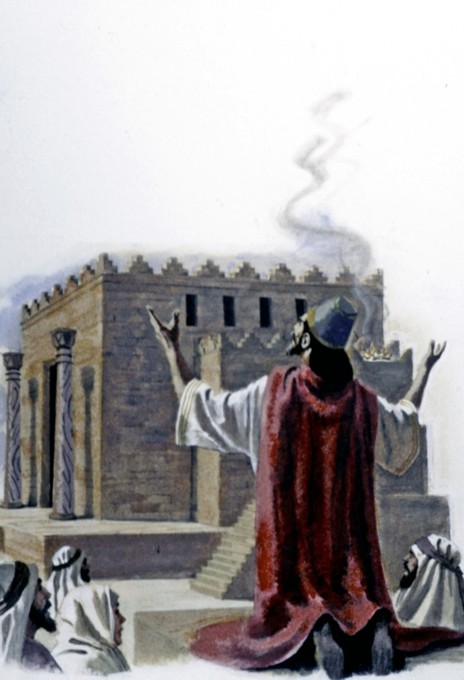
In Solomon's early years as king, when he built the Temple, he was a very godly man, offering a prayer of devotion to dedicate his finished Temple (1 Kings 8:22-61; 2 Chronicles 6:12--7:3).

In Solomon’s early years as king, when he built the Temple, he was a very godly man, offering a prayer of devotion to dedicate his finished Temple (1 Kings 8:22-61; 2 Chronicles 6:12–7:3).

In 2012, we have gone from the creation in Genesis to the end of Revelation studying the highlights of the Bible as the one story that it is (one chapter a day). What a year it has been!  This week, we will take a break from our reading in God’s word on Monday, and begin the new schedule of studying the “Wisdom Literature” in 2013 on New Year’s Day.  It is going to be a great year, and another very unique and, we trust, rewarding reading experience. We expect to see the completed schedule before Monday, and will post it then.  But we have reason to believe that we will start out in the Book of Proverbs.

We credit Solomon with the writing of Proverbs (we won’t debate the possibility of additional authors here), Ecclesiastes and Song of Solomon in particular, but much “non-inspired” literature is attributed to this king as well.  And we know that to be fact from what we are told in passages such as 1 Kings 4:29-34.  This passage starts with the great wisdom that God gave him (“And God gave Solomon wisdom and understanding beyond measure, and breadth of mind like the sand on the seashore) as a result of his request, which pleased the Lord (1 Kings 3:10-12).  Solomon reigned as king from about 970 – 931 B.C., and was the last king before the kingdom divided.

Summing Up

Each weekend, I post a small PDF of one week of chapter summaries (on the website’s “Summaries” page), current to the beginning of the previous week.  I have posted the summaries for Week 51 (December Week 3) and for Week 52 (December Week 4) of the schedule I have followed this year – the final two weeks for 2012!  The first of these short PDF documents contains condensed comments about Hebrews 6, 7, 8, 9, and 10, and the second about Hebrews 11, and Revelation 4, 5, 21, and 22 with hyperlinks to the ESV version of each chapter for listening or reading, and join the summaries for other weeks already posted there.

/Bob’s boy
___________________
image © V. Gilbert & Arlisle F. Beers

Please note: I did not design the reading plan that I am following in my blog.  All of my comments in this blog, however, are solely my responsibility.  When reading ANY commentary, you should ALWAYS refer first to the scripture, which is God’s unchanging and unfailing word. Reading schedules, as well as a link to the site where you can get the reading plan that I’m currently following for yourself can be found on the “Bible Reading Schedules” page of my website at http://graceofourlord.com.  For questions and help, please see the “FAQ” and “Summaries” pages there.

Sneak Preview of 2013! \ Week 49 summary posted

What a year it’s been pointing to the cross!  We started this blog in January with a Bible reading plan that caught our interest, and went from the creation in Genesis all the way to the death, burial, and resurrection of our Lord, Jesus the Christ – one chapter a day, five days per week.  As we finish the year with the Scriptures pointing the way to His return and our salvation, we hope you have grown and benefited as much as we have from God’s word this year!

Cross-003But, alas the year is soon ending; and the question of what this blog will be focused on in 2013 must now be answered.  Well, fortunately, we recently figured that out.  A very different reading plan has come to our attention that is just too hard to resist.  As of this writing, the designers of this plan (again, not us) are working on the finishing touches of the schedule – which will be ready by the end of the year.  What we can tell you right now is that next year’s reading schedule for this blog will be focused on what is commonly called “The Wisdom Literature,” or sometimes “The Poetry and Wisdom Books of the Bible!”

More details to come before January, but we are excited about a year of an in-depth look into Psalms, Proverbs, the Song of Solomon, Ecclesiastes, the Book of Job and, as an added bonus, the Book of James!  The latter is not included in the list of “Wisdom books” normally, but it is often called the “Proverbs of the New Testament;” and we think it is a fabulous choice to end the year with in 2013!

So that brings us to the subject of the approaching date of December 21, 2012 and that pesky Mayan calendar.  We were recently treated to a very well-written article on that very subject.  Please enjoy it at the following link in its title – “What does the Bible say about the Mayan Calendar and Doomsday on December 21?”

Summing Up

Each weekend, I am now posting a small PDF of one week of chapter summaries (on the website’s “Summaries” page), current to the beginning of the previous week.  I have posted the summary for Week 49 (December Week 1) of the schedule I am following.  This short PDF document contains condensed comments about Ephesians 2, 3, 4, 5, and 6, with hyperlinks to the ESV version of each chapter for listening or reading, and joins the summaries for other weeks already posted there.

/Bob’s boy
___________________
image © V. Gilbert & Arlisle F. Beers

Please note: I did not design the reading plan that I am following in my blog.  All of my comments in this blog, however, are solely my responsibility.  When reading ANY commentary, you should ALWAYS refer first to the scripture, which is God’s unchanging and unfailing word. Reading schedules, as well as a link to the site where you can get the reading plan that I’m currently following for yourself can be found on the “Bible Reading Schedules” page of my website at http://graceofourlord.com.  For questions and help, please see the “FAQ” and “Summaries” pages there.