Psalm 77 – Has God Forgotten?

This psalm has been seen both as a national (or community) lament and a personal lament.  It is appropriate for both because the underlying question is the same in either case – “has God abandoned me?”  The psalmist raises the questions not disrespectfully, but in genuine wonder and distress.  The problem is not an uncommon one for any of us.  How do we deal with the doubt that can come over us when there are times in lives that result in grave trouble or great sorrow?

crying_002No matter whether the trials are from illness, loss of a loved one, loneliness, or any kind of suffering at all, how do we come to terms with the pain and suffering we feel and reconcile those feelings with a loving, just, and gracious God? When the trials continue for long periods of time with seemingly no relief, do we not have the same questions of God that this psalmist has?  (“Has God forgotten to be gracious? Has he in anger shut up his compassion?” “Has His steadfast love ceased forever?” “Will the Lord spurn forever, and never again be favorable?”)

The devil uses those feelings to bring our doubts to their fullest heights in the hope that our faith will ultimately fail.  Little by little (or sometimes a lot by a lot) he tries to wear us down and bring doubt to our Christian hearts.  There is no reason to suppose that God is offended by the questions.  We already have the answers after all.  God is love – His love never ceases.

He cannot forget to be gracious because His grace is everlasting.  Repeatedly, the Scriptures tell us that “The LORD is slow to anger and abounding in steadfast love, forgiving iniquity and transgression” (Numbers 14:18).  Remember Psalm 27:14: Wait for the LORD; Be strong and let your heart take courage” – and again, verse 14 of this chapter “You are the God who works wonders; you have made known your might among the peoples.”

Read or listen to audio of ESV version of this selection from this link.

/Bob’s boy
___________________
some images © V. Gilbert & Arlisle F. Beers

Please note: I did not design the reading plan that I am following in my blog.  All of my comments in this blog, however, are solely my responsibility.  When reading ANY commentary, you should ALWAYS refer first to the scripture, which is God’s unchanging and unfailing word. Reading schedules, as well as a link to the site where you can get the reading plan that I’m currently following for yourself can be found on the “Bible Reading Schedules” page of my website at http://graceofourlord.com.  For questions and help, please see the “FAQ” and “Summaries” pages there.

Psalm 34 – Taste and See That the Lord Is Good

The superscript here refers to David feigning madness in the  presence of Achish, otherwise known by the Philistine title of Abimelech in 1 Samuel 21:10-14 (not to be confused with Ahimelech, the priest of the previous few verses).   Barnes identified the following four paragraphs in the psalm: (1) thanksgiving for deliverance (Psalm 34:1-6); (2) from his experience, he invites others to join in praise (Psalm 34:7-10); (3) special instructions and exhortations for the young to trust in God (Psalms 34:11-14); (4) a general summary of the security, joys, and protection for those who truly rely upon God (Psalms 34:15-22).

Don’t misunderstand verses 17-19:

“When the righteous cry for help, the Lord hears
and delivers them out of all their troubles.
The Lord is near to the brokenhearted
and saves the crushed in spirit.
Many are the afflictions of the righteous,
but the Lord delivers him out of them all.”

Those who have a contrite heart (crushed in spirit) – those who truly repent instead of continuing to do wrong – will be delivered in the end.  God has no regard for the prayers of those who have no intention of changing their ways.   The righteous will indeed suffer, but their salvation and their comfort is promised.

Of this, Coffman wrote:

“Our Lord himself was a man of sorrows and acquainted with grief; and he is the ever ready comforter and Saviour of those whose hearts have been broken by the soul’s tragic encounter with the wicked world in which we live.

NSRW Rudyard Kipling

NSRW Rudyard Kipling (Photo credit: Wikipedia)

The words of Kipling come to mind:

‘The tumult and the shouting dies;
The Captains and the Kings depart.
Still stands Thine ancient sacrifice,
An humble and a contrite heart.
Lord God of Hosts, be with us yet,
Lest we forget; lest we forget!’

— Rudyard Kipling (The Recessional)”

Regarding verse 8’s first half “Oh, taste and see that the Lord is good!, Coffman rightly stated: “God has made it possible for men to know whether or not his word is true. The person who receives it, obeys it, and trusts its promises will shortly come to know, Whom he has believed, having tasted the good Word of God and the powers of the age to come…”   Peter repeated it in 1 Peter 2:1-3.  When we dedicate our lives to serving the Lord and continue  to grow in prayer and learning from His word, our lives are better because of the goodness of the Lord and the assurance of His promises.

Of verses 9-10 (“those who seek the Lord lack no good thing”), one must not think that the scripture promises that those who fear the Lord will never have any of their earthly needs or desires lacking in satisfaction, for not all things are good for everyone – nor is what may be good for one person necessarily good for another.  Instead, we trust that the Lord will provide what we truly need.  Just come and taste for yourself!

Read or listen to audio of ESV version of this selection from this link.

/Bob’s boy
___________________
some images © V. Gilbert & Arlisle F. Beers

Please note: I did not design the reading plan that I am following in my blog.  All of my comments in this blog, however, are solely my responsibility.  When reading ANY commentary, you should ALWAYS refer first to the scripture, which is God’s unchanging and unfailing word. Reading schedules, as well as a link to the site where you can get the reading plan that I’m currently following for yourself can be found on the “Bible Reading Schedules” page of my website at http://graceofourlord.com.  For questions and help, please see the “FAQ” and “Summaries” pages there.

Psalm 30 – Joy Comes with the Morning

The superscript for this psalm generates some discussion because David, of course, was not around for the dedication of the temple.  That happened during Solomon’s reign.  This of course would not preclude the psalm from having been used on that occasion, but that context is not the nature way that these superscripts are generally phrased.  Others have suggested that it was actually during re-dedication of David’s palace after reclaiming it from Absalom.  One other school of thought is that the psalm was composed during dedication of the threshing floor of Araunah (2 Samuel 24:18-25), after the terrible pestilence that claimed the lives of 70,000.

David instructs Joab to number the people.

David instructs Joab to number the people.

This latter seems quite likely, and the reference to the Lord’s anger does lend some credence to it.  David referred to his former view of his prosperity in verse 6, and the fact that it was his own self-glorification that had led to his command for the numbering of his forces makes for a convincing argument for this explanation. The lesson for us could also be in how quickly our fortunes may be turned when we forget to depend upon the Lord.  As Clarke noted “Peace and prosperity had seduced the heart of David, and led him to suppose that his mountain – his dominion, stood so strong, that adversity could never affect him.”  We must never forget that all that we are blessed with comes from the Lord, and any or all of it could be lost in the twinkling of an eye.  Entire life savings have been wiped out by recent economic tragedy, loved ones we depend on sometimes die.  It is the Lord that is always our rock and our salvation.

Read or listen to audio of ESV version of this selection from this link.

/Bob’s boy
___________________
some images © V. Gilbert & Arlisle F. Beers

Please note: I did not design the reading plan that I am following in my blog.  All of my comments in this blog, however, are solely my responsibility.  When reading ANY commentary, you should ALWAYS refer first to the scripture, which is God’s unchanging and unfailing word. Reading schedules, as well as a link to the site where you can get the reading plan that I’m currently following for yourself can be found on the “Bible Reading Schedules” page of my website at http://graceofourlord.com.  For questions and help, please see the “FAQ” and “Summaries” pages there.
Psalm 3-4 – Save Me, O My God

Chapter 3 is the first of the Psalms with a title (sometimes called a sub-script or superscription).  These titles are not part of the inspired word, but they are ancient.  And they have had their critics who question their accuracy, although we have been given no good reason for doing so.  This one reads “A Psalm of David, when he fled from Absalom his son,”  which refers to the events of 2 Samuel 15-17 (here, particularly to 2 Samuel 15:13-17).

How quickly and completely David’s fortunes had changed!  He was king, but his own son had conspired so successfully against him that David had to flee from Jerusalem, fearing that even the city he had built and loved would be destroyed if he remained, as Absalom now commanded more of his army than he did.  David was a hunted man, now in danger of losing even his life.  Yet the remarkable lesson for us in verses 1-6 is that this unbelievably painful crisis brought him closer to God, rather than leaving him feeling abandoned.

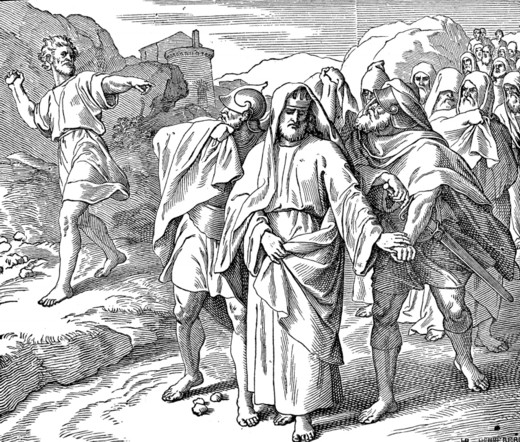
Shimei throwing stones at David.

Shimei throwing stones at David.

When reading in verse 2 that “many are saying of my soul, there is no salvation for him in God,” one cannot help but think of Shimei in 2 Samuel 16:7-8.  But David professes his faith that his enemies cannot stand against him with the Lord on his side (verses 7-8) – the same kind of faith Paul encourages in Romans 8:31 (“If God is for us, who can be against us?”).  As David gives all glory to the Lord, he unselfishly asks blessings on all His people (verse 8).

In verses 4 -5 of chapter 4, he tells us not to let our agitation and distress cause us to turn away from God into sin (see also Ephesians 4:26).  He calls upon us to put our trust in the Lord, and finishes the chapter praising God and declaring his confidence in verse 8: “In peace I will both lie down and sleep; for you alone, O Lord, make me dwell in safety.”

Though his situation was dire and the odds against him, David took comfort in knowing the Lord heard his cry, and He will hear ours.  He always does!

Read or listen to audio of ESV version of this selection from this link.

/Bob’s boy

Please “like” us on Facebook at  https://www.facebook.com/bobsboy01

___________________
some images © V. Gilbert & Arlisle F. Beers

Please note: I did not design the reading plan that I am following in my blog.  All of my comments in this blog, however, are solely my responsibility.  When reading ANY commentary, you should ALWAYS refer first to the scripture, which is God’s unchanging and unfailing word. Reading schedules, as well as a link to the site where you can get the reading plan that I’m currently following for yourself can be found on the “Bible Reading Schedules” page of my website at http://graceofourlord.com.  For questions and help, please see the “FAQ” and “Summaries” pages there.

Psalm 119:1-8; Psalm 1 – The Way of the Righteous

English: Aleph is the first letter of hebrew A...

English: Aleph is the first letter of hebrew Alphabet Deutsch: Aleph ist der Erste Buchstabe des Hebräischen Alphabets (Photo credit: Wikipedia)

Today we begin our reading of Psalm 119 with the first 8 verses.  It is the longest chapter in the Bible (176 verses), and it is one of a few acrostics in the Bible, employing all 22 letters of the Hebrew alphabet in its structure.  We will have more to say about this incredible structure in this weekends preview of the coming week.  But for now we’ll focus on the Scripture itself.  These eight verses are brought to you by the letter “Aleph.”

As with the other 21 stanzas, these eight verses employ different synonyms for the word “law” (testimonies, precepts, statutes, commandments, rules).  These verses declare not only that God wants us to be diligent in keeping His commandments (verse 4), but also that by doing so our lives are blessed, and we can worship Him with our hearts in the right place.  It doesn’t mean that we can ever be truly blameless,  but our intentions to live according to His word will give us an “upright heart” (verses 5-7).

Psalm 1 begins in the first verse speaking instead on the path that the righteous do not take.  Two kinds of people are spoken of throughout the Bible – the servants of God and the enemies of the Lord.  It is the heart that chooses which of those paths one will not take that makes him part of the other group.  There is no middle ground.  Those who choose not to take the advice and example of the wicked are happy living under God’s law (verse 2).  Their lives endure the test of time by choosing righteousness (verse 3), but evil will not triumph in the long course of time (verses 4-6).

Read or listen to audio of ESV version of this selection from this link.

/Bob’s boy

Please “like” us on Facebook at  https://www.facebook.com/bobsboy01

___________________
some images © V. Gilbert & Arlisle F. Beers

Please note: I did not design the reading plan that I am following in my blog.  All of my comments in this blog, however, are solely my responsibility.  When reading ANY commentary, you should ALWAYS refer first to the scripture, which is God’s unchanging and unfailing word. Reading schedules, as well as a link to the site where you can get the reading plan that I’m currently following for yourself can be found on the “Bible Reading Schedules” page of my website at http://graceofourlord.com.  For questions and help, please see the “FAQ” and “Summaries” pages there.

Sneak Preview of 2013! \ Week 49 summary posted

What a year it’s been pointing to the cross!  We started this blog in January with a Bible reading plan that caught our interest, and went from the creation in Genesis all the way to the death, burial, and resurrection of our Lord, Jesus the Christ – one chapter a day, five days per week.  As we finish the year with the Scriptures pointing the way to His return and our salvation, we hope you have grown and benefited as much as we have from God’s word this year!

Cross-003But, alas the year is soon ending; and the question of what this blog will be focused on in 2013 must now be answered.  Well, fortunately, we recently figured that out.  A very different reading plan has come to our attention that is just too hard to resist.  As of this writing, the designers of this plan (again, not us) are working on the finishing touches of the schedule – which will be ready by the end of the year.  What we can tell you right now is that next year’s reading schedule for this blog will be focused on what is commonly called “The Wisdom Literature,” or sometimes “The Poetry and Wisdom Books of the Bible!”

More details to come before January, but we are excited about a year of an in-depth look into Psalms, Proverbs, the Song of Solomon, Ecclesiastes, the Book of Job and, as an added bonus, the Book of James!  The latter is not included in the list of “Wisdom books” normally, but it is often called the “Proverbs of the New Testament;” and we think it is a fabulous choice to end the year with in 2013!

So that brings us to the subject of the approaching date of December 21, 2012 and that pesky Mayan calendar.  We were recently treated to a very well-written article on that very subject.  Please enjoy it at the following link in its title – “What does the Bible say about the Mayan Calendar and Doomsday on December 21?”

Summing Up

Each weekend, I am now posting a small PDF of one week of chapter summaries (on the website’s “Summaries” page), current to the beginning of the previous week.  I have posted the summary for Week 49 (December Week 1) of the schedule I am following.  This short PDF document contains condensed comments about Ephesians 2, 3, 4, 5, and 6, with hyperlinks to the ESV version of each chapter for listening or reading, and joins the summaries for other weeks already posted there.

/Bob’s boy
___________________
image © V. Gilbert & Arlisle F. Beers

Please note: I did not design the reading plan that I am following in my blog.  All of my comments in this blog, however, are solely my responsibility.  When reading ANY commentary, you should ALWAYS refer first to the scripture, which is God’s unchanging and unfailing word. Reading schedules, as well as a link to the site where you can get the reading plan that I’m currently following for yourself can be found on the “Bible Reading Schedules” page of my website at http://graceofourlord.com.  For questions and help, please see the “FAQ” and “Summaries” pages there.