Proverbs 12 – The Way of a Fool

Because of the nature of the book of Proverbs, and the impossibly of commenting on all of a single chapter in these short paragraphs,we choose to pick one or two verses on which to focus.. Please see our  previous post on study tips for Proverbs.

Today this blog will focus on a single short verse from chapter 12. verse 15 reads:

“The way of a fool is right in his own eyes, but a wise man listens to advice.”  

This has been the plague of men (and women) since  time began; and the more learned we become the worse it gets.  During the cycle of the Judges 17:6 and 21:25 in Israel,  the text says “In those days there was no king in Israel. Everyone did what was right in his own eyes.”  The people would fall into apostasy over and over again until God rescued them and they would start the cycle all over again.   People worshiped their idols and turned away from God until things got so bad that they ended up crying out to him, and then he would save and deliver them.  This continued throughout the kingship of David and even the author of this book.

Even Solomon allowed the women that he turned to lead him into idolatry.  God often has tolerated foolishness by the self-deception of man since time immemorial and has allowed him to continue to make those kinds of mistakes because we have our own freedom to make our mistakes.The wise man listens to the advice and wisdom of our God, His son, and the Holy Spirit.

We are brought up in a world that teaches our children macro-evolution that we are no more than advanced animals that, this world is all there is, and that the Bible is little more than a book of fables.  So-called educated men make it their purpose in life to convince people who there is no purpose in life.  But His evidence is all around us, including His attributes (Romans 1:20).  We exchange the wisdom of God for the foolishness of man that we call wisdom, in order to justify our own unrighteousness and worship our own idols of sin and depravity (Romans 1:22-23). We tell the child there is no God and that he was foolish to believe there is and then we  wonder why so many lose heart and hope.

We must give true wisdom to our children though God’s word to combat the lies that this world tells them about who we are and where we come from; and teach them where they can go.

Read or listen to audio of ESV version of this selection from this link.

/Bob’s boy
___________________
some images © V. Gilbert & Arlisle F. Beers

Please note: I did not design the reading plan that I am following in my blog.  All of my comments in this blog, however, are solely my responsibility.  When reading ANY commentary, you should ALWAYS refer first to the scripture, which is God’s unchanging and unfailing word. Reading schedules, as well as a link to the site where you can get the reading plan that I’m currently following for yourself can be found on the “Bible Reading Schedules” page of my website at http://graceofourlord.com.  For questions and help, please see the “FAQ” and “Summaries” pages there.

Reading the Psalms

The book of Psalms is 150 poems written for our instruction, pleasure and benefit in prayer and praise to God.  They were used by the Jews and early Christians for songs of praise, and indeed many of the songs we sing in worship today God come from these pages.  Traditionally, they have been divided into five books, perhaps to signify the five books of the Pentateuch. It has the most authors of any book in the Bible.  Many we know or surmise by the superscripts, which though not inspired are ancient.  David is ascribed as the author of  73 of these and the new Testament also credits him with Psalm 2 (Acts 4:25) and Psalm 95 (Hebrews 4:7).


English: The Psalms scroll, one of the Dead Se...

English: The Psalms scroll, one of the Dead Sea scrolls. Hebrew transcription included. English translation available here. Français : le rouleau des Psaumes, l’un des manuscrits de la mer Morte. Une transcription en hébreu moderne est incluse. Une traduction anglaise est disponible ici. (Photo credit: Wikipedia)


This aligns very well with what the Book of Samuel tells us.  He was brought to Saul when he was king by his servants because of his skill in playing the Lyre (1 Samuel 16:16-23).  He was an accomplished songwriter, having written the song of the Bow lament in 2 Samuel 1:17-27, and his song of deliverance in 2 Samuel 22:1:23:7.   2 Samuel 23:1 calls him the sweet psalmist of Israel. The sons of Korah are attributed with about 25 psalms.  Korah was the grandson of Kohath who along with some of the Reubenites, rebelled against God, challenging Moses in Numbers 16. After his death, his sons were spared in Numbers 26:9-11, and under King David became great leaders of song and praise in the Temple and Tabernacle (1 Chronicles 6:31-39), responsible for such lines as “As the Deer Panteth for the Water.”   They are not in chronological order, else Psalm 95 would likely be first, as it is attributed to Moses.


More to come in another blog, but I will leave you with a link to an article that has tips for studying a Psalm, that I think are quite useful.  Please see “8 steps to Study a Psalm” and download the PDF for reference.


Summing Up


Each weekend, I post a small PDF of one week of chapter summaries (on the website’s “Summaries” page), current to the beginning of the previous week.  I have posted the summary for Week 3 (January 2013 Week 3) of the schedule I am following this year.  This short PDF documents contains condensed comments about Psalm 119:1-8, Psalm 1, Proverbs 10, Psalms 3-4, Job 1, and Psalm 9, with hyperlinks to the ESV version of each chapter for listening or reading, and joins the summaries for other weeks already posted there.


/Bob’s boy


___________________


image © V. Gilbert & Arlisle F. Beers


Please note: I did not design the reading plan that I am following in my blog.  All of my comments in this blog, however, are solely my responsibility.  When reading ANY commentary, you should ALWAYS refer first to the scripture, which is God’s unchanging and unfailing word. Reading schedules, as well as a link to the site where you can get the reading plan that I’m currently following for yourself can be found on the “Bible Reading Schedules” page of my website at http://graceofourlord.com.  For questions and help, please see the “FAQ” and “Summaries” pages there.


Introducing Job – Chapter 1

Tennyson, as Poet Laureate, used verse to prom...

Among the books of the Bible widely classified as “wisdom and poetry literature,” one would naturally think of Psalms among the poetry.  But the book of Job is not one that comes to the mind of most people when they think of poetry.  The great poet Alfred Lord Tennyson, however, would disagree.  Tennyson called Job “the greatest poem, whether of ancient or modern literature.”  A common statement made about Job is that it is about the question of why good people suffer.

Well, that question certainly was raised in Job, but there is a problem with that description after a careful reading – that question was never really answered.  Oswald Chambers said it better when presenting a summary of all five of the wisdom books.  Speaking of Job, he said it describes “how to suffer.”   And that is just about as good of a description as you will get, for much of the book does teach us how the righteous should face suffering, when it comes into their lives.  And in fact, Job is overflowing with poetry, as well as wisdom.  Every Thursday this year, we will read a chapter from this great book.

One question that constantly comes up about Job is whether it is fiction or history.  Defending the (correct, I solemnly believe) view that the Book of Job is the real story of a real man who suffered unimaginably difficult times is beyond the scope of this blog – except maybe to point out that God’s word treats it as such, and His inspired writers in other books refer to Job as a historic figure (Ezekiel 14:14, 20 and James 5:11, for example).  For a more in-depth  look at the historicity of Job, please see this article at ApologeticsPress.org.
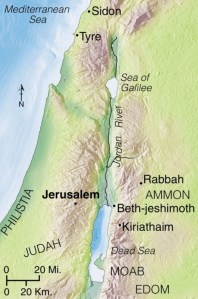
Ammon, Moab, Edom, and Philistia, although once united with Judah against Babylon, had abandoned Judah and rejoiced to see its ruin. But these nations were as sinful as Judah and would also feel the sting of God's judgment.

Ammon, Moab, Edom, and Philistia, although once united with Judah against Babylon, had abandoned Judah and rejoiced to see its ruin. But these nations were as sinful as Judah and would also feel the sting of God’s judgment.

We will start off chapter one by stating that there is much we do not know.  We do not know who the author was or when it was written.  The absence of reference to a Levitical priesthood (as demonstrated in verse 5) along with Job’s longevity (see Job 42:16), however, suggest roughly a time in Genesis after the flood.  We also do not know where, geographically, Job’s home in Uz was either, other than it was in the east (verse 3) and near a desert (verse 19).  It could be related to the northern home of Uz, the grandson of Shem (Genesis 10:22-23), Noah’s son, of whom the historian Josephus wrote in “Antiquities of the Jews” (book 1, chapter 6, paragraph 4), crediting him with the founding of Trachonitis and Damascus.  It could also be the land of Abraham’s nephew Uz (Genesis 22:20-21).  It could even be the land of the Uz the descendant of Seir, who had been related to Esau by marriage (Genesis 36:28).  It could also be the same land spoken of in Jeremiah 25:17-29 and Lamentations 4:21, which would be near or even include Edom to the south and east of the Dead Sea.

There is a lot of speculation also about verses 6-12.  Some say that the “sons of God” in verse 6 were angels.  Others make the perfectly good point that the term “sons of God” is used elsewhere in the scriptures to speak of people who serve the Lord (e.g. Romans 8:14 “For all who are led by the Spirit of God are sons of God”).  Along those lines, it is noteworthy that six times in these six verses, the Tetragrammaton (the Hebrew letters usually transliterated as YHWH or JHVH, which many refer to as Jehovah, rather than Yahweh) are used for God.  This use of the proper covenental name of God would seem to suggest a gathering of worshipers in which Satan asserted himself.

What we do know is that Job was a wealthy man who lived an upright life in the fear of the Lord (verses 1-3),

Messengers tell Job of his losses.

Messengers tell Job of his losses.

even to the point of offering sacrifices to God for his ten children (verse 5).  He seemed to have everything one could desire in life.  Then came the news from messengers, one after another, each telling of the great calamities that had fallen upon Job.  The Sabeans came from the south and killed his oxen and donkeys, and then murdered his servants that were with them (verses 14-15).  Then what we could assume as lightning had struck and killed his sheep and the servants that tended them (verse 16).  Before the second messenger had finished, another came and told Job that the Chaldeans, coming from the north, had taken his camels and killed the servants that were with them as well (verse 17).  The worst blow came again before the third messenger finished delivering his news.  All of his children, having been at the feast at his oldest son’s house had been killed by what must have been a great tornado that destroyed the house (verse 19).

Of Job’s immense grief at all of this loss, we get only a sense, as he tore his robe and shaved his head (signs of mourning) in verse 20.  He then fell upon the ground and worshiped God, rather than cursing him as Satan had hoped.  Verses 21-22 begin the real lesson of this book:

“And he said, ‘Naked I came from my mother’s womb, and naked shall I return. The Lord gave, and the Lord has taken away; blessed be the name of the Lord.’  In all this Job did not sin or charge God with wrong.”

Many have suffered great loss in this world (though few as great as this in such a short time), but who has not known someone who blamed God for their troubles, even those that were really self-inflicted?  How often have we been inclined to do the same?  Any loss, however great, is not the end of eternity.  Not for us, nor for any of the loved ones we may have lost.  Every blessing we have received in this life has come from God (James 1:17), unearned by us, and all of those blessings will be only a memory by the end of this life.  But as James, the Lord’s brother, also wrote in 1:12:

“Blessed is the man who remains steadfast under trial, for when he has stood the test he will receive the crown of life, which God has promised to those who love him.”

But Job’s story is only beginning.  We will take up chapter 2 next Thursday.

Read or listen to audio of ESV version of this selection from this link.

/Bob’s boy

Please “like” us on Facebook at  https://www.facebook.com/bobsboy01

___________________
some images © V. Gilbert & Arlisle F. Beers

Please note: I did not design the reading plan that I am following in my blog.  All of my comments in this blog, however, are solely my responsibility.  When reading ANY commentary, you should ALWAYS refer first to the scripture, which is God’s unchanging and unfailing word. Reading schedules, as well as a link to the site where you can get the reading plan that I’m currently following for yourself can be found on the “Bible Reading Schedules” page of my website at http://graceofourlord.com.  For questions and help, please see the “FAQ” and “Summaries” pages there.

Proverbs 10 – Integrity and Love

Today, we begin our weekly Tuesday reading of the chapters in Proverbs which look more like what we would expect from the book.  Chapter 10 has 32 verses; but for today, this blog will look closer at just three that deal with integrity and love. For tips on getting the most out of Proverbs, see this previous post.

“Whoever walks in integrity walks securely,but he who makes his ways crooked will be found out.” (Proverbs 10:9)

heart001If we consistently try to do the right thing in all situations, refusing to compromise on truth, honor, and good will toward others, it fosters a peace within us.  When we know that our intentions are pure, our conscience gives us serenity.  We know that we will bring no justifiable harm upon ourselves because of our own actions, nor will we be as likely to bring others to harm.  But, as 1 Timothy 5:25-26 agrees, those who scheme and connive, who try to hide their corrupt actions and their deceitful heart cannot keep such a secret forever.  How many times in the last few years have we known of someone, famous or not so famous, whose scandalous behavior over a period of years finally came out?  The shame they brought upon themselves was bad enough, but what about the people close to them that were hurt?  Integrity matters – to God, and to us.

“Hatred stirs up strife, but love covers all offenses.” (Proverbs 10:12)

“The one who conceals hatred has lying lips, and whoever utters slander is a fool.” (Proverbs 10:18)

It is easy to move many people to discord, gossip, and to be hurtful to one another by our own hateful thoughts, words, or actions. Sometimes people do so without realizing they are doing wrong.  It is a matter of the heart; and the cure is love. James 5:20 and 1 Peter 4:8 repeat that “love covers a multitude of sins.”  When we seek to think of, and to do good to, others in a manner that shows we truly care about them, that love affects us  as well.  The reason that “love covers all offenses” is that it changes us – our hearts, our minds, and our lives.  It makes us better and happier men and women.  It was this wisdom that Jesus was trying to convey when he said that loving your neighbor was the second greatest commandment in Matthew 22:37-39.

The first part of verse 18 makes it clear that it is not enough to just hide ones hatred for someone and keep ones mouth shut about it.  Your words then betray you and make you worse than a mere hater, because you become a liar as well.  The change must come from within the heart.  The second part of the verse (“whoever utters slander is a fool”) ties the two verses together.  The answer is not to just “let it all out” and speak ill of those for whom you hold ill will, for by doing so, you harm them as well as yourself.

Wisdom demands that we examine our own thoughts and actions, and let the Lord speak to us through His word, helping us to shape our lives and our hearts.  What can we do this week to show someone we care about them?

Read or listen to audio of ESV version of this selection from this link.

/Bob’s boy

Please “like” us on Facebook at  https://www.facebook.com/bobsboy01

___________________
some images © V. Gilbert & Arlisle F. Beers

Please note: I did not design the reading plan that I am following in my blog.  All of my comments in this blog, however, are solely my responsibility.  When reading ANY commentary, you should ALWAYS refer first to the scripture, which is God’s unchanging and unfailing word. Reading schedules, as well as a link to the site where you can get the reading plan that I’m currently following for yourself can be found on the “Bible Reading Schedules” page of my website at http://graceofourlord.com.  For questions and help, please see the “FAQ” and “Summaries” pages there.

Psalm 119:1-8; Psalm 1 – The Way of the Righteous

English: Aleph is the first letter of hebrew A...

English: Aleph is the first letter of hebrew Alphabet Deutsch: Aleph ist der Erste Buchstabe des Hebräischen Alphabets (Photo credit: Wikipedia)

Today we begin our reading of Psalm 119 with the first 8 verses.  It is the longest chapter in the Bible (176 verses), and it is one of a few acrostics in the Bible, employing all 22 letters of the Hebrew alphabet in its structure.  We will have more to say about this incredible structure in this weekends preview of the coming week.  But for now we’ll focus on the Scripture itself.  These eight verses are brought to you by the letter “Aleph.”

As with the other 21 stanzas, these eight verses employ different synonyms for the word “law” (testimonies, precepts, statutes, commandments, rules).  These verses declare not only that God wants us to be diligent in keeping His commandments (verse 4), but also that by doing so our lives are blessed, and we can worship Him with our hearts in the right place.  It doesn’t mean that we can ever be truly blameless,  but our intentions to live according to His word will give us an “upright heart” (verses 5-7).

Psalm 1 begins in the first verse speaking instead on the path that the righteous do not take.  Two kinds of people are spoken of throughout the Bible – the servants of God and the enemies of the Lord.  It is the heart that chooses which of those paths one will not take that makes him part of the other group.  There is no middle ground.  Those who choose not to take the advice and example of the wicked are happy living under God’s law (verse 2).  Their lives endure the test of time by choosing righteousness (verse 3), but evil will not triumph in the long course of time (verses 4-6).

Read or listen to audio of ESV version of this selection from this link.

/Bob’s boy

Please “like” us on Facebook at  https://www.facebook.com/bobsboy01

___________________
some images © V. Gilbert & Arlisle F. Beers

Please note: I did not design the reading plan that I am following in my blog.  All of my comments in this blog, however, are solely my responsibility.  When reading ANY commentary, you should ALWAYS refer first to the scripture, which is God’s unchanging and unfailing word. Reading schedules, as well as a link to the site where you can get the reading plan that I’m currently following for yourself can be found on the “Bible Reading Schedules” page of my website at http://graceofourlord.com.  For questions and help, please see the “FAQ” and “Summaries” pages there.

Five Tips for Reading the Book of Proverbs

Having completed the first nine chapters of Proverbs, we now settle in to our regular reading schedule for this year (you can find details on this year’s schedule in this previous post).  Monday is Psalm 119 day.  On Tuesdays, we will read a chapter of Proverbs, Job on Thursdays, and different Psalms on Wednesdays and Fridays.  Today’s blog is focused on the subject of “Tuesdays.”

Proverbs 3:13

Proverbs 3:13 (Photo credit: heymarchetti)

So now that on every Tuesday we will be reading Proverbs, some good questions arise.  How can we get the most out of reading these other chapters?  Proverbs is, after all, a very different book from any other in the entire Bible.  There is no intuitive continuity of thought in each of the remaining chapters – seemingly just one “proverb” after another.  And really, just what is a proverb  anyway?  Is it just a wise saying, like “Early to bed and early to rise…?”  Like all Scripture, this book is inspired – it contains the wisdom of God!  One writer said that “God in His wisdom provided the book of Proverbs as a help in navigating life,” and that is an excellent description of them.  But one that we like even better was written by David Kidner is his commentary:

It is a book which seldom takes you to church. Like its own figure of Wisdom, it
calls across to you in the street about some everyday matter, or points things out
at home. Its function in Scripture is to put godliness into working clothes; to
name business and society as spheres in which we are to acquit ourselves with
credit to our Lord, and in which we are to look for his training.”

Proverbs 1:7

Proverbs 1:7 (Photo credit: heymarchetti)

That is so true.  But even one chapter of this great book can seem very overwhelming if you try to take all of it in at once. There is wisdom to be had in this book that could fill volumes; and we may find proverbs in these chapters that apply to the circumstances and/or difficulties in our lives at any time.  But not every proverb in every chapter is going to seem applicable to our lives at all times.  And certainly any attempt to “blog” on an entire chapter of Proverbs in just a few short paragraphs would be woefully inadequate.

So we will be taking a different approach, focusing on selected verses in a chapter each Tuesday; and we suggest that you take a different approach to Proverbs as well.  And since there are only 22 chapters left, we will start again (with chapter 10 and following) later in the year, in order to focus on a few other verses.

Here are some tips for the Book of Proverbs as we go through the year:

  • As you read a chapter in Proverbs each week, underline, highlight, or copy and paste one or two verses that stand out as particularly relevant to your life at the time.
  • After reading the chapter, go back over those verses you singled out, and find one or two that seem really meaningful to you.  Work on memorizing one or both of those two verses during the week.
  • Consider speaking about that verse with someone you care for, a friend, or even posting a comment on one of these pages.  Your thoughts on the subject may be helpful to someone else!
  • Don’t forget to mark some of those that you simply do not understand in some different manner ( a separate list, different color highlight, etc.), so that you can look at some other time.  You will be surprised what a difference a fresh look and a different perspective can make.

Finally, and most importantly, begin applying the proverbs that you have singled out in your daily life.  As we “put godliness into working clothes” in 2013, we will surely have grown in wisdom by the end of this year!

/Bob’s boy

Please “like” us on Facebook at  https://www.facebook.com/bobsboy01

Summing Up

Each weekend, I am now posting a small PDF of one week of chapter summaries (on the website’s “Summaries” page), current to the beginning of the previous week.  I have posted the summary for Week 1 (January 2013 Week 1) of the schedule I am following this year.  This short PDF documents contains condensed comments about Proverbs 1, 2, 3, 9, and 10 with hyperlinks to the ESV version of each chapter for listening or reading.

___________________
image © V. Gilbert & Arlisle F. Beers

Please note: I did not design the reading plan that I am following in my blog.  All of my comments in this blog, however, are solely my responsibility.  When reading ANY commentary, you should ALWAYS refer first to the scripture, which is God’s unchanging and unfailing word. Reading schedules, as well as a link to the site where you can get the reading plan that I’m currently following for yourself can be found on the “Bible Reading Schedules” page of my website at http://graceofourlord.com.  For questions and help, please see the “FAQ” and “Summaries” pages there.

Proverbs 8 – The Blessings of Wisdom

An Oxford degree ceremony — the Pro-Vice-Chanc...

An Oxford degree ceremony — the Pro-Vice-Chancellor in MA gown and hood, Proctor in official dress and new Doctors of Philosophy in scarlet full dress. Behind them, a bedel, another Doctor and Bachelors of Arts and Medicine. (Photo credit: Wikipedia)

Solomon begins by personifying Lady Wisdom further, summoning the reader to hear her call.  This is the ultimate of these chapters illuminating the two paths of wisdom and folly, or foolishness. The fact that the “fear of the Lord” is the beginning of all knowledge is again made infinitely plain in this chapter.  “She” begins by further developing the inclusion of righteousness as an integral part of wisdom (verses 6-9), the reasons for seeking it so earnestly (verses 10-11), and the benefits it provides mankind (verses 15-19).

She calls upon all the “children of man” (verse 4) – the simple, the fool, the learned – all who seek wisdom diligently will find it (verse 17).  But again, we are reminded of the difference between mere knowledge and true wisdom – the insight that comes to those who seek it without wickedness, who have prudence, who are just and seek justice, and those who abhor evil and are not full of pride, arrogance, and who avoid perverse speech.  True wisdom does not dwell in those who do not walk in the path that the Lord has made for us, no matter how “intelligent” that person may be.  Verses 8-9 make clear that only those who truly understand these facts will attain that wisdom, and that is so because those facts are clear for them to understand.  The unrighteous cannot have that understanding, and so they are denied true wisdom.

Verses 22 and following detail how wisdom “was” before God created the earth and all things universal, and how he delighted in his creation.  He created all things physical, all things invisible, and even the abstract.  There would not even be any concept of things such as beauty, love, truth, right, wrong, or even the concept of such things as a name or a number, but for the power of the Lord.  And Jesus, the Son, was there and is Himself that wisdom (1 Corinthians 1:22-24, 1 Cor 1:30, 1 Corinthians 8:6, Colossians 1:15-18).

Read or listen to audio of ESV version of this selection from this link.

/Bob’s boy
___________________
some images © V. Gilbert & Arlisle F. Beers

Please note: I did not design the reading plan that I am following in my blog.  All of my comments in this blog, however, are solely my responsibility.  When reading ANY commentary, you should ALWAYS refer first to the scripture, which is God’s unchanging and unfailing word. Reading schedules, as well as a link to the site where you can get the reading plan that I’m currently following for yourself can be found on the “Bible Reading Schedules” page of my website at http://graceofourlord.com.  For questions and help, please see the “FAQ” and “Summaries” pages there.

Proverbs 7 – Warning Against the Adulteress

When David sinned against Bath-sheba and her husband Uriah, God sent the Prophet Nathan to tell David of his sin and punishment (2 Samuel 12; 1 Chronicles 20:1-3).

When David sinned against Bath-sheba and her husband Uriah, God sent the Prophet Nathan to tell David of his sin and punishment (2 Samuel 12).

The chapter again opens with the plea to listen to wise instruction; and there are continued references to “Lady Wisdom” and “Lady Folly.”  Verse  4 advises the reader to keep wisdom as a sister, and insight as a friend.  His intimacy with discernment and understanding will keep the young person (and the older person) from adulterous behavior if their heart is in the right place.  The folly of succumbing to seduction here is applicable to male and female, young and old, the lonely,or the simply innocent or gullible.  The smooth talk, and the seductive looks and dress are equally tempting to all categories of people.  Notice the disconnect between the woman’s declaration of having performed her service to God, and the way she is living her life.  This is the same sort of contradiction spoken of in Isaiah 1:10-20, and  shows how people may represent themselves (and even believe) as though they are trying to be honest and upright, when in fact their behavior says otherwise.

The message in the end is that someone promoting the desire for lust may say or do anything to trap their prey – to pull the victim into their desires with their words.  The woman in these verses does not really care about this young man, nor did she seek him out in particular, as she suggests.  Any other young man may have been the target of her desires.  How often have young women (and men) been fooled by the flattering expectations that she engenders in this young man?  But the scripture reminds us of the path to destruction, down which the victim of these advances is being led.  Adultery takes from them that which was never intended for the adulterer, but for their spouse, when the time comes.

Read or listen to audio of ESV version of this selection from this link.

/Bob’s boy
___________________
some images © V. Gilbert & Arlisle F. Beers

Please note: I did not design the reading plan that I am following in my blog.  All of my comments in this blog, however, are solely my responsibility.  When reading ANY commentary, you should ALWAYS refer first to the scripture, which is God’s unchanging and unfailing word. Reading schedules, as well as a link to the site where you can get the reading plan that I’m currently following for yourself can be found on the “Bible Reading Schedules” page of my website at http://graceofourlord.com.  For questions and help, please see the “FAQ” and “Summaries” pages there.

Proverbs 6 – Practical Warnings

English: The signature of John Hancock on an e...

English: The signature of John Hancock on an envelope. Restored by Jim S. (Photo credit: Wikipedia)

The first five verses of this chapter deal with the issue of putting up security for someone else.  This would be today’s equivalent of co-signing a note for someone.  Certainly, many of us have done this sort of thing for one of our children; and the verses are not saying that putting up security like that even for someone other than our children is sinful – or even morally wrong.  But it is certainly unwise, and so much so, that the reader is urged to get out of it at once. In verse 2, being “snared in the words of your mouth” are the same as putting one’s signature on a promissory note.

Getting out of such an obligation these days is not so simple, but the point is – a wise person would not obligate himself in such a manner.  Doing so places one – and maybe also one’s own family – in peril of great loss, at the mercy of someone who ultimately may have nothing to lose (the actual debtor).  And if that becomes a reality, we have only helped them bring damnation upon themselves by not doing the right thing!  If we want to, and can afford to help someone out, give them a generous gift instead.  Such is wiser, and certainly approved of by the Lord.

Verses 6-11 warn us that laziness and being unprepared can result in great poverty, while verses 12-15 admonish that evil behavior such as knowingly cheating others will “catch up” with such a person, and often in a horrific way (certainly to be the case after life’s end).  Verses 16-19 list seven things that God finds truly despicable.  Read through these, and notice that every one of them is a deed that is bound to bring harm to others.  God cares deeply about how we treat each other.  That fact resonates in book after book, and chapter after chapter of His word; and Jesus makes that clear in Matthew 7:12 and Mark 12:30-31. Verses 20-35 are more warnings against sexual immorality in general, and adultery in particular.


Read or listen to audio of ESV version of this selection from this link.

/Bob’s boy
___________________
some images © V. Gilbert & Arlisle F. Beers

Please note: I did not design the reading plan that I am following in my blog.  All of my comments in this blog, however, are solely my responsibility.  When reading ANY commentary, you should ALWAYS refer first to the scripture, which is God’s unchanging and unfailing word. Reading schedules, as well as a link to the site where you can get the reading plan that I’m currently following for yourself can be found on the “Bible Reading Schedules” page of my website at http://graceofourlord.com.  For questions and help, please see the “FAQ” and “Summaries” pages there.

Proverbs 5 – Warning Against Adultery

After the opening verses, again admonishing the reader to both hear and to understand, the chapter immediately begins its warning against sexual promiscuity.  Most people rightly see the particular application to young people.  But the message to parents is somewhat more subtle if one does not focus on it.  Take verse 23 in particular: “He dies for lack of discipline.”   Nothing should be more sobering to parents than this warning about how much is at stake.

Bible-time weddings were festive occasions, sometimes lasting a week or more, with great celebration and joy.

Bible-time weddings were festive occasions, sometimes lasting a week or more, with great celebration and joy.

Our young people today more than ever grow up in a world that is rich in media that glorifies sexual immorality, with role models and adults in positions of authority that do little to contradict (and most often, reinforce) this outlook.  It is the job of the parent to educate the souls of the little ones entrusted to them concerning the intention God has for right use of the sexual relationship – between a husband and wife.   Verses 15-20 (“Drink water from your own cistern…” and “…let them be for yourself alone…””) remind of Jesus in Matthew 19:4-5, quoting Genesis 2:24: “the two shall become one flesh.”

Read or listen to audio of ESV version of this selection from this link.

/Bob’s boy
___________________
some images © V. Gilbert & Arlisle F. Beers

Please note: I did not design the reading plan that I am following in my blog.  All of my comments in this blog, however, are solely my responsibility.  When reading ANY commentary, you should ALWAYS refer first to the scripture, which is God’s unchanging and unfailing word. Reading schedules, as well as a link to the site where you can get the reading plan that I’m currently following for yourself can be found on the “Bible Reading Schedules” page of my website at http://graceofourlord.com.  For questions and help, please see the “FAQ” and “Summaries” pages there.