Acts 23 – A Plot to Kill Paul

Paul appeared before the Jewish council

Paul had just begun to speak to the Sanhedrin council, when the high priest unlawfully ordered him to be struck (it was unlawful to strike a man who had not yet been condemned).  Paul correctly predicts Ananias’ demise in verse 3, as he will be killed by his own people at the start of the Jewish war.  There are a lot of theories (total speculation, of course) about verses 4-5 and Paul’s disrespect for Ananias, but whatever the case, we should take Paul at his word that he did not know who he was addressing.  It is noteworthy, however, how quick they were to point out that fact, yet ignore the willful violation made against Paul.  At that point, he would have no question (if there was doubt before) about whether he would receive a fair hearing from them.

Paul then uses the fact that the Sanhedrin council was made up of both Pharisees and Sadducees to his advantage.  The Sadducees did not believe in resurrection, but the Pharisees did – and the division between them because of it was great.  Paul’s statement in verse 6 makes that division so sharp that it became violent.  The Roman tribune then feared that Paul would be torn to pieces, and had the soldiers remove him and take him to the barracks.  Paul’s statement that set it in motion was “brothers, I am a Pharisee, a son of Pharisees. It is with respect to the hope and the resurrection of the dead that I am on trial;” and every word of it was true.  Paul had been raised a Pharisee (Philippians 3:5-9), and it was indeed because of the resurrection of Jesus Christ, and the hope, that he was on trial.  The following night, the Lord stood by him for encouragement and told him that he must go to Rome to testify the facts about Him (verse 11).
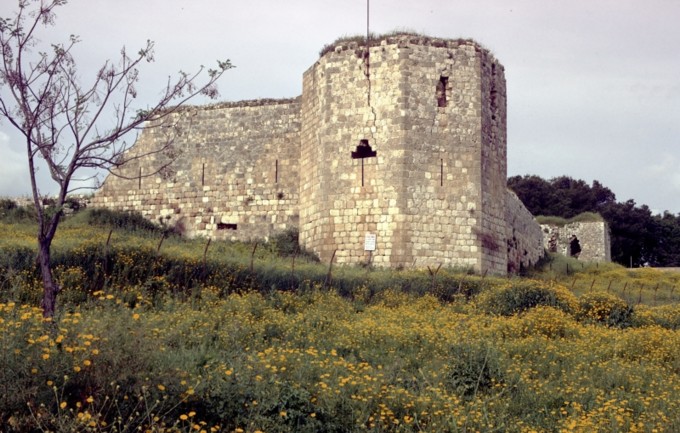
Antipatris was the Old Testament Philistine city of Aphek (1 Samuel 4: 1; 29: 1). The New Testament city was built by Herod the Great in 9 BC. Antipatris was named for Antipater, Herod the Great’s father. Ras el-‘Ain is the site of the ruins of the ancient city. The spring at Antipatris is the source of the River Auja. Paul was taken here (Acts 23: 31) on the way to his imprisonment in Caesarea.

The Jews then sensed that Paul’s fate was slipping away, so more than forty of them conspired to kill him, taking an oath not to eat or drink until they had done so.  Such an oath was a serious matter – not made flippantly (and reminds us of Jezebel in 1 Kings 19:2).  Verse 14  leaves no doubt of the extent of corruption there, as we learn that the chief priests and elders were involved in this despicable plot.  But Paul’s sister learned of the plot and sent her son to warn him.  Paul then sends his nephew to tell the tribune (whose name we learn in verse 26 is  Claudius Lysias).  Lysias then composed a letter to Felix the governor (verse 26-30), putting himself, of course, in a favorable light.  At his orders, Paul gets an escort of two hundred soldiers to deliver him and the letter to Antipatris by the dark of night.  Upon reading the letter and questioning Paul as to his birthplace, he ordered Paul held in Herod’s praetorium (one of Herod’s palaces that the governor used for his quarters), as he awaits his accusers for a hearing.

Read or listen to audio of ESV version of this selection from this link.

/Bob’s boy
___________________
some images © V. Gilbert & Arlisle F. Beers

Please note: I did not design the reading plan that I am following in my blog.  All of my comments in this blog, however, are solely my responsibility.  When reading ANY commentary, you should ALWAYS refer first to the scripture, which is God’s unchanging and unfailing word. Reading schedules, as well as a link to the site where you can get the reading plan that I’m currently following for yourself can be found on the “Bible Reading Schedules” page of my website at http://graceofourlord.com.  For questions and help, please see the “FAQ” and “Summaries” pages there.

Acts 22 – Paul and the Roman Tribune

Paul bound with chains

Paul, having been arrested and beaten, had at the close of chapter 22 convinced the Roman tribune to allow him to speak to the mob.  When he spoke in Hebrew, it settled them down and they listened.  He then gave them a history of himself as a Jew, “educated at the feet of Gamaliel” (a Pharisee and renowned teacher, who was also a member of the Sanhedrin council – see Acts 5:34).  He also recounted his own persecution of Christians and the “Way ” (see previous post here for more information on “the Way”); and then told of his encounter with the Lord in Acts 9:3-8, in which he was blinded.   The re-telling of that event here in verses 6-11 is not contradictory at all, despite what some say.  Those who were with Paul on that road could hear what was said, but were not made to understand.

Paul then turns to Ananias restoring his sight and his subsequent baptism in verses 12-16.  But when he told them of his encounter with the Lord, and how He had told Paul that He was sending him to the Gentiles (verses 17-21), the crowd became wild with anger again.  The tribune ordered him to be flogged in order to find out why they were shouting out against him.  But as he was stretched out, Paul told the tribune that he was a Roman citizen by birth (verses 25-28); and the Roman tribune became fearful (Roman law forbade flogging a Roman citizen without a hearing or a formal condemnation).  So in verse 30, the chapter ends with the tribune having Paul brought before the Sanhedrin, since scourging was not an option.

Read or listen to audio of ESV version of this selection from this link.

/Bob’s boy
___________________
some images © V. Gilbert & Arlisle F. Beers

Please note: I did not design the reading plan that I am following in my blog.  All of my comments in this blog, however, are solely my responsibility.  When reading ANY commentary, you should ALWAYS refer first to the scripture, which is God’s unchanging and unfailing word. Reading schedules, as well as a link to the site where you can get the reading plan that I’m currently following for yourself can be found on the “Bible Reading Schedules” page of my website at http://graceofourlord.com.  For questions and help, please see the “FAQ” and “Summaries” pages there.
Acts 21 – Paul Goes to Jerusalem

We left the book of Acts after chapter 20, as Paul was in Miletus, with his tearful goodbye to the Ephesian elders.  While in that area, Paul wrote the letters to the Corinthians and to the Romans.  Now, as he said in his letter to the latter, he is leaving for Jerusalem.  They sailed past Cos, Rhodes, Patera, Cyprus and landed at Tyre, where they remained for seven days, then on to Ptolemais and finally Caesarea  before setting off on foot to Jerusalem.  While in Caesarea, they stayed at the house of Philip, who Luke says was “one of the seven.”  Most likely he means that he was one of the seven chosen to serve in Acts 6:1-6, and was the same Philip who converted the Ethiopian eunuch.   And after that event, he did end up in Caesarea (Acts 8:40).

Agabus (the prophet who predicted the famine in Acts 11:2-28) came from Judea to tell how the Jews at Jerusalem will bind and deliver Paul into the hands of the Gentiles (verses 10-14).  Luke and the others present tried to persuade Paul not to go, but he told them that he was not only ready for prison, but even to die for the Lord Jesus.  Notice though, that the words from the prophet were not quoted in these verses as a warning to prevent him from going – but as a statement of fact (verse 11); and Luke and the others finally said “Let the will of the Lord be done.”

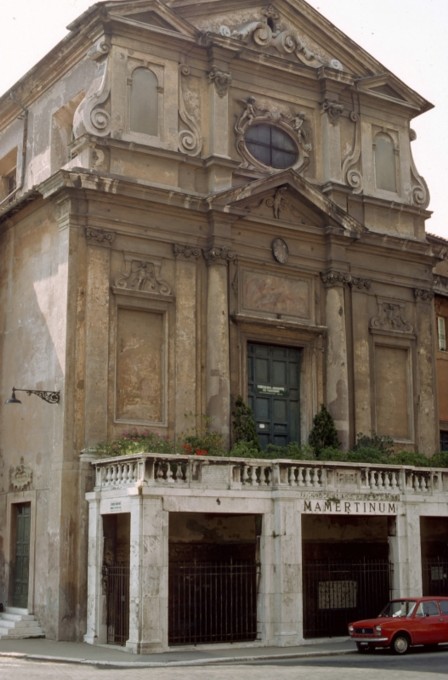
Mamertine Prison, Rome, Italy. Carcere Mamertino according to tradition was the jail where St Peter and St Paul was imprisoned. It consists of two levels and was the most horrible part of the ancient state prison located in the caves under the Capitoline Hill. Numerous illustrious enemies of Rome died here. The higher part of the prison was built in the 2nd century BC and was named Mamertino.

After arriving in Jerusalem, Paul went to see James and told him and the elders about his travels and the many Gentile conversions, for which they glorified God.  They then asked Paul to demonstrate that he was not preaching that Jews had to become like Gentiles and give up all of their customs in order to be a Christian, as many were falsely reporting.  So Paul participated with four men under a vow in a purification ritual.  This event is the subject of much confusion and controversy.  But it does not have to be.  Paul never preached that Jews had to give up their entire way of life or never participate in any ritual or feast (remember Romans 14 and 15), nor that they should not circumcise their young.  Remember that he circumcised Timothy to avoid offending the Jews they were going to visit in Acts 16:3.

But still Paul was arrested, having been dragged from the temple first and beaten by a mob that had gone wild with accusations and fervor.   Until Paul spoke Greek to him, the tribune that arrested him was under the impression that he was an Egyptian revolutionary (verse 38).  The event he mentions in that verse was written about by the historian, Josephus.  At Paul’s urging, the tribune allows him to speak to the mob; and he does so in Hebrew, as the chapter closes.

Read or listen to audio of ESV version of this selection from this link.

/Bob’s boy
___________________
some images © V. Gilbert & Arlisle F. Beers

Please note: I did not design the reading plan that I am following in my blog.  All of my comments in this blog, however, are solely my responsibility.  When reading ANY commentary, you should ALWAYS refer first to the scripture, which is God’s unchanging and unfailing word. Reading schedules, as well as a link to the site where you can get the reading plan that I’m currently following for yourself can be found on the “Bible Reading Schedules” page of my website at http://graceofourlord.com.  For questions and help, please see the “FAQ” and “Summaries” pages there.
Romans 15 – Christ the Hope of Jews and Gentiles

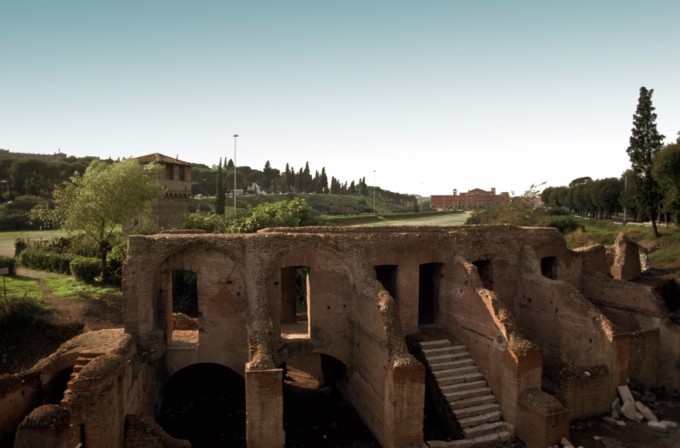
Circus Maximus: Rome’s entertainment center.
The Circus Maximus is an ancient arena and mass entertainment center located in Rome, Italy. It was first built about 600 BC. Situated in the valley between the Palatine and Aventine Hills, it met the demands of the Roman people for mass public entertainment on a lavish scale, primarily chariot races, but also wild beast fights and naval battles. Julius Caesar expanded the Circus around 50 BC, after which the track measured approximately 1800 feet in length, and 750 feet in breadth and could accommodate an estimated 150,000 to 350,000 seated spectators.

In the previous chapter, Paul had been addressing the division and dispute among the Jew and Gentile members of the church at Rome concerning 1) the problem related most probably to the Gentiles eating meat that had been sacrificed to idols, which would have been offensive to the Jews (an issue he had to speak to elsewhere as well) and 2) the “esteeming” of one day over another (probably the Gentiles’ objection to the Jews who still observed the feast days from the old Law).  Having already spoken to this, he admonishes them further, as he did the brethren at Corinth in 1 Corinthians 10, that they must think about their brethren and their souls as well as their consciences and help each other bear their own weaknesses.

As for the Old Testament Law, he says in verse 4 that “…whatever was written in former days was written for our instruction, that through endurance and through the encouragement of the Scriptures we might have hope.”  This was to say that we have much that is profitable to learn from the old Law.  But while all should be  sensitive to the consciences of others, this does not give those others license for imposing those matters on their brethren, but rather they should all live in harmony, and “welcome one another as Christ has welcomed you.”   He finishes this section of the chapter in verses 8-13 by reminding them that “Christ became a servant”  for the sake of Jews and Gentiles alike, according to God’s plan.

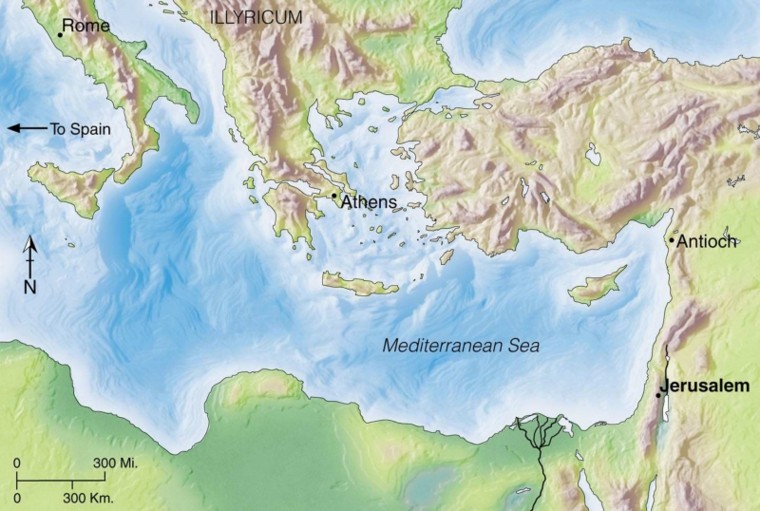
When Paul wrote his letter to the church in Rome, he had not yet been there, but he had taken the gospel from Jerusalem clear over into Illyricum. He planned to visit and preach in Rome one day and hoped to continue to take the gospel farther west, even to Spain.

Paul then speaks of his ministry to the Gentiles for the gospel of Jesus, and it becomes clear how passionate he was about that important mission.  He speaks of the collection for the poor of the church in Jerusalem – which he is preparing to deliver now; and he is proud of the Gentiles stepping up as they have done to help their Jewish brethren.  It is important to Paul, and it is important to the Gentiles themselves, as well as to their unity with Jewish brethren everywhere, as many will see it as symbolic of the entrance of the Gentiles into the kingdom (verse 17-18).   Of that mission, Paul says in verse 19 that he had traveled preaching the gospel from Jerusalem to the Roman province of Illyricum (later called Dalmatia).   He said he had done all of that as it was written in Isaiah 52:15, which he quotes in verse 21: “Those who have never been told of him will see, and those who have never heard will understand.”

Paul finishes this chapter in verses 22-33 by telling the brethren in Rome that he plans to finally come to visit them on his way to Spain after he goes to Jerusalem.

Read or listen to audio of ESV version of this selection from this link.

/Bob’s boy
___________________
some images © V. Gilbert & Arlisle F. Beers

Please note: I did not design the reading plan that I am following in my blog.  All of my comments in this blog, however, are solely my responsibility.  When reading ANY commentary, you should ALWAYS refer first to the scripture, which is God’s unchanging and unfailing word. Reading schedules, as well as a link to the site where you can get the reading plan that I’m currently following for yourself can be found on the “Bible Reading Schedules” page of my website at http://graceofourlord.com.  For questions and help, please see the “FAQ” and “Summaries” pages there.
Resuming Romans (and Acts) \ Week 45 summary posted

We will begin this week with the 15th chapter of Paul’s Epistle to the Romans, and then return to the book of Acts, where we pick up Paul’s story as he starts out to Jerusalem.

English: page with text of Epistle to the Roma...

English: page with text of Epistle to the Romans 1:1-7 (Photo credit: Wikipedia)

In a previous blog, we noted that Paul began some of his letters (within the greeting) by declaring his apostleship whenever he was writing to a church that was either unfamiliar with him (he had not even been to the Roman church, for example) or when the church to whom he was writing had a dispute about his being an apostle.  But why did they all begin with his name?

Coffman wrote what seems like the best explanation: “All letters and other written communications, in New Testament times, were written upon parchments and conveyed to their recipients in rolled-up form; and that ancient style of letter required, as a practical consideration, that the signature of the writer be at the beginning. Otherwise, it would have been necessary to unroll the entire scroll to find the name of the sender. Therefore, Paul followed the custom of the times in placing his name along with the salutation in the beginning of the epistle.

Summing Up

Each weekend, I am now posting a small PDF of one week of chapter summaries (on the website’s “Summaries” page), current to the beginning of the previous week.  I have posted the summary for Week 45 (November Week 1) of the schedule I am following.  This short PDF document contains condensed comments about 1 Corinthians 11, 13, 15, 2 Cor 3, and 2 Cor 6, with hyperlinks to the ESV version of each chapter for listening or reading, and joins the summaries for other weeks already posted there.

/Bob’s boy
___________________
image © V. Gilbert & Arlisle F. Beers

Please note: I did not design the reading plan that I am following in my blog.  All of my comments in this blog, however, are solely my responsibility.  When reading ANY commentary, you should ALWAYS refer first to the scripture, which is God’s unchanging and unfailing word. Reading schedules, as well as a link to the site where you can get the reading plan that I’m currently following for yourself can be found on the “Bible Reading Schedules” page of my website at http://graceofourlord.com.  For questions and help, please see the “FAQ” and “Summaries” pages there.

Romans 3 – God’s Righteousness Upheld

Appian Way – most famous of the Roman roads, built (312 B.C.) under Appius Claudius Caecus. It connected Rome with Capua and was later extended to Beneventum (now Benevento), Tarentum (Taranto), and Brundisium (Brindisi). It was the chief highway to Greece and the East. Its total length was more than 350 mi (563 km). The substantial construction of cemented stone blocks has preserved it to the present.

After telling the brethren of the Roman church in chapter 2 that the Gentiles are now true Jews by way of the Spirit, Paul then addresses the question that would naturally come from the Jews.  Was there no advantage or value of being a Jew, or of being circumcised?  Paul says that indeed there was.  The Jews had been the keepers of the “oracles of God” (verse 2) – the Scriptures; and in that capacity at least, they had remained faithful.  God’s word, as He would make certain, had been preserved; and just as importantly, God had remained faithful to His promises to them, despite the unfaithfulness they had shown to Him.

In verses 10-18, Paul says that “it is written…” and follows that with quotations from several passages.  Verses 10-12 are from Psalm 14:1-3 and Ecclesiastes 7:20.  Verses 13-14 are from Psalm 5:9 and Psalm 10:7.  Verses 15-17 are from Isaiah 59:7-8, and verse 18 is from Psalm 36:1.   He is making it clear that the Jews among them are no better off than the Gentiles (verse 9) because all are “under sin.”  The phrase “…no one does good, not even one…” in verse 12 can be understood by the first part of the verse “All have turned aside.”  Nobody is without sin.  And verse 18 finishes with the reason for it all – “there is no fear of God before their eyes.”  That brings to the mind of this blogger the words of the wisest man (Solomon) in Ecclesiastes 12:13-14:

“The end of the matter; all has been heard. Fear God and keep his commandments, for this is the whole duty of man. For God will bring every deed into judgment, with every secret thing, whether good or evil.”

Paul illustrates again the old with the new, and provides a good summary of God’s plan for salvation – the Law and the Prophets bear witness to  “the righteousness of God through faith in Jesus Christ for all who believe” (verses 21-22) – “for all have sinned and fall short of the glory of God, and are justified by his grace as a gift, through the redemption that is in Christ Jesus” (verse 23).  The word “propitiation” in verse 25 means that the sacrifice Jesus made was an offering to appease God’s wrath and turn it to favor.  This was necessary for the forgiveness of sins, and it is what now gives favor to Jews and Gentiles alike, making no distinction between them.

Read or listen to audio of ESV version of this selection from this link.

/Bob’s boy
___________________
some images © V. Gilbert & Arlisle F. Beers

Please note: I did not design the reading plan that I am following in my blog.  All of my comments in this blog, however, are solely my responsibility.  When reading ANY commentary, you should ALWAYS refer first to the scripture, which is God’s unchanging and unfailing word. Reading schedules, as well as a link to the site where you can get the reading plan that I’m currently following for yourself can be found on the “Bible Reading Schedules” page of my website at http://graceofourlord.com.  For questions and help, please see the “FAQ” and “Summaries” pages there.

Romans 2 – God’s Judgment and the Law

Colosseum, Rome, Italy.
Many gladiators and wild beasts were killed here to entertain the Roman people. Tradition says that this was the site where many Christians were martyred, especially under the Emperor Nero.

In this chapter, Paul addresses the Jews of the church at Rome, as their self-righteousness threatens the unity of the church – just as it did in Galatia and elsewhere.  But here again, the applications to all people are clear.  He again states that the Gentiles are without excuse, for just as the evidence for God abounds, he also says “the law is written on their hearts.”  So even though they did not have prophets who wrote the law as the Jews knew it, the Gentiles knew enough “to do what the law requires” (verses 14-15).

But the Jews, who had the law and were circumcised, were warned that they who pass judgment on others are not without sin themselves.  So they should not boast and be judgmental because if they know the law and additionally are circumcised, but still live in sin they are just as guilty – for God shows no partiality.  They are not favored of God for their knowledge of the law or for their circumcision.  Though it is still admirable that they keep the law of circumcision, it is no longer required anyway, and it is of no value to them in their sin.

Paul is not speaking of baptism here, nor is he comparing it to circumcision.  But as Christians today we would do well to remember this passage when it comes to others.  Being “raised in the church,” knowing and even reading their Bible, and even having been baptized are all of no value if we live in sin anyway.  In that case, we will be just as lost as those who never obeyed the gospel.  As it was true then of being a Jew and being circumcised, it is living a life that is consistent with faith in (and commitment to) the Lord that has value.

Read or listen to audio of ESV version of this selection from this link.

/Bob’s boy
___________________
some images © V. Gilbert & Arlisle F. Beers

Please note: I did not design the reading plan that I am following in my blog.  All of my comments in this blog, however, are solely my responsibility.  When reading ANY commentary, you should ALWAYS refer first to the scripture, which is God’s unchanging and unfailing word. Reading schedules, as well as a link to the site where you can get the reading plan that I’m currently following for yourself can be found on the “Bible Reading Schedules” page of my website at http://graceofourlord.com.  For questions and help, please see the “FAQ” and “Summaries” pages there.

Romans 1 – God’s Wrath on Unrighteousness

Paul opens this letter affirming his apostleship, as was his custom with letters to churches that were not so familiar with him. He reinforces that in verses 4-6 by stating that, through Jesus, he and the other apostles “received grace and apostleship to bring about the obedience of faith for the sake of his name among all the nations, including you who are called to belong to Jesus Christ…”    The long introduction also affirms that Jesus is the Son of God, and that he was descended from David, fulfilling Old Testament prophecy (verse 4); and he declares the mission to the Gentiles (verse 13).  He also expresses, at some length, his eagerness to go to Rome for fellowship and sharing the gospel with them.

The Arch of Titus from outside the Forum, Rome, Italy. Located at the highest point of the Via Sacra which leads to the Roman Forum, this triumphal arch, with only one passageway, commemorates Titus’ conquest of Judea which ended the Jewish Wars (66-70). Engaged fluted columns frame the passageway.

Not much is known for certain about the church at Rome.  But by virtue of it being in Rome, its fame would have been considerable and, like the other churches, it was composed of both Jews and Gentiles.  The remainder of this chapter focuses on the need for righteousness on the part of the Gentiles, and Paul does not mince words in pointing out the history of unrighteousness on their part.  But as the letter continues, it will become apparent that McGarvey’s assessment is largely correct.  He writes:

“The Judaizing tendencies which had recently appeared in Corinth and Galatia were sure eventually to appear in other churches, perhaps ultimately in all, and the attitude assumed by a church already so influential and destined to increase in power was sure to carry great weight in deciding the controversy. Therefore, to set the church of Rome right as to the design and nature of the gospel was a work of supreme importance…”

Heading off such a crevasse in this church was of great concern, to be sure.  McGarvey further expounds most aptly:

“The purpose of the letter is to set forth, as Baur rightly expresses it, ‘both the relation of Judaism and heathenism to each other, and the relation of both to Christianity;’  primarily, for the instruction of the Christians in Rome, and, secondarily, for the benefit of all the churches by the establishment of peace between their Jewish and Gentile elements, and, ultimately, for the enlightening of the kingdom of God in all ages.”

Though verses 18-24 are here specifically directed at those Gentiles, they contain some of the most profound (and certainly definitive) statements applicable to all people everywhere concerning God’s existence, and thus they provide the very basis of sound apologetics.  The “wrath of God” in verse 18 represents his holiness, judgment, and yet loving response to the unrighteousness of mankind.  When Paul says that all mankind knows God, he is not speaking of the concept of a god or of deity in general.  Man knows the one true and living God because the evidence abounds in everything He created, yet he suppresses the truth in unrighteousness.  His attributes, including His eternal power and divine nature have been clearly perceived since the creation of the world, so that everyone is without excuse.

And God said, “Let the waters under the heavens be gathered together into one place, and let the dry land appear.” And it was so. Gen 1:9

Man has always tended to be full of himself because of the material knowledge he acquires, only made possible by God; and “claiming to be wise, they became fools…”  Man’s desire for sin and all that is an abomination to his Creator moves him to exchange the truth about God for a lie (verse 25) and worship the creature rather than the Creator even to this day.  People who deny Him do so by conscious choice in a futile attempt to justify their own unrighteousness.  The “shameful acts” Paul lists as driving this begins with unnatural relations of men and women with others of the same gender, and in verse 29 runs from gossips to murderers and “all manner of evil” in between – as God makes no distinction between what man considers “small” or large sins.

Any claim by someone who says they would believe if the evidence was there is hogwash.   Blindness to the more than substantial evidence is entirely willful.

Read or listen to audio of ESV version of this selection from this link.

/Bob’s boy
___________________
some images © V. Gilbert & Arlisle F. Beers

Please note: I did not design the reading plan that I am following in my blog.  All of my comments in this blog, however, are solely my responsibility.  When reading ANY commentary, you should ALWAYS refer first to the scripture, which is God’s unchanging and unfailing word. Reading schedules, as well as a link to the site where you can get the reading plan that I’m currently following for yourself can be found on the “Bible Reading Schedules” page of my website at http://graceofourlord.com.  For questions and help, please see the “FAQ” and “Summaries” pages there.

2 Corinthians 6 – The Temple of the Living God

Corinth turkish watering place

Paul quotes Isaiah 49:8 in verse 2, noting that now is the favorable time for their salvation.  Receiving God’s grace in vain refers to having been saved and now running the risk of slipping away.  He points out that they experience great persecution unjustly (verses 8-10), but they endure hardships and adversities by the gifts of the spirit within them.  Verses 14-18 are often taken to mean that Christians should not have any associations with unbelievers, but such is not the case since he tells us in 1 Corinthians 5:10 that we would have to “go out of the world” in order to do that; and we must be “in the world” in order to spread the gospel.  Jesus prayed about being “in the world” but not “of the world” in John 17:15-16.  But their association with idol worshipers is problematic; and it may drag many back into its clutches (verses 14-18)s.

The applications for us are 1) that our faith in Jesus as Lord is our anchor when we suffer adversity and 2) that if we have a sinful inclination that we have overcome, we should not put ourselves in a position to be taken back into that sin. Just as it would be a mistake for someone who had been an alcoholic to return to frequenting bars for company, those who had previously worshiped idols should not return to spending time at those temples.

Read or listen to audio of ESV version of this selection from this link.

/Bob’s boy
___________________
some images © V. Gilbert & Arlisle F. Beers

Please note: I did not design the reading plan that I am following in my blog.  All of my comments in this blog, however, are solely my responsibility.  When reading ANY commentary, you should ALWAYS refer first to the scripture, which is God’s unchanging and unfailing word. Reading schedules, as well as a link to the site where you can get the reading plan that I’m currently following for yourself can be found on the “Bible Reading Schedules” page of my website at http://graceofourlord.com.  For questions and help, please see the “FAQ” and “Summaries” pages there.

2 Corinthians 3 – Ministers of the New Covenant

It would seem that some of those false teachers at Corinth that had caused some much trouble there had come forward with letters of recommendation from other brethren and/or churches that lent credence to their positions, while claiming that Paul was falsely promoting himself as a spiritual authority that had no basis in reality.  He responds in verses 2-4 by saying that the brethren at Corinth are his letter of recommendation “written not with ink but with the Spirit of the living God, not on tablets of stone but on tablets of human hearts.”    The transformation of their hearts and their lives (not to mention the spiritual gifts given them by the Spirit) served as their own testament to the fact that Paul was “an apostle of Christ Jesus by the will of God (2 Corinthians 1:1).”

And behold, the curtain of the temple was torn in two, from top to bottom. And the earth shook, and the rocks were split.

Paul’s points in verses 4-11 are that it was not anything in himself or his brethren that made a difference, but the sufficiency given by God as ministers of the new covenant.  The old covenant (the law of Moses , which was deficient only because of man’s sins) was the ministry of condemnation (because man could not uphold the law).  But the end of the old covenant is marked by the removal of the veil (which also could allude to the veil of the temple), which is removed through Christ, revealing the glory of the Lord (verses 14-18).

Read or listen to audio of ESV version of this selection from this link.

/Bob’s boy
___________________
some images © V. Gilbert & Arlisle F. Beers

Please note: I did not design the reading plan that I am following in my blog.  All of my comments in this blog, however, are solely my responsibility.  When reading ANY commentary, you should ALWAYS refer first to the scripture, which is God’s unchanging and unfailing word. Reading schedules, as well as a link to the site where you can get the reading plan that I’m currently following for yourself can be found on the “Bible Reading Schedules” page of my website at http://graceofourlord.com.  For questions and help, please see the “FAQ” and “Summaries” pages there.