Philippians 4 – Whatever is Honorable

In this last chapter of the epistle, Paul’s affection for the people of Philippi comes through clearly, calling them his “joy and my crown” in verse one. His first congregation in Europe was still strong and he was certainly proud of them, and the great hope of salvation for them surely brought him joy in his confinement. Appealing to them to “stand firm thus in the Lord,” he uses no less than four terms of endearment. Although not naming the nature of the disagreement, he addresses two women, Euodia and Syntyche, by name asking them to mend their differences. He had evidently done much work in Philippi aided by them, as well as someone named Clement. 

On Paul's Second Missionary Journey, Paul and Silas were imprisoned at Philippi. But when God freed them with an earthquake, the Philippian jailer tried to kill himself (Acts 16:16-40).

On Paul’s Second Missionary Journey, Paul and Silas were imprisoned at Philippi. But when God freed them with an earthquake, the Philippian jailer tried to kill himself (Acts 16:16-40).

The rest of this chapter contains so much wisdom and so many familiar verses that they hardly need comment at all, yet they certainly cannot be ignored here. Beginning with the words that make up the totality of a familiar hymn, he tells them to “Rejoice in the Lord always; again I will say, rejoice.” The intentional repetition is significant, as the words to follow are intended to encourage them to live their lives in a joyous manner that demonstrates to the world what righteous living does for those who live it – as well as how it reflects to others around them (us).

First, there is the peace that the righteous can have in their relationship with the Lord:

Let your reasonableness be known to everyone.
The Lord is at hand; do not be anxious about anything,
but in everything by prayer and supplication with thanksgiving
let your requests be made known to God.
And the peace of God, which surpasses all understanding,
will guard your hearts and your minds in Christ Jesus.

And he extends that further with the righteous living that will inspire and capture the hearts of wayward souls:

Finally, brothers, whatever is true, whatever is honorable,
whatever is just, whatever is pure, whatever is lovely,
whatever is commendable, if there is any excellence,
if there is anything worthy of praise, think about these things.
What you have learned and received and heard and seen in me—practice these things,
and the God of peace will be with you.

Paul closes the letter by thanking them for their concern, for their support, and for the gifts they sent with Epaphroditus. Seeking to put their minds at ease about him, Paul then gives the following inspiring words that we all would do well be able to honestly use to describe our own attitudes in the face of adversity:

I have learned in whatever situation I am to be content.
I know how to be brought low, and I know how to abound.
In any and every circumstance, I have learned the secret
of facing plenty and hunger, abundance and need.
I can do all things through him who strengthens me.

That last line, most often taken out of context, is not meant to imply that we can always be on top of the world no matter what. Rather, it lets us know that with the Lord’s help, we can get through the times when life may not be going so well.

“The grace of the Lord Jesus Christ be with your spirit.”

Read or listen to audio of ESV version of this selection from this link.

/Bob’s boy
___________________
some images © V. Gilbert & Arlisle F. Beers

Please note: I did not design the reading plan that I am following in my blog.  All of my comments in this blog, however, are solely my responsibility.  When reading ANY commentary, you should ALWAYS refer first to the scripture, which is God’s unchanging and unfailing word. Reading schedules, as well as a link to the site where you can get the reading plan that I’m currently following for yourself can be found on the “Bible Reading Schedules” page of my website at http://graceofourlord.com.  

Ephesians 6 – The Whole Armor of God

Paul closes his letter to the Ephesians in this chapter beginning with the admonition for children to “honor your father and mother,” referring to the fifth of the Ten Commandments (Exodus 20:12) as being “the first commandment with a promise, ‘that it may go well with you and that you may live long in the land.'”  It was the only one of those ten commandments to contain a promise; and the emphasis throughout the Bible on children being expected to obey their parents is nothing to be taken lightly.  Consider the opposite of the aforementioned promise, for example.  Verse 4, as with all of these “submission passages” reminds fathers of their duty to them – to love their children enough to “bring them up in the discipline and instruction of the Lord.”  As Proverbs 22:6 teaches, such instruction will stay with them.

Paul was a prisoner in Rome, under house arrest, but he was free to preach the Gospel to many who came to listen (Acts 28:16-31).

Paul was a prisoner in Rome, under house arrest, but he was free to preach the Gospel to many who came to listen (Acts 28:16-31).

He continues the theme of Christians submitting one to another that he began in Chapter 5:21 with similar instructions for bondservants and their masters.  Verses 5-9 do not constitute an endorsement of slavery or servitude on the part of the Apostle.  Its applications then and today are relevant to the relationship of people to any lawfully established authority (and vice-versa, which is sometimes forgotten).

The “meat and potatoes” of this chapter come in verse 10 and following.  The “whole armor of God” described in these verses correlate to a fully armed soldier, and the descriptions would be familiar to people throughout the Roman Empire.  Verse 12 reminds us that the spiritual forces of evil – the devil himself – is a very real adversary, not some imagined foe, but the very real “roaring lion” (1 Peter 5:8).  Christians arm themselves for this battle with a list of items he relates to this armor and weapons – truth, righteousness, and the readiness given by the gospel of peace.  Faith, he says, is our shield against “flaming darts of the evil one.”

As he encourages them to be strong in prayer, he asks also for their prayers for him to be strong, as he declares himself their “ambassador in  chains.”

Read or listen to audio of ESV version of this selection from this link.

/Bob’s boy
___________________
some images © V. Gilbert & Arlisle F. Beers

Please note: I did not design the reading plan that I am following in my blog.  All of my comments in this blog, however, are solely my responsibility.  When reading ANY commentary, you should ALWAYS refer first to the scripture, which is God’s unchanging and unfailing word. Reading schedules, as well as a link to the site where you can get the reading plan that I’m currently following for yourself can be found on the “Bible Reading Schedules” page of my website at http://graceofourlord.com.  For questions and help, please see the “FAQ” and “Summaries” pages there.
Ephesians 5 – Walk In Love

As Paul opens in this chapter telling the Ephesians to be imitators of God, he tells them in verse 2 to “walk in love.”  The verb “walk” is used to mean “to live ones life, and exhibit the characteristics of.” This fits perfectly with 1 John 4:8, which says “Anyone who does not love does not know God, because God is love.”  Paul refers to the expectation that Christians walk in love in other passages such as Romans 14:15, and says it is what “binds everything together in perfect harmony (Colossians 3:14).

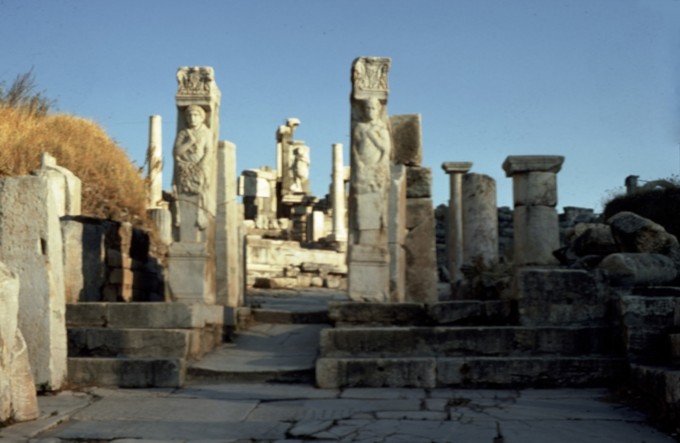
Ruins at Ephesus

Ruins at Ephesus

Paul contrasts that by urging them to stay away from sexual immorality (which covers everything outside of relations between a husband and a wife), as well as all impurity and covetousness – which is idolatry – and even filthy talk, or crude joking.  Indeed, he says that such should not even be named of the people of God.  A Christian’s integrity and reputation matter, and public sins dishonor the Lord.  He makes it clear in verse 5 that those who are guilty of these things have “no inheritance in the kingdom of Christ and God.”  Verse 8’s “children of light” remind us of Jesus’ words in John 12:35-36.

Verses 21-33 deal with the relationship of a husband and wife – not women and men in general.  Paul restates Genesis 3:16 in terms of the husband being the head of the wife, just as Jesus is the head of the church (Ephesians 1:22-23).  But that does not give the husband license to be a tyrant.  Rather, the husband is to love his wife as Jesus loved the church, and “gave himself up for her.”  A wife should be able to count on just such love from her husband.  Verse 31 quotes Genesis 2:24, as they become one flesh; and the husband should also love his wife as he loves himself.

Read or listen to audio of ESV version of this selection from this link.

/Bob’s boy
___________________
some images © V. Gilbert & Arlisle F. Beers

Please note: I did not design the reading plan that I am following in my blog.  All of my comments in this blog, however, are solely my responsibility.  When reading ANY commentary, you should ALWAYS refer first to the scripture, which is God’s unchanging and unfailing word. Reading schedules, as well as a link to the site where you can get the reading plan that I’m currently following for yourself can be found on the “Bible Reading Schedules” page of my website at http://graceofourlord.com.  For questions and help, please see the “FAQ” and “Summaries” pages there.

Ephesians 4 – Unity in the Body of Christ

Paul is preaching unity here, as he emphasizes the church as the body of Christ, with Christ as the head (Colossians 1:18, Ephesians 2:16, 1 Corinthians 12:27) – that there is one body and one Spirit, just as we have been “called to the one hope” (verses 4-5) of eternal life in Christ and “one Lord, one faith, one baptism, one God and Father of all.”  But in this unity, grace was given to each individual member, according to the measure of Christ’s gift (verses 7-11).  This is not speaking just of supernatural gifts, as the age of those will soon pass (though they, too, had their place in “building up the body of Christ”); and Paul is speaking not just to Christians of that age, but to all future Christians.  Verse 8 is from Psalm 68:18.

Along a main inland road from Ephesus to the Euphrates River, Colossae shared the beauty of the Lycus Valley with its sister cities Hierapolis. The original roads from Ephesus and Sardis joined there, and this defensible and well-watered hill became a strategic point in antiquity. Declining in importance by the time of Paul's Epistle to them, they had already been surpassed in size by the other Lycus Valley cities.

Along a main inland road from Ephesus to the Euphrates River, Colossae shared the beauty of the Lycus Valley with its sister cities Hierapolis. The original roads from Ephesus and Sardis joined there, and this defensible and well-watered hill became a strategic point in antiquity. Declining in importance by the time of Paul’s Epistle to them, they had already been surpassed in size by the other Lycus Valley cities.

Paul began in verse 1 stating that we must walk in a manner worthy of that calling; and he picks up that thought again beginning in verse 17, as he says they (we) must no longer walk as the Gentiles do.  This is relevant to us as well as a reference to all unbelievers, who are “darkened in their understanding, alienated from the life of God because of the ignorance that is in them, due to their hardness of heart…given themselves up to sensuality, greedy to practice every kind of impurity.”

But instead, a Christian, taught the truth in Christ, is “to put off your old self, which belongs to your former manner of life and is corrupt through deceitful desires, and to be renewed in the spirit of your minds” (verses 21-23).  Then, he turns in verses 25-32 to the importance of honesty and being Godly in speech, thought, and heart, which is to rule how we treat each other; and sharing with those in need is to play an important role in our lives (verse 27).  Verse 26 says “be angry and do not sin.”  One can have anger, particularly “righteous anger,” but it should not rule our hearts or our mouths.    Verse 32 sums up that section well – “Be kind to one another, tenderhearted, forgiving one another, as God in Christ forgave you.”

Read or listen to audio of ESV version of this selection from this link.

/Bob’s boy
___________________
some images © V. Gilbert & Arlisle F. Beers

Please note: I did not design the reading plan that I am following in my blog.  All of my comments in this blog, however, are solely my responsibility.  When reading ANY commentary, you should ALWAYS refer first to the scripture, which is God’s unchanging and unfailing word. Reading schedules, as well as a link to the site where you can get the reading plan that I’m currently following for yourself can be found on the “Bible Reading Schedules” page of my website at http://graceofourlord.com.  For questions and help, please see the “FAQ” and “Summaries” pages there.

Ephesians 3 – The Mystery of the Gospel Revealed

Ephesus, in modern Turkey, is the best-preserved classical city on the Mediterranean, and one of the best places in the world to get the feeling for what life was like for early Christians in Roman times. Roman theater.

Ephesus, in modern Turkey, is the best-preserved classical city on the Mediterranean, and one of the best places in the world to get the feeling for what life was like for early Christians in Roman times. Roman theater.

Verse 1 of this chapter is key to the message Paul is conveying here.  He is a prisoner for Jesus Christ, on behalf of the Gentiles.  The “mystery” that he received revelation about was (as  verse 6 says) “that the Gentiles are fellow heirs, members of the same body, and partakers of the promise in Christ Jesus through the gospel.” This plan was not known to previous generations (verse 5), but now has been revealed to His apostles and prophets.  He declares this as his ministry in verse 7 – “of this gospel I was made a minister according to the gift of God’s grace, which was given me…”  And he makes it known in verses 10-11 that this was always God’s plan, according to His wisdom – “this was according to the eternal purpose that he has realized in Christ Jesus our Lord…”

The chapter ends with Paul’s prayer for spiritual strength in verses 14-21, that he began in the previous chapter.  This is one of the most beautiful and poignant prayers in the Bible.  Read it again and again, and take comfort in wisdom and truth of it, as well as the promise it brings to the hearts of Christians:

“For this reason I bow my knees before the Father,
from whom every family in heaven and on earth is named,
that according to the riches of his glory he may grant you to be strengthened with power through his Spirit in your inner being
so that Christ may dwell in your hearts through faith—that you, being rooted and grounded in love
may have strength to comprehend with all the saints what is the breadth and length and height and depth,
and to know the love of Christ that surpasses knowledge, that you may be filled with all the fullness of God.
Now to him who is able to do far more abundantly than all that we ask or think, according to the power at work within us,
to him be glory in the church and in Christ Jesus throughout all generations, forever and ever. Amen.”

Read or listen to audio of ESV version of this selection from this link.

/Bob’s boy
___________________
some images © V. Gilbert & Arlisle F. Beers

Please note: I did not design the reading plan that I am following in my blog.  All of my comments in this blog, however, are solely my responsibility.  When reading ANY commentary, you should ALWAYS refer first to the scripture, which is God’s unchanging and unfailing word. Reading schedules, as well as a link to the site where you can get the reading plan that I’m currently following for yourself can be found on the “Bible Reading Schedules” page of my website at http://graceofourlord.com.  For questions and help, please see the “FAQ” and “Summaries” pages there.

Ephesians 2 – By Grace Through Faith

The ruins of the Roman Theater in Ephesus, Turkey. Paul visited here on his Second Missionary Journey and later wrote the epistle Ephesians to the Christians of Ephesus

The ruins of the Roman Theater in Ephesus, Turkey. Paul visited here on his Second Missionary Journey and later wrote the epistle Ephesians to the Christians of Ephesus

Paul, addressing the Ephesians, interchanges the pronouns “you”, “we”, and “us” (verses 1, 3, and 4, for example), pointing out that we were all lost in our sin.  But God, being rich in mercy, made us alive through Jesus Christ, in whom we were raised up, along with Him.  He says that we are saved by grace through faith.  The significance of that statement is emphasized by making clear that it is not by anything that we did (verse 8), but it is the gift of God.  But one must take account of the whole of Scripture in order to understand this part, as is always the case.  It is by grace that we are saved, certainly.  But it is not by grace alone, otherwise the entire world would be saved without even having belief.  Therefore, faith is a necessary part of that salvation, but faith alone, without grace, cannot save us.  But one must also remember that, as James said (James 2:24),  “a person is justified by works and not by faith alone.”

He then goes on to remind that the Gentiles were once separated by the Law of Moses, a wall that in Christ Jesus was broken down (verses 13-16); and through Him, Jews and Gentiles alike have access “in one spirit to the father” (verse 18).  Such salvation for all people of the world was always the plan of God through Jesus (Titus 2:11), on which foundation He is the cornerstone (verses 20-21, Isaiah 28:16).

Read or listen to audio of ESV version of this selection from this link.

/Bob’s boy
___________________
some images © V. Gilbert & Arlisle F. Beers

Please note: I did not design the reading plan that I am following in my blog.  All of my comments in this blog, however, are solely my responsibility.  When reading ANY commentary, you should ALWAYS refer first to the scripture, which is God’s unchanging and unfailing word. Reading schedules, as well as a link to the site where you can get the reading plan that I’m currently following for yourself can be found on the “Bible Reading Schedules” page of my website at http://graceofourlord.com.  For questions and help, please see the “FAQ” and “Summaries” pages there.

Acts 27 – Paul Sails for Rome / Shipwreck

Once again, Luke begins the chapter speaking in the first person plural, indicating that he was with Paul all the way to Rome as they set sail for Italy.  The centurion, Julius, that Paul and the other prisoners were delivered to is said to have been “of the Augustan Cohort.”  A cohort generally consisted of six hundred men under the command of six centurions.  However, auxiliary forces of the cohort could push the numbers up to a thousand men.  The cohorts were given names – this one likely given the name for the imperially dedicated regiment founded by the emperor, Augustus, who reigned from 27 BC to 14 AD.

Map of Paul’s second missionary journey (shown to illustrate location of Mysia)

Don’t get confused by verse 2’s statement “embarking in a ship of Adramyttium.”  The ship was from Adramyttium (the Latin name for Edremit), an ancient port city of Mysia in the Roman province of Asia Minor (see first map), near present-day Edremit – Turkey.  But it was carrying them from their starting point in Caesarea – the next stop being Sidon (see second map).  Aristarchus, mentioned as accompanying them in the same verse, is one of the disciples that was dragged into the theater during the riot in Ephesus (Acts 19:29).

Verse 9’s “the Fast” refers to the Day of Atonement, which would have been in October.  From this time to about April, Meditteranean sailing is (and was) most dangerous; and Paul was already warning them that the voyage would result in “injury and much loss” (verse 10).  But the centurion sided with the captain and the rest of the crew, who judged the harbor at Fair Havens to be unsuitable for the winter.  So they decided to try to make it to “Phoenix, a harbor of Crete,” (probably present day Phineka Bay) to spend the winter.  This was, after all, a 2,000 mile voyage to Rome.

Paul began his 2,000 mile trip to Rome at Caesarea. To avoid the open seas, the ship followed the coastline. At Myra, Paul was put on a vessel bound for Italy. It arrived with difficulty at Cnidus, then went to Crete, landing at the port of Fair Havens. The next stop was Phoenix, but the ship was blown south around the island of Cauda, then drifted for two weeks until it was shipwrecked on the island of Malta.

When a northeaster – a fearsome storm – arrived, it tossed them about so badly that they began jettisoning cargo and tossing the ship’s “tackle” overboard (the tackle may have been the beam supporting the ship’s mainsail).  Most had lost hope when Paul told them that “an angel of the God to whom I belong and whom I worship” had appeared and told him not to be afraid – that he must stand before Caesar, so they would all be spared.  But, he told them, they would have to run the ship aground on “some island”  (verse 26).

The mention of the men taking a “sounding” refers to measuring the depth of the water by use of a “sounding line.”  When they found that they were nearing land, the sailors (afraid of the ship hitting rocks) were lowering boats to abandon ship under the pretense of laying anchors.  But Paul warned the centurion, saying that they would not make it if the sailors left the ship.  So the soldiers cut the boats loose from the ship to prevent escape.

Having conserved all they could, the fourteenth day without having eaten approached, and Paul urged them all to eat, in order to gather their strength.  He did so himself, giving thanks to God; and they were encouraged, and all ate some.  There were 276 aboard (verse 27) – about the right amount for the vessel to have been a large grain ship , meaning it was probably not worthy of such a voyage.

Verses 39-44 detail the horrific shipwreck on the reefs, and the escape to land that all of them made safely, hanging on to the wreckage.  Verses 42-43 tell us that the soldiers had planned to kill the prisoners, so that none could escape.  But the centurion, wishing to save Paul, prevented them.  God had, as always, made good on his promise to save them.

Read or listen to audio of ESV version of this selection from this link.

/Bob’s boy
___________________
some images © V. Gilbert & Arlisle F. Beers

Please note: I did not design the reading plan that I am following in my blog.  All of my comments in this blog, however, are solely my responsibility.  When reading ANY commentary, you should ALWAYS refer first to the scripture, which is God’s unchanging and unfailing word. Reading schedules, as well as a link to the site where you can get the reading plan that I’m currently following for yourself can be found on the “Bible Reading Schedules” page of my website at http://graceofourlord.com.  For questions and help, please see the “FAQ” and “Summaries” pages there.

Acts 26 – Paul’s Defense Before Agrippa

English: A coin bronze minted by Herod of Chal...

English: A coin bronze minted by Herod of Chalcis depicting Herod with his brother Agrippa of Judaea crowning Roman Emperor Claudius I. On display at the british museum. CM 1985.10-2.1 (Photo credit: Wikipedia)

As the chapter opens, Agrippa has given Paul permission to speak in his defense.  In verses 2-3, Paul speaks of feeling fortunate to be appearing before Agrippa, since he was familiar with “the customs and controversies of the Jews.”  In fact, Agrippa’s reputation was that of a pious Jew, though much of the rest of his reputation was not so good.  Still, he was (like his uncle Herod) in control of the temple treasury, and the Romans consulted him on religious matters.

Paul then tells Agrippa of his persecution of Christians before his conversion, then gives us the third account in this book of his vision – his encounter with the Lord on the road to Damascus (the other two being in Acts 9 and Acts 22), and ending with the charge that Jesus gave him (verses 15-18).  From this chapter’s account, we have more details about what Jesus said to him on that first occasion.  “To kick against the goads” in verse 14 is an old proverbial saying that refers to use of a pointed instrument to prod oxen as they plowed.  A stubborn ox that continued to kick would only injure itself if it continued to do so – making its resistance futile.

The outburst of Festus during Paul’s reference to the fulfilling of all that Moses and the prophets said would take place would seem to affirm his alignment with the Jewish accusers.  But Paul seems pretty confident that Agrippa is not so inclined.  Note verse 27 – “King Agrippa, do you believe the prophets? I know that you believe.”  Agrippa is no fool, and Paul is surely not foolish enough to speak hastily when he says in verse 26: “For the king knows about these things, and to him I speak boldly. For I am persuaded that none of these things has escaped his notice, for this has not been done in a corner.”  Indeed, regarding that last phrase, Coffman summed it up beautifully:

That earthquake which accompanied the Son of God in his visitation of our planet is still sending shock waves around the earth. The fact of his birth split human history into B.C. and A.D.; his crucifixion bruised the head of Satan himself; his resurrection brought life and immortality to light through the gospel; his teachings monitor the deeds and thoughts of all men; and his word shall judge the living and the dead at the Last Day. Done in a corner? Yes, in a little corner of the universe known as the Planet Earth; but that earth can never forget him, or get rid of him. As some of the Sadducees and Pharisees were able to see while he was among them: “The world is gone after him (John 12:19).

King Agrippa judged Paul, but Paul had already appealed to Caesar, so Agrippa could not set him free

Verse 28 is difficult in translation, but regardless of the translated version, it says that Agrippa was not quite ready to accept the fact of Jesus as Lord and Christ; and is the inspiration for the hymn, “Almost Persuaded.”  Paul’s response is that he would have Agrippa and all who hear him to be as Paul himself is (minus the chains, of course) – that is, to believe in the Lord.

Agrippa’s statement to Festus after he, Bernice and the others had met outside Paul’s presence (verses 30-32) is a sort of vindication, but not the end of Paul’s ordeal.  Agrippa could have set Paul free if he had not appealed to Caesar, but he had no choice by law but to send him to so appear before the emperor.

Read or listen to audio of ESV version of this selection from this link.

/Bob’s boy
___________________
some images © V. Gilbert & Arlisle F. Beers

Please note: I did not design the reading plan that I am following in my blog.  All of my comments in this blog, however, are solely my responsibility.  When reading ANY commentary, you should ALWAYS refer first to the scripture, which is God’s unchanging and unfailing word. Reading schedules, as well as a link to the site where you can get the reading plan that I’m currently following for yourself can be found on the “Bible Reading Schedules” page of my website at http://graceofourlord.com.  For questions and help, please see the “FAQ” and “Summaries” pages there.

Acts 25 – Paul Appeals to Caesar

After Festus arrived in Caesarea to become governor instead of Felix, he judged Paul

Antonius Felix was replaced by Porcius Festus as the Roman procurator of Judea from about 59 to 62 AD.  During his reign, hostility to Roman rule was heating to a fevered pitch, preceding the “Great Revolt” (the Jewish-Roman war of AD 66) that ended with the destruction of Jerusalem in AD 70.  Wasting no time after Festus assumed his role, verse 2 says that “the chief priests and the principal men of the Jews laid out their case against Paul,” trying to persuade him to send Paul to Jerusalem so they could ambush him.  These “chief priests and principal men” were most likely of the Sanhedrin, and had conspired with more than 40 others to kill Paul in Acts 23:12-15.  In verse 9, Festus was ready to send Paul to Jerusalem as a favor to the Jews, when Paul invoked his right as a Roman citizen to appeal to Caesar.

After some days, Festus met with King Agrippa II and his sister, Bernice, who was always by his side (one of his other siblings was Drusilla, who was the wife of Festus’ predecessor, Felix).  This Agrippa was educated in the court of the emperor Claudius, and was the son of Herod Agrippa I, who in Acts 12:1-3 had the Apostle James killed and Peter arrested, and who the Lord stuck down dead in Acts 12:21-23.  He was also the great-grandson of Herod the Great – who had ordered the killing of all the male children of the region around Bethlehem when Jesus was born.   As Festus laid out the case against Paul, he concluded by surmising that the matter was a dispute about their religion, and the death of “a certain Jesus, who was dead, but whom Paul asserted to be alive” (verse 19).

The first Herod, called The Great, wanted to honor his patron, Augustus Caesar, with a fine harbor. Joppa was not fitting since it was dominated by strong Jewish, anti-Roman, feelings. So Herod spent twelve years building a magnificent harbor and naming it Caesarea. Here Paul was imprisoned for two years and brought to trial before governors Felix and Festus, King Agrippa, and Bernice. Ruins here are from both Roman times and later Crusader times, about 1100-1300 A.D. Ruins of the Crusader city.

The next day, Festus introduced Paul, saying in a nutshell that (interestingly enough) he had found no charge deserving of death for Paul, and therefore he thought it wise to have him appear to Agrippa, so that maybe he (Festus) would have “something to write” before sending him to Caesar.

Read or listen to audio of ESV version of this selection from this link.

/Bob’s boy
___________________
some images © V. Gilbert & Arlisle F. Beers

Please note: I did not design the reading plan that I am following in my blog.  All of my comments in this blog, however, are solely my responsibility.  When reading ANY commentary, you should ALWAYS refer first to the scripture, which is God’s unchanging and unfailing word. Reading schedules, as well as a link to the site where you can get the reading plan that I’m currently following for yourself can be found on the “Bible Reading Schedules” page of my website at http://graceofourlord.com.  For questions and help, please see the “FAQ” and “Summaries” pages there.
 

Acts 24 – Paul Before Felix at Caesarea

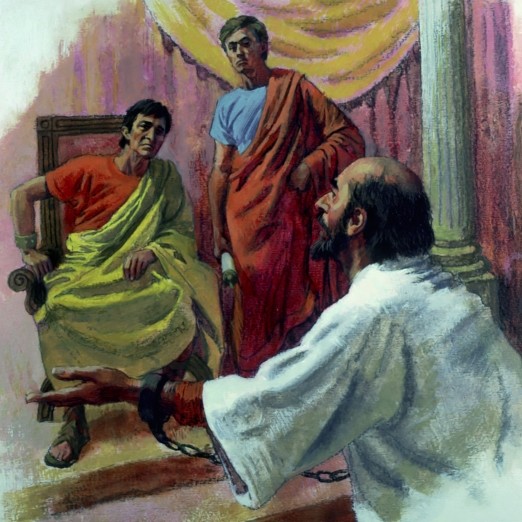
While Paul was held as a prisoner in Caesarea, Tertullus came to accuse him before governor Felix (Acts 24).

Having been escorted to Caesarea on the order of Lysias, the Roman tribune, Paul finally appears before Felix after Ananias and the rest of his accusers arrive.  Not much is known about the “spokesman,” Tertullus.  Some suppose that he may have been a both a Gentile (which, if true, this blogger finds nearly hilariously ironic and hypocritical) and a lawyer.  When he addresses Felix, he begins by flattering him with praise about his reforms and the “peace” they enjoy.  This was utter nonsense!  Antonius Felix is remembered today for his cruelty, bribe-taking, and general corruption; and the crime rate soared under his reign in Judea.   When he went back to Rome after his tenure, he was accused of using a dispute between Jews and Syrians to murder and pillage numbers of the  people of Caesarea. He escaped prosecution thanks to his brother, Marcus Antonius Pallas, who had been the secretary of treasury to Emperor Claudius.

When Felix gave him his turn, Paul laid out his defense in verses 10-21, methodically disputing the accusations with the obvious truth – which his accusers were unable to counter.  In verse 14, he “confesses” that he is a part of “the Way” (which Tertullus called “the sect of the Nazarenes,”), through which he worships “the God of our fathers, believing everything laid down by the Law and written in the Prophets, having a hope in God, which these men themselves accept, that there will be a resurrection of both the just and the unjust.”   Thus, Paul not only makes the case that he is a “good Jew,” but that Christianity is God’s divine will.

Felix seemed to be aware of Paul’s innocence, but was more interested in the possibility of getting some money from him over a period of time (verse 26), as well as garnering support from the Jews.  After two years had passed, he left Paul in prison as a favor to them when he was replaced by Porcius Festus.

Read or listen to audio of ESV version of this selection from this link.

/Bob’s boy
___________________
some images © V. Gilbert & Arlisle F. Beers

Please note: I did not design the reading plan that I am following in my blog.  All of my comments in this blog, however, are solely my responsibility.  When reading ANY commentary, you should ALWAYS refer first to the scripture, which is God’s unchanging and unfailing word. Reading schedules, as well as a link to the site where you can get the reading plan that I’m currently following for yourself can be found on the “Bible Reading Schedules” page of my website at http://graceofourlord.com.  For questions and help, please see the “FAQ” and “Summaries” pages there.