Paul Invokes His Roman Citizenship – Acts 22

English: Papyrus fragment of the 9th century w...

English: Papyrus fragment of the 9th century written in Serto variant. A passage from the Acts of the Apostles is recognizable. (Photo credit: Wikipedia)

Paul , speaking to the mob, then tells them about Ananias restoring his sight and his subsequent baptism in verses 12-16. But when he told them of his encounter with the Lord, and how He had told Paul that He was sending him to the Gentiles (verses 17-21), the crowd became wild with anger again. The tribune ordered him to be flogged in order to find out why they were shouting out against him. But as he was stretched out, Paul told the tribune that he was a Roman citizen by birth (verses 25-28); and the Roman tribune became fearful (Roman law forbade flogging a Roman citizen without a hearing or a formal condemnation). So in verse 30, the chapter ends with the tribune having Paul brought before the Sanhedrin, since scourging was not an option.

Schedule for this week
Read or listen to audio of this week’s selection from Acts here
Read or listen to audio of this weeks selection from 2 Chronicles here

/Bob’s boy
___________________

some images © V. Gilbert & Arlisle F. Beers

Please visit this site’s menu item “The Author’s Books” for info on the author’s books, website, and Facebook page.

All of my comments in this blog are solely my responsibility. When reading any commentary, you should always refer first to the scripture, which is God’s unchanging and unfailing word.


Paul Speaks to the Mob – Acts 22

English: St. Paul. From the Acts of the Apostl...

English: St. Paul. From the Acts of the Apostles printed in , Georgia, in 1709 (Photo credit: Wikipedia)

Paul, having been arrested and beaten, had at the close of chapter 22 convinced the Roman tribune to allow him to speak to the mob. When he spoke in Hebrew, it settled them down and they listened. He then gave them a history of himself as a Jew, “educated at the feet of Gamaliel” (a Pharisee and renowned teacher, who was also a member of the Sanhedrin council – see Acts 5:34). He also recounted his own persecution of Christians and the “Way .”

Paul then told of his encounter with the Lord in Acts 9:3-8, in which he was blinded. The re-telling of that event here in verses 6-11 is not contradictory at all, despite what some say. Those who were with Paul on that road could hear what was said, but were not made to understand.

Schedule for this week
Read or listen to audio of this week’s selection from Acts here
Read or listen to audio of this weeks selection from 2 Chronicles here

/Bob’s boy
___________________

some images © V. Gilbert & Arlisle F. Beers

Please visit this site’s menu item “The Author’s Books” for info on the author’s books, website, and Facebook page.

All of my comments in this blog are solely my responsibility. When reading any commentary, you should always refer first to the scripture, which is God’s unchanging and unfailing word.


Paul Arrested in Jerusalem – Acts 21

English: Saint paul arrested

English: Saint paul arrested (Photo credit: Wikipedia)

After arriving in Jerusalem, Paul went to see James and told him and the elders about his travels and the many Gentile conversions, for which they glorified God. They then asked Paul to demonstrate that he was not preaching that Jews had to become like Gentiles and give up all of their customs in order to be a Christian, as many were falsely reporting. So Paul participated with four men under a vow in a purification ritual. This event is the subject of much confusion and controversy. But it does not have to be. Paul never preached that Jews had to give up their entire way of life or never participate in any ritual or feast (remember Romans 14 and 15), nor that they should not circumcise their young. Remember that he circumcised Timothy to avoid offending the Jews they were going to visit in Acts 16:3.

But still Paul was arrested, having been dragged from the temple first and beaten by a mob that had gone wild with accusations and fervor. Until Paul spoke Greek to him, the tribune that arrested him was under the impression that he was an Egyptian revolutionary (verse 38). The event he mentions in that verse was written about by the historian, Josephus. At Paul’s urging, the tribune allows him to speak to the mob; and he does so in Hebrew, as the chapter closes.


Schedule for this week

Read or listen to audio of this week’s selection from Acts here
Read or listen to audio of this weeks selection from 2 Chronicles here

/Bob’s boy
___________________

some images © V. Gilbert & Arlisle F. Beers

Please visit this site’s menu item “The Author’s Books” for info on the author’s books, website, and Facebook page.

All of my comments in this blog are solely my responsibility. When reading any commentary, you should always refer first to the scripture, which is God’s unchanging and unfailing word.


Paul Prepares to Go to Jerusalem – Acts 21

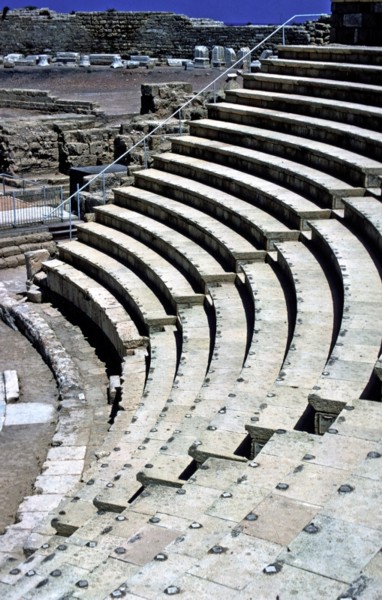
Ruins of the Roman theater at Caesarea

Ruins of the Roman theater at Caesarea

We left the book of Acts after chapter 20, as Paul was in Miletus, with his tearful goodbye to the Ephesian elders. While in that area, Paul wrote the letters to the Corinthians and to the Romans. Now, as he said in his letter to the latter, he is leaving for Jerusalem. They sailed past Cos, Rhodes, Patera, Cyprus and landed at Tyre, where they remained for seven days, then on to Ptolemais and finally Caesarea before setting off on foot to Jerusalem. While in Caesarea, they stayed at the house of Philip, who Luke says was “one of the seven.” Most likely he means that he was one of the seven chosen to serve in Acts 6:1-6, and was the same Philip who converted the Ethiopian eunuch. And after that event, he did end up in Caesarea (Acts 8:40).

Agabus (the prophet who predicted the famine in Acts 11:2-28) came from Judea to tell how the Jews at Jerusalem will bind and deliver Paul into the hands of the Gentiles (verses 10-14). Luke and the others present tried to persuade Paul not to go, but he told them that he was not only ready for prison, but even to die for the Lord Jesus. Notice though, that the words from the prophet were not quoted in these verses as a warning to prevent him from going – but as a statement of fact (verse 11); and Luke and the others finally said “Let the will of the Lord be done.”


Schedule for this week

Read or listen to audio of this week’s selection from Acts here
Read or listen to audio of this weeks selection from 2 Chronicles here

/Bob’s boy
___________________

some images © V. Gilbert & Arlisle F. Beers

Please visit this site’s menu item “The Author’s Books” for info on the author’s books, website, and Facebook page.

All of my comments in this blog are solely my responsibility. When reading any commentary, you should always refer first to the scripture, which is God’s unchanging and unfailing word.


Paul’s Emotional Goodbye to the Elders of Ephesus – Acts 20

English: Photograph of the Theater at Ephesus

English: Photograph of the Theater at Ephesus (Photo credit: Wikipedia)

While at Miletus, Paul called the elders at Ephesus to come to him, a journey of perhaps 30 miles or so. Verses 18-37 end with a tearful goodbye, as he tells them that he knows he will never see their faces again. He tells them that he is going to Jerusalem and that he does not know what will happen to him “except that the Holy Spirit testifies to me in every city that imprisonment and afflictions await me.” He recounts his faithfulness to preaching and teaching the word in the three years that he had spent with them, declaring that he was “innocent of the blood of all.”

These very emotional parting words have an important point besides the obvious. In his letter to the Thessalonians, Paul had stressed the importance of the local church members having respect for those who had been appointed as elders of their congregation (1 Thessalonians 5:12-13). Here in Acts 20, he is making it clear to these elders – and to all elders of the church everywhere – that they have the responsibility to shepherd the flock among them. Fierce wolves, he says, will come in “not sparing the flock,” and that “from among your own selves will arise men speaking twisted things, to draw away the disciples after them.” The elders of the local church everywhere have an awesome responsibility, and must always be on guard for the souls of those in their midst. It was true then, as it is now.

In the middle of all this, Paul quotes to these elders one of Jesus’ most famous sayings in verse 35 “It is more blessed to give than to receive.” The words are actually not found in any of the gospels. But it is good to remember the words that John wrote in John 21:25. Jesus did and said so much more in His time on earth than what was written in the gospels. It is appropriate that some words the Lord used in His teachings are reported to us by Paul – who wrote so much of the Bible!


Schedule for this week

Read or listen to audio of this week’s selection from Acts here
Read or listen to audio of this weeks selection from 2 Chronicles here

/Bob’s boy
___________________

some images © V. Gilbert & Arlisle F. Beers

Please visit this site’s menu item “The Author’s Books” for info on the author’s books, website, and Facebook page.

All of my comments in this blog are solely my responsibility. When reading any commentary, you should always refer first to the scripture, which is God’s unchanging and unfailing word.


Paul Preaches at Troas – Acts 20

Deutsch: Aleaxandria Troas Therme

Deutsch: Aleaxandria Troas Therme (Photo credit: Wikipedia)

After the riot in Ephesus had passed, Paul said his farewells and went to Macedonia, then to Greece where he spent three months until a plot against him by the Jews was discovered. So he headed back to Macedonia accompanied by others, including Timothy, Aristarchus and Gaius (two victims of the riot from Acts 19:29), all of whom were sent on to Troas. It is in verse 5 that Luke again begins speaking in the first person plural, indicating he accompanied Paul as they sailed from Philippi to meet the others at Troas. The seaport of Troas was located near the site of the ancient city of Troy, and was rebuilt by Alexander the Great’s successors and renamed Alexandria Troas.

It is there that Paul broke bread with them on the first day of the week and, preaching to midnight, a young man named Eutychus fell asleep and fell from a third-story window. But Paul took him in his arms, and in verse 12 “they took the youth away alive, and were not a little comforted.” Indeed, excitement over this resurrection would no doubt have contributed to their staying up until daybreak (verse 11). Then, Luke says that he and the others set sail for Assos, while Paul went by land and met them there. From there, they sailed to To Chios, Samos and Miletus, as Luke says that Paul had decided not to stop at Ephesus because he wanted to get to Jerusalem by Pentecost.


Schedule for this week

Read or listen to audio of this week’s selection from Acts here
Read or listen to audio of this weeks selection from 2 Chronicles here

/Bob’s boy
___________________

some images © V. Gilbert & Arlisle F. Beers

Please visit this site’s menu item “The Author’s Books” for info on the author’s books, website, and Facebook page.

All of my comments in this blog are solely my responsibility. When reading any commentary, you should always refer first to the scripture, which is God’s unchanging and unfailing word.


Festus Before Agrippa – Acts 19

Herod Agrippa II was the seventh and last king...

Herod Agrippa II was the seventh and last king of the family of Herod the Great, thus last of the Herodians. (Photo credit: Wikipedia)

After some days, Festus met with King Agrippa II and his sister, Bernice, who was always by his side (one of his other siblings was Drusilla, who was the wife of Festus’ predecessor, Felix). This Agrippa was educated in the court of the emperor Claudius, and was the son of Herod Agrippa I, who in Acts 12:1-3 had the Apostle James killed and Peter arrested, and who the Lord stuck down dead in Acts 12:21-23. He was also the great-grandson of Herod the Great – who had ordered the killing of all the male children of the region around Bethlehem when Jesus was born. As Festus laid out the case against Paul, he concluded by surmising that the matter was a dispute about their religion, and the death of “a certain Jesus, who was dead, but whom Paul asserted to be alive” (verse 19).

The next day, Festus introduced Paul, saying in a nutshell that (interestingly enough) he had found no charge deserving of death for Paul, and therefore he thought it wise to have him appear to Agrippa, so that maybe he (Festus) would have “something to write” before sending him to Caesar.


Schedule for this week

Read or listen to audio of this week’s selection from Acts here
Read or listen to audio of this weeks selection from 2 Chronicles here

/Bob’s boy
___________________

some images © V. Gilbert & Arlisle F. Beers

Please visit this site’s menu item “The Author’s Books” for info on the author’s books, website, and Facebook page.

All of my comments in this blog are solely my responsibility. When reading any commentary, you should always refer first to the scripture, which is God’s unchanging and unfailing word.


Paul Invokes Roman Citizenship – Acts 19

Coin of Porcius Festus

Coin of Porcius Festus (Photo credit: Wikipedia)

Antonius Felix was replaced by Porcius Festus as the Roman procurator of Judea from about 59 to 62 AD. During his reign, hostility to Roman rule was heating to a fevered pitch, preceding the “Great Revolt” (the Jewish-Roman war of AD 66) that ended with the destruction of Jerusalem in AD 70. Wasting no time after Festus assumed his role, verse 2 says that “the chief priests and the principal men of the Jews laid out their case against Paul,” trying to persuade him to send Paul to Jerusalem so they could ambush him.

These “chief priests and principal men” were most likely of the Sanhedrin, and had conspired with more than 40 others to kill Paul in Acts 23:12-15. In verse 9, Festus was ready to send Paul to Jerusalem as a favor to the Jews, when Paul invoked his right as a Roman citizen to appeal to Caesar.


Schedule for this week

Read or listen to audio of this week’s selection from Acts here
Read or listen to audio of this weeks selection from 2 Chronicles here

/Bob’s boy
___________________

some images © V. Gilbert & Arlisle F. Beers

Please visit this site’s menu item “The Author’s Books” for info on the author’s books, website, and Facebook page.

All of my comments in this blog are solely my responsibility. When reading any commentary, you should always refer first to the scripture, which is God’s unchanging and unfailing word.


Paul Sails to Syria – Acts 18

English: the beginning of the 1. Epistle to th...

English: the beginning of the 1. Epistle to the Corinthians (Photo credit: Wikipedia)

Sosthenes, who was beaten in verse 17, may have succeeded Crispus after he became a Christian. Sosthenes may have become a Christian himself, and could be the same one mentioned by Paul in his first letter to the Corinthians (1 Corinthians 1:1), but we do not know for sure. At Corinth’s eastern port of Cenchrea, Paul had cut his hair at the completion of a vow (likely a Nazirite vow, as in Numbers 6:2). It is speculated, that Paul would have kept some of his observances of ceremonial law, which would not be inappropriate at all. He would not, however, bind such on others.

Paul then set sail for Syria, taking Priscilla and Aquila with him. Stopping to establish the church at Ephesus, he left Priscilla and Aquila there, promising to return “if God wills.” He then set sail to Caesarea, traveled to report to the church in Jerusalem and up to Antioch of Syria, ending his second missionary journey in verse 22. Verse 23 then begins Paul’s third missionary journey, going up though Galatia and Phyrgia, “strengthening all the disciples” at the churches he had begun.

Meanwhile, a Jew named Apollos came to Ephesus from Alexandria. He was a learned and eloquent man, well-versed in the Old Testament. Luke says that “he spoke and taught accurately the things concerning Jesus, though he knew only the baptism of John,” meaning that he taught accurately what he knew, but Aquila and Priscilla filled in for him, teaching him “the way of God more accurately.” It is likely that Aquila baptized him into Christ. Wishing to go into Achaia, he was encouraged by the brothers, and became a powerful speaker of the gospel.


Schedule for this week

Read or listen to audio of this week’s selection from Acts here
Read or listen to audio of this weeks selection from 2 Chronicles here

/Bob’s boy
___________________

some images © V. Gilbert & Arlisle F. Beers

Please visit this site’s menu item “The Author’s Books” for info on the author’s books, website, and Facebook page.

All of my comments in this blog are solely my responsibility. When reading any commentary, you should always refer first to the scripture, which is God’s unchanging and unfailing word.


Paul Goes to Corinth – Acts 18

Bust of Roman emperor Claudius (reworked from ...

Bust of Roman emperor Claudius (reworked from a bust of emperor Caligula), circa 50 AD. It was found in the so-called Otricoli basilica in Lanuvium, Italy, in 1779, and now stands in the “Sala Rotonda” (Round Hall) in the Museo Pio-Clementino (Vatican Museums). (Photo credit: Wikipedia)

Paul left Athens, and went to Corinth, which was 46 miles away. He met with Aquila and Priscilla there, who had come from Italy after the Roman emperor Claudius had ordered all Jews to leave Roman (we know this to have been issued in 49 AD). At that time, they made no distinction between Jews and Christians. Aquila and Priscilla were tent makers by trade, like Paul, and he stayed with them. They became faithful friends, and he mentions them again a few times in Scripture (Romans 16:3-5, for example). As always, he reasoned in the synagogue every Sabbath, preaching Jesus as the Christ. But when they opposed him, he went to the home of Titius Justis, about whom we know nothing. Crispus, the ruler of the synagogue, was one of the Corinthians that we know Paul baptized himself (1 Corinthians 1:14).

The Lord spoke to Paul in a vision, telling him to keep teaching, and that no harm would come to him there. So he remained for a year and a half (verse 11). The proconsul was the chief judicial officer. In this case, it was Gallio (verses 12-14) that held that position when the Jewish leaders there, in a united assault, had Paul brought before the tribunal. We know from fragments of a letter from Claudius (the Delphi Inscription, found in 1905 by a French expedition) that he began this office in 51 AD. He was a brother of the philosopher, Seneca, who was an advisor to Nero. Born as “Marcus Annaeus Novatus”, he took the full name “Lucius Junius Gallio Annaeus,” after the rich man who adopted him.But before Paul could defend himself, Gallio ruled that this was a religious matter between the Jews and ran them out of the tribunal.


Schedule for this week

Read or listen to audio of this week’s selection from Acts here
Read or listen to audio of this weeks selection from 2 Chronicles here

/Bob’s boy
___________________

some images © V. Gilbert & Arlisle F. Beers

Please visit this site’s menu item “The Author’s Books” for info on the author’s books, website, and Facebook page.

All of my comments in this blog are solely my responsibility. When reading any commentary, you should always refer first to the scripture, which is God’s unchanging and unfailing word.