Changing the Hearts of Two Apostles – Acts 9-10

A lot happens in Acts chapter 9, but clearly the most important thing is that the man (Saul of Tarsus) who had ravaged the church and approved of the deaths of Christians (including that of Stephen) is converted. In fact, he is found  preaching in the synagogue and declaring that Jesus is the Son of God. This naturally amazed and bewildered a great many people. Such a turnaround in such a short time made a lot of people skeptical. It is the most significant conversion of the New Testament because Paul, as he came to be called, ended up writing the epistles that became most of what we call the New Testament.

English: Peter's vision of a sheet with animal...

English: Peter’s vision of a sheet with animals, from Acts 10; illustration from Henry Davenport Northrop, “Treasures of the Bible,” published 1894 (Photo credit: Wikipedia)

In chapter 10, Peter has a vision that changes his life once again. The vision shows him that no animal is unclean, and Mosaic Law had demanded and that Gentiles, by extension, required a revision of his views. After he arrived at his house, Peter had told Cornelius of how the Spirit had pointed him toward their meeting. So then Cornelius told him of his vision, and that all present were commanded to hear what Peter has to say.  So then, Peter preached to them about the gospel of Jesus Christ.

There will be much more discussion about Gentiles in the kingdom of the Lord before the “Jerusalem Conference” of chapter 15, but Peter’s mind on the subject is made up already, it appears. In verses 34-35, he says “Truly I understand that God shows no partiality, but in every nation anyone who fears him and does what is right is acceptable to him.” And he finishes preaching with these words “all the prophets bear witness that everyone who believes in him receives forgiveness of sins through his name.”

 /Bob’s boy

Bible Reading Schedule for this month
Click links below to read or listen to audio of one of this week’s chapters in Colossians and Luke

Acts 8, Acts 9, Acts 10, Acts 11, Acts 12

___________________

some images © V. Gilbert & Arlisle F. Beers

Please visit this site’s menu item “The Author’s Books” for info on the author’s books, website, and Facebook page.

All of my comments in this blog are solely my responsibility. When reading any commentary, you should always refer first to the scripture, which is God’s unchanging and unfailing word.


Selecting the Deacons and the Death of Stephen Acts 6-7

In chapter 6, at the urging of the apostles, the disciples chose seven men for the apostles to appoint to “serve tables” for the church – the first deacons. It is an important distinction. It is the elders of the church who are to appoint the deacons, true enough. But they make their decisions as to who to appoint based solely upon the group of men that the church members select. One could logically assume that the wisdom in doing it this way is because the members are closer to their fellow disciples and they are going to better know the hearts and lives of the men that they select,

English: St Stephen (detail), painting by Giac...

English: St Stephen (detail), painting by Giacomo Cavedone (Photo credit: Wikipedia)

Two of the men they select will become key figures. Though Stephen’s time will end in chapter 7, his life, the speech that he gives, and his death have great meaning and served the fulfillment of the Lord’s commands, as well as the growth of his church in ways that we can only partially know. Phlip will be instrumental in chapters to come for the conversion and salvation of many. The other five that the text mentions do not appear elsewhere after this chapter.

Stephen makes his enemies much angrier in his “history lesson to the Sanhedrin in chapter 7. He speaks of the tabernacle that Moses had built under God’s direction (verse 44, Exodus 25). He speaks of the Israelites bringing it into Canaan under Joshua, where it remained until David’s time. Then Solomon built a house for the Lord. But he reminds them in verses 48-50, that God does not dwell in the temple, and for all its glory, His own hands made everything in it.

He then addresses the council more personally, and speaks of their own vile rejection of “the cornerstone” and their betrayal of God and His son, saying:

You stiff-necked people, uncircumcised in heart and ears, you always resist the Holy Spirit. As your fathers did, so do you. Which of the prophets did your fathers not persecute? And they killed those who announced beforehand the coming of the Righteous One, whom you have now betrayed and murdered, you who received the law as delivered by angels and did not keep it.

Stephen had not only turned the tables on his own accusers as having gone against God, but had called them the murderers that they were! Their fury had to have been something to see. So they dragged him out of the city, and laid their garments at the feet of a man named Saul (stoning was hard, sweaty work) before they stoned Stephen to death.

/Bob’s boy

Bible Reading Schedule for this month
Click links below to read or listen to audio of one of this week’s chapters in Colossians and Luke

Acts 3, Acts 4, Acts 5, Acts 6, Acts 7

___________________

some images © V. Gilbert & Arlisle F. Beers

Please visit this site’s menu item “The Author’s Books” for info on the author’s books, website, and Facebook page.

All of my comments in this blog are solely my responsibility. When reading any commentary, you should always refer first to the scripture, which is God’s unchanging and unfailing word.


Being His Disciple – Luke 14-15

Jesus again talks about what it takes to be one of His disciples in Luke 14. In verses 26-33, He tells them that a disciple must hate his own family — and even his own life. And he finishes up by saying that the disciple must renounce all that he has. Of course we know that Jesus does not want us to hate anyone. It is an expression often used in the bible when talking about loving someone or something more than another, and that is the point.

English: An etching by Jan Luyken illustrating...

English: An etching by Jan Luyken illustrating Luke 14:16-24 in the Bowyer Bible, Bolton, England. (Photo credit: Wikipedia)

By the same token, we do not have to give away everything we own. But those people and those things mean little — must mean little — to us in the grand scheme of things. Our devotion to the Lord is what will carry us to the prize at the end.

Much is made by the Pharisees, in chapter 15 and elsewhere, about Jesus associating with sinners and those that the pious do not approve of. Those are naturally the very people Jesus came to associate with, as He said time and again. How often do we try to alienate ourselves from those sorts of people? Certainly, we do not want to put ourselves in a position to be tempted to imitate ungodly behavior. But we have to be “in the world.” We cannot do that if we separate ourselves entirely.


/Bob’s boy

Bible Reading Schedule for this month
Click links below to read or listen to audio of one of this week’s chapters in Colossians and Luke

Luke 12, Luke 13, Luke 14, Luke 15, Luke 16

___________________

some images © V. Gilbert & Arlisle F. Beers

Please visit this site’s menu item “The Author’s Books” for info on the author’s books, website, and Facebook page.

All of my comments in this blog are solely my responsibility. When reading any commentary, you should always refer first to the scripture, which is God’s unchanging and unfailing word.


Lost Book of the Bible? Colossians 3-4

In the third chapter of the Book of Colossians, Paul clearly spells out that idolatry is still just as much of a problem today as it ever has been. In verse five, he tells them some of the things that Christians must do in their walk with God:

Put to death therefore what is earthly in you: sexual immorality, impurity, passion, evil desire, and covetousness, which is idolatry.

But he doesn’t stop there. He says that we must “put them all away,” meaning those things that make us less like Christ — such as anger, wrath, malice, slander, and obscene talk. Swearing “like a sailor” seems to getting more and more acceptable among some who consider themselves to be Christians. Clearly, this goes against the teachings of the Bible.

Along a main inland road from Ephesus to the Euphrates River, Colossae shared the beauty of the Lycus Valley with its sister cities Hierapolis. The original roads from Ephesus and Sardis joined there, and this defensible and well-watered hill became a strategic point in antiquity. Declining in importance by the time of Paul's Epistle to them, they had already been surpassed in size by the other Lycus Valley cities.

Along a main inland road from Ephesus to the Euphrates River, Colossae shared the beauty of the Lycus Valley with its sister cities Hierapolis. The original roads from Ephesus and Sardis joined there, and this defensible and well-watered hill became a strategic point in antiquity. Declining in importance by the time of Paul’s Epistle to them, they had already been surpassed in size by the other Lycus Valley cities.

In chapter four, there is a passage that has become the subject of much discussion, and even has fueled theories of “lost books” of the Bible. Verse 16 says:

And when this letter has been read among you, have it also read in the church of the Laodiceans; and see that you also read the letter from Laodicea.

So the talk goes among some scholars that the Book that was the letter to Laodicea is los to us — possibly in one of the earthquakes of the period. The first thing this writer has to say about that is “can anyone seriously believe that God would allow such a thing to happen?” I think not.

Despite claims to the contrary by skeptics, the integrity of the Bible’s translations and how it compares from manuscripts of different periods is so amazing that it is unrivaled by any secular work. Secondly, this same verse demonstrates that Paul’s letters were circulated among the churches for their edification.

Exactly which letter the Laodiceans had is something else that is much debated. But in verse 17, Paul speaks of Archippus. The only other book in which Archippus is mentioned is Philemon, which gives credence to the belief some have that Paul’s letter to Philemon is actually the letter that the Laodiceans had.


/Bob’s boy

Bible Reading Schedule for this month
Click links below to read or listen to audio of one of this week’s chapters in Colossians and Luke

Col. 1, Col. 2, Col. 3, Col. 4, Luke 1

___________________

some images © V. Gilbert & Arlisle F. Beers

Please visit this site’s menu item “The Author’s Books” for info on the author’s books, website, and Facebook page.

All of my comments in this blog are solely my responsibility. When reading any commentary, you should always refer first to the scripture, which is God’s unchanging and unfailing word.


Empty Deceit – Colossians 1-2

Colossians is one of Paul’s “prison epistles.” It is supposed that he wrote this letter while in prison after his voyage to Rome, which was documented in the Book of Acts. In chapter one, Paul spends some time talking to them about the fact that (as John 1:1-3 states) Jesus was with God from the beginning of time. But don’t miss the fact that he also states that in Jesus “all things hold together.” You can also refer to Hebrews 1:3 for this, as it says “he upholds the universe by the word of his power.” We have an expectation that scientific experiments performed today will yield the same results tomorrow. We expect that the law of thermodynamics and other scientific truths will not be dis-proven tomorrow morning. The Lord promised us it would be so, as long as we live in this world (Jeremiah 33:25).

English: the first of the Epistles to the Colo...

English: the first of the Epistles to the Colossians (Photo credit: Wikipedia)

In chapter 2, Paul makes a statement that is very noteworthy for Christians of all time. Beginning in verse 8, he says “See to it that no one takes you captive by philosophy and empty deceit, according to human tradition, according to the elemental spirits of the world, and not according to Christ.” Some versions say “see to it that no one robs you…” It is the empty philosophy and deceit of man, who tends to be “wise in his own eyes,” that he is speaking of here.

Molecules-to-man evolution and other distortions of reality are great examples of empty deceit that have taken many people captive today.  We must be ever vigilant to teach our children a proper defense of the word of God in the face of such things. We cannot depend on their Sunday school teachers to do it for us, and we certainly cannot depend on the school system for it. We alone must take that responsibility.

/Bob’s boy

Bible Reading Schedule for this month
Click links below to read or listen to audio of one of this week’s chapters in Colossians and Luke

Col. 1, Col. 2, Col. 3, Col. 4, Luke 1

___________________

some images © V. Gilbert & Arlisle F. Beers

Please visit this site’s menu item “The Author’s Books” for info on the author’s books, website, and Facebook page.

All of my comments in this blog are solely my responsibility. When reading any commentary, you should always refer first to the scripture, which is God’s unchanging and unfailing word.


Stirring Up One Another – Hebrews 10-11

Beginning in verse 11 of Hebrews chapter 10, the writer compares the sacrifices made by the priests under the old law to the sacrifice of Jesus Christ:

And every priest stands daily at his service, offering repeatedly the same sacrifices, which can never take away sins. But when Christ had offered for all time a single sacrifice for sins, he sat down at the right hand of God For by a single offering he has perfected for all time those who are being sanctified.

Frans Floris - The Sacrifice of Jesus Christ, ...

Frans Floris – The Sacrifice of Jesus Christ, Son of God, Gathering and Protecting Mankind – WGA7949 (Photo credit: Wikipedia)

And then, speaking of how Christians must work together to hold one another up, verses 23-25 explain what we have discussed before in this blog about “going to church.” So many people are convinced that they can serve God just as well from their own living rooms. But like so many other references, this passage explains that we need each other, and Christianity is not about one’s own selfishness. Salvation cannot be obtained without giving of yourself to your brethren:

And let us consider how to stir up one another to love and good works, not neglecting to meet together, as is the habit of some, but encouraging one another, and all the more as you see the Day drawing near.

Chapter 11 is the well-known “faith” chapter, speaking in detailed examples of faith throughout the scriptures. Verse one is most famous: “Now faith is the assurance of things hoped for, the conviction of things not seen.

But the writer is not talking about simply a “blind” faith, as skeptics would have you believe. We have a reasoned faith because of a great many evidences that we only have to open our eyes to see. We know that is true because God tells us all throughout the Bible, as Paul told the Romans in Romans 1:18-25:

For what can be known about God is plain to them, because God has shown it to them. For his invisible attributes, namely, his eternal power and divine nature, have been clearly perceived, ever since the creation of the world, in the things that have been made.

/Bob’s boy

Bible Reading Schedule for this month
Click links below to read or listen to audio of one of this week’s chapters in Hebrews

Heb. 9, Heb. 10, Heb. 11, Heb. 12, Heb. 13

___________________

some images © V. Gilbert & Arlisle F. Beers

Please visit this site’s menu item “The Author’s Books” for info on the author’s books, website, and Facebook page.

All of my comments in this blog are solely my responsibility. When reading any commentary, you should always refer first to the scripture, which is God’s unchanging and unfailing word.


Priest of a New Covenant – Hebrews 7-8

In chapter 7, the writer of Hebrews offers some explanation of the “order of Melchizedek.” In Genesis 14:17-20, He is called “priest of God most high.” But Melchizedek came along before the Levitical priesthood. Aaron himself had not been born yet– much less Levi. It is clear that Melchizedek was a special case, and that he was very important. He blessed Abraham; and verse seven of Hebrews 7 says “It is beyond dispute that the inferior is blessed by the superior.”

Photograph of medieval canvas "Abraham an...

Photograph of medieval canvas “Abraham and Melchisedek” (Photo credit: Wikipedia)

We know very little about this man. His genealogy is not given. He was the king of Salem. Some suppose that this was a shortened name for Jerusalem. If so, that would seem meaningful to us. But the most important thing for us to get from all of this is that Jesus is said to be the new “high priest;” and that He was a priest after the order of Melchizedek. He was not a Levite, and therefore could not be a priest under the old law. But he is to  be thought of as a priest under the new covenant, in that He intercedes for us through our prayers.

But unlike the high priests who had sin in their own lives, and would have to sacrifice for themselves as well, Jesus was without sin. He bore our sins for us on the cross. The writer closes chapter 8 by confirming the replacement of the old covenant with the new, when he says is verse 13 In speaking of a new covenant, he makes the first one obsolete. And what is becoming obsolete and growing old is ready to vanish away.”

/Bob’s boy

Bible Reading Schedule for this month
Click links below to read or listen to audio of one of this week’s chapters in Hebrews

Heb. 4, Heb. 5, Heb. 6, Heb. 7, Heb. 8


___________________

some images © V. Gilbert & Arlisle F. Beers

Please visit this site’s menu item “The Author’s Books” for info on the author’s books, website, and Facebook page.

All of my comments in this blog are solely my responsibility. When reading any commentary, you should always refer first to the scripture, which is God’s unchanging and unfailing word.


Delivered From Lifelong Slavery – Heb 1-2

This previous post contains some discussion on the subject, but we truly do not know who wrote the Book of Hebrews. It is very much a book that celebrates the Son of God as the savior of the world. Verses 3 and 4 of chapter one state that after “making purification for sins, he sat down at the right hand of the Majesty on high,  having become as much superior to angels as the name he has inherited is more excellent than theirs. This theme, and a comparison of the old law to the new covenant we have in Jesus resound throughout the book.

crucifixion01The writer cites many passages from the Psalms in this chapter — (verse 5) Psalm 2:7, Psalm 89:26-27, (verse 6) Psalm 97:7, (verse 7) Psalm 104:4, (verse 8) Psalm 45:6-7, (verse 10) Psalm 102:25-27, and (verse 13) Psalm 110:1. These are all, of course, Messianic passages. The writer is making comparisons between Jesus and the angels, asking whether God had considered them to be as important as Jesus. Of the angels, the writer asks “Are they not all ministering spirits sent out to serve for the sake of those who are to inherit salvation?” The angels do indeed have an important role for us, but obviously, it pales in comparison.

The writer continues in chapter to press the importance of the mission of Jesus, saying that for a little while, He was made lower than the angels, so that He might taste death for everyone. And in verses 14-17, he said:

…he himself likewise partook of the same things, that through death he might destroy the one who has the power of death, that is, the devil,  and deliver all those who through fear of death were subject to lifelong slavery. For surely it is not angels that he helps, but he helps the offspring of Abraham.

Christians, as Paul told us in Galatians 3, are the offspring of Abraham through Christ. And he then speaks of Jesus as our “high priest”in verse 17. The term will come up again later in the book.

 /Bob’s boy

Bible Reading Schedule for this month
Click links below to read or listen to audio of one of this week’s chapters in Philippians and Hebrews

Phil. 3, Phil. 4, Heb. 1, Heb. 2, Heb. 3

___________________

some images © V. Gilbert & Arlisle F. Beers

Please visit this site’s menu item “The Author’s Books” for info on the author’s books, website, and Facebook page.

All of my comments in this blog are solely my responsibility. When reading any commentary, you should always refer first to the scripture, which is God’s unchanging and unfailing word.


Forgetting What Lies Behind – Philippians 3-4

Chapter 3 of Paul’s letter to the Christians at Philippi contains only 21 verses, but it is some of Paul’s finest writing. Paul really “gets it,” when it comes to the gospel, and he tells us what it is all about for us right here. He starts out comparing Christians to those of the circumcision party that suppose their status under the old law makes them chosen (having confidence in the flesh). He makes the point that if such things mattered, he has more reason than those of that party to be confident.

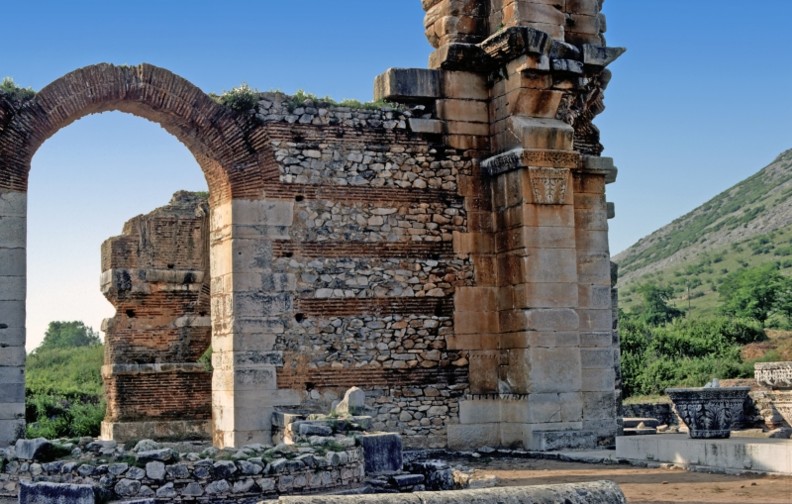
Philippi theater.

Philippi theater.

Paul then lists his credentials as a Jew, and as a Pharisee. Though a persecutor of the church, he had been in a position that was respected and honored. But all of that he says he counted as loss for knowing the Lord Jesus Christ:

that I may know him and the power of his resurrection, and may share his sufferings, becoming like him in his death, that by any means possible I may attain the resurrection from the dead.

He has not attained perfection, he knows. And he has not done anything on his own.

But one thing I do: forgetting what lies behind and straining forward to what lies ahead, I press on toward the goal for the prize of the upward call of God in Christ Jesus.  Let those of us who are mature think this way, and if in anything you think otherwise, God will reveal that also to you.

Paul knew, and he was trying to make them see, that this world is not our home. We must set our minds apart from those who wish to be of this world — those who make themselves enemies of the cross:

Their end is destruction, their god is their belly, and they glory in their shame, with minds set on earthly things. But our citizenship is in heaven, and from it we await a Savior, the Lord Jesus Christ, who will transform our lowly body to be like his glorious body, by the power that enables him even to subject all things to himself.

He closes the letter in chapter 4, sending encouragement and prayers with two of the best passages for advice for Christians of all time. The first, in verses 4-7:

Rejoice in the Lord always; again I will say, rejoice. Let your reasonableness be known to everyone. The Lord is at hand; do not be anxious about anything, but in everything by prayer and supplication with thanksgiving let your requests be made known to God. And the peace of God, which surpasses all understanding, will guard your hearts and your minds in Christ Jesus.

And the second in verse 8:

Finally, brothers, whatever is true, whatever is honorable, whatever is just, whatever is pure, whatever is lovely, whatever is commendable, if there is any excellence, if there is anything worthy of praise, think about these things.

/Bob’s boy

Bible Reading Schedule for this month
Click links below to read or listen to audio of one of this week’s chapters in Philippians and Hebrews

Phil. 3, Phil. 4, Heb. 1, Heb. 2, Heb. 3

___________________

some images © V. Gilbert & Arlisle F. Beers

Please visit this site’s menu item “The Author’s Books” for info on the author’s books, website, and Facebook page.

All of my comments in this blog are solely my responsibility. When reading any commentary, you should always refer first to the scripture, which is God’s unchanging and unfailing word.


Have This in Mind – Phillipians 1-2

Paul begins his letter to the Christians at Philippi without the statements that defend his apostleship, seen in some of the other epistles, which leads us to believe that no such controversy existed there at that time. It is another epistle written from prison; and one in which he offers encouragement for the saints there. It was the first church that he established in Europe, and where he converted the Philippian jailor. He assures them of his well-being, and in verse 12 states that his imprisonment has actually served to advance the gospel.

Philippi Basilica A.

Philippi Basilica A.

He wants them to know that he will come to see them if possible, but that whether or not he does, he wants to hear that they “are standing firm in one spirit, with one mind striving side by side for the faith of the gospel, and not frightened in anything by your opponents.” He tells them that they are privileged that for the sake of Christ they believe in him — and that they will suffer for His sake, just as Paul has.

He continues that theme in chapter two. Not only will Christians suffer for Jesus, but they are supposed to put others ahead of themselves, doing nothing from selfish ambition, but looking toward the interests of others. That is hard to do sometimes, and Paul knew it. So he gave them the following words to encourage and embolden us, knowing the reward that Jesus claimed for us:

Have this mind among yourselves, which is yours in Christ Jesus, who, though he was in the form of God, did not count equality with God a thing to be grasped, but emptied himself, by taking the form of a servant, being born in the likeness of men. And being found in human form, he humbled himself by becoming obedient to the point of death, even death on a cross.

If Jesus could selflessly do all that for us, we can endure anything comes our way in life until we receive our reward.

 /Bob’s boy

Bible Reading Schedule for this month
Click links below to read or listen to audio of one of this week’s chapters in Ephesians and Philippians

Eph. 4, Eph. 5, Eph. 6, Phil. 1, Phil. 2

___________________

some images © V. Gilbert & Arlisle F. Beers

Please visit this site’s menu item “The Author’s Books” for info on the author’s books, website, and Facebook page.

All of my comments in this blog are solely my responsibility. When reading any commentary, you should always refer first to the scripture, which is God’s unchanging and unfailing word.