Joshua 8 – The Fall of Ai

After the people had once again been consecrated, the Lord reminded Joshua not to be dismayed, and told him to take the fighting men to Ai and victory will be theirs.  An ambush is what God commanded, and that is what they did.  Joshua sent one group of warriors behind the city at night to lay in ambush to the west, between Bethel and Ai.  Joshua took the other group to camp north of the city, and he made sure to be seen.

Mt. Ebal and Mt. Gerizim, olive trees in front

So the king of Ai went out with all the men of the city to meet the Israelites in battle.  Taking advantage of the defeat of chapter 7, Joshua has them flee again – pretending a second defeat – while the men in ambush come and take the city (verses 14-17).  Seeing that the city was captured, the Israelites turn around and fight their pursuers.  As God instructed, Joshua held out his javelin toward the city and kept it pointed until the victory was complete (verses 18, 26), much as Moses did in the defeat of Amalek in Exodus 17:8-13.

The victory is significant and historic, as verses 30-35 tell us how Joshua builds the altar on Mount Ebal, following the command of Moses from Deuteronomy 27:1-8.  In verse 32, Joshua creates the fourth stone monument in the new land.

Read or listen to audio of ESV version of this selection from this link.

/Robert
___________________
some images © V. Gilbert & Arlisle F. Beers

Please note: I did not design the reading plan that I am following in my blog.  All of my comments in this blog, however, are solely my responsibility.  When reading ANY commentary, you should ALWAYS refer first to the scripture, which is God’s unchanging and unfailing word. Reading schedules, as well as a link to the site where you can get the reading plan that I’m currently following for yourself can be found on the “Bible Reading Schedules” page of my website at http://graceofourlord.com.  For questions and help, please see the “FAQ” and “Summaries” pages there.

Joshua 1 – God Commissions Joshua

Joshua prepares to lead

We move past the end of Deuteronomy and the death of Moses and into Joshua.  God speaks to Joshua and gives him the same charge that Moses did in Deuteronomy 31:6-8.  Many of God’s words here are identical to the text in Deuteronomy (Moses was speaking for the Lord, after all), and God repeats that He will be with him, will not leave or forsake him.  Three times Joshua is told to be strong and courageous – but he is also told to meditate on, and not to turn aside from, all of the law that the Lord commanded Moses.  One can surmise from this that there are going to be times during the taking of the land that it would be easy for Joshua as a leader to become frightened, dismayed, or both.

Indeed, the people he is charged with performing this task will face large numbers of opposing forces and there will be blood shed.  But the Lord said in verse 5 “No man shall be able to stand before you all the days of your life.”  With that, Joshua takes charge, and has his officers prepare to pass over the Jordan river in three days (verse 11).  he then reminds the tribes of Reuben, Gad, and Manasseh of their responsibility.  They acknowledge and pledge their allegiance (verses 16-18).

God repeats Himself as He does in the opening verses of Joshua in other places in the Bible, which is a good clue that what He is saying to us has great importance.  He reinforces His covenant now with Joshua, and promises that as long as he keeps God’s commandments, he will be successful in achieving the goal.  Our charge to keep the Lord’s commandments come from the lips of our Savior, Jesus Christ, and from His apostles repeatedly (John 14:23-24, 1 John 5:3-5,). His promise to us is that if we do so, we will make our home with Him in the end.

As we will see again soon in this very book, God always keeps His promises.

Read or listen to audio of ESV version of this selection from this link.

/Robert
___________________
some images © V. Gilbert & Arlisle F. Beers

Please note: I did not design the reading plan that I am following in my blog.  All of my comments in this blog, however, are solely my responsibility.  When reading ANY commentary, you should ALWAYS refer first to the scripture, which is God’s unchanging and unfailing word. Reading schedules, as well as a link to the site where you can get the reading plan that I’m currently following for yourself can be found on the “Bible Reading Schedules” page of my website at http://graceofourlord.com.  For questions and help, please see the “FAQ” and “Summaries” pages there.
Numbers 32 – Reuben and Gad Settle in Gilead

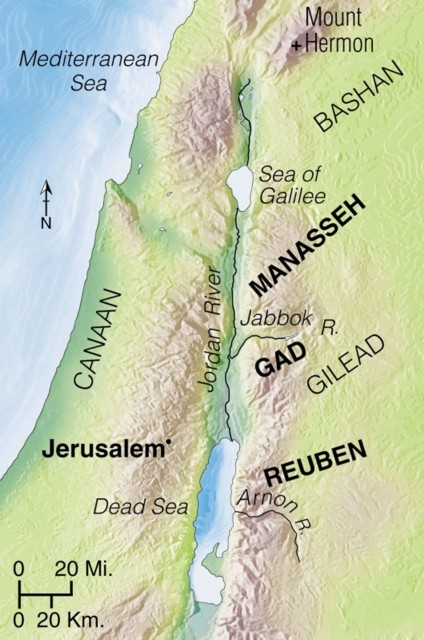
Land divided - TransJordan

The land received after the conquest of the Amorites and their king, Sihon and that of Og and the land of Bashan was found desirable to the tribes of Reuben and Gad for their vast livestock reserves.  So they propose to settle there instead of across the Jordan.

This angers Moses, as he reminds them of the consequences to the people when the spies 40 years earlier discouraged entry into the land from Kadesh-barnea.  The tribes reassure him that they will cross over to defeat the Canaanites across the Jordan anyway.

So Moses agrees under those conditions (with a stern warning – verse 23), and a portion of the land of Gilead is also set aside for the half-tribe of Manasseh after it was captured.  The portion of northern Gilead given to them is described in Joshua 13:29-31.

Read or listen to audio of ESV version of this selection from this link.

/Robert
___________________
image © V. Gilbert & Arlisle F. Beers

Please note: I did not design the reading plan that I am following in my blog.  All of my comments in this blog, however, are solely my responsibility.  When reading ANY commentary, you should ALWAYS refer first to the scripture, which is God’s unchanging and unfailing word. Reading schedules, as well as a link to the site where you can get the reading plan that I’m currently following for yourself can be found on the “Bible Reading Schedules” page of my website at http://graceofourlord.com.  For questions and help, please see the “FAQ” and “Summaries” pages there.

Numbers 21:4-9 / Num 25 – Baal Worship at Peor

Mount Hor where it is believed that Aaron brot...

Image via Wikipedia

Much has happened in the wilderness as we come into this reading.  We have skipped over Aaron’s death in chapter 20; and Moses has descended Mount Hor with Aaron’s son Eleazar.  The first part of this reading is about the bronze serpent in chapter 21, on the heels of their first victory against the Canaanites (brought on by the attack by the king of Arad).    The people have been grumbling about the “miserable food” and God has begun dealing with them in a dramatic way – with fiery serpents.  At God’s instruction, Moses makes the bronze serpent, which saves the lives of those who look upon it.  Verse 5 suggests that their grumbling was more than just a little bit disrespectful.  After the close brush with self-destruction in the golden calf fiasco, it is almost surprising to see that any of them would dare to behave in that way.  But, as we will see in the second part of this reading, it gets worse.

So why make such note of the bronze serpent passage – just about 6 verses?  Great question, actually.  First, it begs some questions – what actually saved the people?  Was it just the fact that they looked at the bronze serpent?  Did they have to believe that it would save them?  Could that belief alone have saved them – without actually doing the act of looking at it?  Jesus refers to this event in John 3:14, where he tells Nicodemus (and us) how to achieve salvation.  This reference by and about our savior is “sandwiched” between Jesus telling Nicodemus he must be born again, and the baptisms and lessons in obedience to Christ in the verses all the way to the end of John 3.   Do yourself a favor and read this entire chapter of John (36 verses) after reading Numbers 21:4-9.  Jesus’ references to being lifted up has other meaning here, as it does in John 8:28 and John 12:32.

In chapter 25, Shittim is the last encampment before the people cross the Jordan, and apostasy again rears its ugly head in a horrible affront to God.  Some scholars think this may be Tell el-Hammam (about 16 kilometers east of Jericho).  The sins are numerous and include the worship of Baal with the Moabites.  we do not find out for sure until chapter 31, but it is Balaam who leads them to this.  We are not reading his story from the last few chapters in this schedule, but he is referred to again in 2 Peter 2:15 and Jude 1:11. Eleazar’s son, Phineas gains favor with the Lord and keeps the ensuing plague from getting any worse (verses 7-9).  But this sin at Peor will not keep the Lord from sending His people to conquer the Canaanites.  It is not for their righteousness, as Moses will remind them – but for the evil of the Canaanites themselves.

Read or listen to audio of ESV version of this selection from this link.

/Robert
___________________
image © V. Gilbert & Arlisle F. Beers 

Please note: I did not design the reading plan that I am following in my blog.  All of my comments in this blog, however, are solely my responsibility.  When reading ANY commentary, you should ALWAYS refer first to the scripture, which is God’s unchanging and unfailing word. Reading schedules, as well as a link to the site where you can get the reading plan that I’m currently following for yourself can be found on the “Bible Reading Schedules” page of my website at http://graceofourlord.com.  For questions and help, please see the “FAQ” and “Summaries” pages there.

Preview – Closing Numbers \ March Week 2 Summary Posted

Moses Sees the Promised Land from Afar, as in ...

Moses Sees the Promised Land from Afar, as in Numbers 27:12, by James Tissot (Photo credit: Wikipedia)

Our Bible reading in the book of Numbers will end with chapter 32 on Tuesday, as the tribes of Reuben, Gad, and the half-tribe of Manasseh take possession of important land east of the Jordan.  This schedule will skip the book of Deuteronomy altogether in our daily reading.  This is not to minimize the importance of that book (and this blog will certainly cover much of it in the future) as the New Testament – and Jesus himself – quoted from it often.  But this ambitious reading schedule is intended to help give a better understand of the Bible (in a years reading) as a complete story – one that has a beginning, a middle, and an ending.

So, with that in mind, we will sadly say farewell to Moses as we read of God’s charge to Joshua on Wednesday and close out this month with the first three chapters of that book in God’s word.  Joshua is a very easy book of the Bible to read and love – and, more importantly, much to learn from.

Summing Up

Each weekend, I am now posting a small PDF of one week of chapter summaries (on the website’s “Summaries” page), current to the beginning of the previous week.  I have posted the summary for Week 11 (March Week 2) of the schedule I am following.  This short PDF document contains condensed comments about Exodus chapters 16, 17, 19, 20 and 24, with hyperlinks to the ESV version of each chapter for listening or reading, and joins the summaries for other weeks already posted there.

/Robert
___________________
image © V. Gilbert & Arlisle F. Beers

Please note: I did not design the reading plan that I am following in my blog.  All of my comments in this blog, however, are solely my responsibility.  When reading ANY commentary, you should ALWAYS refer first to the scripture, which is God’s unchanging and unfailing word. Reading schedules, as well as a link to the site where you can get the reading plan that I’m currently following for yourself can be found on the “Bible Reading Schedules” page of my website at http://graceofourlord.com.  For questions and help, please see the “FAQ” and “Summaries” pages there.

Numbers 14 – The People Rebel

English: The spies showing the fertility of Ca...

Image via Wikipedia

Once again, the people who have seen the power and the Glory of the Lord with their own eyes forget His promise and this time, believing the report of the spies and (as Joshua and Caleb aptly put it in verse 9) rebelling against the Lord will cost them dearly.  God is once again fed up with their disobedience; and in verse 12, He tells Moses (as He did in Exodus 32:10) that He will destroy them and start over with Moses.

But Moses again intercedes and passionately pleads with the Lord in verses 13-19.  It is this blogger’s opinion that the Lord relented on their destruction not because of Moses’ argument in those verses about what the nations around them will think.  The Lord’s time is His own, and He would do as He wills and the nations would see His power anyway.  Consider instead, His simple statement afterward in verse 20.  “I have pardoned, according to your word.”  That was it.  Moses favor and his request were enough to grant their pardon.

So just as Pharaoh decided the fate of his own in Exodus 11:5, siding with the spies and disobeying God would mean that these people decided their own fate.  Instead of their little ones becoming a prey as they said in verse 3, those little ones will be the ones to enter Canaan – only after these people all die in the wilderness.  But except for Caleb and Joshua, the spies would all meet their doom more quickly (verse 38).

Having received this news, the people have a change of heart and despite Moses’ warning that God would no longer be with them, they make an attempt to enter Canaan anyway – and are soundly defeated (verses 40-45).  The time for obeying God is always now.

Read or listen to audio of ESV version of this selection from this link.

/Robert
___________________
image © V. Gilbert & Arlisle F. Beers

Please note: I did not design the reading plan that I am following in my blog.  All of my comments in this blog, however, are solely my responsibility.  When reading ANY commentary, you should ALWAYS refer first to the scripture, which is God’s unchanging and unfailing word. Reading schedules, as well as a link to the site where you can get the reading plan that I’m currently following for yourself can be found on the “Bible Reading Schedules” page of my website at http://graceofourlord.com.  For questions and help, please see the “FAQ” and “Summaries” pages there.

Numbers 13 – Spies Sent into Canaan

English: The Spies Return from Canaan, engravi...

Image via Wikipedia

We take the story of God’s word up now almost half way into the Book of Numbers.  The people of Israel left Sinai in chapter 10 and the Lord makes the command for one leader from each of the tribes of their fathers to be sent into the land of Canaan to spy.  Notice the reminder in verse 2 that this is the Land that He is giving to the people of Israel.  But except for Joshua and Caleb, the spies forget the promise.  After 40 days travel through the Negeb (or Negev), Hebron. Ahiman, Sheshai, and Talmai, they bring back a report that the land is indeed good.  But their description of the way the land is defended, and indeed the people themselves (verses 32-33) is calculated to persuade the people that taking the land would be impossible.

(Side note: Some background on the Negeb (or Negev) along with a modern photo are provided in this article at Ferrell’s Travel Blog)

Read or listen to audio of ESV version of this selection from this link.

/Robert
___________________
some images © V. Gilbert & Arlisle F. Beers

Please note: I did not design the reading plan that I am following in my blog.  All of my comments in this blog, however, are solely my responsibility.  When reading ANY commentary, you should ALWAYS refer first to the scripture, which is God’s unchanging and unfailing word. Reading schedules, as well as a link to the site where you can get the reading plan that I’m currently following for yourself can be found on the “Bible Reading Schedules” page of my website at http://graceofourlord.com.  For questions and help, please see the “FAQ” and “Summaries” pages there.

Exodus 40 – The Tabernacle Erected

The Tabernacle, Camp, & c.

Image via Wikipedia

Chapter 40 is extremely momentous in the story of God’s people and our salvation.  After the golden calf disaster, the covenant with the Lord has been renewed, the instructions for the construction of the Tabernacle were given; and in verses 16-19, it was erected as the Lord commanded a year after they came to Sinai (verse 17 – “the first month in the second year, on the first day of the month”).  The previous chapters were rich with the description of the tabernacle in every particle, showing us that God does indeed care about the details of his commands.  Here too, in verses 18-33 much detail is given; and the important preparations for Aaron and his sons to assume the role of priests for generations to come is given.  This is described further in Leviticus 8:1-13.

The Glory of the Lord in verses 34-38 is an important sign that the Lord is now dwelling among His people after He approves of the Tabernacle.  It is a presence that the people will cherish as their relationship with Him has been restored, and this momentous occasion will be repeated with much celebration after Solomon builds the Temple in 1 Kings 8:10-11.

Read or listen to audio of ESV version of this selection from this link.

/Robert
___________________
some images © V. Gilbert & Arlisle F. Beers

Please note: I did not design the reading plan that I am following in my blog.  All of my comments in this blog, however, are solely my responsibility.  When reading ANY commentary, you should ALWAYS refer first to the scripture, which is God’s unchanging and unfailing word. Reading schedules, as well as a link to the site where you can get the reading plan that I’m currently following for yourself can be found on the “Bible Reading Schedules” page of my website at http://graceofourlord.com.  For questions and help, please see the “FAQ” and “Summaries” pages there.

Exodus 33 – The Command to Leave Sinai

Climbing the trail near the summit of Mount Sinai.

Image via Wikipedia

The Lord tells Moses to take the people and leave Mount Sinai for Canaan; and again tells him that He will send an angel, but He will not go with them.  The people feel the loss in this proclamation (verse 4), and Moses intercedes.  Moses has matured, and has found favor with God, and their relationship reminds us of that of the Lord with Abraham – as verse 11 even uses the comparison of their conversations to that which occurs between friends.  God’s favor with Abraham as friend is recounted in Isaiah 41:8, where He reassures His people; as well as in James 2:23.

Moses also brings Abraham’s bargaining intercession to mind (from Genesis 18:22-33), as he pleads for the people in verses 12-16.  the Lord agrees in verse 17 because Moses has “found favor in my sight, and I know you by name.”  Despite His very real and righteous anger, the Lord seems to be training Moses as the leader that He wants him to be.  His request in verse 18 should be understood as desire for an outward sign of his favor with the Lord as His chosen leader of the people.

Read or listen to audio of ESV version of this selection from this link.

/Robert
___________________
some images © V. Gilbert & Arlisle F. Beers

Please note: I did not design the reading plan that I am following in my blog.  All of my comments in this blog, however, are solely my responsibility.  When reading ANY commentary, you should ALWAYS refer first to the scripture, which is God’s unchanging and unfailing word. Reading schedules, as well as a link to the site where you can get the reading plan that I’m currently following for yourself can be found on the “Bible Reading Schedules” page of my website at http://graceofourlord.com.  For questions and help, please see the “FAQ” and “Summaries” pages there.

Exodus 32 – The Golden Calf

English: Worshiping the golden calf, as in Exo...

Image via Wikipedia

It is hard to believe that these are the people who in Exodus 20:18-19 were so fearful and in awe of the Lord; and that in Exodus 20:23 were explicitly warned not to make idols.  Could it be any coincidence that the disaster of Jeroboam I making the two idols was done with him using almost the exact words of verse 4, when he said in 1 Kings 12:28 “Behold your gods, O Israel, who brought you up out of the land of Egypt”?  The golden calf was probably the Egyptian bull “deity” Apis.  Sadly, Aaron’s confession to Moses about what they had done is so lame in verses 22-24 – He just threw their gold into the fire, and out comes this calf!  Does any of that remind you of Adam in Genesis 3:12, as it does me?

Joshua had been waiting for Moses at his post on the mountain when he remarked to Moses that the noise from the people below sounded like war.  Notice that Moses, having been informed by the Lord, asks in verse 26 “Who is on the Lord’s side?”  When the sons of Levi come to his side, he orders them to put to death a number of those who did not come at that time – an easy detail to miss with so much happening.  In verse 29, he blesses them, saying that they have been ordained for the Lord.

But the Lord is rightfully hot with anger at this “stiff-necked people” and He wants nothing more to do with them.  Stephen refers to those who had rejected Jesus in the same way in Acts 7:51, before he is stoned.

(Side note: more information about the Egyptian idol that the calf may have been fashioned after can be found in this Wikipedia article)

Read or listen to audio of ESV version of this selection from this link.

/Robert
___________________
image © V. Gilbert & Arlisle F. Beers

Please note: I did not design the reading plan that I am following in my blog.  All of my comments in this blog, however, are solely my responsibility.  When reading ANY commentary, you should ALWAYS refer first to the scripture, which is God’s unchanging and unfailing word. Reading schedules, as well as a link to the site where you can get the reading plan that I’m currently following for yourself can be found on the “Bible Reading Schedules” page of my website at http://graceofourlord.com.  For questions and help, please see the “FAQ” and “Summaries” pages there.