Revelation 21 – The New Jerusalem

With all of the imagery amid these chapters, just what is meant by a new heaven and a new earth is highly debated.  Many see it as a literal renewal of earth after the old has passed away.  But much about what is spoken of in this chapter simply does not fit into such a notion.  2 Peter 3:10-13 affirms that the earth and the heavenly bodies will be destroyed – burned up  – after the judgment.  Just how this imagery of a new heaven and a new earth does fit into the coming of the faithful to heaven is uncertain.  What is certain is that there will be a literal new home for the faithful that is so wonderful than our minds probably could not grasp it without the imagery contained here that is full of references to precious metals and jewels and such.

Alexander building a wall against Gog and Magog

Alexander building a wall against Gog and Magog (Photo credit: Wikipedia)

No sun or moon will be needed because “the glory of God gives it light, and its lamp is the Lamb.”  No temple is there because God will be in the midst of his faithful, and they shall be His people.  This is an echo of the prophetic language in Isaiah 60:19-20.  The description of John being carried away in the Spirit to the high mountain to view the new Jerusalem is reminiscent of the time after “Gog and Magog’s” destruction Ezekiel 38-39, when Ezekiel was transported to “a very high mountain” (Ezekiel 40:2-3) to see the future temple of God.  The measurements done this time are enormous (a stadia was about 185 meters) and all are multiples of twelve; and the number is repeated in other descriptions here as both the twelve apostles and the twelve tribes of Israel are mentioned.  Both of these groups were important, after all, in both the old covenant and the new covenant.

The last word of comfort in this chapter for these first century Christians – and for us – is that once in heaven, no longer will they have to live among those who do evil in the world or, most especially, do evil to them, as verse 27 says “…nothing unclean will ever enter it, nor anyone who does what is detestable or false, but only those who are written in the Lamb’s book of life.”

Read or listen to audio of ESV version of this selection from this link.

/Bob’s boy
___________________
some images © V. Gilbert & Arlisle F. Beers

Please note: I did not design the reading plan that I am following in my blog.  All of my comments in this blog, however, are solely my responsibility.  When reading ANY commentary, you should ALWAYS refer first to the scripture, which is God’s unchanging and unfailing word. Reading schedules, as well as a link to the site where you can get the reading plan that I’m currently following for yourself can be found on the “Bible Reading Schedules” page of my website at http://graceofourlord.com.  For questions and help, please see the “FAQ” and “Summaries” pages there.

Revelation 5 – The Scroll and the Lamb

The lion is the symbol of the Tribe of Judah. ...

The lion is the symbol of the Tribe of Judah. It is often represented in Jewish art, such as this sculpture outside a synagogue (Photo credit: Wikipedia)

The image here of God holding the scroll that no one in heaven or on earth was worthy to open is certainly a symbol of the fulfillment of God’s plan for the redemption of man and our salvation.  Jesus is the only one that could fill that post.  The image of the Lamb who is the Lion of Judah ( a reference to Genesis 49:9) from the root of David all point back to Isaiah (Isaiah 11:1, 10, Isaiah 53:4-7).  Taking the scroll from the hand of God is clearly symbolic of Jesus, the Lamb, having been crucified, thereby fulfilling God’s plan and taking His place there with God, having proved himself worthy to be praised and worshiped as God was in the previous chapter (verses 9-11).

Read or listen to audio of ESV version of this selection from this link.

/Bob’s boy
___________________
some images © V. Gilbert & Arlisle F. Beers

Please note: I did not design the reading plan that I am following in my blog.  All of my comments in this blog, however, are solely my responsibility.  When reading ANY commentary, you should ALWAYS refer first to the scripture, which is God’s unchanging and unfailing word. Reading schedules, as well as a link to the site where you can get the reading plan that I’m currently following for yourself can be found on the “Bible Reading Schedules” page of my website at http://graceofourlord.com.  For questions and help, please see the “FAQ” and “Summaries” pages there.

Hebrews 9 – Redemption Through the Blood of Christ

When Aaron prepared the Levites for consecration, he adjusted the seven lamps of the menorah, candlestick, or lampstand forward.(Numbers 8:1-4).

When Aaron prepared the Levites for consecration, he adjusted the seven lamps of the menorah, candlestick, or lampstand forward.(Numbers 8:1-4).

When considering this chapter’s beginning, as it speaks of the tabernacle prepared by Moses instead of the Herodian temple, it is because the theme of the writer is that of the covenant being “inaugurated” (verse 18), or “sealed.” Moses did so with the blood of animals, as verses 19-21 remind us.   As verse 22 says, “Indeed, under the law almost everything is purified with blood, and without the shedding of blood there is no forgiveness of sins.”  Jesus Christ sealed the new covenant with His own blood.

The tabernacle and the items inside (the lampstand, table, the Bread of the Presence, etc) described in the first few verses, are detailed for the most part in Exodus 25, 30 and 37. As the text says, only the high priest could enter the section that was the “Most Holy Place,” and even he could only do so once a year – to offer blood for himself and for the unintentional sins of others (verse 7) – which had to be repeated each year.  All these things, it says, were mere copies of the heavenly things (verse 23).  Jesus entered the true “Most Holy Place” which is heaven, by offering His own blood – “once for all” and “thus securing an eternal redemption” for us all.  Verse 28 concludes with the glorious promise for us: “so Christ, having been offered once to bear the sins of many, will appear a second time, not to deal with sin but to save those who are eagerly waiting for him.”

The Arch of Titus from outside the Forum, Rome, Italy.  Located at the highest point of the Via Sacra which leads to the Roman Forum, this triumphal arch, with only one passageway, commemorates Titus' conquest of Judea which ended the Jewish Wars (66-70). Engaged fluted columns frame the passageway.

The Arch of Titus from outside the Forum, Rome, Italy. Located at the highest point of the Via Sacra which leads to the Roman Forum, this triumphal arch, with only one passageway, commemorates Titus’ conquest of Judea which ended the Jewish Wars (66-70). Engaged fluted columns frame the passageway.

As an aside, Coffman offers some interesting facts regarding the Holy things of the temple:

History, through the overruling providence of God, has preserved a likeness of the golden candlestick that was in the Herodian temple destroyed by Vespasian and Titus in 70 A.D. The candlestick, along with other treasures, was looted and carried in the triumphal procession in Rome; and, when the Arch of Titus was constructed to memorialize the victory, both the table of showbread and the candlestick were detailed in the carvings decorating the arch and may still be seen there in the excavated ruins of ancient Rome. Plaster casts of those carvings are exhibited in the Metropolitan Museum, New York; and from these is evident the immense weight of those golden treasures, several men being necessary to bear each of them.

Read or listen to audio of ESV version of this selection from this link.

/Bob’s boy
___________________
some images © V. Gilbert & Arlisle F. Beers

Please note: I did not design the reading plan that I am following in my blog.  All of my comments in this blog, however, are solely my responsibility.  When reading ANY commentary, you should ALWAYS refer first to the scripture, which is God’s unchanging and unfailing word. Reading schedules, as well as a link to the site where you can get the reading plan that I’m currently following for yourself can be found on the “Bible Reading Schedules” page of my website at http://graceofourlord.com.  For questions and help, please see the “FAQ” and “Summaries” pages there.

Hebrews 7 – Jesus Compared to Melchizedek

The Hebrew writer has already, in previous chapters, made much mention of Jesus being our High Priest, after the order of Melchizedek.  But who was this Melchizedek?  We know only as much, as always, as God ordained important for us to know.  The Old Testament only speaks of him in two places – Genesis 14:17-20, and again in the Messianic royal Psalm 110 (110:4), which is quoted here in this chapter again.  After Abraham came back from rescuing his abducted kinsman, Lot, and after what is called here “the slaughter of the kings” (see Genesis 14:1-16), he was visited by Melchizedek, “king of Salem” and “priest of God Most High,” who blessed him.  Some believe that the Salem mentioned here is the same historical location as Jerusalem, but we do not know for sure, as another possibility exists.  The name is related to the Hebrew word for “peace,” and Melchizedek translates to “king of righteousness.”

Having conquered Sodom, Kedorlaomer left for his home country, taking many captives with him. Abram learned what had happened and chased Kedorlaomer past Dan and beyond Damascus. There he defeated the king and rescued the captives, among them Lot. After Abram (Abraham) rescued Lot from Kedorlaomer, he met Melchizedek, a king and a priest of God. Abram gave ten percent of (tithed) all he had recovered.

Having conquered Sodom, Kedorlaomer left for his home country, taking many captives with him. Abram learned what had happened and chased Kedorlaomer past Dan and beyond Damascus. There he defeated the king and rescued the captives, among them Lot. After Abram (Abraham) rescued Lot from Kedorlaomer, he met Melchizedek, a king and a priest of God. Abram gave ten percent of (tithed) all he had recovered.

What is of note here, is that the Hebrew writer points out that Melchizedek was superior to Abraham, and blessed him.  From Abraham’s loins, Levi would come; and it was only the Levitical line that could be priests among the Israelites.  But Abraham paid tithes to this “priest of God Most High,” and so he was greater than even those priests – though he was both not a Levite, nor even a Jew.  Yet he held two distinct positions – that of king and priest, and is exalted as “great” here, and the writer declares that “it is beyond dispute that the inferior is blessed by the superior” (verse 7).  It is after this order that Jesus Christ, the Son of God, became our High Priest, though He was not from the tribe of Levi either.

What about verse 3?  It says of Melchizedek: “He is without father or mother or genealogy, having neither beginning of days nor end of life, but resembling the Son of God he continues a priest forever.”  Melchizedek is a real historical figure of the Old Testament, and the best way to think of this is that he has no recorded genealogy in Scripture which is intended to validate his priesthood.  In addition, unlike the Levitical priests, has no recorded death which transfers his priesthood to another, so he continues as one forever, just as Jesus continues forever as our High Priest and King.  The former priests were “prevented by death from continuing in office” (verse 23).  So the Law requiring the priest to be a Levite (Numbers 18) has been set aside by Jesus, “the guarantor of a better covenant” (verse 22).

Our High Priest has no need to offer sacrifices like the Aaronic priests, because “he did this once for all when he offered up himself” (verse 27).  He is unstained by sin, this perfect Son of God, who was made priest with an oath of the Lord (verses 17, 21, 28, Psalm 110:4).

Read or listen to audio of ESV version of this selection from this link.

/Bob’s boy
___________________
some images © V. Gilbert & Arlisle F. Beers

Please note: I did not design the reading plan that I am following in my blog.  All of my comments in this blog, however, are solely my responsibility.  When reading ANY commentary, you should ALWAYS refer first to the scripture, which is God’s unchanging and unfailing word. Reading schedules, as well as a link to the site where you can get the reading plan that I’m currently following for yourself can be found on the “Bible Reading Schedules” page of my website at http://graceofourlord.com.  For questions and help, please see the “FAQ” and “Summaries” pages there.

Hebrews 6 – The Certainty of God’s Promise

The Hebrew writer continues in this chapter after his rebuke to the recipients of the letter in chapter 5, stating that it is time to move from “the elementary doctrine of Christ and go on to maturity….” This does not mean that the first principles of Christianity to which he refers are unimportant, or that they should be forgotten.  Rather, it is time for them to grow into maturity spiritually;  and they will do that (as will we) by diligently studying the Scriptures and “by constant practice to distinguish good from evil” as stated in 5:14.

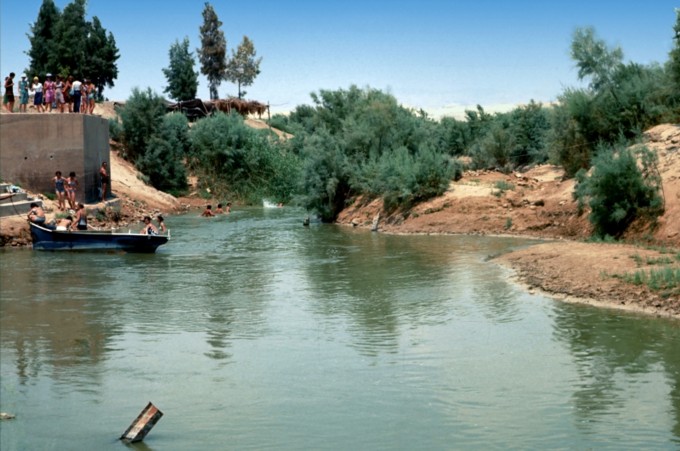
Jordan River, traditional site of Jesus' baptism

Jordan River, traditional site of Jesus’ baptism

Verses 4-8 do not refer to sin that is unforgivable by God.  As 1 John 1:7 says the blood of Jesus his Son cleanses us from all sin.”  But the text does make it plain that those who have been saved can fall away from the Lord, and we must be careful.  When he says that it is impossible to bring such a person who once “shared in the Holy Spirit” back to repentance, he means it is impossible for his fellow Christians to bring that person to repentance if his heart has been hardened.  Nothing is impossible for God, however, and He has and does bring some who have fallen into apostasy back.  But living a life of sin once one has known the truth can result in a condition of heart and spirit from which there is no return.

Verses 13-20 remind us of the promise God made to Abraham and his heirs – that He made it with an oath, and it is impossible for God to lie (Titus 1:1-2), promising the faithful heirs eternal life.  And as Christians, baptized into Christ, we are those heirs (Galatians 3:27-29).  As verses 19-20 conclude, we have that hope as a steadfast anchor through Jesus “having become a high priest forever after the order of Melchizedek.”

Read or listen to audio of ESV version of this selection from this link.

/Bob’s boy
___________________
some images © V. Gilbert & Arlisle F. Beers

Please note: I did not design the reading plan that I am following in my blog.  All of my comments in this blog, however, are solely my responsibility.  When reading ANY commentary, you should ALWAYS refer first to the scripture, which is God’s unchanging and unfailing word. Reading schedules, as well as a link to the site where you can get the reading plan that I’m currently following for yourself can be found on the “Bible Reading Schedules” page of my website at http://graceofourlord.com.  For questions and help, please see the “FAQ” and “Summaries” pages there.
Hebrews 5 – Warning Against Apostatsy

The Hebrew writer continues on the subject of Jesus as our high priest.  To understand the context of this writing, we should remember that many of the Christians this letter was written to were Jews or Gentiles that had first aspired to Judaism before becoming Christians.  Much of their persecution would not be happening to them if they had not become followers of Christ; and their lives would be much easier if they turned back to Judaism.  Secondly, the high priest was an attractive and important part of that faith they had previously known. Coffman’s summary as follows is well put:

Jewish high priest wearing a hoshen, and Levit...

Jewish high priest wearing a hoshen, and Levites in ancient Judah. (Photo credit: Wikipedia)

Without doubt, the earthly splendor of the Jewish high priest was a factor of seductive influence on Christians, especially those of Jewish background. His rich robes, the extravagantly ornate breastplate, the unique privilege of entering the Holy of Holies on the day of atonement, his status as judge and president of the Sanhedrin, his dramatic influence as the official representative of the Jewish nation, more especially at a time when they had no king, the traditional descent of the office from the sons of Aaron and reaching all the way back to the Exodus, and the grudging respect paid to the office, even by Roman conquerors – all these things and many others elevated the Jewish high priest to a position of isolated splendor in the eyes of the people.

The writer is letting them know that they still have a high priest – but a better one now!  Jesus is their high priest and intercedes for us now, and he is fully qualified – and was appointed as such by God (verses 5-6)!  But they should know this by now, and the writer rebukes them, warning them not to fall back into their old ways.  By now, he says, they should be teaching others, but they need teaching again themselves.  They “…need milk, not solid food” (verse 12) – meaning they have to get back to the first principles of Christianity before they can move forward with maturity.

Read or listen to audio of ESV version of this selection from this link.

/Bob’s boy
___________________
some images © V. Gilbert & Arlisle F. Beers

Please note: I did not design the reading plan that I am following in my blog.  All of my comments in this blog, however, are solely my responsibility.  When reading ANY commentary, you should ALWAYS refer first to the scripture, which is God’s unchanging and unfailing word. Reading schedules, as well as a link to the site where you can get the reading plan that I’m currently following for yourself can be found on the “Bible Reading Schedules” page of my website at http://graceofourlord.com.  For questions and help, please see the “FAQ” and “Summaries” pages there.

Hebrews 4 – Jesus the Great High Priest

The Hebrew writer continues the theme he began in chapter 3 of the rest that was prepared by God for us – “his works were finished from the foundation of the world.”  “Rest” here for us is entrance into heaven.  They received “good news” in the old covenant, but the message did not benefit them because they were not faithful in their belief.  The point that the writer is making in the first few verses is that the promise is ours to forfeit – just as it was theirs (verse 11).  Verse 12’s reference to the word of God as “living” is not in the sense of John 1:1, but that of 1 Peter 1:23 and others that refer to it as such.

praying_handsCoffman says a lot about verse 12 that seems right on the mark: “The word ‘active’ shows that the word does not lie inert and dead but at all times carries within itself the mighty power of its divine author. Rather than trying to find subtle differences in the meaning of such words as ‘soul’ and ‘spirit,’ it is perhaps just as well to view this verse as a heaping together of powerful terms for the purpose of showing the utmost ability of the word of God to penetrate the complex inward nature of man, to convict him of sin, to expose his hidden motives, and to judge the very nature of life itself….The passage presents God’s word as totally different from the word of men, making it infinite in power, all-seeing in discernment, and able to pierce or penetrate any human subterfuge.”
And just so, verse 13 tells the reader that there is nobody that can hide from Him – we are all “naked and exposed to the eyes of him to whom we must give account.”

Verses 14-16 pick back up on Chapter 3’s reference to Jesus as our high priest – a subject to which the writer speaks much about in this epistle – and points out that he is not one that is unable to sympathize with our weaknesses.  The Lord experienced temptation “in every respect,” it says.  So we can approach our Father through Him with confidence (verse 16) “that we may receive mercy and find grace to help in time of need.”  What a reassuring passage!  We often speak of someone “being there” for us.  Jesus truly is!

Read or listen to audio of ESV version of this selection from this link.

/Bob’s boy
___________________
some images © V. Gilbert & Arlisle F. Beers

Please note: I did not design the reading plan that I am following in my blog.  All of my comments in this blog, however, are solely my responsibility.  When reading ANY commentary, you should ALWAYS refer first to the scripture, which is God’s unchanging and unfailing word. Reading schedules, as well as a link to the site where you can get the reading plan that I’m currently following for yourself can be found on the “Bible Reading Schedules” page of my website at http://graceofourlord.com.  For questions and help, please see the “FAQ” and “Summaries” pages there.

Hebrews 3 – Jesus Greater Than Moses

Mount Nebo, where Moses could see the Promised Land, but could not enter it.

Mount Nebo, where Moses could see the Promised Land, but could not enter it.

This chapter by the Hebrew writer is the only place in Scripture that Jesus is called an apostle.  Remember that an apostle is another word for a messenger, one who is sent (or more correctly, one who is commissioned, so that the messenger has the authority of the one who sent him).  Jesus said in John 12:49. “For I have not spoken on my own authority, but the Father who sent me has himself given me ma commandment—what to say and what to speak.”  The writer continues that Jesus was faithful to Him that appointed Him, just as Moses was faithful in all God’s house.  But Moses was faithful as a servant.  Note that the writer says that Jesus is faithful over God’s house as a son – and we are that house.  But verse 6 reminds that we must persevere (hold fast) in the Christian life.

Verses 7-11 are quoted from Psalm 95:7-11,   We are warned as benefactors of the new covenant to not do as those who fell away in the old covenant.  We need the fellowship of our Christian brothers and sisters, so that we “…exhort one another every day, as long as it is called ‘today,’ that none of you may be hardened by the deceitfulness of sin.”

Read or listen to audio of ESV version of this selection from this link.

/Bob’s boy
___________________
some images © V. Gilbert & Arlisle F. Beers

Please note: I did not design the reading plan that I am following in my blog.  All of my comments in this blog, however, are solely my responsibility.  When reading ANY commentary, you should ALWAYS refer first to the scripture, which is God’s unchanging and unfailing word. Reading schedules, as well as a link to the site where you can get the reading plan that I’m currently following for yourself can be found on the “Bible Reading Schedules” page of my website at http://graceofourlord.com.  For questions and help, please see the “FAQ” and “Summaries” pages there.

Ephesians 5 – Walk In Love

As Paul opens in this chapter telling the Ephesians to be imitators of God, he tells them in verse 2 to “walk in love.”  The verb “walk” is used to mean “to live ones life, and exhibit the characteristics of.” This fits perfectly with 1 John 4:8, which says “Anyone who does not love does not know God, because God is love.”  Paul refers to the expectation that Christians walk in love in other passages such as Romans 14:15, and says it is what “binds everything together in perfect harmony (Colossians 3:14).

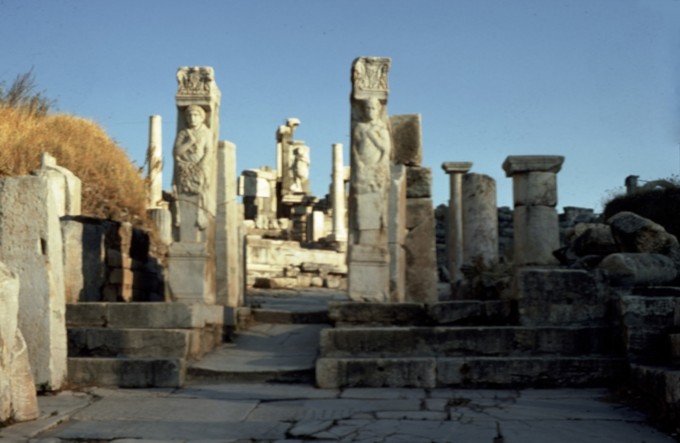
Ruins at Ephesus

Ruins at Ephesus

Paul contrasts that by urging them to stay away from sexual immorality (which covers everything outside of relations between a husband and a wife), as well as all impurity and covetousness – which is idolatry – and even filthy talk, or crude joking.  Indeed, he says that such should not even be named of the people of God.  A Christian’s integrity and reputation matter, and public sins dishonor the Lord.  He makes it clear in verse 5 that those who are guilty of these things have “no inheritance in the kingdom of Christ and God.”  Verse 8’s “children of light” remind us of Jesus’ words in John 12:35-36.

Verses 21-33 deal with the relationship of a husband and wife – not women and men in general.  Paul restates Genesis 3:16 in terms of the husband being the head of the wife, just as Jesus is the head of the church (Ephesians 1:22-23).  But that does not give the husband license to be a tyrant.  Rather, the husband is to love his wife as Jesus loved the church, and “gave himself up for her.”  A wife should be able to count on just such love from her husband.  Verse 31 quotes Genesis 2:24, as they become one flesh; and the husband should also love his wife as he loves himself.

Read or listen to audio of ESV version of this selection from this link.

/Bob’s boy
___________________
some images © V. Gilbert & Arlisle F. Beers

Please note: I did not design the reading plan that I am following in my blog.  All of my comments in this blog, however, are solely my responsibility.  When reading ANY commentary, you should ALWAYS refer first to the scripture, which is God’s unchanging and unfailing word. Reading schedules, as well as a link to the site where you can get the reading plan that I’m currently following for yourself can be found on the “Bible Reading Schedules” page of my website at http://graceofourlord.com.  For questions and help, please see the “FAQ” and “Summaries” pages there.
Nearing Year End \ Week 47 summary posted

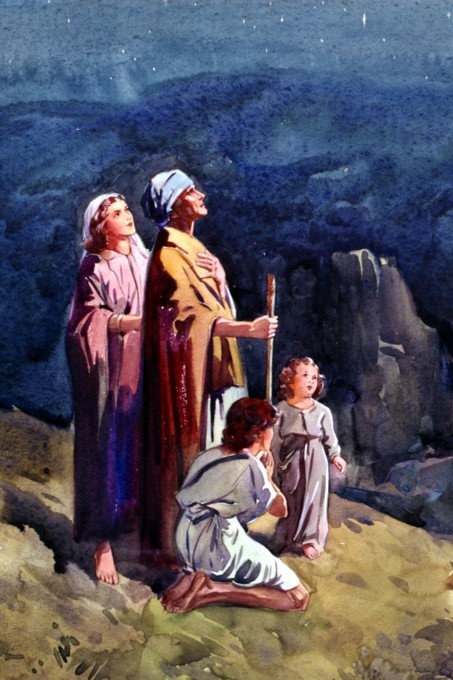
Israelites of the Old Testament look toward the coming of the Messiah — Malachi 3:1-5, Isaiah 53

As December has now arrived, it seems hard to believe that 11 months have passed since this blog started on this Bible reading plan.  We began literally “In the beginning” in Genesis, reading the first promise of the Messiah (Genesis 3:15) and, therefore, the first hints of God’s plan for man’s salvation.  Truly, one could not follow even this easy plan without seeing that the Bible is one story, with a beginning, a middle, and soon we will find, and end as well.  We read of the ancestry, birth, life, and sacrificial death of our Lord and Savior, Jesus Christ.  The focus o the Scripture now is clearly on looking ahead to Jesus’ return, as we all are; and we still have a month of the New Testament left of getting the “big picture” of the Bible.

Summing Up

Each weekend, I am now posting a small PDF of one week of chapter summaries (on the website’s “Summaries” page), current to the beginning of the previous week.  I have posted the summary for Week 47 (November Week 3) of the schedule I am following.  This short PDF document contains condensed comments about Romans 15, Acts 21, 22, 23, and 24, with hyperlinks to the ESV version of each chapter for listening or reading, and joins the summaries for other weeks already posted there.

/Bob’s boy
___________________
image © V. Gilbert & Arlisle F. Beers

Please note: I did not design the reading plan that I am following in my blog.  All of my comments in this blog, however, are solely my responsibility.  When reading ANY commentary, you should ALWAYS refer first to the scripture, which is God’s unchanging and unfailing word. Reading schedules, as well as a link to the site where you can get the reading plan that I’m currently following for yourself can be found on the “Bible Reading Schedules” page of my website at http://graceofourlord.com.  For questions and help, please see the “FAQ” and “Summaries” pages there.