Psalm 61 – Lead Me to the Rock

As a lament, Psalm 61, though very short,  is one of the more beautiful, and one of the better known hymns that come from it is  “The Rock that is Higher than I” (verse 2).  Most scholars believe that this psalm was written during the time of Absalam’s conspiracy and David’s flight from Jerusalem (2 Samuel 15-18).  It is viewed as an individual lament, as David is asking the Lord to “hear my cry” (verse 1) and “prolong the life of the king” (verse 6).

mountain_003But as short as it is, it obviously is more than that, and it is easy to see why it has been popular for so long as both a congregational song and morning prayer.  Consider verse 2 “from the end of the earth I call to you when my heart is faint. Lead me to the rock that is higher than I.”  Then consider verse 5: “you have given me the heritage of those who fear your name.” 

That heritage is the covenant God made with David in 2 Samuel 7 – that of our Lord Jesus coming through the Davidic line.  The rest of verse 6 and verse 7 cinch it, as David finishes his prayer making it obvious that it was written after that covenant was made: “Prolong the life of the king; may his years endure to all generations! May he be enthroned forever before God…”

Read or listen to audio of ESV version of this selection from this link.

/Bob’s boy
___________________
some images © V. Gilbert & Arlisle F. Beers

Please note: I did not design the reading plan that I am following in my blog.  All of my comments in this blog, however, are solely my responsibility.  When reading ANY commentary, you should ALWAYS refer first to the scripture, which is God’s unchanging and unfailing word. Reading schedules, as well as a link to the site where you can get the reading plan that I’m currently following for yourself can be found on the “Bible Reading Schedules” page of my website at http://graceofourlord.com.  For questions and help, please see the “FAQ” and “Summaries” pages there.

Old Testament Facts – Why Read Leviticus?

The third book of the Pentateuch (the Books of Law) – Leviticus – is one of the least understood books of the Bible and, not surprisingly, one of the least read.  Many “read the whole Bible in a year” reading plans have come to a dead stop in the early chapters of this book.  And without question, it can be a difficult book to get through.  But there is much to learn from it that is very relevant to our understanding of the worship of the Lord and the ultimate coming of Jesus the Christ.

Leviticus

In the Septuagint, this book is called “leyitikon,” which means “things concerning Levites.”  There is much that applies to God’s people in general, both with moral and ethical values, as well as with ritual purity.  But the name is appropriate because the Levites were those that were charged with seeing that ritual adherence was maintained. 

It is important for those who read these Scriptures today to remember that although some aspects of these rituals seem strange and difficult at times to understand, it is still the word of God, and there is much we can learn from it.  This is especially true as we relate it to the sacrifice of Jesus Christ, which unlike these offerings, provides for true forgiveness.  A close study of the different offerings will give the reader a deeper understanding and appreciation of the cross.  It is important in that study to know that ritual “uncleanness” and purity have nothing to do with hygiene; and equally important to know the difference (as well as the connection) with moral purity.

So what can we possibly learn from Leviticus that is relevant to New Testament Christianity?

The answer, it turns out, is plenty:

  • The Lord is to dwell with them (Exodus 40:34), so it is the duty of His people to deal with their sins and drive themselves toward holiness.
  • The Lord expects worship to Him to be done according to His will, and He does “sweat the details” (Leviticus 22:17-30)
  • As per the Day of Atonement ritual (Leviticus 16), the cleansing of sins is impossible from the human side.
  • Spiritual leaders bear a heavy burden of responsibility (Leviticus 4, Lev 21).  Compare to elders in 1 Timothy 5:17-25, for example.
  • Sin is dealt with by the grace of the Lord (Leviticus 17:11).

   Key Concepts and Events

/Bob’s boy
___________________
image © V. Gilbert & Arlisle F. Beers


Psalm 69 – Deliver Me

depression_002This psalm is another of those that apply both to David and to Jesus.  Whether from a time when David was on the run from Saul, we do not know, nor does it matter.  He is crying out to God, clearly suffering and just as clearly afraid.  Many appeals contained in this psalm are appropriate for prayer today at times when life is bleak:

Save me, O God!
For the waters have come up to my neck.
I sink in deep mire,
where there is no foothold;
I have come into deep waters,
and the flood sweeps over me.

But the psalm is indicative of the Messiah’s plight in places as well.  Verse 4 (“They hated me without a cause”) is quoted by Jesus in John 15:25.  Verse 9 (zeal for your house has consumed me) is quoted in John 2:17.  And verse 21 (“They gave me poison for food,and for my thirst they gave me sour wine to drink”) is referred to in all four gospels (such as Luke 23:36).   Indeed, this psalm is quoted by Paul in Romans 15:3 (69:9b), Romans 11:9 (69:22), Romans 11:10 (69:23), and Acts 1:20 (69:25).

Read or listen to audio of ESV version of this selection from this link.

/Bob’s boy
___________________
some images © V. Gilbert & Arlisle F. Beers

Please note: I did not design the reading plan that I am following in my blog.  All of my comments in this blog, however, are solely my responsibility.  When reading ANY commentary, you should ALWAYS refer first to the scripture, which is God’s unchanging and unfailing word. Reading schedules, as well as a link to the site where you can get the reading plan that I’m currently following for yourself can be found on the “Bible Reading Schedules” page of my website at http://graceofourlord.com.  For questions and help, please see the “FAQ” and “Summaries” pages there.

Psalm 60 – Vain Is The Salvation of Man

A desolate wasteland south of the Dead Sea, which may have been the Valley of Salt

A desolate wasteland south of the Dead Sea, which may have been the Valley of Salt

The rather long superscription instructs the singing of this psalm to be to the tune of “Shushan Eduth” which is usually translated “the Lily of the Testimony,” which some suppose is the same song mentioned in the superscription of Psalms 45, 69, and 80.    There is no record in Scripture of the battles referred to in the first part of this superscription, which is understandable if (as some suppose from the first few verses) that they were defeats for Israel.  The victory in the last part that is ascribed to Joab (for he was David’s commander) in “the Valley of Salt” is accounted in 2 Samuel 8:13-14 and 1 Chronicles 18:12-13.   In the former, David was given the victory and in the latter, Abishai – David was his king and Joab was his commander.  So, although the superscriptions are not part of the inspired word, there is no inconsistency on that account.  As for the difference in the number of Edomites struck down, we will of course refer to the inspired word for the correct final count.

In any case, the psalm appears to be referring to the defeats mentioned above.  Verses 1-5 begin with the suggestion of God’s displeasure with them, as well as the confidence that He would come through for them in the end.  What follows in verses 6-8 is a recital by specific name of various lands that God had promised His people by general reference to Canaan.  Verses 9-12 look forward to the victory at Edom.

For us, verse 11 is the lesson (“Oh, grant us help against the foe, for vain is the salvation of man!”).  It has always been mankind’s folly to rely solely on his own capabilities.  Whether he acknowledges it or not, eventually man is dependent on God.

Read or listen to audio of ESV version of this selection from this link.

/Bob’s boy
___________________
some images © V. Gilbert & Arlisle F. Beers

Please note: I did not design the reading plan that I am following in my blog.  All of my comments in this blog, however, are solely my responsibility.  When reading ANY commentary, you should ALWAYS refer first to the scripture, which is God’s unchanging and unfailing word. Reading schedules, as well as a link to the site where you can get the reading plan that I’m currently following for yourself can be found on the “Bible Reading Schedules” page of my website at http://graceofourlord.com.  For questions and help, please see the “FAQ” and “Summaries” pages there.

Proverbs 27 – On Trusted Friends

Proverbs 18:24 reads: “A man of many companions may come to ruin, but there is a friend who sticks closer than a brother.”  We all know that there are different degrees of friendship.  There are some that are little more than acquaintances in reality.  At different times in our lives, there may be those whose company we enjoy immensely; and we may we even spend countless hours with such.  But when times get tough, can these friends be counted on to stand by us?  The truth is – not always.  Verse 10 of chapter 27 advises:

“Do not forsake your friend and your father’s friend,
and do not go to your brother’s house in the day of your calamity

friendship01The first part of the verse has a couple of things to take away from it.  First, it entreats us to know our true friends.  “Your friend and your father’s friend” exemplifies a very long-standing relationship.  Fair-weather friends and mere companions will come and they will certainly go.  But one who remains our friend over a very long time has stood the test of time because that friend will have been there through the good times as well as the bad.  The other thing to take away from it is more important – that we do not forsake such friends.  We are to be the sort of friend that stands the test of time for them, for there will come a time when they need us to be there for them.   How sad if we should fail them in that time.

Having understood and lived according to the first part of the verse, the second part is self-evident.   When we have built such a relationship in concert with such a friend, it is to that friend that we will turn in time of tragedy, and often that may means doing so rather than turning to a relative.  How much better for the Christian today, if the friendship has been built with a “brother” (or sister) in Christ -with the type of friend that will encourage us, as well as hold us accountable to our commitment to the Lord?

Read or listen to audio of ESV version of this selection from this link.

/Bob’s boy
___________________
some images © V. Gilbert & Arlisle F. Beers

Please note: I did not design the reading plan that I am following in my blog.  All of my comments in this blog, however, are solely my responsibility.  When reading ANY commentary, you should ALWAYS refer first to the scripture, which is God’s unchanging and unfailing word. Reading schedules, as well as a link to the site where you can get the reading plan that I’m currently following for yourself can be found on the “Bible Reading Schedules” page of my website at http://graceofourlord.com.  For questions and help, please see the “FAQ” and “Summaries” pages there.
Psalms 68 – The Procession of My God

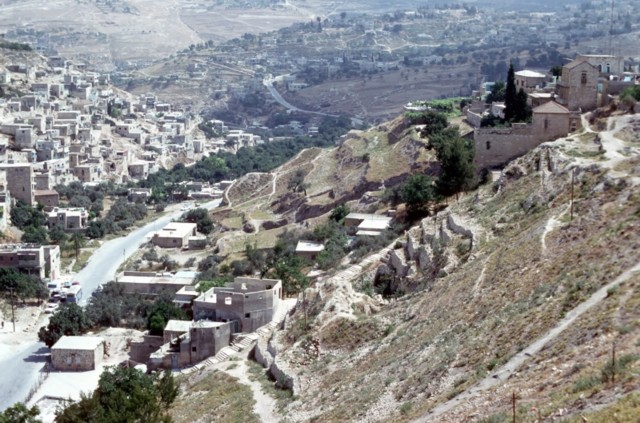
This psalm is extolled by commentators as one of the most magnificent hymnal psalms of praise that David wrote – and in some ways, one of the most difficult to outline and interpret.  It is widely accepted as having been written at the time of the removal of “the ark of God from the house of Obed-edom to the city of David with rejoicing” ( 2 Samuel 6:12).  And that certainly seems to be the case, as it starts out in verse one (“God shall arise, his enemies shall be scattered; and those who hate him shall flee before him!”) – the same way the ark was always put on its journey (see Numbers 10:35).

Hill of Ophel, south of Jerusalem, where the city of David was located.

Hill of Ophel, south of Jerusalem, where the city of David was located.

Throughout the chapter, it echoes the praise for God when on a similar journey among His people, He led them from bondage in Egypt (i.e. verses 4, 6, 7-8).  Verse 20 (“Our God is a God of salvation, and to God, the Lord, belong deliverances from death”) is one of few verses in the Old Testament that clearly demonstrates an understanding of God’s saving grace for the righteous in eternity, as we understand now comes to us from the sacrifice of His Son.

But praise for God and His power is the sole intent of this song.  Part of Spurgeon’s description of the singing which follows here conjures quite an image:

“With the words of the first two verses the ark is uplifted, and the procession begins to move. In Psalm 68:3-6, the godly in the assembly are exhorted to commence their joyous songs, and arguments are adduced to help their joy. Then the glorious march of Jehovah in the wilderness is sung: Psalm 68:7-10, and his victories in war are celebrated in verses Psalm 68:11-14. The joyous shouts are louder as Zion comes in sight, and the ark is borne up the hill…”

The psalm concludes majestically:

Awesome is God from his sanctuary;
the God of Israel—he is the one who gives power and strength to his people.
Blessed be God!

Read or listen to audio of ESV version of this selection from this link.

/Bob’s boy
___________________
some images © V. Gilbert & Arlisle F. Beers

Please note: I did not design the reading plan that I am following in my blog.  All of my comments in this blog, however, are solely my responsibility.  When reading ANY commentary, you should ALWAYS refer first to the scripture, which is God’s unchanging and unfailing word. Reading schedules, as well as a link to the site where you can get the reading plan that I’m currently following for yourself can be found on the “Bible Reading Schedules” page of my website at http://graceofourlord.com.  For questions and help, please see the “FAQ” and “Summaries” pages there.

Psalm 58 – God Who Judges the Earth

There is considerable dispute over both the translation and meaning of verse one: “Do you indeed decree what is right, you gods?”  Some translations have the last word replaced with “mighty lords.”  Others insist that it is “silent ones,” implying those accustomed to running things from afar.  In any case, David (for we have no reason to doubt the superscription’s claim that it is another of David’s “Psalms of the Golden Secret” – a Miktam) would certainly not speak of false gods as entities that actually did anything.

snake charmerAs one of the so-called imprecatory psalms, it speaks with sarcastic irony of the rulers and judges that are corrupt and wicked as being like deaf adders who cannot be charmed.  The psalm declares that the righteous will rejoice when God has his vengeance upon such evil men (verse 10).  It is a mistake to believe that righteous people will not do so when evil is defeated.  even the souls of those in heaven who have been slain by such men will rejoice when evil is crushed by the Lord (Revelation 6:9-10).  It is God who judges the earth!

Read or listen to audio of ESV version of this selection from this link.

/Bob’s boy
___________________
some images © V. Gilbert & Arlisle F. Beers

Please note: I did not design the reading plan that I am following in my blog.  All of my comments in this blog, however, are solely my responsibility.  When reading ANY commentary, you should ALWAYS refer first to the scripture, which is God’s unchanging and unfailing word. Reading schedules, as well as a link to the site where you can get the reading plan that I’m currently following for yourself can be found on the “Bible Reading Schedules” page of my website at http://graceofourlord.com.  For questions and help, please see the “FAQ” and “Summaries” pages there.

Proverbs 26 – More Hope For a Fool

donkey-01In many cases, when verses of the Book of Proverbs talk about a fool, this describes someone who simply refuses to believe the truth (as in the more famous verses 4-5).   Sometimes it refers to someone who consistently makes really bad choices.  This chapter of Proverbs begins with 11 verses concerning the fool. It varies from the poor advisability of depending on a fool for anything important, to the harm a fool can do to good people by his actions.  Then comes verse 12:

Do you see a man who is wise in his own eyes?
There is more hope for a fool than for him.

The reference to being “wise” in one’s own eyes is used in many passages throughout the Bible.  Paul referred to it in Romans 11:25 and Romans 12:16.  This refers to a person who will not consider anything that contradicts their own views because they trust their own intelligence and wisdom too much.  It is this obstinate arrogance that takes them to a degree beyond a fool.   There is little hope for such people because their intellectual conceit will likely prevent them from ever changing.  There is hope for the fool, however, if you can ever get one to stop long enough to actually listen.

Read or listen to audio of ESV version of this selection from this link.

/Bob’s boy
___________________
some images © V. Gilbert & Arlisle F. Beers

Please note: I did not design the reading plan that I am following in my blog.  All of my comments in this blog, however, are solely my responsibility.  When reading ANY commentary, you should ALWAYS refer first to the scripture, which is God’s unchanging and unfailing word. Reading schedules, as well as a link to the site where you can get the reading plan that I’m currently following for yourself can be found on the “Bible Reading Schedules” page of my website at http://graceofourlord.com.  For questions and help, please see the “FAQ” and “Summaries” pages there.
Psalms 50 – God Himself is Judge

This is the first of 12 “songs of Asaph.”  Asaph was one of David’s chief musicians (1 Chronicles 16:7), and undoubtedly did write some of the psalms (2 Chronicles 29:30), although it is not certain that he wrote all 12 of these, or simply was known to sing some of them.  Most commentators agree however that this one was likely written by him.  Adam Clarke said “The style of David is more polished, flowing, correct, and majestic, than that of Asaph, which is more stiff and obscure.”

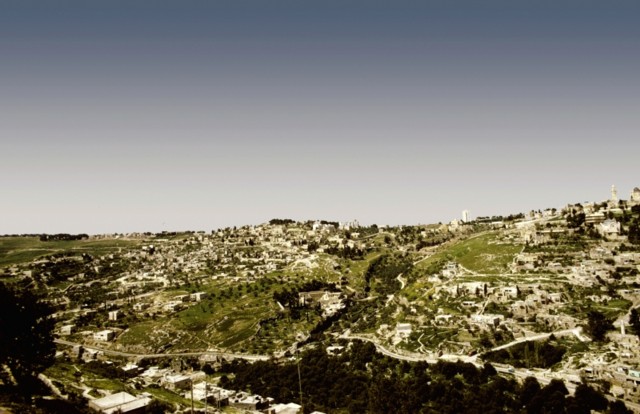
Mount Zion, Aceldama, Akeldama, or Hakeldamia, the Field of Blood.

Mount Zion, Aceldama, Akeldama, or Hakeldamia, the Field of Blood.

Some say that this is a prophetic psalm concerning the Messiah, and that does have some merit.  Verse 2 (“Out of Zion, the perfection of beauty,God shines forth”) seems akin to Isaiah 2:3 (“For out of Zion shall go the law, and the word of the Lord from Jerusalem”).  In the latter, “the word” obviously is Jesus (John 1:14).  And in verses 8-14, God tells His chosen ones that He neither needs nor wants their sacrifices (which we are reminded in Hebrews 10:5-7).

He rebukes the wicked among them in verses 16-22 for believing they can live their lives doing any sort of sinful act, as long as they make their sacrifices to atone for it.  God hates fake worship; and the verses are just as relevant for us today.  Too many of us live as pagans Monday through Saturday night, yet still consider themselves Christians on Sunday, as long as they go to worship services.  God will judge us for how we live our daily lives, and His salvation is for he who “orders his way rightly” (verse 23).

Read or listen to audio of ESV version of this selection from this link.

/Bob’s boy
___________________
some images © V. Gilbert & Arlisle F. Beers

Please note: I did not design the reading plan that I am following in my blog.  All of my comments in this blog, however, are solely my responsibility.  When reading ANY commentary, you should ALWAYS refer first to the scripture, which is God’s unchanging and unfailing word. Reading schedules, as well as a link to the site where you can get the reading plan that I’m currently following for yourself can be found on the “Bible Reading Schedules” page of my website at http://graceofourlord.com.  For questions and help, please see the “FAQ” and “Summaries” pages there.

Psalms 57 – Cry Out to God Most High

According to the superscription of this psalm, it was one  written by David when he fled from Saul “in the cave” – possibly on the occasion of either 1 Samuel 22:1 or 1 Samuel 24:1-3, more likely the former.  It is hard to imagine the despair that David felt as he had to hide himself in fear for his very life, appealing to God “My soul is in the midst of lions; I lie down amid fiery beasts…”

Public domain image from www.public-domain-image.comVerse one is another of the several verses found in the psalms (17:8, 36:7, and 63:7, for example) and elsewhere that refer to a place of safety as being “in the shadow of your wings.”  In verses 1-6, David makes his “cry out to God most high” in prayer for His help.  But even in so doing, he expresses his faith in the Lord saying “I will take refuge, till the storms of destruction pass by.”  When we have done all that we can do, we must learn to trust in Him.

Then in verses 7-11, he finishes his prayer renewed with strength, and praises God for his comfort and steadfast love.  The refrain of the song, found in verse 5 is returned to in verse 11:

Be exalted, O God, above the heavens!
Let your glory be over all the earth!

It is a song that is a model for prayer most appropriate at times of despair, fear, or oppression – any time that we need to “cry out to God most high” as we often do, remembering as we make our plea, that He hears us and that He deserves our praise for all that He is and does.

Read or listen to audio of ESV version of this selection from this link.

/Bob’s boy
___________________
some images © V. Gilbert & Arlisle F. Beers

Please note: I did not design the reading plan that I am following in my blog.  All of my comments in this blog, however, are solely my responsibility.  When reading ANY commentary, you should ALWAYS refer first to the scripture, which is God’s unchanging and unfailing word. Reading schedules, as well as a link to the site where you can get the reading plan that I’m currently following for yourself can be found on the “Bible Reading Schedules” page of my website at http://graceofourlord.com.  For questions and help, please see the “FAQ” and “Summaries” pages there.