2 Samuel 11 – David and Bathsheba

We have moved past chapters 8-10 in which David enjoys some key military victories, and in chapter 9, he seeks a survivor of Saul’s house so that he could show kindness to them for Jonathan’s sake.  He finds Miphibosheth, Jonathan’s son, who is lame.  From that day forward, he eats at David’s table.

But chapter 11 focuses on David’s great sin, for which he will pay most dearly.  It is the story of one of the Bible’s greatest men brought to the deepest depravity and callousness by lust and adultery.  It is most disappointing to see a great man of God fall so low.  When David saw her in verse 3 from his roof bathing, his first sin was lust – the right thing would have been to turn away.  When he inquired about her, he is told that she is the wife of Uriah the Hittite.  We find out in 2 Samuel 23:39 that this is one of David’s closest warriors – his famous “mighty men” listed in 23:8-39.  He did battle for David loyally, and probably considered him his friend.

King David Handing the Letter to Uriah (1611) ...

King David Handing the Letter to Uriah (1611) by Pieter Lastman, oil on panel, 51.1 x 61.3 cm, Detroit Institute of Arts (Photo credit: Wikipedia)

David is powerful, and only he can be blamed for this adultery.  When she becomes pregnant, David plots Uriah’s death.  To make things worse, before he returns to battle, Uriah shows his great character and loyalty in verse 11.  Then David sends him to battle with the note containing instructions for Uriah’s death delivered by his own hand!  Joab carries out this sickening deed, and in verse 26 we are told that Bathsheba mourned for her husband.  When the mourning was over, David took her as his wife, and she bore him a son.

This is not the David we know, nor is it the man after God’s own heart that we have read about for so many chapters; and verse 27 tells us that it “displeased the Lord.”  This seems like a very mild statement, and we will see God forgive David.  But the consequences for this deed will be anything but mild.

Sin often has its consequences – for us, and for others; and God never promises to “fix” all the damage we bring on ourselves and others.  We cannot plan to sin, thinking that we will just ask God to forgive us later,  and that He will simply do our bidding – repairing for us all the heartache we may have caused from our sin.  But through or savior Jesus Christ, we can obtain the forgiveness for any sin we truly repent about – no matter how terrible we think of what we have done.

Read or listen to audio of ESV version of this selection from this link.

/Bob’s boy
___________________
some images © V. Gilbert & Arlisle F. Beers

Please note: I did not design the reading plan that I am following in my blog.  All of my comments in this blog, however, are solely my responsibility.  When reading ANY commentary, you should ALWAYS refer first to the scripture, which is God’s unchanging and unfailing word. Reading schedules, as well as a link to the site where you can get the reading plan that I’m currently following for yourself can be found on the “Bible Reading Schedules” page of my website at http://graceofourlord.com.  For questions and help, please see the “FAQ” and “Summaries” pages there.

Ruth 1-2 – Naomi and Ruth

Naomi entreating Ruth and Orpah to return to t...

Naomi entreating Ruth and Orpah to return to the land of Moab by William Blake, 1795 (Photo credit: Wikipedia)

Because of a famine, Naomi and her husband, Elimelech, and their two sons went to the country of Moab.  The sons took wives from the Moabite women.  But all of the men died, and Naomi prepared to return to Judah, as she would have to depend on family now.  She told her young daughters-in-law to stay there with their people and return to their parents, but Ruth vowed to remain with Naomi and to serve “her God” (verse 16).  In verse 22 , they came to Bethlehem at the beginning of barley harvest, which would be about April – May.

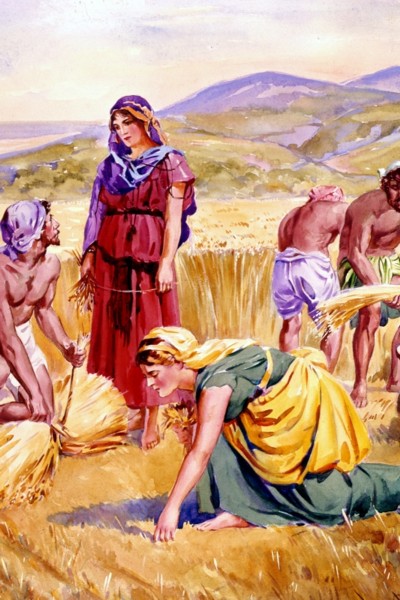
Ruth went to glean in the fields.  Gleaning was a practice allowed to the poor and the sojourner as God had commanded.  The corners of the field and any sheaves left throughout the middle on the first harvest were to be left for such people to feed themselves (Leviticus 19:9-10, Deuteronomy 24:19).  The fact that Ruth is a Moabite is mentioned several times, and that should emphasize that the Lord is working through His people.  She finds favor with Boaz because he has been told of her great kindness and loyalty to his relative, Naomi.

Read or listen to audio of ESV version of this selection from this link.

/Robert
___________________
some images © V. Gilbert & Arlisle F. Beers

Please note: I did not design the reading plan that I am following in my blog.  All of my comments in this blog, however, are solely my responsibility.  When reading ANY commentary, you should ALWAYS refer first to the scripture, which is God’s unchanging and unfailing word. Reading schedules, as well as a link to the site where you can get the reading plan that I’m currently following for yourself can be found on the “Bible Reading Schedules” page of my website at http://graceofourlord.com.  For questions and help, please see the “FAQ” and “Summaries” pages there.
Closing out Judges \ April Week 2 Summary Posted

Ruth gleans in the fields of Boaz

This week, we will finish our scheduled reading of the book of Judges with the rest of Samson’s tragic story, and complete the book of Ruth as well.  Ruth is a very short book but, as is the case with all of God’s word, an important one, and very different from the book of Judges.  The child that Ruth and Boaz will have (Obed) will be  the father of Jesse – who in turn will have a son named David that will become king in the book of Samuel.  This lineage of Jesus Christ is related in Matthew 1:1-5.

Summing Up

Each weekend, I am now posting a small PDF of one week of chapter summaries (on the website’s “Summaries” page), current to the beginning of the previous week.  I have posted the summary for Week 15 (April Week 2) of the schedule I am following.  This short PDF document contains condensed comments about Joshua 9, 10, 24, and Judges 1 and 2, with hyperlinks to the ESV version of each chapter for listening or reading, and joins the summaries for other weeks already posted there.

/Robert
___________________
image © V. Gilbert & Arlisle F. Beers

Please note: I did not design the reading plan that I am following in my blog.  All of my comments in this blog, however, are solely my responsibility.  When reading ANY commentary, you should ALWAYS refer first to the scripture, which is God’s unchanging and unfailing word. Reading schedules, as well as a link to the site where you can get the reading plan that I’m currently following for yourself can be found on the “Bible Reading Schedules” page of my website at http://graceofourlord.com.  For questions and help, please see the “FAQ” and “Summaries” pages there.
Exodus 1 – Israel Increases Greatly in Egypt

Highlights we have passed over in Genesis – As Israel (Jacob) nears death, he takes Joseph’s sons, Ephraim and Manasseh as his own (Gen 48:5). That is why there is not tribe of Joseph in the “Twelve Tribes of Israel”.  These two make up the “half-tribes”.  Jacob sets Joseph and Ephraim apart, and once again the younger is blessed above the first-born as he says that “his offspring shall become a multitude of nations” (Gen 48:19). He makes it clear that he is to be buried in Canaan, where his people shall end up, and blesses all of his sons. Chapter 49 is full of poetic imagery and prophecy, much of it (particularly verses 8-12) pointing to the empire of King David, and ultimately, the Lord Jesus, the Messiah.  In chapter 50, Pharaoh allows Joseph to bury his father in Canaan, and Genesis concludes with the death of Joseph.  And so, God’s word picks up 400 years later…

Genesis 15:13-14:
Then the Lord said to Abram, “Know for certain that your offspring will be sojourners in a land that is not theirs and will be servants there, and they will be afflicted for four hundred years. 14 But I will bring judgment on the nation that they serve, and afterward they shall come out with great possessions.

Pharaoh Oppresses Israel

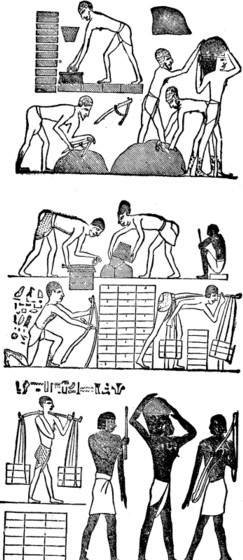
The 12 sons of Israel (Jacob) (and Joseph’s sons, Ephraim and Manasseh) have long since died; and their descendants, now referred to as “the people of Israel” have multiplied greatly – to the extent that the ruler of Egypt fears their numbers.  So they are ruthlessly made slaves (verse 13), and the mid-wives instructed to kill all newborn sons.  But the midwives feared God (verse 17), and they let them live.  “And the people multiplied greatly and grew very strong” (verse 20), as God had promised Abraham in Genesis 13:16.  Pharaoh then ordered his people to cast every son that is born to the Hebrews into the Nile.

Read or listen to audio of ESV version of this selection from this link.

/Robert
___________________
image © V. Gilbert & Arlisle F. Beers

Please note: I did not design the reading plan that I am following in my blog.  All of my comments in this blog, however, are solely my responsibility.  When reading ANY commentary, you should ALWAYS refer first to the scripture, which is God’s unchanging and unfailing word. Reading schedules, as well as a link to the site where you can get the reading plan that I’m currently following for yourself can be found on the “Bible Reading Schedules” page of my website at http://graceofourlord.com.  For questions and help, please see the “FAQ” and “Summaries” pages there.