Hebrews 10 – The Full Assurance of Faith

In the previous chapters of this letter, the writer has been driving home the superiority of the new covenant, and of Jesus as our high priest.  He continues in verse one, stating that the law was just “a shadow of the good things to come instead of the true form of these realities.”    The sacrifices of old, year after year, were just a temporary forgiveness of sins because “it is impossible for the blood of bulls and goats to take away sins.”  But Jesus Christ came to do God’s will (verses 5-7 quote Psalm 40:6-8), and offered Himself up as a single sacrifice for all time (verses 10-12).

Crucifixion

Crucifixion (Photo credit: Wikipedia)

Verses 19-23 bring it all home.  Whereas before we as servants of God could not enter the holy place, Jesus has torn the curtain – the veil – open for all time (an allusion to the literal event of Matthew 27:51-52 when Jesus was crucified).  And because we have “a great priest over the house of God,” we can draw near with confidence, clean from evil conscience, and with a true heart – full of the assurance of faith that our sins are forgiven.  We can now hold fast to our hope without wavering because “he who promised is faithful.”

Verses 24-25 are quoted often to remind us that we need to be faithful in attendance of worship, as it says:

“…let us consider how to stir up one another to love and good works, not neglecting to meet together, as is the habit of some, but encouraging one another…”

Those who claim they can serve the Lord themselves without being part of a worship service ignore this passage at their own peril.  How can we “stir up one another” or “encourage one another” if we do not meet together, as the writer, inspired by the Holy Spirit, says?  Verse 26, and following, warn of the danger of trying to “go it alone.” It is far too easy to slip away from the path, and back into sin.  As verse 31 says, “It is a fearful thing to fall into the hands of the living God.”

We need each other because that encouragement, those things that “stir up one another” help give us endurance.  And we “have need of endurance, so that when you have done the will of God you may receive what is promised.”

Read or listen to audio of ESV version of this selection from this link.

/Bob’s boy
___________________
some images © V. Gilbert & Arlisle F. Beers

Please note: I did not design the reading plan that I am following in my blog.  All of my comments in this blog, however, are solely my responsibility.  When reading ANY commentary, you should ALWAYS refer first to the scripture, which is God’s unchanging and unfailing word. Reading schedules, as well as a link to the site where you can get the reading plan that I’m currently following for yourself can be found on the “Bible Reading Schedules” page of my website at http://graceofourlord.com.  For questions and help, please see the “FAQ” and “Summaries” pages there.

Hebrews 9 – Redemption Through the Blood of Christ

When Aaron prepared the Levites for consecration, he adjusted the seven lamps of the menorah, candlestick, or lampstand forward.(Numbers 8:1-4).

When Aaron prepared the Levites for consecration, he adjusted the seven lamps of the menorah, candlestick, or lampstand forward.(Numbers 8:1-4).

When considering this chapter’s beginning, as it speaks of the tabernacle prepared by Moses instead of the Herodian temple, it is because the theme of the writer is that of the covenant being “inaugurated” (verse 18), or “sealed.” Moses did so with the blood of animals, as verses 19-21 remind us.   As verse 22 says, “Indeed, under the law almost everything is purified with blood, and without the shedding of blood there is no forgiveness of sins.”  Jesus Christ sealed the new covenant with His own blood.

The tabernacle and the items inside (the lampstand, table, the Bread of the Presence, etc) described in the first few verses, are detailed for the most part in Exodus 25, 30 and 37. As the text says, only the high priest could enter the section that was the “Most Holy Place,” and even he could only do so once a year – to offer blood for himself and for the unintentional sins of others (verse 7) – which had to be repeated each year.  All these things, it says, were mere copies of the heavenly things (verse 23).  Jesus entered the true “Most Holy Place” which is heaven, by offering His own blood – “once for all” and “thus securing an eternal redemption” for us all.  Verse 28 concludes with the glorious promise for us: “so Christ, having been offered once to bear the sins of many, will appear a second time, not to deal with sin but to save those who are eagerly waiting for him.”

The Arch of Titus from outside the Forum, Rome, Italy.  Located at the highest point of the Via Sacra which leads to the Roman Forum, this triumphal arch, with only one passageway, commemorates Titus' conquest of Judea which ended the Jewish Wars (66-70). Engaged fluted columns frame the passageway.

The Arch of Titus from outside the Forum, Rome, Italy. Located at the highest point of the Via Sacra which leads to the Roman Forum, this triumphal arch, with only one passageway, commemorates Titus’ conquest of Judea which ended the Jewish Wars (66-70). Engaged fluted columns frame the passageway.

As an aside, Coffman offers some interesting facts regarding the Holy things of the temple:

History, through the overruling providence of God, has preserved a likeness of the golden candlestick that was in the Herodian temple destroyed by Vespasian and Titus in 70 A.D. The candlestick, along with other treasures, was looted and carried in the triumphal procession in Rome; and, when the Arch of Titus was constructed to memorialize the victory, both the table of showbread and the candlestick were detailed in the carvings decorating the arch and may still be seen there in the excavated ruins of ancient Rome. Plaster casts of those carvings are exhibited in the Metropolitan Museum, New York; and from these is evident the immense weight of those golden treasures, several men being necessary to bear each of them.

Read or listen to audio of ESV version of this selection from this link.

/Bob’s boy
___________________
some images © V. Gilbert & Arlisle F. Beers

Please note: I did not design the reading plan that I am following in my blog.  All of my comments in this blog, however, are solely my responsibility.  When reading ANY commentary, you should ALWAYS refer first to the scripture, which is God’s unchanging and unfailing word. Reading schedules, as well as a link to the site where you can get the reading plan that I’m currently following for yourself can be found on the “Bible Reading Schedules” page of my website at http://graceofourlord.com.  For questions and help, please see the “FAQ” and “Summaries” pages there.

Hebrews 8 – Jesus, High Priest of a Better Covenant

Moses makes the tabernacle in the wilderness -- Exodus 35-40.

Moses makes the tabernacle in the wilderness — Exodus 35-40.

The Hebrew writer gets to the meat of Jesus as our High Priest, affirming that He sits at the right hand of God in the “true tent” (or tabernacle).  The earthly tabernacle serves as a shadow of the entrance into God’s presence, whereas heaven is where Jesus is in true presence and intercession for us.  Jesus “has obtained a ministry that is as much more excellent than the old as the covenant he mediates is better, since it is enacted on better promises” (verse 6).  On that new covenant, verses 8-12 quote Jeremiah 31:31-34, which foreshadows the covenant we now have with the Lord, through the blood of Jesus Christ.  Verse 13 says that the old covenant is made obsolete, as we now have full forgiveness freely available through Him.

Read or listen to audio of ESV version of this selection from this link.

/Bob’s boy
___________________
some images © V. Gilbert & Arlisle F. Beers

Please note: I did not design the reading plan that I am following in my blog.  All of my comments in this blog, however, are solely my responsibility.  When reading ANY commentary, you should ALWAYS refer first to the scripture, which is God’s unchanging and unfailing word. Reading schedules, as well as a link to the site where you can get the reading plan that I’m currently following for yourself can be found on the “Bible Reading Schedules” page of my website at http://graceofourlord.com.  For questions and help, please see the “FAQ” and “Summaries” pages there.

1 Peter 1 – Called to Be Holy

Map of the route of Paul's second missionary journey.  Here in the epistle, Peter writes to Christians to the north and east.

Map of the route of Paul’s second missionary journey. Here in the epistle, Peter writes to Christians to the north and east.

Peter opens this letter addressing Christians in the northern and eastern provinces of Turkey (such as Pontus,  Cappadocia, and Bithynia) who had scattered because of persecution – and indeed still suffered such.  It is notable that Peter now refers to Christians – Jew and Gentile – in terms formerly reserved only for the Jews (chosen, elect exiles of the dispersion, etc.).  Because of the blood of Jesus Christ, according to the foreknowledge of God the Father, Christians were now the chosen ones, as Jesus made plain in John 15:16-19.  Peter is offering them comfort, as he reminds them that God in His mercy has caused us to be born again through the resurrection of His son, Jesus, for an imperishable inheritance of salvation.

Ruins in Cappadocia, the largest province of Asia Minor, located in what is today eastern Turkey. It became more easily accessible to points south, including Jerusalem, after the Romans constructed roads through the Cilician Gates in the Taurus range. Despite the Roman empire's disdain for Christians, these roads actually helped the Gospel to spread.

Ruins in Cappadocia, the largest province of Asia Minor, located in what is today eastern Turkey. It became more easily accessible to points south, including Jerusalem, after the Romans constructed roads through the Cilician Gates in the Taurus range. Despite the Roman empire’s disdain for Christians, these roads actually helped the Gospel to spread.

His words of comfort urge them to realize that the persecution they are enduring  will test the genuineness of their faith, but their love for Him and steadfastness will be rewarded by His grace.  He reminds them of the promise of the prophets concerning Christ, who was “foreknown before the foundation of the world” – that they were ransomed by His blood and by His victory over death.  Peter calls on them to not fall back on their old ways – the ways of their fathers – but to purify themselves in love for one another and to be holy.

This latter point is most important.  People often try to excuse their sinful behavior by saying “God wants me to be happy.”   Sure, God wants us to rejoice in  the hope that we have because of Jesus, but He is not nearly so focused on our personal happiness.  He wants us to be holy!  Peter reminds us in verses 15-16 (quoting Leviticus 11:44) “…as he who called you is holy, you also be holy in all your conduct, since it is written, ‘You shall be holy, for I am holy.'”  Verses 24-25 are cited from Isaiah 40:6-8, reminding us to trust in God , whose word endures forever.

Read or listen to audio of ESV version of this selection from this link.

/Bob’s boy
___________________
some images © V. Gilbert & Arlisle F. Beers

Please note: I did not design the reading plan that I am following in my blog.  All of my comments in this blog, however, are solely my responsibility.  When reading ANY commentary, you should ALWAYS refer first to the scripture, which is God’s unchanging and unfailing word. Reading schedules, as well as a link to the site where you can get the reading plan that I’m currently following for yourself can be found on the “Bible Reading Schedules” page of my website at http://graceofourlord.com.  For questions and help, please see the “FAQ” and “Summaries” pages there.

Ephesians 4 – Unity in the Body of Christ

Paul is preaching unity here, as he emphasizes the church as the body of Christ, with Christ as the head (Colossians 1:18, Ephesians 2:16, 1 Corinthians 12:27) – that there is one body and one Spirit, just as we have been “called to the one hope” (verses 4-5) of eternal life in Christ and “one Lord, one faith, one baptism, one God and Father of all.”  But in this unity, grace was given to each individual member, according to the measure of Christ’s gift (verses 7-11).  This is not speaking just of supernatural gifts, as the age of those will soon pass (though they, too, had their place in “building up the body of Christ”); and Paul is speaking not just to Christians of that age, but to all future Christians.  Verse 8 is from Psalm 68:18.

Along a main inland road from Ephesus to the Euphrates River, Colossae shared the beauty of the Lycus Valley with its sister cities Hierapolis. The original roads from Ephesus and Sardis joined there, and this defensible and well-watered hill became a strategic point in antiquity. Declining in importance by the time of Paul's Epistle to them, they had already been surpassed in size by the other Lycus Valley cities.

Along a main inland road from Ephesus to the Euphrates River, Colossae shared the beauty of the Lycus Valley with its sister cities Hierapolis. The original roads from Ephesus and Sardis joined there, and this defensible and well-watered hill became a strategic point in antiquity. Declining in importance by the time of Paul’s Epistle to them, they had already been surpassed in size by the other Lycus Valley cities.

Paul began in verse 1 stating that we must walk in a manner worthy of that calling; and he picks up that thought again beginning in verse 17, as he says they (we) must no longer walk as the Gentiles do.  This is relevant to us as well as a reference to all unbelievers, who are “darkened in their understanding, alienated from the life of God because of the ignorance that is in them, due to their hardness of heart…given themselves up to sensuality, greedy to practice every kind of impurity.”

But instead, a Christian, taught the truth in Christ, is “to put off your old self, which belongs to your former manner of life and is corrupt through deceitful desires, and to be renewed in the spirit of your minds” (verses 21-23).  Then, he turns in verses 25-32 to the importance of honesty and being Godly in speech, thought, and heart, which is to rule how we treat each other; and sharing with those in need is to play an important role in our lives (verse 27).  Verse 26 says “be angry and do not sin.”  One can have anger, particularly “righteous anger,” but it should not rule our hearts or our mouths.    Verse 32 sums up that section well – “Be kind to one another, tenderhearted, forgiving one another, as God in Christ forgave you.”

Read or listen to audio of ESV version of this selection from this link.

/Bob’s boy
___________________
some images © V. Gilbert & Arlisle F. Beers

Please note: I did not design the reading plan that I am following in my blog.  All of my comments in this blog, however, are solely my responsibility.  When reading ANY commentary, you should ALWAYS refer first to the scripture, which is God’s unchanging and unfailing word. Reading schedules, as well as a link to the site where you can get the reading plan that I’m currently following for yourself can be found on the “Bible Reading Schedules” page of my website at http://graceofourlord.com.  For questions and help, please see the “FAQ” and “Summaries” pages there.

Ephesians 3 – The Mystery of the Gospel Revealed

Ephesus, in modern Turkey, is the best-preserved classical city on the Mediterranean, and one of the best places in the world to get the feeling for what life was like for early Christians in Roman times. Roman theater.

Ephesus, in modern Turkey, is the best-preserved classical city on the Mediterranean, and one of the best places in the world to get the feeling for what life was like for early Christians in Roman times. Roman theater.

Verse 1 of this chapter is key to the message Paul is conveying here.  He is a prisoner for Jesus Christ, on behalf of the Gentiles.  The “mystery” that he received revelation about was (as  verse 6 says) “that the Gentiles are fellow heirs, members of the same body, and partakers of the promise in Christ Jesus through the gospel.” This plan was not known to previous generations (verse 5), but now has been revealed to His apostles and prophets.  He declares this as his ministry in verse 7 – “of this gospel I was made a minister according to the gift of God’s grace, which was given me…”  And he makes it known in verses 10-11 that this was always God’s plan, according to His wisdom – “this was according to the eternal purpose that he has realized in Christ Jesus our Lord…”

The chapter ends with Paul’s prayer for spiritual strength in verses 14-21, that he began in the previous chapter.  This is one of the most beautiful and poignant prayers in the Bible.  Read it again and again, and take comfort in wisdom and truth of it, as well as the promise it brings to the hearts of Christians:

“For this reason I bow my knees before the Father,
from whom every family in heaven and on earth is named,
that according to the riches of his glory he may grant you to be strengthened with power through his Spirit in your inner being
so that Christ may dwell in your hearts through faith—that you, being rooted and grounded in love
may have strength to comprehend with all the saints what is the breadth and length and height and depth,
and to know the love of Christ that surpasses knowledge, that you may be filled with all the fullness of God.
Now to him who is able to do far more abundantly than all that we ask or think, according to the power at work within us,
to him be glory in the church and in Christ Jesus throughout all generations, forever and ever. Amen.”

Read or listen to audio of ESV version of this selection from this link.

/Bob’s boy
___________________
some images © V. Gilbert & Arlisle F. Beers

Please note: I did not design the reading plan that I am following in my blog.  All of my comments in this blog, however, are solely my responsibility.  When reading ANY commentary, you should ALWAYS refer first to the scripture, which is God’s unchanging and unfailing word. Reading schedules, as well as a link to the site where you can get the reading plan that I’m currently following for yourself can be found on the “Bible Reading Schedules” page of my website at http://graceofourlord.com.  For questions and help, please see the “FAQ” and “Summaries” pages there.

Ephesians 1 – Spiritual Blessings in Christ

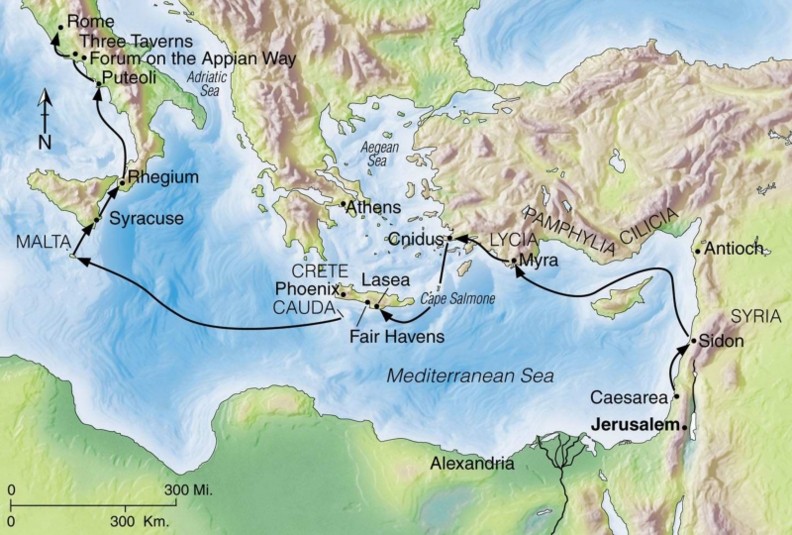
Paul finally visited Rome while a captive awaiting his trial before Caesar. The letter to the Ephesians is one of the Prison Letters. It was probably written during his first imprisonment in Rome, which lasted from A.D. 60 to 62.

Paul’s epistle to the Ephesians is one of the four “prison epistles” that he wrote while imprisoned by the Romans (the other three being Philippians, Colossians and Philemon).  Paul established the church there on his second missionary journey (Acts 18:18-21) and returned on his third missionary journey, staying for two years (Acts 19). and said a tearful farewell to the Ephesian elders in Acts 20:17-38.

In chapter one, he begins with his signature greeting; and speaks in verses 4-12 of their (and his) “adoption as sons through Jesus Christ, according to the purpose of his will.”  This does not mean that certain people are selected by God to be saved, and certain others to be condemned, no matter what they do.  The Lord predestined His chosen people – the ones who serve Him – to be saved.  Whether we wish to be part of that blessing is our choice to make.  Coffman’s commentary says it well:

“Inherent in this is the fact of God’s calling and electing people before the foundation of the world; and very few theological questions have demanded more attention and interest than this. Clearly revealed in this is the fact that the coming of Jesus Christ into the world for the purpose of taking out of it a people for himself and redeeming them unto eternal life was no afterthought on God’s part. Before the world was ever created, the divine plan of the Son of God’s visitation of the human family existed in the eternal purpose of God. That body that Christ would gather from the populations of earth is destined to receive eternal life; because what God purposes is certain of fulfillment. Such a calling and election of those “in Christ” to receive eternal glory, however, is not capricious. Every man may decide if he will or will not become a part of it and receive the intended blessing.”

Regarding verse 9’s use of the word mystery, there is more in Ephesians 3:3 and 1 Timothy 3:16.   But Coffman’s comments on this as well are salient: The New Testament use of the term ‘mystery’ is not very closely related to the modern use of the word, conveying instead the meaning of a secret once unknown, now revealed. Mackay called it ‘God’s unveiled secret.”  

Paul commends them for their faith in Jesus, and declares the ultimate authority of Jesus Christ as the “head” of the church, speaking of it as a spiritual body (verses 15-32).

Read or listen to audio of ESV version of this selection from this link.

/Bob’s boy
___________________
some images © V. Gilbert & Arlisle F. Beers

Please note: I did not design the reading plan that I am following in my blog.  All of my comments in this blog, however, are solely my responsibility.  When reading ANY commentary, you should ALWAYS refer first to the scripture, which is God’s unchanging and unfailing word. Reading schedules, as well as a link to the site where you can get the reading plan that I’m currently following for yourself can be found on the “Bible Reading Schedules” page of my website at http://graceofourlord.com.  For questions and help, please see the “FAQ” and “Summaries” pages there.


Romans 3 – God’s Righteousness Upheld

Appian Way – most famous of the Roman roads, built (312 B.C.) under Appius Claudius Caecus. It connected Rome with Capua and was later extended to Beneventum (now Benevento), Tarentum (Taranto), and Brundisium (Brindisi). It was the chief highway to Greece and the East. Its total length was more than 350 mi (563 km). The substantial construction of cemented stone blocks has preserved it to the present.

After telling the brethren of the Roman church in chapter 2 that the Gentiles are now true Jews by way of the Spirit, Paul then addresses the question that would naturally come from the Jews.  Was there no advantage or value of being a Jew, or of being circumcised?  Paul says that indeed there was.  The Jews had been the keepers of the “oracles of God” (verse 2) – the Scriptures; and in that capacity at least, they had remained faithful.  God’s word, as He would make certain, had been preserved; and just as importantly, God had remained faithful to His promises to them, despite the unfaithfulness they had shown to Him.

In verses 10-18, Paul says that “it is written…” and follows that with quotations from several passages.  Verses 10-12 are from Psalm 14:1-3 and Ecclesiastes 7:20.  Verses 13-14 are from Psalm 5:9 and Psalm 10:7.  Verses 15-17 are from Isaiah 59:7-8, and verse 18 is from Psalm 36:1.   He is making it clear that the Jews among them are no better off than the Gentiles (verse 9) because all are “under sin.”  The phrase “…no one does good, not even one…” in verse 12 can be understood by the first part of the verse “All have turned aside.”  Nobody is without sin.  And verse 18 finishes with the reason for it all – “there is no fear of God before their eyes.”  That brings to the mind of this blogger the words of the wisest man (Solomon) in Ecclesiastes 12:13-14:

“The end of the matter; all has been heard. Fear God and keep his commandments, for this is the whole duty of man. For God will bring every deed into judgment, with every secret thing, whether good or evil.”

Paul illustrates again the old with the new, and provides a good summary of God’s plan for salvation – the Law and the Prophets bear witness to  “the righteousness of God through faith in Jesus Christ for all who believe” (verses 21-22) – “for all have sinned and fall short of the glory of God, and are justified by his grace as a gift, through the redemption that is in Christ Jesus” (verse 23).  The word “propitiation” in verse 25 means that the sacrifice Jesus made was an offering to appease God’s wrath and turn it to favor.  This was necessary for the forgiveness of sins, and it is what now gives favor to Jews and Gentiles alike, making no distinction between them.

Read or listen to audio of ESV version of this selection from this link.

/Bob’s boy
___________________
some images © V. Gilbert & Arlisle F. Beers

Please note: I did not design the reading plan that I am following in my blog.  All of my comments in this blog, however, are solely my responsibility.  When reading ANY commentary, you should ALWAYS refer first to the scripture, which is God’s unchanging and unfailing word. Reading schedules, as well as a link to the site where you can get the reading plan that I’m currently following for yourself can be found on the “Bible Reading Schedules” page of my website at http://graceofourlord.com.  For questions and help, please see the “FAQ” and “Summaries” pages there.
Romans 1 – God’s Wrath on Unrighteousness

Paul opens this letter affirming his apostleship, as was his custom with letters to churches that were not so familiar with him. He reinforces that in verses 4-6 by stating that, through Jesus, he and the other apostles “received grace and apostleship to bring about the obedience of faith for the sake of his name among all the nations, including you who are called to belong to Jesus Christ…”    The long introduction also affirms that Jesus is the Son of God, and that he was descended from David, fulfilling Old Testament prophecy (verse 4); and he declares the mission to the Gentiles (verse 13).  He also expresses, at some length, his eagerness to go to Rome for fellowship and sharing the gospel with them.

The Arch of Titus from outside the Forum, Rome, Italy. Located at the highest point of the Via Sacra which leads to the Roman Forum, this triumphal arch, with only one passageway, commemorates Titus’ conquest of Judea which ended the Jewish Wars (66-70). Engaged fluted columns frame the passageway.

Not much is known for certain about the church at Rome.  But by virtue of it being in Rome, its fame would have been considerable and, like the other churches, it was composed of both Jews and Gentiles.  The remainder of this chapter focuses on the need for righteousness on the part of the Gentiles, and Paul does not mince words in pointing out the history of unrighteousness on their part.  But as the letter continues, it will become apparent that McGarvey’s assessment is largely correct.  He writes:

“The Judaizing tendencies which had recently appeared in Corinth and Galatia were sure eventually to appear in other churches, perhaps ultimately in all, and the attitude assumed by a church already so influential and destined to increase in power was sure to carry great weight in deciding the controversy. Therefore, to set the church of Rome right as to the design and nature of the gospel was a work of supreme importance…”

Heading off such a crevasse in this church was of great concern, to be sure.  McGarvey further expounds most aptly:

“The purpose of the letter is to set forth, as Baur rightly expresses it, ‘both the relation of Judaism and heathenism to each other, and the relation of both to Christianity;’  primarily, for the instruction of the Christians in Rome, and, secondarily, for the benefit of all the churches by the establishment of peace between their Jewish and Gentile elements, and, ultimately, for the enlightening of the kingdom of God in all ages.”

Though verses 18-24 are here specifically directed at those Gentiles, they contain some of the most profound (and certainly definitive) statements applicable to all people everywhere concerning God’s existence, and thus they provide the very basis of sound apologetics.  The “wrath of God” in verse 18 represents his holiness, judgment, and yet loving response to the unrighteousness of mankind.  When Paul says that all mankind knows God, he is not speaking of the concept of a god or of deity in general.  Man knows the one true and living God because the evidence abounds in everything He created, yet he suppresses the truth in unrighteousness.  His attributes, including His eternal power and divine nature have been clearly perceived since the creation of the world, so that everyone is without excuse.

And God said, “Let the waters under the heavens be gathered together into one place, and let the dry land appear.” And it was so. Gen 1:9

Man has always tended to be full of himself because of the material knowledge he acquires, only made possible by God; and “claiming to be wise, they became fools…”  Man’s desire for sin and all that is an abomination to his Creator moves him to exchange the truth about God for a lie (verse 25) and worship the creature rather than the Creator even to this day.  People who deny Him do so by conscious choice in a futile attempt to justify their own unrighteousness.  The “shameful acts” Paul lists as driving this begins with unnatural relations of men and women with others of the same gender, and in verse 29 runs from gossips to murderers and “all manner of evil” in between – as God makes no distinction between what man considers “small” or large sins.

Any claim by someone who says they would believe if the evidence was there is hogwash.   Blindness to the more than substantial evidence is entirely willful.

Read or listen to audio of ESV version of this selection from this link.

/Bob’s boy
___________________
some images © V. Gilbert & Arlisle F. Beers

Please note: I did not design the reading plan that I am following in my blog.  All of my comments in this blog, however, are solely my responsibility.  When reading ANY commentary, you should ALWAYS refer first to the scripture, which is God’s unchanging and unfailing word. Reading schedules, as well as a link to the site where you can get the reading plan that I’m currently following for yourself can be found on the “Bible Reading Schedules” page of my website at http://graceofourlord.com.  For questions and help, please see the “FAQ” and “Summaries” pages there.

1 Corinthians 11 – The Lord’s Supper

The first 16 verses of this chapter are notoriously difficult; and many honest and well-intentioned people have interpreted parts of them differently.  Unfortunately, they have also been misused and, most ironically (especially in light of verses 16 and 17), that has caused contention and division at times.    One thing that is not in question in these 16 verses is the fact that God intended men to be the leader of their families (verse 3, Genesis 3:16-17, Ephesians 5:22).  But what about the head covering?  What about hair length?

Lenski, in his commentary, translated the use of the covered head reference in verse 4 as “having something down from his head,” with no indication from the Corinthian letter of what that “something” was.  An effective argument can be made for the entirety of the references to covering as referring to hair.  But there are women even today who cannot, in good conscience, attend worship services without a hat on their head.  In that case, it is good that they go ahead and wear one for that reason.   It is pointed out also by many that in this pagan society at Corinth, the priestesses of Aphrodite and prostitutes were distinguished many times by cropped hair, and even shaved heads.  A very good point can be made that the main thing to take away from these 16 verses is that Christians must not set about the business of offending the sensibilities of the society in which live, nor give the appearance of being “of the world.”

It can be argued that the earlier verses about traditions are given far more importance than Paul intended.  Paul speaks of a very important tradition in verses 17-33 – one that was instituted by the Lord Himself – the Lord’s Supper.  Incredibly, they had turned the observance of the Lord’s Supper into a meal, with some even becoming drunk.  Just as bad, the wealthy would bring enough food to be gluttons, and leave the poor hungry.  This was not fellowship, and it was not “in remembrance” of the Lord; and by doing this, one was eating and drinking “judgment on himself.”  Paul admonishes them not only to observe the Lord’s Supper properly, but with reverence, with each one “examining” himself while doing so.

It is difficult for many of us to realize at times the complete turn-around that many of these Corinthians had made, or the struggles that they continued to have in doing so.   The society they lived in, and had participated in fully, was pagan; and idol-worship, drunkenness and revelry, as well as promiscuity, were a way of life.  It was certainly not any easier for them to be holy than it is for us today.

Read or listen to audio of ESV version of this selection from this link.

/Bob’s boy
___________________
some images © V. Gilbert & Arlisle F. Beers

Please note: I did not design the reading plan that I am following in my blog.  All of my comments in this blog, however, are solely my responsibility.  When reading ANY commentary, you should ALWAYS refer first to the scripture, which is God’s unchanging and unfailing word. Reading schedules, as well as a link to the site where you can get the reading plan that I’m currently following for yourself can be found on the “Bible Reading Schedules” page of my website at http://graceofourlord.com.  For questions and help, please see the “FAQ” and “Summaries” pages there.