With All Authority – Paul’s Epistle to Titus

Paul’s authorship of the letter to Titus has been questioned by a few scholars, largely because of the mention of having been on the island of Crete, when there is no other scriptural record of Paul having visited the island. But of course, the Bible is neither the biography of Paul, nor is it his journal. In truth, it is plain to see that Paul wrote this letter after he wrote his first letter to Timothy and before his second letter to him, which he wrote from his final imprisonment in Rome, while awaiting his death. By bits and pieces, we at least get a partial picture of Paul’s travels after his first imprisonment there.

Tradition says that after Paul was released from prison in Rome (before his second and final imprisonment), he and Titus traveled together for a while. They stopped in Crete, and when it was time for Paul to go, he left Titus behind to help the churches there.

Tradition says that after Paul was released from prison in Rome (before his second and final imprisonment), he and Titus traveled together for a while. They stopped in Crete, and when it was time for Paul to go, he left Titus behind to help the churches there.

Crete is one of the five largest islands in the Mediterranean, only about 1/3 the size of Sicily and Sardinia, but it is the largest of the Greek islands. It is about 160 miles from east to west, and about 37 miles at its widest point. From the familiarity that Paul clearly has with the island and its people (as expressed in this letter) he must have spent considerable time there, before leaving Titus with a charge to nurture the fledgling congregations there.

Among the things that Paul has to say to Titus here is to urge him to set about the work of “what remained” to be put in order, including the appointment of elders in every town. Just how many towns were involved in this effort, we do not know. Paul also lists some important qualifications for those who would be considered for that task (Titus 1:5-9). One reason for the urgency was that Paul expressed some concern about the problem of false teachers, including those of the circumcision party that had made their way even to the island already.

With respect to those false teachers and the “deceivers,” Paul tells Titus to be firm in teaching the truth while dealing with such matters. In chapter 2:15, he tells him to “exhort and rebuke with all authority. Let no one disregard you.” In chapter 3, he concludes the letter with good advice for living as a Christian, and avoiding controversy and dissensions. He asks Titus to do his best to come to Nicopolis, where Paul says he plans to spend the winter. It is unclear which Nicopolis he referred to, but it could have been Actia Nicopolis, of western Greece. It was once the capital of the Roman province of Epirus Vetus.

(This year’s reading plan for Luke, Acts, and 1 and 2 Chronicles averages just 15 verses per day – 5 days per week!)
Schedule for this week


/Bob’s boy


___________________


some images © V. Gilbert & Arlisle F. Beers


Please note: I did not design the reading plan that I am following in my blog.  All of my comments in this blog, however, are solely my responsibility.  When reading ANY commentary, you should ALWAYS refer first to the scripture, which is God’s unchanging and unfailing word. Reading schedules, as well as a link to the site where you can get the reading plan that I’m currently following for yourself can be found on the “Bible Reading Schedules” page of my website at http://graceofourlord.com.


Enhanced by Zemanta

The Great Commitment


Creator of Abor Day, Julius Sterling Morton in...

Creator of Abor Day, Julius Sterling Morton in 1858. (Photo credit: Wikipedia)

In the last two verses of Luke chapter 14, Jesus talks about salt that has lost its flavor. Numerous explanations have been given us for how salt can lose its flavor, and some sound pretty close to accurate, while others do not (IMHO). So I am going to offer my own. Julius Sterling Morton was a philanthropist and early settler of Nebraska. Deciding that it was much too flat, he began the business of planting enormous amounts of trees there. He eventually created a 400 acre arboretum, which has grown into a 1700 acre wonder of living trees, bushes, etc. Grover Cleveland made him the 3rd U.S. Secretary of Agriculture, and a notable addition to his accomplishments was the founding of Arbor Day.

In 1911, one of his sons, Joy Morton, turned the business he had bought into the incorporated Morton Salt Company. The slogan “when it rains, it pours” was adapted from an old proverb. The little girl holding the umbrella in the rain was created with the slogan. The company had begun adding magnesium chloride to prevent caking when it became humid. It worked very well, but in a shaker you will still sometimes see that people have put a few grains of rice in to absorb moisture and prevent clumping, as it is out of the box and it sits for a long time.

The salt we buy these days with that little girl and the umbrella (or a more generic brand, if you prefer) can be bought for about 50 cents a box today. It is refined salt, which removes many natural minerals, and various companies add different chemicals for various reasons. But the salt that was around in Jesus’ day was unrefined salt – just the way God made it. You can buy unrefined salt today, but the same amount of unrefined salt as what you get in that round box will set you back anywhere from $6 -$15. But many of us believe it is much healthier for you.

Salt farmers harvesting salt, Pak Thale, Ban L...

Salt farmers harvesting salt, Pak Thale, Ban Laem, Phetchaburi, Thailand (Photo credit: Wikipedia)

This unrefined salt contains many minerals (some would call “impurities,” which is a bogus assessment). In those times, if the salt became moist and started to dissolve over a long period of time, it would eventually become bland in taste, as the ratio of sodium chloride to mineral content began to become smaller.

So what has that to do with us? The context in which Jesus was talking about this was all about “counting the cost” of what it takes before becoming a Christian. And in these last two verses, he said “Salt is good, but if salt has lost its taste, how shall its saltiness be restored? It is of no use either for the soil or for the manure pile. It is thrown away.”

When we first become Christians – assuming we are truly committed – we are full of zeal and enthusiasm. But as time goes by and the cares of this life begin taking their toll, some of that zeal and enthusiasm can easily be lost. It is easy for us to begin the race and then slow down over time – or even veer off the path. If we are not careful, we can lose our way, and our faith can become in vain – useless to anyone who might otherwise be positively influenced by our example.

The best way to keep the “moisture” of life’s troubles and temptations from leaching away our “saltiness” is by keeping the light of God’s word in our lives and nurturing our relationships and love with other Christians. We need a daily dose of reading God’s word, and fellowship that not only gives us encouragement, but also accountability.

(This year’s reading plan for Luke, Acts, and 1 and 2 Chronicles averages just 15 verses per day – 5 days per week!)
Schedule for this week

/Bob’s boy
___________________
some images © V. Gilbert & Arlisle F. Beers

Please note: I did not design the reading plan that I am following in my blog.  All of my comments in this blog, however, are solely my responsibility.  When reading ANY commentary, you should ALWAYS refer first to the scripture, which is God’s unchanging and unfailing word. Reading schedules, as well as a link to the site where you can get the reading plan that I’m currently following for yourself can be found on the “Bible Reading Schedules” page of my website at http://graceofourlord.com.

Enhanced by Zemanta

The Movie “Noah” – Assaulting God’s Children For Fun and Profit

English: A photo I personally took of Darren A...

English: A photo I personally took of Darren Aronofsky when he visited San Diego to talk about his upcoming movie “The Wrestler.” (Photo credit: Wikipedia)

It is official. We live in a world where “tolerance” for just about anything is heralded like it is the national motto. Almost everyone goes out of their way to be careful not to offend anyone about anything. That is, unless the group of people you are offending is Christians. Christians, it seems, are fair game for any sort of denigration, disrespect, ridicule – whatever suits you. Darren Aronofsky (director and co-writer) and company are shamelessly making a fortune at the expense of the sensibilities of Christians of today, and of Christians of days gone by. If he had made a comedy about all of the Christians that were murdered and even made into human torches in the time of the great persecution of the first century, I suppose that would have been worse. But not by much.

Never before can I remember being conscious of frowning so much during a movie. Never before can I remember becoming so angry at the makers of a film while watching it. I wanted to leave before it ended many times. But I forced myself to stay until the closing credits.

I wanted to like this film – truly I did. From the day when I first saw the previews, I had high hopes that at last a film was being made that might do justice to the story of the second biggest event since creation. Don’t get me wrong, I knew that it probably wouldn’t be true to God’s word. But I was willing to overlook a lot of that in hopes of seeing something besides a small fishing boat with a giraffe’s head poking out of  the top. What I got instead was about two hours of disregard for the truth, disrespect for God, and ridicule for believers of His word. It is unimaginable to me that Aronofsky’s intention was not to offend me, my brothers, and my sisters.

English: God's conversation with Noah. Series ...

English: God’s conversation with Noah. Series History of Noah. Français : Conversation de Dieu avec Noë. Série Histoire de Noë. Polski: Rozmowa Boga Ojca z Noem. Seria Dzieje Noego. (Photo credit: Wikipedia)

In fairness, there are some things that they did get right, whether by accident or just for the sake of good film segments. I would give them a “B-” on the animals making their way to the ark. There were far too many that appeared to be the same “kind,” in my opinion. But their appearance and entrance to the ark was spectacular. I would give a “C+” also on the size of the ark. Estimates are from the measurements in the bible that it was equal in volume to about 520 railroad cars. This one seemed much smaller, but it was quite massive nonetheless.

I would have to give them an “A” on many aspects of the flood, including an attempt at portraying the opening of the “fountains of the great deep” (Genesis 7:11). In fact, that was one of the things that had attracted me to the movie in the previews. And they get extra points for recognizing the flood as a global event (something that some of our own brethren cannot get right, believe it or not).

I perhaps could have gotten past the Nephilim. There is so much misunderstanding of this term (largely because of the bad translation of the King James version) that I suppose getting that part right would have been too much to ask in any case. But these guys appeared to be the product of J.R.R. Tolkien. At several points, I really thought the Hobbits might make an appearance.

For 120 years, Noah built the great ark, as God had commanded. Noah was an example of obedience (Genesis 6:14-22).

For 120 years, Noah built the great ark, as God had commanded. Noah was an example of obedience (Genesis 6:14-22).

Unfortunately, those creatures are not the worst of the errors and distortions of this movie. “The Creator” uses the big bang to create everything, and man’s presence is explained with the unscriptural viewpoint that we know as “theistic evolution.” But is the movie “Noah” as bad on the level of distortion and blasphemy as “The DaVinci Code?” Absolutely. God (who is only referred to as “the Creator” throughout the film) is depicted as being cruel and viscous.

And He doesn’t even give Noah the instructions he needs about what he is supposed to do or how he is supposed to do it.  Instead, Noah has to rely on his grandfather (Methuselah), who is represented as some sort of sorcerer (as if God would allow a practice He condemns to be used in such a purpose). And incredibly, the serpent’s shed skin is kept by Adam and Eve, and handed down through the generations as some sort of magic juju that they use to “bless” their families.

Noah is depicted as a murderous psychopath even at the beginning of the film, and it got worse (Genesis 6:9 says that “Noah was a righteous man, blameless in his generation. Noah walked with God“). And he purposely allows a girl who may have otherwise become his daughter-in-law to be brutally murdered. Noah himself comes very close to murdering his own infant grandchildren in their mother’s arms while on the ark. When he stops himself at the last minute, he declares that he has failed “the Creator” by not completing the task.

You see, Noah had figured out that “the Creator” was destroying man because of what they had done to the earth (not because of sin), and that he intended for the innocents (the animals) to be the only ones to ultimately survive. He and his family were to die off without reproducing. In the end, Noah decides to further “defy” the Creator, and it is his idea to tell his family to “be fruitful and replenish the earth.” The only time Noah prays is when he decides that he must murder his unborn grandchild if it is a girl. But who can blame him? Every time he looks up into the heavens asking “the Creator” what he is supposed to do, he gets no help at all.

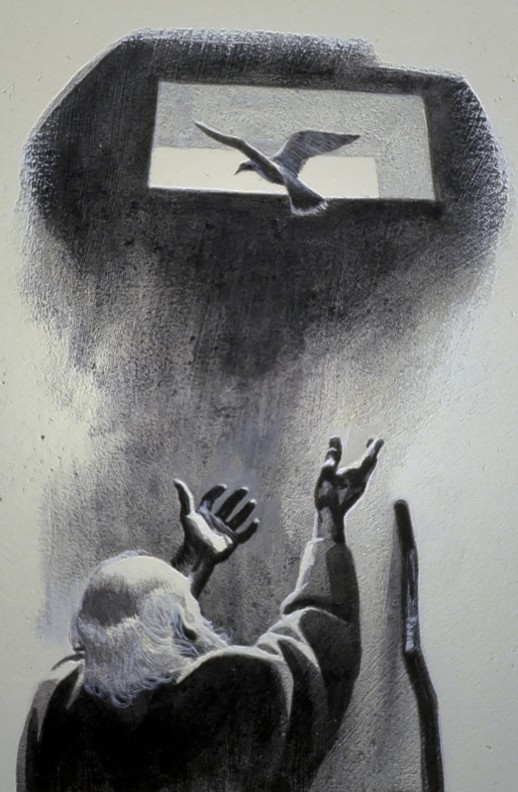
After the flood ended Noah sent out a raven, then a dove, to search for dry land (Genesis 8:6-12).

After the flood ended Noah sent out a raven, then a dove, to search for dry land (Genesis 8:6-12).

There is much more that I could say about the distortion of scripture and the blasphemous nature of this film. In the end, one might say “what is the harm? It’s only a movie.” There is much harm. Anyone who does not know the truth, as well as those who have always thought of the Bible as a book of fairy tales, will from this Tolkien-esque abomination, see nothing but reinforcement of that opinion. Those Christians who themselves have never been taught the reality of the great flood will have every reason to have doubt cast on the scripture’s account, in light of this depiction.

I am not advocating a boycott of the film. For one thing, as is the case with most boycotts, it would be ineffective. But should a Christian go ahead and see this movie simply for its entertainment value? I do not believe so, and must recommend against doing so. We are expected to be “a royal priesthood, an holy nation, a peculiar people” (1 Peter 2:9) – not conformed to this world (Romans 12:2). I cannot see any justification for throwing financial support for something that openly contradicts God’s word and even His righteousness itself. There are better ways to entertain one’s self. And as far as Noah is concerned, I recommend the book. It’s much better.

I also recommend a secular book for anyone interested in some good analysis of the ark itself and the time Noah and his family spent with it – “Noah’s Ark: A Feasibility Study” by John Woodmorappe.

(This year’s reading plan for Luke, Acts, and 1 and 2 Chronicles averages just 15 verses per day – 5 days per week!)
Schedule for this week

/Bob’s boy
___________________
some images © V. Gilbert & Arlisle F. Beers

Please note: I did not design the reading plan that I am following in my blog.  All of my comments in this blog, however, are solely my responsibility.  When reading ANY commentary, you should ALWAYS refer first to the scripture, which is God’s unchanging and unfailing word. Reading schedules, as well as a link to the site where you can get the reading plan that I’m currently following for yourself can be found on the “Bible Reading Schedules” page of my website at http://graceofourlord.com.

Enhanced by Zemanta

Do Not Grow Weary – (2 Thessalonians)

Paul’s second letter to the brethren at Thessalonica was probably written from Corinth about 49-51 A.D., shortly after his first letter. The reason for the second letter could be a sense of urgency because someone was sending letters to the church at certain locations falsely claiming to be from Paul or another apostle. Consider 2 Thessalonians 2:1-2:

“Now concerning the coming of our Lord Jesus Christ and our being gathered together to him, we ask you, brothers, not to be quickly shaken in mind or alarmed, either by a spirit or a spoken word, or a letter seeming to be from us, to the effect that the day of the Lord has come.”

Thessalonica

Thessalonica

Further evidence of this is found in 2 Thessalonians 3:17, where Paul closes the letter with: “I, Paul, write this greeting with my own hand. This is the sign of genuineness in every letter of mine; it is the way I write. The grace of our Lord Jesus Christ be with you all.” Such a wicked and cruel deception was probably done by someone simply wishing to discourage Gentiles from Christianity, or by someone whose only intention was to harm the church. Either way, the latter was the effect, of course.

We know that the Thessalonians already had some distress because in the first letter, Paul had needed to reassure them. False teachers had made them to grieve for those who had already “fallen asleep,” thinking that they were gone forever – that only those alive when Jesus returned would be taken to heaven. Paul devotes 1 Thessalonians 4:13-18 to explain to them concerning this. And just as in 1 Thessalonians, the bulk of this letter is geared toward the second coming of Jesus.

It seems now they had fallen prey to the idea that the second coming had already occurred, and they were very afraid of being left behind. To make matters worse, they were being persecuted – and that in itself just made these fears worse. It may be that this was the cause of another problem Paul addresses in the letter. In 2 Thessalonians 3:6-15, he spends some time speaking about reports he had received that there were those among them that had stopped working, and so they were sponging off of others and generally becoming “busybodies” in their idleness. Perhaps this false notion of the second coming had something to do with this problem.

Paul’s message was that unbelievers will be condemned, and the righteous will be saved when Jesus does return, and there will not be any that are not included. And of course, Christians should not take advantage of the charitable character of their fellow Christians, and should “not grow weary in doing good.”

(This year’s reading plan for Luke, Acts, and 1 and 2 Chronicles averages just 15 verses per day – 5 days per week!)
Schedule for this week

/Bob’s boy
___________________
some images © V. Gilbert & Arlisle F. Beers

Please note: I did not design the reading plan that I am following in my blog.  All of my comments in this blog, however, are solely my responsibility.  When reading ANY commentary, you should ALWAYS refer first to the scripture, which is God’s unchanging and unfailing word. Reading schedules, as well as a link to the site where you can get the reading plan that I’m currently following for yourself can be found on the “Bible Reading Schedules” page of my website at http://graceofourlord.com.

Enhanced by Zemanta

On Transfiguration, Revelation, and Crosses – Luke 9

The ninth chapter of Luke is not the longest chapter of this gospel, but there is a great deal going on in it as Luke picks up the pace in his account. After the feeding of the five thousand, we pick up in verse 18 with Jesus asking the disciples who people are saying that He is. Their answer is that they either say He is John the baptist, Elijah, or one of the other prophets (so in all cases, one raised from the dead). So the bulk of people that are referred to here are familiar enough with the signs and wonders that Jesus has done to know that He is definitely not some ordinary man. And in each case, they obviously believe that He was sent from God.

Jesus is transfigured on a mountain. Moses and Elijah join him, while Peter, James and John watch--Matthew 17 1-13; Mark 9 1-13; Luke 9 28-36.

Jesus is transfigured on a mountain. Moses and Elijah join him, while Peter, James and John watch–Matthew 17 1-13; Mark 9 1-13; Luke 9 28-36.

But now that Jesus has His disciples thinking about this, He wants to know what they have come to think about who He is. It is here that Luke records the fact that it was Peter who first spoke the correct answer – that He is the Christ (the long-awaited Messiah) and the Son of God. In verse 21, Jesus “strictly charged and commanded them” not to tell anyone else. But why is that? The Bible does not explicitly answer that question for us, but it is really not too difficult to figure out the answer from the other information we have in the Scripture.

Given the fact that the people, by and large, already believe that Jesus was sent from God, it would be very easy for most of them to believe that He is the Messiah, once that word started spreading. But what would the reaction be? Given also that Jesus knew that the sort of Messiah they were expecting was one that would lead them to the end of Roman dominance and lead Israel to its former place as a world power, belief in Him as the Messiah before His death could be problematic.

The crowds (5,000 men plus women and children most recently) had become vast in numbers. An expectation that Jesus was there to be their earthly king would result in chaos. It is in this light that Jesus tells them in verse 22 that He must “suffer many things and be rejected by the elders and chief priests and scribes, and be killed, and on the third day be raised.” Nothing could be allowed to hinder this – and it would happen on God’s timetable.

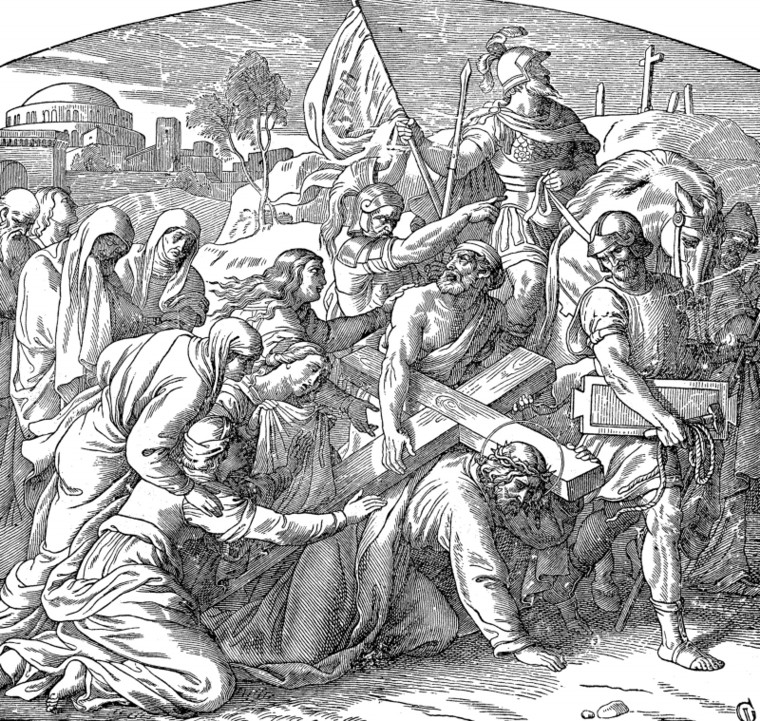
Simon of Cyrene is compelled to carry Jesus' cross

Simon of Cyrene is compelled to carry Jesus’ cross

In verse 23, Jesus talks to the disciples about what it will mean to follow Him. He speaks of it as “taking up” one’s cross and following Him. The context of the next few verses culminates with the statement that some of those present at that very moment would not “taste of death” before they see the kingdom of God. Being a disciple and following Him before such time would not have been an easy thing to do. But Jesus seems to be referring to the cost of following Him after He has risen, and the kingdom has been established.

Taking up one’s cross would mean bearing the burdens that discipleship that just might make life a great deal more difficult. Indeed, many of those first-century Christians would know persecution and suffering unimaginable to us. Jesus knew that many would even be killed for being a part of that kingdom. But those who would lose their lives would gain everlasting life with God. Those who would rather be safe and pursue worldly pleasure and gain, turning their backs on the kingdom, would suffer a worse fate in the end.  In a very real sense, taking up one’s cross often means doing what one would much rather not do.

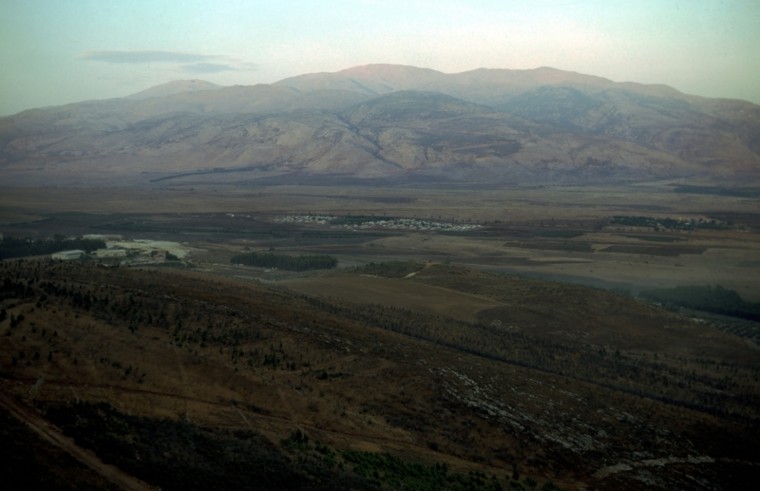
Eight days later, Jesus took Peter, James, and John with Him to “the mountain” to pray. Which mountain it was, we do not know. One traditional belief is that it was Mount Hermon because of its height. It is estimated that this mountain is about 45 kilometers from Capernaum, so it is definitely possible. Others believe that it was Mount Tabor. But the mountain is not the focus of the gospel in verses 28-36.

Mount Hermon is one traditional site for Jesus' transfiguration

Mount Hermon is one traditional site for Jesus’ transfiguration

As Jesus was praying, “the appearance of his face was altered, and his clothing became dazzling white.” We are not given much detail about just what was happening or in what way His face was altered. But clearly, the Holy Spirit brought about some changes to Him that were important to God’s plan. Peter and the others woke from a deep sleep to see two men talking with Him (Moses and Elijah). Luke says that they appeared in “glory” and they saw Jesus’ glory as He spoke with them. This is a term that was used in the Old Testament to describe the dramatic visual effect of the presence of God; and that is exactly what was going on here as well.

Peter, either having it revealed to him or learning from what he heard, knew who the two men were. But he did not understand what was happening, as he suggested they make some extra tents for them.  They became afraid as a cloud came and surrounded them. Then the voice of God sounded out as He told them “This is my Son, my Chosen One; listen to him!” Peter, James, and John probably would not fully understand until after Pentecost, but the point for them (and for us) was made when Moses and Elijah left, and Jesus alone was standing there. God was telling them that it was the words of His Son that they would listen to from now on – not Moses, and not the prophets.

Another point to ponder from the record of the transfiguration is the fact that Moses had died hundreds of years ago (Deuteronomy 34:5). Elijah had been taken up by God many “lifetimes” ago (2 Kings 2:1-12).  What does this tell us about life after death and everlasting life? It certainly tells us that we can count on God’s word, as always. But what conclusions should we draw from Moses’ presence? Something to ponder for perhaps another time.

(This year’s reading plan for Luke, Acts, and 1 and 2 Chronicles averages just 15 verses per day – 5 days per week!)
Schedule for this week
Read or listen to audio of today’s selection from Luke here
Read or listen to audio of today’s selection from 1 Chronicles here

/Bob’s boy
___________________
some images © V. Gilbert & Arlisle F. Beers

Please note: I did not design the reading plan that I am following in my blog.  All of my comments in this blog, however, are solely my responsibility.  When reading ANY commentary, you should ALWAYS refer first to the scripture, which is God’s unchanging and unfailing word. Reading schedules, as well as a link to the site where you can get the reading plan that I’m currently following for yourself can be found on the “Bible Reading Schedules” page of my website at http://graceofourlord.com.  

Enhanced by Zemanta

Nailed To the Cross – Epistle To Colossae

Paul’s letter to the Colossians is one of the four “prison epistles” (he also wrote letters to the Ephesians, the Philippians, and to Philemon while in prison).  The date of writing is generally thought to be about 62 A.D., which assumes that he wrote it from prison in Rome after his fateful voyage in Acts 27-28.

English: Saint Epaphroditus Русский: Ап. Епафр...

English: Saint Epaphroditus Русский: Ап. Епафродит. Миниатюра из греко-груз. рукописи. XV в. (РНБ. О. I.58. Л. 114 об.) (Photo credit: Wikipedia)

Some scholars believe that Paul did not have a hand in establishing the church at Colossae personally. This is partially due to the reference in verse 7 to them having learned the truth from Epaphras. But if one reads verse 6 along with it, the mention of Epaphras appears to be an additional source of preaching of the gospel to the brethren there. It is likely that he at least had a hand in it, and we find it difficult to believe (as some have stated) that he never even visited them – especially being at Ephesus for three years during his third missionary journey. Regardless, Paul’s letter to them demonstrates no small measure of familiarity, and it should be noted that Philemon, to whom another prison epistle was written, was himself a Colossian. And Timothy, who apparently acted as Paul’s secretary for this letter (verse 1), was likely no stranger to them either.

Some parts of this letter appear to be addressing a problem with false teachers, possibly rising from within the ranks of the brethren, just as he warned the Ephesian elders about in Acts 20:28-30. One passage that particularly seems to allude to this is in Colossians 4:18, which says “let no one disqualify you, insisting on asceticism and worship of angels, going on in detail about visions, puffed up without reason by his sensuous mind…”

But the overriding message to the brethren at Colossae (and to us) is about the gift of life given to us by Jesus. It is summarily contained in great detail in chapter 2:8-15. There, Paul speaks of Jesus Christ as deity and “the head of all rule and authority,” with whom we have been buried in baptism. And we, who were dead in our sins, have had our debts paid for us by Him and they were “nailed to the cross.”

(This year’s reading plan for Luke, Acts, and 1 and 2 Chronicles averages just 15 verses per day – 5 days per week!)
Schedule for this week

/Bob’s boy
___________________
some images © V. Gilbert & Arlisle F. Beers

Please note: I did not design the reading plan that I am following in my blog.  All of my comments in this blog, however, are solely my responsibility.  When reading ANY commentary, you should ALWAYS refer first to the scripture, which is God’s unchanging and unfailing word. Reading schedules, as well as a link to the site where you can get the reading plan that I’m currently following for yourself can be found on the “Bible Reading Schedules” page of my website at http://graceofourlord.com.

Enhanced by Zemanta

Twelve (extra) Ordinary Men

All four of the Gospels contain numerous references to Jesus going to God in prayer. On this occasion (in Luke 6:12), Luke says that he went to “the mountain” and spent the whole night in prayer. We do not know what mountain this was. It is reasonable to believe it was one located close to what was then Capernaum.

Ministry of the Apostles, a complex multi-figu...

Ministry of the Apostles, a complex multi-figure icon with a full-height image of Jesus Christ, surrounded by sectors with scenes of His disciples’ calling, ministry and martyrdom. Icon from the Yaroslavl Museum Preserve. (Photo credit: Wikipedia)

What was the occasion of such a lengthy and fervent time of prayer by the Son of God? The next verse gives us the answer, for when day came, He chose from among His disciples twelve men from various backgrounds, and named them “apostles,” a word very familiar to us. He chose this term because it describes what their mission would be very well. It comes from the Greek word “apostolos,” which means “messenger” or more aptly “one who is sent out.” This will become most appropriate when He gives them their “Great Commission.” The list of apostles also occurs in Matthew 10:2-4, and in Mark 3:14-19. There are some differences, but it is the same twelve men in those gospels as listed here in Luke. Like Simon, many were known by more than one name.

The first two are “Simon, whom he named Peter, and Andrew his brother” The next two listed are James and John (the sons of Zebedee), who were partners in fishing with Peter and Andrew. This James is sometimes called “James the greater” to distinguish him from the other apostle named James. John referred to himself as the “disciple whom Jesus loved” (John 13:23, John 20:2). Philip was one of the first disciples, but is not mentioned after Jesus’ ascension. He should not be confused with the Philip in the book of Acts that was a deacon.

The next apostle listed is Bartholomew, also known as Nathanael (John 1:44-49); and he is almost always mentioned along with Philip. Next was Matthew, also known as Levi, the tax collector, followed by Thomas (who, unfairly really, will always be remembered as “doubting Thomas”). Next come James the son of Alpheus (also known as James the less), and Simon “who was called the Zealot.” In the days before the destruction of Jerusalem in 70 A.D., the group of people known as Zealots were men who wished to overthrow the Roman government. It is unknown for certain whether the term here is meant in a religious sense or in that political sense. If the latter, it would mean that a change of heart and purpose occurred in his life after becoming a disciple. Otherwise, Jesus would not have made him an apostle.

English: Icon of James, the Just, brother of J...

English: Icon of James, the Just, brother of Jesus Português: Ícone de Tiago, o Justo, irmão de Jesus (Photo credit: Wikipedia)

Number eleven in the Gospel of Luke is “Judas the son of James,” known in Matthew as Thaddaeus. Some scholars believe that this is the Jude that wrote the book of Jude, but there are some problems with that. In the opening for the Book of Jude, he calls himself “the brother of James,” while he is listed here as the son of James. It is certainly possible for someone to have a brother with the same name as their father, but it is more likely that Jude was referring to a more well-known James – the brother of Jesus. If so, it would make that Jude the brother of Jesus also (both he and James called themselves “servants” of Jesus Christ in the scriptures). Jesus did have a brother named Jude, short for Judas (Matthew 13:55). But none of the apostles could have been brothers of Jesus. Though His brothers did come to believe in Him, at the time of John 7:5, they did not; and the circumstances in that passage occurred well after His apostles were named. The last apostle in the list is Judas Iscariot who, we all know, betrayed Jesus.

Twelve men who were just like you and me, who saw in Jesus salvation for the world. Their lives were never the same after meeting Him. And once Jesus went home, the Holy Spirit would make their understanding of what they were a part of complete. But for now, they have a lot to learn.

(This year’s reading plan for Luke, Acts, and 1 and 2 Chronicles averages just 15 verses per day – 5 days per week!)
Schedule for this week
Read or listen to audio of today’s selection from Luke here
Read or listen to audio of today’s selection from 1 Chronicles here

/Bob’s boy
___________________
some images © V. Gilbert & Arlisle F. Beers

Please note: I did not design the reading plan that I am following in my blog.  All of my comments in this blog, however, are solely my responsibility.  When reading ANY commentary, you should ALWAYS refer first to the scripture, which is God’s unchanging and unfailing word. Reading schedules, as well as a link to the site where you can get the reading plan that I’m currently following for yourself can be found on the “Bible Reading Schedules” page of my website at http://graceofourlord.com.  

Enhanced by Zemanta

About the Recent Debate…

This past week, a much publicized debate occurred between Bill Nye, the popular ’90’s TV icon known as “the Science Guy,” and Ken Ham, the CEO of the “Answers In Genesis” organization that maintains a website presence with a staff of scientists of their own. The subject of the debate was, as is always the case, in the form of a question. The question that was debated in this instance was “Is creation a viable model of origins. As expected, both of these highly intelligent, educated men presented their positions well. Mr Ham remarked that this type of debate has occurred much less frequently since their popularity 30 years ago or so. What he didn’t say was that the reason is largely because the atheists and agnostics have increasingly avoided these debates because they usually did not do so well. It sometimes works out that way when you go up against the truth.

A message from the founder

A message from the founder (Photo credit: ellenm1)

I understand there were no moments when one of the debaters was totally embarrassed by the other. To my knowledge, there were no mass baptisms following the debate. Neither were there mass closings of churches due to loss of faith. And I suspect that most of the people who watched or listened to the debate did not change from non-believer to believer or vice-versa directly afterward. Those who look at the evidence of the natural world in such cases (on both sides) do so with their own presuppositions and an epistemology that they are mostly committed to; and most of them usually leave with their original worldview mostly intact. 

Don’t get me wrong – I love apologetics. I have spent hundreds upon hundreds of hours studying apologetics, and will likely continue to do so until the day that I die. The more I study – the more evidence from the natural world that I examine, the more certain I become of what I already know to be the truth: “In the beginning, God created the heavens and the earth.” It is the same for bible study. I have read the entire Bible – all of it at least once; and I have spent countless hours studying it. And something occurred to me a long time ago. I am convinced that it is not possible to read and study – and I mean TRULY study – the Bible with an open mind and not realize that it really is the word of God. Take one of the caveats out of that sentence, and yeah maybe. But really study it with an open mind, and I do not believe you can miss knowing that Romans 1:19-20 nails it:

For what can be known about God is plain to them, because God has shown it to them. For his invisible attributes, namely, his eternal power and divine nature, have been clearly perceived, ever since the creation of the world, in the things that have been made. So they are without excuse.

Bill Nye the Science Guy at The UP Experience ...

Bill Nye the Science Guy at The UP Experience 2010. Note: this photo is Creative Commons Attribution. You are welcome to use it with “photo by Ed Schipul” (Photo credit: Wikipedia)

But I really don’t like watching debates any more. In fact, I did not watch very much of this past week’s debate. There, I’ve said it. Fortunately, there is no apologist’s registration card or anything that I now have to surrender. But it’s true. Now, I did tune in to pieces of the recording, and heard much of what I expected. I have read and listened to media about a great deal of what “AnswersInGenesis.org” publishes on their website – and I agree with most of it. Their scientists are top-notch, everything is peer-reviewed, and I love reading it.

And Mr. (Dr.?) Nye was quite eloquent in the segments that I saw. He did use a couple of the emotional plea bits that we have come to expect from non-believers arguing their position. You know the type of statement – “you (Christians) seem to think all of the other faiths (some of them much older than your Bible) are all wrong.” To his credit, he didn’t use the old “are you saying my dear sweet mother is going to hell?” bit that Dan Barker used in a debate a few years ago. But like other debates I have seen in recent years, I just didn’t feel good watching it. I do still listen to one debate that I have probably heard 50 or more times – “The Great Debate” between the late Dr. Greg Bahnsen and Dr. Gordon Stein in 1985. Dr. Bahnsen gave us what I believe was the greatest example of defending the faith of our time. I really never seem to tire of it – because, to me, it was a masterpiece.

bibles

bibles (Photo credit: fancycwabs)

But these other debates just make me sad. And I don’t mean just a little bit. They truly get me depressed; and it’s not hard for me to figure out why. Bill Nye was made in God’s image too. To hear and watch a man with such a brilliant mind (who truly believes in what he is saying), and know that if he continues on the path he is on that he will be lost – that just really hurts my heart. It would be different if I could just believe that he was some sort of monster – an evil man. But I happen to believe that the opposite is true – that he is probably a very good man. He, no doubt, has a family that he loves and who love him; and I am sure that he is good to them. No, I just cannot bring myself to truly dislike the man. And so, the debate makes me sad for him. And sad for all of the others who applaud his efforts to show that only idiots believe the Bible is the word of God.

Something else that makes me sad about it is motivation. I can’t help wondering why those who claim not to believe in God feel the need to evangelize people. It just seems that they feel the need to convince themselves, and that by convincing as many other people as possible, they can feel more confident in their own unbelief. After all, if absolutely nobody but Bill Nye was an unbeliever, it would be hard for him to keep that belief very strong. What I think that Bill Nye – and others like him – just don’t get, is that our (the Christian’s) motivation has nothing to do with anything like that. They seem to believe that we are all about imposing our beliefs on others needlessly. They cannot understand that we evangelize because we want to share something very good with others – and that our desire to help others get to heaven is genuine. That’s it, folks. No ulterior motive.

cross_080214And so, I have said a few prayers for Bill Nye, and for those who believe as he does. There is always hope. And that is one of the answers to the question of why I continue to study apologetics so hard; and why I will engage in casual debate myself. The most important reason is, of course, 1 Peter 3:15“in your hearts honor Christ the Lord as holy, always being prepared to make a defense to anyone who asks you for a reason for the hope that is in you.”

And then there is the hope that we have for those who are lost. I must get over the sadness, and thank the Lord that it is not my job to judge. I also thank Him that it is not my responsibility to see to it that every person I meet becomes a believer. Those who simply will not ever believe are spiritually dead, and I cannot raise the dead. It IS my job to speak up, though. It IS my job to try to “plant the seed” of truth any time I have an opportunity. God will take it from there, and I am truly thankful for that.

I find comfort often by thinking of it this way. In the beginning, before sin came into the world, everything was very good. In the end, no matter who is saved and who is lost, God is still in control, and He will make it all very good again. That is where faith truly comes in. I still have to learn to trust Him more.

/Bob’s boy

(This year’s reading plan for Luke, Acts, and 1 and 2 Chronicles averages just 15 verses per day – 5 days per week!)
Schedule for this week

___________________
some images © V. Gilbert & Arlisle F. Beers

All of my comments in this blog are solely my responsibility.  When reading ANY commentary, you should ALWAYS refer first to the scripture, which is God’s unchanging and unfailing word. Reading schedules, as well as a link to the site where you can get the reading plan that I’m currently following for yourself can be found on the “Bible Reading Schedules” page of my website at http://graceofourlord.com.  

Enhanced by Zemanta

Down To Capernaum

After Jesus left Nazareth in Luke 4, he went down to Capernaum. Here Luke mentions that Capernaum was in Galilee, which of course was for the benefit of Theophilus (and any Gentile reader), where He was teaching people on the Sabbath. Luke said that they were “astonished” at His teaching because His word “possessed authority.” This was an appropriate assessment, as it was a case of the word of God being taught by the Lord. It is with that same authority that He commands an unclean spirit to come out of a man in the synagogue, and the people marvel at that as well. And verse 37 says that “reports about him went out into every place in the surrounding region.”

Capernaum, Sea of Galilee

Capernaum, Sea of Galilee (Photo credit: Wikipedia)

In verse 38, Jesus goes to the home of  Peter, whose mother-in-law is very ill with a high fever. Here, he shows His authority over even sickness, as the scripture says He “stood over her and rebuked the fever, and it left her, and immediately she rose and began to serve them.” It is here that we learn that the “reports” about Him that are mentioned in verse 37 have caused a great many people to bring their sick and diseased relatives to Jesus to be healed; and He heals them all (verse 40).  We are also told that demons came out of many, and that they knew He was the Son of God. But Jesus rebuked them. He was not ready for this fact to become known far and wide.

The verses here in Luke and in other parts of the Gospels concerning demons can be difficult for us to understand because such things are so foreign to our experience. But there is much we do not know about where spirits and demons are concerned. For whatever reason, God allowed these spirits to dwell in and among many people just prior to and after Jesus’s time here on earth. We have some opinions about that, which we wrote about here in this article. Hopefully, that may be helpful to you in understanding better, but remember, it is just an opinion – hopefully, an informed opinion, but an opinion, just the same.

Verse 42, says that when it was day, He departed and went to a “desolate place.” This implies that He must have spent all night – from sunset on (see verse 40)  healing people. This verse indicates that He was tired and needed time alone. The people did not want Him to go, and went looking for Him. Verse 43 gives His response: “I must preach the good news of the kingdom of God to the other towns as well; for I was sent for this purpose.” And in verse 44, He begins preaching in synagogues throughout Judea.

For two good articles with pictures of Capernaum, please see this article with an aerial photo and this article with a picture of a partially reconstructed synagogue from Ferrell’s Travel Blog.

(This year’s reading plan for Luke, Acts, and 1 and 2 Chronicles averages just 15 verses per day – 5 days per week!)
Schedule for this week
Read or listen to audio of today’s selection from Luke here
Read or listen to audio of today’s selection from 1 Chronicles here

/Bob’s boy
___________________
some images © V. Gilbert & Arlisle F. Beers

Please note: I did not design the reading plan that I am following in my blog.  All of my comments in this blog, however, are solely my responsibility.  When reading ANY commentary, you should ALWAYS refer first to the scripture, which is God’s unchanging and unfailing word. Reading schedules, as well as a link to the site where you can get the reading plan that I’m currently following for yourself can be found on the “Bible Reading Schedules” page of my website at http://graceofourlord.com.  

Enhanced by Zemanta

Growing Daily By Prayer

Rejoice always, pray without ceasing, give thanks in all circumstances; for this is the will of God in Christ Jesus for you.
1 Thessalonians 5:16-18

By making daily Bible reading a part of our lives, we hear from God each day, and our lives are enriched. The other half of that communication occurs when we talk to Him in prayer. This year, we have committed to developing our prayer life so that we can pray more effective prayers that are pleasing to our Lord. To begin that effort this month, we have decided to dust off the old prayer box and pull out one of the oldest outlines for prayer method we know about – the ACTS method.

Jesus in Pray

Jesus in Pray (Photo credit: Wikipedia)

It is unknown where this originated, but it has been repeated countless times by innumerable evangelists. While it is true that there is no set of rules or structure for prayer that God wants us to use or has mandated, this method contains very good key elements to prayer that are easily remembered. No, we are not referring to the Book of the Acts of the Apostles. People love acronyms because when they are not too complex, they help us remember things.  With that in mind, the elements of prayer represented by the ACTS method are adoration, confession, thanksgiving, and supplication.

The element of adoration is to recognize the greatness of our Creator and that He is worthy of our praise, our worship, and our love for His majesty, His holiness, and His omnipotence. By loving acknowledgement of His awesome power, His boundless goodness and loving care, and the majesty of all that He has created, we give Him the glory of which He is worthy, and we focus our minds and hearts in the right frame of mind for the rest of our prayer.

Through confession in our prayers, we acknowledge our weaknesses to God, admitting that we are in need of His forgiveness to keep our hearts pure. And as Christians, this helps us to stay focused on the reason that we even have the privilege of being able to obtain forgiveness in prayer. We have a “High Priest,” who gave His life so that we could have that forgiveness, and by whom we can approach our heavenly Father in prayer.

Thanksgiving is so integral and important to prayer that we cannot emphasize it enough. We must recognize the love and care that God has shown for us – and continuously does so in all that He does for us. God has given us so many material and spiritual blessings in this world that He has created – not because we deserve any of it, but because He loves us even though we are not worthy of that love.

By making supplication to God, we recognize our dependence on Him for all things. We give Him our petitions, acknowledging and addressing not only our own needs, but the needs of others as well – a key component of prayer. Expressing our love and concern for others to God in prayer builds our faith, and helps us to grow as His children, reflecting the love that His Son had for all people and which He charged us to have as well.

There are many ways to pray, and this method is not the only one that will work.  Also, there is no prescribed order to these elements, nor are they all required in every prayer. But they can serve as a great frame of reference for planning our prayer. That planning – the preparation for prayer is an important aspect that we plan to focus more upon in our study of prayer this year.

We will more closely examine the first element in this method (adoration) next month, as we continue our study in prayer life.

/Bob’s boy
___________________
some images © V. Gilbert & Arlisle F. Beers

Please note: I did not design the reading plan that I am following in my blog.  All of my comments in this blog, however, are solely my responsibility.  When reading ANY commentary, you should ALWAYS refer first to the scripture, which is God’s unchanging and unfailing word. Reading schedules, as well as a link to the site where you can get the reading plan that I’m currently following for yourself can be found on the “Bible Reading Schedules” page of my website at http://graceofourlord.com.  

Enhanced by Zemanta