Psalm 135 – Whatever the Lord Pleases

English: Scroll of the Psalms

English: Scroll of the Psalms (Photo credit: Wikipedia)


This is another “Hallelujah Psalm,” but not to be confused with one of the “Hallel” (Psalms 113-118). It begins and ends by praising and blessing God. The praise covers several times and events in the history of Israel, beginning with God choosing Jacob (Israel) for His own (verse 4).


Verses 5-7 praise God for His majesty and power over earth wind, sea and sky. Verses 8-9 contain specific praise for God’s signs and works against Egypt and Pharaoh, while verses 10-12 speak of his victories over the kings in Canaan, giving their land to Israel. Verses 15-18 praise God, while pointing out silliness of worshiping idols, which are unreal, nonliving, and unintelligent.


The psalm is called a mosaic (Spurgeon said a “tessellated pavement) because there are so many parts of it that are found or quoted in other books of the Old Testament. Verses 1-2 are taken from Psalm 134:1-3, verse 5 from Exodus 18:11,  verse 7 is like Jeremiah 10:13, and verses 15-18 are like Psalm 115:4-8. There are several others.


This harmonious and  poetic arrangement of praise verses was compared also by one writer to flowers arranged in a bouquet. It is a fitting description, and a just reason for the servant of God to present such to the Lord. As Barnes said, “the whole design of the psalm is to excite praise to God, and to show reasons for doing so.” To this end, the psalm does a very good job indeed.


Read or listen to audio of ESV version of this selection from this link.


/Bob’s boy


___________________


some images © V. Gilbert & Arlisle F. Beers


Please note: I did not design the reading plan that I am following in my blog.  All of my comments in this blog, however, are solely my responsibility.  When reading ANY commentary, you should ALWAYS refer first to the scripture, which is God’s unchanging and unfailing word. Reading schedules, as well as a link to the site where you can get the reading plan that I’m currently following for yourself can be found on the “Bible Reading Schedules” page of my website at http://graceofourlord.com.  

 

O T Facts (First Book of Law) – Genesis

In this installment of our Old Testament Facts series, we will focus today on the first book of the Pentateuch – Genesis, the first “Book of Law.”   This is not intended to be an exhaustive list of events of this book.  Rather, it is presented as a summary of events that seem most relevant to worship of the Lord and the ultimate coming of Jesus the Christ.

Creation_003Genesis

The book of the beginning and of new beginnings

Genesis 1 – Creation of the universe

Genesis 2 – Adam and Eve created

Genesis 3 – “The fall” – sin enters the world; first promise of the Messiah (Gen 3:15)

Genesis 4 – Cain murders Abel

Genesis 6–9 – Noah and the flood

Mamre, near Hebron. Abraham's home at one time

Mamre, near Hebron. Abraham’s home at one time

Genesis 12 and 15 – God’s covenant with Abraham (promise of land, a “great nation” and the Messiah)

Genesis 21 – Birth of Isaac

Genesis 32:28, Gen 35 – God names Jacob “Israel” (meaning God fights)

Genesis 37 – Joseph sold into slavery

Genesis 41 – Joseph rises to power in Egypt under Pharoah

Genesis 46 – Joseph brings his family to Egypt, is reunited with Jacob

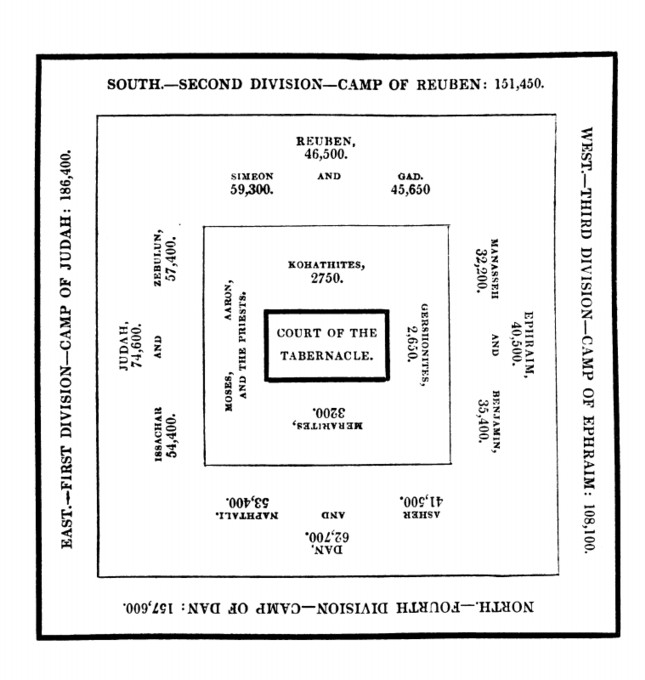
Tabernacle - arrangement of tribes

Tabernacle – arrangement of tribes

Genesis 48 – Jacob (Israel) blesses Joseph’s sons Ephraim and Manasseh, claims them as “his” (Gen 48:5-6), again favoring the younger (Ephraim) over the first-born (Genesis 48:14-20).

Genesis 49 – Jacob blesses his sons, but declares that Simeon and Levi (their descendants) will be scattered among the other tribes (Gen 49:5-7).  So the Twelve Tribes of Israel are named – to include Ephraim and Manasseh (Genesis 49:3-28).  Jacob’s death and burial (Genesis 49:29-50:14).

Genesis 50:22-26 – Death of Joseph – end of Genesis

/Bob’s boy

___________________
image © V. Gilbert & Arlisle F. Beers

Please note: I did not design the reading plan that I am following in my blog.  All of my comments in this blog, however, are solely my responsibility.  When reading ANY commentary, you should ALWAYS refer first to the scripture, which is God’s unchanging and unfailing word. Reading schedules, as well as a link to the site where you can get the reading plan that I’m currently following for yourself can be found on the “Bible Reading Schedules” page of my website at http://graceofourlord.com.  For questions and help, please see the “FAQ” and “Summaries” pages there.

Proverbs 12 – The Way of a Fool

Because of the nature of the book of Proverbs, and the impossibly of commenting on all of a single chapter in these short paragraphs,we choose to pick one or two verses on which to focus.. Please see our  previous post on study tips for Proverbs.

Today this blog will focus on a single short verse from chapter 12. verse 15 reads:

“The way of a fool is right in his own eyes, but a wise man listens to advice.”  

This has been the plague of men (and women) since  time began; and the more learned we become the worse it gets.  During the cycle of the Judges 17:6 and 21:25 in Israel,  the text says “In those days there was no king in Israel. Everyone did what was right in his own eyes.”  The people would fall into apostasy over and over again until God rescued them and they would start the cycle all over again.   People worshiped their idols and turned away from God until things got so bad that they ended up crying out to him, and then he would save and deliver them.  This continued throughout the kingship of David and even the author of this book.

Even Solomon allowed the women that he turned to lead him into idolatry.  God often has tolerated foolishness by the self-deception of man since time immemorial and has allowed him to continue to make those kinds of mistakes because we have our own freedom to make our mistakes.The wise man listens to the advice and wisdom of our God, His son, and the Holy Spirit.

We are brought up in a world that teaches our children macro-evolution that we are no more than advanced animals that, this world is all there is, and that the Bible is little more than a book of fables.  So-called educated men make it their purpose in life to convince people who there is no purpose in life.  But His evidence is all around us, including His attributes (Romans 1:20).  We exchange the wisdom of God for the foolishness of man that we call wisdom, in order to justify our own unrighteousness and worship our own idols of sin and depravity (Romans 1:22-23). We tell the child there is no God and that he was foolish to believe there is and then we  wonder why so many lose heart and hope.

We must give true wisdom to our children though God’s word to combat the lies that this world tells them about who we are and where we come from; and teach them where they can go.

Read or listen to audio of ESV version of this selection from this link.

/Bob’s boy
___________________
some images © V. Gilbert & Arlisle F. Beers

Please note: I did not design the reading plan that I am following in my blog.  All of my comments in this blog, however, are solely my responsibility.  When reading ANY commentary, you should ALWAYS refer first to the scripture, which is God’s unchanging and unfailing word. Reading schedules, as well as a link to the site where you can get the reading plan that I’m currently following for yourself can be found on the “Bible Reading Schedules” page of my website at http://graceofourlord.com.  For questions and help, please see the “FAQ” and “Summaries” pages there.
Ezra 3 – Rebuilding the Temple

In verse 1, by Israel’s calendar, the seventh month was Tishri (about September).  It was the month of the Day of Atonement (Leviticus 23:26–32), and then came the Feast of Booths (Leviticus 23:33–43), celebrating the exodus.  It was important to build the altar first, as it was the first thing done when the people first entered the land after the exodus (Deuteronomy 27:1-8); and it was built at the site of the old altar (verse 3), and they began sacrificing at once.  In verse 7, they gave money to the masons and carpenters, and to the Sidonians and the Tyrians for the cedars of Lebanon to be brought.

Day of Atonement

Day of Atonement (Photo credit: Wikipedia)

The Temple project began in the  second year (about 537 BC). The second month, in verse 8, was Ziv (1 Kings 6:1) and is in the spring.  It was the same time of year that Solomon began construction of the original temple (2 Chronicles 3:2).  In verses 10-11, the people shouted with joy at the laying of the foundation.  But in verses 12-13, some of the very old remembered the first temple, and they did not believe that the new one would be as awesome and beautiful as the first (see Haggai 2:2-9).  So the sounds of weeping and joy could not be distinguished from each other.

Read or listen to audio of ESV version of this selection from this link.

/Bob’s boy
___________________
some images © V. Gilbert & Arlisle F. Beers

Please note: I did not design the reading plan that I am following in my blog.  All of my comments in this blog, however, are solely my responsibility.  When reading ANY commentary, you should ALWAYS refer first to the scripture, which is God’s unchanging and unfailing word. Reading schedules, as well as a link to the site where you can get the reading plan that I’m currently following for yourself can be found on the “Bible Reading Schedules” page of my website at http://graceofourlord.com.  For questions and help, please see the “FAQ” and “Summaries” pages there.

Amos 5 – Let Justice Roll Down

This prophecy from Amos is directed to the northern kingdom during the time of the reign of Jeraboam II.  Amos’s message from God is that doom is coming to Israel because of social injustice.  They are mistreating and persecuting the poor and at the same time, offering worship that is insincere at best.  The “lamentation” in verse 1 stresses that Amos – and God – grieve at what lays ahead for Israel.  Jesus offers a similar lament in Matthew 23:37-39.   But there is still time.  Verses 4-9 are a plea for them to seek the Lord, rather than the pagan forms of worship being done at Bethel, Gilgal, and Beersheba.

Assyria

Assyria (Photo credit: nafmo)

Their worship had deteriorated to the point that there was no visible line between worship to God and worship to idols.   Sikkuth and Kiyyun in verse 26 were Mesopotamian deities.  There were also golden calves, priests who were not Levites, and other violations of the Law.  God despises their sacrifices because of their sinful acts, the perversion of their worship, and their injustice to the needy and the righteous (verse 12).  The scriptures have shown over and over that God cares a great deal about social justice.  He made it clear though Moses, for example, in Exodus 22:21-26.  Their hearts were not right.

Verse 27’s “exile beyond Damascus” was a poignant prediction, as Assyria in the time of Amos was not yet a strong power.

Read or listen to audio of ESV version of this selection from this link.

/Bob’s boy
___________________
some images © V. Gilbert & Arlisle F. Beers

Please note: I did not design the reading plan that I am following in my blog.  All of my comments in this blog, however, are solely my responsibility.  When reading ANY commentary, you should ALWAYS refer first to the scripture, which is God’s unchanging and unfailing word. Reading schedules, as well as a link to the site where you can get the reading plan that I’m currently following for yourself can be found on the “Bible Reading Schedules” page of my website at http://graceofourlord.com.  For questions and help, please see the “FAQ” and “Summaries” pages there.

2 Kings 10 – Jehu Strikes Down the Prophets of Baal

Jehu-on-black-obelisk

Jehu-on-black-obelisk (Photo credit: Wikipedia)

Ahab had seventy sons in Samaria.  So Jehu sent letters to the rulers of the city to prepare to fight him.  But after he had killed the two kings, they were afraid and so he told them to send him the heads of Ahab’s sons.  After this was done, he struck down all that remained in the house of Ahab at Jezreel (verse 11).  On the way to Samaria, he did the same with all the relatives of Ahaziah; and after reaching Samaria, he dealt with the remainder of the house of Ahab.  So now it was fulfilled as Lord had spoken to Elijah (verse 17).

Verses 18-26 detail brilliant planning and execution (literally) on Jehu’s part to exterminate the prophets of Baal in the land.  But although verse 28 says that he wiped out Baal from Israel, but verse 29 says that he left the golden calves in Bethel and Dan and “did not turn aside from the sins of Jeroboam.” And as Assyria grows stronger, the Lord had already begun (verse 32) to “cut of parts of Israel.”  After the demonstration in the last few chapters of the Lord’s power and His will always coming to pass, it is no surprise to see Hazael of Syria beginning to defeat them throughout Israel territory, as prophesied in 1 Kings 19:15-18. verse 38 tells us that Jehu reigned 28 years before his death, and then Jehoahaz, his son, reigned in his place.

Read or listen to audio of ESV version of this selection from this link.

/Bob’s boy
___________________
some images © V. Gilbert & Arlisle F. Beers

Please note: I did not design the reading plan that I am following in my blog.  All of my comments in this blog, however, are solely my responsibility.  When reading ANY commentary, you should ALWAYS refer first to the scripture, which is God’s unchanging and unfailing word. Reading schedules, as well as a link to the site where you can get the reading plan that I’m currently following for yourself can be found on the “Bible Reading Schedules” page of my website at http://graceofourlord.com.  For questions and help, please see the “FAQ” and “Summaries” pages there.

2 Kings 9 – Jehu Anointed King of Israel

English: Jezabel and Ahab Meeting Elijah in Na...

English: Jezabel and Ahab Meeting Elijah in Naboth’s Vineyard Giclee. Print by Sir Frank Dicksee. (Photo credit: Wikipedia)

God has ordained that Elisha will anoint Jehu (son of Jehoshaphat, son of Nimshi) as king over Israel.  The servant of the prophet, at Elisha’s instructions, anointed him in secret chambers (reminiscent of Samuel’s anointing of Saul in 1 Samuel 9:27-10:1).   As he anointed him, the servant gave him the instructions of the Lord as given to Elisha (verses 6-10).  He is to carry out the prophecy of 1 Kings 21:21-4 that Elijah had spoken to Ahab, declaring the death and destruction of Ahab’s house, that Jezebel would be eaten by dogs (we learn later that this is for killing the Lord’s prophets), and that Ahab’s blood would be shed in the very same place where he and Jezebel had caused Naboth to be stoned to death for his vineyard (1 Kings 21:19).  Because of Ahab’s repentance in 1 Kings 21:25-29, the Lord relents on Ahab himself, and has Elijah wait for his son to come to power.

Jehu wastes no time in assuming power (verses 12-13), and heads to Jezreel to deal with Ahab’s son, Joram and his mother Jezebel.   The tension of the story mounts while Jehu furiously approaches, as one by one, messengers sent to inquire of Jehu’s intentions fail to return – instead turning to ride with Jehu!    Ahaziah, the king of Judah, had come to visit Joram, so at first reading, one might think that it was just his bad luck to be there.  But another account of this event with more details is in 2 Chronicles 22 (especially 2 Chronicles 22:7-9), making it clear that Ahaziah’s death was ordained by God.

English: Jehu was king of Israel, the son of J...

English: Jehu was king of Israel, the son of Jehoshaphat [1], and grandson of Nimshi. (Photo credit: Wikipedia)

After Jehu, kills Joram, he has his body taken to be thrown on the ground of Naboth’s vineyard.  He then pursues Ahaziah and has him shot near Ibleam; and Ahaziah makes it to Megiddo before dying.   Back in Jezreel, he had Jezebel tossed out the window; and when he sat down to eat, he gave instructions to have her buried.  But when they went to get her, there was not much left of her body (verses 35-37), just as God had said.

This chapter shows us once again that when God’s will is made known, you can count on it coming to pass – in His time.

Side notes:

This link to an interesting article about excavations in Tel Jezreel has a lot of great information and pictures, and interesting bits of history, such as a reference that “shortly before Jehu’s revolt in 842 BCE King Joram and the dowager Queen Jezebel were in residence in Jezreel.”

Also, this link to the British Museum is about an Assyrian exhibit of a find in an 1846 excavation containing the Black Obelisk of Shalmanesar III (a public monument erected about 825 BCE), which both mentions and pictures Jehu (the earliest known picture made of an Israelite) and Ahab’s father Omri.  It has an inscription about tribute the Assyrian king received from Jehu when he was king (dated about 841 BCE) written in Assyrian cuneiform:

“The tribute of Jehu, son of Omri: I received from him silver, gold, a golden bowl, a golden vase with pointed bottom, golden tumblers, golden buckets, tin, a staff for a king [and] spears.”

Read or listen to audio of ESV version of this selection from this link.

/Bob’s boy
___________________
some images © V. Gilbert & Arlisle F. Beers

Please note: I did not design the reading plan that I am following in my blog.  All of my comments in this blog, however, are solely my responsibility.  When reading ANY commentary, you should ALWAYS refer first to the scripture, which is God’s unchanging and unfailing word. Reading schedules, as well as a link to the site where you can get the reading plan that I’m currently following for yourself can be found on the “Bible Reading Schedules” page of my website at http://graceofourlord.com.  For questions and help, please see the “FAQ” and “Summaries” pages there.

Trouble in the Northern Kingdom \ Week 23 summary posted

We will begin this weeks reading tomorrow with Elisha demonstrating God’s sovereign power, while a succession of kings in the northern kingdom accompanies trouble because of the wickedness and idolatry of the people.  Change is in the air.

English: Kurkh stela of Shalmaneser that repor...

English: Kurkh stela of Shalmaneser that reports battle of Karkar, of 853 BC. (Photo credit: Wikipedia)

As or schedule has left first 1 Kings behind and has skipped over some of the wicked king Ahab’s story (some will be revisited next week), we thought it appropriate to include another interesting bit of archaeological evidence of Ahab’s rule from the Assyrian empire, which was on the rise at the time.  This article from Bible and Spade contains a picture and account of a monolith found in 1861 in southeastern Turkey, which inscriptions record the Assyrian kings first six military campaigns.  The battle in 853 BCE listing 2,00 chariots and 10, 000 soldiers received as aid from “Ahab, the Israelite” is not mentioned in the Bible because it is not relevant.  A bit ironic that Israel provided aid to the rise of an empire that would come to crush them later.

Summing Up

Each weekend, I am now posting a small PDF of one week of chapter summaries (on the website’s “Summaries” page), current to the beginning of the previous week.  I have posted the summary for Week 23 (June Week 1) of the schedule I am following.  This short PDF document contains condensed comments about 1 Kings 1, 2, 3, 6, and 8:1 – 9:9, with hyperlinks to the ESV version of each chapter for listening or reading, and joins the summaries for other weeks already posted there.

/Bob’s boy
___________________
image © V. Gilbert & Arlisle F. Beers

Please note: I did not design the reading plan that I am following in my blog.  All of my comments in this blog, however, are solely my responsibility.  When reading ANY commentary, you should ALWAYS refer first to the scripture, which is God’s unchanging and unfailing word. Reading schedules, as well as a link to the site where you can get the reading plan that I’m currently following for yourself can be found on the “Bible Reading Schedules” page of my website at http://graceofourlord.com.  For questions and help, please see the “FAQ” and “Summaries” pages there.

2 Samuel 15 – Absalom’s Conspiracy

The trouble in David’s house has already become bad, but it will get worse.  In chapter 13, his son Amnon raped his daughter Tamar.  There just is no other word for what happened.  It was a horrible and detestable act. 2 Samuel 13:21 states that David was very angry, yet he did nothing.   David’s other son Absalom quickly finds out, and he hated Amnon for it.  But he waits 2 full years to plot his revenge, and has Amnon killed.  Absalom fled to Geshur, and was there another 3 three years (2 Samuel 13:38).  In chapter 14, Joab intercedes, and Absalom is allowed to return.  But he must stay in a separate house, and never be in David’s presence (2 Samuel 14:24).  David cannot bring himself to forgive, but he never really punishes him.  This went on for two more years. After Absalom dramatically gets Joab’s attention in 2 Samuel 14:29-31,   He has Joab tell his father to either let him back “in” or put him to death.  So a reconciliation occurs.  Or does it…?

In chapter 15, we find Absalom conspiring to take the throne.His strategy – how he “stole the hearts of the men of Israel” is brilliant in verses 1-7.  This went on for four more years, then he asked David to allow him to go to Hebron to worship the Lord to fulfill a vow.  David allowed it, and he went.  But he sent secret messengers throughout the tribes of Israel to ready for the rebellion to come.  He took 200 men with him, but verse 11 says that they were innocent and did not know what was coming.

Word comes to David, and he knows that if he stays in Jerusalem , Absalom will bring his army to crush him. So he flees the city with his remaining force.  Abiathar and Zadok came with the ark, but David refuses to use it as some sort of “lucky charm,” and sends them back with it, saying that the Lord will bring him back to it and the city if it is His will (verse 26).  In verse 30, David and company reach and ascend the Mount of Olives weeping as they went.  Then he gets more bad news.  Ahithophel, his trusted counselor (and a wise man) has joined Absalom in the conspiracy.  In verse 31, he prays to the Lord to make Ahiphothel’s counsel foolishness. So he send Hushai to Jerusalem to work undercover and report to Abiathar and Zadok, so they can get word to him.   The evil being raised up against him in his own house for his sin with Bathsheba that was prophesied in 2 Samuel 12:11 has reached a new high.

Despite his sin, David has proven to be a great leader and king, as well as a man of God in contrast to Saul.  But chapters 13-14 especially have shown him to be a lousy father.  God’s word does not sugar-coat the heroes of the story of the Bible.  From Noah to Abraham to Jacob, and now David, we see them “warts and all.”  In the end, no matter how favored they are with God, they are just men.  Sinners who need God’s forgiveness – just like us.

Read or listen to audio of ESV version of this selection from this link.

/Bob’s boy
___________________
some images © V. Gilbert & Arlisle F. Beers

Please note: I did not design the reading plan that I am following in my blog.  All of my comments in this blog, however, are solely my responsibility.  When reading ANY commentary, you should ALWAYS refer first to the scripture, which is God’s unchanging and unfailing word. Reading schedules, as well as a link to the site where you can get the reading plan that I’m currently following for yourself can be found on the “Bible Reading Schedules” page of my website at http://graceofourlord.com.  For questions and help, please see the “FAQ” and “Summaries” pages there.

2 Samuel 5 – David Anointed King of Israel

Ophel (City of David), Jerusalem, Israel. The ...

Ophel (City of David), Jerusalem, Israel. The Kidron Valley and Mount of Olives are in the background. (Photo credit: Wikipedia)

The kingdom has become unified, and David has now become king of all Israel, just as God intended.  Now he wants Jerusalem, but the Jebusites are in the way, and they do not think David and his army are a threat (verse 6).  But his army is victorious, 1 Chronicles 11:6-9 tell us that it was this battle that resulted in Joab becoming his commander.  David took the stronghold at Zion, and it became the City of David.

Then David went up against the Philistines, whom he heard were after him (verse 20).  He defeated them at Baal-perazim (verse 20), and they left their idols there.  This is a bit ironic, as it was the Philistines who had captured the ark of the covenant in 1 Samuel 4:1-11.  It is in  1 Chronicles 14:12 that we learn that David had these idols burned.

Verse 11 tells us that “Hiram king of Tyre sent messengers to David, and cedar trees, also carpenters and masons who built David a house.”  It is unsure whether this is the same king Hiram of Tyre that in 1 Kings 5:1–18 provided David’s son, Solomon with the cedars to build the temple – or maybe his son.  But David and his kingdom have become greater and greater (verse 10).

Read or listen to audio of ESV version of this selection from this link.

/Bob’s boy
___________________
some images © V. Gilbert & Arlisle F. Beers

Please note: I did not design the reading plan that I am following in my blog.  All of my comments in this blog, however, are solely my responsibility.  When reading ANY commentary, you should ALWAYS refer first to the scripture, which is God’s unchanging and unfailing word. Reading schedules, as well as a link to the site where you can get the reading plan that I’m currently following for yourself can be found on the “Bible Reading Schedules” page of my website at http://graceofourlord.com.  For questions and help, please see the “FAQ” and “Summaries” pages there.