Psalm 69 – Deliver Me

depression_002This psalm is another of those that apply both to David and to Jesus.  Whether from a time when David was on the run from Saul, we do not know, nor does it matter.  He is crying out to God, clearly suffering and just as clearly afraid.  Many appeals contained in this psalm are appropriate for prayer today at times when life is bleak:

Save me, O God!
For the waters have come up to my neck.
I sink in deep mire,
where there is no foothold;
I have come into deep waters,
and the flood sweeps over me.

But the psalm is indicative of the Messiah’s plight in places as well.  Verse 4 (“They hated me without a cause”) is quoted by Jesus in John 15:25.  Verse 9 (zeal for your house has consumed me) is quoted in John 2:17.  And verse 21 (“They gave me poison for food,and for my thirst they gave me sour wine to drink”) is referred to in all four gospels (such as Luke 23:36).   Indeed, this psalm is quoted by Paul in Romans 15:3 (69:9b), Romans 11:9 (69:22), Romans 11:10 (69:23), and Acts 1:20 (69:25).

Read or listen to audio of ESV version of this selection from this link.

/Bob’s boy
___________________
some images © V. Gilbert & Arlisle F. Beers

Please note: I did not design the reading plan that I am following in my blog.  All of my comments in this blog, however, are solely my responsibility.  When reading ANY commentary, you should ALWAYS refer first to the scripture, which is God’s unchanging and unfailing word. Reading schedules, as well as a link to the site where you can get the reading plan that I’m currently following for yourself can be found on the “Bible Reading Schedules” page of my website at http://graceofourlord.com.  For questions and help, please see the “FAQ” and “Summaries” pages there.

Psalm 33 -The Steadfast Love of the Lord

Psalm 33 is a hymn – a song of praise and prayer to the Lord, by whose word the heavens were made.  And it begins with the reasons for that praise – His word for man, His faithfulness to that word (verse 4), and the fact that He loves righteousness and justice.  The Lord has shown in His word over and over again how faithful He is to the promises He has made to us, and He does love righteousness.  But how fortunate for us that He also loves justice – for the fact that He is just.

201_01_0066_NatureCreationBkgAfter more praise for His creation of the world by His very word (verses 7-9), the psalmist returns to elaborate on that faithfulness and justice (verses 10-12).  Verses 16-17 simply mean that man’s faith in his own power and strength – even in large armies gives him an illusion of safety and a false promise of salvation.  He then points out God’s care for all those who wait upon Him, as He watches over those who fear Him, and see to it they are provided for (verses 18-19).  He finishes with prayer for the love of the Lord, as His people look toward Him with hope.

Read or listen to audio of ESV version of this selection from this link.

/Bob’s boy
___________________
some images © V. Gilbert & Arlisle F. Beers

Please note: I did not design the reading plan that I am following in my blog.  All of my comments in this blog, however, are solely my responsibility.  When reading ANY commentary, you should ALWAYS refer first to the scripture, which is God’s unchanging and unfailing word. Reading schedules, as well as a link to the site where you can get the reading plan that I’m currently following for yourself can be found on the “Bible Reading Schedules” page of my website at http://graceofourlord.com.  For questions and help, please see the “FAQ” and “Summaries” pages there.

Proverbs 17 – The Lord Tests hearts

crucible

Proverbs 17:3: “The crucible is for silver, and the furnace is for gold, and the Lord tests hearts.”

A crucible is a container that is used to melt metal on a furnace. A crucible for silver would usually be made of clay/graphite, and would have to withstand extremely high temperatures, possibly ranging from 1800 – 2500 degrees Fahrenheit.  In the process of refining these precious metals, the impurities float to the surface as “dross” where they can be removed.  The extreme heat makes the precious metals better – richer, and even more pure.

The Lord does test our hearts (1 Chronicles 29:17), for He looks upon man in a different way than other men do (1 Samuel 16:7).  And James tells us that we should “count it all joy” when we encounter trials (James 1:2-4).  So what do we do when those times of trial seem too much to bear?

Ahhh… that’s the part that is most difficult to accept, at least it is for this blogger.  Let’s look closely at what James says in verses 5-8:

“If any of you lacks wisdom, let him ask God, who gives generously to all without reproach, and it will be given him. But let him ask in faith, with no doubting, for the one who doubts is like a wave of the sea that is driven and tossed by the wind. For that person must not suppose that he will receive anything from the Lord; he is a double-minded man, unstable in all his ways.”

Most of my life, I have failed to put verses 5-8 together with verses 4-6.  James is trying to tell us that if we do not know how to “let steadfastness have its full effect,” if we do not seem to be able to cope -to stand the heat, we should ask for God to give us the wisdom to do so.  He has promised to give it “without reproach.”  And God always keeps His promises.  That means He does not disapprove of our asking for it.  He will not chastise us for our weakness, nor will he belittle us for any ineptitude on our part.  But we must ask with faith, not just believing, but knowing that God will deliver that wisdom to us.  That is the kind of faith for which I must continually pray.  I am still working on it.

Read or listen to audio of ESV version of this selection from this link.

/Bob’s boy
___________________
some images © V. Gilbert & Arlisle F. Beers

Please note: I did not design the reading plan that I am following in my blog.  All of my comments in this blog, however, are solely my responsibility.  When reading ANY commentary, you should ALWAYS refer first to the scripture, which is God’s unchanging and unfailing word. Reading schedules, as well as a link to the site where you can get the reading plan that I’m currently following for yourself can be found on the “Bible Reading Schedules” page of my website at http://graceofourlord.com.  For questions and help, please see the “FAQ” and “Summaries” pages there.

Psalm 19 – The Perfect Law of the Lord

Jupiter

Jupiter

This is truly one of the greatest psalms and a magnificent prayer.  It brims with the majesty of God’s creation, His love, and His power.   It opens with the assurance that the very heavens declare the glory of God, and the sky above, his handiwork.  The poetry of verses 4-6 brings the sun to the forefront of His creation, pointing the way to all things, as none remain hidden when it rises it the heavens.

Just as His creation of our universe is evident in all we see around us, the truth and beauty of His rules, His commandments come to be understood as the perfection of divine law when we understand that living in His light and be His precepts makes our lives better.  The foolish of heart will never see this, and they are to be pitied, for His way is truly sweeter than honey and more precious than gold.

The prayer of this chapter ends with great awe and perfect reverence, and is a great model for prayer for us today:

Let the words of my mouth and the meditation of my heart
be acceptable in your sight,
O Lord, my rock and my redeemer

Read or listen to audio of ESV version of this selection from this link.

/Bob’s boy
___________________
some images © V. Gilbert & Arlisle F. Beers

Please note: I did not design the reading plan that I am following in my blog.  All of my comments in this blog, however, are solely my responsibility.  When reading ANY commentary, you should ALWAYS refer first to the scripture, which is God’s unchanging and unfailing word. Reading schedules, as well as a link to the site where you can get the reading plan that I’m currently following for yourself can be found on the “Bible Reading Schedules” page of my website at http://graceofourlord.com.  For questions and help, please see the “FAQ” and “Summaries” pages there.
Psalm 5-6 – Lead Me In Your Righteousness

Both of these Psalms are regarded generally as Psalms of Lament.  Both have the quite frequent musical direction in the superscript.  In Psalm 5, some versions say that it is “for the flute(s),” but that is far from settled.  The Hebrew word is “Nehiloth.”  Easton’s Bible Dictionary says: “It is probably derived from a root meaning “to bore,” “perforate,” and hence denotes perforated wind instruments of all kinds. The psalm may be thus regarded as addressed to the conductor of the temple choir which played on flutes and such-like instruments.”

Psalm 5’s label as a lament, though technically correct is unfortunate.  It is ascribed to David, and we do not know the time or circumstances that it occurred in his life, but like many other “Lament” psalms, it does contain pleas for deliverance from enemies.  But it is often called a “morning prayer” because of verse three, where he tells the Lord that He hears his voice in the morning as he offers his sacrifice – his worship to the Lord.

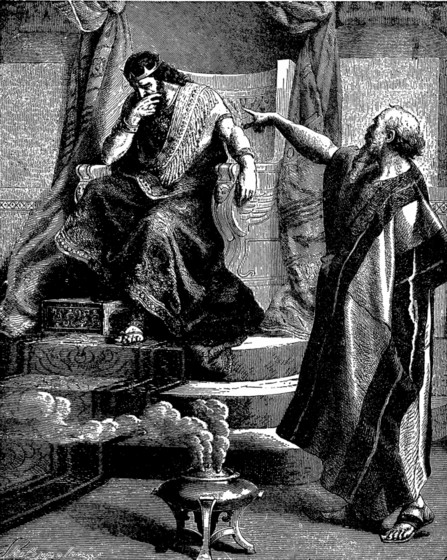
Nathan condemns David because of Bathsheba.

Nathan condemns David because of Bathsheba.

It is a reminder for us of the importance of personal prayer, and of worship.  Notice the repeated use (six times) of the word “my” in the first three verses – “give ear to my words…the sound of my cry…my King and my God…”   In verses 4-6, he acknowledges how God hates wickedness, the deceitful, the proud or boastful – all evildoers – and how they will not stand before him as the righteous (see also Psalm 1:5).  Clearly in verse 7, he considers the privilege he has to be able to come and worship Him, because of the Lord’s “steadfast love.”

Psalm 6 is one that many classify as one of penitence, although we are not told of what sin for which he is repenting.  It seems clear in verses 2-5 that he is ill – so much so that he believes he could die from whatever the illness might be.   It may, as some are often prone to think, that he feared his illness was God’s punishment for that sin (Job’s friends being a case in point).  In any case, he is not only gravely ill, and possibly in peril from his enemies (verses 8, 10), but he is also deeply ashamed of whatever wrong he has done.  But he knows that now that he has repented, “the Lord has heard my plea; the Lord accepts my prayer.” 

Both psalms serve as models of prayer and the privilege we have to worship the Lord and to receive His forgiveness and His care in times of trouble because of His “steadfast love” (5:7, 6:9).

Read or listen to audio of ESV version of this selection from this link.

/Bob’s boy
___________________
some images © V. Gilbert & Arlisle F. Beers

Please note: I did not design the reading plan that I am following in my blog.  All of my comments in this blog, however, are solely my responsibility.  When reading ANY commentary, you should ALWAYS refer first to the scripture, which is God’s unchanging and unfailing word. Reading schedules, as well as a link to the site where you can get the reading plan that I’m currently following for yourself can be found on the “Bible Reading Schedules” page of my website at http://graceofourlord.com.  For questions and help, please see the “FAQ” and “Summaries” pages there.

Hebrews 4 – Jesus the Great High Priest

The Hebrew writer continues the theme he began in chapter 3 of the rest that was prepared by God for us – “his works were finished from the foundation of the world.”  “Rest” here for us is entrance into heaven.  They received “good news” in the old covenant, but the message did not benefit them because they were not faithful in their belief.  The point that the writer is making in the first few verses is that the promise is ours to forfeit – just as it was theirs (verse 11).  Verse 12’s reference to the word of God as “living” is not in the sense of John 1:1, but that of 1 Peter 1:23 and others that refer to it as such.

praying_handsCoffman says a lot about verse 12 that seems right on the mark: “The word ‘active’ shows that the word does not lie inert and dead but at all times carries within itself the mighty power of its divine author. Rather than trying to find subtle differences in the meaning of such words as ‘soul’ and ‘spirit,’ it is perhaps just as well to view this verse as a heaping together of powerful terms for the purpose of showing the utmost ability of the word of God to penetrate the complex inward nature of man, to convict him of sin, to expose his hidden motives, and to judge the very nature of life itself….The passage presents God’s word as totally different from the word of men, making it infinite in power, all-seeing in discernment, and able to pierce or penetrate any human subterfuge.”
And just so, verse 13 tells the reader that there is nobody that can hide from Him – we are all “naked and exposed to the eyes of him to whom we must give account.”

Verses 14-16 pick back up on Chapter 3’s reference to Jesus as our high priest – a subject to which the writer speaks much about in this epistle – and points out that he is not one that is unable to sympathize with our weaknesses.  The Lord experienced temptation “in every respect,” it says.  So we can approach our Father through Him with confidence (verse 16) “that we may receive mercy and find grace to help in time of need.”  What a reassuring passage!  We often speak of someone “being there” for us.  Jesus truly is!

Read or listen to audio of ESV version of this selection from this link.

/Bob’s boy
___________________
some images © V. Gilbert & Arlisle F. Beers

Please note: I did not design the reading plan that I am following in my blog.  All of my comments in this blog, however, are solely my responsibility.  When reading ANY commentary, you should ALWAYS refer first to the scripture, which is God’s unchanging and unfailing word. Reading schedules, as well as a link to the site where you can get the reading plan that I’m currently following for yourself can be found on the “Bible Reading Schedules” page of my website at http://graceofourlord.com.  For questions and help, please see the “FAQ” and “Summaries” pages there.

Genesis 32 – Jacob Wrestles with God

Jacob Fears Esau

Genesis 32 is a key turning point for Jacob.  He is finally headed home after 20 years of being away – and he had left out of fear that his brother Esau was going to take his life!  Now, he’s coming back to the very same place, and he is not at all confident that his brother won’t do just that (much less be happy to see him).  But the Lord has told him to return, and that is what he intends to do.  And when his messengers return to tell him that Esau is coming to meet him with four hundred men, it must have been a bit frightening.  But when he left, he had only his staff (as he says in his remarkable prayer to God in verses 9-12). But now, the wealth he has accumulated makes it possible to split his livestock and people into “two camps.”  He does this after the “angels of God” have met him along the way (in v 1).  He named the place where that happened “Mahanaim” which means “two camps,” and that theme is repeated in the chapter.

Jacob decides to try to appease his brother by sending his servants ahead of him, along with large amounts of livestock as presents for Esau from “your servant Jacob.”  A bit ironic, since the Lord had said in Gen 25:23 that “the older shall serve the younger.”  So for safety, Jacob splits the caravan into droves, and his camp into two camps, so one could get away if necessary.

Jacob Wrestles with God

The unexpected wrestling event of verses 22 and following are a source of much confusion to readers.  Jacob realizes quickly that he is actually wrestling with God, but we know that scripture says no one looks on God in His true form and lives, so how do we explain this – or Moses and his later encounters?  God’s word has several examples of God appearing to His people in biblical times in human form for His own reasons.  Remember Abraham’s encounter in Genesis 18 before the Lord destroyed Sodom?  Also, Jesus was fully God, and took human form.  There is much that we do not know, but the important thing is the change that is to come over Jacob, along with the change of his name from Jacob (which means “trickster”) to his new name “Israel,” (which means “God fights”).

The other important thing to take away from this chapter is the above-mentioned prayer in v 9-12.  Read it again, and notice the reverence, the humbleness, and the thanksgiving that accompanies his petition to God.  Only Jesus gives us a better example for prayer.

(Side note: Here is an interesting article about the possible site of Mahanaim)

Read or listen to audio of ESV version of this selection from this link.

___________________

Please note: I did not design the reading plan that I am following in my blog.  All of my comments in this blog, however, are solely my responsibility.  When reading ANY commentary, you should ALWAYS refer first to the scripture, which is God’s unchanging and unfailing word.  Reading schedules, as well as a link to the site where you can get the reading plan that I’m currently following for yourself can be found on the “Schedules” page of my website at http://graceofourlord.com.   For questions and help, please see the “FAQ” and “Summaries” pages there.
/Robert