A Savior, Who Is Christ the Lord

The Birth of Our Lord Jesus Christ

The Birth of Our Lord Jesus Christ (Photo credit: Wikipedia)

Verse 8 of Luke chapter 2 picks up with the shepherds who are out in their field at night. Depending on the version you read, they were in the same region as Mary and Joseph or in the same country. The translation has the same effect in either case – so that we are not sure exactly how far away they are, but certainly not in a separate country. When the angel of the Lord appeared to them, “the glory of the Lord shone around them and they were filled with fear.” Any time that term is used, it is accompanied by great light – whatever else it means. In this case, certainly not as bright as what Paul (Saul) encountered on the road to Damascus (Acts 9), but in a dark field in a time when there were no distant city lights, it would be quite substantial and unnerving.

Gabriel making the Annunciation to the Virgin ...

Gabriel making the Annunciation to the Virgin Mary. Painting by El Greco, 1575 (Museo del Prado, Madrid). (Photo credit: Wikipedia)

Calming them, the angel told them of the good news of the birth in the city of David of “a Savior, who is Christ the Lord,” and old them how they would know him when they went to see. The sudden appearance with the angel of “a multitude of the heavenly host”  raises the question of what makes up a heavenly host. Generally, a “host” is a military term, where the collective group is associated with fighting a battle or guarding something. In the case of the Lord, they are associated as being at His side, praising Him, and ready to do his bidding (Psalm 103:21, Daniel 7:10). And verse 15 gives us the answer. After they finished praising the Lord Jesus, the verse tells us that the “angels” went away into heaven. Since only one angel had appeared before the heavenly host came, that tells us what sort of multitude they were.

When they arrived and saw Jesus, verse 17 says they “made known” what had been told to them by the angel, which created an understandable stir. But Mary, it said, treasured all of these things in her heart – no doubt recalling the visit from the angel Gabriel before the conception. And then on the eighth day, he was circumcised according to the Law of Moses and given the name Jesus, just as Gabriel had told her. And just like that, the will of God that He made known to the serpent way back in Genesis 3:15 was brought to fruition:

I will put enmity between you and the woman,
and between your offspring and her offspring

(This year’s reading plan for Luke, Acts, and 1 and 2 Chronicles averages just 15 verses per day – 5 days per week!)
Schedule for this week
Read or listen to audio of today’s selection from Luke here
Read or listen to audio of today’s selection from 1 Chronicles here

/Bob’s boy
___________________
some images © V. Gilbert & Arlisle F. Beers

All of my comments in this blog, however, are solely my responsibility.  When reading ANY commentary, you should ALWAYS refer first to the scripture, which is God’s unchanging and unfailing word. Reading schedules can be found on the “Bible Reading Schedules” page of my website at http://graceofourlord.com.

Enhanced by Zemanta

Unremarkably Momentous

English: A statue of the first Roman Emperor A...

English: A statue of the first Roman Emperor Augustus (r. 27 BC – 14 AD) as a younger Octavian, this sculpted artwork dated to around 30 BC. It is located in the Museo Capitolino of Rome, Italy. (Photo credit: Wikipedia)

Luke chapter 2 opens the story of the birth of Jesus with two verses that skeptics, always quick to pounce on perceived biblical contradictions, are happy to use in their repertoire. The verses in the NKJV read “And it came to pass in those days that a decree went out from Caesar Augustus that all the world should be registered. This census first took place while Quirinius was governing Syria.”

The problems with the two verses are two-fold. First, Quirinius was the governor of Syria beginning in 6 A.D. Herod the Great died in 4 B.C., and we know from scripture that Jesus was born during the reign of Herod. Secondly, although there is secular record of the census during the governorship of Quirinius, no historical record of the previous census has been found.

There are several answers that have been proposed to this supposed dilemma that include the fact that it is recorded in the “Acts of Augustus” that he authorized censuses throughout the empire in 28 B.C., 8 B.C., and 14 A.D. Further, it is known that provincial censuses were held in 14 year intervals, which would fit with the known census of 6 A.D. Jesus was born sometime from 7 B.C. to 4 B., which would fit the beginning date in 8 B.C. for that census. Also, Publius Sulpicius Quirinius, served at the favored pleasure of Augustus as governor of Crete and Cyrene, as a soldier, and as consul beginning about 14 B.C.

We do well to note the meticulous detail and accuracy of Luke’s writings throughout both of his books. For example, he knew about and acknowledged the 6. A.D. census in Acts 5:37. In the second place, we must remember that the Bible, as God’s inspired word, has stood the test of time, and has been found historically accurate numerous times, even when previous secular history showed no corroboration. Take for example, the fact that skeptics once believed that Pontius Plate was a mythological concoction of the Bible until the Italian archaeologists found the “Pilate Stone” in 1961.

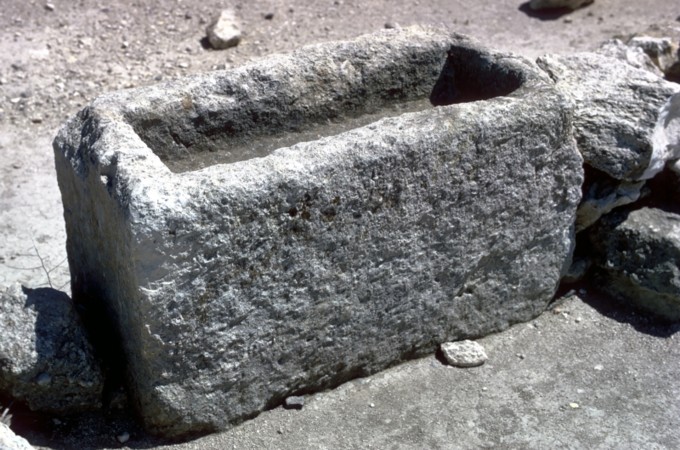
Stone manger from Bible times, perhaps similar to the one that cradled the baby Jesus in Bethlehem. The manger held food for animals.

Stone manger from Bible times, perhaps similar to the one that cradled the baby Jesus in Bethlehem. The manger held food for animals.

“All the world” in verse one means all of the roman Empire, of course. Since everyone went to register in their home town, this is how Jesus came to be born in Bethlehem instead of Nazareth – thus fulfilling prophecies such as that of Micah 5:2. This is because Joseph was of the house of David. When Joseph and Mary arrived there, there was no room in the inn. So when she gave birth, she wrapped our Lord in swaddling clothes, and put him in a manger (a feeding trough for animals) for his bed. It is here in just 2 verses (5-7) that we learn of the birth of the most important person ever born in this world – with absolutely no fanfare.

(This year’s reading plan for Luke, Acts, and 1 and 2 Chronicles averages just 15 verses per day – 5 days per week!)
Schedule for this week
Read or listen to audio of today’s selection from Luke here
Read or listen to audio of today’s selection from 1 Chronicles here

/Bob’s boy
___________________
some images © V. Gilbert & Arlisle F. Beers

All of my comments in this blog, however, are solely my responsibility.  When reading ANY commentary, you should ALWAYS refer first to the scripture, which is God’s unchanging and unfailing word. Reading schedules can be found on the “Bible Reading Schedules” page of my website at http://graceofourlord.com.
Enhanced by Zemanta

The Birth of John the Baptist

In Luke 1:57, Elizabeth  bears a son, and all of their friends and relatives rejoiced with her. On the eighth day, they came to circumcise him, according to Mosaic Law (Genesis 17:12, Leviticus 12:3). Everyone fully expected the child to be named Zechariah after his father, but when Elizabeth told them that his name was John, they appealed to Zechariah to make a sign – as he was still mute.

When Zechariah wrote that the child’s name was John as well, he then became able to speak again, praising God. This event, together with the very fact that this couple beyond child-bearing years now had a son, spread news and wonder throughout the hill country that God’s hand was surely involved. This child, they knew, was going to be special.

Birth of St. John the Baptist, depicting Zecha...

Birth of St. John the Baptist, depicting Zechariah writing, “His name is John”. (Photo credit: Wikipedia)

Zechariah, filled with the Holy Spirit, began to prophesy and from verses 68-79, he says a great deal about his son and his calling, as well as the coming savior, that he would not have known without such divine guidance. In verse 69, the “horn of salvation” that God has raised up is of course, Jesus. The horn was a symbol of strength and power, and is referred to in many Bible passages, including Hannah’s song in 1 Samuel 2. In the ensuing verses, he continues to speak of this salvation in terms of the covenant with Abraham and his descendants.

Then, in verse 79, he addresses the child, saying that he “will be called the prophet of the Most High; for you will go before the Lord to prepare his ways, to give knowledge of salvation to his people in the forgiveness of their sins…” The first part is in keeping with what is foretold in Malachi 3:1, and Isaiah 40:3. And true forgiveness of sins is part of the new covenant that was promised in Jeremiah 31:31-34, which is affirmed by Jesus during the institution of the Lord’s Supper in Matthew 26:28, when he spoke of “my blood of the covenant, which is poured out for many for the forgiveness of sins.

In confirmation of just how special this child was to be, verse 80 tells the reader that he “grew and became strong in spirit, and he was in the wilderness until the day of his public appearance to Israel.” John the Baptist would wait for his calling from the Lord.

(This year’s reading schedule for Luke, Acts, and 1 and 2 Chronicles averages just 15 verses per day – 5 days per week!)
Read or listen to audio of today’s selection from Luke here
Read or listen to audio of today’s selection from 1 Chronicles here

/Bob’s boy
___________________
some images © V. Gilbert & Arlisle F. Beers

All of my comments in this blog, however, are solely my responsibility.  When reading ANY commentary, you should ALWAYS refer first to the scripture, which is God’s unchanging and unfailing word. Reading schedules can be found on the “Bible Reading Schedules” page of my website at http://graceofourlord.com.

Enhanced by Zemanta

Gabriel Appears To Mary

Gabriel making the Annunciation to the Virgin ...

Gabriel making the Annunciation to the Virgin Mary. Painting by El Greco, 1575 (Museo del Prado, Madrid). (Photo credit: Wikipedia)

Verse 26 of Luke chapter one begins ” in the sixth month,” which refers to the time following Elizabeth’s conception of John the Baptist. Note that the description of Nazareth’s location by Luke is further evidence of his intended Gentile audience. Any Jew would know very well where Nazareth was. The angel Gabriel was sent by God to a virgin named Mary, who was betrothed to Joseph, of the house of David. Betrothal in those days was nothing like the sense in which we imagine such a term. Rather, it was a negotiated agreement that was binding upon both the bride and the groom to the extent that they were legally and religiously married in all respects – except that of living together.

Gabriel told Mary, who did not “know a man,”  that she would bear a son by the power of the Holy Spirit and the “Most High” (verse 35), and name Him Jesus. This  reference to God as “Most High” (Elyon, used seven times in Luke) is seen first in Genesis 14:18-20 when Abram met Melchizedek, and was used quite often thereafter – seen often in the Psalms, Numbers 24:16, and Daniel 3:26, and 4:24,34. He also told her some very important things about Jesus: 1) that He will be called holy – the Son of God, 2) that God will give Him the throne of David, his father, from which He will reign over the house of Jacob forever and 3) that of His kingdom there shall be no end. Before he left, Gabriel told Mary of the pregnancy of her elderly relative, Elizabeth, which was his offering of a sign for Mary’s encouragement in what he had told her.

John the baptist Church in Ein Karem Jerusalem...

John the baptist Church in Ein Karem Jerusalem, Israel, 2006 (Photo credit: Wikipedia)

Mary went to see her relative, and when she arrived, we are told that Elizabeth’s baby (who was filled with the holy Spirit) leaped for joy in her womb at the presence of the Lord – providing yet another affirmation for the Christian of the sanctity of life in the womb. Mary stayed with her for about three months before returning home. Verses 47-55 contain Mary’s song – a psalm of praise to God that has come to be known at the “Magnificat” – a title which comes from the Latin translation.

Side note: In verse 39, when Mary went to see Elizabeth, the text says that she went “into the hill country to a town in Judah.” We do not really know where in that area it actually was, but traditional belief widely held is that the home of John the Baptist was in Ein Karem, about 5 miles west of Jerusalem. There is an interesting article with some pictures of the area in this feature at Ferrell’s Travel Blog.

(This year’s reading plan for Luke, Acts, and 1 and 2 Chronicles averages just 15 verses per day – 5 days per week!)
Read or listen to audio of today’s selection from Luke here
Read or listen to audio of today’s selection from 1 Chronicles here

/Bob’s boy
___________________
some images © V. Gilbert & Arlisle F. Beers

All of my comments in this blog, however, are solely my responsibility.  When reading ANY commentary, you should ALWAYS refer first to the scripture, which is God’s unchanging and unfailing word. Reading schedules can be found on the “Bible Reading Schedules” page of my website at http://graceofourlord.com.

Enhanced by Zemanta

The Conception of John the Baptist

Nowhere in the Bible but the Gospel of Luke are we told about the events leading to the birth of John the Baptist. Though certainly not predicted for as long of a time as the birth of the Lord Jesus Himself, it had been anticipated for hundreds of years – at the very least, since the time of Malachi (Malachi 4:5), which most scholars place at about the middle of the 5th century B.C.

English: Herod the Great Suomi: Herodes Suuri

English: Herod the Great Suomi: Herodes Suuri (Photo credit: Wikipedia)

Verse 5 opens with “in the days of Herod, king of Judea…” There tends to be some confusion as to which Herod the Bible refers to between the gospels and the Book of Acts. This one is the one known as “Herod the Great.” He was the vassal king of Judea by virtue of his relationship with the Roman government and the favor he found with Octavius. He was born in Edom (Greek “Idumaea”) and thus a descendant of Esau. His family converted to Judaism, and he referred to himself as a Jew. The main portion of his reign was from 37 B.C. to his death in 4 B.C.

John the Baptist’s father, Zechariah, is said in the same verse to be “of the division of Abijah.” The number of priests was extremely large, and they were organized into 24 divisions. Each division would have one of their priests serve in the temple twice per year – the question of who served being decided by casting lots. But none was allowed to burn incense more than once in their lifetime – some never at all. This was Zechariah’s once in a lifetime event – in more ways than one.

Imagine Zechariah’s excitement as he contained himself with the expected dignity and reverence when he entered the temple and approached the altar of incense to perform the task that he had likely been anticipating for a great length of time. But as he did so, there appeared an angel of the Lord, and his excited happiness was immediately changed to overwhelming fright! But the angel uttered words to put him at ease that would change not only his mood (once more), but his life – forever! Though he knew his wife, Elizabeth, to be barren, he was told that they would have a child, and that his name would be John.

Zechariah & the angel

Zechariah & the angel (Photo credit: Lawrence OP)

John, the angel told Zechariah, would not drink wine or strong drink, and would be great before the Lord “in the spirit and power of Elijah,” turning many people back to God and make them ready for “the Lord.”  Significant also in verse 15, the angel said that “he will be filled with the Holy Spirit, even from his mother’s womb.” For us as Christians, this is just one of a few passages that should forever put to rest any question of whether an unborn baby is a person!

Zechariah’s doubt, when he asked how he could know this would really happen, knowing that Elizabeth was beyond child-bearing years, was met with a rebuke that would cause him to be mute until the child was born. The angel, who we learn here was named Gabriel, informed him that he stands in the presence of the Lord, and was sent by God to give Zechariah this good news. This is only the second of the angels we read about in scripture that is mentioned by name (the other being Michael, in Daniel 10:21 and Jude 1:1-9. Revelation 8:2 tells of seven such archangels that stand before God.

Zechariah finishes his service in silence, making signs to those who were inquisitive at his delay inside the temple for so long, and then went home. Elizabeth, we are told in verse 24, did conceive in the following days, and kept herself hidden from public view for 5 months.

(This year’s reading plan for Luke, Acts, and 1 and 2 Chronicles averages just 15 verses per day – 5 days per week!)
Read or listen to audio of today’s selection from Luke here
Read or listen to audio of today’s selection from 1 Chronicles here

/Bob’s boy
___________________
some images © V. Gilbert & Arlisle F. Beers

All of my comments in this blog, however, are solely my responsibility.  When reading ANY commentary, you should ALWAYS refer first to the scripture, which is God’s unchanging and unfailing word. Reading schedules can be found on the “Bible Reading Schedules” page of my website at http://graceofourlord.com.

Enhanced by Zemanta

Luke’s First Prologue to Theophilus

Gospel Book, Title page to the Gospel of Luke,...

Gospel Book, Title page to the Gospel of Luke, Walters Manuscript W.528, fol. 116r (Photo credit: Walters Art Museum Illuminated Manuscripts)

The Gospel According to Luke is one of the synoptic gospels (Matthew, Mark, and Luke), so named because they all include similar material concerning the Lord Jesus – whereas John is much different. The fact that Luke was the author is well-supported by early church tradition, and we find arguments to the contrary without merit. It is generally accepted to have been written in the early to mid-60’s. The book is addressed to “Theophilus,” who we can assume to be a Gentile (Greek, the name suggests, as it is assumed that Luke is as well). Considering the way that Luke addresses him in verse 3, it is supposed that he might be some sort of government official – likely a man of some means as well. The first four verses of chapter one tell us a great deal about what we can expect from the Book of Luke:

Inasmuch as many have undertaken to compile a narrative of the things that have been accomplished among us, just as those who from the beginning were eyewitnesses and ministers of the word have delivered them to us, it seemed good to me also, having followed all things closely for some time past, to write an orderly account for you, most excellent Theophilus, that you may have certainty concerning the things you have been taught.”

The first part tells us that even before Luke had started writing this book, a great deal had already been written by others of the events he was writing about. Many hold that the Gospel of Mark was one of those accounts. Possibly. Best estimates by many scholars suggest a time in the mid-50’s for the writing of Mark. As for Matthew, scholars and early church figures (such as Irenaeus of Lyons) indicate that it was written when both Peter and Paul were alive. So it could possibly have been one of those writings as well. But since Luke refers to “many” narratives, it would seem that there were several written by non-inspired sources as well.

English: The evangelist portrait from the Gosp...

English: The evangelist portrait from the Gospel of Luke (Photo credit: Wikipedia)

Next, Luke indicates that people who were either eyewitnesses to the events of Jesus’ life, death, and resurrection, or who had been brought into teaching the gospel, had related many of the events to him – and to others – already. But note also that his reference to eyewitnesses in verse 2 is in the context of those who were “from the beginning.” Luke had been thorough in his research, as well as in his writing, but he had the advantage of living in precisely the right time, when he could benefit from the accounts and information from so many who were there through it all.

Finally, Luke tells Theophilus that he wanted to write an “orderly” account of these things for him so that he might “have certainty” about the things he had been taught. That tells us that Theophilus, if not already a Christian, had received some instruction concerning Jesus Christ. And that brings us back around to several things we can put into the context of the statement Luke made in verse one, referring to “a narrative of the things that have been accomplished among us.” As Luke began writing this, the Lord had long ago risen and ascended into heaven. The day of Pentecost in Acts Chapter 2, had come and gone, and the church had been established. And, as one Gentile is writing to another quite literally about the gospel of Jesus Christ, we can deduce that Cornelius and his family had already been converted (Acts 10). It is also quite likely then, that the Jerusalem Conference (or Jerusalem Council) of Acts 15 had also taken place.

In our next look at Luke chapter one, we will take a closer look at the parents of John the Baptist.

(This year’s reading plan for Luke, Acts, and 1 and 2 Chronicles averages just 15 verses per day – 5 days per week!)
Read or listen to audio of today’s selection from Luke here
Read or listen to audio of today’s selection from 1 Chronicles here

/Bob’s boy
___________________
some images © V. Gilbert & Arlisle F. Beers

All of my comments in this blog, however, are solely my responsibility.  When reading ANY commentary, you should ALWAYS refer first to the scripture, which is God’s unchanging and unfailing word. Reading schedules can be found on the “Bible Reading Schedules” page of my website at http://graceofourlord.com.  

Enhanced by Zemanta

Update – Luke, Acts, and Chronicles!

English: the first page of the Gospel of Luke

English: the first page of the Gospel of Luke (Photo credit: Wikipedia)

It’s official. We decided to map out a reading schedule for the blog ourselves this year. The schedule for January has been posted here on the “Schedules” page. We will read a chapter a week of the Gospel of Luke (24) chapters, and then about June, we will start reading the Book of Acts (28 chapters). In addition, we will  read 1 and 2 Chronicles (a total of 65 chapters) this year. Why the Book of Chronicles? Due to an unfortunate placement in our Bibles just after 1 and 2 Kings, these two books are probably the most neglected books of the bible – next to Revelation. Since some of the text in 2 Samuel and in the Books of Kings is contained word for word, most of us get to Chronicles and figure – why read that again?

Well, surprise! the Books of Chronicles are actually very unique in their perspective, and contain much more than a mere repetition of other passages. In fact, our first blog of this year’s schedule (to be published in a couple of hours) will focus on an introduction to Chronicles that we hope you will find informative and helpful.

English: I took photo with Canon camera.

English: I took photo with Canon camera. (Photo credit: Wikipedia)

We will begin the first week with Luke chapter one and the first chapter of 1 Chronicles! The best part is that the pace of reading necessary to keep up with this schedule is quite easy. Although there will be weeks when we may cover 20 to 30 verses per day, on the average, it will only take 15 verses per day to read these four books this year!

Finally, a reading plan that practically anyone can keep up with! 15 verses per day, and you get the whole story of the birth, life, death, and resurrection of our Lord, followed by the details of how the Apostles carried out the commission he gave to them. And all the while, you will learn much of the history of God’s people from the time of Saul, then David, all the way to the end of the Babylonian exile!

And on Sundays, we will be focusing on other New Testament books, the subject of apologetics, and (we feel most importantly) ways to enrich your prayer life. We invite you to join us this year in what we feel will be a very enlightening year of reading and commentary in God’s word

/Bob’s boy
Enhanced by Zemanta

Luke 24 – On the Road to Emmaus

(Note: for a summary of the events of this chapter from the resurrection at dawn to Jesus’ first appearances to Mary Magdalene and the other women, please see post at this link.  After the resurrection, Jesus – as He had told the disciples in Matthew 26:32 that He would meet them there – would be with them at the Sea of Galilee, and at a mountain there that He directs them to.  But several other events occur before and after this, the details of which are interspersed throughout the gospels in Matthew 28 and John 20.  And events in a single chapter are in some cases separated by days, and even weeks, as Jesus remained for forty days before the ascension.)

El Kubeibeh, also spelled el-Qubeibeh, is the most likely, of the four traditional sites, as the site of Bible-time Emmaus, on the road to which Jesus appeared to Cleopas and a friend after his resurrection

It is still Sunday, the day that Jesus rose; and two of His disciples were traveling to the village of Emmaus.  One was named Cleopas, but we do not know the name of the other.  We are told in verse 16 that “their eyes were kept from recognizing him” when Jesus drew near.  When He asks them about the conversation they are having, the two men proceed to tell him about Jesus of Nazareth.  They speak of how great he was, how the chief priests and rulers condemned and crucified him.  And now, they say, some women of their company had been to his tomb and found it empty – a fact which others confirmed!  They are clearly distressed.

Jesus then gave them a mild rebuke for being slow to believe what the prophets had spoken.  He then interpreted Scriptures from Moses and the prophets concerning the Christ.   As they reached the village, they urged him to stay with them, as the evening would be coming soon.  He blessed and broke bread with them, and it was at this point that their eyes were opened and they recognized him.  Jesus then vanished from their sight.

That very hour, they went back to Jerusalem and found the eleven, who confirmed to the two traveler’s that yes, Jesus has risen (verse 34) and has appeared to Simon (Peter).  No details here or in the other three gospels are given of that appearance to Peter (although Paul does speak of it in 1 Corinthians 15:5). But given Peter’s intense grief over his denial of Jesus, it was important to reach him quickly; and it was important to get to the rest of the eleven this day as well.

In the 40 days from His resurrection to his ascension to heaven, Jesus appeared many times to His disciples.

Jesus then entered while the men were talking, and they were frightened, as if He was a spirit.  He had them touch him, and even ate some fish in front of them – spending some time to assure them both that he was a living man, and the same Jesus they had known.  He then opened their minds to the Scriptures concerning Him.  Jesus then tells them a bit about the witness they will bear to the world in the great commission, but he says they must stay in Jerusalem until they are “clothed with power from on high” (the coming of the Holy Spirit in Acts).  When He tells them to stay in Jerusalem, he means after he is gone.  They will be with him at the Sea of Galilee (John 21:1), and on a mountain in Galilee that He has directed them to (Matthew 28:16) before his ascension.  Galilee is three days journey from Jerusalem.

Bethany is about two miles east of Jerusalem, on the east slope of the Mount of Olives.

Luke records Jesus’ ascension to heaven (at the end of forty days) in verses 50-53, as he leads them from Jerusalem to Bethany.  We are told in verses 52-53 that they “returned to Jerusalem with great joy, and were continually in the temple blessing God.”

Side note: Why did Jesus appear to them in Jerusalem, when He knew that they would meet Him in Galilee – and He had told Mary Magdalene and other disciples as well?  Peter and the other apostles, as well as many other disciples (witness the “road to Emmaus account) were grief-stricken, traumatized, and even afraid for their own lives (John 20:19).  Two very well-written articles that deal with this subject can be found here and here.

Read or listen to audio of ESV version of this selection from this link.

/Bob’s boy
___________________
some images © V. Gilbert & Arlisle F. Beers

Please note: I did not design the reading plan that I am following in my blog.  All of my comments in this blog, however, are solely my responsibility.  When reading ANY commentary, you should ALWAYS refer first to the scripture, which is God’s unchanging and unfailing word. Reading schedules, as well as a link to the site where you can get the reading plan that I’m currently following for yourself can be found on the “Bible Reading Schedules” page of my website at http://graceofourlord.com.  For questions and help, please see the “FAQ” and “Summaries” pages there.

Luke 20 – The Wicked Tenants

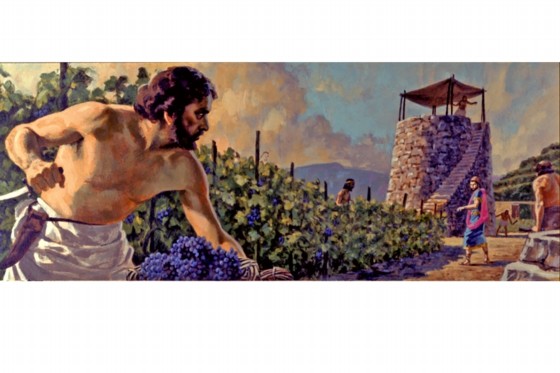
In Jesus’ parable; wicked vineyard tenants murdered servants the owner had sent, and eventually murdered the owner’s son. This was an illustration of the wicked leaders who would murder God’s own Son, Jesus (Matthew 21:33-46).

In the parable of the wicked tenants in verses 9-16 , the word for owner in the “owner of the vineyard” is the same as “lord.”  The three servants he sent to the tenants represent the prophets.  The fruit of the vineyards they are seeking represents Israel’s obedience to God.  Then, sending his “beloved son” reminds us of what God said (“This is my beloved Son…”) at Jesus’ baptism in Matthew 3:17.  The tenants killing the owner’s son alludes to His coming death.  When Jesus says that the vineyard owner would come and destroy those tenants, it seems likely to be referring first to the destruction of Jerusalem that will come in A.D. 70. But in a larger sense, it speaks to the final judgment.  Those hearing the parable say “Surely not!” as they perceive that the parable applies to the people of Israel.  Would God take away the land and give it to other people?  But He looks directly at them and says ““What then is this that is written:
“The stone that the builders rejected
has become the cornerstone?”
This is from Psalm 118:22, referred to as well in Isaiah 28:16, and is quoted by Peter in Acts 4:11 and 1 Peter 2:7.

A denarius minted circa 18 BC. Obverse: CAESAR...

A denarius minted circa 18 BC. Obverse: CAESAR AVGVSTVS; reverse: DIVVSIVLIV(S) (Photo credit: Wikipedia)

In verse 19, the scribes and chief priests were predictably angry, as they knew the parable was directed at them.  So they sent people to try to trap him with sedition against the Roman government.  Jesus’ answer in verse 25 was “render to Caesar the things that are Caesar’s, and to God the things that are God’s.” This can be read in different ways, given that He had asked whose image was on the denarius.  One interpretation is that we are made in God’s image, and thus we must render ourselves to God’s service.

The Sadducees do not believe in the resurrection, so they try to test him in verses 27-33 with a scenario revolving around the teaching of Moses.  But in verse 37 (and in Matthew 22:31-32) Jesus quotes Moses’ encounter with God at the burning bush in Exodus 3:6, explaining that God is the God of the living.

Read or listen to audio of ESV version of this selection from this link.

/Bob’s boy
___________________
some images © V. Gilbert & Arlisle F. Beers

Please note: I did not design the reading plan that I am following in my blog.  All of my comments in this blog, however, are solely my responsibility.  When reading ANY commentary, you should ALWAYS refer first to the scripture, which is God’s unchanging and unfailing word. Reading schedules, as well as a link to the site where you can get the reading plan that I’m currently following for yourself can be found on the “Bible Reading Schedules” page of my website at http://graceofourlord.com.  For questions and help, please see the “FAQ” and “Summaries” pages there.

Luke 15 – The Parable of the Prodigal Son

As Jesus was teaching, the tax collectors and sinners had gathered around him.  We are not told what the latter were guilty of, but they obviously had a dubious reputation because of it.  The Pharisee and scribes, of course, were looking for anything to use against Jesus; and they began grumbling about the company He was keeping.  Of the three parables Jesus then tells in this chapter, the parable of the prodigal son is the most famous.  But all three make the point about those who are lost, best stated in verse 7 by Jesus – “there will be more joy in heaven over one sinner who repents than over ninety-nine righteous persons who need no repentance.”

Frans Francken (II) - The Parable of the Prodi...

Frans Francken (II) – The Parable of the Prodigal Son – WGA8205 (Photo credit: Wikipedia)

The image in verse 20 of the father running to his son to embrace him when he returned should be comforting to anyone who has fallen away from the Lord and wants to return.  No matter what we have done, God wants us to come back to Him, and will receive us gladly.  The elder son is upset that his father is celebrating the return of his prodigal brother who, in verse 30,  he does not even want to acknowledge as such (“this son”) because of his anger.  After all, he had remained behind and did not “devour” his father’s “property with prostitutes” (verse 30).   Why should his brother deserve to be received that way?  God will forgive in the same way; and we must realize that it is not because any of us deserve that forgiveness.

Read or listen to audio of ESV version of this selection from this link.

/Bob’s boy
___________________
some images © V. Gilbert & Arlisle F. Beers

Please note: I did not design the reading plan that I am following in my blog.  All of my comments in this blog, however, are solely my responsibility.  When reading ANY commentary, you should ALWAYS refer first to the scripture, which is God’s unchanging and unfailing word. Reading schedules, as well as a link to the site where you can get the reading plan that I’m currently following for yourself can be found on the “Bible Reading Schedules” page of my website at http://graceofourlord.com.  For questions and help, please see the “FAQ” and “Summaries” pages there.