John 13 – Jesus Washes the Disciples’ Feet

Chapter 13 begins the second half of the Gospel of John, and the first chapter of what is known as Jesus’ farewell discourse.  As the Feast of the Passover approaches, Jesus knows that His time with the twelve is short.  This was a time and a land where people would walk very long distances on sandy, dusty, and often considerably unsanitary roads wearing sandals.  It was the custom then for people to arrange ahead of time to have water available for the washing of the feet of their guests.   Washing the feet of another person was the work of servants.  So when Jesus began washing their feet, Peter at first objected.  But Jesus told him “What I am doing you do not understand now, but afterward you will understand.”  They do understand His humbleness because He has been teaching them for a long time, but they will not fully understand this act until after His crucifixion.  But He does want them to think about it – so they will recall that it was important to Jesus.

In verse 12, when He had finished, He said ““Do you understand what I have done to you?”  There would be no point to that question unless there was a deeper meaning to what was done.  That meaning is in verse 16 (“a servant is not greater than his master, nor is a messenger greater than the one who sent him.”).  He is their teacher and He is the one who is “sending” them into the world.  He did this to serve them.  They should serve each other according to their needs.  The words from verse 16 will be repeated to them in John 15:20, and they have already heard them in Matthew 10:24.  On both of those occasions, it was to tell them to expect to be treated as He was by others.  Here, it is to teach them to serve others.

Then Jesus told them that one of them would betray Him.  In verse 27, when He tells Judas to do it quickly, the others still do not realize what is taking place. He then gives them their “new commandment” in verses 34-35 to love each other as He has loved them, as He takes this opportunity to say goodbye for now.  Peter, still not understanding, declares that he will lay down his life for him.  But Jesus breaks the terrible news to him that he will deny Jesus three times.

Read or listen to audio of ESV version of this selection from this link.

/Bob’s boy
___________________
some images © V. Gilbert & Arlisle F. Beers

Please note: I did not design the reading plan that I am following in my blog.  All of my comments in this blog, however, are solely my responsibility.  When reading ANY commentary, you should ALWAYS refer first to the scripture, which is God’s unchanging and unfailing word. Reading schedules, as well as a link to the site where you can get the reading plan that I’m currently following for yourself can be found on the “Bible Reading Schedules” page of my website at http://graceofourlord.com.  For questions and help, please see the “FAQ” and “Summaries” pages there.

John 12 – The Unbelief of the People

Spikenard

In John’s account of Jesus’ entry into Jerusalem during the final days, we get some more details, including the account of Mary anointing Jesus (verse 3).  Some commentators get this confused with a similar event in Luke 7:35-39, but that is a different woman and occasion.  Verse 7 seems to mean that Mary had kept the ointment to use to prepare Jesus for burial – but this was the time to use it.   In verses 4-6, we learn from John that Judas had been stealing money from the money bag he was charged with carrying. 3oo denarii would be almost a year of a laborer’s wages.  The expensive nard (from spikenard) was imported from northern India.

In verses 9-11, Jesus raising Lazarus from the dead had achieved two very different results.  First, a large number of Jews had been attracted to come and see for themselves that he was now indeed alive.  But incredibly, the chief priests were plotting the death of Lazarus because it was causing many to believe in Jesus.  They simply did not want it to be so; and their frustration grows, as in verse 19 they say to one another “Look, the world has gone after him.”  This was at John’s account of the triumphal entry on Sunday of Jesus’ last week.

In verses 2-26, Gentiles come to worship and request to see Jesus; and Jesus acknowledges both that it is time for Him to be glorified, and removes all doubt that anyone – Jew or Gentile – that sacrifices himself to follow Jesus will be saved.    In verse 27, we again see that Jesus had come to earth as flesh and with human emotion, as he was troubled that the time of His death was approaching.  But he acknowledges that this was the reason He had come.  As God speaks to Him, some thought it was thunder, but Jesus made it clear that the voice had been intended for those who would believe (verse 30).  People do not understand why the Christ must be “lifted up,”  and was going to die.  Their understanding of the Christ remaining forever was one they had always related to an earthly reign.  They still did not understand His kingdom.

John quotes Isaiah 53:1 in verse 38, and Isaiah 6:10  in verse 40, as he notes the continued unbelief of many despite the signs Jesus had given them.  In verses 44-50, Jesus tells them that He has come to save the world – those who are not blinded by the hardness of their hearts.  Those who reject Him are rejecting God and the light that He has sent into the world.   Even miracles will not convince those who are bent on self-deception.

Read or listen to audio of ESV version of this selection from this link.

/Bob’s boy
___________________
some images © V. Gilbert & Arlisle F. Beers

Please note: I did not design the reading plan that I am following in my blog.  All of my comments in this blog, however, are solely my responsibility.  When reading ANY commentary, you should ALWAYS refer first to the scripture, which is God’s unchanging and unfailing word. Reading schedules, as well as a link to the site where you can get the reading plan that I’m currently following for yourself can be found on the “Bible Reading Schedules” page of my website at http://graceofourlord.com.  For questions and help, please see the “FAQ” and “Summaries” pages there.

John 9 – Jesus Heals a Man Born Blind

Upon passing a man who was born blind, some of Jesus’ disciples ask a question in verse 2 that seems strange to most of us now – “who sinned, this man or his parents…?”  But this mistaken belief about sin and suffering was not uncommon; and we see in verse 34 that the religious leaders that opposed Jesus held the view that the man was born in sin.  We know differently, and Ezekiel 18:20 specifically says otherwise, so they should have known as well.  Jesus corrects them, letting them know in verses 3-4 that his disability will be used for the glory of God.

The Blind Man Washes in the Pool of Siloam

The Blind Man Washes in the Pool of Siloam (Photo credit: Wikipedia)

We know (and have already read of specific examples) that Jesus could have given the man his sight without even touching him.  Some writers have postulated several theories as to why He used the mud that He made from His spittle, before sending the man to the pool of Siloam to wash.  Some see a symbolic connection between the scripture’s use of the Verb for the word “anoint” to describe how Jesus applied it to his eyes (“Christ” and “Messiah” mean “anointed one”). Others see Jesus purposely making mud (or clay) using his spittle as an analogy to kneading dough, in order to challenge the Pharisees. But we really do not know.  There was purpose in everything that Jesus did; and as this was once again on the Sabbath, the point He was making no doubt had its desired effect at that time on those around Him – and the religious leaders that it angered.

At any rate, there is division among these religious leaders at one point (verse 16); and his parents are sent for, and questioned.  They confirmed that the man was their son and that he had been born blind.  But despite the previously mentioned division, the leaders had made it known that anyone who said that Jesus was the Christ (Messiah), they would be put out of the synagogue.  So the man’s parents in verses 21-23 seem to be disingenuous as to knowing how he gained his vision; and they pass the buck back to their son. The blind man is interviewed by the Pharisees and other religious leaders for the second time, and was “cast out” of the synagogue for his comments in verses 30-33.  He found it amazing that they did not know where Jesus came from.  So do we…

Side note: Details and pictures of discoveries at the excavations at the Pool of Siloam are in this article at BiblePlaces.com.  That one is a well-written, but older article.  A more recent article can be found at this link to BiblicalArchaeology.org.

Read or listen to audio of ESV version of this selection from this link.

/Bob’s boy
___________________
some images © V. Gilbert & Arlisle F. Beers

Please note: I did not design the reading plan that I am following in my blog.  All of my comments in this blog, however, are solely my responsibility.  When reading ANY commentary, you should ALWAYS refer first to the scripture, which is God’s unchanging and unfailing word. Reading schedules, as well as a link to the site where you can get the reading plan that I’m currently following for yourself can be found on the “Bible Reading Schedules” page of my website at http://graceofourlord.com.  For questions and help, please see the “FAQ” and “Summaries” pages there.
John 3 – For God So Loved the World

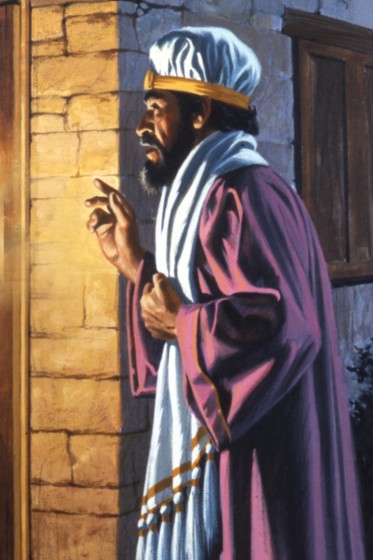
Nicodemus was a Pharisee.  Verse one says that he was a “ruler of the Jews,” which would make him a member of the Sanhedrin – the Jewish governing council.  In fact, one of the other two places he is mentioned is in John 7:50, as there is division among them concerning arresting Jesus. Nicodemus states his belief that Jesus is sent from God because of the signs that he did, confirming that Jesus did many more miracles than were written in the gospel, as John states in John 20:30-31.  Nicodemus seems to be trying to understand what Jesus means by being born again in a physical manner.  But Jesus is speaking of being re-born by the Spirit by way of baptism (Romans 6:3-4, Colossians 2:12-13).  In verse 14, Jesus refers to Moses lifting up the Bronze Serpent in Numbers 21:5-9 to save the people when they had spoken against God; and gives Nicodemus a preview of His crucifixion, which likely he would also not understand – yet.  He will repeat this reference to being lifted up in John 8:28 and John 12:32-33.

The Bronze Serpent

Verse 16 is one of the most famous of the New Testament, and most Bibles that put the words of Jesus in red assign verses 16-21 as His words.  But many scholars believe that these verses are actually John’s inspired words, and the fact that he speaks of God having given His son in the past tense seems to bear that out.  In any case, these verses are joined with verse 15 in such a way that together they well represent the message of the gospel concerning salvation.  The phrase “God so loved the world” followed by the other references to the world are often overlooked in their significance – not only for salvation being open to all, but the declaration of God’s love for all the world, not just the people of Israel.

It is no coincidence that the text immediately jumps to the baptism being done by John the Baptist (who is not yet in prison in this part of the gospel) and now by Jesus and His disciples (verses 22-26). John’s disciples note that people are going to Jesus for baptism now, and John reminds them that he himself told them that he is not the Christ, but had been sent before him.  And in verse 30, says “He must increase, but I must decrease.”  John had done what God had sent him to do.

Read or listen to audio of ESV version of this selection from this link.

/Bob’s boy
___________________
some images © V. Gilbert & Arlisle F. Beers

Please note: I did not design the reading plan that I am following in my blog.  All of my comments in this blog, however, are solely my responsibility.  When reading ANY commentary, you should ALWAYS refer first to the scripture, which is God’s unchanging and unfailing word. Reading schedules, as well as a link to the site where you can get the reading plan that I’m currently following for yourself can be found on the “Bible Reading Schedules” page of my website at http://graceofourlord.com.  For questions and help, please see the “FAQ” and “Summaries” pages there.

John 1 – The Word Became Flesh

The message of the gospel of John can be summed up in one statement – “Jesus is the son of God.”  His gospel is full of passages that illustrate that fact, but nowhere is it made clearer than in the language of chapter 1:1-4.  John leaves no doubt, as it begins with an echo of the opening of the Book of Genesis:

“In the beginning was the Word, and  the Word was with God, and the Word was God.
 He was in the beginning with God.
 All things were made through him, and without him was not any thing made that was made.
 In him was life, and the life was the light of men.”

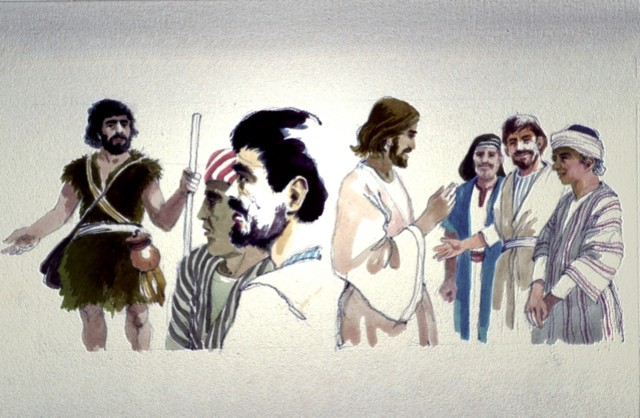
Andrew, Peter’s brother, heard John the Baptist speak. They became disciples of Jesus. Peter, along with James and John formed the inner circle of Jesus’ disciples.

This reference to Jesus as “the Word” has meaning throughout the Old Testament.  Two of many examples are seen as God brings things into existence by His very Word (Genesis 1:3), or accomplishes whatever His purpose may be by His Word, which He sends out (Isaiah 55:10-11).  This is used by John again in his 1st epistle (1 John 1:1-3), as he adds the fact that he and the other apostles had physical contact with this Word, the Lord Jesus Christ.  The Word is also referred to as living and active, for example in Hebrews 4:12.  Jesus confirms that He was with God in the beginning in John 17:5; and John specifically identifies the word in verses 14-17:

“And the Word became flesh and dwelt among us, and we have seen his glory, glory as of the only Son from the Father, full of grace and truth.
(John bore witness about him, and cried out, “This was he of whom I said, ‘He who comes after me ranks before me, because he was before me.’”)
For from his fullness we have all received, grace upon grace.
For the law was given through Moses; grace and truth came through Jesus Christ. “

John moves swiftly from this powerful and awesome account to the testimony of John the Baptist.  In verses 29-34, this John identifies Jesus as the “Lamb of God” – which they would not yet fully understand – and gives evidence of his own special revelation that he received from God, concerning His son.  In verses 19-23, John the Baptist,appearing before the priests and then the Pharisees, denied that he himself was the Christ, or Elijah.  “The Prophet” that they ask him about could be  a misunderstanding by them of the promise of a “new prophet like me” to lead them, which Moses spoke of in Deuteronomy 18:15-16.  He leaves no doubt in verse 23 though, that his baptism is to prepare the way for the Messiah, as he clearly states that he is the one referred to in Isaiah 40:3.

The chapter ends with Jesus calling the first of His disciples, some of which He undoubtedly already had a relationship with.  But Nathanael marvels that he knows him, and realizes that He truly is the Son of God (verses 48-49) because of it.  Jesus tells them that they will see much greater things to come. Verse 51 is a very clear reference to Jacob’s dream in Genesis 28:12.

Read or listen to audio of ESV version of this selection from this link.

/Bob’s boy
___________________
some images © V. Gilbert & Arlisle F. Beers

Please note: I did not design the reading plan that I am following in my blog.  All of my comments in this blog, however, are solely my responsibility.  When reading ANY commentary, you should ALWAYS refer first to the scripture, which is God’s unchanging and unfailing word. Reading schedules, as well as a link to the site where you can get the reading plan that I’m currently following for yourself can be found on the “Bible Reading Schedules” page of my website at http://graceofourlord.com.  For questions and help, please see the “FAQ” and “Summaries” pages there.