The Bread of Life – John 6-7

In the sixth chapter of John, perhaps the greatest of Jesus’s miracles occurred – the feeding of the five thousand. Of course, walking on water was not a small feat by any means. But his “Bread of Life” sermon was quite remarkable. When speaking to the Jews about “eating his flesh” and “drinking his blood,” most (including the twelve) would not fully understand it until later. One meaning is obvious to us as a reference to the Lord’s supper – which he had not yet instituted. The other would be understandable to those who could discern his parables.

In chapter 7, the scribes and Pharisees sent officers to arrest Jesus, But it was not time yet. Don’t miss verse 24, which says “Do not judge by appearances, but judge with right judgment.” God have us minds to be able to judge what is right and what is wrong by way of His word. The “judge not” verse that everyone is so fond of using to excuse every sort of sin does not, in fact, do so.

/Bob’s boy

Bible Reading Schedule for this month
Click links below to read or listen to audio of one of this week’s chapters in Colossians and Luke

John 6, John 7, John 8, John 9, John 10

___________________

some images © V. Gilbert & Arlisle F. Beers

Please visit this site’s menu item “The Author’s Books” for info on the author’s books, website, and Facebook page.

All of my comments in this blog are solely my responsibility. When reading any commentary, you should always refer first to the scripture, which is God’s unchanging and unfailing word.


Stirring Up Water – John 5

Chapter 5 is a great example of how John offers proof of the deity of Christ. But for some people, one of the most striking things about the chapter is the fact that verse 4 is missing from some translations. There are a great many reliable manuscripts that do not contain the verse – and the ESV does not contain it either. The controversial verse omitted says

for an angel of the Lord went down at certain seasons into the pool, and stirred the water: whoever stepped in first after the stirring of the water was healed of whatever disease he had

It just does not seem consistent with the way the Lord chose miracles to be performed during the time of the Jesus’s ministry. But to complicate matters further, verse 7 is in all the manuscripts, and it reads:

The sick man answered him, “Sir, I have no one to put me into the pool when the water is stirred up, and while I am going another steps down before me.

Once again, the good thing about these sorts of irregularities is 2) there are very very few of them and b) none of them matter as far as doctrine is concerned. Nobody’s salvation depends on verse 4.

/Bob’s boy

Bible Reading Schedule for this month
Click links below to read or listen to audio of one of this week’s chapters in Colossians and Luke

John 1, John 2, John 3, John 4, John 5

___________________

some images © V. Gilbert & Arlisle F. Beers

Please visit this site’s menu item “The Author’s Books” for info on the author’s books, website, and Facebook page.

All of my comments in this blog are solely my responsibility. When reading any commentary, you should always refer first to the scripture, which is God’s unchanging and unfailing word.


The Word and His Miracle- John 1-2

John’s gospel is both previewed and summarized in chapter one by the message that Jesus is the Son of God. reference to Jesus as “the Word” has meaning throughout the Old Testament. Two of many examples are seen as God brings things into existence by His very Word (Genesis 1:3), or accomplishes whatever His purpose may be by His Word, which He sends out (Isaiah 55:10-11). The Greek word “logos” is what is translated as “word,” and it had a special meaning to the Greeks of the day. It signified the bridge between the transcendent, or spiritual, to the physical. john’s use of it here is quite appropriate in light of the aforementioned passages.

Jesus meets John the Baptist

Jesus meets John the Baptist (Photo credit: Wikipedia)

John moves later in the chapter to the testimony of John the Baptist. In verses 29-34, this John identifies Jesus as the “Lamb of God” – which they would not yet fully understand – and gives evidence of his own special revelation from God, concerning His son. In verses 19-23, John the Baptist,appearing before the priests and then the Pharisees, denied that he himself was the Christ, or Elijah. “The Prophet” that they ask him about could be a misunderstanding by them of the promise of a “new prophet like me” to lead them, which Moses spoke of in Deuteronomy 18:15-16. He leaves no doubt in verse 23 though, that his baptism is to prepare the way for the Messiah, as he clearly states that he is the one referred to in Isaiah 40:3. The chapter ends with Jesus calling the first of His disciples, some of which He undoubtedly already had a relationship with.

The event of the wedding at Cana in chapter 2 is where Jesus performed His first miracle. Some make reference to this as an argument for social drinking, but it would be safe to say that the Lord would not be providing a means for people to become drunk with wine. For Jesus to have done so would have been a sin (Habakkuk 2:15); and the point of this scripture is found in examining the miracle (or sign, as John refers to it) itself. There were six stone jars, each holding 20-30 gallons. Note that verse 7 says that He had the servants fill the jars to the brim with water – nothing could have been poured into them afterward, and Jesus never touched them. Running out of wine at a wedding feast would be particularly awkward.

Addressing His mother as “Woman” in verse 4 would seem disrespectful to people today, but such was not the case in the language of the day. It was a term of respectful distance. Note that the anger is righteous anger, as Jesus drives out the merchants and money changers. The temple area spoken of here would be the surrounding area of the temple itself that would be used for worship as well by worshiping Gentiles. So these traders would be disrupting that worship. In verse 18, the Jews present questioned Jesus as to what His authority for doing this was. He answered “Destroy this temple, and in three days I will raise it up.” Of course, they did not understand that He was talking about His own body – not the temple He had just cleansed. But verse 22 confirms that His disciples would remember after the crucifixion.

/Bob’s boy

Bible Reading Schedule for this month
Click links below to read or listen to audio of one of this week’s chapters in Colossians and Luke

John 1, John 2, John 3, John 4, John 5

___________________

some images © V. Gilbert & Arlisle F. Beers

Please visit this site’s menu item “The Author’s Books” for info on the author’s books, website, and Facebook page.

All of my comments in this blog are solely my responsibility. When reading any commentary, you should always refer first to the scripture, which is God’s unchanging and unfailing word.


John 21 – Jesus Appears to the Other Disciples

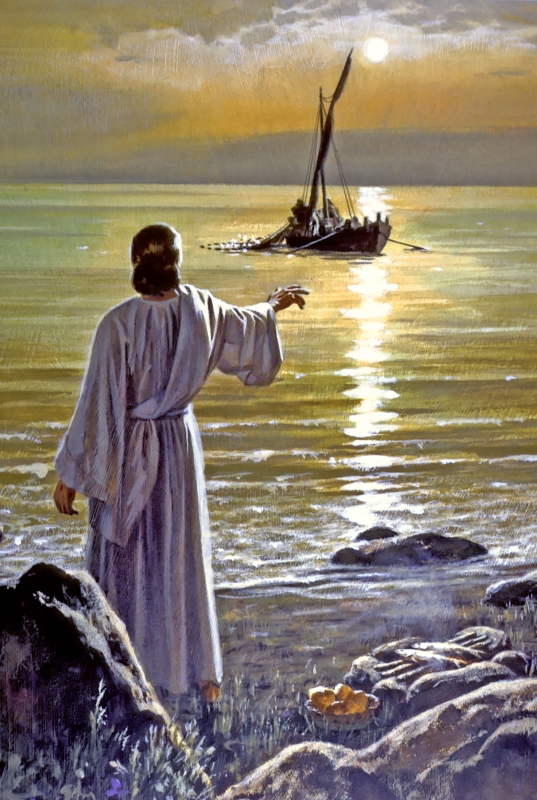
In this final chapter of John’s gospel, Jesus appears to seven of the disciples that have gone fishing on the Sea of Tiberias (Sea of Galilee).  Appearing to them 100 yards from shore at daybreak, they did not recognize Him until they cast their net out where He told them – and then were unable to haul it in, so great was the catch (verse 6).  John must have at once been reminded of the similar incident in Luke 5:4-6, as he exclaimed to Peter that “It is the Lord!”  Peter, impulsive as usual, jumps in to swim to shore while the others drag the fish with the boat.  Jesus had a fire going, and was cooking them breakfast.  There have been many attempts to make some symbolic interpretation of the number of fish they caught (153) in verse 11, but fishermen naturally counted their fish before taking them to market.  Verse 12 is simply an indication that even though they knew this was Jesus, the disciples were still getting used to the fact that He was alive again.

Verses 15-19 make up the “feed my sheep” conversation between Jesus and Peter.  Much has been written and discussed about the two different Greek words for love (agape and phileo) that are in the text.  But the two words are used interchangeably in the book of John, and even throughout the Septuagint.  It is no more valid to make something different of this than the two different words this very same text uses for “feed” and even “sheep.”  There are only two things of significance.  One is that Peter denied Jesus three times; and though it grieved Peter (verse 17) that Jesus asked him whether He loved Him a third time, Jesus knew that it would also be somewhat of a comfort to Peter later.  The command to him to “feed my sheep” came from “the Good Shepherd” Himself (John 10:11,14) for Peter and the other apostles, and is carried forward to all elders to “shepherd the flock of God that is among you” (1 Peter 5:1-4, Acts 20:28).  With verses 18-19, Jesus foretells Peter’s being bound and led to his own crucifixion.

As this gospel wraps up, “the disciple whom Jesus loved” wants us to know that Jesus did so much more while He was here than was written about.

Read or listen to audio of ESV version of this selection from this link.

/Bob’s boy
___________________
some images © V. Gilbert & Arlisle F. Beers

Please note: I did not design the reading plan that I am following in my blog.  All of my comments in this blog, however, are solely my responsibility.  When reading ANY commentary, you should ALWAYS refer first to the scripture, which is God’s unchanging and unfailing word. Reading schedules, as well as a link to the site where you can get the reading plan that I’m currently following for yourself can be found on the “Bible Reading Schedules” page of my website at http://graceofourlord.com.  For questions and help, please see the “FAQ” and “Summaries” pages there.

John 20 – Jesus Appears to Thomas

(Note: for a summary of the events of this chapter from the resurrection at dawn to Jesus’ first appearances to Mary Magdalene and the other women, please see post at this link.  After the resurrection, Jesus – as He had told the disciples in Matthew 26:32 that He would meet them there – would be with them at the Sea of Galilee, and at a mountain there that He directs them to.  But several other events occur before and after this, the details of which are interspersed throughout the gospels in Matthew 28 and John 20.  And events in a single chapter are in some cases separated by days, and even weeks, as Jesus remained for forty days before the ascension.)

In the evening of the day of the resurrection, verse 19 tells us, the disciples had the doors locked where they were “for fear of the Jews.”  But Jesus comes and stands among them.  This is not to imply that the risen Lord was now some disembodied spirit.  But a locked door was certainly no challenge to the Lord, who had raised the dead.  He showed them His hands and His side’ and in verses 21-23, John gives his account of a foretaste of the Holy Spirit to come to them when He leaves.   Verse 23 confirms what He told them in Matthew 18:18.

English: The Incredulity of Saint Thomas by Ca...

English: The Incredulity of Saint Thomas by Caravaggio. Found at http://www.christusrex.org/www2/art/images/carav10.jpg. Category:Artistic portrayals of Jesus Category:Images of paintings (Photo credit: Wikipedia)

The “doubting Thomas” verses are next as Thomas was not with the others on the above occasion.  When the others told Thomas they had seen the Lord, he said “Unless I see in his hands the mark of the nails, and place my finger into the mark of the nails, and place my hand into his side, I will never believe.”  Eight days later, Jesus again enters where they are locked in and He has Thomas do exactly those things.  When Thomas acknowledges Him as the Lord, Jesus says “Have you believed because you have seen me? Blessed are those who have not seen and yet have believed.”

Though there still remains one chapter in the gospel of John, he ends this chapter by stating that Jesus did many wondrous things that were not written in his gospel.  But he says it was written “that you may believe that Jesus is the Christ, the Son of God, and that by believing you may have life in his name.”

Read or listen to audio of ESV version of this selection from this link.

/Bob’s boy
___________________
some images © V. Gilbert & Arlisle F. Beers

Please note: I did not design the reading plan that I am following in my blog.  All of my comments in this blog, however, are solely my responsibility.  When reading ANY commentary, you should ALWAYS refer first to the scripture, which is God’s unchanging and unfailing word. Reading schedules, as well as a link to the site where you can get the reading plan that I’m currently following for yourself can be found on the “Bible Reading Schedules” page of my website at http://graceofourlord.com.  For questions and help, please see the “FAQ” and “Summaries” pages there.

John 18 – Betrayal and Arrest of Jesus


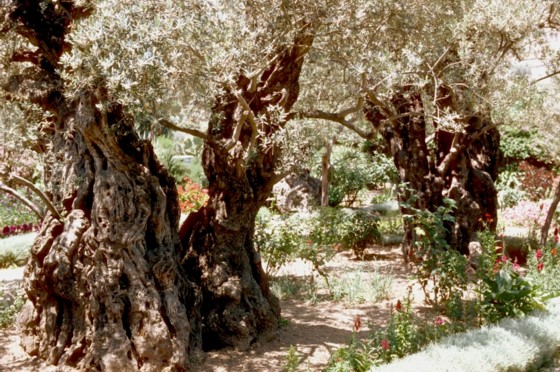
Olive Trees in the Garden of Gethsemane, on the Mount of Olives

Having finished the Olivet discourse, including His prayer, Jesus and His disciples went across the Kidron brook into a garden.  John does not identify Gethsemane as Matthew and Mark do (Matthew 26:36 and Mark 14:32).  But he does say in verse 2 that Judas knew the place where Jesus would be because He often met there with His disciples.  And we know from several scriptures (Luke 21:37 and Luke 22:39, for example)  that it was His custom to go to the Mount of Olives at night.  Knowing that this was the time, Jesus came forward to the soldiers and officers of the Pharisees that Judas had brought.  Much commentary has been written about verse 6 (“When Jesus said to them, “I am he,” they drew back and fell to the ground”) – but we just do not know exactly what happened there.  Clearly however, this was a significant response that we would not have expected from Jesus’ captors.  But it really does seem appropriate for the Son of God at this hour in His life.

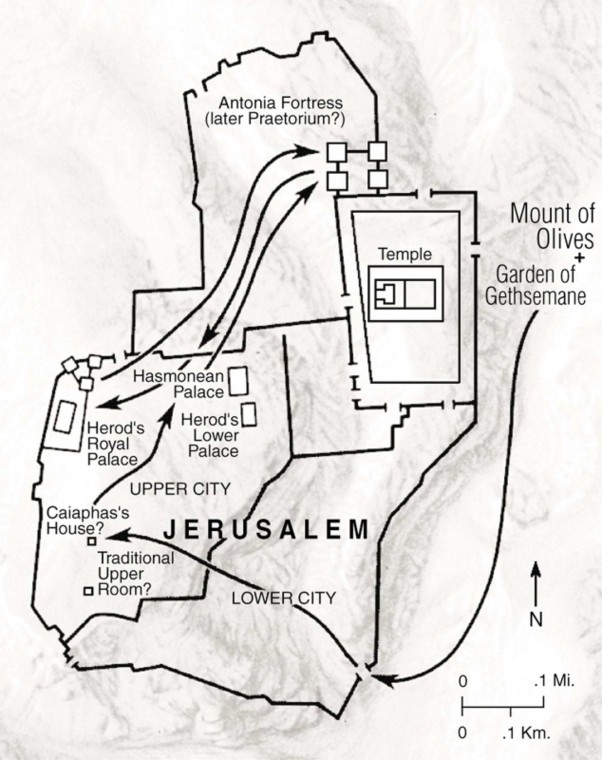
Verses 15-17 contain the account of Peter’s denial.  Though we are not told, the “other disciple” mentioned in verses 15-16 is probably John himself (the disciple that Jesus loved – as in John 20:2). John is the only one of the four gospels that gives us the account of Jesus going first to Annas. He had been High Priest from 6-15 A.D., but had been deposed by Valerius Gratus, the former Roman prefect of Judea (Josephus Antiquities 18.26, 34, 95).  But the position stayed in the family – currently his son-in-law, Caiaphas.  Since the position had traditionally been one that was life-long, Annas was still considered a High Priest by many Jews.  Jesus was then taken to Caiaphas.  John does not record the events of that encounter, but the synoptic gospels do (Matthew 26:57-68, Mark 14:53-65, and Luke 22:66-71).  It was Caiaphas that had suggested that Jesus should die back in John 11:49-51.

After Judas singled Jesus out for arrest, the mob took Jesus first to Annas, then Caiaphas, the high priest. Jesus then was taken to Pilate

From there, Jesus was taken to the Praetorian – the Roman governor’s residence – to appear before Pilate.  In verse 31, Pilate wants them to “judge him by your own law.”  But the Roman government had supposedly taken away the Sanhedrin’s right to capital punishment (though clearly they exercised exceptions to this, as with Stephen in Acts 7:57-60), and they wanted Him put to death.  Besides, as verse 32 reminds us, it was the Roman method of execution that would fulfill the scripture (Isaiah 52:13, John 12:32-33).  When Pilate speaks with Jesus asking what He had done and whether He was a kink, Jesus lays aside all doubt as to what type of Kingdom He had come to establish in verse 36:

“My kingdom is not of this world. If my kingdom were of this world, my servants would have been fighting, that I might not be delivered over to the Jews. But my kingdom is not from the world.”

Pilate still tries to avoid the responsibility for their blood lust, but he lacks the courage to go against the crowd.  So he offers to free either Jesus or the known criminal Barabbas, no doubt thinking they would choose the latter.

But such was not to be.  Jesus took the place of all of us, including Barrabas.


Read or listen to audio of ESV version of this selection from this link.

/Bob’s boy
___________________
some images © V. Gilbert & Arlisle F. Beers

Please note: I did not design the reading plan that I am following in my blog.  All of my comments in this blog, however, are solely my responsibility.  When reading ANY commentary, you should ALWAYS refer first to the scripture, which is God’s unchanging and unfailing word. Reading schedules, as well as a link to the site where you can get the reading plan that I’m currently following for yourself can be found on the “Bible Reading Schedules” page of my website at http://graceofourlord.com.  For questions and help, please see the “FAQ” and “Summaries” pages there.


John 17 – The High Priestly Prayer

Old Roman steps leading down toward the Kidron Valley. Jesus and his disciples may have walked on these very steps after the Last Supper

In this chapter, Jesus prays first for himself (verses 1-5), for His disciples (verses 6-19), and then for all believers to come (verses 20-26).  He states in verse 4 that He has glorified God on earth “having accomplished the work that you gave me to do”  (meaning that He did not fail to setup His kingdom as some have claimed – or anything else for that matter).  He gave up the glory that He had with God since before the world existed (verse 5), and now asks God to glorify Him in His presence (after the resurrection), which will also achieve the result of the Son glorifying the Father.

As He prays for His disciples, He notes in verse 12 that He has guarded them and not one has been lost other than “the Son of destruction” (Judas) – which fulfilled the Scripture (Psalm 41:9):

“Even my close friend in whom I trusted,
who ate my bread, has lifted his heel against me.”

Verses 6, 11 and 26’s use of God’s name is the manifestation of His character and will that Jesus made known to them through His teaching and His actions.  In verses 20-26, He prays for all who believe in Him, so that they may be with Him to see the the glory that He had “before the foundation of the world” (for all eternity).   Those who believe know that God sent Him.  They will know God through the Son; and the love God has for His son will be in them through Jesus.

Read or listen to audio of ESV version of this selection from this link.

/Bob’s boy
___________________
some images © V. Gilbert & Arlisle F. Beers

Please note: I did not design the reading plan that I am following in my blog.  All of my comments in this blog, however, are solely my responsibility.  When reading ANY commentary, you should ALWAYS refer first to the scripture, which is God’s unchanging and unfailing word. Reading schedules, as well as a link to the site where you can get the reading plan that I’m currently following for yourself can be found on the “Bible Reading Schedules” page of my website at http://graceofourlord.com.  For questions and help, please see the “FAQ” and “Summaries” pages there.

John 16 – Your Sorrow Will Turn into Joy

Jesus continues His farewell discourse in chapter 16, adding to His warning of the persecution they will face noting that they will be put out of the synagogues.  Then the shocking statement that people will kill His disciples in the belief that they serving God by doing so.  Indeed, one who will do that very thing (Saul of Tarsus) will become an apostle.

Jesus giving the Farewell discourse to his ele...

Jesus giving the Farewell discourse to his eleven remaining disciples, from the Maesta by Duccio, 1308-1311. (Photo credit: Wikipedia)

He acknowledges their coming sorrow that He is leaving, but says that He must go for the Helper – the Holy Spirit – to come and guide them.  “And when he comes, he will convict the world concerning sin, righteousness, and judgment” – means that many who do not believe will be given hope because of their repentance.  In verse 21, Jesus makes the analogy of a woman giving birth (“she no longer remembers the anguish, for joy that a human being has been born into the world”).  The statement that their sorrow will turn into joy means that once Jesus is resurrected and the Holy Spirit comes, their full realization of what has been born will replace their sorrow with joy (compare verses 20-21).

Read or listen to audio of ESV version of this selection from this link.

/Bob’s boy
___________________
some images © V. Gilbert & Arlisle F. Beers

Please note: I did not design the reading plan that I am following in my blog.  All of my comments in this blog, however, are solely my responsibility.  When reading ANY commentary, you should ALWAYS refer first to the scripture, which is God’s unchanging and unfailing word. Reading schedules, as well as a link to the site where you can get the reading plan that I’m currently following for yourself can be found on the “Bible Reading Schedules” page of my website at http://graceofourlord.com.  For questions and help, please see the “FAQ” and “Summaries” pages there.

John 15 – I Am the True Vine

Green fields and vineyards grow in the area near Mamre, near Hebron, where Abraham once pitched his tent.

The vineyard references are deeply embedded in the Old Testament as a symbol for Israel, especially in two vineyard songs in Isaiah (Isaiah 5:1-7 and Isaiah 27:2-6).  But Israel failed in bearing fruit.  God as the vinedresser is taken from the first vineyard song.  In that passage, God is depicted tending His vineyard, but the vineyard produced wild grapes (unrighteousness).  Jesus is the true vine, and His disciples are the branches.   The fruit is the outward signs and effect on the world of the Christian life in those branches.  Those who do not bear fruit are not abiding in Jesus – not being true disciples, perhaps just going through some of the motions.  Verse 7 (“If you abide in me, and my words abide in you, ask whatever you wish, and it will be done for you”) is another important point to remember about prayer – abiding in Him means that our prayers reflect His will.

As Jesus again commands them to love each other as He has loved them, He tells them they are His friends,not just servants; and because of that He has made known to them the things of the Father, and the Holy Spirit will come to guide them.  He also warns that just as He was persecuted they will also be persecuted.  The “word that is written in their Law” Jesus referred to being fulfilled in verse 25 comes from Psalm 69:4 and Isaiah 35:19.

Read or listen to audio of ESV version of this selection from this link.

/Bob’s boy
___________________
some images © V. Gilbert & Arlisle F. Beers

Please note: I did not design the reading plan that I am following in my blog.  All of my comments in this blog, however, are solely my responsibility.  When reading ANY commentary, you should ALWAYS refer first to the scripture, which is God’s unchanging and unfailing word. Reading schedules, as well as a link to the site where you can get the reading plan that I’m currently following for yourself can be found on the “Bible Reading Schedules” page of my website at http://graceofourlord.com.  For questions and help, please see the “FAQ” and “Summaries” pages there.

John 14 – The Way, and the Truth, and the Life

Jesus continues His farewell discourse in this chapter by softening the blow a bit after having told His chosen ones that He is leaving them.  Verse 2 is translated in ways in some versions that confound the meaning.  The King James says it in such a way as to make people think they will have their own mansion in heaven.  The ESV (and NASB) simply says “In my Father’s house are many rooms (dwelling places),”  not intending to convey that space is small, but to drive home the point that we are going to live with God – not separated from Him.  Jesus is telling them that they will follow Him, and He will prepare a place for them.

Thomas points out that since they do not know where He is going, they do not know the way.  Jesus then said “I am the way, and the truth, and the life. No one comes to the Father except through me.”  In Acts 9:2, Christians are for the first time described as belonging to “The Way,” a term which is repeated in scripture as well as by secular historians (such as Josephus Flavius).  It is hard to imagine that the term did not come from these words of Jesus.

Six of Jesus’ disciples, later called apostles, or The Twelve

In verses 13-14, Jesus says “Whatever you ask in my name, this I will do, that the Father may be glorified in the Son.  If you ask me anything in my name, I will do it.”  We must remember first that other scriptures define prayer properly.  Secondly, in this age, a person’s name represented what that person was as a being – who they were, so to speak.  So praying in Jesus’ name means praying in a way consistent with His will and His character.

Jesus then offers more reassurance to His apostles in verses 15-28, as He confirms that He is one with the Father, and that He is going to Him.  But He will not leave them as “orphans.”  The promise of the Holy Spirit in these verses is for the apostles, not for us.  As those who He is sending, they will need the guidance of the “Helper” to speak His word and make the will of God known.  As His chosen ones, the Holy Spirit also help them remember all that He has told them.  But  Jesus says that He will no longer talk much with them.

The end is very near, but that end will be very much a new beginning.

Read or listen to audio of ESV version of this selection from this link.

/Bob’s boy
___________________
some images © V. Gilbert & Arlisle F. Beers

Please note: I did not design the reading plan that I am following in my blog.  All of my comments in this blog, however, are solely my responsibility.  When reading ANY commentary, you should ALWAYS refer first to the scripture, which is God’s unchanging and unfailing word. Reading schedules, as well as a link to the site where you can get the reading plan that I’m currently following for yourself can be found on the “Bible Reading Schedules” page of my website at http://graceofourlord.com.  For questions and help, please see the “FAQ” and “Summaries” pages there.