Romans 2 – God’s Judgment and the Law

Colosseum, Rome, Italy.
Many gladiators and wild beasts were killed here to entertain the Roman people. Tradition says that this was the site where many Christians were martyred, especially under the Emperor Nero.

In this chapter, Paul addresses the Jews of the church at Rome, as their self-righteousness threatens the unity of the church – just as it did in Galatia and elsewhere.  But here again, the applications to all people are clear.  He again states that the Gentiles are without excuse, for just as the evidence for God abounds, he also says “the law is written on their hearts.”  So even though they did not have prophets who wrote the law as the Jews knew it, the Gentiles knew enough “to do what the law requires” (verses 14-15).

But the Jews, who had the law and were circumcised, were warned that they who pass judgment on others are not without sin themselves.  So they should not boast and be judgmental because if they know the law and additionally are circumcised, but still live in sin they are just as guilty – for God shows no partiality.  They are not favored of God for their knowledge of the law or for their circumcision.  Though it is still admirable that they keep the law of circumcision, it is no longer required anyway, and it is of no value to them in their sin.

Paul is not speaking of baptism here, nor is he comparing it to circumcision.  But as Christians today we would do well to remember this passage when it comes to others.  Being “raised in the church,” knowing and even reading their Bible, and even having been baptized are all of no value if we live in sin anyway.  In that case, we will be just as lost as those who never obeyed the gospel.  As it was true then of being a Jew and being circumcised, it is living a life that is consistent with faith in (and commitment to) the Lord that has value.

Read or listen to audio of ESV version of this selection from this link.

/Bob’s boy
___________________
some images © V. Gilbert & Arlisle F. Beers

Please note: I did not design the reading plan that I am following in my blog.  All of my comments in this blog, however, are solely my responsibility.  When reading ANY commentary, you should ALWAYS refer first to the scripture, which is God’s unchanging and unfailing word. Reading schedules, as well as a link to the site where you can get the reading plan that I’m currently following for yourself can be found on the “Bible Reading Schedules” page of my website at http://graceofourlord.com.  For questions and help, please see the “FAQ” and “Summaries” pages there.

Romans 1 – God’s Wrath on Unrighteousness

Paul opens this letter affirming his apostleship, as was his custom with letters to churches that were not so familiar with him. He reinforces that in verses 4-6 by stating that, through Jesus, he and the other apostles “received grace and apostleship to bring about the obedience of faith for the sake of his name among all the nations, including you who are called to belong to Jesus Christ…”    The long introduction also affirms that Jesus is the Son of God, and that he was descended from David, fulfilling Old Testament prophecy (verse 4); and he declares the mission to the Gentiles (verse 13).  He also expresses, at some length, his eagerness to go to Rome for fellowship and sharing the gospel with them.
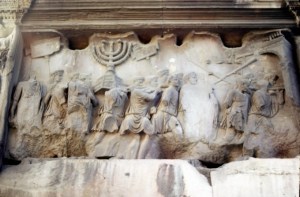
The Arch of Titus from outside the Forum, Rome, Italy. Located at the highest point of the Via Sacra which leads to the Roman Forum, this triumphal arch, with only one passageway, commemorates Titus’ conquest of Judea which ended the Jewish Wars (66-70). Engaged fluted columns frame the passageway.

Not much is known for certain about the church at Rome.  But by virtue of it being in Rome, its fame would have been considerable and, like the other churches, it was composed of both Jews and Gentiles.  The remainder of this chapter focuses on the need for righteousness on the part of the Gentiles, and Paul does not mince words in pointing out the history of unrighteousness on their part.  But as the letter continues, it will become apparent that McGarvey’s assessment is largely correct.  He writes:

“The Judaizing tendencies which had recently appeared in Corinth and Galatia were sure eventually to appear in other churches, perhaps ultimately in all, and the attitude assumed by a church already so influential and destined to increase in power was sure to carry great weight in deciding the controversy. Therefore, to set the church of Rome right as to the design and nature of the gospel was a work of supreme importance…”

Heading off such a crevasse in this church was of great concern, to be sure.  McGarvey further expounds most aptly:

“The purpose of the letter is to set forth, as Baur rightly expresses it, ‘both the relation of Judaism and heathenism to each other, and the relation of both to Christianity;’  primarily, for the instruction of the Christians in Rome, and, secondarily, for the benefit of all the churches by the establishment of peace between their Jewish and Gentile elements, and, ultimately, for the enlightening of the kingdom of God in all ages.”

Though verses 18-24 are here specifically directed at those Gentiles, they contain some of the most profound (and certainly definitive) statements applicable to all people everywhere concerning God’s existence, and thus they provide the very basis of sound apologetics.  The “wrath of God” in verse 18 represents his holiness, judgment, and yet loving response to the unrighteousness of mankind.  When Paul says that all mankind knows God, he is not speaking of the concept of a god or of deity in general.  Man knows the one true and living God because the evidence abounds in everything He created, yet he suppresses the truth in unrighteousness.  His attributes, including His eternal power and divine nature have been clearly perceived since the creation of the world, so that everyone is without excuse.

And God said, “Let the waters under the heavens be gathered together into one place, and let the dry land appear.” And it was so. Gen 1:9

Man has always tended to be full of himself because of the material knowledge he acquires, only made possible by God; and “claiming to be wise, they became fools…”  Man’s desire for sin and all that is an abomination to his Creator moves him to exchange the truth about God for a lie (verse 25) and worship the creature rather than the Creator even to this day.  People who deny Him do so by conscious choice in a futile attempt to justify their own unrighteousness.  The “shameful acts” Paul lists as driving this begins with unnatural relations of men and women with others of the same gender, and in verse 29 runs from gossips to murderers and “all manner of evil” in between – as God makes no distinction between what man considers “small” or large sins.

Any claim by someone who says they would believe if the evidence was there is hogwash.   Blindness to the more than substantial evidence is entirely willful.

Read or listen to audio of ESV version of this selection from this link.

/Bob’s boy
___________________
some images © V. Gilbert & Arlisle F. Beers

Please note: I did not design the reading plan that I am following in my blog.  All of my comments in this blog, however, are solely my responsibility.  When reading ANY commentary, you should ALWAYS refer first to the scripture, which is God’s unchanging and unfailing word. Reading schedules, as well as a link to the site where you can get the reading plan that I’m currently following for yourself can be found on the “Bible Reading Schedules” page of my website at http://graceofourlord.com.  For questions and help, please see the “FAQ” and “Summaries” pages there.

Acts 15 – The Jerusalem Council

Despite Peter’s vision, and the fact that the Holy Spirit was given to the Gentiles in chapter 10, the acceptance of Gentiles in the church was still meeting resistance. In Acts 6:7, we are told of a significant number of priests that believed and were added to the church.  Many of these would be of the Pharisaic party referred to in verse 5.  There were people being taught that all had to be circumcised and to keep the law of Moses, causing Christianity to be looked upon as a sect of Judaism (and to some, a sect that had gone very wrong).  The time had come to deal with this issue once and for all.

Paul had been given his revelation on the matter, as the Lord had told Ananias in Acts 9:15 that “he is a chosen instrument of mine to carry my name before the Gentiles…”  He and Barnabas and others were appointed to go to Jerusalem to speak to the apostles and elders about the matter.  In verse 3, we have them passing through Phoenicia and Samaria, bringing great joy as they describe the conversion of the Gentiles.

Peter spoke to the council in verses 7-11, reminding them of the gift of the Holy Spirit.  Then Paul and Barnabas related the signs and wonders God had done through them on their journey.  James, the Lord’s brother, then affirms by quoting Amos 9:11-12 in verses 16-18.  The apostles then chose men to go with Paul and Barnabas to Antioch, and sent a letter with them, affirming with one accord that the Gentiles were not to be burdened with the requirements that the circumcision party was trying to impose.  The stipulations referred to in verses 20 and 29 were to make clear that they were to abstain from behavior that would make them  appear to the world as the idol-worshipers that were so common (sexual immorality was a predominant theme in idol worship).

Pamphylia hill country, Turkey, a small Roman province in southern Asia Minor during Paul’s time. Paul preached here on his First Missionary Journey. Later, John Mark left Paul and Barnabas and went home.

Paul and Barnabas stayed in Antioch (of Syria) preaching for a while, then prepared to re-visit the cities where they had been.  Verse 39 describes “a sharp disagreement” between the two.  Barnabas wanted to take Mark with them.  But verse 38 says that “Paul thought best not to take with them one who had withdrawn from them in Pamphylia and had not gone with them to the work.”  Separating, Barnabas and Mark went to Cyprus, and Paul took Silas and went through Syria and Cilicia.  The Scripture does not elaborate on this, but it has been pointed out that the disagreement had the end result of making their efforts doubly fruitful.

Read or listen to audio of ESV version of this selection from this link.

/Bob’s boy
___________________
some images © V. Gilbert & Arlisle F. Beers

Please note: I did not design the reading plan that I am following in my blog.  All of my comments in this blog, however, are solely my responsibility.  When reading ANY commentary, you should ALWAYS refer first to the scripture, which is God’s unchanging and unfailing word. Reading schedules, as well as a link to the site where you can get the reading plan that I’m currently following for yourself can be found on the “Bible Reading Schedules” page of my website at http://graceofourlord.com.  For questions and help, please see the “FAQ” and “Summaries” pages there.