Psalm 69 – Deliver Me

depression_002This psalm is another of those that apply both to David and to Jesus.  Whether from a time when David was on the run from Saul, we do not know, nor does it matter.  He is crying out to God, clearly suffering and just as clearly afraid.  Many appeals contained in this psalm are appropriate for prayer today at times when life is bleak:

Save me, O God!
For the waters have come up to my neck.
I sink in deep mire,
where there is no foothold;
I have come into deep waters,
and the flood sweeps over me.

But the psalm is indicative of the Messiah’s plight in places as well.  Verse 4 (“They hated me without a cause”) is quoted by Jesus in John 15:25.  Verse 9 (zeal for your house has consumed me) is quoted in John 2:17.  And verse 21 (“They gave me poison for food,and for my thirst they gave me sour wine to drink”) is referred to in all four gospels (such as Luke 23:36).   Indeed, this psalm is quoted by Paul in Romans 15:3 (69:9b), Romans 11:9 (69:22), Romans 11:10 (69:23), and Acts 1:20 (69:25).

Read or listen to audio of ESV version of this selection from this link.

/Bob’s boy
___________________
some images © V. Gilbert & Arlisle F. Beers

Please note: I did not design the reading plan that I am following in my blog.  All of my comments in this blog, however, are solely my responsibility.  When reading ANY commentary, you should ALWAYS refer first to the scripture, which is God’s unchanging and unfailing word. Reading schedules, as well as a link to the site where you can get the reading plan that I’m currently following for yourself can be found on the “Bible Reading Schedules” page of my website at http://graceofourlord.com.  For questions and help, please see the “FAQ” and “Summaries” pages there.

Psalm 60 – Vain Is The Salvation of Man

A desolate wasteland south of the Dead Sea, which may have been the Valley of Salt

A desolate wasteland south of the Dead Sea, which may have been the Valley of Salt

The rather long superscription instructs the singing of this psalm to be to the tune of “Shushan Eduth” which is usually translated “the Lily of the Testimony,” which some suppose is the same song mentioned in the superscription of Psalms 45, 69, and 80.    There is no record in Scripture of the battles referred to in the first part of this superscription, which is understandable if (as some suppose from the first few verses) that they were defeats for Israel.  The victory in the last part that is ascribed to Joab (for he was David’s commander) in “the Valley of Salt” is accounted in 2 Samuel 8:13-14 and 1 Chronicles 18:12-13.   In the former, David was given the victory and in the latter, Abishai – David was his king and Joab was his commander.  So, although the superscriptions are not part of the inspired word, there is no inconsistency on that account.  As for the difference in the number of Edomites struck down, we will of course refer to the inspired word for the correct final count.

In any case, the psalm appears to be referring to the defeats mentioned above.  Verses 1-5 begin with the suggestion of God’s displeasure with them, as well as the confidence that He would come through for them in the end.  What follows in verses 6-8 is a recital by specific name of various lands that God had promised His people by general reference to Canaan.  Verses 9-12 look forward to the victory at Edom.

For us, verse 11 is the lesson (“Oh, grant us help against the foe, for vain is the salvation of man!”).  It has always been mankind’s folly to rely solely on his own capabilities.  Whether he acknowledges it or not, eventually man is dependent on God.

Read or listen to audio of ESV version of this selection from this link.

/Bob’s boy
___________________
some images © V. Gilbert & Arlisle F. Beers

Please note: I did not design the reading plan that I am following in my blog.  All of my comments in this blog, however, are solely my responsibility.  When reading ANY commentary, you should ALWAYS refer first to the scripture, which is God’s unchanging and unfailing word. Reading schedules, as well as a link to the site where you can get the reading plan that I’m currently following for yourself can be found on the “Bible Reading Schedules” page of my website at http://graceofourlord.com.  For questions and help, please see the “FAQ” and “Summaries” pages there.

Psalms 68 – The Procession of My God

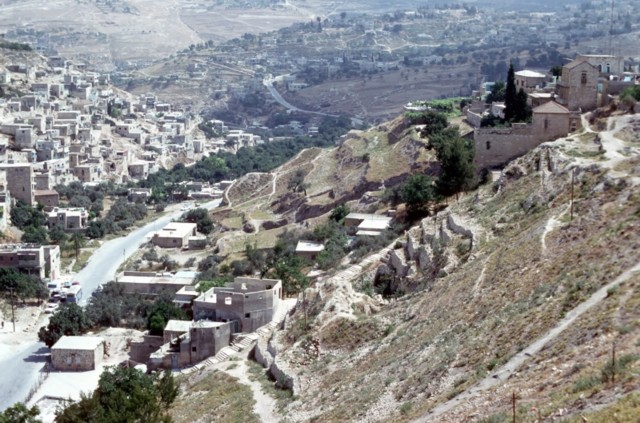
This psalm is extolled by commentators as one of the most magnificent hymnal psalms of praise that David wrote – and in some ways, one of the most difficult to outline and interpret.  It is widely accepted as having been written at the time of the removal of “the ark of God from the house of Obed-edom to the city of David with rejoicing” ( 2 Samuel 6:12).  And that certainly seems to be the case, as it starts out in verse one (“God shall arise, his enemies shall be scattered; and those who hate him shall flee before him!”) – the same way the ark was always put on its journey (see Numbers 10:35).

Hill of Ophel, south of Jerusalem, where the city of David was located.

Hill of Ophel, south of Jerusalem, where the city of David was located.

Throughout the chapter, it echoes the praise for God when on a similar journey among His people, He led them from bondage in Egypt (i.e. verses 4, 6, 7-8).  Verse 20 (“Our God is a God of salvation, and to God, the Lord, belong deliverances from death”) is one of few verses in the Old Testament that clearly demonstrates an understanding of God’s saving grace for the righteous in eternity, as we understand now comes to us from the sacrifice of His Son.

But praise for God and His power is the sole intent of this song.  Part of Spurgeon’s description of the singing which follows here conjures quite an image:

“With the words of the first two verses the ark is uplifted, and the procession begins to move. In Psalm 68:3-6, the godly in the assembly are exhorted to commence their joyous songs, and arguments are adduced to help their joy. Then the glorious march of Jehovah in the wilderness is sung: Psalm 68:7-10, and his victories in war are celebrated in verses Psalm 68:11-14. The joyous shouts are louder as Zion comes in sight, and the ark is borne up the hill…”

The psalm concludes majestically:

Awesome is God from his sanctuary;
the God of Israel—he is the one who gives power and strength to his people.
Blessed be God!

Read or listen to audio of ESV version of this selection from this link.

/Bob’s boy
___________________
some images © V. Gilbert & Arlisle F. Beers

Please note: I did not design the reading plan that I am following in my blog.  All of my comments in this blog, however, are solely my responsibility.  When reading ANY commentary, you should ALWAYS refer first to the scripture, which is God’s unchanging and unfailing word. Reading schedules, as well as a link to the site where you can get the reading plan that I’m currently following for yourself can be found on the “Bible Reading Schedules” page of my website at http://graceofourlord.com.  For questions and help, please see the “FAQ” and “Summaries” pages there.

Psalm 58 – God Who Judges the Earth

There is considerable dispute over both the translation and meaning of verse one: “Do you indeed decree what is right, you gods?”  Some translations have the last word replaced with “mighty lords.”  Others insist that it is “silent ones,” implying those accustomed to running things from afar.  In any case, David (for we have no reason to doubt the superscription’s claim that it is another of David’s “Psalms of the Golden Secret” – a Miktam) would certainly not speak of false gods as entities that actually did anything.

snake charmerAs one of the so-called imprecatory psalms, it speaks with sarcastic irony of the rulers and judges that are corrupt and wicked as being like deaf adders who cannot be charmed.  The psalm declares that the righteous will rejoice when God has his vengeance upon such evil men (verse 10).  It is a mistake to believe that righteous people will not do so when evil is defeated.  even the souls of those in heaven who have been slain by such men will rejoice when evil is crushed by the Lord (Revelation 6:9-10).  It is God who judges the earth!

Read or listen to audio of ESV version of this selection from this link.

/Bob’s boy
___________________
some images © V. Gilbert & Arlisle F. Beers

Please note: I did not design the reading plan that I am following in my blog.  All of my comments in this blog, however, are solely my responsibility.  When reading ANY commentary, you should ALWAYS refer first to the scripture, which is God’s unchanging and unfailing word. Reading schedules, as well as a link to the site where you can get the reading plan that I’m currently following for yourself can be found on the “Bible Reading Schedules” page of my website at http://graceofourlord.com.  For questions and help, please see the “FAQ” and “Summaries” pages there.

Psalms 57 – Cry Out to God Most High

According to the superscription of this psalm, it was one  written by David when he fled from Saul “in the cave” – possibly on the occasion of either 1 Samuel 22:1 or 1 Samuel 24:1-3, more likely the former.  It is hard to imagine the despair that David felt as he had to hide himself in fear for his very life, appealing to God “My soul is in the midst of lions; I lie down amid fiery beasts…”

Public domain image from www.public-domain-image.comVerse one is another of the several verses found in the psalms (17:8, 36:7, and 63:7, for example) and elsewhere that refer to a place of safety as being “in the shadow of your wings.”  In verses 1-6, David makes his “cry out to God most high” in prayer for His help.  But even in so doing, he expresses his faith in the Lord saying “I will take refuge, till the storms of destruction pass by.”  When we have done all that we can do, we must learn to trust in Him.

Then in verses 7-11, he finishes his prayer renewed with strength, and praises God for his comfort and steadfast love.  The refrain of the song, found in verse 5 is returned to in verse 11:

Be exalted, O God, above the heavens!
Let your glory be over all the earth!

It is a song that is a model for prayer most appropriate at times of despair, fear, or oppression – any time that we need to “cry out to God most high” as we often do, remembering as we make our plea, that He hears us and that He deserves our praise for all that He is and does.

Read or listen to audio of ESV version of this selection from this link.

/Bob’s boy
___________________
some images © V. Gilbert & Arlisle F. Beers

Please note: I did not design the reading plan that I am following in my blog.  All of my comments in this blog, however, are solely my responsibility.  When reading ANY commentary, you should ALWAYS refer first to the scripture, which is God’s unchanging and unfailing word. Reading schedules, as well as a link to the site where you can get the reading plan that I’m currently following for yourself can be found on the “Bible Reading Schedules” page of my website at http://graceofourlord.com.  For questions and help, please see the “FAQ” and “Summaries” pages there.

Psalm 119:121-128; Psalm 76 – Who Can Stand Before You?

ayinThis stanza of Psalm 119 begins each line with the 16th letter of the Hebrew Aleph-Bet, “ayin.”  The psalmist repeats three times the reference to himself as God’s servant.  In 121, he declares his faithfulness to God as that servant, asking Him for deliverance from those which oppress him.  In verse 126, he urges the Lord to act now because his laws have been broken.  Whether this refers to a specific occasion or simply the general state of God’s people at the time, we are not told, but it hardly matters.  It is a prayer to God for His justice.

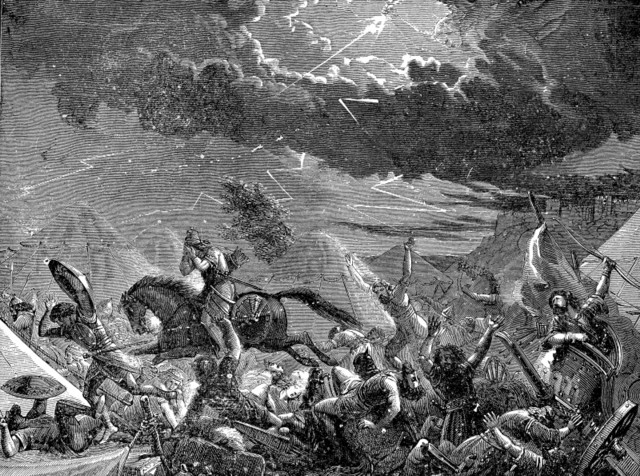
It is the general consensus of most commentators that Psalm 76 centers around God’s destruction of Sennacherib‘s army during the time of Hezekiah.  This would make “Asaph” in the superscription actually be those Levite descendants which were so named.  The complete destruction and defeat described in verses 3-8 fits this line of thought.

Sennacherib's army

Miraculous destruction of Sennacherib’s army.

Salem in verse 2 is the name of the kingdom city of Melchizedek (Genesis 14:18), and it is used synonymously with Jerusalem, especially in reference to Adonizedek (see Joshua 10:1-3).  The references to the wrath of man praising God in verse 10, and the following verses about the victory of God’s people over the kings of man, echo well the insolence of Sennacherib being his downfall.  His anger with God’s people brought him to pit an assault on God’s people with an army led by blasphemous representatives (2 Kings 18:17-36).   Sennacherib’s defiance and mockery of the Lord were followed by Isaiah’s prophecy of his downfall and the subsequent crushing of his army by the angel of the Lord (2 Kings 19:14-36, Isaiah 37:36).

Read or listen to audio of ESV version of this selection from this link.

/Bob’s boy
___________________
some images © V. Gilbert & Arlisle F. Beers

Please note: I did not design the reading plan that I am following in my blog.  All of my comments in this blog, however, are solely my responsibility.  When reading ANY commentary, you should ALWAYS refer first to the scripture, which is God’s unchanging and unfailing word. Reading schedules, as well as a link to the site where you can get the reading plan that I’m currently following for yourself can be found on the “Bible Reading Schedules” page of my website at http://graceofourlord.com.  For questions and help, please see the “FAQ” and “Summaries” pages there.

Psalms 51 – The sacrifices of God are a broken spirit

EnstromAccording to the superscript, the occasion of this psalm was when the prophet Nathan came to rebuke David for his sinful affair with Bathsheba and the premeditated murder of her husband and David’s loyal soldier and friend, Uriah the Hittite (2 Samuel 12:1-14).  It is a psalm of prayer from one who has committed grievous sin, and who makes no excuse for it.  As a prayer, the psalm is a great model for us, because it shows us the correct attitude one must have toward his own sins, and in asking God for His forgiveness.

God does not take sin lightly, but He does forgive us for our sins when we come to Him with a truly repentant and contrite heart.    It is with a properly broken spirit that David says “I know my transgressions, and my sin is ever before me. Against you, you only, have I sinned and done what is evil in your sight.”  David knows that no sacrifice or burnt offering would appease God in this case, and that God has no interest in it; and he says that “the sacrifices of God are a broken spirit; a broken and contrite heart, O God, you will not despise” (verse 17).

Read or listen to audio of ESV version of this selection from this link.

/Bob’s boy
___________________
some images © V. Gilbert & Arlisle F. Beers

Please note: I did not design the reading plan that I am following in my blog.  All of my comments in this blog, however, are solely my responsibility.  When reading ANY commentary, you should ALWAYS refer first to the scripture, which is God’s unchanging and unfailing word. Reading schedules, as well as a link to the site where you can get the reading plan that I’m currently following for yourself can be found on the “Bible Reading Schedules” page of my website at http://graceofourlord.com.  For questions and help, please see the “FAQ” and “Summaries” pages there.

Psalm 55 – Cast Your Burden on the Lord

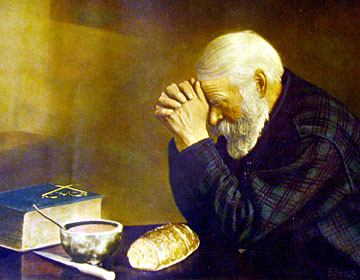
prayingmanA good portion of this psalm relates to betrayal by a once close and trusted friend; and Spurgeon seems right to assess it as reading “like a song of the times of Absalom and Ahithophel.”  Some have also seen it as a prophetic foretelling of the prayers of Jesus in the face of His betrayal and imminent death; and that certainly does fit as well.  There is no reason why it cannot be both, as most of the Royal psalms do refer to present as well as prophetic circumstances.  Consider verses 3-6:

…in anger they bear a grudge against me.
My heart is in anguish within me;
the terrors of death have fallen upon me.
Fear and trembling come upon me,
and horror overwhelms me.
And I say, “Oh, that I had wings like a dove!
I would fly away and be at rest;

But as a lament, much of it also seems to have application to the despair that overwhelms one because of the oppression of the world and the ultimate enemy – the devil himself, who lays in wait, constantly seeking to beat us down, and causes us grievous harm in ways we may not understand as being from his work at the time they occur.  As such, it is like a great many other psalms, which have tremendous power and application in our own prayers when we often wonder how we can carry on through our suffering:

Give ear to my prayer, O God,
and hide not yourself from my plea for mercy!
Attend to me, and answer me;
I am restless in my complaint and I moan
because of the noise of the enemy

Read or listen to audio of ESV version of this selection from this link.

/Bob’s boy
___________________
some images © V. Gilbert & Arlisle F. Beers

Please note: I did not design the reading plan that I am following in my blog.  All of my comments in this blog, however, are solely my responsibility.  When reading ANY commentary, you should ALWAYS refer first to the scripture, which is God’s unchanging and unfailing word. Reading schedules, as well as a link to the site where you can get the reading plan that I’m currently following for yourself can be found on the “Bible Reading Schedules” page of my website at http://graceofourlord.com.  For questions and help, please see the “FAQ” and “Summaries” pages there.

Psalms 37:21-40 – The Lord Loves Justice

Eastman Johnson - The Lord is my Shepard - Oil...

Eastman Johnson – The Lord is my Shepard – Oil on wood -16.625 x 13.125 in – c 1863 – Scanned from Eastman Johnson: Painting America – fig 76 pg 141 (Photo credit: Wikipedia)

This entire psalm is quite elegant.  To begin with, it is an acrostic.  Verse 1 begins with the first letter of the Hebrew alphabet, verse three with the second letter, and so on.   It is not intuitively apparent, but in addition to being alphabetic, it is an elaborate chiasmus, where verses repeat themes, ideas, etc. in an A-B-B-A structure.  in this case, the entire psalm appears to do so as in this example:

verses 1-11  The Lord is faithful to the righteous
verses 12-15 Righteousness will prevail
verses 16-20 The Lord upholds the righteous
verses 21-24 Righteousness delights the Lord
verses 25-31 The Lord upholds the righteous
verses 32-33 Righteousness will prevail
verses 34-40 The Lord is faithful to the righteous

Robert Alden suggests a much more elaborate Chiasmus within as follow (Alden, Robert l., “Everyman’s Bible Commentary, Vol I”, Moody Publishers, 1958):

“1-8    A    The righteous are exhorted to ignore
the wicked and trust God
9      B    Wait and inherit the land
10-15    C    The righteous inherit but the Lord
destroys the plotting wicked
16    D    The poor are blessed though poor
17    E    The Lord upholds the righteous
18a    F    The Lord guides the righteous
18b    G    The righteous inherit
19    H    The righteous    receive
20a    I    The wicked perish
20b    J    The wicked are like a sacrifice
20c    J    The wicked are like a sacrifice
21a    I    The wicked give not
21b    H    The righteous give
22    G    The blessed inherit
23    F    The Lord guides the righteous
24    E    The Lord upholds
25-26    D    The blessed may be poor but not forsaken
27-33    C    The Lord loves the righteous who
will live and inherit, but the plotting
wicked will die
34    B    Wait and inherit the land
35-40    A    God destroys the wicked but saves the righteous

The basic message of the psalm is the safety and blessing of those who trust in God and the insecurity of the ungodly.”

The second half of this psalm implores us to turn away from the evil ways of the world and strive to do good, give generously, wait for the Lord, and keep His way (verses 21, 27, 34).  Verse 28 says that the Lord loves justice and will not forsake his saints.  The psalmist says he was young and now is old but has never seen the righteous forsaken, or God’s children begging for bread.  There is future for the man of peace, he says.

He is their stronghold in the time of trouble.
the Lord helps them and delivers them;
He delivers them from the wicked and saves them,
because they take refuge in him.

Taking refuge in the Lord means more than just turning to Him in times of trouble.  It means trusting in God, not only when we are fearful, down-trodden or discouraged, but keeping that trust alive through all of the good times and the bad, the joy and the sorrow – all of the days of our lives.   A faith based solely on expectations of protection and comfort is worthless if it is not there also when we must weather the storms.  The key is to remember that He does not abandon us.  Repeated again and again the scriptures exclaim that we must often “wait for the Lord.”  It is the ability to do that with the assurance of hope that keeps us strong and carries us through difficulty.

Read or listen to audio of ESV version of this selection from this link.

/Bob’s boy
___________________
some images © V. Gilbert & Arlisle F. Beers

Please note: I did not design the reading plan that I am following in my blog.  All of my comments in this blog, however, are solely my responsibility.  When reading ANY commentary, you should ALWAYS refer first to the scripture, which is God’s unchanging and unfailing word. Reading schedules, as well as a link to the site where you can get the reading plan that I’m currently following for yourself can be found on the “Bible Reading Schedules” page of my website at http://graceofourlord.com.  For questions and help, please see the “FAQ” and “Summaries” pages there.

Psalms 54 and 56 – The Lord Upholds My Life

The superscription of Psalm 54 denotes a time when the Ziphites determined to betray David to Saul in order to gain his favor (1 Samuel 23:15-24).  It is a song of prayer to God for deliverance and praise to Him for being that one on whom we can depend in times of need.  David had just fled Keilah after he and his men had saved them from the Philistines.  The Lord had confirmed to him that even after saving them, they would give him up to Saul (1 Samuel 23:1-14).

woods-001The superscription in Psalm 56 directs the chief musician that the song is performed according to one called “the Dove.”  Adam Clarke translates the Teribinths as the “remote woods.”  We do not know what a “Michtam” is, but many suppose that it means this is “a golden psalm of David,” – golden equating to “precious.”

It also refers to the Philistines seizing him in Gath.  The scriptures do speak of David going to Gath.  One of those times was in 1 Samuel 21, but there is no record of the Philistines seizing him.  But that should not be considered cause to doubt the superscription’s accuracy.  We can be certain that there are many events in David’s life that are not chronicled in the scriptures, just as in the lives of other Biblical patriarchs.  The psalm itself is a song about trust in the Lord, even through times of great trouble and fear, and of maintaining one’s faith throughout it all.

Read or listen to audio of ESV version of this selection from this link.

/Bob’s boy
___________________
some images © V. Gilbert & Arlisle F. Beers

Please note: I did not design the reading plan that I am following in my blog.  All of my comments in this blog, however, are solely my responsibility.  When reading ANY commentary, you should ALWAYS refer first to the scripture, which is God’s unchanging and unfailing word. Reading schedules, as well as a link to the site where you can get the reading plan that I’m currently following for yourself can be found on the “Bible Reading Schedules” page of my website at http://graceofourlord.com.  For questions and help, please see the “FAQ” and “Summaries” pages there.