The Queen of Sheba

Solomon's fame regarding his wisdom and wealth spread throughout the ancient world, even as far away as Ophir and Sheba. It is not certain where Sheba is exactly, but many scholars believe it may have been located along the Red Sea on the Arabian peninsula.The Temple that Solomon built for the Lord drew upon the vast wealth of his enormous kingdom. Once it was completed, Solomon's Temple was no doubt one of the great wonders of its time.Solomon's reputation brought acclaim and riches from many nations, but he disobeyed God, marrying pagan women and worshiping their gods. So God raised up enemies like Hadad from Edom and Rezon from Zobah (modern-day Syria). Jeroboam from Zeredah was another enemy who would eventually divide this mighty kingdom.

Solomon’s fame regarding his wisdom and wealth spread throughout the ancient world, even as far away as Ophir and Sheba. It is not certain where Sheba is exactly, but many scholars believe it may have been located along the Red Sea on the Arabian peninsula.
The Temple that Solomon built for the Lord drew upon the vast wealth of his enormous kingdom. Once it was completed, Solomon’s Temple was no doubt one of the great wonders of its time.
Solomon’s reputation brought acclaim and riches from many nations, but he disobeyed God, marrying pagan women and worshiping their gods. So God raised up enemies like Hadad from Edom and Rezon from Zobah (modern-day Syria). Jeroboam from Zeredah was another enemy who would eventually divide this mighty kingdom.

Sheba is accepted by most archaeologists to be the ancient civilization of Saba in Yemen. Generally thought to have been a  trading nation, it has been speculated that the Queen’s motives were more commercial than a genuine interest in Solomon’s wisdom. That is not what the scripture tells us, however. Verse 4 says that after she had seen and heard all of his wisdom, his house, officials, and all of the burnt offerings he made to the Lord “there was no more breath in her.

In fact, she said that the reports she had received really understated the greatness of his wisdom. She gave the king 120 talents of gold (estimated to be about 75 pounds) and a very great quantity of spices, and precious stones. Verse 9 says that there were no spices like she had given to him. In return, verse 12 says, Solomon gave her whatever she desired.

The chronicler went on to tell of the 666 talents of gold that came to him in one year (“besides that which the explorers and merchants brought“), 500 shields of gold that were made, an ivory throne overlaid with gold, and other items demonstrating his great wealth. So great was his wealth and wisdom that it exceeded all other kings of every nation, and “all the kings of the earth sought the presence of Solomon to hear his wisdom, which God had put into his mind.” In fact, the chronicler says that they all brought him expensive gifts year after year, increasing his wealth.

The chapter ends with Solomon’s death after 40 years as king. His son, Rehoboam reigned in his place.

(This year’s reading plan for Luke, Acts, and 1 and 2 Chronicles averages just 15 verses per day – 5 days per week!)
Schedule for this week
Read or listen to audio of today’s selection from Acts here
Read or listen to audio of today’s selection from 2 Chronicles here

/Bob’s boy
___________________
some images © V. Gilbert & Arlisle F. Beers

All of my comments in this blog, however, are solely my responsibility.  When reading ANY commentary, you should ALWAYS refer first to the scripture, which is God’s unchanging and unfailing word. Reading schedules, as well as a link to the site where you can get the reading plan that I’m currently following for yourself can be found on the “Bible Reading Schedules” page of my website at http://graceofourlord.com.  

Enhanced by Zemanta

Burst Open – Acts 1

When Peter rose to speak to all of the brethren that were present, he told of Judas’ betrayal, having been numbered as one of them in this ministry. The purchase of the field that Peter referred to was done by the Sanhedrin after Judas had given the money back that he had been paid for showing them the way to find and arrest Jesus.

Judas Iscariot

Judas Iscariot (Photo credit: Wikipedia)

Rather than mentioning Judas having hanged himself, Peter allowed that he “burst open in the middle and all his bowels gushed out” (although he did not say that he was alive before that happened). Of course, these two accounts are the source of finger-pointing by skeptics who say this is a contradiction. We will not spend a lot of time on this because there are plenty of other resources that do a better job of explaining this, such as this article at Apologetics Press. We find the likelihood that Judas’ body was highly decomposed, causing Peter’s rather graphically described end, a likely scenario. It is especially so when one considers that he hanged himself at the time of Passover (we do not know where for certain – probably far from where anyone would find him readily). Touching a dead body at any time would make one ceremonially unclean for seven days after purification. That would certainly be undesirable during the Passover feast.

Peter speaks of the fate of Judas in terms of fulfilling prophecy (Psalm 69:25 and Psalm 109:8). The latter, “may another take his office,” means that they must now choose someone to replace Judas. The choice was made by much praying and casting lots. The one they chose was Matthias. We never hear much about him after that, which leads some to speculate that they appointed him in error, and that Paul was really the Lord’s choice for replacement. We should be satisfied instead with the prophecy spoken of here. What became of Matthias was not important to the gospel, so we do not know. We do know that Paul was chosen by the Lord Himself, and the apostles would decrease in number again soon enough – beginning with James in Acts 12.

(This year’s reading plan for Luke, Acts, and 1 and 2 Chronicles averages just 15 verses per day – 5 days per week!)
Schedule for this week
Read or listen to audio of today’s selection from Acts here
Read or listen to audio of today’s selection from 2 Chronicles here

/Bob’s boy
___________________
some images © V. Gilbert & Arlisle F. Beers

All of my comments in this blog, however, are solely my responsibility.  When reading ANY commentary, you should ALWAYS refer first to the scripture, which is God’s unchanging and unfailing word. Reading schedules, as well as a link to the site where you can get the reading plan that I’m currently following for yourself can be found on the “Bible Reading Schedules” page of my website at http://graceofourlord.com.  

Enhanced by Zemanta

Ten Days Until Pentecost – Acts 1

It is in verse 12 that Luke’s account of the time between the ascension of Jesus into heaven and the day of Pentecost seems to confuse a great many people. It begins with the apostles returning to Jerusalem after Jesus has gone from the mount called Olivet. The text says that it was a “Sabbath day’s journey.” According to rabbinic law, Jews were prohibited from walking anywhere that was beyond what would amount to a little more than a half mile. The generally accepted length of this Pharisaic law is about 2000 cubits. A more important point at this juncture is that from the day of Jesus’ ascension to heaven until the Day of Pentecost (next chapter) is 10 days. File that away for now.

English: Mount of Olives.

English: Mount of Olives. (Photo credit: Wikipedia)

Back in Jerusalem in verse 13, the apostles went up to the upper room, where they were staying. The text then names them – all eleven of the remaining apostles. Eleven apostles staying in one upper room. A little crowded perhaps, but not overwhelmingly so, especially for the times. The next verse tells of how they were “with one accord devoting themselves to prayer together with the women and Mary the mother of Jesus and his brothers.”

Uncannily, some scholars have taken that to mean that all of those women, as well as Jesus’ mother and brothers were staying in that room as well! We find that utterly preposterous. Forgetting the impropriety of such an arrangement in the first place, this upper room was not a high school gymnasium, after all! It would have been cramped  for just the eleven.  They were staying there, but naturally they would not spend all of their time in that room. Jesus hadn’t commanded them not to leave their room. No, the verse was not saying they were doing all of those things in that small room. Luke is merely describing how they spent their days while waiting for this “power” from the Holy Spirit.

Then, in verse 15, Luke says  “In those days Peter stood up among the brothers (the company of persons was in all about 120)…” Even more incredibly, many scholars even place the entire 120 of them inside that upper room! One has to wonder just what sort of upper room these people are imagining – not to mention, just what sort of building! The term translated “in those days” merely means that the action being spoken of occurred during the time period contextually. So we are not talking about the apostles coming back from Olivet, doing some praying, and then Peter getting up to make a speech all in the same room and on the same day.

At this point, one might ask, “so what?” Indeed, why is any of this important? It will become quite important when we begin chapter 2 next week, and we will refer back to this. For now, it is enough to realize that the apostles were not sharing that upper room with half of a village, nor were they spending all of their time every day there for 10 days. It was a place to sleep and/or eat.

(This year’s reading plan for Luke, Acts, and 1 and 2 Chronicles averages just 15 verses per day – 5 days per week!)
Schedule for this week
Read or listen to audio of today’s selection from Acts here
Read or listen to audio of today’s selection from 2 Chronicles here

/Bob’s boy
___________________
some images © V. Gilbert & Arlisle F. Beers

All of my comments in this blog, however, are solely my responsibility.  When reading ANY commentary, you should ALWAYS refer first to the scripture, which is God’s unchanging and unfailing word. Reading schedules, as well as a link to the site where you can get the reading plan that I’m currently following for yourself can be found on the “Bible Reading Schedules” page of my website at http://graceofourlord.com.  

Enhanced by Zemanta

Into Heaven – Acts 1

In verse 6, it is clear  that the apostles still do not understand what the Lord’s kingdom is all about, as they ask Jesus if he would “at this time restore the kingdom to Israel?” Jesus doesn’t rebuke or correct them, but gives them an answer that applies to the way things really are: “It is not for you to know times or seasons that the Father has fixed by his own authority.” He then tells them that after they receive power from the Holy Spirit they will be “my witnesses in Jerusalem and in all Judea and Samaria, and to the end of the earth.”

Jesus Ascension to Heaven 64

Jesus Ascension to Heaven 64 (Photo credit: Waiting For The Word)

It was at this point, Luke says, that Jesus was lifted up and a cloud took Him out of their sight. Verse 10 says that they were gazing into heaven watching. “Into heaven” simply means “upward,” and F. F. Bruce made a particularly important observation:

“We need not be alarmed by suggestions that the ascension story is bound up with a pre-Copernican conception of the universe, and that the former is therefore as obsolete as the latter. Anyone appearing to leave the earth’s surface must appear to spectators to be ascending” (F. F. Bruce, “The New Testament Documents: Are they Reliable?” William B. Eerdmans Publishing, 1959).

This is so true. We do not know where heaven is in relation to our finite universe, and that is not something we will likely ever know in our earthly lives. The two men that we find standing with them, asking what the apostles are looking at, are obviously angels; and their dress confirms it from other accounts (Matthew 28:3, John 20:12).

(This year’s reading plan for Luke, Acts, and 1 and 2 Chronicles averages just 15 verses per day – 5 days per week!)
Schedule for this week
Read or listen to audio of today’s selection from Acts here
Read or listen to audio of today’s selection from 2 Chronicles here

/Bob’s boy
___________________
some images © V. Gilbert & Arlisle F. Beers

All of my comments in this blog, however, are solely my responsibility.  When reading ANY commentary, you should ALWAYS refer first to the scripture, which is God’s unchanging and unfailing word. Reading schedules, as well as a link to the site where you can get the reading plan that I’m currently following for yourself can be found on the “Bible Reading Schedules” page of my website at http://graceofourlord.com.  

Enhanced by Zemanta

O Theophilus – Acts 1

English: page of the Acts of the Apostles from...

English: page of the Acts of the Apostles from the last edition of the bible originally translated by Johann Dietenberger, published in Augsburg 1776 (Photo credit: Wikipedia)

Luke begins the book of The Acts of the Apostles by addressing Theophilus again. He summarizes what he had told him in “the first book” — the Gospel of Luke, emphasizing the charge Jesus had given to the apostles after his resurrection, and the fact that He spent 40 days speaking with them about the kingdom of God. He also made a point to say that Jesus provided “many proofs” during that time. It was an important point, and one that Paul also stressed at times (1 Corinthians 15:5-7). Peter also said plainly that they were “eyewitnesses of His majesty” (2 Peter 1:16).

He further told Theophilus that Jesus had ordered them not to leave Jerusalem, but to wait for the promise of the Father, “which you heard from me.” It was in Luke 24:49 that Jesus said “I am sending the promise of my Father upon you. But stay in the city until you ware clothed with power from on high.” Here, he says “John baptized with water, but you will be baptized with the Holy Spirit not many days from now.”

It is that baptism which will ensure that Jesus’ apostles have all of the knowledge they need to grow the Lord’s church.

(This year’s reading plan for Luke, Acts, and 1 and 2 Chronicles averages just 15 verses per day – 5 days per week!)
Schedule for this week
Read or listen to audio of today’s selection from Acts here
Read or listen to audio of today’s selection from 2 Chronicles here

/Bob’s boy
___________________
some images © V. Gilbert & Arlisle F. Beers

All of my comments in this blog, however, are solely my responsibility.  When reading ANY commentary, you should ALWAYS refer first to the scripture, which is God’s unchanging and unfailing word. Reading schedules, as well as a link to the site where you can get the reading plan that I’m currently following for yourself can be found on the “Bible Reading Schedules” page of my website at http://graceofourlord.com.  

Enhanced by Zemanta

Letter From “the Elder” – 2 John

The traditional site of the tomb of John_the_A...

The traditional site of the tomb of John_the_Apostle — one of Jesus’ twelve apostles in the ancient city of Ephesus, an important religious centre of early Christianity. Ephesus is today located in Turkey. (Photo credit: Wikipedia)

John’s second epistle is the shortest book of the New Testament, consisting of only one chapter that is composed of only 13 verses. John opens the letter this way:

“The elder to the elect lady and her children, whom I love in truth, and not only I, but also all who know the truth, because of the truth that abides in us and will be with us forever…”

Here, John refers to himself as an elder, just as Peter did (1 Peter 5:1). Some speculate that he uses the term “the elder” because at the time of this writing, he is the only one of the apostles left alive. That is certainly a possibility.

John is not addressing a particular woman in this letter. The lady that he refers to is likely a particular church in the region where he is living – possibly Ephesus, and its children are other congregations that have been started in other cities as a result of the work being done there. The word “church” in Greek is feminine in gender, and John refers to it as t”the bride” elsewhere in his writings.

John’s purpose in writing the letter is to urge them to love one another, and particularly, as in all three of his epistles, to warn against false doctrines. The appearance on the scene of gnosticism has likely become a big concern for the apostle, and his pastoral role is to help guard them against such things.

(This year’s reading plan for Luke, Acts, and 1 and 2 Chronicles averages just 15 verses per day – 5 days per week!)
Schedule for this week

/Bob’s boy
___________________
some images © V. Gilbert & Arlisle F. Beers

All of my comments in this blog, however, are solely my responsibility.  When reading ANY commentary, you should ALWAYS refer first to the scripture, which is God’s unchanging and unfailing word. Reading schedules, as well as a link to the site where you can get the reading plan that I’m currently following for yourself can be found on the “Bible Reading Schedules” page of my website at http://graceofourlord.com.

Enhanced by Zemanta

Solomon’s Accomplishments – 2 Chronicles 8

Depiction of Solomon and Pharaoh's daughter re...

Depiction of Solomon and Pharaoh’s daughter reciting the Song of Solomon. (Photo credit: Wikipedia)

In the first verse of chapter 8, the chronicler tells us that it took 20 years to build the temple and Solomon’s Palace. Estimates are that this temple stood for about 410 years, when it was destroyed and Babylonian captivity began. The chronicler goes on to mention some of the accomplishments Solomon made after its completion. Verse 2 describes Solomon rebuilding the cities that Hiram had given him. These cities were actually given to Hiram earlier as either gift or, more likely, surety for a loan. That would explain why he got them back.

Verse 3’s account of Solomon taking Hamath-zobah and building Tadmor in the wilderness  is not recorded anywhere else in scripture. The former was located about 200 KM north of Damascus, and the latter was about 200 KM northeast. These cities of commerce represented the maximum boundaries Solomon’s kingdom would have. The chronicler goes on to recount the other strongholds Solomon built up, as well as the conscription of Canaanites remaining in the land as slaves for labor.

In verse 11, Solomon brought the Pharaoh’s daughter into a separate house away from “the house of David” and the ark of the covenant because it was holy. Solomon knew that his union with foreign women was not acceptable. Verses 12-15 give us an account of how he kept the feast days and appointed the Levites to their proper duties.

Outwardly, the kingdom seemed to be expected to follow all of God’s commandments. Unfortunately, the same cannot be said for the king himself.

(This year’s reading plan for Luke, Acts, and 1 and 2 Chronicles averages just 15 verses per day – 5 days per week!)
Schedule for this week
Read or listen to audio of today’s selection from Luke here
Read or listen to audio of today’s selection from 2 Chronicles here

/Bob’s boy
___________________
some images © V. Gilbert & Arlisle F. Beers

All of my comments in this blog, however, are solely my responsibility.  When reading ANY commentary, you should ALWAYS refer first to the scripture, which is God’s unchanging and unfailing word. Reading schedules, as well as a link to the site where you can get the reading plan that I’m currently following for yourself can be found on the “Bible Reading Schedules” page of my website at http://graceofourlord.com.  

Enhanced by Zemanta

Jesus Bids Farewell – Luke 24


"Son of man" appears 25 times in Luk...

“Son of man” appears 25 times in Luke, a copy (c. 800) shown here. (Photo credit: Wikipedia)

Luke records Jesus’ ascension to heaven (at the end of forty days) in verses 50-53, as he leads them from Jerusalem to Bethany.  We are told in verses 52-53 that they “returned to Jerusalem with great joy, and were continually in the temple blessing God.” Luke’s gospel leaves out many of the events of those forty days that we get from John 21. But as John tells us, the things that could have been written about Jesus during His time with them would fill many volumes (John 21:25).

This concludes the reading this year of the Gospel of Luke. Nearly 6 months of studying this great gospel have been a blessing. But I well imagine that another reading of the book in the future will yield just as much new understanding as this one has done. Next week, we begin our reading of the Book of Acts, which is arguably one of the most important books of the New Testament. I look forward top the same measure of attention and study of that great book as we have been blessed with concerning Luke.

This year’s reading plan for Luke, Acts, and 1 and 2 Chronicles averages just 15 verses per day – 5 days per week!)
Schedule for this week
Read or listen to audio of today’s selection from Luke here
Read or listen to audio of today’s selection from 2 Chronicles here

/Bob’s boy
___________________
some images © V. Gilbert & Arlisle F. Beers

All of my comments in this blog, however, are solely my responsibility.  When reading ANY commentary, you should ALWAYS refer first to the scripture, which is God’s unchanging and unfailing word. Reading schedules, as well as a link to the site where you can get the reading plan that I’m currently following for yourself can be found on the “Bible Reading Schedules” page of my website at http://graceofourlord.com.  

Enhanced by Zemanta

Jesus appears to Disciples – Luke 24

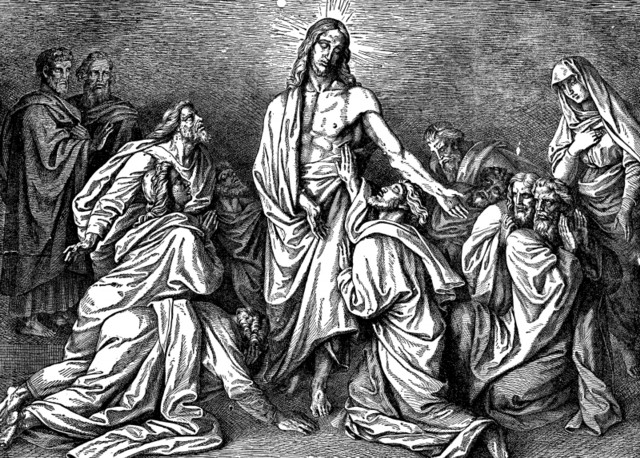
The disciples that Jesus met on the way to Emmaus went back to Jerusalem and found the eleven, who confirmed to the two traveler’s that yes, Jesus has risen (verse 34) and has appeared to Simon (Peter). No details here or in the other three gospels are given of that appearance to Peter (although Paul does speak of it in 1 Corinthians 15:5). But given Peter’s intense grief over his denial of Jesus, it was important to reach him quickly; and it was important to get to the rest of the eleven this day as well.

Jesus shows His wounds to Thomas.

Jesus shows His wounds to Thomas.

Jesus then entered while the men were talking, and they were frightened, as if He was a spirit. He had them touch him, and even ate some fish in front of them – spending some time to assure them both that he was a living man, and the same Jesus they had known. He then opened their minds to the Scriptures concerning Him. Jesus then tells them a bit about the witness they will bear to the world in the great commission, but he says they must stay in Jerusalem until they are “clothed with power from on high” (the coming of the Holy Spirit in Acts). When He tells them to stay in Jerusalem, he means after he is gone. They will be with him at the Sea of Galilee (John 21:1), and on a mountain in Galilee that He has directed them to (Matthew 28:16) before his ascension. Galilee is three days journey from Jerusalem.

(This year’s reading plan for Luke, Acts, and 1 and 2 Chronicles averages just 15 verses per day – 5 days per week!)
Schedule for this week
Read or listen to audio of today’s selection from Luke here
Read or listen to audio of today’s selection from 2 Chronicles here

/Bob’s boy
___________________
some images © V. Gilbert & Arlisle F. Beers

All of my comments in this blog, however, are solely my responsibility.  When reading ANY commentary, you should ALWAYS refer first to the scripture, which is God’s unchanging and unfailing word. Reading schedules, as well as a link to the site where you can get the reading plan that I’m currently following for yourself can be found on the “Bible Reading Schedules” page of my website at http://graceofourlord.com.  

Enhanced by Zemanta

Emmaus Revisited – Luke 24

 Well, I pulled the trigger on this a couple of weeks early :-). We had written a blog a year or so ago on the Road to Emmaus, a portion of Luke 24 that we are reading this week. So we’ll provide some excerpts of that to supplement the remainder of our reading of the chapter.

The Road to Emmaus appearance, based on Luke 2...

The Road to Emmaus appearance, based on Luke 24:13-32, painted by Joseph von Führich, 1830. (Photo credit: Wikipedia)

It is still Sunday, the day that Jesus rose; and two of His disciples were traveling to the village of Emmaus.  One was named Cleopas, but we do not know the name of the other.  We are told in verse 16 that “their eyes were kept from recognizing him” when Jesus drew near.  When He asks them about the conversation they are having, the two men proceed to tell him about Jesus of Nazareth.  They speak of how great he was, how the chief priests and rulers condemned and crucified him.  And now, they say, some women of their company had been to his tomb and found it empty – a fact which others confirmed!  They are clearly distressed.

Jesus then gave them a mild rebuke for being slow to believe what the prophets had spoken.  He then interpreted Scriptures from Moses and the prophets concerning the Christ.   As they reached the village, they urged him to stay with them, as the evening would be coming soon.  He blessed and broke bread with them, and it was at this point that their eyes were opened and they recognized him.  Jesus then vanished from their sight.

Such a mysterious and dramatic revelation of Himself to these two disciples would appear to serve one purpose above any other – a proper eyewitness account.

(This year’s reading plan for Luke, Acts, and 1 and 2 Chronicles averages just 15 verses per day – 5 days per week!)
Schedule for this week
Read or listen to audio of today’s selection from Luke here
Read or listen to audio of today’s selection from 2 Chronicles here


/Bob’s boy


___________________


some images © V. Gilbert & Arlisle F. Beers


All of my comments in this blog, however, are solely my responsibility.  When reading ANY commentary, you should ALWAYS refer first to the scripture, which is God’s unchanging and unfailing word. Reading schedules, as well as a link to the site where you can get the reading plan that I’m currently following for yourself can be found on the “Bible Reading Schedules” page of my website at http://graceofourlord.com.  


Enhanced by Zemanta