Judges 7 – Gideon’s Three Hundred Men

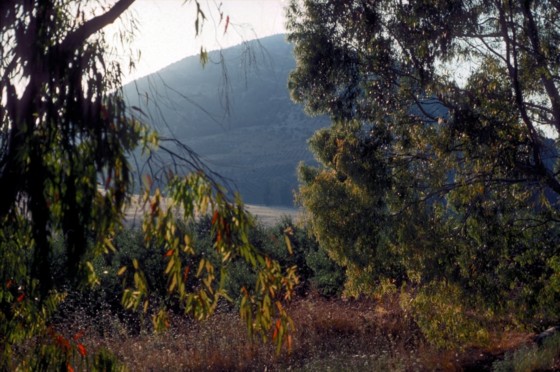
Spring of Harod, where Gideon’s men drank

As Gideon prepares for his first battle, he has 32,000 camped at the spring of Harod, while the Midianites are north by the hill of Moreh in the valley.  But God decides there are too many of them.  He wants the number reduced, so that the people know without a doubt that the victory does not come from their own might, but from the one true God. 22,000 leave at first in verse 3, but God has them “tested” by the manner that they drink from the spring to further reduce the force to 300 (verses 4-6).

To again boost the confidence of the timid warrior, God sends him to the outskirts of their camp to overhear one of the foes relating his dream to a comrade, which foretells the victory (verses 13-14).  Though their number is “as the sand that is on the seashore,” Gideon is convinced; and separates the 300 into three groups on each side.  They charge armed with 300 trumpets and glass jars with torches inside.  The sound of the breaking glass, trumpets, and shouting  (verse 19-20) had the desired effect in verse 21, and the victory was complete in verses 24-25.

(Side note: An brief article on this chapter with great modern photographs of the landmarks of this scene can be found at the following link to Ferrell’s Travel Blog)

Read or listen to audio of ESV version of this selection from this link.

/Robert
___________________
some images © V. Gilbert & Arlisle F. Beers

Please note: I did not design the reading plan that I am following in my blog.  All of my comments in this blog, however, are solely my responsibility.  When reading ANY commentary, you should ALWAYS refer first to the scripture, which is God’s unchanging and unfailing word. Reading schedules, as well as a link to the site where you can get the reading plan that I’m currently following for yourself can be found on the “Bible Reading Schedules” page of my website at http://graceofourlord.com.  For questions and help, please see the “FAQ” and “Summaries” pages there.

Judges 6 – Midian Oppresses Israel

Chapter 6 is the story of Gideon, the reluctant and rather timid judge.  This time, the Israelites are overpowered by the Midianites.  Verses 3-4 tell us that whenever they planted crops, the Midianites and Amalekites would come and “devour” the land, leaving no sustenance – not even livestock.  They hid in caves and were terrified.  But this time when they cried out to the Lord, He sent a prophet to rebuke them for their apostasy (verses 7-10).  And we soon learn the depths that their apostasy and idol worship have reached are great.  It is no wonder the anger of God is burning against them!

Gideon tears down the Baal altars and the
wooden Asherah idols (Judges 6:25-27)

The angel of the Lord then appears to Gideon, the son of Joash the Abiezrite.  Abiezer was part of the tribe of Manasseh that settled west of the Jordan River (Joshua 17:1-2).  Gideon shows a low opinion of himself in verse 15, but asks for “a sign that it is you who speak with me.”  The angel of the Lord gives him one in verse 21, and vanishes.  Afterward, the Lord commands him to take his father’s bulls and pull down the altar of Baal that his father has, and the Asherah beside it.   The Asherah probably refers to sacred wooden poles erected to worship the goddess Asherah.  He was too afraid of his family and the others to do in the daytime, so he took 10 servants and destroyed it by night.

When the men of the town found what he had done the next day, they wanted to kill him.  This is a chilling illustration of how low they have gone.  But Joash intervenes in verse 31 and tells them that they should let the “powerful ” Baal contend for himself.  Gideon, clothed with the spirit of the Lord (verse 34) called out the Abiezrites, sent messengers throughout Manasseh, Asher, Zebulun, and Naphtali.  But he asks for another sign – the sign of the fleece in verses 36-40 – not once, but twice, clearly knowing he was wrong in testing the Lord (Deuteronomy 6:16).  But God lets him have it anyway, maybe from knowing the boy was weak and needed confidence to perform such a great task.  The task was for God to save Israel by his hand.

Is he ready now?

Read or listen to audio of ESV version of this selection from this link.

/Robert
___________________
some images © V. Gilbert & Arlisle F. Beers

Please note: I did not design the reading plan that I am following in my blog.  All of my comments in this blog, however, are solely my responsibility.  When reading ANY commentary, you should ALWAYS refer first to the scripture, which is God’s unchanging and unfailing word. Reading schedules, as well as a link to the site where you can get the reading plan that I’m currently following for yourself can be found on the “Bible Reading Schedules” page of my website at http://graceofourlord.com.  For questions and help, please see the “FAQ” and “Summaries” pages there.
Judges 4 – Deborah and Barak

Mount Tabor

Judges 4 is a riveting story of the wisdom and courage of two women who served God.  When the people next “did what was evil in the sight of the Lord,” they came under the oppression of Jabin, the king of Hazor, whose army was commanded by Sisera.  Deborah was the next judge, and she gave Barak the command to gather 10,000 men from Naphtali and Zebulun at Mount Tabor.  Barak’s response seems a bit less than heroic in verse 8, so she goes with him.  But she lets him know that he will not get glory for the victory, but that the Lord will sell Sisera into the hand of a woman.

They routed Sisera and his 900 iron chariots, but Sisera fled to the house of Heber the Kenite, who was at peace with Hazor.  Heber was a descendant of the father-in-law of Moses, and his wife was Jael.  After Sisera was asleep, Jael drove a tent peg through Sisera’s temple into the ground.  Verses 23-24 tell how God made their victory over Jabin utterly complete.

Jael Smote Sisera, and Slew Him, circa 1896-19...

Jael Smote Sisera, and Slew Him, circa 1896-1902, by James Jacques Joseph Tissot (French, 1836-1902) or follower, gouache on board, 5 7/16 x 7 3/8 in. (13.9 x 18.8 cm), at the Jewish Museum, New York (Photo credit: Wikipedia)

Read or listen to audio of ESV version of this selection from this link.

/Robert
___________________
some images © V. Gilbert & Arlisle F. Beers

Please note: I did not design the reading plan that I am following in my blog.  All of my comments in this blog, however, are solely my responsibility.  When reading ANY commentary, you should ALWAYS refer first to the scripture, which is God’s unchanging and unfailing word. Reading schedules, as well as a link to the site where you can get the reading plan that I’m currently following for yourself can be found on the “Bible Reading Schedules” page of my website at http://graceofourlord.com.  For questions and help, please see the “FAQ” and “Summaries” pages there.

Judges 3 – The Lord Raises Up Judges

The cycle that is repeated throughout the book of Judges is in full swing.  The cycle is:

(1) The people do what is evil in the sight of God (verses 7, 12)

(2) God allows them to be oppressed (verses 8, 12-14)

(3) they cry out to God (verses 9, 15)

(4) God sends a judge to deliver them (verses 9, 15)

(5) There is a period of rest, before the apostasy begins the cycle again.

Illustration to The Holy Bile, Judges, chapter...

Illustration to The Holy Bile, Judges, chapter 3. Eglon assassinated by Ehud. (Photo credit: Wikipedia)

The Baal worship referred to in the scripture included a system of sacred prostitutes – “priestesses” of Baal.  In this chapter, the first judge was Othniel, who delivered Israel from Cushan-rishathaim, king of Mesopotamia.  The second was Ehud, a left-handed man, who hid his sword bound to his right thigh under his clothes (verse 16).  He tricked Eglon, the king of Moab into being alone with him and killed him (verses 20-23).  Then he led the people to defeat the Moabites.  This time, the period of rest lasts 80 years.  The third judge is Shamgar, mentioned briefly in verse 31.

Read or listen to audio of ESV version of this selection from this link.

/Robert
___________________
some images © V. Gilbert & Arlisle F. Beers

Please note: I did not design the reading plan that I am following in my blog.  All of my comments in this blog, however, are solely my responsibility.  When reading ANY commentary, you should ALWAYS refer first to the scripture, which is God’s unchanging and unfailing word. Reading schedules, as well as a link to the site where you can get the reading plan that I’m currently following for yourself can be found on the “Bible Reading Schedules” page of my website at http://graceofourlord.com.  For questions and help, please see the “FAQ” and “Summaries” pages there.

Who Were the Judges? \ April Week 1 Summary Posted

Mosaic of the 12 Tribes of Israel. From Givat ...

Mosaic of the 12 Tribes of Israel. From Givat Mordechai synagogue wall in Jerusalem. Top row, right to left: Reuben, Judah, Dan, Asher Middle: Simeon, Issachar, Naphtali, Joseph Bottom: Levi, Zebulun, Gad, Benjamin (Photo credit: Wikipedia)

Tomorrow, we will learn that Caleb’s younger brother Othniel, mentioned in Judges 1:13, will become one of the judges. But for now, the people have no leader.  But what was a judge?  generally, these were people called by the Lord to administer justice, and to drive out the adversaries of the people – often given miraculous power for doing so.  Many of them served purposes almost entirely military in nature.  In order of appearance in the book, the oppressors of the people at various times are Mesopotamians, Moabites, Philistines, Canaanites Midianites, Ammonites, and then the Philistines.  The book tells us that the judges came from at least 8 of the twelve tribes of Israel (Judah, Benjamin, Ephraim, Manasseh, Issachar, Gilead-Manasseh, Zebulun, Dan).

Here are the judges in order of the scripture:

Othniel (ch 3:7–11)           – written time for oppression and period of rest was 48 years (Judges 3:8,11)
Ehud (ch 3:12–30)            – written time for oppression and period of rest was 98 years (Judges 3:14, 30)
Shamgar (ch 3:31)             – written time for oppression and period of rest is unknown.
Deborah (chs. 4–5)           – written time for oppression and period of rest was 60 years (Judges 4:3,5:31)
Gideon (chs. 6–8)             – written time for oppression and period of rest was 47 years (Judges 6:1, 8:28)
Tola (ch 10:1–2)                – written time for oppression and period of rest was 23 years (Judges 10:2)
Jair (ch 10:3–5)                 – written time for oppression and period of rest was 22 years (Judges 10:3)
Jephthah (ch 10:6–12:7)  – written time for oppression and period of rest was  24 years (Judges 10:8, 12:7)
Ibzan (ch 12:8–10)            – written time for oppression and period of rest was 7 years (Judges 12:9)
Elon (ch 12:11–12)             – written time for oppression and period of rest was 10 years (Judges 12:11)
Abdon (ch 12:13–15)         – written time for oppression and period of rest was 8 years (Judges 12:14)
Samson (chs. 13–16)         – written time for oppression and period of rest was 60 years (Judges 13:1, 15:20, 16:31)

The pattern of the book of Judges is:

(1) The people do what is evil in the sight of God
(2) God allows them to be oppressed
(3) They cry out to God
(4) God sends a judge to deliver them
(5) There is a period of rest, before the apostasy begins the cycle again.

Summing Up

Each weekend, I am now posting a small PDF of one week of chapter summaries (on the website’s “Summaries” page), current to the beginning of the previous week.  I have posted the summary for Week 14 (April Week 1) of the schedule I am following.  This short PDF document contains condensed comments about Joshua chapters 4, 5, 6, 7 and 8, with hyperlinks to the ESV version of each chapter for listening or reading, and joins the summaries for other weeks already posted there.

/Robert
___________________
image © V. Gilbert & Arlisle F. Beers

Please note: I did not design the reading plan that I am following in my blog.  All of my comments in this blog, however, are solely my responsibility.  When reading ANY commentary, you should ALWAYS refer first to the scripture, which is God’s unchanging and unfailing word. Reading schedules, as well as a link to the site where you can get the reading plan that I’m currently following for yourself can be found on the “Bible Reading Schedules” page of my website at http://graceofourlord.com.  For questions and help, please see the “FAQ” and “Summaries” pages there.

Judges 2 – Israel’s Disobedience

In chapter 2, the apostasy of the people is made explicit, and the angel of the Lord’s words to them brings fear, tears, and sacrificing.  But unfortunately, not true repentance, as they return to their idol worship of Baal and Ashtaroth (verses 11-13).   The repetition  of the death of Joshua serves to explain the behavior That prevented them from completing the task of driving out the Canaanites.  The problem was not just a lack of faith, but a lust for the wickedness and the immoral and often perverse behavior that accompanied idolatry.

Verses 11-23 present a summary of the book of Judges, and verse 11 sums it up very well – “And the people of Israel did what was evil in the sight of the Lord.”   God would no longer drive the Canaanites out for them, but leave them as a snare and a test for them.  Indeed, verse 15 says that “Whenever they marched out, the hand of the Lord was against them for harm, as the Lord had warned, and as the Lord had sworn to them.”

Their condition was miserable.  How could a nation that had been honored to have the visible presence of the one true God among them, and witness His power with their own eyes turn to bow down to statues and carved images?  Judges is the illustration of our own ability to turn away from God and worship immorality when His presence is made perfectly clear in everything we see (Romans 1:18-21).

Read or listen to audio of ESV version of this selection from this link.

/Robert
___________________
some images © V. Gilbert & Arlisle F. Beers

Please note: I did not design the reading plan that I am following in my blog.  All of my comments in this blog, however, are solely my responsibility.  When reading ANY commentary, you should ALWAYS refer first to the scripture, which is God’s unchanging and unfailing word. Reading schedules, as well as a link to the site where you can get the reading plan that I’m currently following for yourself can be found on the “Bible Reading Schedules” page of my website at http://graceofourlord.com.  For questions and help, please see the “FAQ” and “Summaries” pages there.

Judges 1 – The Continuing Conquest of Canaan

The book of Judges opens by relating successes by the tribes of Judah and Simeon in driving out the Canaanites, but ends with verse after verse of failures to complete the task.  Notice in verses 27 and following that the scripture says that they “did not drive out” the Canaanites from their tribe’s allotted territories, but left them dwelling among them – in some cases using them for forced labor.

Othniel Ben Kenaz is the first of the Biblical...

Othniel Ben Kenaz is the first of the Biblical Judges. (Photo credit: Wikipedia)

This refusal to obey the Lord’s command is the key to all the trouble that will follow; and God through Moses and Joshua warned them over and over that any Canaanites they leave to dwell with them would be a snare and a thorn to them, leading them into apostasy; and that the Lord would do to them as He was doing to the Canaanites as a result (see Exo 34:10-17, Num 33:51-56, Deut 7:1-5).  Notorious worshipers of Baal and other false gods, the remnant Canaanites would influence the weak of faith to do the same.

Caleb’s younger brother Othniel, mentioned in verse 13 will become one of the judges. But for now, the people have no leader.  But what was a judge?  generally, these were people called by the Lord to administer justice, and to drive out the adversaries of the people – often given miraculous power for doing so.  Many of them served purposes almost entirely military in nature.

Read or listen to audio of ESV version of this selection from this link.

/Robert
___________________
some images © V. Gilbert & Arlisle F. Beers

Please note: I did not design the reading plan that I am following in my blog.  All of my comments in this blog, however, are solely my responsibility.  When reading ANY commentary, you should ALWAYS refer first to the scripture, which is God’s unchanging and unfailing word. Reading schedules, as well as a link to the site where you can get the reading plan that I’m currently following for yourself can be found on the “Bible Reading Schedules” page of my website at http://graceofourlord.com.  For questions and help, please see the “FAQ” and “Summaries” pages there.

Joshua 24 – The Covenant Renewal at Shechem

English translation of hebrew version. Map of ...

English translation of hebrew version. Map of the twelve tribes of Israel, before the move of Dan to the North (Photo credit: Wikipedia)

Joshua has divided the land between the tribes of Israel, and some years have passes.  The last two chapters of Joshua are remembered as his farewell speech and final words at the covenant renewal ceremony at Shechem.  This latter is laid out just like an ancient treaty or covenant between a suzerain (a superior or dominant entity) and its vassals (or subjects).  Such treaties contain a preamble introducing the sovereign (verse 2), a historical prologue of past graciousness with the vassals (verse 2-13), stipulations of the vassal’s responsibilities (verses 14-24), written record preserving the covenant agreement (verse 26), named witnesses (verses 26-27), and blessings and curses (verse 20 and throughout).

Joshua’s famous charge to them in verse 15 to “choose who you will serve” along with the warning in verse 20 should serve as a chilling reminder to them that God will not tolerate apostasy from them.  Unfortunately, the insistence of the people that they will serve only the Lord will all too soon be forgotten by many, as we see the pattern of the judges.

Verses 29-33 detail the death and burial of Joshua at the place of his inheritance at Timnath-serah, Eleazar’s burial at Gibeah, and the burial of Joseph’s bones at Shechem.

(Side note: Archaeologists have found Shechem to have been a large center of pagan worship.  A great article on Shechem can be found at the following link to Bibleplaces.com)

Read or listen to audio of ESV version of this selection from this link.

/Robert
___________________
some images © V. Gilbert & Arlisle F. Beers

Please note: I did not design the reading plan that I am following in my blog.  All of my comments in this blog, however, are solely my responsibility.  When reading ANY commentary, you should ALWAYS refer first to the scripture, which is God’s unchanging and unfailing word. Reading schedules, as well as a link to the site where you can get the reading plan that I’m currently following for yourself can be found on the “Bible Reading Schedules” page of my website at http://graceofourlord.com.  For questions and help, please see the “FAQ” and “Summaries” pages there.

Joshua 10 – The Sun Stands Still

When the king of Jerusalem, Adoni-zedek, learned of the fall of Ai and of the treaty of the people of Gibeon with Joshua and the people of Israel, he “feared greatly.”  verse 2 says that Gibeon was like a royal city – greater than Ai, and all its men were warriors.  So Adoni-zedek formed an alliance with the kings of Hebron, Lachish, Jarmuth, and Eglon to attack Gibeon.  So the Gibeonites appealed to Joshua for help.

Joshua commanding the sun to stand still

Joshua commanding the sun to stand still (Photo credit: Wikipedia)

Though God had commanded them not to make any covenants with any of the Canaanites, now that one had been made with the Gibeonites, He made it clear in verse 8 that He would help them honor it.  So after Joshua and his men marched all night from Gilgal, God threw their adversaries into a panic; and as they chased them from Beth-horon, He struck them with hailstones, killing more than the Israelites did with their swords (verses 10-11).  Then the famous long day as Joshua, consulting with the Lord commanded the sun to “stand still” as they finished off their enemies (verses 12-14). Then, one by one, they took the cities of all 5 of the kings and finished off the captured kings themselves (verses 20-27).   A sizable victory related in verses 40-43 secures the land to ready for the northern campaign.

Side Note 1: A good article on the “sun stand still” event can be found at this page on the Apologetics Press website.

Side Note 2: Contrary to claims of critics, this passage is not geocentric but uses the language of observation; and many passages can be cited to show scientific knowledge and foreknowledge in the Bible.  While I ‘m not going to make those citations in today’s blog, I will offer this quote from

Henry Morris with Henry Morris III, Many Infallible Proofs: Practical and Useful Evidences for the Christian Faith, Master Books, Arizona, 1996, p. 253:

“All motion is relative motion, and the sun is no more “fixed” in space than the Earth is. … The scientifically correct way to specify motions, therefore, is to select an arbitrary point of assumed zero velocities and then to measure all velocities relative to that point. The proper point to use is the one which is most convenient to the observer for the purposes of his particular calculations. In the case of movements of the heavenly bodies, normally the most suitable point is the Earth ‘s surface at the latitude and longitude of the observer, and this therefore is the most “scientific” point to use. David [Psalm 19:6] and Joshua are more scientific than their critics in adopting such a convention for their narratives.”

Read or listen to audio of ESV version of this selection from this link.

/Robert
___________________
some images © V. Gilbert & Arlisle F. Beers

Please note: I did not design the reading plan that I am following in my blog.  All of my comments in this blog, however, are solely my responsibility.  When reading ANY commentary, you should ALWAYS refer first to the scripture, which is God’s unchanging and unfailing word. Reading schedules, as well as a link to the site where you can get the reading plan that I’m currently following for yourself can be found on the “Bible Reading Schedules” page of my website at http://graceofourlord.com.  For questions and help, please see the “FAQ” and “Summaries” pages there.

Joshua 9 – The Gibeonite Deception

As verse one says “the Hittites, the Amorites, the Canaanites, the Perizzites, the Hivites, and the Jebusites, heard of this, they gathered together as one to fight against Joshua and Israel.”  The word “this” refers to the complete destruction of Ai.  Word of Jericho’s fall would have already reached them; and as verses 9-10 tell us, all had already heard of the defeat of King Sihon of Heshbon (Num 21:21-26) and Og of Basham (Num 21:31-35).  Indeed, they had been given more than 40 years to dread the Israelites, as verse 9 also acknowledges all that God did for them in Egypt.  But the Gibeonites had a different strategy.

Gibeon, view north of El Jib; the Gibeonites tricked
Joshua to make a treaty with them.

The Lord warned that leaving Canaanites to dwell among the people would be a mistake, and specifically commanded them to make no covenant with any of them. They were commanded not to do this more than once, as in Deuteronomy 7:1-5, where they are told that the Canaanites  “would turn away your sons from following me, to serve other gods.”  Once again, Joshua failed to consult with God when he made the covenant with the Gibeonites.  Their deception (verses 4-6) was well planned and convincing, however, and Joshua and the elders believed they truly were from another land far away.  They would spend the rest of their days serving the Israelites, but the damage was done, and the vow would not be rescinded.  The Gibeonite cities of Gibeon, Chephirah, Beeroth, and Kiriath-jearim were not attacked.

(Side note: The city of Gibeon was positively identified with el-Jib by archaeologist James Pritchard for the Museum of the University of Pennsylvania, whose excavations found numerous inscribed jar handles there over 50 years ago. More information on that, as well as a recent discovery there can be found in this article at Ferrell’s Travel Blog)

Read or listen to audio of ESV version of this selection from this link.

/Robert
___________________
some images © V. Gilbert & Arlisle F. Beers

Please note: I did not design the reading plan that I am following in my blog.  All of my comments in this blog, however, are solely my responsibility.  When reading ANY commentary, you should ALWAYS refer first to the scripture, which is God’s unchanging and unfailing word. Reading schedules, as well as a link to the site where you can get the reading plan that I’m currently following for yourself can be found on the “Bible Reading Schedules” page of my website at http://graceofourlord.com.  For questions and help, please see the “FAQ” and “Summaries” pages there.